The Curse of Skeleton Munroe

Category: Ibis the Invincible

  • MINOR SUPER-HERO ROUND-UP 069

    Mostly, but not all, updates. 

    Ibis the Invincible **UPDATE**:

    1941 sees Ibis the Invincible’s omnipotence tempered a bit via a slight limitation that is added to the Ibistick: it is not directly able to affect things created by or otherwise powered by evil magic, and it might not work at all in overtly magical areas such as a giant’s floating castle.

    This is balanced out somewhat by the fact that it gives Ibis the chance to demonstrate his lateral thinking skills by indirectly affecting these things, whether it be with a right hook or a summoned Egyptian god. (Whiz Comics 016, 1941)

    the Lieutenant Marvels:

    The Lieutenant Marvels are also the members of the Billy Batson Club, being three other kids with the name Billy Batson who all gather in New York Fawcett City to… share the pain of having the same name as a media figure with the figure in question? I guess that’s what they were doing? Turns out they all get along well enough to form a club, and to distinguish themselves they all choose a nickname: the lanky Westerner becomes Tall Billy, the squat Brooklynite is Fat Billy, the Southerner chooses to be Hill Billy and the famous one is acclaimed as Real Billy. This is the sort of nicknaming system that seems fine when you’re thirteen but can really fester over the years.

    The meetup is not all about comparing names and making friend, however, because these guys all have access to the comic books from our universe somehow and as such they all know about the link between yelling “SHAZAM!” while being named Billy Batson and becoming Captain Marvel, BUT ALSO are surprised when Real Billy does so and transforms. It’s a real pickle how they might have most of the info but not that last piece – perhaps the comics in this world that will eventually be designated Earth-S posit that Billy summons Captain Marvel by yelling for him. 

    Thanks to some name-based misunderstandings, the four all end up being captured by Dr Sivana and his group the Vengeful Four and tied to a deathtrap loud enough that all four Billys need to shout together to get the SHAZAM through to the lightning dispatcher. Surprisingly, the “any Billy Batson yelling SHAZAM = Captain Marvel” idea that they all had in their heads was accurate, and they all transform into equivalently powerful super-beings, with a ready-made names that are not actually used until their second appearance: Tall Marvel, Fat Marvel and Hill Marvel.

    (I have to admit here that I had for many years thought that the “Lieutenant” in Lieutenant Marvels was like when a villain’s top guy is called their lieutenant, like these guys are Captain Marvel’s helpers. I just now realized that it is in fact a straight military hierarchy joke) 

    The Lieutenant Marvels show up now and then to this day when Captain Marvel needs three other guys to help him do something, but given that they debut just a few months before Captain Marvel Jr and a year and a bit before Mary Marvel, their services aren’t as in-demand as one might expect.  (Whiz Comics 021, 1941) 

    Golden Arrow **Update**: 

    Though as previously noted the Golden Arrow strip essentially switched from a Modern West to Old West setting after about two or three issues, there has always been a bit of ambiguity as to the specific century the action was taking place in. Though some might point to the presence of a working stagecoach system or other anachronisms in earlier issues as evidence that Golden Arrow was firmly Old West, I have been burned before and it took something like this declaration of the train as a new-fangled arrival to convince me that the comic wasn’t suddenly going to feature Nazi fifth columnists. (Whiz Comics 021, 1941)

    the Arrow **Update**: 

    The Arrow finally gets an alter ego in his final comic book appearance, and it’s US Intelligence agent Ralph Payne. Is this an improvement over being an unnamed giant of a man? I leave that as an exercise for the reader. He also gets a more conventional super-hero cowl mask (with just a hint of the visible hairline that made his fellow Centaur character the Fantom of the Fair look so distinctive) and some cool boots at the same time. (The Arrow 003, 1941)

  • DIVINE ROUND-UP 023

    The gods they just keep on coming. 

    Osiris: 

    Ibis the Invincible’s power levels get a bit of a nerf in 1941 when the caveat that his Ibistick is ineffective, variously, against magic, evil magic and in areas of ambient magic (just which is the case depends on the dramatic needs of the story). This forces him to come up with creative solutions to his problems, such as during this attack by a storm demon summoned by his arch-foe Trug, in which he summons the Ancient Egyptian god Osiris to act as divine muscle.

    Osiris is one of the more humanoid of the Egyptian gods, so the only major critique to levy about his appearance (other than all of the stuff that any Egyptology nerds who read this are yelling about of course), aside from the fact that he’s supposed to be green. I’m not sure if Osiris is the go-to god for demon-battling either. Maybe Horus would be a better choice?

    Regardless, Osiris defeats the demon and then takes off. I’m sure that the above panel is meant to represent him returning to the land of the gods, but I get a real kick out of the image of him just wandering off into the California countryside, inspiring religious mania in the locals. 

    God Style: Real (Whiz Comics 016, 1941)

    Thoth: 

    After yet another magical attack by his enemy Trug, Ibis again turns to the gods of Egypt for aid, this time appropriately from the ibis-headed god of wisdom, Thoth.

    I appreciate that the artist made an effort, but while this version of Thoth looks reasonably cool that is absolutely not an ibis head. It’s more like an angry and disturbingly flesh-toned duck. Duck head or no, Thoth comes through and supplies Ibis with a divination spell capable of locating the magically-shielded Trug.

    God Style: Real (Whiz Comics 017, 1941)

    the Man of the Mountain:

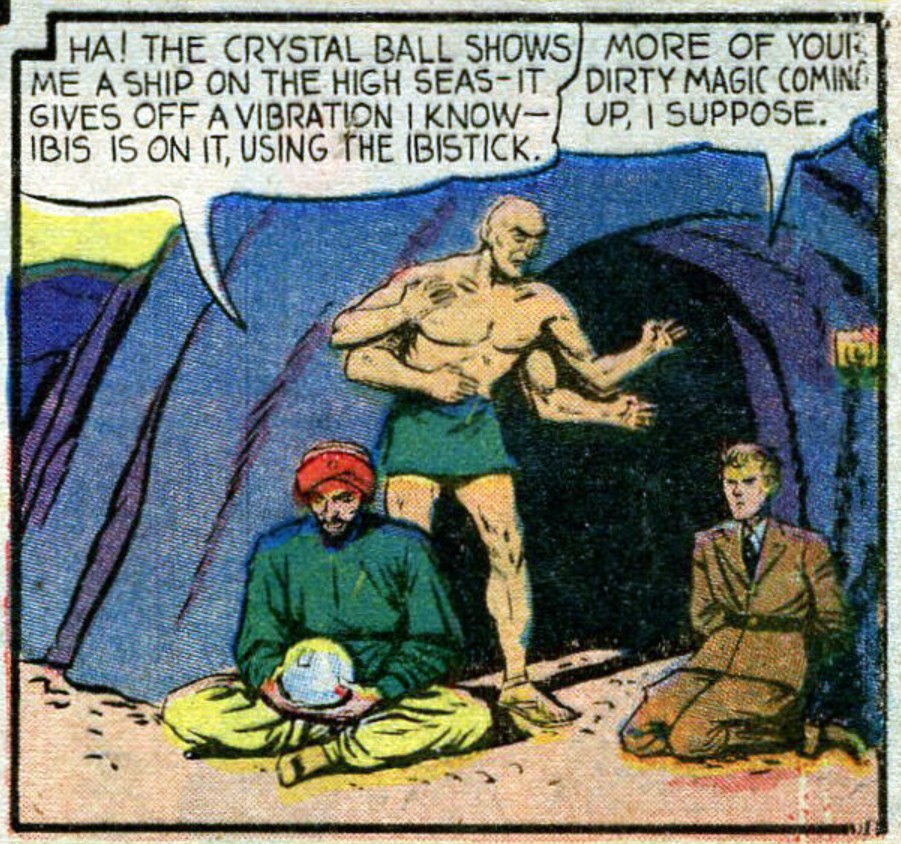
    Once Ibis locates Trug he also has to contend with the Man of the Mountain, a guy with four arms who, appropriately, lives on a mountaine. 

    While Ibis calls the Man of the Mountain an evil spirit, Trug insists that he is a “Great God of Revenge.” The being in question remains silent, which is a shame because he really could have cleared up this taxonomic problem for us with a few words.

    Whatever the Man of the Mountain is, he is also unable to withstand the fall off of his home mountain after Ibis tabletops him. He shatters at the bottom, revealing (to me at least) that he is in fact made of stone. RIP, Man of the Mountain.

    God Style: Real (Whiz Comics 017, 1941)

    the Snake-God: 

    The subject of cult worship and human sacrifice in a cavern somewhere under NYC, this particular snake seemingly has a bit more of the divine about it than its fellow animal subjects of worship in comics. At the very least it is bulletproof, though this does not avail it against the raw might of Dr Occult’s mitts. And as a bonus, its entire cult is crushed in its death throes!

    God Style: Animist (Real?) (More Fun Comics 027, 1937)

  • DIVINE ROUND-UP 023

    The gods they just keep on coming. 

    Osiris: 

    Ibis the Invincible’s power levels get a bit of a nerf in 1941 when the caveat that his Ibistick is ineffective, variously, against magic, evil magic and in areas of ambient magic (just which is the case depends on the dramatic needs of the story). This forces him to come up with creative solutions to his problems, such as during this attack by a storm demon summoned by his arch-foe Trug, in which he summons the Ancient Egyptian god Osiris to act as divine muscle.

    Osiris is one of the more humanoid of the Egyptian gods, so the only major critique to levy about his appearance (other than all of the stuff that any Egyptology nerds who read this are yelling about of course), aside from the fact that he’s supposed to be green. I’m not sure if Osiris is the go-to god for demon-battling either. Maybe Horus would be a better choice?

    Regardless, Osiris defeats the demon and then takes off. I’m sure that the above panel is meant to represent him returning to the land of the gods, but I get a real kick out of the image of him just wandering off into the California countryside, inspiring religious mania in the locals. 

    God Style: Real (Whiz Comics 016, 1941)

    Thoth: 

    After yet another magical attack by his enemy Trug, Ibis again turns to the gods of Egypt for aid, this time appropriately from the ibis-headed god of wisdom, Thoth.

    I appreciate that the artist made an effort, but while this version of Thoth looks reasonably cool that is absolutely not an ibis head. It’s more like an angry and disturbingly flesh-toned duck. Duck head or no, Thoth comes through and supplies Ibis with a divination spell capable of locating the magically-shielded Trug.

    God Style: Real (Whiz Comics 017, 1941)

    the Man of the Mountain:

    Once Ibis locates Trug he also has to contend with the Man of the Mountain, a guy with four arms who, appropriately, lives on a mountaine. 

    While Ibis calls the Man of the Mountain an evil spirit, Trug insists that he is a “Great God of Revenge.” The being in question remains silent, which is a shame because he really could have cleared up this taxonomic problem for us with a few words.

    Whatever the Man of the Mountain is, he is also unable to withstand the fall off of his home mountain after Ibis tabletops him. He shatters at the bottom, revealing (to me at least) that he is in fact made of stone. RIP, Man of the Mountain.

    God Style: Real (Whiz Comics 017, 1941)

    the Snake-God: 

    The subject of cult worship and human sacrifice in a cavern somewhere under NYC, this particular snake seemingly has a bit more of the divine about it than its fellow animal subjects of worship in comics. At the very least it is bulletproof, though this does not avail it against the raw might of Dr Occult’s mitts. And as a bonus, its entire cult is crushed in its death throes!

    God Style: Animist (Real?) (More Fun Comics 027, 1937)

  • MINOR SUPER-VILLAIN 900: TRUG

    MINOR SUPER-VILLAIN 900: TRUG

    (Whiz Comics 013, 1941) 

    Trug is a student of magic and of Ibis the Invincible specifically who creeps out of the shadows after Ibis and Taia’s ward Tommy has defeated his school’s boxing champion and tempts the despondent youth into stealing the Ibistick for him (the sad boy is then turned into a tree and then never mentioned again – very sad).

    Trug’s Ibis scholarship extends beyond kind of dressing like him and knowing where his extended family hang out into important topics like how not to kill yourself while using the Ibistick. Unlike every poor chump who has gotten their hands on it before him, Trug is aware that it will visit any harm intended for Ibis back on its wielder and so deals exclusively in barriers, crevasses and other nonlethal means of keeping his rival at bay.

    Where Trug fails is in not being a creep and kidnapping Taia as he leaves to enjoy his newfound power. Quite aside from any moral implications, this is a sure way to make Ibis just that much more determined in his quest to defeat his foe.

    Fore reasons of his own, Trug heads north, subjugates the local peoples and builds a palace, and here I notice that he has kidnapped Taia not as a creepy “I will make you my queen” kind of thing but as a hostage, which I would still not call a good idea but which at least has a bit of logic to it.

    One thing that Trug has clearly not considered is that Ibis still has access to magical items that he used the Ibistick to create and that using two of these – the crystal ball and super-plane, specifically – he is able to locate and travel to Trug’s new kingdom in swift order. Trug thus makes the mistake of summoning an air force to deal with whoever might be encroaching on his airspace, only for them to turn on him and cause a piece of his own palace to fall and bonk him unconscious.

    Trug ends his days as a decorative statue as part of the compensation offered by Ibis to his former subjects. (Whiz Comics 014, 1941) 

    Trug isn’t a statue for very long before he is carried off by slavers and worshipped as an idol. When Ibis is then asked for help, he restores Trug to human form as part of a scheme to show that he is a mere mortal.

    Turning Trug back and forth from statue to man to show that he is in fact powerless swiftly convinces his erstwhile worshippers to abandon him, and somehow also that they should give up their warlike ways and make peace with their former enemies. Trug, meanwhile, is left at liberty and feeling vengeful, though he is under-dressed in the Arctic. (Whiz Comics 015, 1941)

    Undaunted by his circumstances, Trug hops on a log and starts paddling his way South, and has the good fortune to encounter a helpful man with a magic bag of wind, who he promptly robs and murders. He makes an opportunistic and unsuccessful attempt to kill Ibis and Taia by summoning a storm demon, then composes himself and… (Whiz Comics 016, 1941)

    … kidnaps Ibis and Taia’s ward Tommy and uses him as bait in yet another attempt to kill Ibis, and while the first part of that plan works like a charm, his trapping game is pretty haphazard. His ace in the hole is clearly the god-monster the Man of the Mountain (the four-armed guy above) but he also blows up the ship that Ibis is crossing the Pacific on (ineffective) and places fairly obvious traps like a clearly-carnivorous tree and a demon disguised as a pretty lady on the path leading to his cave hideout. (Whiz Comics 017, 1941) 

    The Man of the Mountain, though imposing, is not too bright and is lured off of a cliff with relative ease, after which Trug just kind of gives up. There is a small amount of tension as the ambient magical energies of the area render the Ibistick powerless and thus Ibis and Taia are trapped on the side of a mountain, but that barely counts as a deathtrap. (Whiz Comics 018, 1941)

    We now enter that phase of any recurring villain’s career in which they go from being a legitimate threat to a bit of a joke, and in Trug’s case this begins when he is rejected by a loser named Mudge who himself is looking to get revenge on Ibis for foiling his plans. Trug might have fallen on hard times but he knows how to size up a fool, and Mudge is exactly the kind of guy to fall for the old Fake Satan trick. Where he was unwilling to team up with an unsuccessful magician he is more than happy to sell his soul for a chance at revenge, the dope.

    Mudge and Satan/Trug attempt to kill Ibis and Taia with a magic bomb, but fail as Ibis saw them coming a mile away and substituted a couple of magical duplicates for them. He afflicts Mudge with donkey ears for his trouble, which only redoubles his commitment to revenge.

    The duo next attempt to harm Ibis by killing Taia and are fooled by the same magical duplicate trick, upon which Ibis reveals that he was not only on to them but that he know that “Satan” was actually Trug the whole time. Mudge and Trug are then sealed up in a wall to die, which is pretty tough justice, but we must remember that Ibis is from another time.

    Though Mudge’s fate is sealed, Trug will return in 1942. (Whiz Comics 020, 1941)

  • MINOR SUPER-VILLAIN 900: TRUG

    (Whiz Comics 013, 1941) 

    Trug is a student of magic and of Ibis the Invincible specifically who creeps out of the shadows after Ibis and Taia’s ward Tommy has defeated his school’s boxing champion and tempts the despondent youth into stealing the Ibistick for him (the sad boy is then turned into a tree and then never mentioned again – very sad).

    Trug’s Ibis scholarship extends beyond kind of dressing like him and knowing where his extended family hang out into important topics like how not to kill yourself while using the Ibistick. Unlike every poor chump who has gotten their hands on it before him, Trug is aware that it will visit any harm intended for Ibis back on its wielder and so deals exclusively in barriers, crevasses and other nonlethal means of keeping his rival at bay.

    Where Trug fails is in not being a creep and kidnapping Taia as he leaves to enjoy his newfound power. Quite aside from any moral implications, this is a sure way to make Ibis just that much more determined in his quest to defeat his foe.

    Fore reasons of his own, Trug heads north, subjugates the local peoples and builds a palace, and here I notice that he has kidnapped Taia not as a creepy “I will make you my queen” kind of thing but as a hostage, which I would still not call a good idea but which at least has a bit of logic to it.

    One thing that Trug has clearly not considered is that Ibis still has access to magical items that he used the Ibistick to create and that using two of these – the crystal ball and super-plane, specifically – he is able to locate and travel to Trug’s new kingdom in swift order. Trug thus makes the mistake of summoning an air force to deal with whoever might be encroaching on his airspace, only for them to turn on him and cause a piece of his own palace to fall and bonk him unconscious.

    Trug ends his days as a decorative statue as part of the compensation offered by Ibis to his former subjects. (Whiz Comics 014, 1941) 

    Trug isn’t a statue for very long before he is carried off by slavers and worshipped as an idol. When Ibis is then asked for help, he restores Trug to human form as part of a scheme to show that he is a mere mortal.

    Turning Trug back and forth from statue to man to show that he is in fact powerless swiftly convinces his erstwhile worshippers to abandon him, and somehow also that they should give up their warlike ways and make peace with their former enemies. Trug, meanwhile, is left at liberty and feeling vengeful, though he is under-dressed in the Arctic. (Whiz Comics 015, 1941)

    Undaunted by his circumstances, Trug hops on a log and starts paddling his way South, and has the good fortune to encounter a helpful man with a magic bag of wind, who he promptly robs and murders. He makes an opportunistic and unsuccessful attempt to kill Ibis and Taia by summoning a storm demon, then composes himself and… (Whiz Comics 016, 1941)

    … kidnaps Ibis and Taia’s ward Tommy and uses him as bait in yet another attempt to kill Ibis, and while the first part of that plan works like a charm, his trapping game is pretty haphazard. His ace in the hole is clearly the god-monster the Man of the Mountain (the four-armed guy above) but he also blows up the ship that Ibis is crossing the Pacific on (ineffective) and places fairly obvious traps like a clearly-carnivorous tree and a demon disguised as a pretty lady on the path leading to his cave hideout. (Whiz Comics 017, 1941) 

    The Man of the Mountain, though imposing, is not too bright and is lured off of a cliff with relative ease, after which Trug just kind of gives up. There is a small amount of tension as the ambient magical energies of the area render the Ibistick powerless and thus Ibis and Taia are trapped on the side of a mountain, but that barely counts as a deathtrap. (Whiz Comics 018, 1941)

    We now enter that phase of any recurring villain’s career in which they go from being a legitimate threat to a bit of a joke, and in Trug’s case this begins when he is rejected by a loser named Mudge who himself is looking to get revenge on Ibis for foiling his plans. Trug might have fallen on hard times but he knows how to size up a fool, and Mudge is exactly the kind of guy to fall for the old Fake Satan trick. Where he was unwilling to team up with an unsuccessful magician he is more than happy to sell his soul for a chance at revenge, the dope.

    Mudge and Satan/Trug attempt to kill Ibis and Taia with a magic bomb, but fail as Ibis saw them coming a mile away and substituted a couple of magical duplicates for them. He afflicts Mudge with donkey ears for his trouble, which only redoubles his commitment to revenge.

    The duo next attempt to harm Ibis by killing Taia and are fooled by the same magical duplicate trick, upon which Ibis reveals that he was not only on to them but that he know that “Satan” was actually Trug the whole time. Mudge and Trug are then sealed up in a wall to die, which is pretty tough justice, but we must remember that Ibis is from another time.

    Though Mudge’s fate is sealed, Trug will return in 1942. (Whiz Comics 020, 1941)

  • REAL PERSON ROUND-UP 019

    For various definitions of the word real. 

    Adolf Hitler: 

    Just why this nonsense-language-speaking pilot henchman of the Mask is named Reltih is a mystery, but it’s also a fact. BONUS VERY ANNOYING THING: I can decipher the nonsense in that second panel as “I’ll murder the bum” but this makes me think that I should be able to do the same with the rest of his half-dozen or so lines of dialogue but I can’t. Utterly vexing!

    The Mask also employs an English-speaker with the very annoying name of Inilossom in the same issue. (Whiz Comics 010, 1940)

    Here’s straightforward Hitler analog King Rodend of Kalnar about to be beaten up by the Flame. (Wonderworld Comics 011, 1940)

    Wretched humour comic “Don Quixote in Modern Times” features villain “Adolphus Stalini”. (Wonderworld Comics 020, 1940)  

    Devil’s Island: 

    Newsreel camerawoman Patty O’Day covers a prisoner’s revolt on the penal colony in what might just be the least sympathetic portrayal of Devil’s Island in comics. (Wonderworld Comics 015, 1940)

    J. Edgar Hoover:

    Minor appearances: 

    Whiz Comics 003a, 1940 

    Whiz Comics 005, 1940 

    John Galt: 

    File this one under “amazing coincidences”. A character named John Galt, a full seventeen years before Atlas Shrugged is published. And to top it off:

    Dr John Galt’s radium has been stolen by Dr James Kirk (aka Doctor Death), a full twenty-six years before Star Trek debuts. Would it be a bit more narratively satisfying if John Galt was the selfish shitheel and James Kirk was the selfless hospital administrator? Sure, but that’s just details. (Whiz Comics 002, 1940)

    the Koh-i-Noor Diamond:

    Reporter Scoop Smith is sent on assignment to find the fabled South African Rooirand Emerald, which his editor sees as a direct parallel to the Koh-i-noor. Just how this is the case is what baffles me – I initially thought that it might have been stolen and editor Lane was thinking of the Agatha Christie novel in which that happened, but the more I look at it the more I think that it’s just a big gem that some white guys are trying to steal. 

    (this story also has one of the more stupid desus ex machina endings in all comics, when the sacred snake handler of the isolationist tribe that worship the emerald turns out to be Sam Jones, African American train porter and eternally loyal to Smith because of a five dollar tip) (Whiz Comics 004, 1940) 

    Lázaro Cárdenas del Rio: 

    You know me: I love to dunk on old comics for their portrayals of in-office world leaders, and let’s just say that if you look up a picture of Lázaro Cárdenas, president of Mexico from 1934 to November of 1940, he doesn’t have a long white beard. I didn’t bother to check if the President of Mexico has an enormous ornate throne to sit in, but I can only hope. (Whiz Comics 005, 1940)

    Mata Hari: 

    Hundanian spy Mata Dara, the latest in a long line of women in espionage to have a sound-alike name to Mata Hari. (Zip Comics 001, 1940)

    Senusret III: 

    Mentioned as being a cousin of Taia’s in Whiz Comics 002, “King Senwosri” aka Pharaoh Senusret III then makes an appearance in person as he rises from the dead to punish an American explorer for violating the sanctity of his tomb. He returns to his eternal slumber after an intervention by cousin Taia and cousin-in-law Ibis the Invincible. (Whiz Comics 003b, 1940)

  • DIVINE ROUND-UP 016

    Gods aplenty! 

    Tyalpo: 

    The god worshipped by Ibis the Invincible villain Piang the Terrible. Probably real, in that Piang has real magical power that he calls upon Tyalpo to activate, even if the god himself shows up only in idol form.

    God Style: Idol (Real?) (Whiz Comics 009, 1940) 

    Goddess of the Jungle: 

    Sandor is a jungle hero who doesn’t so much adventure as get into one long series of scrapes and situations in Northern India, the second most popular location to be a jungle hero by my reckoning. One of those scrapes involves him nearly getting sacrificed to the Goddess of the Jungle, about whom we never really learn more than her name. 

    God Style: Invoked (New Comics 006, 1936)

    the Golden Dragon: 

    “The Golden Dragon” is a serial that ran in Adventure Comics for around three years (and in fact started back when the book was called New Comics), about a group of adventurers and soldiers of fortune travelling from China to Mongolia in search of the fabled treasure of the Golden Dragon, while fending off attempts by the villainous Torgadoff to halt their journey, presumably so that he can seek the treasure himself. 

    Adventure Comics 034 finds de facto expedition leader Ian Murray at the end of the trail, which turns out to be a very much still in-use Temple of the Golden Dragon, with Torgadoff turning out to be one of the high priests. Does this dampen his desire to strip the place of its treasure? Absolutely not! This is a 1930s adventurer we’re talking about! The presence of a non-Christian religious practice only increases his lust for gold!

    Even the treasure-hungry Murray is taken aback, however, when the Golden Dragon shows up and turns out to be a real, living creature – presumably some sort of giant snake rather than a more traditional dragon based on how dumb it seems to be. 

    Murray’s reverence for this wonder of the natural world extends about as far as his respect for other cultures, and he ends up blasting the Golden Dragon at the first opportunity (but not before tossing Torgadoff into it’s crushing coils). The death of their god causes the worshippers to retreat, and the heroic adventurers are able to loot the temple and retire to lives of ease and luxury.

    God Style: Animist (Adventure Comics 034, 1939) 

    the Golden God: 

    The Golden God is one of the innumerable gods worshipped by the uncountable made-up Amazon tribes that comics are full of, and like so many of these gods, the Golden God is sought out by adventurers because it is represented by an idol of solid gold. Heroic adventurers the Companions Three seek out the idol after being hired by a woman named Cassie Bennett to find her father, Professor Bennett, who is supposedly after it on anthropological grounds 

    As usual, the anthropological value of an artifact outweighs the fact that the idol in question is still being used, but that turns out to matter a bit less than it normally does because the Golden God has in fact been discarded in favour of an unnamed new god, This new god in turn is revealed to be the Companions’ antagonist Hook Harroday, who is himself after the gold.

    Harroday’s plan to messily murder the Companions Three falls apart under a barrage of punches, and the group escapes with the idol of the Golden God, which Professor Bennett sells to a museum in a real triumph for selfless anthropology. 

    God Style: Idol (Master Comics 015, 1941) 

  • DIVINE ROUND-UP 016

    Gods aplenty! 

    Tyalpo: 

    The god worshipped by Ibis the Invincible villain Piang the Terrible. Probably real, in that Piang has real magical power that he calls upon Tyalpo to activate, even if the god himself shows up only in idol form.

    God Style: Idol (Real?) (Whiz Comics 009, 1940) 

    Goddess of the Jungle: 

    Sandor is a jungle hero who doesn’t so much adventure as get into one long series of scrapes and situations in Northern India, the second most popular location to be a jungle hero by my reckoning. One of those scrapes involves him nearly getting sacrificed to the Goddess of the Jungle, about whom we never really learn more than her name. 

    God Style: Invoked (New Comics 006, 1936)

    the Golden Dragon: 

    “The Golden Dragon” is a serial that ran in Adventure Comics for around three years (and in fact started back when the book was called New Comics), about a group of adventurers and soldiers of fortune travelling from China to Mongolia in search of the fabled treasure of the Golden Dragon, while fending off attempts by the villainous Torgadoff to halt their journey, presumably so that he can seek the treasure himself. 

    Adventure Comics 034 finds de facto expedition leader Ian Murray at the end of the trail, which turns out to be a very much still in-use Temple of the Golden Dragon, with Torgadoff turning out to be one of the high priests. Does this dampen his desire to strip the place of its treasure? Absolutely not! This is a 1930s adventurer we’re talking about! The presence of a non-Christian religious practice only increases his lust for gold!

    Even the treasure-hungry Murray is taken aback, however, when the Golden Dragon shows up and turns out to be a real, living creature – presumably some sort of giant snake rather than a more traditional dragon based on how dumb it seems to be. 

    Murray’s reverence for this wonder of the natural world extends about as far as his respect for other cultures, and he ends up blasting the Golden Dragon at the first opportunity (but not before tossing Torgadoff into it’s crushing coils). The death of their god causes the worshippers to retreat, and the heroic adventurers are able to loot the temple and retire to lives of ease and luxury.

    God Style: Animist (Adventure Comics 034, 1939) 

    the Golden God: 

    The Golden God is one of the innumerable gods worshipped by the uncountable made-up Amazon tribes that comics are full of, and like so many of these gods, the Golden God is sought out by adventurers because it is represented by an idol of solid gold. Heroic adventurers the Companions Three seek out the idol after being hired by a woman named Cassie Bennett to find her father, Professor Bennett, who is supposedly after it on anthropological grounds 

    As usual, the anthropological value of an artifact outweighs the fact that the idol in question is still being used, but that turns out to matter a bit less than it normally does because the Golden God has in fact been discarded in favour of an unnamed new god, This new god in turn is revealed to be the Companions’ antagonist Hook Harroday, who is himself after the gold.

    Harroday’s plan to messily murder the Companions Three falls apart under a barrage of punches, and the group escapes with the idol of the Golden God, which Professor Bennett sells to a museum in a real triumph for selfless anthropology. 

    God Style: Idol (Master Comics 015, 1941) 

  • GENERIC COSTUMED VILLAIN ROUND-UP 028

    GENERIC COSTUMED VILLAIN ROUND-UP 028

    Scoundrels! Mid-tier scoundrels! 

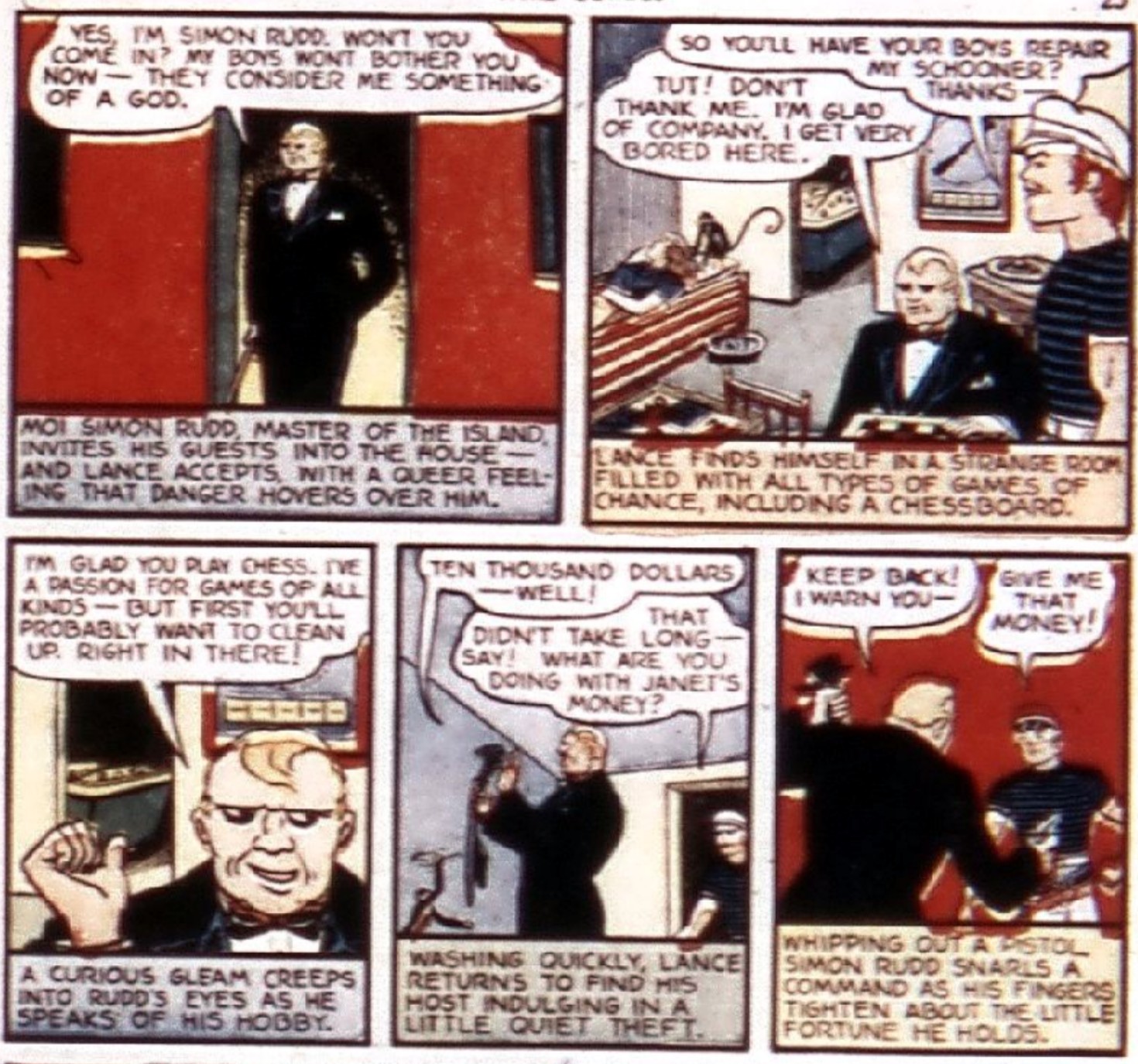
    Simon Rudd loves games and gambling and taking chances, and somehow that has led him to a South Pacific island where he wears a full tuxedo and bosses around a local tribe all day. When ocean adventurer Lance O’Casey and his companions wash up on his shores, Rudd engages in a little Most Dangerous Game action with them, presumably out of sheer boredom. This being a Lance O’Casey story, his ultimate fate is to be socked in the nose. (Whiz Comics 010, 1940)

    Ordinarily these round-ups have four characters in them, but I’m breaking tradition today and making it either two or seven, depending on how you look at it, because today we look at all of the crooks and ne’er-do-wells who have gotten their hands on Ibis the Invincible’s Ibistick.

    The Ibistick is first stolen by an unnamed thief as Ibis searches for Taia’s mummy in a likewise-unnamed European city. His role in the story is mainly to provide an object lesson of just how the Ibistick works: anyone can use it to, for example, make so many gold coins that they start falling out the window and make you easier to track down, but just try to harm Ibis, the wand’s true owner, and your magic will rebound back on you. In this case, the thief is turned to gold. (Whiz Comics 002, 1940)

    Murder Malone is a pretty rotten character whom Ibis and Taia first encounter while investigating trouble at a town of orphan boys – the trouble turns out to be that Malone’s gang has enslaved all of the boys and is forcing them to manufacture weapons. The experience leaves Malone with a desire to own the magic wand that played such a major role in his undoing, but once he gets ahold of it he makes the classic mistake and ends up turning himself into a toad. (Whiz Comics 005, 1940)

    The very next issue features our old pal the Hobo-Millionaire getting all the power in the world and turning himself into ice with it.


    In Whiz Comics 007, Ibis and Taia travel to Hollywood to see the stars, whereupon they fall in with unscrupulous movie producer Carl Brand, who initially offers to buy the Ibistick and then manages to steal it. He then of course tries to turn Ibis into a rabbit and is made one himself, but unlike the rest of those who have made the same mistake, Brand is given a second chance by Ibis and turned back.

    He of course repays this mercy by kidnapping Taia in another bid to get his hands on the wand, only to ultimately be murdered by Piang the Terrible as part of his bid to acquire it.

    Piang finally gets ahold of the Ibistick in Whiz Comics 010, only to immediately screw it up by attempting to remove “all magical powers” from Ibis, which of course rebounds on him, leaving him open to be “accidentally” tossed off of a cliff by the hero.

    When Piang is stripped of all magical power, the Ibistick flies out of his hand and ends up in a nearby river. From there, it finds its way into the hands of an escaped convict with the unlikely name of Grom Deeters, who weirdly is the only alternate wielder of the Ibistick to almost get away with it, thanks to his initial impulse to merely imprison Ibis and Taia upon meeting them, rather than devising some gruesome magical death for them.

    Deeters makes his way to Egypt, where he is undone by his own impulse to be a horny creep: since Taia was the last woman he saw, he summons her to him to try and put the moves on her, then inadvertently animates the Sphinx, then has to summon Ibis in order to calm it down (this incidentally means that in  the Fawcett universe the Sphinx is located a few hundred feet away from where it would normally be found).

    The longer that Deeters has the wand, the longer it becomes clear that his initial successes were the merest flukes, as after attempting to bribe Ibis into convincing his wife to “go for” him he commands Taia to stab Ibis to death, only to of course be the one to taste her blade. 

    That’s all of the Ibistick thieves of 1940 – stay tuned for more in 1941. 

  • MINOR SUPER-HERO ROUND-UP 061

    Superfolk galore! 

    the Buzzard: 

    In an unnamed New-York-alike city, the gadgeteering mayor equips a young man with a suite of devices to help him engage in a vigilante crusade against crime. Chief among these gadgets is a gas that makes whomever it touches resemble a balding, big-nosed man in thick glasses and a tailcoat – the perfect disguise! Armed with this gas, plus some clawed gloves and a heat ray, the Buzzard begins tearing his way through the city’s underworld. 

    The gas also seems to allow the Buzzard to make his shadow resemble his namesake bird, an ability that is very useful for vexing the city’s Buzzard-hating police chief who, it turns out, is also the father of the Buzzard’s secret identity. 

    I unironically love the Buzzard and his whole weird setup, and while I find most modern revivals of public domain Golden Age characters to be a pretty mixed bag, I’m pretty bummed that none of them have elevated him out of his single issue obscurity – he’s got a real weirdo charm that the fiftieth version of the Nedor characters can’t approach. (Wham Comics 002, 1940) 

    the Cyclone: 

    The Cyclone is really Peter Grant, a young man who has a fairly unique version of the Batman origin, which of course is when a tragedy inspires an obsessive dedication to training and working toward some related goal, i.e., in Batman’s case the murder of his parents inspiring his eternal war against crime. The real twist in the Cyclone’s case seems to be the total absence of a motivation: Grant just woke up one day and decided to turn his body into a living weapon to aim at evil.

    The Cyclone is presented as being a regular human and so I had been assuming that the whirlwind patterns around his lower body when he jumps around were a stylistic choice meant to represent his fantastic leaping ability. They really are some enormous jumps, however, so it’s also possible that the Cyclone is meant to have some sort of wind-assisted jumping power. He only had three adventures, alas, so we shall never know. (Whirlwind Comics 001, 1940)

    Ibis the Invincible: 

    Ibis the Invincible, aka Prince Amentep, is a 12th Dynasty Egyptian who just kind of spontaneously comes back to life after 4000 years as a mummy. Why? Well, it’s not spelled out until the 1942 Ibis the Invincible series, but spoilers: his true love had been shot with an arrow that put her to sleep for those four millennia and he put himself in a magical sleep of his own in order to be with her again. 

    Ibis achieves this state of mystic sleep with the aid of the Ibistick, a magical wand capable of very nearly anything. Much like his fellow Golden Age magical super-heroes, Ibis’ near-omnipotence can occasionally seem plot-obliteratingly powerful. 

    The key difference between Ibis and his contemporaries, however, is that the Ibistick is a small object that is constantly being lost or stolen. Further, it requires absolutely no special knowledge to be used and can be operated by both children and animals with ease. More than a few of Ibis’ greatest foes (e.g., the Hobo-Millionaire) are simply regular humans armed with his own magic wand. The caveat to all this is the fact that the Ibistick will never harm its true owner, and will in fact inflict any baleful magic cast from it at him back on its wielder. This means that Ibis is able to defeat an evil wielder of the Ibistick by merely being annoying enough that they try to turn him into a toad or gold or ice or on on memorable occasion to mind control Taia into stabbing him to death and then wait for it to backfire on them. (Whiz Comics 002, 1940)

    UPDATE 1941 

    Taia: 

    Taia is the 4000-year-sleeping love for whom Ibis the Invincible made his way to the future. After a bit of moping around the globe he manages to track down her mummy and revive her, upon which they kind of implicitly are a married couple. While I very much enjoy Taia and the dynamic she has with Ibis, she does get a pretty raw deal – being your own husband’s de facto sidekick is bad enough, but Taia very rarely gets to be anything more than a kidnap victim/bargaining chip. The few modern versions of Ibis the Invincible try to do more with her, but they still don’t do much.

    Taia is said to be cousin to “Senwosri III” who is probably meant to be Pharaoh Senusret III, given that Taia and Ibis are said to be from the 12th Dynasty. So that’s something. (Whiz Comics 002, 1940)