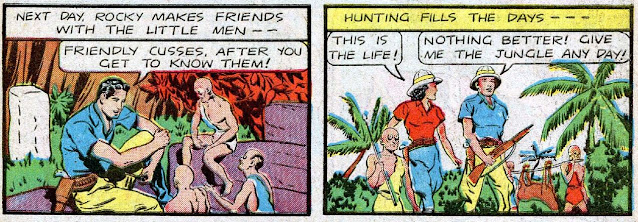
The Curse of Skeleton Munroe

Category: Fate of Atlantis

  • ALIENS AND SO FORTH ROUND-UP 056

    Aliens are just like us if you think about it, man.

    Atlanteans:

    First things first: these are not actually Atlanteans, at least not yet. As far as I can tell, the word “Atlantis” is not employed in any Namor appearance from 1939-1941, and his people are collectively referred to as “Sub-Mariners” just like their prince. We are left with one of our signature Vexing Conundrums: just when do the Sub-Mariners become Atlanteans? Will we find out before we learn the location of Camp Lehigh or before someone says “Keystone City” in print? Only time will tell. 

    Given that they are only later assigned the status of being descended from the humans of old Atlantis (and then unassigned from it if I understand correctly – my interest in Namor has never been great enough that I internalized a lot of his lore), it makes sense that they are much less humanoid than a lot of their peers. They range from being full-on fish-men like Emperor Thakorr to being essentially human-looking but for their huge eyes. And not just human looking, as Namor’s own parentage attests: they can also successfully interbreed with humanity! And it’s a close enough hybridization that he’s not completely infertile, though the fact that he has only one conventionally-conceived child is a bit telling.

    One of the hallmarks of Marvel’s Atlanteans going forward is of course the fact that they all have blue or green skin, which is fun because it appears to have originally been a stylistic choice on the part of Bill Everett to indicate that they were underwater. Frankly I think that it was a good development: I have no desire to see Emperor Thakoor rendered in shades of pale pink. (Marvel Comics 001 1939)

    Balticans:

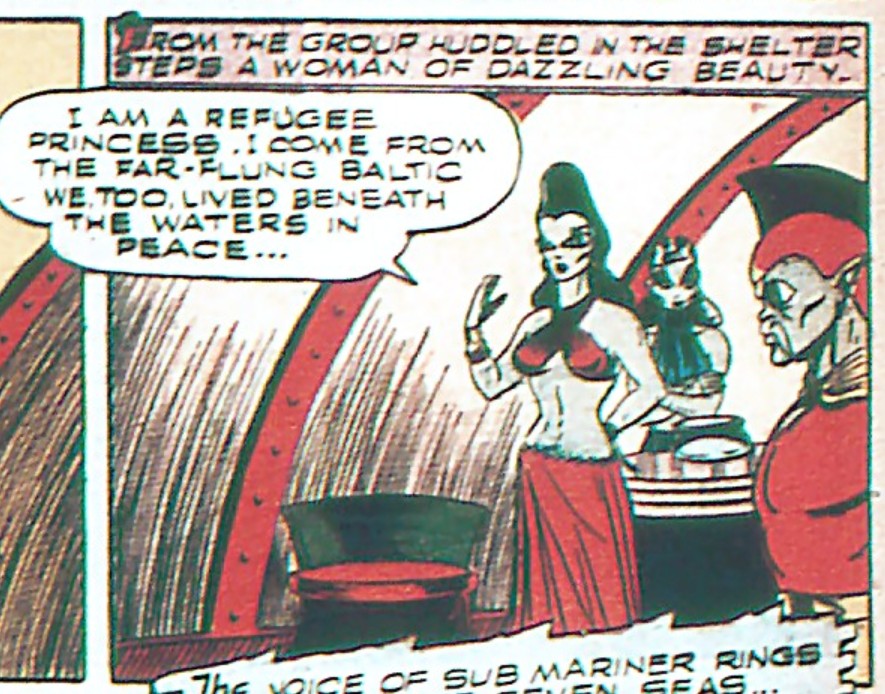
    Represented here by the villainous Rathia, the Balticans are an Atlantean subgroup that live in the Baltic Sea (natch). They might be a different colour than regular Atlanteans, but given the quality of the available scan and the unreliable nature of modern recolouring it is very hard to say for sure. (Human Torch v1 005b, 1941)

    Cygnusians:

    The Cygnusians and their enemies the Draconians are initially set up to star in a little allegorical story about institutionalized racism and the arbitrary nature of warfare, but things get derailed pretty quickly due to the fact that both Queen Luxor of Cygnus and Queen Feros of Draco are women and cheap misogyny laffs are easy. Rock Braddon of the Space Legion ends the war by arranging a queen-on-queen catfight. (Crack Comics 011, 1941) 

    Martians:

    After dealing with all the crazy bullshit that lurks beneath the Earth’s surface in 50032 CE and doing a bit of civilization-rebuilding, Blaze Barton and his romantic/ adventure partner Teddy set out to establish relations with the people of Mars. As they arrive they (and possibly also the Martians) learn that there is a second, bearded population of Martians who live in vast caverns under the planet’s surface and eschew modern technology other than rocket planes and planet-wide smoke screens. These Dark Martians capture Blaze and Teddy in order to hold them for a ransom of lamp oil from an Earth that is probably not equipped to deliver it, given the recent global disasters it has suffered, not to mention the 47 thousand-odd years since the collapse of the whaling industry.

    The main problem with being a low-tech antagonist in a science fiction world is that you are only effective as long as you can keep your opponent off-balance, as the Lord of Martianland learns when he gives Blaze a moment to breathe and finds his men completely outclassed by Blaze’s ray gun and working knowledge of electricity. The king himself is finished off with a low-tech right hook, and his people opt to learn about new and exciting sources of light. (Hit Comics 005, 1940)

  • ALIENS AND SO FORTH ROUND-UP 056

    ALIENS AND SO FORTH ROUND-UP 056

    Aliens are just like us if you think about it, man.

    Atlanteans:

    First things first: these are not actually Atlanteans, at least not yet. As far as I can tell, the word “Atlantis” is not employed in any Namor appearance from 1939-1941, and his people are collectively referred to as “Sub-Mariners” just like their prince. We are left with one of our signature Vexing Conundrums: just when do the Sub-Mariners become Atlanteans? Will we find out before we learn the location of Camp Lehigh or before someone says “Keystone City” in print? Only time will tell. 

    Given that they are only later assigned the status of being descended from the humans of old Atlantis (and then unassigned from it if I understand correctly – my interest in Namor has never been great enough that I internalized a lot of his lore), it makes sense that they are much less humanoid than a lot of their peers. They range from being full-on fish-men like Emperor Thakorr to being essentially human-looking but for their huge eyes. And not just human looking, as Namor’s own parentage attests: they can also successfully interbreed with humanity! And it’s a close enough hybridization that he’s not completely infertile, though the fact that he has only one conventionally-conceived child is a bit telling.

    One of the hallmarks of Marvel’s Atlanteans going forward is of course the fact that they all have blue or green skin, which is fun because it appears to have originally been a stylistic choice on the part of Bill Everett to indicate that they were underwater. Frankly I think that it was a good development: I have no desire to see Emperor Thakoor rendered in shades of pale pink. (Marvel Comics 001 1939)

    Balticans:

    Represented here by the villainous Rathia, the Balticans are an Atlantean subgroup that live in the Baltic Sea (natch). They might be a different colour than regular Atlanteans, but given the quality of the available scan and the unreliable nature of modern recolouring it is very hard to say for sure. (Human Torch v1 005b, 1941)

    Cygnusians:

    The Cygnusians and their enemies the Draconians are initially set up to star in a little allegorical story about institutionalized racism and the arbitrary nature of warfare, but things get derailed pretty quickly due to the fact that both Queen Luxor of Cygnus and Queen Feros of Draco are women and cheap misogyny laffs are easy. Rock Braddon of the Space Legion ends the war by arranging a queen-on-queen catfight. (Crack Comics 011, 1941) 

    Martians:

    After dealing with all the crazy bullshit that lurks beneath the Earth’s surface in 50032 CE and doing a bit of civilization-rebuilding, Blaze Barton and his romantic/ adventure partner Teddy set out to establish relations with the people of Mars. As they arrive they (and possibly also the Martians) learn that there is a second, bearded population of Martians who live in vast caverns under the planet’s surface and eschew modern technology other than rocket planes and planet-wide smoke screens. These Dark Martians capture Blaze and Teddy in order to hold them for a ransom of lamp oil from an Earth that is probably not equipped to deliver it, given the recent global disasters it has suffered, not to mention the 47 thousand-odd years since the collapse of the whaling industry.

    The main problem with being a low-tech antagonist in a science fiction world is that you are only effective as long as you can keep your opponent off-balance, as the Lord of Martianland learns when he gives Blaze a moment to breathe and finds his men completely outclassed by Blaze’s ray gun and working knowledge of electricity. The king himself is finished off with a low-tech right hook, and his people opt to learn about new and exciting sources of light. (Hit Comics 005, 1940)
  • MINOR SUPER-VILLAIN 1001: BARON KRAWMAN

    (Lightning Comics v1 005, 1941)

    Whiz Wilson and his Futuroscope are once again engaging in the Doctor Who style of time travel, in which you just kind of pop into a random time and place and ask a bystander how things are going. In this case he has ended up in Florida in the year 3000, and the vest-wearing Florida Man he speaks to is pretty smug about how great things have been for the past thousand years. Perhaps he is rounding up or thinking extremely locally, because previous Whiz Wilson stories have established a general civilizational collapse in 2040 CE and a more localized one in South America around 2500 CE.

    More importantly, as if summoned by the words “these are wonderful times,” this is the moment that a squad of giant robots attack the city.

    Whiz Wilson is as ever a man of action and takes advantage of a poorly-secured access hatch on the back of one of the robots to get inside and beat up the pilot. This in turn causes the over-cautious leader of the robot pilots, now revealed to be a man named Baron Krawman, to recall his forces.

    Joining the queue of robots in his newly-commandeered ride, Whiz follows them to a domed underwater city “about ten miles” off the Florida coast.

    A quick and stealthy search of the city leads Wilson to an imprisoned woman who introduces herself as Betty Walters, Krawman’s former assistant. She tells him that a) the city is part of the lost continent of Atlantis that Krawman stumbled upon (though how it was missed during a thousand years-plus of intensely ocean-facing Florida life is beyond me) and b) that he is bent on destroying civilization because they laughed at him. Annoyingly, she does not explain why all of Krawman’s minions are nigh-identical bearded beefcakes, because that is all that I am asking about. Was he experimenting with cloning? Are these the descendants of lost Atlantis? Does he just have a type? 

    Whiz and Betty return to the commandeered robot and engage Krawman in thrilling robot-hand-to-robot-hand combat for the future of Florida, a combat that ends with Krawman dead and his city flooded. Once again Whiz Wilson has saved the people of a time period so far in his own future that his bones are naught but dust. Hooray!

    Categorized in: Accessories (Giant Robots), Origins (Villains of the Future), Royalty (Barons)

  • MINOR SUPER-VILLAIN 1001: BARON KRAWMAN

    (Lightning Comics v1 005, 1941)

    Whiz Wilson and his Futuroscope are once again engaging in the Doctor Who style of time travel, in which you just kind of pop into a random time and place and ask a bystander how things are going. In this case he has ended up in Florida in the year 3000, and the vest-wearing Florida Man he speaks to is pretty smug about how great things have been for the past thousand years. Perhaps he is rounding up or thinking extremely locally, because previous Whiz Wilson stories have established a general civilizational collapse in 2040 CE and a more localized one in South America around 2500 CE.

    More importantly, as if summoned by the words “these are wonderful times,” this is the moment that a squad of giant robots attack the city.

    Whiz Wilson is as ever a man of action and takes advantage of a poorly-secured access hatch on the back of one of the robots to get inside and beat up the pilot. This in turn causes the over-cautious leader of the robot pilots, now revealed to be a man named Baron Krawman, to recall his forces.

    Joining the queue of robots in his newly-commandeered ride, Whiz follows them to a domed underwater city “about ten miles” off the Florida coast.

    A quick and stealthy search of the city leads Wilson to an imprisoned woman who introduces herself as Betty Walters, Krawman’s former assistant. She tells him that a) the city is part of the lost continent of Atlantis that Krawman stumbled upon (though how it was missed during a thousand years-plus of intensely ocean-facing Florida life is beyond me) and b) that he is bent on destroying civilization because they laughed at him. Annoyingly, she does not explain why all of Krawman’s minions are nigh-identical bearded beefcakes, because that is all that I am asking about. Was he experimenting with cloning? Are these the descendants of lost Atlantis? Does he just have a type? 

    Whiz and Betty return to the commandeered robot and engage Krawman in thrilling robot-hand-to-robot-hand combat for the future of Florida, a combat that ends with Krawman dead and his city flooded. Once again Whiz Wilson has saved the people of a time period so far in his own future that his bones are naught but dust. Hooray!

    Categorized in: Accessories (Giant Robots), Origins (Villains of the Future), Royalty (Barons)

  • ALIENS AND SO FORTH ROUND-UP 031

    ALIENS AND SO FORTH ROUND-UP 031

    Great value for your alien and so forth dollar today: seven for the price of four!

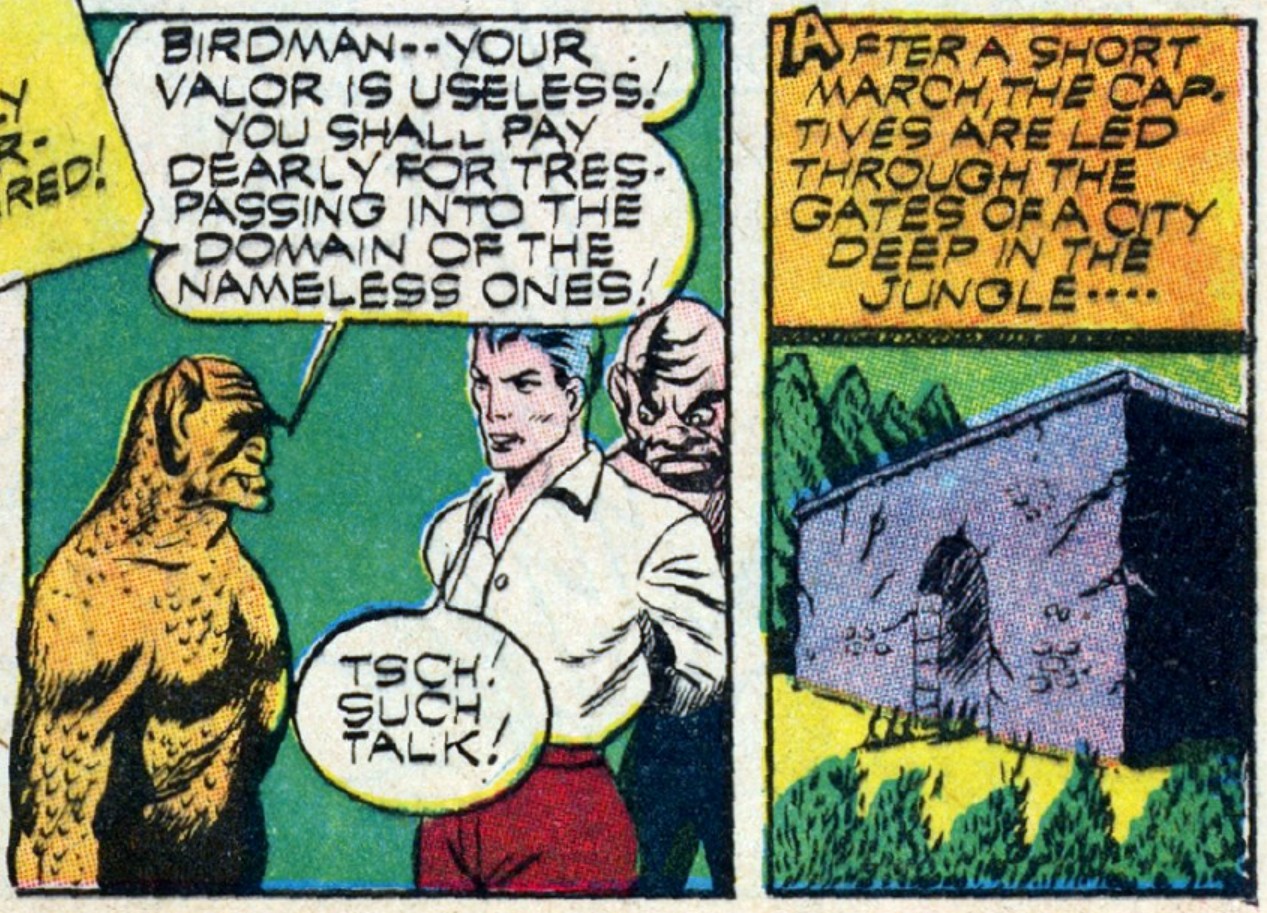
    the Nameless Ones: 

    “The Bingham Boys” was a short-lived feature about twin brothers Billy and Bobby Bingham and their dipshit friend Specs inserting themselves into the life of adventurer Dusty Travis. I their first appearance, the trio tag along on what turns out to be a flight to Mato Grosso, Brazil to search for a clue to the fate of lost Atlantis, for some reason.

    Dusty’s plane crashes thanks to Specs just randomly pushing buttons (I didn’t call him a dipshit for no reason) and the group are quickly set upon and captured by a group of morphologicaly-diverse beings called the Nameless Ones. In a tremendous display of both good and bad luck, the Nameless Ones’ leader – called the Oligarch – confirms that they are the descendants of Atlantis that the four are seeking, but also indicates that they will immediately be sacrificed.

    The Bingham Boys et al cannot be contained by a bunch of scaly weirdos, of course, and once they fight their way free it is time to learn the connection between Atlantis and this extremely inland city, right? WRONG, SUCKA. The Oligarch of the Nameless Ones is extremely serious about the “secret” part of “the secret of the Nameless Ones and Atlantis” and blows up the city rather than giving either Dusty Travis or the reader any kind of satisfaction. (Silver Streak Comics 015, 1941)

    Goors:

    Diver Kinks Mason is testing out a new diving apparatus when a rogue current drags him into an underwater cavern willed with the wreckage of lost ships. There, he encounters two battling groups of aquatic humanoids: the fish-eyed Goors and the conventionally-attractive Proconos.

    Kinks throws in with the Proconos due to the one-two punch of them being led by a hot lady and then telling him that the Goors are evil slavers. We can only hope that they were telling the truth because he proceeds to lead them in an attack that wipes the Goor city off the sub-oceanic map. Using war beasts that look like a cross between a plesiosaur and a duck, to boot! (Fight Comics 001, 1940)

    Grangonians: 

    Space adventurer Flint Baker and his reporter pal Mimi Wilson are noodling around in space one day when they happen upon an old worn-out planet full of immortal old people. These are not the Grangonians but a completely and annoyingly unnamed group. The Grangonians show up later, don’t worry.

    These old aliens have a problem: they discovered the secret to immortality too late and now they are trapped on an old planet. This reflects a kind of… folk belief?… that you get in old science fiction and especially in old science fiction comics, that planets have a sort of life cycle that starts out all swampy and primitive and covered in dinosaurs and ends in dusty ruins. If you’ve encountered this at all it’s probably in the notion of Venus being a younger and thus wetter planet than Earth that continues to crop up in comics into at least the early Sixties.


    Flint and Mimi transport the old aliens to a newly-discovered solar system full of young, vibrant planets, and sure enough they become young aliens as soon as they step foot on the surface of their new home. This is when the Grangonians come in, as their planet (Grango, natch) has been hit by a meteor and they also want to relocate to Planet Dinosaur. Though the Grangonians have more in the way of overt firepower, a combination of dinosaur attacks, old alien technology and Flint Baker’s heroic antics eventually drives them off.

    Both the Grangonians and the old aliens are essentially just regular humans, and while the notion that intelligent life basically looks the same wherever it evolves isn’t exclusive to the “planetary ages” style of sci-fi, it does usually go hand-in-hand with it – just as planets have a life-cycle, so too does the life on them emerge in predictable forms. (Planet Comics 005, 1940)

    Timid Giants:

    The Timid Giants are very appropriately found on the Planet of Timid Giants, where they just kind of keep to themselves. The planet very briefly sees some drama as a group of space explorers are terrified by the Giants’ size, but some light bullying by the Red Comet is sufficient to demonstrate how harmless the aliens are.

    The real threat on the planet are the Stickers, ant-sized aliens who live to torment the Giants and are all too happy to move on to human targets, including a shrunken Red Comet. The Stickers suck. I hate them and their weird cartoon baby faces.

    It turns out that the one thing that can spur the Timid Giants into action is a threat to the life of another, and so one of them eats the Stickers to save the Red Comet. This results in a sequence in which the Comet in turn has to fly his shrunken spaceship inside the giant to save him from being stuck internally, after which he fumigates the entire planet, and while I must still morally be against murdering an entire intelligent species by god do the Stickers make it hard. (Planet Comics 007, 1940) 

  • ALIENS AND SO FORTH ROUND-UP 025

    ALIENS AND SO FORTH ROUND-UP 025

    We got Fish-Men, we got Fishmen, we got other kinds of men.

    Fishmen:

    Adventurer Lance Rand has acquired a map showing the location of the sunken continent of Atlantis and so naturally he sets out to see if it’s accurate and more importantly to find out if there’s any ancient Atlantean treasure there for him to loot. Making his way to the ocean floor, Lance and his pal Tubby are almost immediately accosted by a Fishman riding on a sea monster. This is a good sign!

    The sunken city of Atlantis does indeed turn out to me right where the map said it was, complete with some monumental bare-assed statuary. Lance and Tubby are able to drive their submarine tractor right up to the base of what must have been an important Atlantean idol and pry the disco ball-sized diamond out of its forehead, upon which they have to deal with another squad of hostile Fishmen. Though the implication is of course that these fellows are the descendants of drowned Atlantis, the fact that they never say anything really makes it hard to confirm. Perhaps they are unrelated underwater humanoids who just disapprove of Lance and Tubby’s wanton looting. Whichever it is, I really dig the little wing-fins that grow out of their backs. (Cat-Man Comics 001, 1941)

    Fish-Men: 

    When oceanic adventurer Navy Jones’ submarine is lost at sea, he is rescued by an undersea race of aquatic humanoids who don’t really have an official name but who are more often than not called Fish-Men or something similar. Despite some early conflict engineered by the scheming Prime Minister, Jones soon becomes the Fish-Men’s champion.

    Fish-Men society is ruled over by a more humanoid nobility, represented here in the forms of their unnamed king and his daughter/ Navy Jones’ love interest, Princess Coral. As usual, the reasons for these morphological differences are not explained and likely boil down to “we didn’t want our hero to be romantically involved with a fish.”

    Like many Fiction House heroes, Navy Jones passed through a lot of hands over the course of his career, and the Fish-Men had a correspondingly large number of looks, each of them charming in its own way.(Science Comics 001, 1940)

    Fishmen:

    This Fishman is encountered by Tabu, Wizard of the Jungle in what is probably a prehistoric underground enclave that a group of explorers stumble across “far to the Southeast of the Congo”. I say probably because Tabu gasses on about how they have gone back in time, which might be meant literally and might just be a bit of excessively flowery exposition. 

    The above is virtually all of the on-panel time that the Fishmen get, as the narrative is much more focused on the drama of one of the explorers falling in love with a cave woman. (Jungle Comics 011, 1940) 

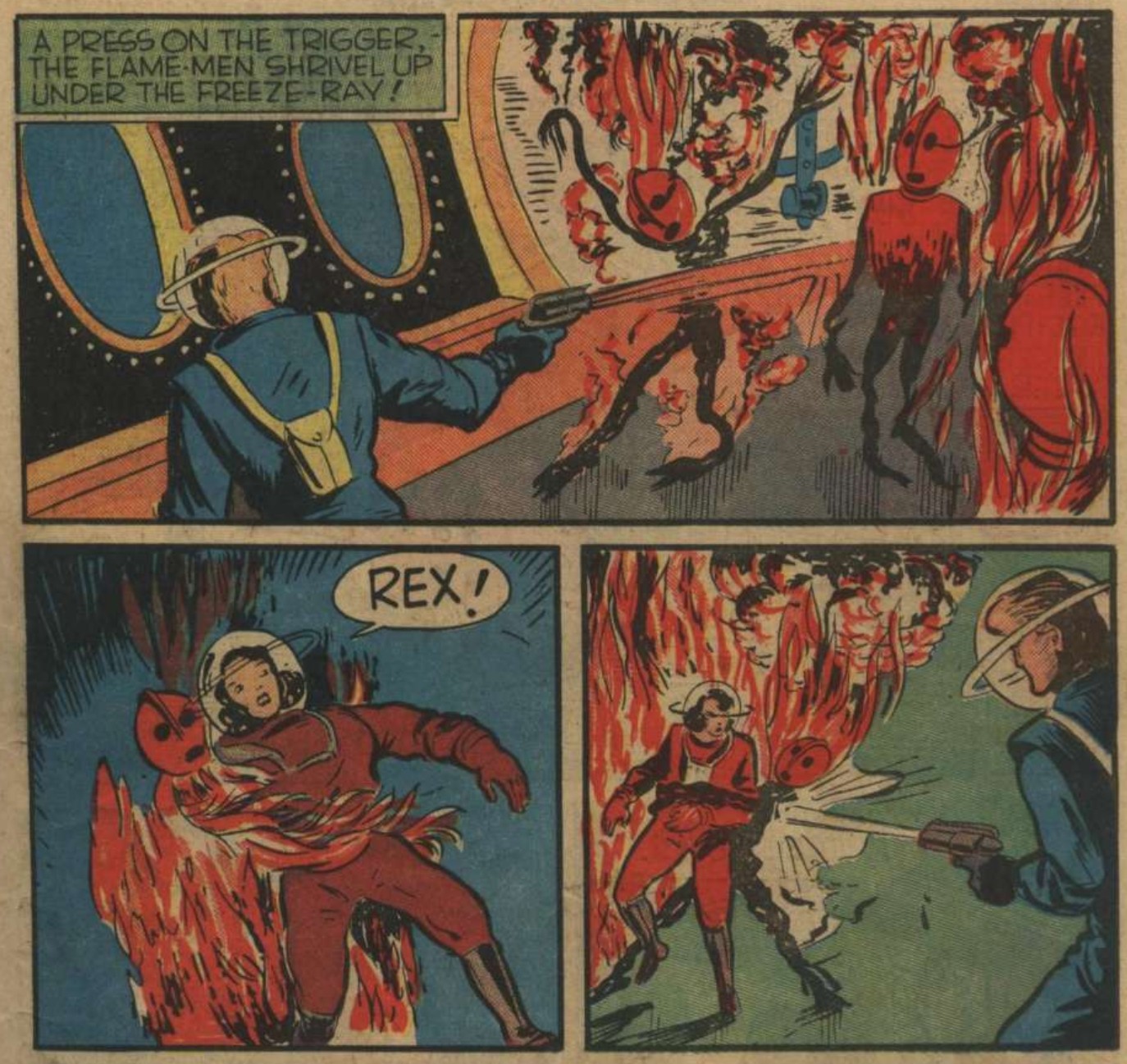
    Flame-Men: 

    Just as Rex Dexter of Mars and his companion Cynde are about to leave the planet Nexis and its friendly inhabitants, the Nexis as part of their never-ending attempt to reach Mars, the world is attacked by some sort of apocalyptic flame weapon.

    Rocketing into space to investigate, Rex and Cynde discover that the source of the attack is a fiery comet that is being directed by a massive spacecraft, by which they are swiftly captured. Inside they find the Flame-Men from Planet Emalf, who are attacking Nexis as the first move in their attempt to destroy the rest of the universe. Why are they doing this? No idea.

    The Flame-Men are unprepared for Rex’s freeze-ray gun, and shrivel up into little burnt matchstick men in a way that is as aesthetically pleasing as it is unsettling. (Mystery Men Comics 010, 1940) 

    Categorized under: Aliens, Animals (Fish), Elements (Fire), Generica (Men)

  • MINOR SUPER-VILLAIN 783: PHATSO

    (Superworld Comics 003, 1940)

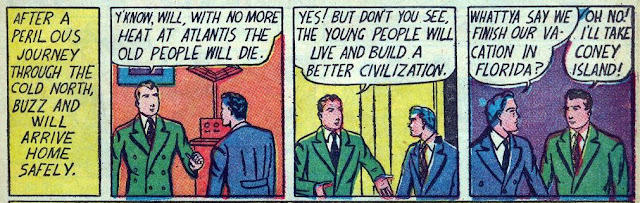
    Buzz “the Invisible Avenger” Allen and Will “also invisible but has no special name” Lawrence are taking an Alaskan vacation with some of the reward money they have earned via vigilantism (and it’s nice to see a variation on super-hero morality now and then – someone has to be accepting awards when offered, surely) when they, hard-core radio amateurs that they are, pick up a panicked broadcast from nearby. Making their way to the location, they find the man who sent the distress call dead and surrounded by weird ribbons of light.

    Finding that the light ribbons are solid, Buzz and Will make the amazing and completely understandable decision to grab onto them as they fly off, and end up being whisked even further North to a hidden city in the ancient Greek style.

    The lads attempt to bluff the city’s ruler, Phatso, with a bit of the old “cower before us for we are wizards” gag, but it turns out that this isn’t a primitive hidden city but a technologically advanced one, and a little bit of invisibility tech isn’t going to get so much as a shiver out of them. They also learn that Phatso is using the light ribbons to kill people and siphon the information from their minds in preparation for a full-scale Atlantean (did I mention that the city represents the remnants of sunken Atlantis?) invasion of the United States. The boys are unceremoniously paralysis-rayed and tossed in the clink.

    I really like Phatso’s villain patter, by the by. “I am Phatso, great, clever ruler of Atlantis. I can speak in any tongue and I am 212 years old!” is a terrific introduction. I just with his name wasn’t an as-far-as-I-can-tell purposeless pun, because it is annoying.

    Buzz and Will escape of course, and immediately blow up the machines that make Arctic Atlantis habitable by humans, with the wild justification that only the old people will die off and thus Atlantean civilization will be improved. Is this the morality of a hero who takes the reward cheques? Is this what I was asking for!!??

    (this is also part of a bit of a recurring theme in stories from Superworld Comics of “inflicting mass casualties” as a standard part of the heroic arsenal – the other examples are all from human vs alien stories that fall a bit outside of my self-imposed purview and so won’t be showing up here, but I assure you that it is there and it leaves a bit of a bad taste in your mouth once you recognize it)

  • MINOR SUPER-VILLAIN 536: NAULUS

    (Fantastic Comics 001, 1939)

    Naulus is an undersea noble who is attempting to usurp the throne of Atlantis from its rightful ruler, Queen Lantida, and do Atlantean aristocrats get up to any other activities? Atlantis needs more hobby stores, I reckon.

    FATE OF ATLANTIS: this version of Atlantis appears to be the standard ancient sunken city saved by super science – specifically a sealed dome city full of air. These aren’t your water breathing Atlanteans, folks. Since this is a Sub Saunders story set in the year 10 000 this is also a much older Atlantis than usual.

    Both Atlantis and Naulus are also unfortunately explicit slavers as they employ the services of these very cool but oppressed frogmen.

  • THE FATE OF ATLANTIS

    (Super Comics 002, 1938)

    This is just a regular account of some survivors of Atlantis (and their wives) setting up a colony somewhere – in this case the South Seas. The development of a priestly class obsessed with covering up their murder of one guy (to the extent that he is eventually made their god of Justice!) is pretty fun.

  • NOTES – MARCH 2024

    The Foot Test For Guns:

    I sincerely can’t believe we’ve found another person trying the Foot Test For Guns, the worst of all ways to see if a gun is working. (Big Shot Comics 004, 1940)

    Kids Playing Super-Heroes:

    Jibby Jones is a pretty weak sauce comic strip (seen here in comic book reprint, natch) but dang if I’m not intrigued by this Moon Man character. (Big Shot Comics 005, 1940)

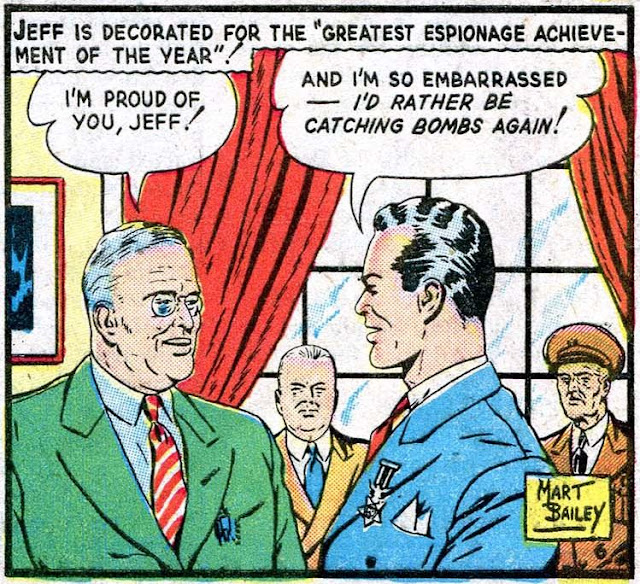
    Honours:

    Jeff Cardiff, Spy-Chief saves Washington DC from being exploded by unspecified foreigners and is rewarded with the very official-sounding honour of “Greatest Espionage Achievement of the Year” by FDR himself! And is that J Edgar Hoover in the background? Probably! (Big Shot Comics 006, 1940)

    Who is Lazy Ray?:

    I’ve been reading Big Shot Comics from the Columbia Comic Corporation for the last week or so and I believe that I’ve spotted an in-joke. But who is the “Lazy Ray” referenced in the two panels? Both Spy-Chief (above) and the Face (below) are Mart Bailey joints, so it could be a personal joke of his or it could be a joke among the contributors of this magazine as a whole (like the seeming industry-wide joke of putting Gil Fox’s name in as a reference at every opportunity – wish I’d though to screenshot those as I came across them). The only Ray associated with Big Shot that I can find is Ray McGill, who seems to have mainly done gag panels. Who can say but I shall be watching out for Lazy Ray going forward.

    MORE LAZY RAY SIGHTINGS:

    “the Face” (Big Shot Comics 011, 1941)

    “the Face” (Big Shot 018, 1941)

    Nova Scotia:

    It’s not like it matters to the plot but the action of this Marvelo story takes place largely on a beach on Cape Breton. (Big Shot Comics 013, 1941)

    the Fate of Mu:

    A fairly straightforward account of a Pacific continent sinking, with the fun added detail that it’s because of Earth’s lost second moon exploding. It’s never actually called Mu and in fact it’s Atlantis that gets namechecked, but a close reading of the relevant text suggests that the two continents merely sank at the same time, so Atlantis was also presumably moonstruck.

    Really fond of these little bug-eyed guys, by the way. (Big Shot Comics 014, 1941)

    Weed Propaganda:

    Santy Claus:

    To the extent that the Columbia Comic Corporation has a shared universe, Santa Clause is confirmed real in it. (Big Shot Comics 020, 1941)

    Drawn Without Reference:

    (Blackstone Super-Magic 001, 1941)