The Curse of Skeleton Munroe

Category: Rang-a-Tang the Wonder Dog

  • MEDIA IN COMICS 006

    Now that’s entertainment. 

    Magazines: 

    Are magazine titles in comics more likely to be plays on real ones than other forms of media? Perhaps. We’ll just have to see how many variations on Life and Time we can find over the years. Pretending to work for Living has enough caché that it gets these fascists into a secure aircraft plant – how long has it been since magazines were so relevant? (Big Shot Comics 014, 1941)

    Movies:

    I never actually mentioned it in the entry on the Hunchback of Hollywood, but the anti-Nazi movie that incites the story’s action is called The Tyrant. Featuring Steve Rogers, Bucky Barnes and Sergeant Duffy in minor roles! (Captain America Comics 003, 1941)

    Rang-a-Tang the Wonder Dog’s boy companion Richy (the Amazing Boy) never seemed to be that impressive to me, but Hollywood disagreed and he was made both the star and subject of a film called Riverfront Richy with lots of animal stunts. (Blue Ribbon Comics 011, 1941)

    There’s never any real indication of what Scoopin’ Jive is about – music seems likely – but it’s such a baffling name for a movie that I must celebrate it (Crackajack Funnies 036, 1941)

    Similarly, we never really learn what Wings Aflutter is about, other than being a “new Navy Air smash hit” with a terrible name. (Jumbo Comics 034, 1941)

    Theatre:

    Minor super-villain the Black Death of course takes his costume and MO from a character in a stage production called The Black Death. There’s not quite enough of the play’s plot in the story to know if the fictional Black Death is supposed to be a metaphor or something or some sort of slasher movie killer as it appears. I sincerely hope it’s the latter. (Thrilling Comics 010, 1940)

    One of Professor X’s attempts to get Sub-Zero involves attacking him in the audience of a big stage musical that his girlfriend Mary is appearing in as part of the “Living Chandelier”. “George Whyte’s Sandels” is a very specific-seeming reference, but I am unable to easily connect it to a show of the era. (Blue Bolt v1 006, 1940)

    Fuller Spunk, former star of stage and now Holmes-inspired detective, starred in the evocatively-named shows Hector’s Last Gulp and The Gripes of Raft. (Hyper-Mystery Comics 001, 1940)

    Waltz of the Vampires is a ballet performance that is narratively used to set off vampire Carlos Hubbelo’s bloodlust, but more importantly, it kind of rules? Comic book media is so often a version of something from the real world that it’s always very fun to see something like this that (as far as I can tell) is just a sincere depiction of a vampire ballet. (Blue Ribbon Comics 011, 1941)

  • FASCIST GOON CLEARING HOUSE 007

    Once again we must discuss the fascists.

    The Black League are a pretty regular-style gang of fifth columnists with two points of distinction: 1) they call one another “Black One”, which is kind of fun and 2) they are trying to steal this completely awesome WWII mech suit and get beat up by Dick Cole, Wonder-Boy for their efforts. (Blue Bolt v1 011, 1941)

    The nation of Bundonia deploys this crack squad of idiots, the Bundsters, to Hollywood to prevent film star Harly Shaplyn from filming the MLJ universe’s version of the Great Dictator but they end up getting beaten up by Rang-a-Tang the Wonder Dog, child actor Richy Waters and a bunch of Boy Scouts. (Blue Ribbon Comics 006, 1940)

    The Young Bundists were just that: a junior version of the German-American Bund. They made the mistake of recruiting naif/ agent of chaos Ty-Gor and the adult leadership ended up jailed while the youths decided to join the Boy Scouts instead. (Blue Ribbon Comics 014, 1941)

    The Purple Shirts are on the one hand a pretty rote version of the American fascist movement working with foreigners of ambiguous origin in order to weaken the US from within and allow leader Angel Cobra and his decidedly Hitlerian lieutenant Scar to take over. On the other hand they have a real place in comics history that their contemporaries never quite manage to match, due to the fact that they are the ones who kill patriot Ezra Smith and trigger his incarnation as the latest version of Uncle Sam. It’s not much of a legacy but it’s better than most of these fascist shitbirds get.

    The Purple Shirts also manage to briefly capture FDR! (National Comics 001, 1940)

  • REAL PERSON ROUND-UP 002

    How did these real people come to be trapped in the 2D realm? We may never know

    Adolf Hitler:

    This one is more tenuous but Blitz Krieg here is Fuehrer of the pseudo-Nazi Bundonian forces in America. He’s not not a Hitler analog. (Blue Ribbon Comics 006, 1940)

    This is Boris Thorax, first foe of Rex Dexter of Mars, who collaborates with the Moon People in order to take over the Earth of 2000 AD. Look at that hair: that’s a Hitler analog. (Mystery Men Comics 001, 1939)

    Alexander the Great:

    Time traveller Stuart Taylor and pals visit Ancient Macedonia for a larf and get mixed up with Alexander and for some reason the Amazons in an adventure that will inspire much eye-rolling in the modern reader. (Jumbo Comics 017, 1940)

    Charlie Chaplin:

    A “Harly Shaplyn”, attacked by “Bundonians” for making a version of the Great Dictator. (Blue Ribbon Comics 006, 1940)

    Samuel Goldwyn: 

    The bald guy in the Harly Shaplyn panels above is named Sam Wyngold and it took me a concerningly long time to realize that he was an analog of Samuel Goldwyn, the G in MGM.

    Count Zaroff:

    Aristocrat Baron von Krasner wants a little of that “Most Dangerous Game” action, so he wrecks a ship and hunts adventurer Gypsy Johnson and his companions on his be-castled island (Blue Ribbon Comics 006, 1940)

    Heinrich Himmler:

    Unnamed head of secret police for Mr Justice foe and Hitler analog the Dictator. Ends up skewered by his own men. (Blue Ribbon Comics 014, 1941)

    Hermann Goering:

    As “Field Marshall Boreing” is manipulated into killing/ being killed by other Nazi analogs by Mr Justice. Boreing is the only survivor but Mr Justice gets him in the next issue. (Blue Ribbon 015, 1941)

    Kit Carson:

    It’s one of those “why did they bother obfuscating this” moments: “Kit Karston” here is probably meant to Kit Carson, formerly widely regraded as a hero of the Old West and now as a mass murderer. “Gravestone” is obviously Tombstone, Arizona. (Blue Ribbon Comics 007, 1940)

    Joachim von Ribbentrop:

    Nazi foreign minister. As “von Fibbenfop” is manipulated into killing/ being killed by other Nazi analogs by Mr Justice. (Blue Ribbon 015, 1941)

    Joseph Goebbels:

    The confusingly-named Deenbee serves as Minister of Propaganda for Mr Justice foe the Dictator (Blue Ribbon Comics 013, 1941) 

    Two issues later, Deenbee is out and “Gobbels” is manipulated into killing/ being killed by other Nazi analogs by Mr Justice. (Blue Ribbon 015, 1941)

    Mahatma Gandhi:

    Cast as “Mahatmama”, leader of a group of Italian-allied North African Arabs, a choice as baffling as it was racist (though it does fit with the sort of broad confusion between the Middle East and the Indian subcontinent I have noticed in other comics of the period) (Blue Ribbon Comics 013, 1941)

  • REAL PERSON ROUND-UP 001

    REAL PERSON ROUND-UP 001

    I have a lot of these in a spreadsheet somewhere but we’ll get to those later. For now it’s as we encounter them: real people and versions of real people and analogs of real people and also the same but famous fictional people in comics.

    Admiral Dewey, John Paul Jones, Sir Francis Drake:

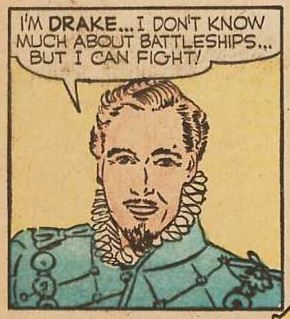
     Their ghosts all volunteer to help Sergeant Spook go pirate hunting (Blue Bolt v1 008, 1941)

    Adolf Hitler: 

    “Gustave Ritter” isn’t really very close to “Adolf Hitler” but I have a finely-honed sense for when someone is making a Hitler analog and this world-conquering barbarian from the year 2041 is just that. I think. (Blue Ribbon Comics 004, 1940)

    Clark Gable:

    As “Stark Brable” in Rang-a-Tang the Wonder Dog’s trip to Hollywood (Blue Ribbon Comics 005, 1940)

    Lana Turner:

    It’s a classic first letter switcheroo as actress Lana Turner shows up as “Tana Lurner” in a Rang-a-Tang the Wonder Dog comic. (Blue Ribbon Comics 005, 1940)

    Maid Marion:

    The “Green Falcon” feature, as far as I can tell, takes place in a Robin-Hood era England with no Robin Hood but with Lady Marion here occupying the Maid Marion role. (Blue Ribbon Comics 004, 1940)

    Orson Welles:

    “Nawson Swelles” is a troublesome “Boy Wonder” and the villain of Rang-a-Tang the Wonder Dog’s visit to Hollywood. (Blue Ribbon Comics 005, 1940)

    Prince John:

    Essentially playing the same part as he does in the Robin Hood stories in the Green Falcon’s adventures. (Blue Ribbon Comics 004, 1940)

    Richard the Lionheart:

    The key to Prince John’s villainry is that the good king is off being a dipshit in the Holy Land and this version of Richard I does not fail in that. (Blue Ribbon Comics 004, 1940)

  • MINOR SUPER-HERO ROUND-UP 009

    All Archie/MLJ edition!

    Rang-a-Tang the Wonder Dog:

    The Wonder Dog is an uncommon but distinct type of comic book hero and Rang-a-Tang here is typical of the breed: essentially a dog with human intelligence. Rang-a-Tang escaped from a cruel but evidently very talented circus dog trainer and almost immediately teamed up with police Detective Hy Speed, who was perhaps lashing out at the world for his own moniker when he gave his new dog one of the all-time worst names. I mean, I get that it’s a knockoff of Rin-Tin-Tin but he also had a very bad name. 

    By issue seven of Blue Ribbon Comics Rang and Hy had moved to Hollywood and acquired a third companion in Richy Waters, aka Richy the Amazing Boy, and apparently free-range child actor with no adult supervision to speak of. Richy gradually usurps Rang-a-Tang’s place as the strip’s protagonist over the next year or so, which is disappointing to those of us who enjoy dogs more than child actors. (Blue Ribbon Comics 001-022, 1939-1942)

    Bob Phantom:

    As far as his super-hero identity goes, Bob Phantom is fairly regular: he shares with many other Golden Age heroes the power to suddenly appear – in a cloud of smoke in his case (though crucially he is generating the smoke as opposed to appearing in a preexisting cloud like the Vision. Or preexisting fire like the Flame, preexisting water like the Shark, etc. You get it) – and also has some degree of intangibility – definitely enough that bullets don’t affect him. Per his name, he’s very into spooking crooks out via psychological torment.

    Bob Phantom’s civilian identity is that of Walt Whitney, writer of the newspaper gossip column “On Broadway” which he uses to taunt both criminals and the New York District Attorney for some reason. Possibly just to be a scamp. (Blue Ribbon Comics 002, 1939)

    (between Bob Phantom, Top Ten character Jack Phantom and cartoon character Danny Phantom there are just enough characters with “Phantom” as a last name to make me think I’m missing some sort of very obvious pun)

    UPDATE

    UPDATE 1940 

    Corporal Collins, Infantryman:

    An American serving in the French Army (and later the British Army after the Nazis conquer France), Corporal Collins is for no apparent reason a super soldier with crack reflexes,  a danger sense that allows him to dodge enemy bullets and a “fabri-steel flexible repeller” that allows him to effectively deflect incoming bullets back to their source. The more overtly super-heroic aspects of  Collins get toned down after a couple of issues and he becomes just another comic book military paragon with a comic relief sidekick named Slapsie and a rivalry with fellow MLJ military hero Sergeant Boyle and his sidekick Twerp. (Blue Ribbon Comics 002, 1939)

    Hercules:

    It’s time for another Hercules! This Hercules is the real deal Olympian, sent to Earth by Zeus to combat evil (and possibly also as a prank? He seems to be completely unprepared when he pops up in the middle of a New York City analog). Functionally, he’s exactly the same as the other two Herculeses we’ve seen so far: a great big shirtless blonde guy with super strength. He even gets a job as a sideshow strongman like the both of them.

    The real innovation in this version of Hercules is the assertion that his famous Twelve Labours were in fact “wiping out the evils of Ancient Greece” and then drawing parallels between them and his adventures in the modern day, including:

    – the Slaying of the Nemean Lion -> killing gang boss Leo Nymia, the Lion of the Underworld (Hercules also steals Nymia’s suit as a version of wearing the lion’s hide)

    – the Slaying of the Lernean Hydra ->  deposing political fixer Hy Dralerny and his “Nameless Nine” organization

    – the Cleaning of the Augean Stables -> cleaning up crooked gambling at the local racetrack – very tortured and involves both a gambler named Augie King, and two jockeys named Tom and Dick Rivers who had to be “set in the right channels”

    – the Capture of the Erymanthian Boar -> very disappointing. Hercules captures a fat pseudo-Nazi General (who isn’t even named Hairy Man Ian) and because he shoots down a bunch of planes while doing it shoehorns in the Slaying of the Stymphalian Birds. Absolutely the worst of the bunch.

    – Stealing the girdle of Hippolyta -> Contending with the villainess Natch, about whom we shall speak anon.

    Sadly for the mythological completionists out there, Hercules stopped appearing after just six labours, so we’ll never get to see him take on Mary Diomedes the Cannibal Equestrian or twin cattle rustlers Gary and Gerry Young. (Blue Ribbon Comics 004, 1940)

  • MINOR SUPER-HERO ROUND-UP 009

    All Archie/MLJ edition!

    Rang-a-Tang the Wonder Dog:

    The Wonder Dog is an uncommon but distinct type of comic book hero and Rang-a-Tang here is typical of the breed: essentially a dog with human intelligence. Rang-a-Tang escaped from a cruel but evidently very talented circus dog trainer and almost immediately teamed up with police Detective Hy Speed, who was perhaps lashing out at the world for his own moniker when he gave his new dog one of the all-time worst names. I mean, I get that it’s a knockoff of Rin-Tin-Tin but he also had a very bad name. 

    By issue seven of Blue Ribbon Comics Rang and Hy had moved to Hollywood and acquired a third companion in Richy Waters, aka Richy the Amazing Boy, and apparently free-range child actor with no adult supervision to speak of. Richy gradually usurps Rang-a-Tang’s place as the strip’s protagonist over the next year or so, which is disappointing to those of us who enjoy dogs more than child actors. (Blue Ribbon Comics 001-022, 1939-1942)

    Bob Phantom:

    As far as his super-hero identity goes, Bob Phantom is fairly regular: he shares with many other Golden Age heroes the power to suddenly appear – in a cloud of smoke in his case (though crucially he is generating the smoke as opposed to appearing in a preexisting cloud like the Vision. Or preexisting fire like the Flame, preexisting water like the Shark, etc. You get it) – and also has some degree of intangibility – definitely enough that bullets don’t affect him. Per his name, he’s very into spooking crooks out via psychological torment.

    Bob Phantom’s civilian identity is that of Walt Whitney, writer of the newspaper gossip column “On Broadway” which he uses to taunt both criminals and the New York District Attorney for some reason. Possibly just to be a scamp. (Blue Ribbon Comics 002, 1939)

    (between Bob Phantom, Top Ten character Jack Phantom and cartoon character Danny Phantom there are just enough characters with “Phantom” as a last name to make me think I’m missing some sort of very obvious pun)

    UPDATE

    UPDATE 1940 

    Corporal Collins, Infantryman:

    An American serving in the French Army (and later the British Army after the Nazis conquer France), Corporal Collins is for no apparent reason a super soldier with crack reflexes,  a danger sense that allows him to dodge enemy bullets and a “fabri-steel flexible repeller” that allows him to effectively deflect incoming bullets back to their source. The more overtly super-heroic aspects of  Collins get toned down after a couple of issues and he becomes just another comic book military paragon with a comic relief sidekick named Slapsie and a rivalry with fellow MLJ military hero Sergeant Boyle and his sidekick Twerp. (Blue Ribbon Comics 002, 1939)

    Hercules:

    It’s time for another Hercules! This Hercules is the real deal Olympian, sent to Earth by Zeus to combat evil (and possibly also as a prank? He seems to be completely unprepared when he pops up in the middle of a New York City analog). Functionally, he’s exactly the same as the other two Herculeses we’ve seen so far: a great big shirtless blonde guy with super strength. He even gets a job as a sideshow strongman like the both of them.

    The real innovation in this version of Hercules is the assertion that his famous Twelve Labours were in fact “wiping out the evils of Ancient Greece” and then drawing parallels between them and his adventures in the modern day, including:

    – the Slaying of the Nemean Lion -> killing gang boss Leo Nymia, the Lion of the Underworld (Hercules also steals Nymia’s suit as a version of wearing the lion’s hide)

    – the Slaying of the Lernean Hydra ->  deposing political fixer Hy Dralerny and his “Nameless Nine” organization

    – the Cleaning of the Augean Stables -> cleaning up crooked gambling at the local racetrack – very tortured and involves both a gambler named Augie King, and two jockeys named Tom and Dick Rivers who had to be “set in the right channels”

    – the Capture of the Erymanthian Boar -> very disappointing. Hercules captures a fat pseudo-Nazi General (who isn’t even named Hairy Man Ian) and because he shoots down a bunch of planes while doing it shoehorns in the Slaying of the Stymphalian Birds. Absolutely the worst of the bunch.

    – Stealing the girdle of Hippolyta -> Contending with the villainess Natch, about whom we shall speak anon.

    Sadly for the mythological completionists out there, Hercules stopped appearing after just six labours, so we’ll never get to see him take on Mary Diomedes the Cannibal Equestrian or twin cattle rustlers Gary and Gerry Young. (Blue Ribbon Comics 004, 1940)

  • NOTES – APRIL 2024

    Nazi Superweapon:

    There’s nothing terribly special about this giant dirigible that the Phantom Sub encounters after it starts to fly as well as submerge, but I do appreciate a dirigible that can not only camouflage itself as a stormcloud but has a proper old-school lightning cannon mounted underneath. And is filled with hydrogen, nuch to its later detriment. (Blue Bolt v2 007, 1941)

    Honours:

    Corporal Collins, Infantryman earns the French Croix de Guerre. (Blue Ribbon Comics 002, 1939)

    Rang-a-Tang the Wonder Dog is made a full-fledged policeman in the NYPD (Blue Ribbon Comics 001, 1939)

    Assuming that this guy knows what he’s talking about, Rang-a-Tang the Wonder Dog probably gets the Congressional Medal (maybe of Honor, maybe another one) (Blue Ribbon Comics 004, 1940)

    Rang-a-Tang the WOnder Dog gets place of honour in a circus parade. (Blue Ribbon Comics 013, 1941)

    Place Names:

    Hercules travels to Missiansas, only our second fake state after the Whip’s “New Texirona” (Blue Ribbon Comics 005, 1940)

    Costumes:

    Speaking of Hercules, this version of Zeus from his adventures might just be the greatest outlier in general dress and design I have ever seen (Blue Ribbon Comics 005, 1940)

    Aliens:

    Really enjoy the vibe of these Martian invaders. Screw cold rationalist aliens; bring on the party aliens! (Blue Ribbon Comics 008, 1941)

    Cops Shoot:

    The police of whatever town Mr Justice lives in attempt to summarily execute him for fleeing a third degree interrogation about him supposedly being bribed by a fake medium. (Blue Ribbon Comics 012, 1941)

    And over in whatever town Captain Flag calls home the cops attempt to gun him down as he breaks jail to stop the Black Hand from carrying out the scheme that he is in jail for due to those same cops being credulous morons. (Blue Ribbon Comics 018, 1941)

  • NOTES – APRIL 2024

    Nazi Superweapon:

    There’s nothing terribly special about this giant dirigible that the Phantom Sub encounters after it starts to fly as well as submerge, but I do appreciate a dirigible that can not only camouflage itself as a stormcloud but has a proper old-school lightning cannon mounted underneath. And is filled with hydrogen, nuch to its later detriment. (Blue Bolt v2 007, 1941)

    Honours:

    Corporal Collins, Infantryman earns the French Croix de Guerre. (Blue Ribbon Comics 002, 1939)

    Rang-a-Tang the Wonder Dog is made a full-fledged policeman in the NYPD (Blue Ribbon Comics 001, 1939)

    Assuming that this guy knows what he’s talking about, Rang-a-Tang the Wonder Dog probably gets the Congressional Medal (maybe of Honor, maybe another one) (Blue Ribbon Comics 004, 1940)

    Rang-a-Tang the WOnder Dog gets place of honour in a circus parade. (Blue Ribbon Comics 013, 1941)

    Place Names:

    Hercules travels to Missiansas, only our second fake state after the Whip’s “New Texirona” (Blue Ribbon Comics 005, 1940)

    Costumes:

    Speaking of Hercules, this version of Zeus from his adventures might just be the greatest outlier in general dress and design I have ever seen (Blue Ribbon Comics 005, 1940)

    Aliens:

    Really enjoy the vibe of these Martian invaders. Screw cold rationalist aliens; bring on the party aliens! (Blue Ribbon Comics 008, 1941)

    Cops Shoot:

    The police of whatever town Mr Justice lives in attempt to summarily execute him for fleeing a third degree interrogation about him supposedly being bribed by a fake medium. (Blue Ribbon Comics 012, 1941)

    And over in whatever town Captain Flag calls home the cops attempt to gun him down as he breaks jail to stop the Black Hand from carrying out the scheme that he is in jail for due to those same cops being credulous morons. (Blue Ribbon Comics 018, 1941)