The Curse of Skeleton Munroe

Category: murderer

  • MINOR SUPER-VILLAIN 820: THE MYSTERY MAN

    (Thrilling Comics 002, 1940) 

    Metropolitan Hospital* is in trouble! A mysterious masked figure dubbed the Mystery Man** has been conducting a campaign of terror against the august institution that includes both seemingly random and seemingly targeted murders, the installation of a gang boss and his henchmen in one of the wards, and the theft of $100 000 worth of radium! It’s the perfect case for the Woman in Red to make her debut, as undercover police officer Peggy Allen is sent to the hospital as a nurse.

    * I was prepared to do my usual song and dance about how this comic was probably set in NYC but that there was no way to really be sure, but danged if I didn’t check and to my surprise there seems to be exactly one Metropolitan Hospital in the world. 

    ** And speaking of rare names, I was certain that we already had a Mystery Man on the books and that there would be all kinds of one shot Mystery Men in comics, like how there are dozens of guys named the Mask and the Masked Man and the Hood, but all we have now is Zoro the Mystery Man and all I can find otherwise is the time that Commissioner Gordon dressed up like a super-hero and called himself Mysteryman. Colour me surprised.

    The Mystery Man is ultimately undone by his radium-thieving ways, as the Woman in Red is able to track it down with a radiation detector and pull the old “coat the loot in a florescent chemical gag” to expose the person who had been handling it (the fact that she was initially able to find it by feeling “an odd burning sensation” through both its container and a reasonably thick wall may be a bad sign for everyone involved, however).

    The Mystery Man turns out to be Dr Billings, the Assistant Superintendent of the hospital, and all this murder and mayhem was just a very extreme attempt to get a promotion. This kind of works, because he kills Hospital Superintendent Thorndyke about halfway through the story, but he doesn’t manage to stick the landing and dies in a fiery car wreck while fleeing the scene.

  • MINOR SUPER-VILLAIN 816: THE MASTERMIND

    (The Spirit, “the Mastermind Strikes”, 6 October, 1940)

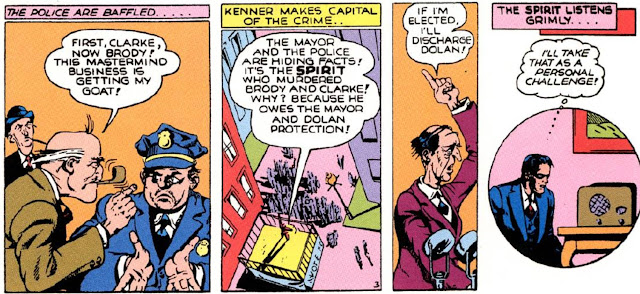
    The Mastermind is really Joel Kenner, a mayoral candidate who tries to get his Tough on Crime campaign a boost by murdering both of his campaign managers and blaming the deaths on the Spirit. This ends poorly for Kenner, who ends up stabbing himself with his own knife like a complete dolt.

  • MINOR SUPER-VILLAIN 815: ORANG, THE APE MAN

    MINOR SUPER-VILLAIN 815: ORANG, THE APE MAN

    (The Spirit, “Orang, the Ape Man”, 1 September 1940)

    After an indeterminate time away (ten to fifteen years, I reckon), Dr Hoyd returns to the United States from Europe and reconnects with his colleague Dr Egel. Upon retiring to Egel’s home, Hoyd is astonished to meet Orang, an orangutan who Egel has imbued with human-level intelligence via training and brain surgery. Dr Hoyd is astonished and delighted by this.

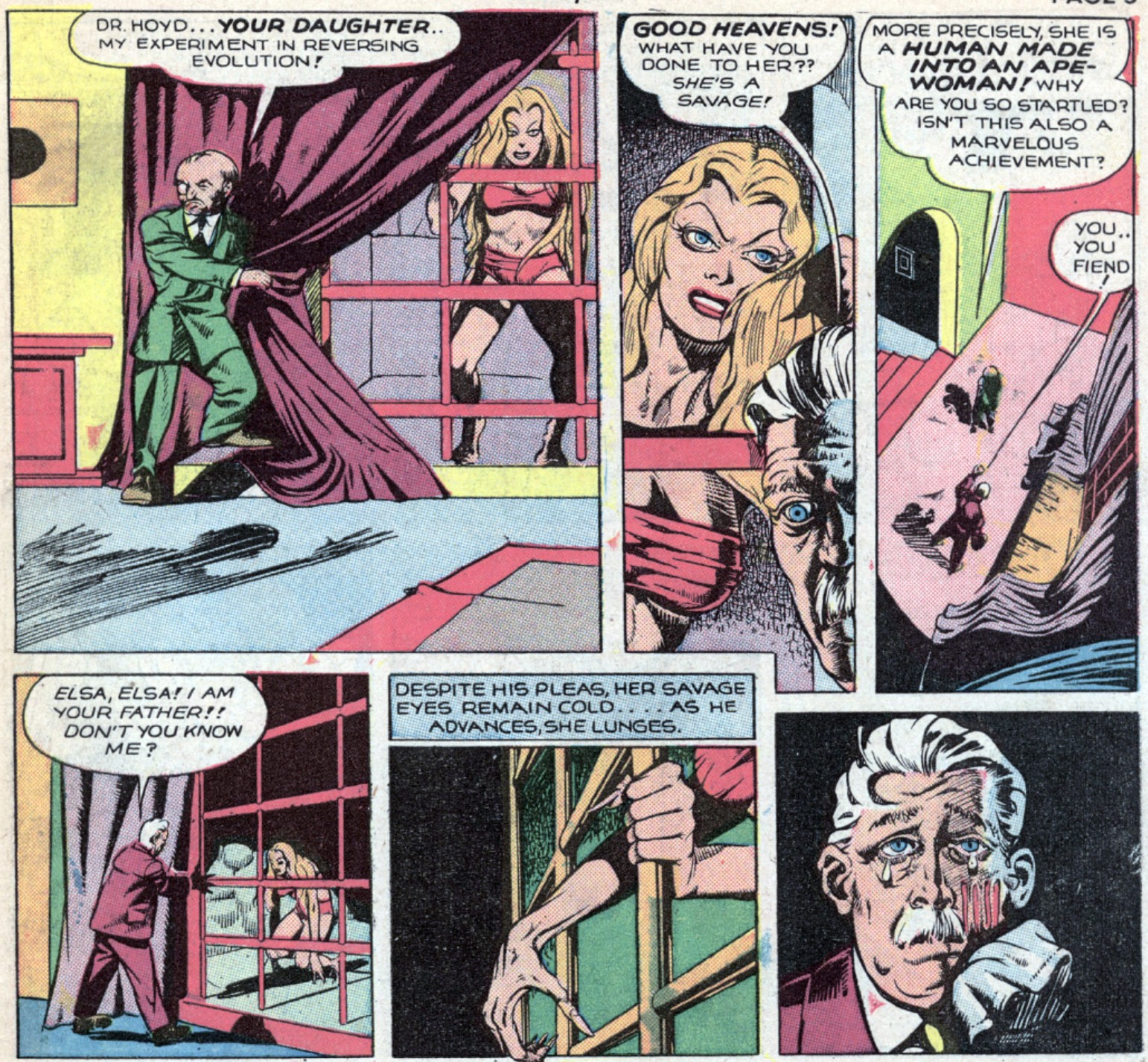
    Hoyd is far less impressed when he tries to reconnect with his daughter Elsa who he had entrusted to Dr Egel to take care of following the death of his wife and I guess just… never really communicated with after that? I say this because Dr Egel has used her as the subject of another of his experiments and regressed her to a wild ape-woman, and maybe Hoyd would have known that something was up if he was in regular contact with his kid.

    Dr Hoyd, broken-hearted, is prepared to take the law into his own hands and murder Egel for his actions, but is talked out of it by the Spirit. He is then immediately murdered by Egel, using Elsa as his weapon.

    Simultaneously, Orang has some sort of mental break when it dawns on him that he has human reasoning but is not human and determines that he must kill Egel in revenge for his now tormented existence, and while I don’t agree with the philosophical underpinnings of Orang’s reasoning, it is about time for Dr Egel to get his comeuppance, so I’ll allow it.

    Orang slays Elsa and then tracks Dr Egel to the docks, where he kills his creator and then ends his own life. A sad end.

    OR IS IT? No it is not, as Orang turns out to have a thick skull or a shaky hand and survives his own suicide attempt. After seeking out medical treatment he ends up in the care of Police Commissioner Dolan. I quite like the Orang/Dolan dynamic, which is an odd couple-type relationship founded on an argument about whether you can arrest someone for being a talking ape, but Orang eventually spoils it by kidnapping Ellen Dolan and running off to Borneo to be with his people.

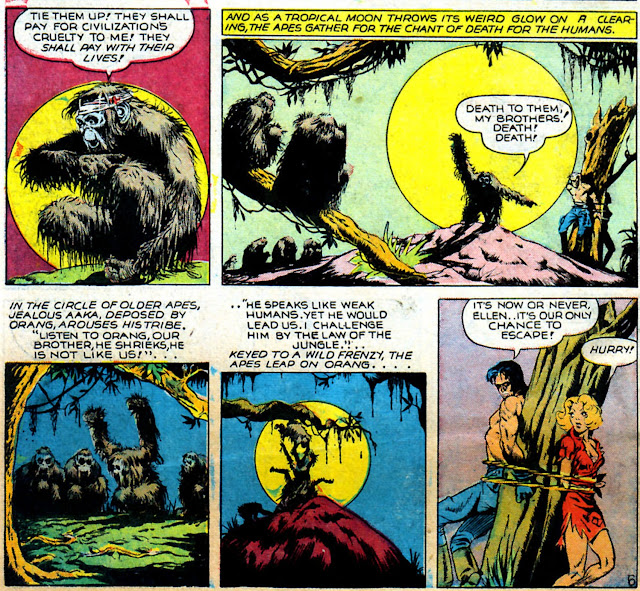
    The Spirit of course sets off in hot pursuit and catches up to the two of them just as Orang has finally worn out his welcome with the group of orangutans he set up house with in Borneo. It seems that “meeting a sad and lonely end” was always his destiny, as he ends up being killed by rival ape Aaka whilst being dramatically silhouetted against the Moon.

  • MINOR SUPER-VILLAIN 812: PALYACHI, THE KILLER CLOWN

    (The Spirit, “Palyachi the Killer Clown”, 28 July, 1940)

    Ah, the crime clown. Always glad to see another one, and one with such an illustrious name, kind of! (I wanted to do some sort of riff on “but doctor, I am Palyachi” but a) it seems like the basic joke has existed jince the 1800s, the first place that Pagliacci was specifically named as the sad clown on the doctor’s couch might actually have been in Watchmen and b) I couldn’t think of one)

    This particular clown turns to crime at the urging of Nonspecific Circus Performer Marka, who puts off his marriage proposals with suggestions that he first kill her enemy Flipo the acrobat and then steal various riches for her. As is obvious to the reader but not to Palyachi, he will never actually do enough to win her heart, but that Palyachi, he just keeps on killing and trying.

    Marva does eventually see the danger of turning your unrequited suitor into an unstoppable killing machine, and so sells him out to the Spirit at the first opportunity. Unfortunately for her, while the Spirit is out hunting for Palyachi, Palyachi returns to where Marva is waiting for the Spirit (completely nude, by the way, because Marva is the horniest woman in a comic full of horny women). Palyachi finally goes completely mad and Marva meets her end at his hands.

    That’s a wrap on Palyachi, and despite the Spirit’s weird defense of him in the final panels, I have to say that no, I don’t think that it was all Marva’s fault. Call me a crank, but I don’t think that being really, really horny is a valid excuse for committing at least four murders, even if you sincerely believe that murdering people might help you get some.

  • MINOR SUPER-VILLAIN 810: MR MIDNIGHT

    (The Spirit, “Mr Midnight”, 14 July, 1940)

    Mr Midnight is your classic police taunter, a crook who not only thinks that they have the wherewithal to pull off the perfect crime but is so confident that they decide to tip off the cops to their plans. In this specific instance, the villain is a dapper blue-skinned fellow who has not only informed the police but the Spirit as well, and further has declared that he will commit his murder in the very office of Police Commissioner Dolan. And he does it! Ellison Wright, Midnight’s erstwhile blackmailer, dutifully shows up and drops dead at the stroke of midnight, and since Happy O’Day, the coroner, declares the death as due to heart failure, Mr Midnight walks right on out the door afterward.

    This is where your “perfect crime” criminals often make their mistake, because while the fact that it can’t actually be proven that Mr Midnight killed Wright might keep the police off of his back, the Spirit is a vigilante, and doesn’t exactly have to worry about things like “the letter of the law” or “evidence” or “not showing up in someone’s house unexpectedly”. He just has the fact that Midnight said that he was going to commit murder to go off of, plus the knowledge that Happy O’Day just loves to call any unexplained death heart failure – not a month and a half earlier he said that Denny “the Spirit” Colt had died of heart failure, after all.

    Indeed, Mr Midnight is almost comically eager to confess that he did it. Midnight, aka John Caliban, was once a stage heartthrob whose life was ruined when he fell in love with a married woman. Blackmailed into poverty by Ellison Wright and turned blue seemingly incidentally by a cosmetics mishap, Caliban murders first his lover and then Wright. 

    What was Caliban’s next move going to be? Impossible to say now, because though he almost gets away when he beans the Spirit with his human skull prop and sets his house on fire, Midnight is captured and dragged back to police headquarters, only to take the ultimate way out via his own poisoned fingernails. A shame – a dapper blue guy would have made a fine addition to any rogue’s gallery.

  • MINOR SUPER-VILLAIN 808: THE BLACK QUEEN

    (The Spirit, “The Black Queen”, June 16, 1940)

    We first meet the Black Queen as the otherwise-unnamed defense lawyer in the murder trial of gangster Slot Gorgan. She already has a reputation for being brilliant, and that reputation proves to be accurate, as Gorgan is acquitted despite the evidence against him.

    Upon returning to the Black Queen’s penthouse, we learn that she is in fact the very first in the Spirit’s long line of female villains, as it turns out that she is the brains behind Gorgan’s gang. Unfortunately for Gorgan and the Black Queen, the Spirit has been engaging in the long-standing comic book tradition of getting mad about not-guilty trial results, and so has preceded them to the apartment. Now he knows about about the Black Queen’s crime ties and that Slot was actually guilty.

    The Spirit manages to wrangle a confession out of Slot in the presence of the District Attorney, which results in a retrial for the same murder he was originally accused of (and while I am not even remotely a lawyer I reckon that this is exactly what double jeopardy is supposed to be about? Or is it one of those things where he was tried for second degree murder the first time and first degree the second?). This time, the Black Queen’s brilliant legal mind is merely able to get his sentenced reduced from death to life imprisonment, but importantly she herself is still running the gang when the episode concludes.

    The Black Queen returns a few weeks later having made the astonishing decision to move from being the secret head of her gang (smart, secure) to personally leading them in a raid on the New York Sub-Treasury building* (dumb, risky). Why do this when her prior setup was so good that she got to the end of a “crime doesn’t pay” comic with her crime career still intact? Since she talks about taking 25 million dollars for herself and splitting town, I can only assume that she has grown tired of the admin of running a gang while being a successful attorney and just wants to retire.

    *this might be the fifth time I have read a story in which crooks try to rob the New York Sub-Treasury, and having looked it up to see if it was a thing I have found that a) it was – the US used to keep stores of cash and gold in a few major cities, presumably due to longer travel times in the past and b) the sub-treasury system was phased out in the 1920s. The Black Queen and her fellows are actually trying to break into a building now known as Federal Hall, administered by the National Park Service, and in 1940 occupied by exhibits relating to the New York World’s Fair. This raises the question: is the major divergence of the various super-hero universes from our own in fact the passing of the Independent Treasury Act of 1920?

    Though the Black Queen’s gang are captured before they can get away with either fifty million dollars or some dioramas about the history of finance, she alone manages to escape in her private yacht. Thanks to a timely intervention by the Governor’s island defense batteries, the yacht is disabled (a very rare artillery-based entry in my collection of cops shooting fleeing suspects), but the Black Queen herself remains at large for a second appearance in a row thanks to a frankly amazing hand grenade throw that disables the Spirit’s flying car. 

    The Black Queen’s third and final appearance is also the one in which she makes the jump to being a full-fledged femme fatale in the (eventual) grand Spirit tradition, and I say that not just because she has started wearing hot pants and a bustier as her everyday outfit.

    No, what really puts the fatale into this femme is the fact that she is going around giving men the literal kiss of death via some poisoned lip gloss. I’m not even sure why she kills this guy – just for the hell of it, I suppose, as he seems to be totally okay with working for her.

    But just what was that guy killed for? Why a formula for creating artificial diamonds, which means that along with the sub-treasury thing from earlier, the Black Queen has engaged in two of the biggest non-crimes in comics history!

    The Black Queen has also seduced a jeweller named Abner Ames into acting as a fence for her. The Spirit goes pretty far out of his way to rescue this guy from getting the Kiss of Death and make sure that he isn’t held criminally responsible, and while I commend him for being nice to Ames’ poor wife in this way I would humbly suggest that she would be better off without him.

    (the above panels also reveal that the Black Queen’s calling card is the queen of spades, and as someone who loves categorizing things I am just pleased as punch to have confirmation on exactly which black queen she was going for with than name) 

    Ames having been saved, there is a thrilling chase that culminates in a fight on the superstructure of a bridge. Though the Black Queen almost gets him, the Spirit manages to take her in. Sadly for those of us who enjoy her style, the Black Queen chooses to take her own life rather than face trial, even though she might have been the first person in history for whom self-representation was a good idea.

  • MINOR SUPER-VILLAIN 804: THE MAD SCIENTIST OF HELL’S KITCHEN

    (The Flame 003, 1940)

    The Mad Scientist of Hell’s Kitchen is a, you guessed it, mad scientist who has developed one of the classic serums, giving him the option to turn into a huge and super strong ape-man with a simple injection. Of note is the fact that this is not a Jekyll and Hyde situation, as the Mad Scientist and his alter ego the Beast appear to be merely physically and not mentally distinct. Also of note: though the Beast is described as “shaggy” at least once, he appears to in fact be completely hairless.

    After the Beast murders the eminent surgeon Doctor Brown, the Flame takes the time to check in on Brown’s only known enemy, the Mad Scientist of Hell’s Kitchen, and spots the Beast emerging from his warehouse/laboratory.

    Though the Beast hands the Flame’s ass to him and then goes out and kidnaps a young woman while Our Hero lies senseless in the gutter, he picks himself up, dusts himself off and continues the investigation. The Mad Scientist of Hell’s Kitchen does a really phenomenal job of deflecting the Flame’s immediate suspicion with his “I’m the only one here and I’m certainly no beast” routine, but then goes and spoils it all by injecting Beast Serum and transforming into the creature directly in front of a window.

    (just a little demonstration of both the Beast’s level of super strength and the Reverse C panel structure, popular in the early Golden age and always infuriating)

    Ultimately, though the Beast proves tough enough to shrug off the Flame’s fists, and walks away from a collapsing building, he isn’t quite invulnerable enough to resist the force of an extremely tall bit of public art. Once caged, the Beast quickly reverts to the form of the Mad Scientist of Hell’s Kitchen and the city is once again safe for its doctors.

  • MINOR SUPER-VILLAIN 802: HAMMERFIST

    (Target Comics v1 011, 1940)

    Hammerfist is a good old-fashioned gang boss-with-a-gimmick, in his case an iron ball in place of his missing right hand. He’s on a mission to take over the night club scene in New York City by the simple expedient of shooting up clubs until business gets so bad that everyone is willing to sell cheap rather than go bankrupt.

    More importantly, Hammerfist is the person responsible for framing Niles “the Target” Reed’s brother Bill for murder, which leads to Bill’s death and then to the creation of the Target and the Targeteers. I really want to say that he’s also the one responsible for the protection racket that left the Targeteers homeless orphans to be taken in by Niles, but while this is plausible it’s never quite explicitly laid out. 

    More importantly, even though Niles/the Target battles and captures his brother’s killer in this issue, he never learns that Hammerfist is the one who framed Bill! Which is actually a very interesting contrast with Bill “supposedly escaped murderer but actually dead in a shallow grave” Reed, with the law seeking a dead but innocent man and the Target looking for a man who has already been captured. I’m sure that someone could really do something with all of this if the Target were still a going concern!

    Hammerfist and his gang do pretty well against drunken nightclub patrons, but ultimately their role is to serve as punching bags to show just how good the Target and his Targeteers are at beating up crooks. And they’re great at it! Don’t worry though: even though he’s hung up for the police to find, Hammerfist will return in 1941 for what is hopefully a more illustrious appearance.

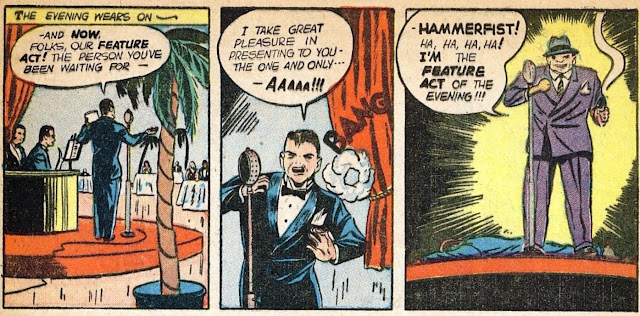
    (almost forgot to include Hammerfist’s amazing entrance)

  • MINOR SUPER-VILLAIN 796: GREBO

    (Target Comics v1 006, 1940)

    Grebo is a simple guy, even if he is a Mercurian. He’s on Venus with his pal Gogg hunting a lost stash of Mercurian platinum that was spirited away by the losing side of a long ago war in which Rogg and Grebo’s ancestors were the victors. And heck, that’d be simple treasure hunting if the underwater city that the swag was in were uninhabited, right?

    Sadly, it turns out that the defeated Mercurians (or the Draxions, as they call themselves) are very much in residence, having adapted to a watery existence as a way to hide from their ancient enemies. And it seems that their caution was entirely justified, as Grebo’s first response to discovering that the platinum might in fact not be up for grabs is to shoot Draxion leader Tuok.

    This little demonstration ensures that Grebo and Rogg have little trouble with the remainder of the peaceful Draxions, and they make their way to the platinum vault with little trouble. At which point Grebo makes some trouble, by murdering Rogg rather than split the loot with him. Classic villain stuff!

    All good things must come to an end, however, and that includes reigns of terror: having been summoned by his friends the Draxions, Spacehawk soon arrives and sends Grebo rocketing into space to his doom. Would Grebo have survived the encounter if he had, say, a second person to back him up? Probably not, but it surely couldn’t have hurt his chances.

    I have to say that the real star of this story were the Draxions. The contrast between their goofy Wolverton faces and the deadly action is surprisingly evocative. Googly-eyed weirdos can have hopes and aspirations too, after all.

    Once the danger is over, Spacehawk helps the Draxions re-adapt to land dwelling forms and I can’t choose between the goofy pointy-headed aquatic Draxions and the more businesslike clearly-enjoying-all-the-air-breathing land Draxions. I love them both dearly.

    Shout out as well to Grebo’s ship full of different types of Mercurians (plus some Saturnian pilots), not only for being great little designs but for (intentionally or not) preemptively shutting down any nit-picking about alien designs not being consistent between Spacehawk adventures. It’s because there are all kinds of different phenotypes, losers!

    (the crew panics when Spacehawk shows up and ends up flying the ship into a mountain, if you were wondering where they were during that final confrontation)

  • MINOR SUPER-VILLAIN 792: THE OCTOPUS

    (Target Comics v1 003, 1940)

    I’m going to start out by saying that I have no idea why this story is called “Return of the Octopus!” as this is as far as I can tell both the first and last appearance of the character. Both the title and the Octopus’ costume seem to be dramatic flourishes that don’t really play out in the text of the story.

    I do really like the Octopus’ costume, though. It’s got a lot of low-effort charm, though now that I think of it I have no idea how easy it would be to source a green sweater with a large octopus decal on it c. 1940.

    Sadly, the Octopus shucks his disguise after one panel when he has to answer an inquiry from Treasury Agent Chick Farrell at his funeral home front, and this is where the other part of his character design comes into play, as physically he embodies a whole set of characteristics that were associated with undertakers in the early 20th Century and beyond: cadaverous face, unnerving stare, unnatural posture, old-fashioned clothing – general creep vibes. This is of course a slander against the hard-working undertakers of the world, but what can you do?

    The extant copy of this comic is unfortunately missing the one or two pages that close this story. At the end of the part that is available, the Octopus has just murdered his accomplice (his kidnap victim’s crooked uncle) and is about to get away on a boat, so based on my long experience in reading comic books I’d say that there’s a 70/30 split on the odds of whether he eventually drowns or is arrested.