The Curse of Skeleton Munroe

Category: murderer

  • MINOR SUPER-VILLAIN 717: THE MASKED TERROR

    MINOR SUPER-VILLAIN 717: THE MASKED TERROR

    (Rocket Comics 003, 1940)

    The Phantom Ranger is just minding his business one day when he receives a sternly-worded letter via throwing knife, warning him to “steer clear of the red-headed girl.” This is of course your classic case of warning the hero off before he has a dang clue what’s going on.

    Everything is okay though, because the young woman who shortly rides up and requests the Ranger’s help has blonde hair. The “red-headed girl” must be seeking aid elsewhere. Or the colourist and the letterer had some sort of miscommunication. One of the two.

    The girl, whatever her hair colour, is named Lindy Davis, and the Masked Terror has kidnapped her father for ransom, a crime you don’t see as much in a lot of Western comics but I am certain is an authentic Old West crime.

    The Phantom Ranger accompanies Lindy to the handoff, where we learn that a) the Masked Terror is one homely cuss and eventually b) that he has already killed Mr Davis. The Phantom Ranger sets off in hot pursuit.

    And of course the Masked Terror turns out to be Ansom, the Davis’ neighbour and, crucially, the only one Lindy told about her plan to contact the Phantom Ranger. Plus I assume that he is the only nearby man ugly enough to be a suspect. The Terror chooses to go for his gun and meets a swift end.

  • MINOR SUPER-VILLAIN 703: THE GREAT INTELLIGENCE

    (Planet Comics 004, 1940)

    Flint Baker and co are making their return trip from Mars and due to an unscheduled diversion to Pluto in Planet Comics 003 they end up passing Jupiter on the way, at which point they are forced to make landfall to avoid an attack by outer space organisms referred to as “stratosphere serpents” despite being more like starfish crossed with octopuses. While there, Flint and gal pal Mimi Wilson do a bit of exploring and discover the city of Zu, inhabited by a wretched mass of oppressed Jovians and ruled over by the Great Intelligence.

    The Great Intelligence is… probably a rogue AI of some description? It watches over the city via the Great Eye, listens with the Great Ear and issues orders with the Great Mouth. It also has flamethrowing capacity. (the reason I hesitate to conclusively say that the Intelligence is a machine is what the Jovian says in the first panel to feature the Great Eye: “our master has lost all human identity.” This could easily be interpreted as a bit of flowery language to describe the declining relationship between the city’s inhabitants and the machines that run it, but how weird and cool would it be if the whole operation was wired into some wizened cyborg in the middle of everything? And as the comic does not bother to resolve the question it could be either, though given the roasting of that poor old man we can at least confirm a distinct lack of humanity)

    Baker manages to fry the Great Eye with his ray gun, upon which we meet the final piece of the city gestalt: its Will, embodied as a bunch of beefy cyborgs.

    For fomenting discord in Zu, Flint and Mimi are  sentenced to death via being ground up and fed to the Great Mouth (and this unusually grotesque method of execution did contribute to my theories about the Intelligence having an at least partially organic makeup, thanks for noticing)! Lucky for them, then, that Mimi stumbles upon the Will’s one weakness: a thin exposed wire at the back of their necks. They escape their fate in the grinder, destroy the Great Ear and Great Mouth, and evacuate the surviving citizens of Zu back to Earth with them. 

    But what of the Great Intelligence itself? Certainly all of its external organs are gone, but the mind itself… who knows?

  • MINOR SUPER-VILLAIN 694: SARKO

    (Planet Comics 001, 1940)

    We’re in the 1940 run of Planet Comics now, so look out for a fair few of space tyrants with one-word nonsense names. Like Sarko here! Sarko is an Earth man who came to Mars in 1933 and set about conquering the dark side of the planet. Now it’s the near future and Sarko has his sights set on taking over the remainder of Mars and the light-side city of Ru in particular. 

    The… Ruvians? No demonym is provided. The Ruvians aren’t really up to the task of defending their domed city from Sarko and his army of One-Eyed Monster Men, but lucky for them intrepid space explorer Flint Baker and his crew of condemned murderers (plus New York Globe reporter and stowaway Mimi Wilson) have arrived just in time to help out.

    In an even greater coincidence, crewman Cliff Grant recognizes Sarko! It turns out that he was in jail for a series of murders committed while under the mental control of a man named Sappo and that Sappo is in fact the same guy! It’s a heckuva thing folks, but that’s comics for you.

    Grant almost gets his revenge, too, but doesn’t quite stick the landing. Sarko manages to kill Grant but is then taken down by another member of Baker’s crew. Mars and Ru are saved!

    BONUS: finding a crashed spaceship from decades earlier is an objectively very funny thing to happen to someone who was just crowing about being the first human on Mars.

    Heck! I almost forgot to show the One-Eyed Monster Men of Mars! Well, here one is.

  • MINOR SUPER-VILLAIN 693: THE TARANTULA

    (Pep Comics 010, 1940)

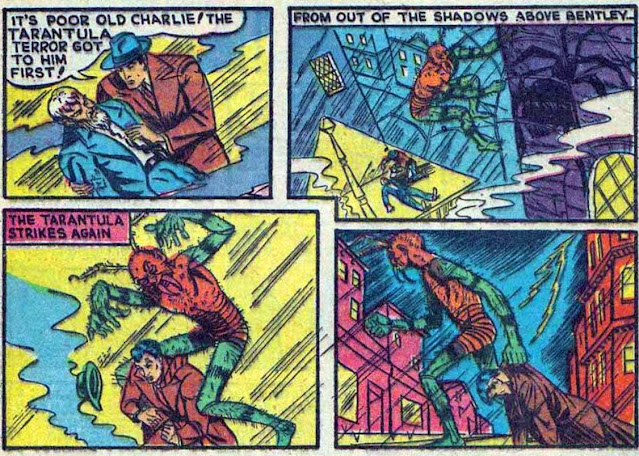
    A vile villain known as the Tarantula is extorting the young wealthy women of London and then murdering the ones who don’t pay up, and Inspector Bentley is on the case after two significant pieces of evidence fall into his lap: the latest body is left on the steps of Scotland Yard and then the latest extortion attempt is made against Deborah Morgan, whose father went to school with Bentley’s boss and you can’t beat the old boys’ club when it comes to swinging the forces of law into action.

    The usual parade of suspects that fills the pages of an Inspector Bentley story is a bit thin on the ground in this one. Don’t get me wrong, the numbers are there, but at least two of them are clearly padding – they don’t even say anything. The only credible suspects are BJ Morgan, his daughter Deborah (assuming some real 4D chess moves on her part), her fiance Bill Barnes and, in a big reach that the comic is not afraid to make, Bentley’s boss. I’ll say right now that the boss is a complete red herring set up by a walking stick.

    (please take note of the Tarantula’s little spider signature, which I love)

    Bentley goes to meet a potential witness, at which point w get the most important revelation of the episode: the Tarantula is not just some murderer but a proper super-villain, with a proper costume and everything! Sure, some spider fans might quibble about the inclusion of antennae (not to mention the use of fairly mild tarantula venom as the murder vehicle) but it’s been so long since I’ve seen a villain who wasn’t just wearing a mask that I literally cheered when I saw this dude.

    The Tarantula turns out to have about the right constitution for a basement dwelling spider breeder and goes down under the attacks of a heavily tied up Bentley. He’s smashed into his case of tarantula containment orbs in a way that would usually signal a villain’s ironic end via their own murder method, but I’ve reread the ending of this story a couple of times now and I have no clue whether the Tarantula is dead or alive at the end.

    The Tarantula turns out to be Deborah’s fiance Bill Barnes, who did it all because he was insecure about marrying a wealthy woman while not having much money himself. Moderately sweet, until you remember that he expressed this insecurity by extorting and murdering other young women. Wotta creep, am I right?

    More importantly is the question of exactly why Bentley was suspicious of Deborah’s circle: because when he went to interview his acquaintance Charlie about a possible Tarantula sighting he found him murdered and the only ones who knew about the potential witness were Deborah and her intimates. But did Bentley set a trap using the life of an innocent beggar or is he just so bad at infosec that he got a man murdered by accident?

  • MINOR SUPER-VILLAIN 690: VULCAN

    (Pep Comics 006, 1940)

    A man working in a London steam plant dies by falling into an industrial furnace. A horrible thing to happen! Why am I showing you this horrible thing?

    I am showing it to you because it is not in fact a horrible accident but a horrible murder, and we know that because the murderer left a horrible little bit of doggerel in order to crow about what he did, and he signed it “Vulcan.”

    Our old pal Inspector Bentley of Scotland Yard is brought in on this case, and it’s a lucky day for him because there are only four possible suspects: the four men who were in the immediate area when John Baker was killed, including his father, his brothers Rex and Bob and his romantic rival Barney Reyman. Like I said: lucky for Inspector Bentley because I’m beginning to suspect that he isn’t a particularly astute detective when he doesn’t have a guy in a rubber mask to hit with his cane.

    Am I saying this because Bentley’s only idea is to have everyone go back to where they were when the murder took place with the foreman standing in for his son and Pa Baker is basically instantly murdered too? Kind of, but it’s more of an observation that his investigations are a bit brute force. For instance, once this second member of the Baker clan is bumped off, Bentley arranges for another one to stand in front of the open furnace.

    Did Bentley know what he was doing? Was he calling Bob Baker’s bluff in order to force him to confess by dodging the deathtrap he had set up for his family members (a button-activated swinging pipe, fyi)? It’s possible, but I personally think that the “Vulcan = hatred for father and brothers” clue is some bullshit. Does Vulcan have more than his share of family drama? Absolutely, but no more than any other Greco-Roman god and frankly I would peg a guy named Vulcan as a potential matricide, if anything.

    So was he right or just trying to winnow down the suspect list a bit? Inspector Bentley will never tell.

  • PROBLEMATIC ROUND-UP 003

    This edition of the Problematic Round-Up is devoted to minor MLJ character Fu Chang and his foes.

    Fu Chang:

    Reading Charlie Chan comics has absolutely messed my head up in a specific way: because Charlie Chan is so clearly a project with the set goal of having a Chinese character who is not an overt racist Yellow Peril stereotype (while, yes, being pretty racist in a bunch of other ways) I give it more of the benefit of the doubt than I otherwise would. For instance, I just kind of skim most of what Charlie Chan says because actually parsing it is very painful. 

    The problem is, I keep automatically giving various other series featuring Chinese American detectives the benefit of the doubt, and very few of them are also earnest-but-flawed attempts to avoid the overtly racist tropes of the day. This is all to say Fu Chang and his adventures are pretty racist and it caught me off guard and I had to work through it here.

    So: Fu Chang is an American educated Chinese man (with a more Caucasian skin tone than the bright yellow Evil Chinese such as the Dragon, below) who is very dedicated to his (personal? family?) god and as a result has been gifted a chess set with “all the magic powers of Aladdin’s Lamp” (and this smearing of everything East of the Mediterranean into one big exotic mess is classic Orientalism) which in effect means that he has a bunch of little guys at hand to do his bidding.

    If there’s one fun thing about Fu Chang, it’s trying to figure out exactly what the heck kind of game this chess set could be used for. Here are the known pieces:

    – the Warrior – just a little guy, used to spy on folks

    – unnamed stage magician – has ESP or other way of locating hidden objects

    – the Little Man of Magic – a magician in the Indian mystic vein. More talkative and proactive than many others. Able to paralyze humans via magic 

    – the Doctor – healing plus some hand-to hand. Also has wings in one story

    – the Mermaid – amphibious

    – the Woodsman – tree-chopping action

    – a pilot – can fly a plane but the plane is sold separately

    – group of men in suits plus military officer and a jodhpured adventurer – engage in combat with the Tiger-Devil

    – Seen but never used: the shirtless guy, the blonde lady in the red dress, the policeman, the crook, the fat bald guy

    – winged people – obviously they can fly. As the series goes on the winged figures show up more and more until the last few adventures feature nothing but up to a couple of dozen of them.

    I suppose it’s possible that you could cobble together a complete chess set out of those. Obviously the winged guys would be the pawns, but where would the mermaid come in? Even more concerning than the fact that there might not have been a complete Fu Chang lore bible with detailed breakdowns of all the chess pieces and their powers is the constant slander of Aladdin’s lamp. Unless Fu Chang and his god have a chronic lack of imagination, this is a pretty weak showing from a fabled object. (Pep Comics 001, 1940)

    the Dragon:

    The Dragon is really notable only for his fantastic name as well as to illustrate the weird vibes-based skin-colouring in the Fu Chang comic – the more good and Westernized you are, the pinker your skin. Otherwise he’s a creep and a low-level Yellow Peril gangster. (Pep Comics 001, 1940)

    the Cult of the Tiger-Devil: 

    While I love the Tiger-Devil itself, the Tiger-Devil Cult that serves and has summoned him is some pan-Asian degeneracy nonsense straight out of Lovecraft. Serves them right for summoning a demon to conquer the world with that it gets beaten up by a bunch of little chessmen – though the Tiger-Devil has dominion over all men, the chess pieces are no men. 

    If the MLJ Universe hadn’t stopped being a continuous continuity in the early 90s it might be more significant that the Tiger-Devil ends up sealed in a jar and dropped into San Francisco Bay. Alas. (Pep Comics 002, 1940)

    the Drug-Master:

    It’s a Fu Chang sweep for this instalment of the Problematic Round-Up with Ghor here, aka the Drug-Master, a very hard-core name that I wish I could celebrate a bit more but no: he’s yet another Yellow Peril type with a bit of added spice in that he is also involved in the sinister Asian Drug Trade. Specifically, he’s bringing a powerful new drug into San Francisco’s Chinatown, one so addictive that it makes anyone his slave rather than do without it, even Fu Chang’s fiance Tay Ming. It’s so potent, in fact, that withdrawal induces a suicidal/homicidal frenzy and since the Drug-Master does not seem to be a particularly good boss, he’s letting his drug slaves go into withdrawal all over town. As is usually the case, the skills that make a criminal successful in human circles are of little use against a bunch of Fu Chang’s tiny guys and the Drug-Master ends up blowing himself to kingdom come. (Pep Comics 003, 1940)
  • MINOR SUPER-VILLAIN 685: SATAN

    MINOR SUPER-VILLAIN 685: SATAN

    (Pep Comics 002, 1940)

    Dateline: Florida! A huge and monstrous face has begun appearing in the clouds across the state to demand fealty! Coincidentally, armoured cars have been disappearing up and down the peninsula at about the same time as the facial appearances.

    The Comet is of course intrigued by this coincidence and decides to investigate. Plotting out the robberies on a map, he proceeds to the swamp located at the central point, and I’ve just realized that it’s a good thing that he’s right because the first thing he does is kick a man into the water and steal his boat and that would be a very embarrassing thing for a super-hero to have done to ,e.g., an innocent game warden. It’s no problem, though, because the guy was in fact an agent of Satan.

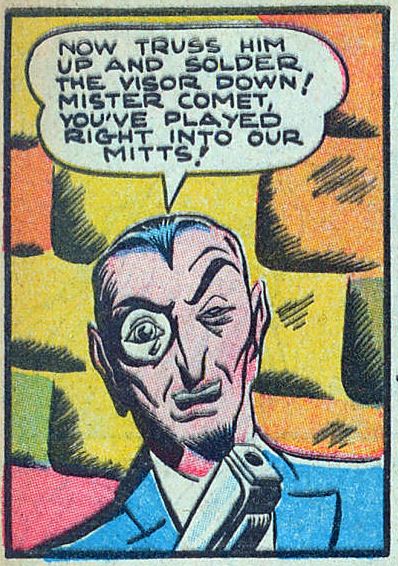
    Satan turns out to be a pretty cagey character: not only does he have a way of dealing with snoopers (dragging their boats through a whirlpool into his sub-swamp lair, as happens to the Comet) but he’s got an impressive level of knowledge of current super-hero news. He knows just who the Comet is and more importantly how to neutralize his major offensive ability, by welding his protective eye mask shut. And this is only the Comet’s second case!

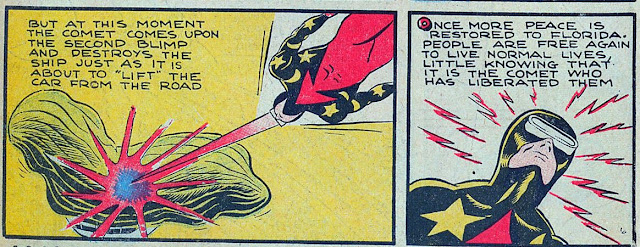
    The mystery of both the monster in the clouds and the disappearing armoured cars, by the way, come down to the same thing: that old favourite, the mighty dirigible. One dirigible equipped with a high-powered projector and loudspeaker and a second with a powerful electromagnet, to be precise – as one is distracting everyone with a big face, the other is making off with the car and the cash (and the unfortunate driver and guards).

    Back to the Comet: Satan’s anti-super-hero savvy extends only so far. Despite his acumen in capturing the Comet and neutralizing his power, Satan has fallen prey to the super-villain’s hubris by leaving him to die in a deathtrap rather than merely shooting him in the head. You see, the really important thing about the Comet’s visor is that it’s just a sheet of glass and thus easily breakable, which the Comet does by the simple expedient of headbutting a rock. After that, it’s just a matter of utterly obliterating not only both dirigibles but the entire swamp base. Satan is toast.

    OR IS HE? In a shock twist, Satan returns in Pep Comics 003 and manages to capture the Comet again, this time taking the trouble to pop him into a glass tube and thus completely neutralizing his powers! (and also delighting me personally, because the name Satan is very ambiguously used in his first appearance and I really appreciated this confirmation that it really is his nom du crime. For my records).

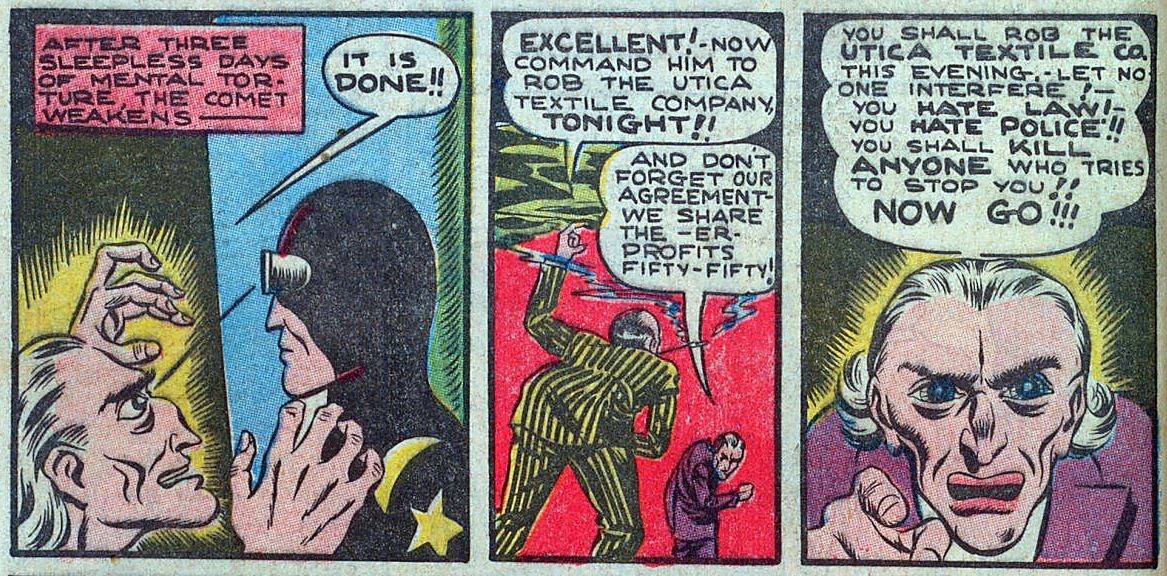
    Satan’s got big plans for the Comet – no cheesy deathtrap this time, no sir. Instead, he brings in put-upon hypnotist Doc Zadar in order to put the Comet to work for him.

    And this isn’t your namby-pamby “can’t be forced to violate your deeply-held morals” hypnotism, this is the real hard-core shit. The Comet goes on a destructive and violent crime spree under Satan and Zagnar’s direction. Notably, this is when he kills a whole bunch of cops, which informs the rest of his Golden Age career by making him one of the few super-heroes who the police have some real justification for constantly trying to gun down (I mean, they still shouldn’t just be trying to execute him in the street, but it’s nice to see them doing it for a reason other than “he’s running away from me even though I’m threatening to kill him!”)

    Once again Satan is undone by his own hubris: this time his failure to see that cheating and abusing the man who controls the actions of a living death ray generator might be a bad idea, and he gets gruesomely dissolved for his mistake. Unfortunately for Zagnar, he forgets the first rule of owning a living death ray generator: always put the safety cap back on. He too is dissolved and the Comet is free to have cops try to gun him down in the street forevermore.

    BONUS: All this Comet talk had me feeling nostalgic and I looked up 1983’s The Comet 001, which I had as a kid. It’s a pretty maudlin book primarily concerned with the Comet castigating himself over what a violent and murderous vigilante he was, and the splash page reflects this via the floating ghosts of the dead who haunt him – note all the cops from Pep Comics 003 at the top there. But just who is that at the lower left?

    I am 75+% certain that this is the monster face that Satan was projecting onto the clouds in Pep 002, which is a pretty hilarious thing to be haunting a depressed 80s super-hero. “I contributed to the death of the airship as a viable mode of transport when I murdered those dirigibles!”

    (the real if boring answer is that it probably is the face from the clouds but, as Satan himself is never actually pictured in the severely abridged version of the story in this comic, the face is being retconned into being his)

  • MINOR SUPER-VILLAIN 681: BARON HOFF

    (National Comics 006, 1940)

    Here’s what Baron Hoff brings to the table: 1. Scale. Hoff’s goal in this comic is to rob one (1) bank, and as a distraction from that crime he sets the entire island of Manhattan on fire.

    2. Look. Not only does he have a striking face and a killer grin but Baron Hoff has a real flair for villainous fashion. Some might balk at accentuating an aviator’s outfit with a monocle and jodhpurs and big puffy sleeves but he really makes it work. The only real misstep in his look is the toothbrush mustache, which pairs misleadingly with the pseudo-military brown outfit to make you think he’s some sort of Hitler analog. Do not waste your time: Hoff is not fascist, he just has poor taste in facial hair.

    3. Ride. I love an auto-gyro, and the fact that Baron Hoff not only flies around in one but uses its blades as a deadly obstacle to those seeking to enter the bank while he’s robbing it is just a bit of a bonus.

    Anyway, Hoff is up against super-speedster Quicksilver and such things as whirling blades of death mean nothing to such a fast man. Hoff is jailed in record time.

  • MINOR SUPER-VILLAIN 681: BARON HOFF

    (National Comics 006, 1940)

    Here’s what Baron Hoff brings to the table: 1. Scale. Hoff’s goal in this comic is to rob one (1) bank, and as a distraction from that crime he sets the entire island of Manhattan on fire.

    2. Look. Not only does he have a striking face and a killer grin but Baron Hoff has a real flair for villainous fashion. Some might balk at accentuating an aviator’s outfit with a monocle and jodhpurs and big puffy sleeves but he really makes it work. The only real misstep in his look is the toothbrush mustache, which pairs misleadingly with the pseudo-military brown outfit to make you think he’s some sort of Hitler analog. Do not waste your time: Hoff is not fascist, he just has poor taste in facial hair.

    3. Ride. I love an auto-gyro, and the fact that Baron Hoff not only flies around in one but uses its blades as a deadly obstacle to those seeking to enter the bank while he’s robbing it is just a bit of a bonus.

    Anyway, Hoff is up against super-speedster Quicksilver and such things as whirling blades of death mean nothing to such a fast man. Hoff is jailed in record time.

  • MINOR SUPER-VILLAIN 674: THE SCALENE ANGLES

    (Miracle Comics 001, 1940)

    “Police athlete” Dash Dixon’s first super-heroic adventure involves him travelling to the small European Republic of Scalene in search of the murderers of several US exporters. Turns out that they were killed to prevent arms and other supplies from being brought into the country, because the Scalene Angles, a group of wealthy jerks, were looking to conquer it.

    The most important thing about the Scalene Angles is of course their name. It’s fun, but it also depends on their country being named Scalene and once you consider that you have to imagine the whole nation being lousy with places like Triangle Square and Three Sides of Different Lengths Locksmithing and the Pythagoras Doesn’t Know Us Bakery (and maybe a few places talking about the neck in some way). It’s still a great name but it’s also probably the name of a triangleball team that one of their kids plays on so no points for originality here.

    (they do leave a note with a little triangle signature and I always like that, so one point to them there. But Dash Dixon does find and destroy them because of that note so the point is a treacherous one)