The Curse of Skeleton Munroe

Category: murderer

  • MINOR SUPER-VILLAIN 541: THE HOODED FIGURE

    (Silver Streak Comics 001, 1939)

    Simply a man who reacts to losing his pilot’s license in a very rational way: he sabotages planes at the local airfield and also booby traps all the parachutes so that they will strangle anyone that uses them.

    Upon being hunted down by two-fisted detective the Duke, the Hooded Figure makes the common mistake of trying to get away in a plane that he himself had already sabotaged. Ah, irony.

  • MINOR SUPER-VILLAIN 528: THE BLACK HAND

    (Blue Ribbon Comics 016, 1941) 

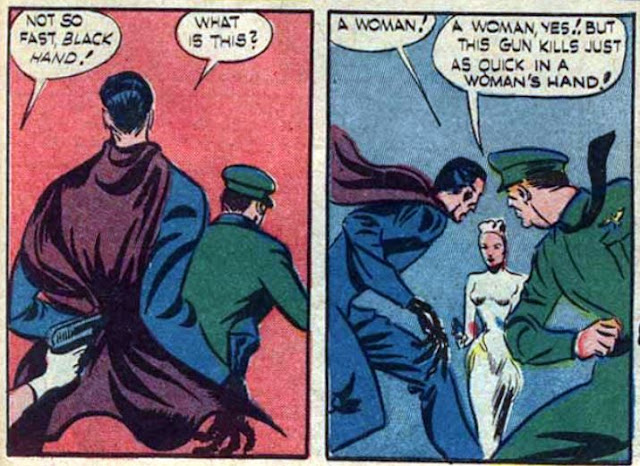
    There’s a quality that some comic book characters have and some do not and I never knew about it until I started writing this blog. That quality is called Standing in Clear View So That I Can Get a Screengrab of Them, and buddy, the Black Hand does not have it. This is about as good of a full look as you get of the guy in his first appearance.

    Enough complaining! The Black Hand is a spy of the Unaffiliated Freelancer subtype, which since he operates out of the US means that he steals US secrets for sale to the Nazis. Is a character who does business with Nazis better than one who is a Nazi? Marginally. The Black Hand is also the recurring villain of Captain Flag, who he is also responsible for becoming a super-hero due to his murder of Flag’s father and failure to proof his lair against narratively significant eagles.

    The Black Hand is called the Black Hand because of his black hand, which he usually conceals beneath a black glove and which is riddled with a deadly disease that the Black hand can transfer to a victim via a simple scratch of his horrible fingernails. It’s definitely a useful power (affliction?) for a villain to have but not one that has a chance of coming up in anyone’s super-power wishlist.

    Throughout his five appearances the Black Hand sports three distinct looks: the initial iteration (either afflicted with a deathly pallor or just overenthusiastic when applying foundation), a sort of suave mustachioed cat-burglar getup with no hint of the grave and then back to the deathly complexion with an added skull-like quality to the face. Realistically this can be put down to Captain Flag being a secondary character without a dedicated artist, but if that was the point of this blog then it would swiftly cease to be much fun.

    Notably, the suave version of the Black Hand wears his glove on the opposite side – could this indicate that he and the corpselike Black Hand are different characters? Perhaps the disease that gives them their name is also slowly killing them, which could account for the more ghoulish appearance of the original Hand over time?

    These questions will never be answered, sadly, as in-universe the Black Hand made a transition from spy the thief to pirate and Captain Flag was quick to invoke the Law of the Sea to hang him from the nearest yardarm. Out of universe, Captain Flag’s feature didn’t survive the cancellation of Blue Ribbon Comics and so the Black Hand had nobody to come back from the dead to torment.

  • MINOR SUPER-VILLAIN 525: RIALB

    (Blue Ribbon Comics 012, 1941)

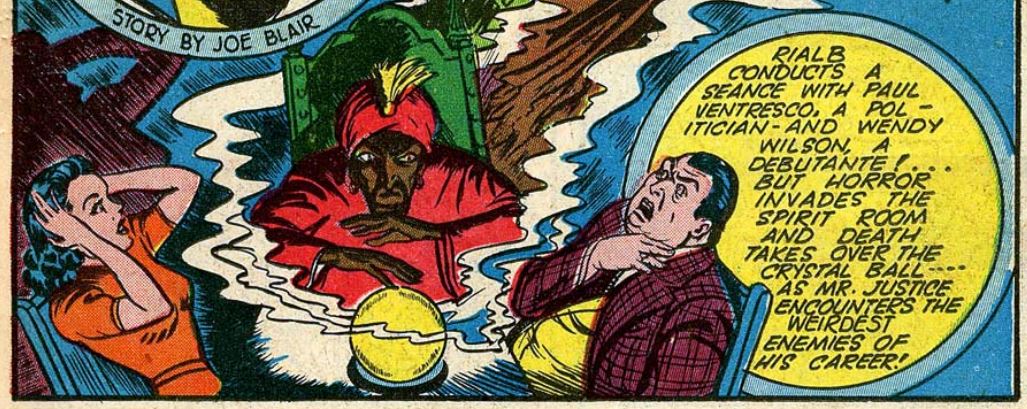
    Here’s a story about my powers of observation: I immediately noticed that our friend Rialb here had a backward name and spent a good half hour trying to figure out which Blair he might be named in reference to (a 1940s spiritualist? a famous skeptic?) before my eyes drifted slightly to the left and I took in the fact that the story was written by Joe Blair. I still have no idea why Joe Blair named the wet-rag villain of the story after himself, but let’s all be happy I figured it out before moaning about it here.

    Speaking of wet rags: let’s discuss Rialb. He’s a fake medium who accidentally discovers that he can actually summon the spirits of the dead but seems to have a knack for bringing back spirits who wish their descendants harm. Further, the first time he does so is witnessed by crooked politician Paul Ventresco, who puts the easily pushed-over Rialb to work as his personal ghost-powered hitman.

    The real stars of the story are the extremely grody ghosts that Rialb manages to conjure up. Just look at this gross old misogynist.

    Shadow imp, skull-faced spectre, pointillism lizard-man… this comic has it all!

    The real star is absolutely this skeleton-limbed hair-face who gets his bony ass kicked back to the netherworld he came from by Mr Justice before he can get up to any mischief. I really enjoy how the unchanging expression on his face reads as both menacing and sad depending on which side of the ass kicking he is.

    Just a regular ghost.

    It’s a bit of a letdown that the last ghosts we see are three sad sack victims of Ventrusco who Mr Justice calls up to cow the pair into surrendering, though he really only needed them for Ventrusco, given that Rialb shows no actual evidence of having a spine during the story – Mr Justice could have just thrown a sheet over a chair and gotten the same result.

  • MINOR SUPER-VILLAIN 525: RIALB

    MINOR SUPER-VILLAIN 525: RIALB

    (Blue Ribbon Comics 012, 1941)

    Here’s a story about my powers of observation: I immediately noticed that our friend Rialb here had a backward name and spent a good half hour trying to figure out which Blair he might be named in reference to (a 1940s spiritualist? a famous skeptic?) before my eyes drifted slightly to the left and I took in the fact that the story was written by Joe Blair. I still have no idea why Joe Blair named the wet-rag villain of the story after himself, but let’s all be happy I figured it out before moaning about it here.

    Speaking of wet rags: let’s discuss Rialb. He’s a fake medium who accidentally discovers that he can actually summon the spirits of the dead but seems to have a knack for bringing back spirits who wish their descendants harm. Further, the first time he does so is witnessed by crooked politician Paul Ventresco, who puts the easily pushed-over Rialb to work as his personal ghost-powered hitman.

    The real stars of the story are the extremely grody ghosts that Rialb manages to conjure up. Just look at this gross old misogynist.

    Shadow imp, skull-faced spectre, pointillism lizard-man… this comic has it all!

    The real star is absolutely this skeleton-limbed hair-face who gets his bony ass kicked back to the netherworld he came from by Mr Justice before he can get up to any mischief. I really enjoy how the unchanging expression on his face reads as both menacing and sad depending on which side of the ass kicking he is.

    Just a regular ghost.

    It’s a bit of a letdown that the last ghosts we see are three sad sack victims of Ventrusco who Mr Justice calls up to cow the pair into surrendering, though he really only needed them for Ventrusco, given that Rialb shows no actual evidence of having a spine during the story – Mr Justice could have just thrown a sheet over a chair and gotten the same result.

  • MINOR SUPER-VILLAIN 524: THE KING OF THE VAMPIRES

    MINOR SUPER-VILLAIN 524: THE KING OF THE VAMPIRES

    (Blue Ribbon Comics 011, 1941) 

    We open not on the King of the Vampires but on a different vampire, one with a monocle. This is Carlos Hubbello, a diplomatic envoy from South America who has been sent to discuss a trade deal with the US that would leave the Nazis in the cold. The two gentlemen with him are no gentlemen at all but rather Nazi spies who are controlling Hubbello by the simple expedient of having turned him into a vampire, which is certainly harder to get out of than say kidnapping his loved ones but comes with a whole lot of extra risk for his handlers.

    This story is rife with lore. To whit:

    LORE: Vampires are easily cowed with a cross, even when wielded by evil men.

    Hubbello comes very close to vampiring Mr Justice’s love interest Pat Clark while they watch a performance of the very weird and cool “Waltz of the Vampire”. A ghost/ vampire brawl ensues.

    LORE: A vampire can lose control when exposed to great art.

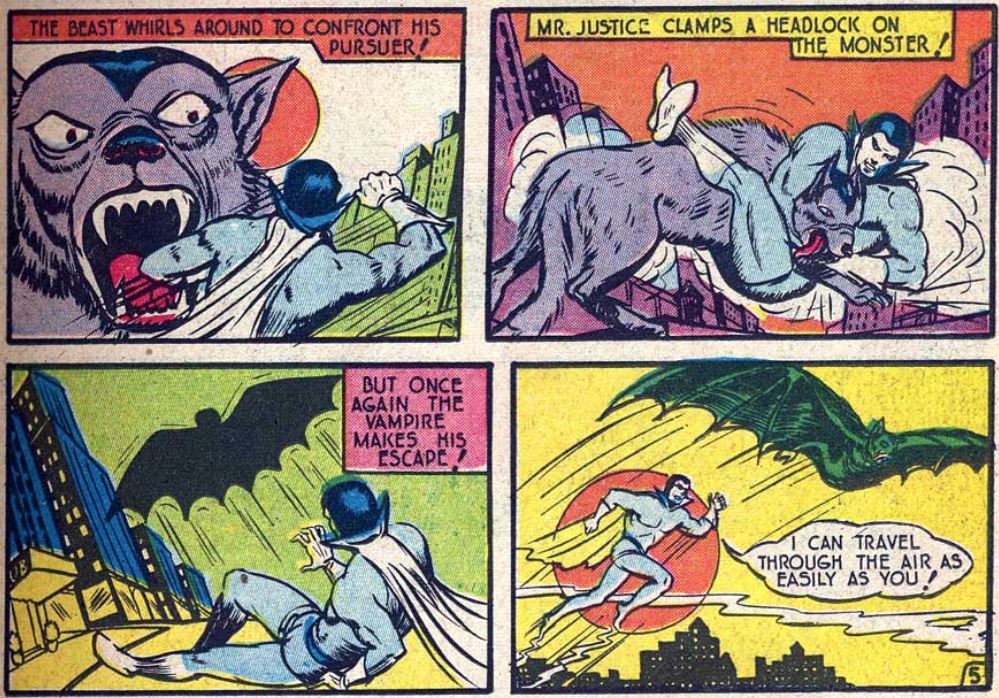
    LORE: vampires can transform into wolves and bats and retain their special vampire haircut in both forms (you can just make out a teeny tiny widow’s peak on the bat if you squint).

    Hubbello, defeated, spills the beans. The Nazis imported the King of the Vampires from Transylvania as part of their scheme to control the trade negotiations. Is the King of the Vampires a Nazi or merely using them to his own ends? This is not explored. Is the King of the Vampires supposed to be Dracula or is Transylvania just a good place for a vampire to come from? We can never know.

    LORE: Kill the head vampire in time and its under-vampires can be saved. What is “in time”? Not sure but it isn’t “before the under-vampire takes a life/ drinks human blood” as in a lot of vampire media, because Hubbello has already done both.

    Enter the King of the Vampires, freshly gorged on the blood of the innocent and battle commences. And I sure hope that Mr Justice knew the LORE that vampire cannot fight vampire because it means that he is on his own.

    LORE: this is the kind of vampire that seemingly isn’t harmed by light so much as by not physically being in his coffin at dawn. And he isn’t, so he dies.

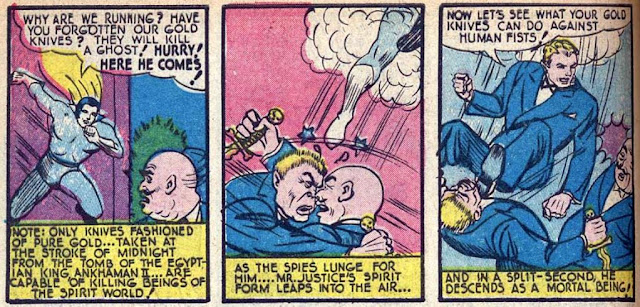
    Hubbello is saved! The trade deal can go forward! And back in the US we are reacquainted with the Nazi vampire-handlers, who come with one last piece of LORE: that knives fashioned of pure gold taken from the tomb of the Egyptian King Ankhaman II are capable – possibly the only things capable – of killing a ghost. A potent weapon against Mr Justice, if only they were any good at knifing. But they aren’t so they get captured immediately and the knives are presumably never seen again.

  • MINOR SUPER-VILLAIN 524: THE KING OF THE VAMPIRES

    MINOR SUPER-VILLAIN 524: THE KING OF THE VAMPIRES

    (Blue Ribbon Comics 011, 1941) 

    We open not on the King of the Vampires but on a different vampire, one with a monocle. This is Carlos Hubbello, a diplomatic envoy from South America who has been sent to discuss a trade deal with the US that would leave the Nazis in the cold. The two gentlemen with him are no gentlemen at all but rather Nazi spies who are controlling Hubbello by the simple expedient of having turned him into a vampire, which is certainly harder to get out of than say kidnapping his loved ones but comes with a whole lot of extra risk for his handlers.

    This story is rife with lore. To whit:

    LORE: Vampires are easily cowed with a cross, even when wielded by evil men.

    Hubbello comes very close to vampiring Mr Justice’s love interest Pat Clark while they watch a performance of the very weird and cool “Waltz of the Vampire”. A ghost/ vampire brawl ensues.

    LORE: A vampire can lose control when exposed to great art.

    LORE: vampires can transform into wolves and bats and retain their special vampire haircut in both forms (you can just make out a teeny tiny widow’s peak on the bat if you squint).

    Hubbello, defeated, spills the beans. The Nazis imported the King of the Vampires from Transylvania as part of their scheme to control the trade negotiations. Is the King of the Vampires a Nazi or merely using them to his own ends? This is not explored. Is the King of the Vampires supposed to be Dracula or is Transylvania just a good place for a vampire to come from? We can never know.

    LORE: Kill the head vampire in time and its under-vampires can be saved. What is “in time”? Not sure but it isn’t “before the under-vampire takes a life/ drinks human blood” as in a lot of vampire media, because Hubbello has already done both.

    Enter the King of the Vampires, freshly gorged on the blood of the innocent and battle commences. And I sure hope that Mr Justice knew the LORE that vampire cannot fight vampire because it means that he is on his own.

    LORE: this is the kind of vampire that seemingly isn’t harmed by light so much as by not physically being in his coffin at dawn. And he isn’t, so he dies.

    Hubbello is saved! The trade deal can go forward! And back in the US we are reacquainted with the Nazi vampire-handlers, who come with one last piece of LORE: that knives fashioned of pure gold taken from the tomb of the Egyptian King Ankhaman II are capable – possibly the only things capable – of killing a ghost. A potent weapon against Mr Justice, if only they were any good at knifing. But they aren’t so they get captured immediately and the knives are presumably never seen again.

  • GENERIC COSTUMED VILLAIN ROUND-UP 011

    Some say they’re not generic enough but I think they’re trying their best.

    This fellow is part of a gang looking to hijack a shipment of railway guns from train engineer Runaway Ronson. I really enjoy the look of the padded suit they use to help survive crashing a car into a high-speed train but I really really enjoy the fact that they immediately scramble off into the woods and are never seen again, as if they were completely unrelated to the criminal plot. (Blue Bolt v1 007, 1940)

    This fellow’s a pseudo-Nazi spy named Ketler who goes up against Sub-Zero in an attempt to influence the very specific Torpedo Workers Union into striking and hindering part of the US defense program. I feel like he overestimates the usefulness of the mask as he doesn’t change anything else about his appearance when not murdering people but that’s not what gets him caught so I guess I’m the fool here.(Blue Bolt v2 002, 1941)

    Colourful enemy aces are the best/ only tolerable part of the absurd number of Golden Age comics about pilot-adventurers, so my little ears pricked up when American-flying-for-the-French Loop Logan was challenged to a dogfight by a Nazi called the Blue Duke but… there’s nothing to him. He’s just a guy with a name who’s been sabotaging French planes and shooting them down. Waste of a good name, if you ask me. (several days later note: it took me an embarrassingly long time to realize that this guy’s name was a play on the Red Baron) (Blue Ribbon Comics 004, 1940)

    These guys briefly terrorize New York (possibly – we have another instance of a city that is Clearly New York City But the Mayor is Wrong) with a futuristic tank mounted with a death ray. If they a) had a name and b) weren’t completely demolished by Mr Justice in about three panels they might have made the leap to full Minor Super-Villain status but as it stands they’re an object lesson in why ultra-powerful ghosts need a tougher class of enemy to be really entertaining. (Blue Ribbon Comics 010, 1941)

  • MINOR SUPER-VILLAIN 514: THE GHOST OF ROCK ROOK

    (Blue Bolt v2 001, 1941)

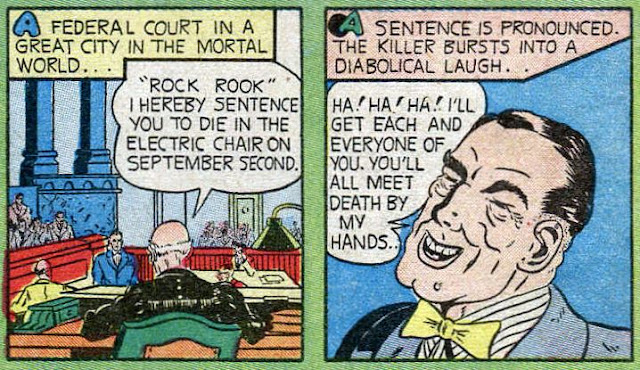
    “Rock” Rook is a gangster with an incredibly annoying name: hard to parse, seems like it should mean something but doesn’t, plus its’ always written as “Rock Rook” and that’s probably just a quirk of early 20th Century English but it makes me think that his last name isn’t even Rook and that makes me think that it means something again but it still doesn’t.

    Anyway, he is sentenced to and executed in the electric chair, ostensibly for murder but his annoying name must have contributed some judicial bloodthirstiness.

    As this is a Sergeant Spook story, Rook’s vow to revenge himself on the judge and jury is not carried out by the traditional methods (fake your own death, hire a mad scientist to resurrect your corpse or put your brain in a gorilla, die but have your secret twin pretend to be your ghost, etc) but rather by his coming back as an actual, factual ghost.

    Unfortunately for Rock Rook the freedom to be a ghostly murderer comes with a major catch: your victim’s ghost can call the ghost cops on you. Sergeant Spook is on the case faster than Rock Rook can line up his next target.

    After that it’s just a matter of experienced ghost vs inexperienced ghost and Rock Rook finds himself in the ghost-proof jail lickety-split.

    Sergeant Spook is still a comic searching for its sweet spot and and for my money this kind of ghost-on-human crime is where it should focus, particularly if it involves stuff like the murder victim calling the ghost cops on the murderer.

    JUDGE AND JURY REVENGE KILLER SCORE: 1/19+ (very weak showing from a unstoppable killing machine)

  • MINOR SUPER-VILLAIN 514: THE GHOST OF ROCK ROOK

    (Blue Bolt v2 001, 1941)

    “Rock” Rook is a gangster with an incredibly annoying name: hard to parse, seems like it should mean something but doesn’t, plus its’ always written as “Rock Rook” and that’s probably just a quirk of early 20th Century English but it makes me think that his last name isn’t even Rook and that makes me think that it means something again but it still doesn’t.

    Anyway, he is sentenced to and executed in the electric chair, ostensibly for murder but his annoying name must have contributed some judicial bloodthirstiness.

    As this is a Sergeant Spook story, Rook’s vow to revenge himself on the judge and jury is not carried out by the traditional methods (fake your own death, hire a mad scientist to resurrect your corpse or put your brain in a gorilla, die but have your secret twin pretend to be your ghost, etc) but rather by his coming back as an actual, factual ghost.

    Unfortunately for Rock Rook the freedom to be a ghostly murderer comes with a major catch: your victim’s ghost can call the ghost cops on you. Sergeant Spook is on the case faster than Rock Rook can line up his next target.

    After that it’s just a matter of experienced ghost vs inexperienced ghost and Rock Rook finds himself in the ghost-proof jail lickety-split.

    Sergeant Spook is still a comic searching for its sweet spot and and for my money this kind of ghost-on-human crime is where it should focus, particularly if it involves stuff like the murder victim calling the ghost cops on the murderer.

    JUDGE AND JURY REVENGE KILLER SCORE: 1/19+ (very weak showing from a unstoppable killing machine)

  • MINOR SUPER-VILLAIN 512: AGENT 17

    MINOR SUPER-VILLAIN 512: AGENT 17

    (Blue Bolt v1 012, 1941)

    There are a lot of dastardly fascist spy chiefs in comics of the 1940s, so it’s nice when one has something to distinguish themself from the monocle-and-dueling-scar heavy pack. Agent 17’s gimmick, as stated by the dying Latonian agent Gonzales, is that he is a “young man with an old face.” How useful is this in the average spy mission? Moderately, I presume.

    Agent 17’s mission is to prevent the government of the South American nation of Latonia from learning before it’s too late that the nonspecific European fascist nation that they just signed a trade pact with is in fact planning to take over their country as a staging area for a full-scale invasion of South America. But though Agent 17 had managed to deal a fatal blow to Latonian secret agent Gonzales, Gonzales had not died before engaging the services of Venusian super-hero Sub-Zero.

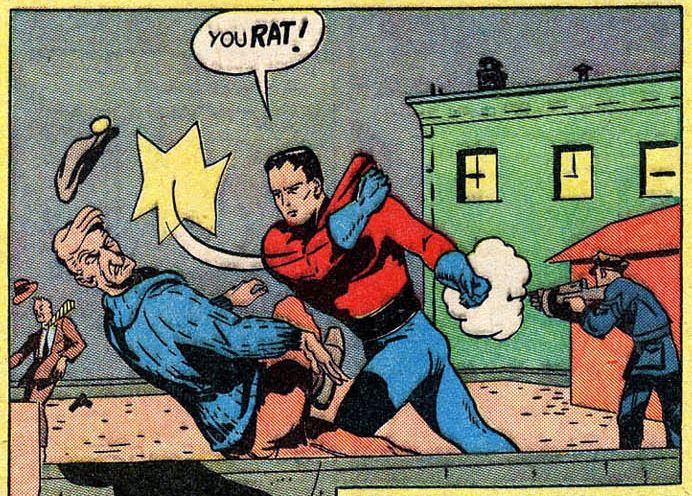
    For all that Agent 17 was going up against a cold-controlling super-hero armed with an old face he almost pulls it off! Latonia almost falls to the unspecified hordes of the enemy! Lucky for them, Sub-Zero manages to show up with a warning in the nick of time. Plus he gets to punch an old man in the face, guilt free!