The Curse of Skeleton Munroe

Category: murderer

  • MINOR SUPER-VILLAIN 978: THE BLACK LEGION

    (The Flame 007, 1941)

    The Black Legion is a mysterious cult who recruit members by sending them a sternly-worded letter through the mail. Presumably they have some way of researching their potential inductees to screen for susceptibility to peer pressure and so forth, because the initiation process involves carving a large letter D into your own chest while swearing fealty to the cult’s leader, the skull-masked Master of Death.

    The Black Legion takes its vows seriously, as member Graves finds when he tries to leave and is brutally murdered. Even Linda Dale, the niece of Black Legion co-leader Emma Dale, is almost killed when she asks a few too many questions about the secret ceremonies taking place in her basement on a regular basis. Lucky for her, then, that she has just become a member of the Flame’s supporting cast, as has Pug, the newest prospective member of the cult.

    So just what is the deal with the Black Legion? What ethos they espouse or dark deity they serve? What, in short, is the point of all this? As the Flame learns after busting the place up, it’s all a huge scam. Emma Dale and the Master of Death have been recruiting gullible fools to the organization and then pocketing the mandatory membership fees, and making even more money off of sales of the mandatory green velour robes. It’s a shocking indictment of the state of comic book cults.

    Categorized in: Colours (Black), Fraud (Con Artists), Misc (Cults)
  • MINOR SUPER-VILLAIN 974: TYRANNUS

    MINOR SUPER-VILLAIN 974: TYRANNUS

    (Fight Comics 015, 1941)

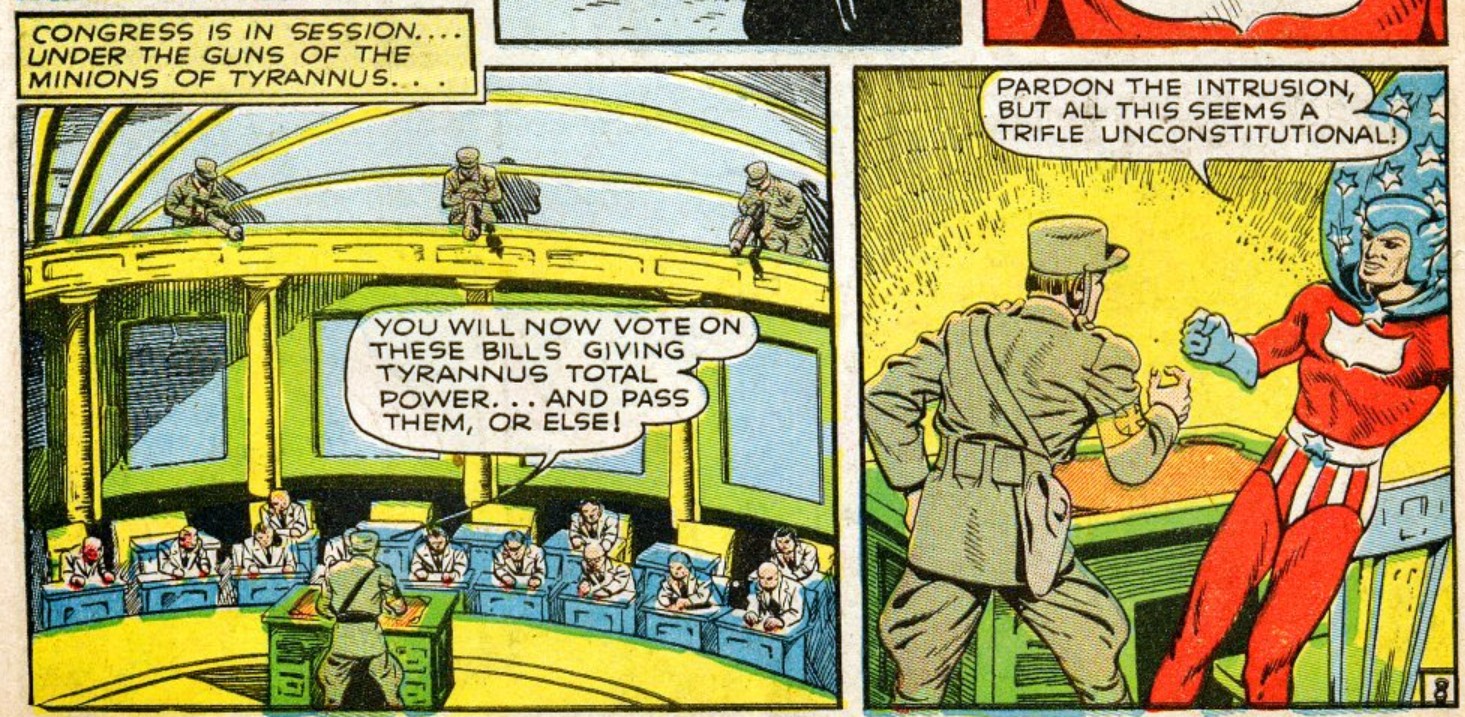
    I sniffed at the chronal implications of Super-American coming back in time to help out 1941 America, but it’s very possible that it is only by his intervention that his future comes to exist at all. By the time he arrives, Tyrannus, leader of an unnamed organization perhaps a couple of levels tougher than your average group of bundists, has already managed to install himself in the Oval Office. Senators are being machine gunned in the streets!

    Despite the fact that he seemingly has control of the entire apparatus of American government, Tyrannus is concerned with the formalities: he wants Congress to formally hand over the reins of power to him. Under the barrels of several machine guns, sure, but what regime change hasn’t come with a little ultra-violence?

    Tyrannus, no fool, legs it while Super-American is saving an off-model FDR. Will we see him again? Yes, right now.

    Fight Comics 016 sees Tyrannus in Europe working for the Hitler-alike dictator Vultro. It’s unclear if the implication is that he was already Vultro’s agent in America or if this represents a career setback for Tyrannus – their swastika-adjacent insignia are different, if that means anything. 

    Even if Tyrannus is no longer his own boss, he still gets to do what he loves, as Vultro is just as interested in the military subjugation of the United States as he is. Amd thanks to the insidious Dr Bund and his freshly-perfected aerial torpedoes he is ready to begin the process!

    Super-American takes a dim view of this scheme, and beats the holy hell out of Vultro’s forces until he is able to corner the dictator himself and bully him into promising not to do war any more. He does essentially say “I’m a little stinker” and scamper off the instant that Super-American’s back is turned, but it’s a noble effort nonetheless.

    As for Tyrannus, he murders Dr Bund in order to secure the only escape plane for himself and is then almost immediately captured by Super-American and returned to the US to face trial for all the crimes he did in his previous appearance.

    Categorized in: Generica (Ends in -us),  Ideologies (Crypto-Fascists), Supercrime (Attempted Conquest of the United States)

  • MINOR SUPER-VILLAIN 972: THE BLACK TALON

    (Captain America Comics 009, 1941)

    The Black Talon is honestly such a disappointing character. Two-thirds of him is composed of concepts that I love, but that remaining third is very rough. A hard character to endorse.

    First good Part: The Black Talon, aka Pascal Horta, is a mad artist who kills both as a way of eliminating his rivals and as a means of deriving inspiration for his series of horror-themed portraits. I always love seeing the mad arts represented in a field that traditionally favours the mad sciences, plus we must applaud the efficiency.

    Second Good Part: Horta’s origin involves the classic trope of the evil transplant that brings some part of its original owner’s mentality to its new host. Specifically, his right hand is crushed in a car accident and is replaced with that of condemned murderer Strangler Burns. A terrific trope, particularly as it so easily dovetails with a Jekyll/ Hyde concept where you can introduce the idea that the transplant recipient isn’t posessed but it just using the idea of a murderer’s body part to enact their own inmost desires. In this specific instance, this idea is offset somewhat by the fact that the hand itself is portrayed as super-human: incredibly strong, equipped with clawlike fingernails (the eponymous Black Talons) and even fireproof as of its second appearance, but the point still stands. 

    (I’ve never asked a transplant surgeon but I reckon that they must hate this trope)

    If you read through all of the panels up to this point you might have noticed the third, unfun thing about the Black Talon: that at least as much weight is given to the fact that the hand comes from an African American man as from a murderer. Could a thoughtful writer do something interesting with the concept of a man who is horrified by the race of his own hand? Certainly! Do they do this here? Certainly not. It really says something when Marvel’s other Black Talons being chicken-themed Voodoo priests is the less racist option.

    After a couple of encounters with Captain America and Bucky, the Black Talon is killed when Cap punches him out a window to his death. Or so Captain America believes, because he never bothers to go check. In reality, Horta is scuttling off to get ready to return in an upcoming issue of Young Allies. Stay tuned!

    Categorized in: Body (Nonhuman Parts, Hands), Colours (Black), Origin (Evil Transplant)

  • MINOR SUPER-VILLAIN 971: THE MONSTER

    (Fantastic Comics 023, 1941)

    The comic opens in media res, as a (the) Monster bursts into the hotel room of art critic Iona Hall and carries her off into the night. Cut to the Gorman Art Gallery the next day, where we see… Iona Hall!?

    As you might have guessed, this isn’t the real Iona Hall, and “famous art connoisseur” Dan Kenneth spots this when he is introduced to the false Hall by gallery owner Gorman. When Kenneth attempts to discover the reason for this imposture, however, he and the repentant fake are attacked by gun-toting goons and have to engage in a thrilling chase, and then, when he is able to ask the question a second time, the Monster shows up and carries away the double in the same manner as the original.

    It’s such a weird situation that Kenneth can’t even convince the police to look into it lest he be thrown in the drunk tank for challenging their view of reality. He simply has to adopt a new identity as the vigilante Gladiator in order to knock the beast out and discover just what the heck is going on.

    So what the heck is going on? It’s perfectly simple: art collector Craven has a painting by the great artist Velasquez and wants to have both it and some more money. To that end here is his plan:

    1. Bring in art critic Iona Hall
    2. Kidnap Hall as the Monster
    3. Replace Hall with lookalike June Starr
    4. Have his crony Gorman sell the painting at auction
    5. Buy his own painting for less than it’s worth
    6. Ask Dan Kenneth to give the painting the once-over for him
    7. As the Monster again, steal the painting from Kenneth
    8. Hold Kenneth responsible for the loss of the painting
    9. Collect the money from Kenneth and enjoy it while the painting hangs in his home.

    Some flaws in this plan include:

    1. Iona Hall seems to be completely superfluous to the plan, unless she is there to authenticate the painting
    2. Even if this is the case, kidnapping and replacing Hall is only necessary if the painting is fake, which it isn’t
    3. June Starr is an unwilling accomplice who acts against the plan at least three times – an unkidnapped Iona Hall is far preferable
    4. The auction is completely unnecessary if Craven openly owns the painting – just ask Kenneth to clean it for you
    5. Plus you’ve driven down the price by buying it cheap. Perhaps they sold it for the amount that they thought that they could get out of Kenneth, in which case they chose the wrong scam and they should have been doing:
    6. Insurance fraud. The scam they should have been pulling was insurance fraud

    All in all I must assume that Craven was just too excited about his cool monster suit and came up with a plan that allowed him to use it a couple of times, because that is the only lens through which this scheme makes a lick of sense.

    Categorized in: Accessories (Personal Transport – Robotic Exoskeletons), Animals (Monsters), Narrative Footballs (Misc Origin Story Guys) 

  • MINOR SUPER-VILLAIN 971: THE MONSTER

    (Fantastic Comics 023, 1941)

    The comic opens in media res, as a (the) Monster bursts into the hotel room of art critic Iona Hall and carries her off into the night. Cut to the Gorman Art Gallery the next day, where we see… Iona Hall!?

    As you might have guessed, this isn’t the real Iona Hall, and “famous art connoisseur” Dan Kenneth spots this when he is introduced to the false Hall by gallery owner Gorman. When Kenneth attempts to discover the reason for this imposture, however, he and the repentant fake are attacked by gun-toting goons and have to engage in a thrilling chase, and then, when he is able to ask the question a second time, the Monster shows up and carries away the double in the same manner as the original.

    It’s such a weird situation that Kenneth can’t even convince the police to look into it lest he be thrown in the drunk tank for challenging their view of reality. He simply has to adopt a new identity as the vigilante Gladiator in order to knock the beast out and discover just what the heck is going on.

    So what the heck is going on? It’s perfectly simple: art collector Craven has a painting by the great artist Velasquez and wants to have both it and some more money. To that end here is his plan:

    1. Bring in art critic Iona Hall
    2. Kidnap Hall as the Monster
    3. Replace Hall with lookalike June Starr
    4. Have his crony Gorman sell the painting at auction
    5. Buy his own painting for less than it’s worth
    6. Ask Dan Kenneth to give the painting the once-over for him
    7. As the Monster again, steal the painting from Kenneth
    8. Hold Kenneth responsible for the loss of the painting
    9. Collect the money from Kenneth and enjoy it while the painting hangs in his home.

    Some flaws in this plan include:

    1. Iona Hall seems to be completely superfluous to the plan, unless she is there to authenticate the painting
    2. Even if this is the case, kidnapping and replacing Hall is only necessary if the painting is fake, which it isn’t
    3. June Starr is an unwilling accomplice who acts against the plan at least three times – an unkidnapped Iona Hall is far preferable
    4. The auction is completely unnecessary if Craven openly owns the painting – just ask Kenneth to clean it for you
    5. Plus you’ve driven down the price by buying it cheap. Perhaps they sold it for the amount that they thought that they could get out of Kenneth, in which case they chose the wrong scam and they should have been doing:
    6. Insurance fraud. The scam they should have been pulling was insurance fraud

    All in all I must assume that Craven was just too excited about his cool monster suit and came up with a plan that allowed him to use it a couple of times, because that is the only lens through which this scheme makes a lick of sense.

    Categorized in: Accessories (Personal Transport – Robotic Exoskeletons), Animals (Monsters), Narrative Footballs (Misc Origin Story Guys) 

  • MINOR SUPER-VILLAIN 970: THE QUEEN OF EVIL

    (Fantastic Comics 022, 1941)

    Nagana, high priest of Isis in Thebes, achieves great power and the secret of immortality through her position and is seemingly consumed with megalomania. Importantly, these magical secrets do not appear to be tied to her faith in Isis so much as accessed as a result of it, as she retains them even after she rejects Isis and declares herself to be her enemy. She sets out to use this power to become the ruler of Thebes and sets her eyes on a hot new priest named Kalkor as her chosen consort.

    Trouble is, Kalkor rejects her due to her casual Isis-disrespect (and possibly also a vow of chastity? It can be hard to pick out specifically why a super-manly comic book character is going “ew, girls”) and Nagana attempts to have him killed for it. Kalkor survives due to his aforementioned manliness and confronts her, at which point she goes on a tirade so blasphemous that Isis drops the entire temple on them, killing hundreds spelling the end of Thebes as a major religious centre (in what is probably a big coincidence, the real-life Egyptian city of Thebes went also into decline about three thousand years ago, but due to an administrative scandal rather than divine wrath).

    Though Nagana is immortal, Isis curses her and transforms her to stone, until she is unearthed in the present day and exposed to moonlight. So restored, she murders the man who found her and vows to take over the world.

    Though Isis is much reduced in the modern world, she is able to resurrect Kalkor and give him the same powers as Nagana as a foil to her evil schemes (luckily for humanity, Kalkor hold Nagana responible for the destruction of Thebes rather than Isis’ fairly broadly-applied wrath).

    For all her big talk of taking over the world, Nagana’s only evil scheme of 1941 consists of her attempting to con an old man out of his fortune using a fortune telling con that is enhanced by a little real magic. She is also foiled by Kalkor with almost ridiculous ease. But fear not! Nagana and Kalkor will return in 1942 for more thrilling conflict!

    Categorized in: Day Jobs (Priests), Origins (Resurrected (Petrified Humans)), Royalty (Queens)

  • MINOR SUPER-VILLAIN 970: THE QUEEN OF EVIL

    (Fantastic Comics 022, 1941)

    Nagana, high priest of Isis in Thebes, achieves great power and the secret of immortality through her position and is seemingly consumed with megalomania. Importantly, these magical secrets do not appear to be tied to her faith in Isis so much as accessed as a result of it, as she retains them even after she rejects Isis and declares herself to be her enemy. She sets out to use this power to become the ruler of Thebes and sets her eyes on a hot new priest named Kalkor as her chosen consort.

    Trouble is, Kalkor rejects her due to her casual Isis-disrespect (and possibly also a vow of chastity? It can be hard to pick out specifically why a super-manly comic book character is going “ew, girls”) and Nagana attempts to have him killed for it. Kalkor survives due to his aforementioned manliness and confronts her, at which point she goes on a tirade so blasphemous that Isis drops the entire temple on them, killing hundreds spelling the end of Thebes as a major religious centre (in what is probably a big coincidence, the real-life Egyptian city of Thebes went also into decline about three thousand years ago, but due to an administrative scandal rather than divine wrath).

    Though Nagana is immortal, Isis curses her and transforms her to stone, until she is unearthed in the present day and exposed to moonlight. So restored, she murders the man who found her and vows to take over the world.

    Though Isis is much reduced in the modern world, she is able to resurrect Kalkor and give him the same powers as Nagana as a foil to her evil schemes (luckily for humanity, Kalkor hold Nagana responible for the destruction of Thebes rather than Isis’ fairly broadly-applied wrath).

    For all her big talk of taking over the world, Nagana’s only evil scheme of 1941 consists of her attempting to con an old man out of his fortune using a fortune telling con that is enhanced by a little real magic. She is also foiled by Kalkor with almost ridiculous ease. But fear not! Nagana and Kalkor will return in 1942 for more thrilling conflict!

    Categorized in: Day Jobs (Priests), Origins (Resurrected (Petrified Humans)), Royalty (Queens)

  • MINOR SUPER-VILLAIN 969: THE SCORPION

    (Fantastic Comics 021, 1941)

    The Scorpion is an Irish super-criminal who, in a classic villain move, inspires the creation of his own nemesis when he slays a man on the moors near Cork one dark night (and whether there are any moors in that area is surprisingly tedious to find out, so just colour me generically skeptical) as part of a scheme to acquire a gold deposit.

    The future nemesis in question is the man’s stepson, Jim O’Donnell, whose subsequent pursuit of justice for the murder leads to him becoming the costumed vigilante known as the Banshee. And speaking of banshees: the reason hat the Scorpion leaves Jim alive as a potential witness to the murder is that he mistakes a wailing gust of wind for a banshee’s cry and runs away rather than finish murdering him.

    In addition to the fact that he is very superstitious and also our first Irish super-villain, the third noteworthy thing about the Scorpion is the fact that he doesn’t look anything like a scorpion, and instead has a kind of demonic imp look going on, perhaps one that is meant to be a kind of “if a scorpion was a guy” concept. 

    The Scorpion next heads to NYC to murder Jim’s step-cousin Joan O’Neill as his original victim’s last surviving heir (as mentioned in the Banshee entry: Jim and his step-father were close in a “vengeance ques” but not a “be left something in the will” kind of way).

    The Scorpion is of course captured before he is able to murder Joan, and it’s a rough one for him: in addition to being unmasked, he is distracted at a critical moment by a police siren (and if that’s the threshold that he has for “banshee noises” then he must live in a state of perpetual fear, even in 1940s NYC), has Jim fall on him and break his leg while stumbling around with a clothesline worth of sheets rapped around him, and to add insult to injury is taken to jail by the only two non-Irish cops in comic book NYC (“what the heck is a banshee?”, sheesh).

    Not to be dissuaded, the Scorpion breaks jail and gets into the arms smuggling business with a new green mask. His major rival in this is crooked air transport company owner Joe Collins, who coincidentally happens to be Joan’s boss who has just agreed to give Jim a job as well. Despite some particularly gruesome warnings in the form a missing pilot’s head and hand, Collins refuses to give up his smuggling business and gets himself murdered by the Scorpion. 

    The Scorpion remains wildly superstitious, however, and once Jim shows up in his Banshee costume it’s basically all over. Do you reckon he gets sent back to Ireland to serve time for his crimes there, or does he go to American jail first?

    Categorized in: Animals (Scorpions), Narrative Footballs (Origin Story Guys), Supranormal Beings (Imps)

  • MINOR SUPER-VILLAIN 969: THE SCORPION

    (Fantastic Comics 021, 1941)

    The Scorpion is an Irish super-criminal who, in a classic villain move, inspires the creation of his own nemesis when he slays a man on the moors near Cork one dark night (and whether there are any moors in that area is surprisingly tedious to find out, so just colour me generically skeptical) as part of a scheme to acquire a gold deposit.

    The future nemesis in question is the man’s stepson, Jim O’Donnell, whose subsequent pursuit of justice for the murder leads to him becoming the costumed vigilante known as the Banshee. And speaking of banshees: the reason hat the Scorpion leaves Jim alive as a potential witness to the murder is that he mistakes a wailing gust of wind for a banshee’s cry and runs away rather than finish murdering him.

    In addition to the fact that he is very superstitious and also our first Irish super-villain, the third noteworthy thing about the Scorpion is the fact that he doesn’t look anything like a scorpion, and instead has a kind of demonic imp look going on, perhaps one that is meant to be a kind of “if a scorpion was a guy” concept. 

    The Scorpion next heads to NYC to murder Jim’s step-cousin Joan O’Neill as his original victim’s last surviving heir (as mentioned in the Banshee entry: Jim and his step-father were close in a “vengeance ques” but not a “be left something in the will” kind of way).

    The Scorpion is of course captured before he is able to murder Joan, and it’s a rough one for him: in addition to being unmasked, he is distracted at a critical moment by a police siren (and if that’s the threshold that he has for “banshee noises” then he must live in a state of perpetual fear, even in 1940s NYC), has Jim fall on him and break his leg while stumbling around with a clothesline worth of sheets rapped around him, and to add insult to injury is taken to jail by the only two non-Irish cops in comic book NYC (“what the heck is a banshee?”, sheesh).

    Not to be dissuaded, the Scorpion breaks jail and gets into the arms smuggling business with a new green mask. His major rival in this is crooked air transport company owner Joe Collins, who coincidentally happens to be Joan’s boss who has just agreed to give Jim a job as well. Despite some particularly gruesome warnings in the form a missing pilot’s head and hand, Collins refuses to give up his smuggling business and gets himself murdered by the Scorpion. 

    The Scorpion remains wildly superstitious, however, and once Jim shows up in his Banshee costume it’s basically all over. Do you reckon he gets sent back to Ireland to serve time for his crimes there, or does he go to American jail first?

    Categorized in: Animals (Scorpions), Narrative Footballs (Origin Story Guys), Supranormal Beings (Imps)

  • MINOR SUPER-VILLAIN 968: THE BLACK RIDER

    (Fantastic Comics 018, 1941)

    The Black Rider is a ruthless bandit chief who has not only terrorized the countryside but has had the audacity to kidnap Bill Carrol, Captain Kidd’s best friend, an unforgivable sin.

    While the Black Rider & Co. might look like they are straight out of a comic set in the American West, Captain Kidd’s 1941 adventures have taken place exclusively in Africa, and given the mention of a city called Tanga above, I think that we can pretty confidently place this comic somewhere in present-day Tanzania, in the part that was then Tanganyika (yes, okay, there’s also a couple of Tangas in Burkina Faso. I just don’t think that they’re the right ones, okay?).

    Though the Black Rider manages to overpower Captain Kidd and stick him in a booby-trapped airplane during their first encounter this is absolutely not enough to dissuade even novice two-fisted adventurer, let alone a grizzled veteran like Kidd. Kidd’s return gambit is to storm the Black Rider’s HQ and machine gun the entire gang.

    The entire gang bar the Black Rider, that is, because it’s time for the dramatic revelation that the Black Rider is… A LADY???!!! Specifically, she is the daughter of the original Black Rider, out for revenge since he was killed by vigilantes but now on her way to a British colonial jail and/or execution. Please note that the Black Rider pulls the old “roughly the same size as an adventure hero until unmasked” trick, going from a burly six foot to a slender 5’6″ in about one panel.

    Categorized in: Colours (Black), Generica (Riders), Origin (Cross-Dressing Characters, Legacy Characters)