The Curse of Skeleton Munroe

Category: murderer

  • MINOR SUPER-VILLAIN 450: COUNTESS BELLADONNA

    (Mystery Men Comics 029, 1941)

    We first see Countess Belladonna at the Westchester Flower Show, where she meets young Brenda Talmadge and murders her for her recently-inherited Riviera Ruby.

    Now here I’m going to jump ahead and spoil the twist of a comic book that was published more than 80 years ago: Countess Belladonna is actually Judge Talmadge, stepfather to Brenda Talmadge. As with any modern reading of a story with gender ambiguity there is a temptation to read more into things than was perhaps intended by the author, but here we go: whereas there are a lot of cases where a crossdressing man in a comic is clearly doing so for convenience, Judge Talmadge appears to have maintained Countess Belladonna as an alternate identity at least long enough for her to become established in New York society, which would presumably take months if not years – it was easier to establish a false identity in the era before electronic records but you had to put in at least some effort.

    Does this dedication to the role indicate that it is an expression of Talmadge’s gender identity? No way to tell, really. Countess Belladonna does go on a murder-and-theft spree immediately thereafter but whether it’s because she was an identity created solely for that purpose or because the murder was spur-of-the-moment and Talmadge/ Belladonna figures he/she might as well get as much cash as possible before abandoning the identity is too close to tell.

    One thing is for sure: Talmadge and Belladonna both have a weird toothless rictus grin and that’s probably how the Blue Beetle cottons onto them.

    Countess Belladonna returns in the next issue, this time adding a third identity: Dr Zinn the carnival barker. Or possibly Dr Zinn has replaced Judge Talmadge as the new second identity, as he is effectively absent from the story bar these few panels. This time the Countess has retired her poisoned knitting needles for a skull-bedecked fan that not only dispenses pepper but can be used to hypnotize people. He also has bunch of Native South American dudes in a cage as circus attractions/ henchmen, so this is one of those “very racist” comics we all love so much.

    Anyway, Dr Zinn is just as reckless as the other two identities, as not only does he return to NYC York City rather than going literally anywhere else in the world. Plus he spends a fair amount of time trying to kill Blue Beetle love interest Joan Mason – not a great way to avoid attracting attention to yourself in a super-hero comic. 

    Countess Belladonna ends up getting away and probably would have returned in another few issues with another identity or two, but this is just before the Blue Beetle’s publishing status gets weird for the first time as he moves from Fox Features to a publisher called Holyoke for a few years. Nobody at Holyoke remembered the Countess, it seemed, and by the time the Blue Beetle was back at Fox, nobody there did either. A pretty slick escape, I must say.

  • MINOR SUPER-VILLAIN 450: COUNTESS BELLADONNA

    (Mystery Men Comics 029, 1941)

    We first see Countess Belladonna at the Westchester Flower Show, where she meets young Brenda Talmadge and murders her for her recently-inherited Riviera Ruby.

    Now here I’m going to jump ahead and spoil the twist of a comic book that was published more than 80 years ago: Countess Belladonna is actually Judge Talmadge, stepfather to Brenda Talmadge. As with any modern reading of a story with gender ambiguity there is a temptation to read more into things than was perhaps intended by the author, but here we go: whereas there are a lot of cases where a crossdressing man in a comic is clearly doing so for convenience, Judge Talmadge appears to have maintained Countess Belladonna as an alternate identity at least long enough for her to become established in New York society, which would presumably take months if not years – it was easier to establish a false identity in the era before electronic records but you had to put in at least some effort.

    Does this dedication to the role indicate that it is an expression of Talmadge’s gender identity? No way to tell, really. Countess Belladonna does go on a murder-and-theft spree immediately thereafter but whether it’s because she was an identity created solely for that purpose or because the murder was spur-of-the-moment and Talmadge/ Belladonna figures he/she might as well get as much cash as possible before abandoning the identity is too close to tell.

    One thing is for sure: Talmadge and Belladonna both have a weird toothless rictus grin and that’s probably how the Blue Beetle cottons onto them.

    Countess Belladonna returns in the next issue, this time adding a third identity: Dr Zinn the carnival barker. Or possibly Dr Zinn has replaced Judge Talmadge as the new second identity, as he is effectively absent from the story bar these few panels. This time the Countess has retired her poisoned knitting needles for a skull-bedecked fan that not only dispenses pepper but can be used to hypnotize people. He also has bunch of Native South American dudes in a cage as circus attractions/ henchmen, so this is one of those “very racist” comics we all love so much.

    Anyway, Dr Zinn is just as reckless as the other two identities, as not only does he return to NYC York City rather than going literally anywhere else in the world. Plus he spends a fair amount of time trying to kill Blue Beetle love interest Joan Mason – not a great way to avoid attracting attention to yourself in a super-hero comic. 

    Countess Belladonna ends up getting away and probably would have returned in another few issues with another identity or two, but this is just before the Blue Beetle’s publishing status gets weird for the first time as he moves from Fox Features to a publisher called Holyoke for a few years. Nobody at Holyoke remembered the Countess, it seemed, and by the time the Blue Beetle was back at Fox, nobody there did either. A pretty slick escape, I must say.

  • MINOR SUPER-VILLAIN 447: THE MANX

    (Mystery Men Comics 026, 1941)

    It’s the Manx! Our second catsuit-clad cat-themed villain after the Cat’s Paw! This fella doesn’t share too much about himself but seems to be a bit of a criminal opportunist – here he’s attempting to steal a pistol used in a 25 year-old murder so that he can blackmail the murderer, now a wealthy and successful man. Given his sneaky climbing style of getting about I’d wager that he’s usually some sort of burglar. A cat burglar, natch.

    Mustn’t forget to note his themed weapon: a cat’s claw mounted on his wrist that he uses to slash up his foes in a surprisingly gory fashion. Also: no tail, just like a real manx!

    Ultimately, the Manx seems to have the wrong ratio of sneaking around vs committing horrific violence going on, particularly once he’s aware that he’s facing a super-powered foe in the Green Mask. With a little more creeping and a little less clawing he might have gotten away with some swag rather than being caught by an oaf.

  • MINOR SUPER-VILLAIN 446: THE ROOK

    (Mystery Men Comics 018, 1941)

    This here is the Rook, the only recurring antagonist of Golden Age duo the Lynx and Blackie the Mystery Boy. In terms of crime, he’s your basic thief and murderer with a sideline in opportunistic kidnapping and extortion. He does have several notable attributes, however:

    Tactics: The Rook has a hypnoray and he is going to use it, dammit. He’s not one of those fickle super-villains who blame their tools every time a plan doesn’t come together. The hypnoray is SOLID, it’s a VALUED MEMBER OF THE TEAM and it’s STAYING.

    The Rare Hate Triangle: In his first appearance, the Rook kills his henchman Killer Burke rather than split the take of their latest job with him. Killer’s brother Baldy Burke swears revenge and attempts to get it for the next four issues. It’s a very fun dynamic because Baldy also hates the Lynx, so his allegiance is fluid. Sometimes he teams up with the Lynx to get the Rook, sometimes the opposite. At least once, Baldy just pops up out of the Rook’s back seat and attempts to shoot him.

    More books should feature a wildcard antagonist! I can’t think of too many examples off the top of my head but those I can are terrific additions to the plot. Also, more super-villains should have non super-hero enemies given how they behave – if nothing else a guy like the Joker should be taking fire from opportunists any time he shows his face in public.

    Eyes: Not only does the Rook have really great staring eyes (and they just keep getting more intense – by the end of his appearances he’s got Muppet-style half ping pong balls going on) but the subjects of his hypnoray also have them. It’s a nice touch and I appreciate it.

    Physical Resilience (or Possibly a Series of Carefully-Planned Escape Routes): The Rook ends his first six appearances in the same way: missing, presumed dead. Specifically, he meets his theoretical end, in order, by fire, a fall, quicksand, drowning, explosion, and being thrown out a window onto sharp rocks and pounding surf far below. The Rook, in other words, operates on slasher movie villain rules – if he surely must have been killed but you don’t have a body then he isn’t dead. And the Lynx must have figured that out because in their final encounter he just breaks both of the Rooks legs rather than trying to kill him like he usually does.

    In conclusion: while the Rook himself isn’t the greatest villain in the world, virtually everything about him is worth incorporating into a villainous MO. Except for the part where he teamed up with literal Nazis. None of that.

  • MINOR SUPER-VILLAIN 445: DR DODO

    MINOR SUPER-VILLAIN 445: DR DODO

    (Mystery Men Comics 024, 1941)

    Gotta say: while I was initially quite excited to have a non-gang boss foe for the Blue Beetle after a run of four or five of them and even moreso after seeing that it was a guy named Dr Dodo who looked like a brute mob from a mid-tier FPS with a supernatural theme (you know, he’d be dressed in a bloody butcher’s apron and take like a minute to kill until you figure out the trick to it) but upon realizing that he was just copying the Sky-Ruler and extorting inventors with the threat of fatal deplaning (albeit without bothering with the cars). It’s dispiriting.

    A point in Dr Dodo’s favour for his clearly-stated gals: he has an explosive ray weapon and he is threatening to blow up NYC York City with it unless he’s paid off.

    Unfortunately for Dr Dodo, it’s just not enough. Yes he looks very cool and menacing and like it’s going to eat up your supply of plasma grenades to take him out. Sure he has a workable scheme. Yes he has a great name. But he spends a considerable portion of the story working to keep anyone from finding out who he is – exploding the body of that poor inventor, burning up the records at the local newspaper, kidnapping and attempting to murder Joan Mason and the Blue Beetle – while going around extorting the city under what is evidently his real name, Dr Dodo! And the background information that he is so keen to safeguard, that he was dismissed from somewhere for growing poisonous roses, has no bearing on his schemes and no part in his downfall! Maddening!

    Lets all look at him one last time, though. He really does look cool, doesn’t he? You’re going to have to reload like five times to take this bad boy out with the starting weapon.

  • MINOR SUPER-VILLAIN 439: THE SKY-RULER

    MINOR SUPER-VILLAIN 439: THE SKY-RULER

    (Mystery Men Comics 019, 1941)

    I’m not sure what the Sky-Ruler’s deal is. 

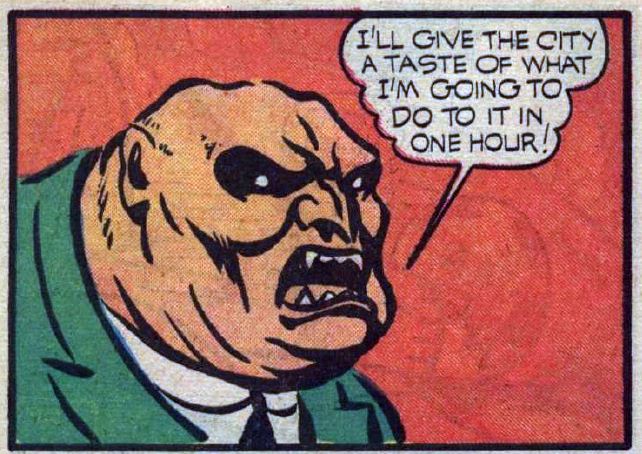
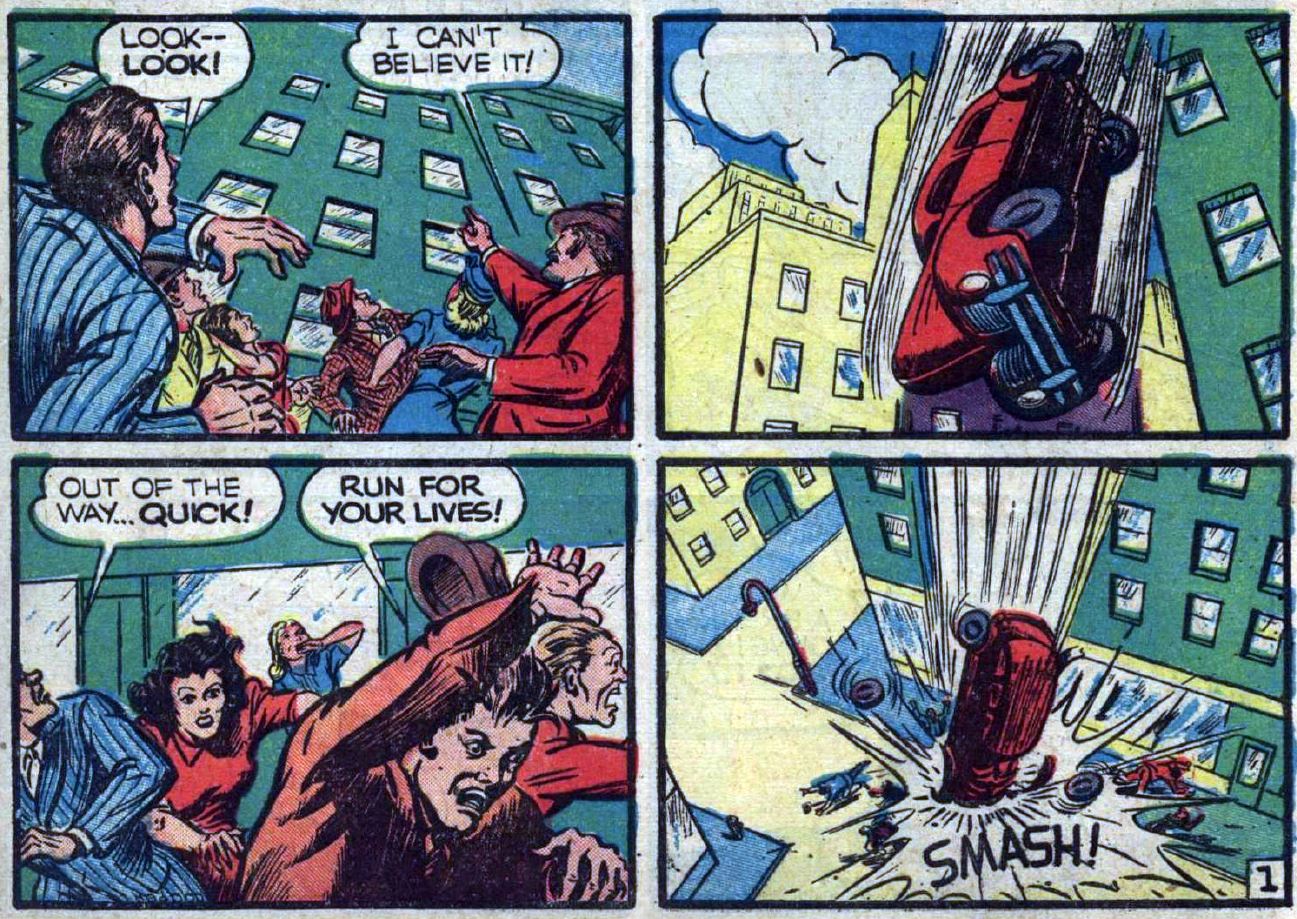
    Scratch that – I know what his deal is. He rules the sky. He flies around in a big bomber plane and uses it to drop cars containing his enemies on the streets of New York City (he also tries to throw off the scent of the police by calling these the “Skyscraper Murders” in his notes but I have to imagine that this would only work as long as nobody noticed the enormous plane circling the city every time one happened).

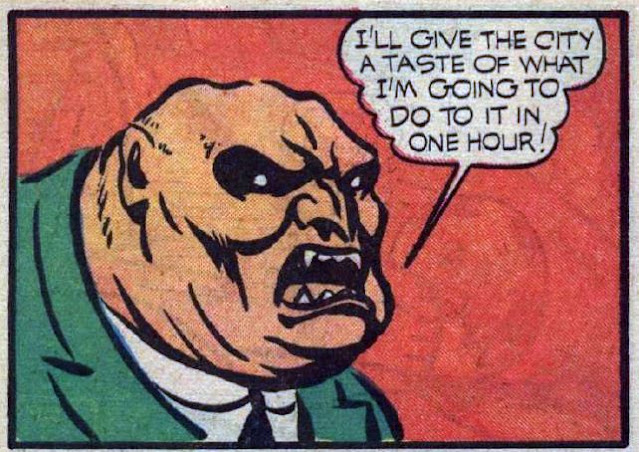
    I also know what the Sky-Ruler is doing: he’s extorting inventors with the threat of being fatally deplaned in order to get ahold of their various formulae. But why does he want them? He claims that “now the city will be at my mercy,” which could mean looting, destruction, ransom or conquest in equal measure. Serves him right that the Blue Beetle captures him by causing his lowly, ground-based car to crash.

    Two more things about the Sky-Ruler: his henchmen are called the Sky-Raiders and I always appreciate a nominative flourish even when applied to no-name thugs, and also I appreciate that his character design seemingly involved giving him as many distinctive facial features as possible.

    But what was his deal?

  • MINOR SUPER-VILLAIN 435: KAR THE DESTROYER

    (Shadow Comics v1 003, 1940)

    Here is a list of elements that are in the three-issue story that Kar the Destroyer is the antagonist of: 

    -a dissolving gas called the Smoke of Eternity

    -a diving bell repurposed as a deathtrap

    -multiple pirate ships

    -Thunder Island, a place with a prehistoric remnant ecosystem complete with dinosaurs

    -Doc Savage

    Here is how the story made me feel:

    -bored

    It’s a real shame because love most of those things! I love Kar’s look! I feel like I should love Doc Savage but I don’t and it  might be for the same reason I didn’t like this: it was a slog to read just like any time I try reading Doc Savage. It’s a real shame!

  • MINOR SUPER-VILLAIN 416: THE PIRANHA

    (Crackajack Funnies 010-017, 1939)

    The Piranha is a mysterious gang boss operating out of New York City and known for the gruesome way he dealt with his enemies, of which we will return to in a second.

    The Piranha is actually the wealthy Senõr Romez, a society luminary known for his fabulous parties and the many unsolved murders that happen at his fabulous parties. He also dresses exactly like the Piranha but with hair and a mask – a lot of the story involves G-Man Ed Tracer trying to find some way to link Romez and the Piranha.

    Back to that murder method. Somewhat predictably, the Piranha feeds his victims to piranhas, but it’s what he does next that really catches the old attention: he sends entire skeletons as warnings (side note – the character receiving the skeleton in the above panels is a radio celebrity named Jimmie Stewart. I don’t think that it’s supposed to be a version of Jimmy Stewart the actor [who was working in radio at the time] but it’s a weird coincidence).

    As predictable as the Piranha using piranhas as a murder method is, it’s even more predictable that he himself would end up on the wrong end of a skeletonization by the end of the story. Live by the piranha, die by the piranha, as they say.

    Now here’s the kicker: when I first read this story a few years back it was as a serial, spread out over eight issues. I didn’t notice then because it was a disjointed way to take in details but revisiting it just now all in a go… I don’t know if we ever learn the reason that the Piranha is killing wealthy partygoers and kidnapping the princess of the South American (?) country of Spanovia and so forth. He’s just generically evil and foreign? Presumably there’s money in it somewhere but as far as the facts on paper go he’s just into some sort of extreme roleplay.

  • MINOR SUPER-VILLAIN 416: THE PIRANHA

    (Crackajack Funnies 010-017, 1939)

    The Piranha is a mysterious gang boss operating out of New York City and known for the gruesome way he dealt with his enemies, of which we will return to in a second.

    The Piranha is actually the wealthy Senõr Romez, a society luminary known for his fabulous parties and the many unsolved murders that happen at his fabulous parties. He also dresses exactly like the Piranha but with hair and a mask – a lot of the story involves G-Man Ed Tracer trying to find some way to link Romez and the Piranha.

    Back to that murder method. Somewhat predictably, the Piranha feeds his victims to piranhas, but it’s what he does next that really catches the old attention: he sends entire skeletons as warnings (side note – the character receiving the skeleton in the above panels is a radio celebrity named Jimmie Stewart. I don’t think that it’s supposed to be a version of Jimmy Stewart the actor [who was working in radio at the time] but it’s a weird coincidence).

    As predictable as the Piranha using piranhas as a murder method is, it’s even more predictable that he himself would end up on the wrong end of a skeletonization by the end of the story. Live by the piranha, die by the piranha, as they say.

    Now here’s the kicker: when I first read this story a few years back it was as a serial, spread out over eight issues. I didn’t notice then because it was a disjointed way to take in details but revisiting it just now all in a go… I don’t know if we ever learn the reason that the Piranha is killing wealthy partygoers and kidnapping the princess of the South American (?) country of Spanovia and so forth. He’s just generically evil and foreign? Presumably there’s money in it somewhere but as far as the facts on paper go he’s just into some sort of extreme roleplay.

  • MINOR SUPER-VILLAIN 415: THE GORILLA

    (Blue Beetle Comics 009-010, 1941)

    The Gorilla is actually Jack Castle, a drunken lout who happens to be the lab assistant to the unhinged Dr Brock. Castle pushes his employer a bit too far and ends up on the wrong end of an ape brain transplant. Dr Brock meanwhile has forgotten one of the major things about brains and so ends up like so many other mad scientists do after transplanting an unwilling one: murdered by his own creation.

    Castle was a creep as a human and he’s no better as a gorilla, so he ends up vowing revenge on all humanity.

    But it’s a tricky prospect, taking on the world with a gorilla body and no people skills. The Gorilla’s only adventure post-origin involves his trying to take over the underworld based solely on physical prowess and it goes poorly – in fact, both of his adventures end with him crawling off to nurse a gunshot wound.

    It’s all okay stuff, but the most interesting part of it is that the Gorilla is an antagonist without a protagonist. In storytelling terms I suppose that the Gorilla is the protagonist and the world is the antagonist? The point it that this is an early experiment in having the villain headline the story and I appreciate it.