The Curse of Skeleton Munroe

Category: murderer

  • MINOR SUPER-VILLAIN 247: THE HAND

    (Flash Comics v1 015, 1941)

    It’s old hat by now: like former Hawkman foe Czar the Unkillable Man and his ilk, the Hand is a henchbeing who is far more interesting to read and talk about than their creator. This is the risk you run when you set out to create an autonomous crime-servant via… I’m guessing magical means? It’s unclear in the text but magic seems more likely than science.

    In this case, the creator is a guy named Edward Thayer, the black sheep of a wealthy family who has decided to turn his amazing talking and flying disembodied hand to the sordid task of killing off his brother Elwin and niece Teddy so that he can inherit enough money to convince some lady to sleep with him. Cue my usual complaints about crooks in super-hero universes not aiming high enough.

    Edward never gets to see his ill-gotten money, though, because Sandra (the lady in question) decides to bump him off for a quick buck. Which leads to the above panel: not only a rare hero/ villain teamup but an as-far-as-I-know unique hero/ disembodied hand teamup! Sadly, the revenge rampage ends with not only Sandra but the Hand itself seemingly plummeting to their deaths in a crashing car. Boo, says I! The Hand should be BRUNG BACK post-haste! Give it a bartending job somewhere.

  • MINOR SUPER-VILLAIN 237: CZAR THE UNKILLABLE MAN

    (Flash Comics v1 007, 1940)

    Like Echo or Hugo Strange’s Monster Men before him, Czar the Unkillable Man is arguably less a super-villain than a tool created by a super-villain, but where’s the fun in listing a buncha guys named Dr Samuels and Professor Tompkins or in this case Boris Nickaloff?

    Nickaloff is a bit of a mystery – he creates Czar by sculpting a complete human body – inside and out – out of “plasm-clay” and then shocking it to life with a shot of adrenaline. Is this meant to be mad science? Magic? A modern day Pygmalion story? No clues are given. Probably science if the adrenaline is any hint, but I prefer to think it’s reality-bending mad art.

    Nickaloff gets Czar to rob some banks and kill a bunch of people, and it’s here that he maybe turn out to be a bit less of a tool than old Echo after all, as he sets about his rampages with  a bit more gusto than is required. He also kidnaps Shiera Sanders in a fit of man-monster horniness, which is both telling and gross.

    Hawkman of course can’t let such wanton killing and reallocation of funds stand, and he eventually stumbles upon the Unkillable Man’s weakness: he still has to breathe. To be clear, he stumbles upon it because Nickaloff repeatedly states that it is Czar’s only weakness in a loud, clear voice, which favour Hawkman repays by killing the both of them via a set of bolas to the neck.

    (as seen above, Hawkman initially thinks that he is dealing with a vampire rather than a living statue and I must say that I love this kind of thing much much more than when the hero jumps to a wild conclusion that is correct. Keep up the dumbass guesses, Hawkman!)

    As an addendum, an honour! Hawkman gets a vote of thanks from the banks!

  • MINOR SUPER-VILLAIN 237: CZAR THE UNKILLABLE MAN

    (Flash Comics v1 007, 1940)

    Like Echo or Hugo Strange’s Monster Men before him, Czar the Unkillable Man is arguably less a super-villain than a tool created by a super-villain, but where’s the fun in listing a buncha guys named Dr Samuels and Professor Tompkins or in this case Boris Nickaloff?

    Nickaloff is a bit of a mystery – he creates Czar by sculpting a complete human body – inside and out – out of “plasm-clay” and then shocking it to life with a shot of adrenaline. Is this meant to be mad science? Magic? A modern day Pygmalion story? No clues are given. Probably science if the adrenaline is any hint, but I prefer to think it’s reality-bending mad art.

    Nickaloff gets Czar to rob some banks and kill a bunch of people, and it’s here that he maybe turn out to be a bit less of a tool than old Echo after all, as he sets about his rampages with  a bit more gusto than is required. He also kidnaps Shiera Sanders in a fit of man-monster horniness, which is both telling and gross.

    Hawkman of course can’t let such wanton killing and reallocation of funds stand, and he eventually stumbles upon the Unkillable Man’s weakness: he still has to breathe. To be clear, he stumbles upon it because Nickaloff repeatedly states that it is Czar’s only weakness in a loud, clear voice, which favour Hawkman repays by killing the both of them via a set of bolas to the neck.

    (as seen above, Hawkman initially thinks that he is dealing with a vampire rather than a living statue and I must say that I love this kind of thing much much more than when the hero jumps to a wild conclusion that is correct. Keep up the dumbass guesses, Hawkman!)

    As an addendum, an honour! Hawkman gets a vote of thanks from the banks!

  • MINOR SUPER-VILLAIN 222: THE PHANTOM DUELIST

    (Doll Man 001, 1941)

    The Phantom Duelist is and example of a couple of my favourite comic book story setups: 1. the eerie local legend used as a basis for crime and 2. the murder mystery with a whole passel of suspects. Plus there’s a dose of “aren’t Hollywood people weird!” for flavour.

    So: movie producer Reynolds decides to drum up a bit of publicity by buying a haunted castle and importing it to Hollywood. The only problem: Reynolds is a bit of a shitheel and so is promptly murdered by someone posing as the castle’s resident ghost, the Phantom Duelist.

    The suspects: 

    -Rocky Perrone, gangster who Reynolds refuses to pay off a gambling debt to

    -Pierce, Reynolds’ leading man who he antagonized and threatened to blacklist

    -Marrow, who wants to marry Reynolds’ leading lady but is unable to because of her contract

    The murder happens at a costume party and Pierce is almost a self-frame due to showing up as the Phantom Duelist. In the end though, the murderer is revealed to be… a fourth guy! Steve Morton the publicity agent who Reynolds has apparently been blackmailing for the past 25 years!

    So a couple of points off for presenting an unfair mystery (and another couple for so many of the characters not having first names) but over all top notch comic book tomfoolery.

    Number of Episodes of the “Super-Villains of Hollywood” podcast: One episode only. SOme prurient attention paid to Reynolds’ shitty doings.

  • MINOR SUPER-VILLAIN 222: THE PHANTOM DUELIST

    (Doll Man 001, 1941)

    The Phantom Duelist is and example of a couple of my favourite comic book story setups: 1. the eerie local legend used as a basis for crime and 2. the murder mystery with a whole passel of suspects. Plus there’s a dose of “aren’t Hollywood people weird!” for flavour.

    So: movie producer Reynolds decides to drum up a bit of publicity by buying a haunted castle and importing it to Hollywood. The only problem: Reynolds is a bit of a shitheel and so is promptly murdered by someone posing as the castle’s resident ghost, the Phantom Duelist.

    The suspects: 

    -Rocky Perrone, gangster who Reynolds refuses to pay off a gambling debt to

    -Pierce, Reynolds’ leading man who he antagonized and threatened to blacklist

    -Marrow, who wants to marry Reynolds’ leading lady but is unable to because of her contract

    The murder happens at a costume party and Pierce is almost a self-frame due to showing up as the Phantom Duelist. In the end though, the murderer is revealed to be… a fourth guy! Steve Morton the publicity agent who Reynolds has apparently been blackmailing for the past 25 years!

    So a couple of points off for presenting an unfair mystery (and another couple for so many of the characters not having first names) but over all top notch comic book tomfoolery.

    Number of Episodes of the “Super-Villains of Hollywood” podcast: One episode only. SOme prurient attention paid to Reynolds’ shitty doings.

  • MINOR SUPER-VILLAIN 214: THE TERROR

    (Detective Comics v1 049, 1941)

    This is one of your technical qualifications: a singer’s former partner, jealous of his success, comes back for revenge. He calls himself the Terror and has a camera-gun and a bunch of hired goons with names like Smokey Joe. It all adds up to just enough to land him in the theoretical super-villain wing of the prison when Slam Bradley busts him.

  • SUPER-VILLAIN YEARBOOK: THE JOKER 1940

    What did the Joker get up to in 1940?

    1. Batman Comics v1 001, ‘Untitled’ **first appearance**

    The Joker really hits the ground running in his first crime-outing. He establishes his character – prideful, mercurial and on-theme – and methods that are still in his repertoire to this day

    He indulges in the old standard of warning the police ahead of time, then killing his target and stealing their named gems (uh, this is a personal term for any gem famous enough to have a name, like the Hope Diamond. they make more frequent appearances in comics than real life, unsurprisingly). Not the most creative of crime sprees by his own eventual standard, but everyone has to start somewhere. He also murders a number of people who challenge him, including a gang boss and a judge who once sent him to jail (a perfect 1/1 judge and jury revenge slaying! Aim low, kids!).

    Also established this adventure: the smiling-death style of Joker Venom, as well as:

    …the classic hideous Joker calling card design.

    But despite racking up an impressive success rate and almost killing both Batman and Robin on several occasions, the Joker ends his first outing in the slammer.

    2. Batman Comics v1 001, ‘The Joker Returns’

    That’s right, the Joker makes his second appearance in the same issue as his first! They knew he was a hot property from the very start!

    After a very dramatic escape from prison and a relocation to his secret cemetery hideout, the Joker settles into his familiar pattern: a taunting message, then theft or the murder of his enemies. In achieving the latter, he employs two of my very favourite deathtraps in comics:

    To bump off the Chief of Police: a sound-activated poison dart launcher concealed in his telephone – and he activates it by shouting his own name real loud! Tremendous style points there.

    The second is just sharpened playing cars with poison on the edges, but again there’s some tremendous style on display in the commitment to the bit of having an entire pack of jokers. Completely worth going around to every gaming supply store in Gotham to buy packs of the same brand of cards.

    A minor point in this adventure is that it highlights that the Joker is primarily a jewel thief, something that I associate with the Golden Age version of the character but that might just be me extrapolating from this issue.

    And finally we have the death of the Joker, truly one of the great on-brand death scenes of all time as he gets stabbed while struggling over a knife with Batman. It was a good run but the Joker is dead.

    OR IS HE???

    3. Batman Comics v1 002, ‘Untitled’

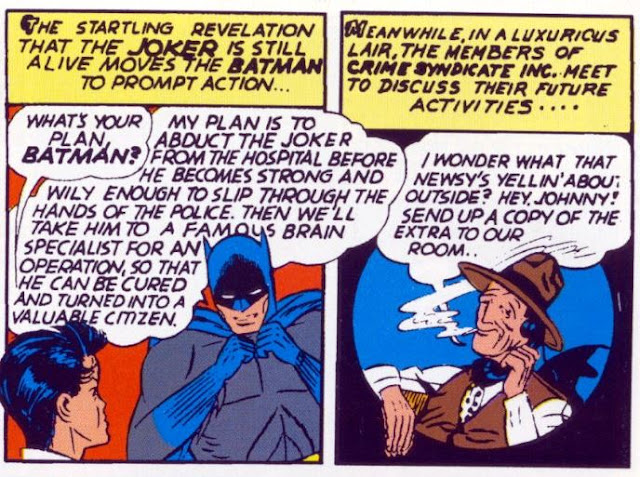
    Since the Joker actually survived the last issue, both Batman and the members of Crime Syndicate Inc  have the same idea: kidnap him while he’s being treated for his injuries, the former for some sort of gruesome lobotomy and the latter as a replacement for their recently deceased leader. More than half of the story is taken up with the dueling Joker kidnappings, after which he predictably betrays the crooks, strikes out on his own and ends up left for dead in a burning castle.

    More interesting to me is that this is the end of a sequence of events that, well, here’s a timeline:

    -Initial Joker crime spree. No time period is specified in the story but it seems a fairly rapid-fire series of crimes. Somewhere between 1 and 2 weeks, we’ll say. Joker is captured.

    -Two days later, Joker escapes. His crime spree resumes at the same pace, with at least two robberies occurring sequentially. Say another 1 to 2 weeks. Joker is seriously injured and rushed to hospital.

    -Crooks spirit Joker away following his treatment. His recovery lasts one week, after which he seemingly dies in a fire.

    What this all adds up to is a situation like Friday the Thirteenth 2 through 4, but whereas that was an astonishingly bloody weekend told over the course of three movies, this is the Joker committing at least 6 high-profile robberies and 13 murders over the course of one to two months! A huge debut for the big guy!

    4. Detective Comics v1 045, ‘The Case of the Laughing Death’

    Predictably, the Joker is not, in fact, dead! He remains alive to this day if you can believe it!

    He has, though, adopted a brand new modus operandi. Perhaps drawing on his brief time with Crime Syndicate Inc, he slips for the first time into an alter ego with the infuriating surname of Rekoj and forms a little gang of his own. Then, after his gang pulls a heist, he robs them as the Joker so that he doesn’t have to split the profits with them. IT’S A DUMB PLAN BUT IT WORKS.

    I’m willing to forgive, but only because of the great deathtraps, and this is a fun one: a record that releases Joker Toxin as it plays, thus killing even as its message is delivered. Insidious!

    At story’s end, the Joker is in the drink, presumed dead. For good? No.

    5. Batman Comics v1 004, ‘The Case of the Joker’s Crime Circus!’

    For his final outing of 1940, the Joker assembles another gang. This time, it’s one of my favourite styles of gang, the circus of crime! They specialize in casing wealthy patrons’ estates and manors and then using their circus skills to rob the various joints.

    Batman being Batman, he pieces together the clues and tracks down the Joker, who ends the adventure in the traditional manner by seemingly plummeting to his death.

    Body Count: at least 14

    End-of-year Status: Presumed Dead

  • SUPER-VILLAIN YEARBOOK: THE JOKER 1940

    What did the Joker get up to in 1940?

    1. Batman Comics v1 001, ‘Untitled’ **first appearance**

    The Joker really hits the ground running in his first crime-outing. He establishes his character – prideful, mercurial and on-theme – and methods that are still in his repertoire to this day

    He indulges in the old standard of warning the police ahead of time, then killing his target and stealing their named gems (uh, this is a personal term for any gem famous enough to have a name, like the Hope Diamond. they make more frequent appearances in comics than real life, unsurprisingly). Not the most creative of crime sprees by his own eventual standard, but everyone has to start somewhere. He also murders a number of people who challenge him, including a gang boss and a judge who once sent him to jail (a perfect 1/1 judge and jury revenge slaying! Aim low, kids!).

    Also established this adventure: the smiling-death style of Joker Venom, as well as:

    …the classic hideous Joker calling card design.

    But despite racking up an impressive success rate and almost killing both Batman and Robin on several occasions, the Joker ends his first outing in the slammer.

    2. Batman Comics v1 001, ‘The Joker Returns’

    That’s right, the Joker makes his second appearance in the same issue as his first! They knew he was a hot property from the very start!

    After a very dramatic escape from prison and a relocation to his secret cemetery hideout, the Joker settles into his familiar pattern: a taunting message, then theft or the murder of his enemies. In achieving the latter, he employs two of my very favourite deathtraps in comics:

    To bump off the Chief of Police: a sound-activated poison dart launcher concealed in his telephone – and he activates it by shouting his own name real loud! Tremendous style points there.

    The second is just sharpened playing cars with poison on the edges, but again there’s some tremendous style on display in the commitment to the bit of having an entire pack of jokers. Completely worth going around to every gaming supply store in Gotham to buy packs of the same brand of cards.

    A minor point in this adventure is that it highlights that the Joker is primarily a jewel thief, something that I associate with the Golden Age version of the character but that might just be me extrapolating from this issue.

    And finally we have the death of the Joker, truly one of the great on-brand death scenes of all time as he gets stabbed while struggling over a knife with Batman. It was a good run but the Joker is dead.

    OR IS HE???

    3. Batman Comics v1 002, ‘Untitled’

    Since the Joker actually survived the last issue, both Batman and the members of Crime Syndicate Inc  have the same idea: kidnap him while he’s being treated for his injuries, the former for some sort of gruesome lobotomy and the latter as a replacement for their recently deceased leader. More than half of the story is taken up with the dueling Joker kidnappings, after which he predictably betrays the crooks, strikes out on his own and ends up left for dead in a burning castle.

    More interesting to me is that this is the end of a sequence of events that, well, here’s a timeline:

    -Initial Joker crime spree. No time period is specified in the story but it seems a fairly rapid-fire series of crimes. Somewhere between 1 and 2 weeks, we’ll say. Joker is captured.

    -Two days later, Joker escapes. His crime spree resumes at the same pace, with at least two robberies occurring sequentially. Say another 1 to 2 weeks. Joker is seriously injured and rushed to hospital.

    -Crooks spirit Joker away following his treatment. His recovery lasts one week, after which he seemingly dies in a fire.

    What this all adds up to is a situation like Friday the Thirteenth 2 through 4, but whereas that was an astonishingly bloody weekend told over the course of three movies, this is the Joker committing at least 6 high-profile robberies and 13 murders over the course of one to two months! A huge debut for the big guy!

    4. Detective Comics v1 045, ‘The Case of the Laughing Death’

    Predictably, the Joker is not, in fact, dead! He remains alive to this day if you can believe it!

    He has, though, adopted a brand new modus operandi. Perhaps drawing on his brief time with Crime Syndicate Inc, he slips for the first time into an alter ego with the infuriating surname of Rekoj and forms a little gang of his own. Then, after his gang pulls a heist, he robs them as the Joker so that he doesn’t have to split the profits with them. IT’S A DUMB PLAN BUT IT WORKS.

    I’m willing to forgive, but only because of the great deathtraps, and this is a fun one: a record that releases Joker Toxin as it plays, thus killing even as its message is delivered. Insidious!

    At story’s end, the Joker is in the drink, presumed dead. For good? No.

    5. Batman Comics v1 004, ‘The Case of the Joker’s Crime Circus!’

    For his final outing of 1940, the Joker assembles another gang. This time, it’s one of my favourite styles of gang, the circus of crime! They specialize in casing wealthy patrons’ estates and manors and then using their circus skills to rob the various joints.

    Batman being Batman, he pieces together the clues and tracks down the Joker, who ends the adventure in the traditional manner by seemingly plummeting to his death.

    Body Count: at least 14

    End-of-year Status: Presumed Dead

  • SUPER-VILLAIN YEARBOOK: CLAYFACE 1940

    SUPER-VILLAIN YEARBOOK: CLAYFACE 1940

    What did Clayface get up to in 1940?

    Detective Comics v1 040, ‘Untitled’ **First Appearance**

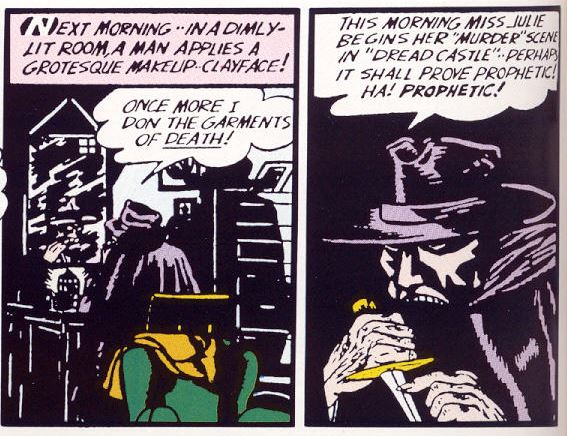
    I’m not surprising anyone when I reveal that Clayface is actually Basil Karlo, an oldtime horror movie star who tanked his own career and couldn’t take it when they started remaking his old movies, thus necessitating a costumed murder spree to ruin the filming of Dread Castle.

    Batman and Robin get involved because one of the prospective victims is Julie Madison, Bruce Wayne’s fiancé (in her last appearance as his fiancé). Much of the action is not, in fact, Clayface-related but rather concerned with the actions of various Clayface suspects such as drunk director Ned Norton, variously-gruntled actors Kenneth Todd and Fred Walker, and Gangster Roxy Brenner.

    Clayface himself wears the common purple hat and cloak combo of an early Batman villain. He doesn’t actually spend much time on-panel, so the degree of grotesqueness of his makeup is hard to judge, whatever the narration boxes say.

    And finally the reveal: Basil Karlo did it and he did it because of horror movies. He might just be the first character in comics to get the Don Quixote “the problematic media of the day is the real villain!” origin for his madness but he certainly won’t be the last.

    Number of Episodes of the “Super-Villains of Hollywood” podcast: Basil’s got to be an entire season all by himself, doesn’t he? If we’re dealing strictly with the events of the year 1940 we’re talking two episodes on his rise and fall, followed by one about the actual Clayface debut.

    Body Count: 2

    End-of-year Status: Captured

  • MINOR SUPER-VILLAIN 209: THE PANTHERMAN

    MINOR SUPER-VILLAIN 209: THE PANTHERMAN

    (Crackajack Funnies 031-033, 1941) 

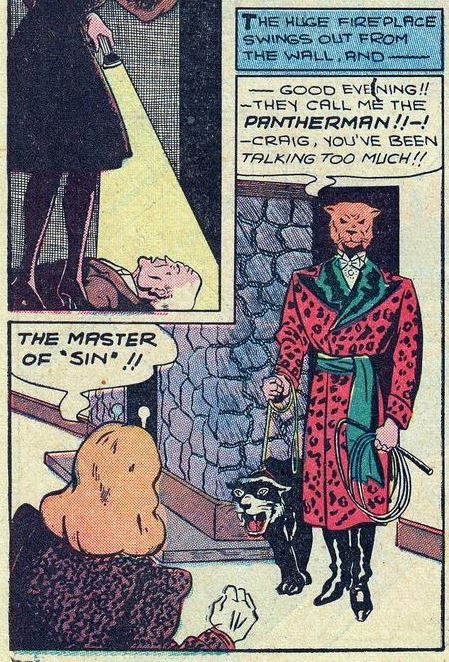
    The first costumed foe to face Dell Comics’ answer to Batman, the Owl, Pantherman strikes a very impressive figure and knows how to make an entrance. He does seem to be a very sloppy operator, however, as he initially attracts the attention of the Owl after mind controlling a man into stealing his own jewels but not somehow thinking to keep him from calling in the police (and renowned private investigator Nick “the Owl” Terry, natch) afterward.

    Subsequent issues reveal that the Pantherman’s sloppiness is more a recent thing, as he has been operating out of the city’s sewers for at least the past 4 years and is well on his way to uniting the underworld with himself at the head. It doesn’t take much to ruin a promising crime career, however, and once the Owl is on the case, Pantherman is soon caught.