The Curse of Skeleton Munroe

Category: murderer

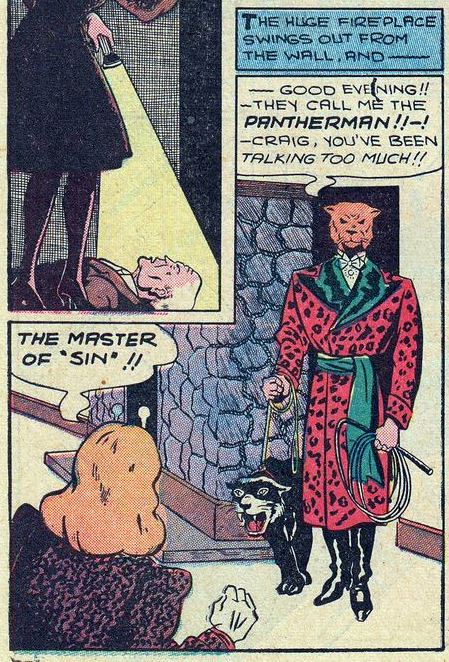
  • MINOR SUPER-VILLAIN 209: THE PANTHERMAN

    MINOR SUPER-VILLAIN 209: THE PANTHERMAN

    (Crackajack Funnies 031-033, 1941) 

    The first costumed foe to face Dell Comics’ answer to Batman, the Owl, Pantherman strikes a very impressive figure and knows how to make an entrance. He does seem to be a very sloppy operator, however, as he initially attracts the attention of the Owl after mind controlling a man into stealing his own jewels but not somehow thinking to keep him from calling in the police (and renowned private investigator Nick “the Owl” Terry, natch) afterward.

    Subsequent issues reveal that the Pantherman’s sloppiness is more a recent thing, as he has been operating out of the city’s sewers for at least the past 4 years and is well on his way to uniting the underworld with himself at the head. It doesn’t take much to ruin a promising crime career, however, and once the Owl is on the case, Pantherman is soon caught.
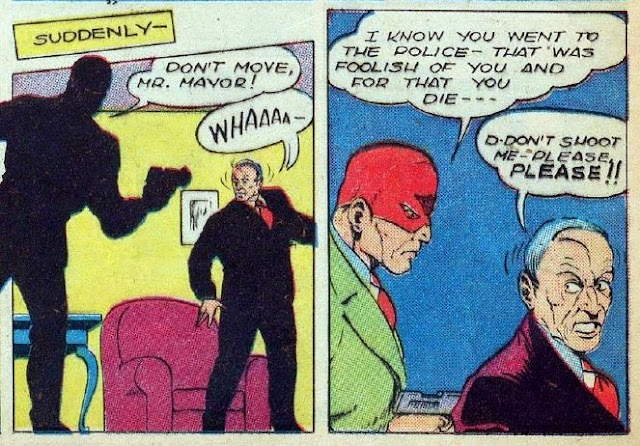
  • MINOR SUPER-VILLAIN 208: THE TERROR

    (Crack Comics 018, 1941)

    Not too much to distinguish this guy: he’s Bumps Bale, a former pinball racketeer (you’re just as likely to see Batman smashing up a bunch of pinball machines as an underground casino or a slot machine in the 40s. Gambling is Bad and Pinball is Gambling, was the attitude) who had hit hard times and decided to go into extorting mayors as a second career. Accordingly, he poisoned city comptroller Ezra Daves and promised Unnamed Mayor here some of the same if one million dollars in small bills was not produced post haste. Sadly for the Terror, the Clock got involved.

    I do have to say that I appreciate the cowl-style mask that the Terror is sporting. Personally I find it far more aesthetically pleasing than the executioner’s hoods and cloth draperies that have been more the norm thusfar.

    (also for those keeping track this is presumably the mayor who took over after the Big Shot was ousted, placing him somewhere on a very spicy alternate Wikipedia page for List of Mayors of New York City)

  • MINOR SUPER-VILLAIN 205: THE JACKAL

    (Crack Comics 017, 1941)

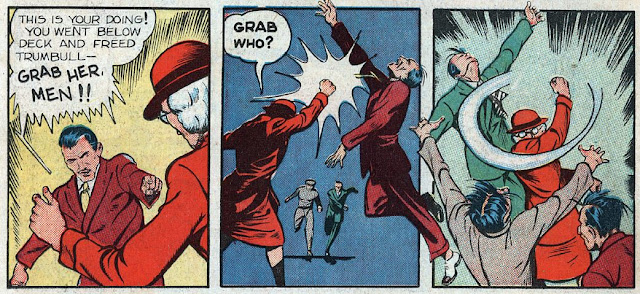
    Like the Cloak before him, the Jackal started out as a fictional villain: made up by promoter Paxton Forbes to obfuscate his own role in murdering sea Captain Bly and stealing his treasure map. But if you do the very things you say that a villain has done, I would contend that you are, in fact, that villain. And Madam Fatal agrees, so there.

  • MINOR SUPER-VILLAIN 205: THE JACKAL

    (Crack Comics 017, 1941)

    Like the Cloak before him, the Jackal started out as a fictional villain: made up by promoter Paxton Forbes to obfuscate his own role in murdering sea Captain Bly and stealing his treasure map. But if you do the very things you say that a villain has done, I would contend that you are, in fact, that villain. And Madam Fatal agrees, so there.

  • MINOR SUPER-VILLAIN 200: THE CRIMSON VULTURE

    (Crack Comics 015, 1941)

    The Crimson Vulture is a prime example of a character who could be so much better with just a little more oomph put behind him. His real name is Sarada, and he is a genius mechanical engineer who is back for revenge after being sent to prison. All well and good, but his actions – attempting to extort money from a series of rich men via mechanical vultures and then blowing them up when they refuse – have no in-story link to his motivation. They easily could, if, say, they were responsible for his incarceration or had profited from his genius while he was away, but no dice. Even if it was made clear that he was striking out at society in general, that would be more of a satisfying motivation.

    He gets blown up by Madam Fatal, a suitably ignominious end for our less-than-satisfying 200th minor super-villain.

  • MINOR SUPER-VILLAIN 193: THE TIGER WOMAN

    (Crack Comics 009, 1941)

    The Tiger Woman is another in a long line of characters who are vilified for pushing back against colonialism – in this case, American explorers appropriating her peoples’ treasures. Or she would be if the way she was pushing back wasn’t murder, which tends to muddy the righteousness of any cause.

    She does have a really great costume, though. Top marks for style.

  • MINOR SUPER-VILLAIN 193: THE TIGER WOMAN

    (Crack Comics 009, 1941)

    The Tiger Woman is another in a long line of characters who are vilified for pushing back against colonialism – in this case, American explorers appropriating her peoples’ treasures. Or she would be if the way she was pushing back wasn’t murder, which tends to muddy the righteousness of any cause.

    She does have a really great costume, though. Top marks for style.

  • MINOR SUPER-VILLAIN 184: THE ASP

    (Crack Comics 004, 1940)

    What makes them a super-villain? Any number of things! The Asp is a jewel thief who taunts his victims/ the police ahead of time and then arranges for seemingly impossible murders using time-delayed poisons. He’s a weird creep who hisses all the time and almost manages to kill the Clock. And yet… it’s all a little perfunctory. I saw someone on the DC wikia editorialize about how the Asp’s MO was similar to the Joker’s first appearance, and they aren’t wrong, but where the Joker had a little room to breathe and establish himself over the course of 3 or 4 crimes, the poor Asp is dead and gone after just one.

  • MINOR SUPER-VILLAIN 182: THE BIG SHOT

    (Crack Comics 001, 1940)

    A series of facts about Golden Age super-hero comics:

    -most of them take place in cities

    -they are either set in a specific location (e.g. Wonder Woman being in Washington DC or the Red Bee in Superior City) or an unidentified large city

    -in the latter case, over time the city acquires characteristics that either lead to it becoming its own thing (e.g. Batman’s unidentified large city becomes Gotham) or being identified as New York City

    Now there are plenty of exceptions to this (Superman starts out in Cleveland which quickly becomes Metropolis; plenty of Golden Age heroes didn’t stick around for their location to gel, etc etc) but it does happen a fair amount and it leads to situations like the above, wherein the Clock, who lives in an unidentified large city clearly based on NYC, arrests crimelord the Big Shot and learns that he is in fact Mayor Kozer! And then over the years it becomes more and more clear that Clock stories are set in New York and you end up with an alternate history of the office of Mayor of New York City in which Fiorello la Guardia is presumably repeatedly ousted from office only to be reelected following the various Evil Mayor Arrested by Vigilante scandals. This is the sort of thing that really gets my heartrate up!

    Anyway: the Big Shot, folks.

    EDIT TO ADD:

    This isn’t even the first Mayor of NYC that the Clock is responsible for the arrest of: one year earlier he helped send Mayor Tull up the river! (Feature Comics 022, 1939)

  • MINOR SUPER-VILLAIN 175: THE MAN WITHOUT A FACE

    (Bulletman 002, 1941) 

    Gangster Scar Malone was convicted of murder and sentenced to the electric chair. He swore revenge against the judge and jury, as you do. And once you’ve done that kind of thing, you only have a few options: fake your own death so you can come back as a fake ghost to kill your enemies; arrange for your body to be taken to a scientist or magic man for post execution revival so you can slay your enemies; have your secret twin pose as your vengeful spirit to kill your enemies, or do what Malone opts for: simply escape while on the way from trial to prison, (optionally searing your face off with hot steam while doing so) and come back months later to kill your enemies.

    If I’m to judge (haha) a judge and jury revenge killer’s relative quality, it’s going to be a numbers game – just how many of their self-assigned targets did they manage to take out. Even though he was a master of escape and disguise, the Man Without a Face managed a mere 2/13 or 15% before being thrown off a roof by Bulletman. A poor showing indeed.