The Curse of Skeleton Munroe

Category: murderer

  • MINOR SUPER-VILLAIN 968: THE BLACK RIDER

    (Fantastic Comics 018, 1941)

    The Black Rider is a ruthless bandit chief who has not only terrorized the countryside but has had the audacity to kidnap Bill Carrol, Captain Kidd’s best friend, an unforgivable sin.

    While the Black Rider & Co. might look like they are straight out of a comic set in the American West, Captain Kidd’s 1941 adventures have taken place exclusively in Africa, and given the mention of a city called Tanga above, I think that we can pretty confidently place this comic somewhere in present-day Tanzania, in the part that was then Tanganyika (yes, okay, there’s also a couple of Tangas in Burkina Faso. I just don’t think that they’re the right ones, okay?).

    Though the Black Rider manages to overpower Captain Kidd and stick him in a booby-trapped airplane during their first encounter this is absolutely not enough to dissuade even novice two-fisted adventurer, let alone a grizzled veteran like Kidd. Kidd’s return gambit is to storm the Black Rider’s HQ and machine gun the entire gang.

    The entire gang bar the Black Rider, that is, because it’s time for the dramatic revelation that the Black Rider is… A LADY???!!! Specifically, she is the daughter of the original Black Rider, out for revenge since he was killed by vigilantes but now on her way to a British colonial jail and/or execution. Please note that the Black Rider pulls the old “roughly the same size as an adventure hero until unmasked” trick, going from a burly six foot to a slender 5’6″ in about one panel.

    Categorized in: Colours (Black), Generica (Riders), Origin (Cross-Dressing Characters, Legacy Characters)

  • MINOR SUPER-VILLAIN 967: THE FANG

    (Fantastic Comics 017, 1941)

    The Fang is a recurring villain in the mould of his Fox Features contemporaries the Rook and the Beast: you can knock him down and seemingly kill him as much as you want but he’s just going to keep on coming back to do more crimes.

    When he first appears, the Fang’s major goal is to acquire the Burma Emerald from its caretaker Princess Kava, in order to decipher the secret of invisibility that has been carved into its surface. His initial attempt to snatch the emerald leads him to murder Police Sergeant Marley of the Princess’ protection detail, which directly inspires Marley’s son Chuck to become a costumed crimefighter under the tutelage of the Black Fury.

    Perhaps because Black Fury scribe realized that a series of comics about a man trying and failing to achieve invisibility would be less interesting than one about an invisible crook, the Fang breaks prison in his second appearance and gets ahold of the emerald almost immediately. So what does he use his newfound powers of invisibility for?

    – bank robbery (Fantastic Comics 018)

    – framing a man for murder in order to buy his house that has an ideal smuggling setup in the form of a secret tunnel to the coast (Fantastic Comics 019)

    – sabotaging arms shipments to Allied Europe on behalf of the Axis (Fantastic Comics 020)

    I judge these… okay criminal uses of invisibility. Nothing spectacular.

    Though I set up the comparison between the Fang and the Rook/the Beast
    myself, I must now point out the way in which he differs from them: he doesn’t seemingly die at the end of every appearance. Instead, he alternates seeming to die being caught: he’s caught in Fantastic 017, crashes into an oil tank in 018, caught again in 019, and does a header into a well full of slime in Fantastic Comics 020. 

    If there’s one thing that invisibility powers are extremely good at it’s in helping to fake one’s own death, though how they help to get out of an ooze pit is beyond me.

    Sadly and annoyingly, the final page or two of the Fang’s last appearance is not currently available. He is in the process of planting a bomb at the end of the portion that we do have, which makes it highly likely that he went on to be blown up, and that death finally claimed him. Alternately, perhaps he was arrested again and just treated with the appropriate amount of care by the authorities. It is my hope that we will someday learn the truth.

    Categorized in: Body (Nonhuman Parts – Fangs), Narrative Footballs (Origin Story Guys), Powers (Invisibility)

  • MINOR SUPER-VILLAIN 967: THE FANG

    (Fantastic Comics 017, 1941)

    The Fang is a recurring villain in the mould of his Fox Features contemporaries the Rook and the Beast: you can knock him down and seemingly kill him as much as you want but he’s just going to keep on coming back to do more crimes.

    When he first appears, the Fang’s major goal is to acquire the Burma Emerald from its caretaker Princess Kava, in order to decipher the secret of invisibility that has been carved into its surface. His initial attempt to snatch the emerald leads him to murder Police Sergeant Marley of the Princess’ protection detail, which directly inspires Marley’s son Chuck to become a costumed crimefighter under the tutelage of the Black Fury.

    Perhaps because Black Fury scribe realized that a series of comics about a man trying and failing to achieve invisibility would be less interesting than one about an invisible crook, the Fang breaks prison in his second appearance and gets ahold of the emerald almost immediately. So what does he use his newfound powers of invisibility for?

    – bank robbery (Fantastic Comics 018)

    – framing a man for murder in order to buy his house that has an ideal smuggling setup in the form of a secret tunnel to the coast (Fantastic Comics 019)

    – sabotaging arms shipments to Allied Europe on behalf of the Axis (Fantastic Comics 020)

    I judge these… okay criminal uses of invisibility. Nothing spectacular.

    Though I set up the comparison between the Fang and the Rook/the Beast
    myself, I must now point out the way in which he differs from them: he doesn’t seemingly die at the end of every appearance. Instead, he alternates seeming to die being caught: he’s caught in Fantastic 017, crashes into an oil tank in 018, caught again in 019, and does a header into a well full of slime in Fantastic Comics 020. 

    If there’s one thing that invisibility powers are extremely good at it’s in helping to fake one’s own death, though how they help to get out of an ooze pit is beyond me.

    Sadly and annoyingly, the final page or two of the Fang’s last appearance is not currently available. He is in the process of planting a bomb at the end of the portion that we do have, which makes it highly likely that he went on to be blown up, and that death finally claimed him. Alternately, perhaps he was arrested again and just treated with the appropriate amount of care by the authorities. It is my hope that we will someday learn the truth.

    Categorized in: Body (Nonhuman Parts – Fangs), Narrative Footballs (Origin Story Guys), Powers (Invisibility)

  • GENERIC COSTUMED VILLAIN ROUND-UP 041

    Mamas lock up your radium, because the z-tier villains are back in town.

    the Fuhrer of Brazil:

    Larry North is a US Naval Reserve Lieutenant and airline pilot who turns hand to Nazi spy-hunting when he and his companion Betty Harmon are hijacked by fascists in Rio di Janiero. They spend their first few adventures dismantling a scheme to conquer Brazil, and when in the course of this the traitorous and toothbrush-mustached Doctor Sanchez mentions a figure called the Fuhrer of Brazil, I naturally figured that he would be the final boss of the saga. No dice, it turns out, as he never personally appears and  probably dies when the Brazilians bomb all of the Nazi bases using North’s intel. (Exciting Comics 012, 1941)

    Billings:

    Billings, along with four other men (Hawkins, Griffith, Stanton and Carton) own the zoo of the as-yet-unnamed city that the Black Terror calls home, I think? They own a zoo, at any rate. Perhaps it is in direct competition with the city’s.

    The thing is that Billings a) holds the mortgage for the zoo and b) is broke while the others are wealthy and c) wants to change that by foreclosing on the zoo and selling the land for a huge profit. He probably could have accomplished this with a bit of underhanded business trickery or possibly by admitting to his three friends that he needs the money, but as is so often the case in comics he instead chooses to put on a mask and murder the other four. Confusingly, he does a pretty good job of framing Carton for killing the other three before attempting to murder him as well. We’ll never get a chance to see how he was going to spin this because it is at this point that the Black Terror knocks his block off. (Exciting Comics 013, 1941)

    Al Walsh:

    This masked blackmailer is actually reporter Al Walsh, who digs up dirt on people in the course of his job and then makes them pay big bucks to keep it under wraps. The Mask settles his hash, but not before getting one of his victims killed in an ill thought-out plan. (Exciting Comics 013, 1941)

    Dr Cobra:

    Dr Cobra is the recurring enemy of Ted Crane, who is one of those 1940s adventurers who compulsively seeks out action and excitement and today would probably be an extreme freeclimber or something like that. Given that he appears seven or eight times and that I have not read most of those issues, I might be selling him short when I say that his cool name is all that he has going for him, but I’m willing to risk it. (Exciting Comics 014, 1941)

  • MINOR SUPER-VILLAIN 962: THE MASTER

    (Exciting Comics 015, 1941)

    The
    Master is a mysterious new crooks who has been going around town kidnapping wealthy men,
    and the Black Terror and Tim have been running around after him and
    trying to figure out just what the heck is going on. The Master is also a classic Bad Boss in the “ruthlessly kill your minions” mould.

    As it turns out, the Master has broadly the same origin story as early Batman villain the Ugliest Man in the World,
    only instead of a medical student who was injected with a random
    cocktail of drugs and turned ugly in a frat hazing gone wrong, he is
    instead a chemistry student who was exploded by a random mixture of chemicals in some frat bullying gone
    wrong. Like his counterpart, the Master (aka Alfred Foster, aka Phillip
    van Allen) dropped out of sight, acquired a rubberoid mask and
    established a new identity so that he could enact his revenge on those
    he blamed for his disfigurement.

    Unlike the Ugliest Man in
    the World, the Master’s theming is not strong. He himself is vaguely
    Egyptian themed, while his henchmen are just a bunch of Malaysian guys who he does not treat very well.

    The
    Master’s plan also revolves around gathering up his tormentors so that
    he can kill them all at once, meaning that his revenge goes almost entirely unfulfilled when he is accidentally
    killed by one of his own men. All in all a very poor foray into super-villainy.

    Revenge Killer Score: 0/12

    Categorized in: Accessories (Rubberoid Mask), Generica (Masters), Origin (Extensively Scarred Face)

  • MINOR SUPER-VILLAIN 961: DR ZINN

    MINOR SUPER-VILLAIN 961: DR ZINN

    (Exciting Comics 009, 1941)

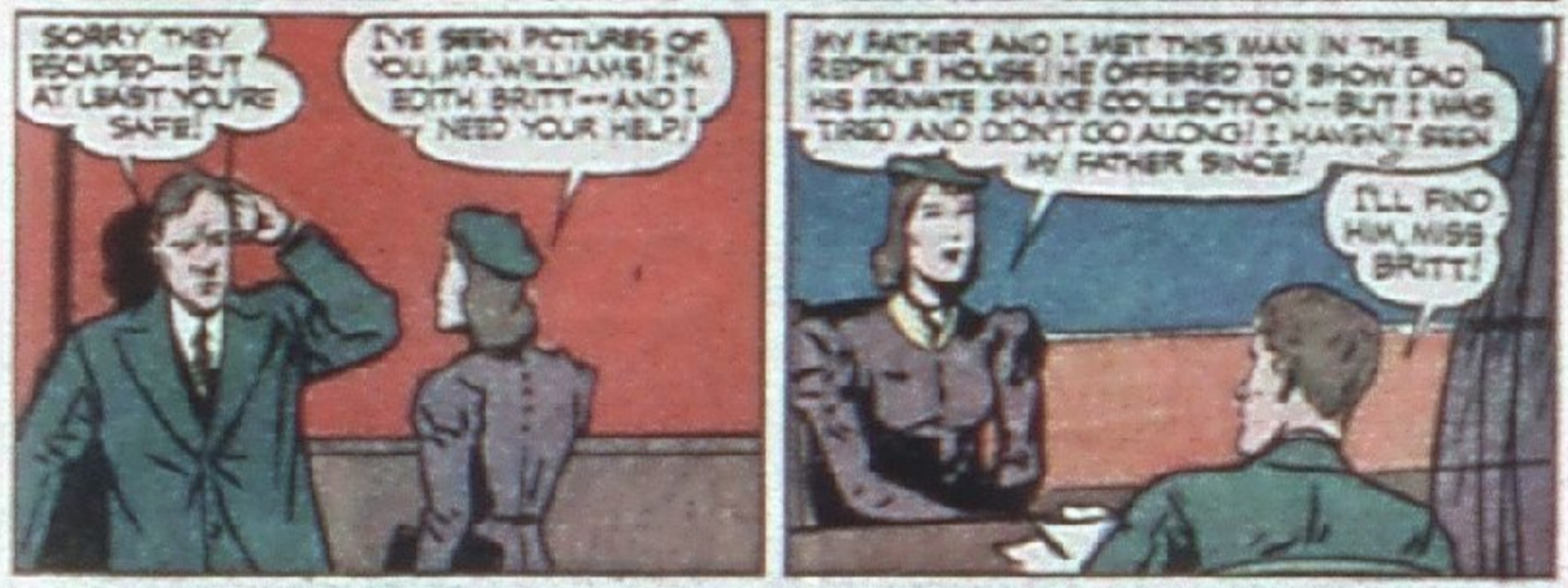
    Dr Zinn feels like a character who is somehow aware of my classification system and who is desperate not to be relegated to the ranks of the Generic Costumed Villain (yes, the “costumed” part has lost all meaning, I know) and so has shoehorned as many extra details into his appearance as possible to force me to give him Minor Super-Villain status. “what if I wasn’t just a super tall hypnotist, but also obsessed with snakes? And what if I ran a cult, the Cult of the Serpent, full of mind controlled thralls and they were also obsessed with snakes?” And I guess it worked.

    Dr Zinn’s main goal in his one appearance is to get ahold of the contents of a safe deposit box owned by a Mr Britt and his daughter, and while they never lay out what exactly is in there I certainly hope it’s securities or deeds to property or something, because if that little bundle of paper is meant to be cash then it’s like ten thousand dollars tops (I guess the Britts could have gotten their hands on some vanishingly-rare ten thousand dollar bills but we’re still not talking about multiple millions) and even in 1941 that’s not enough money to go to so much effort for.

    Zinn is captured after Edith Britt hires PI par excellence Dan Williams, who really undercuts the threat of hypnotic mind control by giving him a couple of eyes full of black pepper. 

    Addendum: I almost forgot to mention that Dr Zinn (whose first name is Mephiste, by the way) comes to the attention of the law when he orders some poisonous snakes through the mail and some get out and kill two postal workers, and he just grabs the rest and skedaddles out of there.

  • MINOR SUPER-VILLAIN 960: THE MAN IN THE HOOD

    MINOR SUPER-VILLAIN 960: THE MAN IN THE HOOD

    (Exciting Comics 008, 1941)

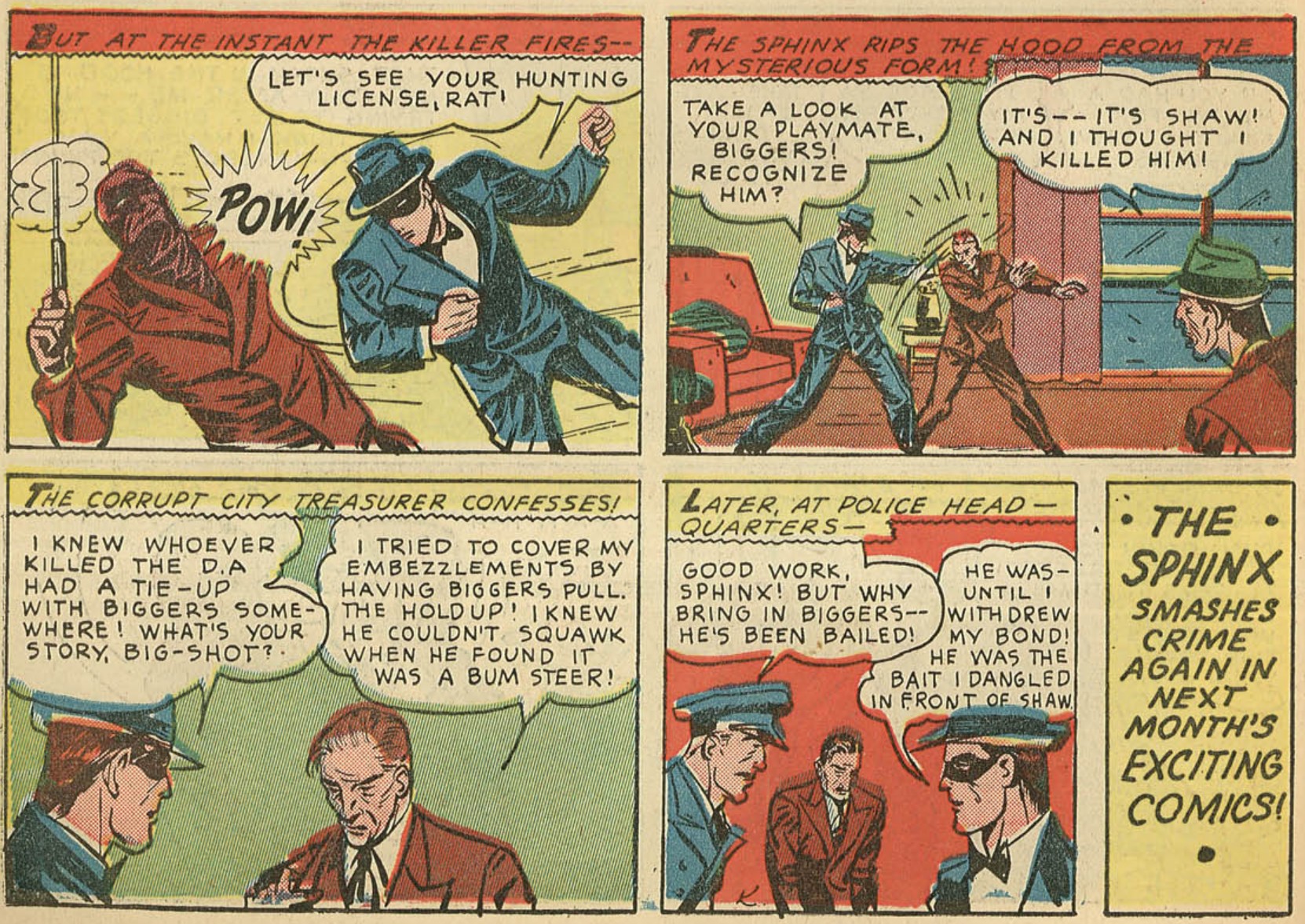
    This fellow expends an awful lot of effort setting up and facilitating a city payroll robbery by gang boss Owney Biggers. He is eventually revealed to be City Treasurer Robert V. Shaw, who has set the whole thing up, double-crossed Biggers, faked his own death and murdered several people in order to cover up the fact that he had been embezzling city funds.

    The most annoying thing about this annoying man (seriously, just an irritating character. True loser energy) is that he isn’t actually called the Man in the Hood, or anything else for that matter. Instead, he is variously referred to as:

    -a Menacing Form

    -that Bozo on the Roof

    -the Masked Attacker

    -the Hooded Killer

    -the Mysterious Assailant

    -that Mug

    -that Sneak in the Hood

    -a Grim Figure

    -that Rat in the Hood

    -the Guy in the Hood

    -the Killer

    -the Mysterious Form

    and “the Man in the Hood” is as good of a throughline as I could achieve from that mess.

    Categorized in: Objects (Hoods), Origins (Faked Own Death), Theft (Embezzlers) 

  • MINOR SUPER-VILLAIN 959: THE INVISIBLE MENACE

    (Dynamic Comics 002, 1941)

    It’s a story as old as comics and then some: an inventor has come up with a cool superscientific gizmo – in this case an invisibility serum – and no sooner are they done than some gangsters come stiffing around looking to exploit it. This particular gang is headed by an unnamed and trigger-happy fellow who guns down the scientist and then his own men in order to get his mitts on the single available dose of the stuff.

    The gangster dubs himself “the Invisible Menace” and this is the only reason I am calling him that instead of “the Invisible Killer” as everyone else in the story including the caption boxes does. 

    There’s a kind of critical and/or cultural debate over the madness of the main character in HG Wells’ the Invisible Man, over whether the titular character goes mad with the power inherent in being invisible or the process itself has some flaw that warps the human mind. Whichever way you slice it, the Invisible Menace has Invisibility Madness: no sooner does he fade from sight than he is slaughtering people left and right. Not that he wasn’t killing people while he was still visible but at least that was to some purpose. This is just wanton murder.

    The big question is: is this guy invisible forever? Neither he nor we ever find out, and frankly it matters quite a lot because it’s going to be pretty difficult to enjoy your riches as an invisible guy if the only other invisible guy anyone has ever heard of is famous for attacking a garden party with a tommy gun.

    The question never really gets resolved thanks to one of the great flaws in any invisibility-related plan: that you are still detectable via other senses. Accordingly, the Invisible Menace is stopped at the fangs of the dog hero K-9.

    Categorized in: Abstract Concepts (Menace), Body (Physical Qualities – Invisibility), Powers (Invisibility)

  • MINOR SUPER-VILLAIN 958: THE YELLOW HOOD

    (Dynamic Comics 002, 1941)

    In probably the cheekiest campaign of terror ever, American defense officials are being murdered and then their shrunken skulls are being sent along to places where people are waiting for them with notes reading “Don’t wait for me any longer, here I am.”

    You may have noticed that all of the skull deliveries involved a man named Professor Curran, and being seasoned comics readers you rightly would have suspected that he was involved in the scheme somehow. It can’t be him, however, as Curran is one of the victims, murdered just out of sight of a captured Major Victory.

    Just kidding: the Yellow Hood and Professor Curran are one and the same, and the murder was staged to throw suspicion off of him. Curran’s role as a Chief Air Warden meant that he was in a prime position to facilitate a Nazi invasion of the United States, and the murders were designed to weaken US defenses further. It’s a high risk/ high reward endeavour, as evidenced by the fact that Curran chucks himself off a cliff rather than be captured by Major Victory.

    Categorized in: Accessories (Calling Cards), Colours (Yellow), Objects (Hoods)

  • MINOR SUPER-VILLAIN 955: THE YELLOW SPOT

    (Dynamic Comics 001, 1941)

    Scientists across the US are going missing, kidnapped by  the magical madman known as the Yellow Spot!

    This brain-draining crime spree inspires the magical scholar Professor Moore to create the super-hero Dynamic Man, which in turn inspires the Yellow Spot to murder Professor Moore. He is just a wee bit too late, however, and instead of preventing the creation of Dynamic Man he merely provides him with a bit of extra motivation in the form of a dying father figure.

    But just why is the Yellow Spot after these men of science? Why, to push back against the death of superstition (very funny in retrospect, as in out world the avowed hyper-rationalism of the 40s and 50s gave way to the mystic syncretism of the 60s and ultimately to the proud anti-science of today). He’s got a machine that shrinks a man’s head and renders him like unto a child, and presumably he plans to keep on shrinking heads until it has an effect on the global scientific consensus.

    Dynamic Man shows up just in time to witness a head shrinking, and while it looks to be a pretty uneven contest at first, he is captured in a net made of woven black magic (very cool) that can only be cut using a knife “forged from the bones of a dying murderer” (even cooler, if hard to imagine).

    The thing about a net that can only be cut by a special knife is that it’s only as effective as your ability to keep that knife away from your prisoner, and I would argue that leaving it unattended on a table in the same room as the prisoner while a bunch of easily suggestible man-children wander around is tantamount to just handing it over. Which is a long-winded way of saying that Dynamic Man gets free with the help of a headshrunken scientist and starts beating up the Yellow Spot’s men.

    The Yellow Spot makes a break for it, but in an eleventh hour bit of plot contrivance it turns out that his bat form (i.e., the main way he gets around) is also the only form in which he can be harmed, and as it flies slower than Dynamic Man, he ends up as a flat bat. Personally, I would sacrifice a bit of convenience to avoid being squashed on the wing like this, but then again I am not an insane magic man.

    Finally, I would like to highlight the Yellow Spot’s minions, a bunch of low-grade monster men who he calls the Hideous Ones at least once. Particularly that last fellow, who I swear has half a mustache. A bold choice!

    Categorized in: Abstract Concepts (Shapes), Colours (Yellow), Origins (Henchmen)