The Curse of Skeleton Munroe

Category: murderer

  • MINOR SUPER-VILLAIN 170: THE BLACK SPIDER

    (Bulletman 001, 1941)

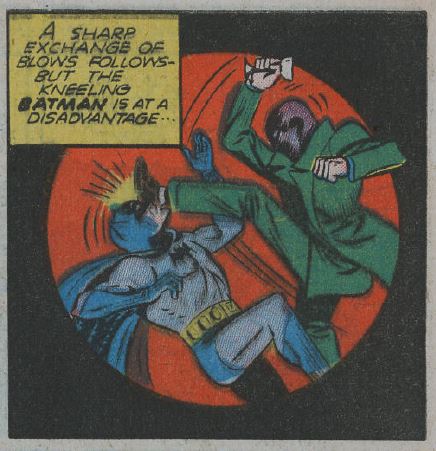
    What makes them a super-villain? The Black Spider is Jules Rey, a French crook who got caught in NYC and shipped back to France, where he was thrown in a dungeon, went blind, befriended the spiders in his cell and escaped. Now he’s back for revenge on those he blames for his circumstances, including Jim “Bulletman” Barr and his coworker and future father-in-law Sergeant Kent. Plus he dresses in a kind of low-rent Batman costume.

    What is interesting about them? Mostly that there is no actual indication in-comic that this guy is either blind or French, other than when they say he is late in the comic. Also he dies for no real reason, just a “he’s dead!”.

  • MINOR SUPER-VILLAIN 170: THE BLACK SPIDER

    (Bulletman 001, 1941)

    What makes them a super-villain? The Black Spider is Jules Rey, a French crook who got caught in NYC and shipped back to France, where he was thrown in a dungeon, went blind, befriended the spiders in his cell and escaped. Now he’s back for revenge on those he blames for his circumstances, including Jim “Bulletman” Barr and his coworker and future father-in-law Sergeant Kent. Plus he dresses in a kind of low-rent Batman costume.

    What is interesting about them? Mostly that there is no actual indication in-comic that this guy is either blind or French, other than when they say he is late in the comic. Also he dies for no real reason, just a “he’s dead!”.

  • MINOR SUPER-VILLAIN 165: THE EEL

    (Blue Beetle v1 006, 1941)


    What makes them a super-villain? I’ll be honest. The Eel’s initial plot – take over 
    NYC York City ‘s shipping industry in order to starve and thereby ransom the city – was, while ambitious, a bit old hat and I was going to write him off as another jagoff gang boss with a decent moniker. But then! He reveals his Room of Horrors(!) where he pickles his enemies alive(!!), and, well, how could I not?

  • MINOR SUPER-VILLAIN 164: THE MASKED MAN

    MINOR SUPER-VILLAIN 164: THE MASKED MAN

    (Batman Comics 008, 1941)

    I got pretty excited when reading this story, as it concerns murders among the cast and crew of a play called the Superstition Murders and there’s a lot of kerfuffle about bad luck and jealousy and drunk has-been actors and I was hopeful that it might boil down to my favourite motive for supercrime: mad art. Just as mad as mad science but it really makes you think, you know?

    Sadly, the real motive for the crimes is simply base capitalism: if playwright Johnny Glim (good name) can tank the production, rights to the script revert to him and he can sell it to Hollywood for beaucoup bucks. But while you know I am all in favour of creator-owned properties I cannot stress enough that multiple homicide is not a good way to go about securing them and his capture by the Batman is a righteous one.

    Number of Episodes of the “Super-Villains of Hollywood” podcast: Part of a poorly-received later season attempt to profile villains who almost got to Hollywood.

  • MINOR SUPER-VILLAIN 162: THE CLOCK MAKER

    (Batman Comics 006, 1941)

    A few different longstanding comic book bits make early appearances in the tale of the Clock Maker. First, Bruce Wayne has to go to a boring old board meeting at one of the many companies that he has an stake in, but that meeting sows the seeds of crime. Specifically, they all go to a clock store together afterward and Atkins, the evil board member who wants to gain sole ownership of the clock company for some reason, meets Elias Brock, an unhinged old man who loves clocks so much that he gets violently angry at the thought of wasting or killing time.

    Which leads to the second recurring comics motif: the calculating villain convinces an unstable person to do their killing for them. Brock takes out two board members and almost gets Bruce Wayne before Batman works out the plan, then kills Atkins and almost blows up a decent part of Gotham before being pitched out a window by Robin.

    A side note is that the comic itself seems to somewhat agree with the clockmaker with regard to the precious nature of time – the man himself is a bit of an anticapitalist…

    … while Batman expresses more of a rise and grind mentality, completely unsurprisingly.

  • MINOR SUPER-VILLAIN 156: OOM THE MIGHTY

    (All-Star Comics 003, 1940)

    Oom the Mighty is, by his own description, a sort of low-rent Gozer the Gozerian: a murderous entity of the ancient past who has returned to kill again. Only instead of whole civilizations boiling in his belly or what have you, Oom kills a handful of people every full moon – still bad, but not quite as much cosmic terror.

    The original appearance of Oom (involving a dimension-hopping battle with the Spectre) maybe kind of implied that he was a spirit that was possessing a bronze grotesque, but later appearances – Oom, like Nyola before him, was Roy Thomased into the Monster Society of Evil in the pages of All-Star Squadron – treat the body as his own, thus introducing the question of why the city of Cliffland New Jersey was festooning their buildings with prehistoric statuary. Whichever is the case, possibly the most interesting thing about Oom is the fact that sometime in the last 30ish years he seems to have made the leap from Justice Society/ Spectre villain to Marvel Family foe, presumably via the Monster Society link.

  • MINOR SUPER-VILLAIN 154: THE YELLOW-FACED TERROR

    (All-Star Comics 002, 1940)


    What makes them a super-villain? He’s a money-mad maniac who murdered his own brother to steal a radiation-orb called the Life-Taker, which he uses to rob by the simple act of lobbing it into an area and waiting until it has killed any resistance. He also has a pretty great look, achieved via a crust of a sulphur/lead compound which shields him from his own orb’s radiations. What he doesn’t really have is a name, so I snitched the one used in the above text box.

    What’s interesting about them? Well, it’s a bit debatable but the Sandman might have murdered him. He discovers Wesley Dodds’ secret in the course of the adventure and then in the final struggle… it kind of looks like the Sandman arranges for him to be shot through the head a bit more enthusiastically than needed. Maybe.

  • MINOR SUPER-VILLAIN 154: THE YELLOW-FACED TERROR

    (All-Star Comics 002, 1940)


    What makes them a super-villain? He’s a money-mad maniac who murdered his own brother to steal a radiation-orb called the Life-Taker, which he uses to rob by the simple act of lobbing it into an area and waiting until it has killed any resistance. He also has a pretty great look, achieved via a crust of a sulphur/lead compound which shields him from his own orb’s radiations. What he doesn’t really have is a name, so I snitched the one used in the above text box.

    What’s interesting about them? Well, it’s a bit debatable but the Sandman might have murdered him. He discovers Wesley Dodds’ secret in the course of the adventure and then in the final struggle… it kind of looks like the Sandman arranges for him to be shot through the head a bit more enthusiastically than needed. Maybe.

  • MINOR SUPER-VILLAIN 145: THE MASK

    (Adventure 068, 1941)

    An orchestra conductor who goes off the deep end when he gets fired. Not a terribly deep concept, but he kills his replacements with an electrified conductor’s baton trap and he leaves comedy and tragedy mask symbols to show his involvement so there’s a lot for me, a themed crime enthusiast, to enjoy.

  • MINOR SUPER-VILLAIN 131: THE ADDER

    (Action Comics v1 035, 1941)

    Yet another spy encountered by Clip Carson, the Adder was interested in blowing up the Panama Canal for unclear reasons. Much more interestingly, he took his name from a snake-shaped ring which both fatally poisoned those he punched with it and left a cool snake mark on the spot he hit, and evidently he used it enough that his men spoke of him in hushed terms as “the Child of Death,” which is an amazing name.

    As with so many villains who use a cool signature weapon, the Adder ends up falling on his own ring. A sad end.