The Curse of Skeleton Munroe

Category: Nazi

  • MINOR SUPER-VILLAIN 300: THE RINGMASTER OF CRIME

    (Captain America Comics 005, 1941)

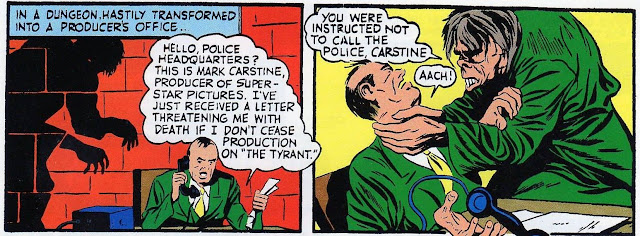
    Finally, FINALLY, after 300  of these guys an arbitrary milestone lines up with a reasonably cool character: the Ringmaster of Crime AKA the Ringmaster of Death. Compounding the fun of the circus of crime aesthetic is the fact that some of that good-style retconning has been going on and the Ringmaster in this tale has been made the father (and presumably later grandfather, per Marvel’s sliding timeline) of the mid-level super-villain the Ringmaster! Uh, if saying that someone is someone else’s grampaw is a retcon, that is.

    The practical upshot of this is that this Minor Super-Villain writeup also functions as Super-Villain Yearbook, 1941 for the Circus of Crime, which, as a family-owned business entity, is contiguous with the version that reappeared in the 60s even though no individual members reoccur.

    All that said, the Ringmaster himself is a fairly regular Nazi creep super-villain. Sure he’s got the Jack Kirby villain snake-man look that we all love to hate but compared to his descendant (or, indeed, a regular circus ringmaster) he’s a positively dour dresser – his actual theming is pretty weak, when you get right down to it.
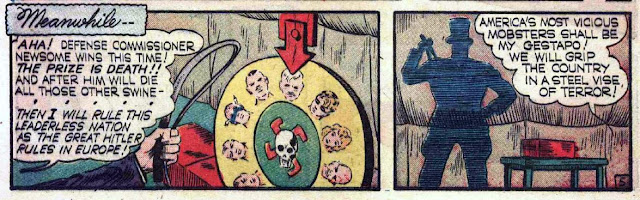
    Although we must not neglect the Wheel of Death, a perfectly cromulent random victim generator that the Ringmaster presumably stole from one of the sideshow games and spends hours/day applying all the little faces to.
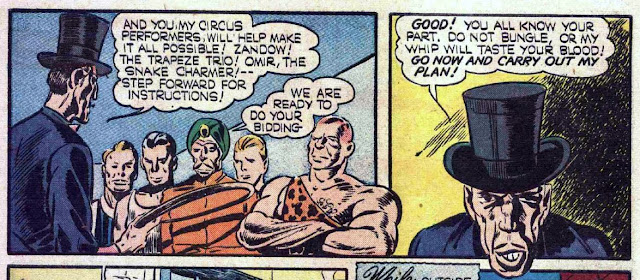
    The real star here is the burgeoning Circus of Crime. Not all of the classic archetypes are present (no tall man, no fat guy) but it’s a pretty good criminal circus lineup already. To whit:

    Omir the Snake Charmer

    the Missing Link putting in an appearance for the sideshow folk

    Tommy Thumb the circus dwarf who might be held against his will? He definitely does not want to be there

    the Trapeze Trio

    Zandow the Strong Man

    various unnamed clowns, roustabouts and elephant handlers

    It’s not quite Princess Python levels but it’s a good showing.

    The Ringmaster of course gets trounced by Captain America, and then according to lore he gets murdered after the war by Nazi loyalists for his failure. His circus endures to this day, however, so that’s something. Speaking of which:

    CIRCUS OF CRIME 1941 

    Body Count: 2

    End-of-year Status: Captured/ Defunct

  • MINOR SUPER-VILLAIN 300: THE RINGMASTER OF CRIME

    (Captain America Comics 005, 1941)

    Finally, FINALLY, after 300  of these guys an arbitrary milestone lines up with a reasonably cool character: the Ringmaster of Crime AKA the Ringmaster of Death. Compounding the fun of the circus of crime aesthetic is the fact that some of that good-style retconning has been going on and the Ringmaster in this tale has been made the father (and presumably later grandfather, per Marvel’s sliding timeline) of the mid-level super-villain the Ringmaster! Uh, if saying that someone is someone else’s grampaw is a retcon, that is.

    The practical upshot of this is that this Minor Super-Villain writeup also functions as Super-Villain Yearbook, 1941 for the Circus of Crime, which, as a family-owned business entity, is contiguous with the version that reappeared in the 60s even though no individual members reoccur.

    All that said, the Ringmaster himself is a fairly regular Nazi creep super-villain. Sure he’s got the Jack Kirby villain snake-man look that we all love to hate but compared to his descendant (or, indeed, a regular circus ringmaster) he’s a positively dour dresser – his actual theming is pretty weak, when you get right down to it.

    Although we must not neglect the Wheel of Death, a perfectly cromulent random victim generator that the Ringmaster presumably stole from one of the sideshow games and spends hours/day applying all the little faces to.

    The real star here is the burgeoning Circus of Crime. Not all of the classic archetypes are present (no tall man, no fat guy) but it’s a pretty good criminal circus lineup already. To whit:

    Omir the Snake Charmer

    the Missing Link putting in an appearance for the sideshow folk

    Tommy Thumb the circus dwarf who might be held against his will? He definitely does not want to be there

    the Trapeze Trio

    Zandow the Strong Man

    various unnamed clowns, roustabouts and elephant handlers

    It’s not quite Princess Python levels but it’s a good showing.

    The Ringmaster of course gets trounced by Captain America, and then according to lore he gets murdered after the war by Nazi loyalists for his failure. His circus endures to this day, however, so that’s something. Speaking of which:

    CIRCUS OF CRIME 1941 

    Body Count: 2

    End-of-year Status: Captured/ Defunct

  • MINOR SUPER-VILLAIN 298: THE UNHOLY LEGION

    (Captain America Comics 004, 1941)

    This is one of those moments where the first examples of a thing that shows up here is not a great example of the thing. Blame the tyranny of alphabetical order, I suppose, because I know for a fact that Star-Spangled Comics will feature the Ring of Rags when I work my way down my list to it, and that is a good example.

    The thing in question is of course Poor People as a Horrifying and Existential Threat, and it’s going to crop up periodically. The poor end up as a creeping horde without real agency of their own who can be mobilized in service to some evil end, in this case the destabilization of the American military/ industrial complex.

    The reason that this is not the best example of the type is that the people in question are probably not actually poor beggars but Nazi spies. I mean, they are absolutely Nazi spies. The probably is in regard to the fact that there’s no indication that any of them are anything else. Actual poor people being portrayed as monsters will have to wait.

    (bonus: the thing that gets Captain America and Bucky on this case is that they give a guy money and then he turns out not to be disabled enough for them to have done so)

  • MINOR SUPER-VILLAIN 296: THE HUNCHBACK OF HOLLYWOOD

    (Captain America Comics 003, 1941)

    The Hunchback of Hollywood is a villain in the same classic vein as Clayface: dressing up like a horror character and using murder and fear tactics to shut down a movie production. Also like Clayface, the production is within the hero’s range due to the studio taking advantage of the castle-rich landscape of the Eastern US 

    (the castle in question is said to be near Camp Lehigh, home base of Steve “Captain America” Rogers and Bucky “Bucky” Barnes so this isn’t one of the famed castles of New York State. But it might have been originally – Camp Lehigh’s official location is in Virginia, now, but a lot of the stories imply that it’s closer to NYC, with officers commuting to homes in Manhattan, soldiers casually visiting Coney island etc. I have no idea when the location was finalized and it’s very frustrating!)

    Much as Clayface was actually Boris Karloff-adjacent horror star Basil Karlo, the prime Hunchback suspect is the even more on-the-nose Goris Barloff.

    Unlike Clayface, the Hunchback is not Barloff at all, nor any other crazed horror actor. Rather, it’s Craig Talbot, star of the film and dues-paying American Nazi, who objects to the film’s anti-authoritarian allegory, ad that’s why unlike Clayface you’ve never heard of him: because he’s a filthy Nazi.

    Number of Episodes of the “Super-Villains of Hollywood” podcast: A two-part episode structured like a whodunnit, with the first running down the careers of Barloff and Talbot and a few other weakly defended suspects and the second detailing the actual crimes.

  • MINOR SUPER-VILLAIN 295: RED SKULL II

    (Captain America Comics 001 & 003, 1941)

    When I started this here blog I tried to put a little bit of thought into the tagging system, and specifically tried to work out how to deal with the fact that a lot of super-villain types have the same names. The solution I came up with is that everyone named, say, the Skull gets the same tag but legacy characters who are adopting a specific persona that another has used get appended with Roman numerals (skull II, Skull III, etc). And here I am breaking that rule the very first time I have the chance.

    Well, kind of. See, this is the original Red Skull so far as appearance in print is concerned. About 4 issues after he dies in his second appearance, the Red Skull returns, but a different Red Skull. This second Skull is the one that continues to appear to this day and the fellow I’m writing about here has been retroactively relegated to the status of Regional Franchise Red Skull. It’s all about not having to bother typing that extra ‘II’ in the tags for the next 80 years worth of appearances, honestly.

    So: the Red Skull (II)! Pretty much the perfect Nazi creep villain complete with a red skull calling card, taunting notes and a gimmick wherein he convinces his victims that he is killing them with his stare when in fact he is sneakily injecting them with poison. Why does he do this? For his own Nazi creep pleasure I guess.

    And just who is this retroactive knockoff? Why, it’s none other than George Maxon, aircraft manufacturer, who sold out the US to Hitler for the promise of high office. Boo this man!

    Maxon seemingly kills himself with his own syringe at the end of his first appearance and his body is shown being examined by the FBI afterward, they evidently just… left him to rot in his secret lair? Which works out pretty well for him, to be honest, since like any good poison-user he is immune to his own weapon.

    This time around, the Skull goes for a touch of death rather than a gaze, which involves a) an electrified costume and b) getting punched in the face a bunch. He seems to enjoy it, so I guess winning is worth a sock in the jaw to him.

    This second adventure sees this Red Skull’s greatest triumph as he steals the designs for a drilling vehicle and uses it to smash up part of NYC in one of those huge cataclysms that happened so often in the 40s. Marvel Universe New York must be simply awash in commemorative plaques detailing them all.

    Unfortunately for George Maxon and his super-villain legacy, this issue also sees his lowest moment, as he mistakes a couple of con artists for the real Captain America and Bucky despite one million signs that they aren’t. Frankly getting blown up with a round bomb a few pages later must have been a bit of a relief from the embarrassment of it all.

    (Maxon also shows up in Young Allies 001 the same year but it’s a weird appearance that has since been retconned pretty thoroughly for good reasons but in a way that has caused me a lot of annoyance when reading fan wikis. An ignominious end to be sure)

    SKULL SCORE: It’s just the eyes, which merits a healthy score of 4! Minus one point for being a mask makes the total come to 3.

  • MINOR SUPER-VILLAIN 293: RATHCONE

    (Captain America Comics 001, 1941)

    I’ll be honest: Rathcone doesn’t have too much going on. He’s your regular style Nazi spy with enough extra sauce to make him stand out. To whit:

    -a maxed-out “Jack Kirby draws a weird creep” stat, complete with fangs and talonlike fingernails

    -an oblique gimmick whereby he plays out his strategy on a chessboard while his men listen in over an intercom. The custom chess set is of course one of the great super-villain accessories

    -most importantly, his henchmen are all called things like Herr Kamelon and Herr Strangler and Number 15 and at this point Rathcone could be removed from the equation entirely because all the villainous side dishes are there for my delectation.

    Rathcone’s final claim to fame is simply the fact that he makes it through the adventure alive, which I would not have put money on given the survival rate of the other Marvel super-villains on our list.

  • MINOR SUPER-VILLAIN 293: RATHCONE

    (Captain America Comics 001, 1941)

    I’ll be honest: Rathcone doesn’t have too much going on. He’s your regular style Nazi spy with enough extra sauce to make him stand out. To whit:

    -a maxed-out “Jack Kirby draws a weird creep” stat, complete with fangs and talonlike fingernails

    -an oblique gimmick whereby he plays out his strategy on a chessboard while his men listen in over an intercom. The custom chess set is of course one of the great super-villain accessories

    -most importantly, his henchmen are all called things like Herr Kamelon and Herr Strangler and Number 15 and at this point Rathcone could be removed from the equation entirely because all the villainous side dishes are there for my delectation.

    Rathcone’s final claim to fame is simply the fact that he makes it through the adventure alive, which I would not have put money on given the survival rate of the other Marvel super-villains on our list.

  • MINOR SUPER-VILLAIN 292: ARMLESS TIGER MAN

    (Marvel Mystery Comics v1 026, 1941)

    Armless Tiger Man! A minor classic in the Characters With Goofy Names category and almost certainly a Wizard Magazine Mort of the Month some time in the late 90s. Also: he wears stirrup pants.

    Unfortunately there’s not a lot going on in the story: Armless Tiger Man is a Nazi saboteur who murders a man in order to save a few bucks on bribes, which leads the Angel to get involved. He ends up getting tracked down due to his taste for hard-to-find Chateau Quim wine (I checked and yes, it absolutely meant the same thing in the 40s as it does now, so this is very cheeky). As seen above he manages to escape only to be apprehended mid-sabotage.

    His origin is a bitt more interesting: after losing his arms in an industrial accident he obsessively trains to use his arms and legs as replacements and develops an unsettling appearance due to his massive jaw muscles. He also develops a hatred of industrial machinery which is the reason that the Gestapo mobilizes him to the US.

    You can’t keep a weird fella like this down forever – Armless Tiger Man is our first properly brung back Marvel Villain, appearing in a Captain America WWII-era comic in 2010, in which he died, then gets to show up in hell! I mean, it’s not illustrious but it’s better than the Vampire Killer got.

  • THE FATE OF RUDOLF HESS

    (Marvel Mystery Comics v1 024-025, 1941)

    Rudolf Hess, a major figure in the Nazi party, flew to Scotland in May 1941, probably without authorization and probably in an attempt to broker some sort of peace treaty. As you can see from the previous sentence, even today the whole thing is pretty murky, and in 1941 it was a tantalizing enough mystery for Hess to crop up in a fair few comics either as himself or as a thinly-veiled stand-in.

    This here is “Herr Huss,” who flew from occupied France to New Jersey as part of a scheme to draw the US into WWII and who was foiled by future Captain America #3, the Patriot. He ends up killing himself rather than be captured.

  • MINOR SUPER-VILLAIN 283: N-4

    (Marvel Mystery Comics v1 023, 1941)

    N-4 is the kind of Nazi spy that really reminds one that the swastika was a costume design go-to for a while there. Gonna be swastikas cropping up basically forever, aren’t there. Like Captain Nazi still shows up from time to time, doesn’t he.

    More interesting than N-4 being one of our earlier costumed Nazis is that they’re a trend-based crime villain! The trend: highways! Their whole scheme revolves around the recently-completed Pennsylvania Turnpike and involves a trick switcheroo tunnel that they use to steal tanks in a complicated scheme that foolishly includes framing the Human Torch and Toro for some reason and of course leads to them being caught.

    And of course I was using neutral pronouns in that last paragraph because I wanted to obfuscate the fact that N-4 was your old classic female agent posing as a male agent for unclear reasons. Also she got caught because of a deus ex bear trap.

    Not a lot to say about N-4, it seems! I’d say sorry N-4 but you are a Nazi, so go rot somewhere.