The Curse of Skeleton Munroe

Category: Sub-Zero

  • MEDIA IN COMICS 006

    Now that’s entertainment. 

    Magazines: 

    Are magazine titles in comics more likely to be plays on real ones than other forms of media? Perhaps. We’ll just have to see how many variations on Life and Time we can find over the years. Pretending to work for Living has enough caché that it gets these fascists into a secure aircraft plant – how long has it been since magazines were so relevant? (Big Shot Comics 014, 1941)

    Movies:

    I never actually mentioned it in the entry on the Hunchback of Hollywood, but the anti-Nazi movie that incites the story’s action is called The Tyrant. Featuring Steve Rogers, Bucky Barnes and Sergeant Duffy in minor roles! (Captain America Comics 003, 1941)

    Rang-a-Tang the Wonder Dog’s boy companion Richy (the Amazing Boy) never seemed to be that impressive to me, but Hollywood disagreed and he was made both the star and subject of a film called Riverfront Richy with lots of animal stunts. (Blue Ribbon Comics 011, 1941)

    There’s never any real indication of what Scoopin’ Jive is about – music seems likely – but it’s such a baffling name for a movie that I must celebrate it (Crackajack Funnies 036, 1941)

    Similarly, we never really learn what Wings Aflutter is about, other than being a “new Navy Air smash hit” with a terrible name. (Jumbo Comics 034, 1941)

    Theatre:

    Minor super-villain the Black Death of course takes his costume and MO from a character in a stage production called The Black Death. There’s not quite enough of the play’s plot in the story to know if the fictional Black Death is supposed to be a metaphor or something or some sort of slasher movie killer as it appears. I sincerely hope it’s the latter. (Thrilling Comics 010, 1940)

    One of Professor X’s attempts to get Sub-Zero involves attacking him in the audience of a big stage musical that his girlfriend Mary is appearing in as part of the “Living Chandelier”. “George Whyte’s Sandels” is a very specific-seeming reference, but I am unable to easily connect it to a show of the era. (Blue Bolt v1 006, 1940)

    Fuller Spunk, former star of stage and now Holmes-inspired detective, starred in the evocatively-named shows Hector’s Last Gulp and The Gripes of Raft. (Hyper-Mystery Comics 001, 1940)

    Waltz of the Vampires is a ballet performance that is narratively used to set off vampire Carlos Hubbelo’s bloodlust, but more importantly, it kind of rules? Comic book media is so often a version of something from the real world that it’s always very fun to see something like this that (as far as I can tell) is just a sincere depiction of a vampire ballet. (Blue Ribbon Comics 011, 1941)
  • CATALOGUE OF WOUNDS 008

    CATALOGUE OF WOUNDS 008

    Everybody gets shot now and then.

    the Bronze Terror: 

    The Bronze Terror is shot in the left arm during his first adventure by the wicked Scar Thornton, which gives him an excuse to show off his penchant for knocking out crooks’ teeth. (Daredevil Comics 002, 1941)

    Whiz, King of Falcons: 

    Whiz is shot through the left wing by a Lord Haw-Haw analog, and since this is the one issue in which he has the power of speech, he gets to complain about it. (Daredevil Comics 001, 1941)

    Trojak the Tiger Man: 

    Clawed across the chest by a lion. (Daring Mystery Comics 002, 1940)

    the Mask:

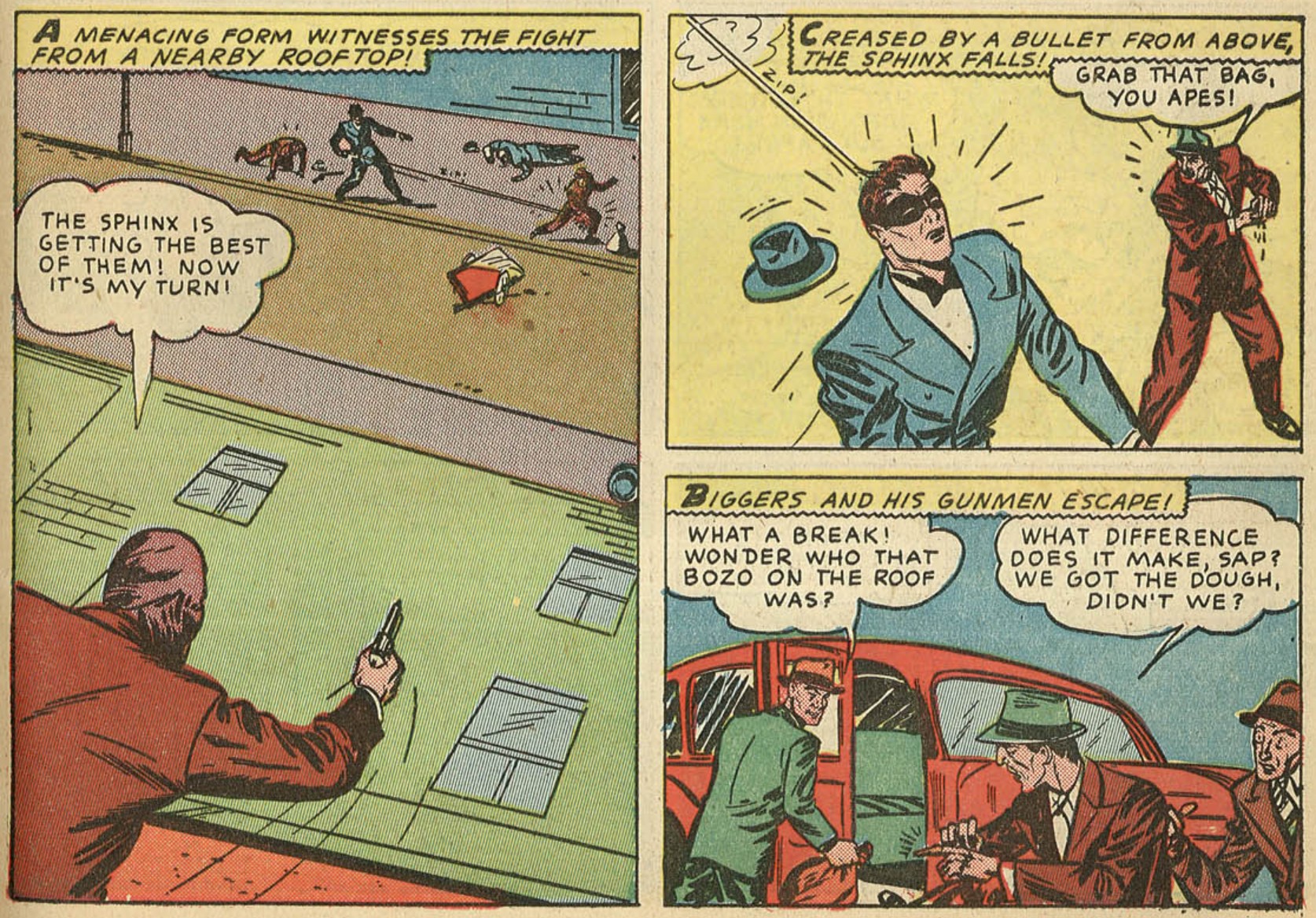
    The Mask gets his head creased by a bullet. (Exciting Comics 007, 1941)

    Sub-Zero: 

    Sub-Zero has an eventful 1941: first he gets shot in the right shoulder while parachuting… (Blue Bolt v1 012, 1941)

     … then breaks his right leg while in pursuit of a suspect… (Blue Bolt v2 001, 1941

    … and finally gets his skull creased by some trigger-happy miscreants.  (Blue Bolt v2 005, 1941

    the White Rider:

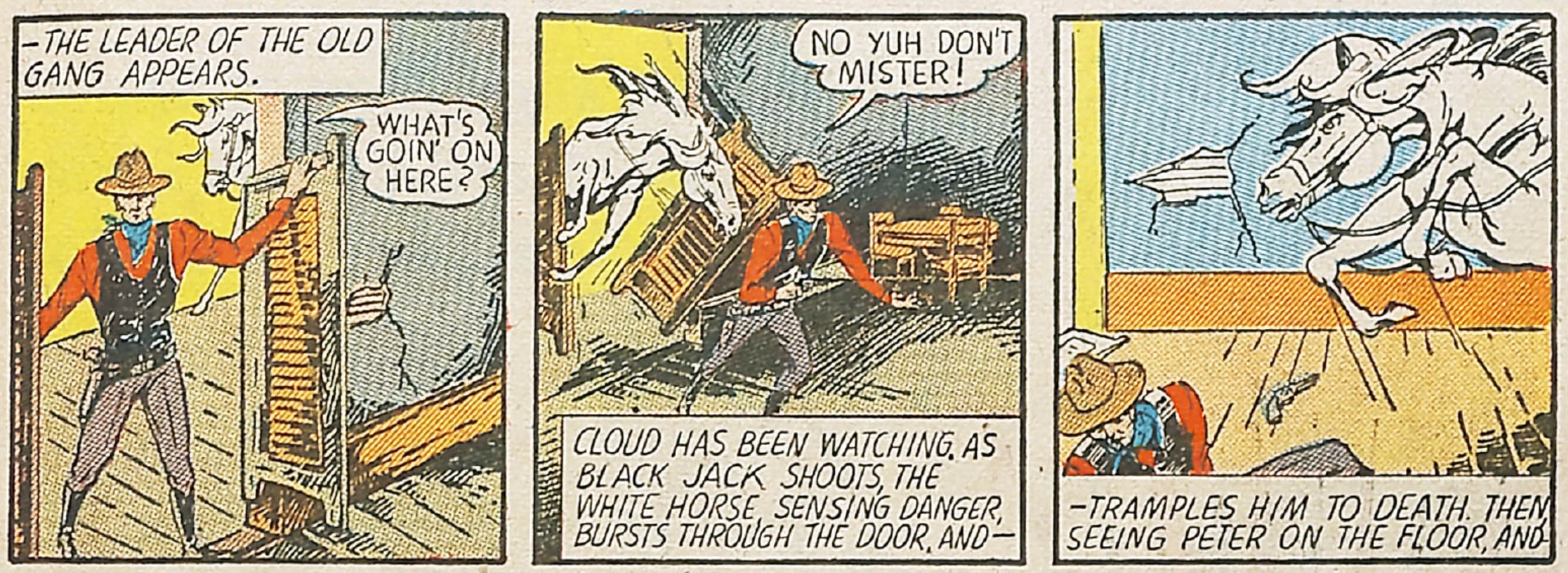
    The White Rider gets himself generically shot during his very first attempt to mete out vigilante justice, and it’s a lucky thing for him that he has Super Horse or there wouldn’t be a second. (Blue Bolt v1 001, 1940)

    Dr Miracle:

    Dr Miracle takes a thrown stiletto to the right shoulder while he is physically merger with his manservant Akim, which might also make this a stiletto to Akim’s shoulder as well. The physics of the situation are unclear. (Champ Comics 012, 1941)

    the Sphinx:

    Though he has in the past proved himself broadly invulnerable, the Sphinx is not immune to getting his skull creased by a bullet. (Exciting Comics 008, 1941) 

  • CATALOGUE OF WOUNDS 008

    CATALOGUE OF WOUNDS 008

    Everybody gets shot now and then.

    the Bronze Terror: 

    The Bronze Terror is shot in the left arm during his first adventure by the wicked Scar Thornton, which gives him an excuse to show off his penchant for knocking out crooks’ teeth. (Daredevil Comics 002, 1941)

    Whiz, King of Falcons: 

    Whiz is shot through the left wing by a Lord Haw-Haw analog, and since this is the one issue in which he has the power of speech, he gets to complain about it. (Daredevil Comics 001, 1941)

    Trojak the Tiger Man: 

    Clawed across the chest by a lion. (Daring Mystery Comics 002, 1940)

    the Mask:

    The Mask gets his head creased by a bullet. (Exciting Comics 007, 1941)

    Sub-Zero: 

    Sub-Zero has an eventful 1941: first he gets shot in the right shoulder while parachuting… (Blue Bolt v1 012, 1941)

     … then breaks his right leg while in pursuit of a suspect… (Blue Bolt v2 001, 1941

    … and finally gets his skull creased by some trigger-happy miscreants.  (Blue Bolt v2 005, 1941

    the White Rider:

    The White Rider gets himself generically shot during his very first attempt to mete out vigilante justice, and it’s a lucky thing for him that he has Super Horse or there wouldn’t be a second. (Blue Bolt v1 001, 1940)

    Dr Miracle:

    Dr Miracle takes a thrown stiletto to the right shoulder while he is physically merger with his manservant Akim, which might also make this a stiletto to Akim’s shoulder as well. The physics of the situation are unclear. (Champ Comics 012, 1941)

    the Sphinx:

    Though he has in the past proved himself broadly invulnerable, the Sphinx is not immune to getting his skull creased by a bullet. (Exciting Comics 008, 1941) 

  • SUPERCUT: IT’S NOT THE SIGN OF THE BLUE BEETLE!

    I assume that this one will get at least a little bigger over time.

    It’s the Sign of the…

    Black Spider:


    Daredevil:

    the Laughing Mask:

    the Mask:

    Sub-Zero:


  • PROBLEMATIC ROUND-UP 002

    Once again I present the worst that comics has to offer.

    The Great Green Turtle:

    The Great Green Turtle is just your standard Yellow Peril Chinatown ganglord, albeit one with a fantastic name. He does try to throw Sub-Zero, a man with ice powers, into a shark tank so we can safely say that he is not a villain with fantastic intelligence. His gem-smuggling ring gets thoroughly kiboshed. (Blue Bolt v1 004, 1940)

    The Lama:

    The Lama is a bandit chief, essentially, albeit one with a name from one religious tradition and henchmen – Thuggees, natch – from another. He hijacks a plantation and then gets beat up by aviator Captain Kidd. (Fantastic Comics 010, 1940)

    The Fire God:

    If there’s one thing that Captain Kidd likes, it’s finding lost explorers, so when a fellow named Benson goes missing he’s off like a shot. He finds Benson about to be sacrificed to the Fire God, a masked figure who a well-placed kick reveals to be a Hitler lookalike in a mask (the Hitler thing is either a coincidence or just kind of meant to indicate generic megalomania in the Fire God’s character). This one not only has a white guy easily convincing a group of credulous natives that he is a god but an instance of White People Vs Everyone else as Captain Kidd fruitlessly tries to get out of a sticky situation by playing the race card.

    The Fire God ultimately meets his end in the classic writer’s cop-out when they don’t want to make their guy do a murder: he falls and hits his head on a rock after a sock to the jaw. (Fantastic Comics 011, 1940)

    Mad Ming:

    Part of me wants to give Mad Ming some credit for not being as racist a Yellow Peril villain as someone like the Great Green Turtle, but he basically is and I am being tricked. Ming talks and dresses like a normal person and so all of his outrageous villainy is recontextualized, and maybe he would be worthy of reconsideration if all of his schemes and his henchmen and his nom de crime weren’t still mired in the muck of the Oriental pulp villain, but as it stands he’s just mildly better than his peers, racist stereotype-wise. (Funny Pages v4 001, 1940)

  • PROBLEMATIC ROUND-UP 002

    Once again I present the worst that comics has to offer.

    The Great Green Turtle:

    The Great Green Turtle is just your standard Yellow Peril Chinatown ganglord, albeit one with a fantastic name. He does try to throw Sub-Zero, a man with ice powers, into a shark tank so we can safely say that he is not a villain with fantastic intelligence. His gem-smuggling ring gets thoroughly kiboshed. (Blue Bolt v1 004, 1940)

    The Lama:

    The Lama is a bandit chief, essentially, albeit one with a name from one religious tradition and henchmen – Thuggees, natch – from another. He hijacks a plantation and then gets beat up by aviator Captain Kidd. (Fantastic Comics 010, 1940)

    The Fire God:

    If there’s one thing that Captain Kidd likes, it’s finding lost explorers, so when a fellow named Benson goes missing he’s off like a shot. He finds Benson about to be sacrificed to the Fire God, a masked figure who a well-placed kick reveals to be a Hitler lookalike in a mask (the Hitler thing is either a coincidence or just kind of meant to indicate generic megalomania in the Fire God’s character). This one not only has a white guy easily convincing a group of credulous natives that he is a god but an instance of White People Vs Everyone else as Captain Kidd fruitlessly tries to get out of a sticky situation by playing the race card.

    The Fire God ultimately meets his end in the classic writer’s cop-out when they don’t want to make their guy do a murder: he falls and hits his head on a rock after a sock to the jaw. (Fantastic Comics 011, 1940)

    Mad Ming:

    Part of me wants to give Mad Ming some credit for not being as racist a Yellow Peril villain as someone like the Great Green Turtle, but he basically is and I am being tricked. Ming talks and dresses like a normal person and so all of his outrageous villainy is recontextualized, and maybe he would be worthy of reconsideration if all of his schemes and his henchmen and his nom de crime weren’t still mired in the muck of the Oriental pulp villain, but as it stands he’s just mildly better than his peers, racist stereotype-wise. (Funny Pages v4 001, 1940)

  • GENERIC COSTUMED VILLAIN ROUND-UP 011

    Some say they’re not generic enough but I think they’re trying their best.

    This fellow is part of a gang looking to hijack a shipment of railway guns from train engineer Runaway Ronson. I really enjoy the look of the padded suit they use to help survive crashing a car into a high-speed train but I really really enjoy the fact that they immediately scramble off into the woods and are never seen again, as if they were completely unrelated to the criminal plot. (Blue Bolt v1 007, 1940)

    This fellow’s a pseudo-Nazi spy named Ketler who goes up against Sub-Zero in an attempt to influence the very specific Torpedo Workers Union into striking and hindering part of the US defense program. I feel like he overestimates the usefulness of the mask as he doesn’t change anything else about his appearance when not murdering people but that’s not what gets him caught so I guess I’m the fool here.(Blue Bolt v2 002, 1941)

    Colourful enemy aces are the best/ only tolerable part of the absurd number of Golden Age comics about pilot-adventurers, so my little ears pricked up when American-flying-for-the-French Loop Logan was challenged to a dogfight by a Nazi called the Blue Duke but… there’s nothing to him. He’s just a guy with a name who’s been sabotaging French planes and shooting them down. Waste of a good name, if you ask me. (several days later note: it took me an embarrassingly long time to realize that this guy’s name was a play on the Red Baron) (Blue Ribbon Comics 004, 1940)

    These guys briefly terrorize New York (possibly – we have another instance of a city that is Clearly New York City But the Mayor is Wrong) with a futuristic tank mounted with a death ray. If they a) had a name and b) weren’t completely demolished by Mr Justice in about three panels they might have made the leap to full Minor Super-Villain status but as it stands they’re an object lesson in why ultra-powerful ghosts need a tougher class of enemy to be really entertaining. (Blue Ribbon Comics 010, 1941)

  • MINOR SUPER-HERO ROUND-UP 008

    MINOR SUPER-HERO ROUND-UP 008

    Some real highs and lows in this one.

    the Twister: 

    The Twister is a quite minor Golden Age super-hero – he managed more than one appearance but not more than seven – who has the distinction of having one of the most well-designed costumes of the era. Not my favourite costume, mind you, but boy oh boy, you can really tell that his creators (Ray Gill and Paul Gustavson as it happens) really sat down for a good think about how to evoke “tornado” via the medium of clothing.

    The Twister turns out to be Bob Sanders, and he turns out to be a descendant of perennial fave Greek hero Odysseus. It turns out that the story of Aeolus gifting Odysseus two bags of wind and his men opening the bag of storm winds thinking that it was full of treasure was more than just another delay in Odysseus’ Bad Voyage, it was akin to the opening of Pandora’s Box and Aeolus had charged Odysseus or his descendants to round up all of the evil violent winds and return the to captivity. 

    Evidently over the years the charge to gather up evil winds has expanded to fighting all evil, and the Twister’s power set allows him to run roughshod over just about anyone using wind control, a tornado form and invulnerability to anything that couldn’t harm actual wind. There is some attempt to establish that he is vulnerable to being locked up somewhere with no airflow but that proves even easier to defeat than all the times that Silver Age Aquaman is locked up and forced to source water from unexpected places.

    The Twister’s other claim to fame is that he was introduced as a mysterious tornado that appeared in the Blue Bolt, Sub-Zero and Dick Cole stories in the issue he first appears in, which is enough to be counted as a rare Golden Age crossover even though none of them shared words. (Blue Bolt v2 001, 1941)

    Freezum:

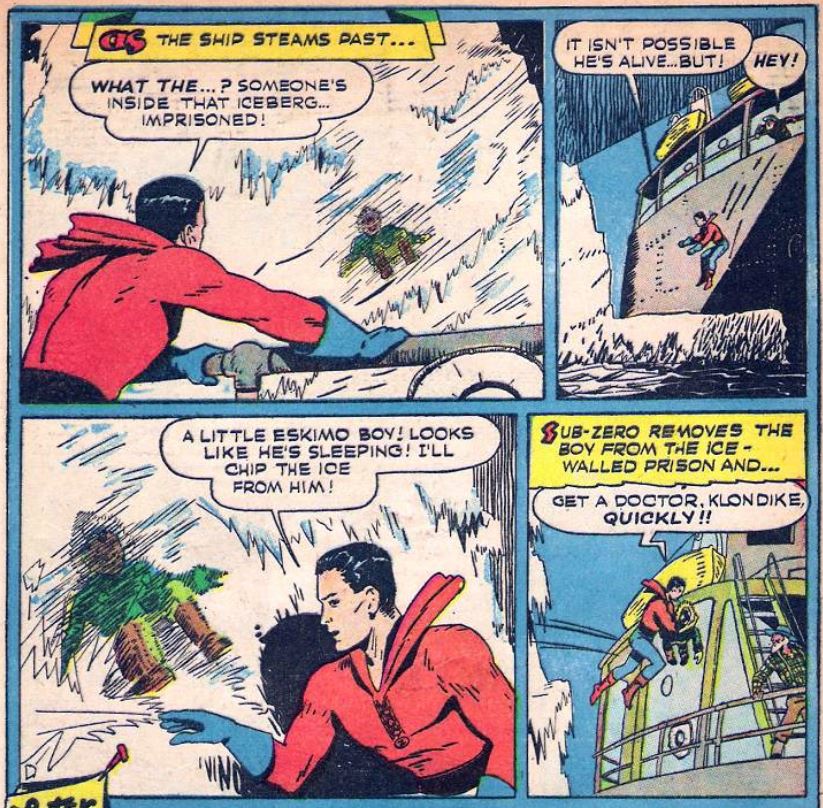
    On an adventure that takes him to Alaska, Sub-Zero happens upon a little Inuit or Aleut boy frozen in a glacier.

    Thawing the kid out and finding him to miraculously be alive, Sub-Zero (as well as an unfortunate doctor) is further astounded to discover that they share the same sort of cold-based powers due to their similar near-death freezing experiences. The kid names himself Freezum, and that’s just the first salvo of a barrage of tired comic relief sidekick shenanigans. Yes, we’ll be sighing and rolling our eyes for the remainder of Sub-Zero’s run – the joys of the Golden Age, friends! (Blue Bolt v2 005, 1941)

    Lois Blake:

    Lois Blake is a woman who Blue Bolt meets while attempting to take down a gang that was swindling immigrants using fake citizenship papers and decides to team up with. At some point when the gang is being particularly elusive he remembers that his pal Dr Bertoff down in the underground Kirby world has a viewscreen that can see virtually any location and so they head down there to use it. Bertoff then very helpfully offers to transfer some of Blue Bolt’s power to Lois and a new crimefighting team is born! (small aside: Golden Age comics don’t get a lot of praise for their art but I really enjoy both the small detail of Lois gripping Blue Bolt’s arm for comfort in the first panel above and her delighted expression in the third).

    Lois never gets a super-hero name and only really makes a handful of appearances before Blue Bolt ditches his costume and powers to become a regular if oddly-named soldier, but he’s such a nonentity post Simon and Kirby that I can’t help but love her for adding some life to the strip.(Blue Bolt v2 007, 1941)

    the Marvel:

    The Marvel is your classic mask-and-tuxedo vigilante, who specializes in showing up to bail reporter Scoop Cody out of the kind of jams you can get in when you’ve cracked a juicy crime story but not accounted for the possibility that the criminals involved might want to stop you from reporting on it.

    Three things about the Marvel: 

    1. The nose cutout never looks as cool as the full-face cowl does but I reckon it’s a heck of a lot more comfortable, so you have to give him some credit for choosing function over form.

    2. Scoop Cody and thus the Marvel only had two appearances and both of them had a teaser at the end promising that the Marvel’s identity would be revealed in the next issue. It’s always possible that they were planning on making the Marvel a completely new, never-before-seen guy but if they weren’t then literally the only suspect is this guy, Scoop Cody’s crusty old unnamed editor.

    3. Love a super-hero calling card, even in the rare cases when it’s a literal calling card.

    Also here is the Marvel’s second appearance in its entirety. (Blue Ribbon Coimcs 002, 1939)

  • MINOR SUPER-HERO ROUND-UP 008

    MINOR SUPER-HERO ROUND-UP 008

    Some real highs and lows in this one.

    the Twister: 

    The Twister is a quite minor Golden Age super-hero – he managed more than one appearance but not more than seven – who has the distinction of having one of the most well-designed costumes of the era. Not my favourite costume, mind you, but boy oh boy, you can really tell that his creators (Ray Gill and Paul Gustavson as it happens) really sat down for a good think about how to evoke “tornado” via the medium of clothing.

    The Twister turns out to be Bob Sanders, and he turns out to be a descendant of perennial fave Greek hero Odysseus. It turns out that the story of Aeolus gifting Odysseus two bags of wind and his men opening the bag of storm winds thinking that it was full of treasure was more than just another delay in Odysseus’ Bad Voyage, it was akin to the opening of Pandora’s Box and Aeolus had charged Odysseus or his descendants to round up all of the evil violent winds and return the to captivity. 

    Evidently over the years the charge to gather up evil winds has expanded to fighting all evil, and the Twister’s power set allows him to run roughshod over just about anyone using wind control, a tornado form and invulnerability to anything that couldn’t harm actual wind. There is some attempt to establish that he is vulnerable to being locked up somewhere with no airflow but that proves even easier to defeat than all the times that Silver Age Aquaman is locked up and forced to source water from unexpected places.

    The Twister’s other claim to fame is that he was introduced as a mysterious tornado that appeared in the Blue Bolt, Sub-Zero and Dick Cole stories in the issue he first appears in, which is enough to be counted as a rare Golden Age crossover even though none of them shared words. (Blue Bolt v2 001, 1941)

    Freezum:

    On an adventure that takes him to Alaska, Sub-Zero happens upon a little Inuit or Aleut boy frozen in a glacier.

    Thawing the kid out and finding him to miraculously be alive, Sub-Zero (as well as an unfortunate doctor) is further astounded to discover that they share the same sort of cold-based powers due to their similar near-death freezing experiences. The kid names himself Freezum, and that’s just the first salvo of a barrage of tired comic relief sidekick shenanigans. Yes, we’ll be sighing and rolling our eyes for the remainder of Sub-Zero’s run – the joys of the Golden Age, friends! (Blue Bolt v2 005, 1941)

    Lois Blake:

    Lois Blake is a woman who Blue Bolt meets while attempting to take down a gang that was swindling immigrants using fake citizenship papers and decides to team up with. At some point when the gang is being particularly elusive he remembers that his pal Dr Bertoff down in the underground Kirby world has a viewscreen that can see virtually any location and so they head down there to use it. Bertoff then very helpfully offers to transfer some of Blue Bolt’s power to Lois and a new crimefighting team is born! (small aside: Golden Age comics don’t get a lot of praise for their art but I really enjoy both the small detail of Lois gripping Blue Bolt’s arm for comfort in the first panel above and her delighted expression in the third).

    Lois never gets a super-hero name and only really makes a handful of appearances before Blue Bolt ditches his costume and powers to become a regular if oddly-named soldier, but he’s such a nonentity post Simon and Kirby that I can’t help but love her for adding some life to the strip.(Blue Bolt v2 007, 1941)

    the Marvel:

    The Marvel is your classic mask-and-tuxedo vigilante, who specializes in showing up to bail reporter Scoop Cody out of the kind of jams you can get in when you’ve cracked a juicy crime story but not accounted for the possibility that the criminals involved might want to stop you from reporting on it.

    Three things about the Marvel: 

    1. The nose cutout never looks as cool as the full-face cowl does but I reckon it’s a heck of a lot more comfortable, so you have to give him some credit for choosing function over form.

    2. Scoop Cody and thus the Marvel only had two appearances and both of them had a teaser at the end promising that the Marvel’s identity would be revealed in the next issue. It’s always possible that they were planning on making the Marvel a completely new, never-before-seen guy but if they weren’t then literally the only suspect is this guy, Scoop Cody’s crusty old unnamed editor.

    3. Love a super-hero calling card, even in the rare cases when it’s a literal calling card.

    Also here is the Marvel’s second appearance in its entirety. (Blue Ribbon Coimcs 002, 1939)

  • MINOR SUPER-VILLAIN 512: AGENT 17

    MINOR SUPER-VILLAIN 512: AGENT 17

    (Blue Bolt v1 012, 1941)

    There are a lot of dastardly fascist spy chiefs in comics of the 1940s, so it’s nice when one has something to distinguish themself from the monocle-and-dueling-scar heavy pack. Agent 17’s gimmick, as stated by the dying Latonian agent Gonzales, is that he is a “young man with an old face.” How useful is this in the average spy mission? Moderately, I presume.

    Agent 17’s mission is to prevent the government of the South American nation of Latonia from learning before it’s too late that the nonspecific European fascist nation that they just signed a trade pact with is in fact planning to take over their country as a staging area for a full-scale invasion of South America. But though Agent 17 had managed to deal a fatal blow to Latonian secret agent Gonzales, Gonzales had not died before engaging the services of Venusian super-hero Sub-Zero.

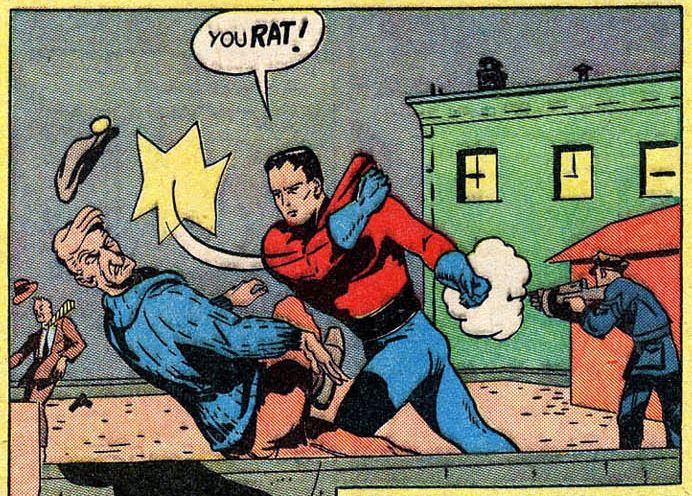
    For all that Agent 17 was going up against a cold-controlling super-hero armed with an old face he almost pulls it off! Latonia almost falls to the unspecified hordes of the enemy! Lucky for them, Sub-Zero manages to show up with a warning in the nick of time. Plus he gets to punch an old man in the face, guilt free!