The Curse of Skeleton Munroe

Category: Mr Justice

  • MEDIA IN COMICS 016

    MEDIA IN COMICS 016

    Production on these Media in Comics showcases must sadly slow down now, for I have worked my way through my backlog. As evidence of this, today we are showcasing some magical books, which are genrally unique items that fall under nobody’s definition of mass media but which I want to include anyway, for fun’s sake.

    Books of Magic:
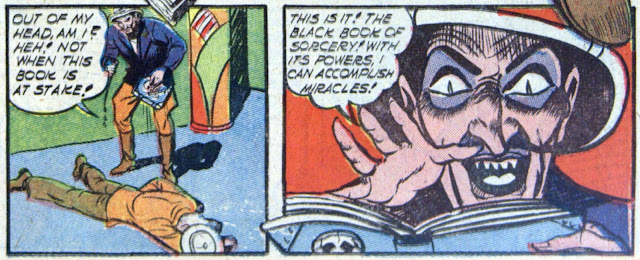
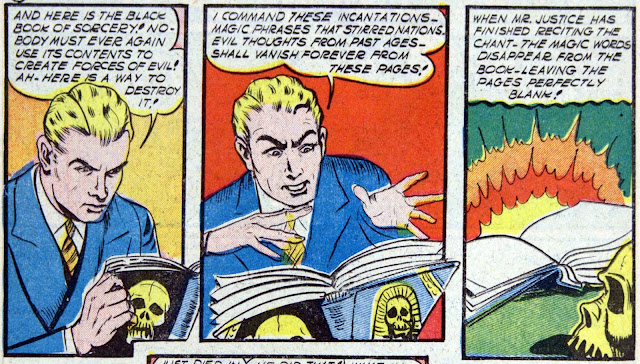
    You all remember the fabled Black Book of Sorcery that the wicked Egyptologist Ford committed all those murders for, well here it is! Until Mr Justice wipes its pages with a convenient self-destruct spell contained within it, that is.

    Origin: Ancient Egyptian 

    Status: Destroyed (Jackpot Comics 003, 1941)
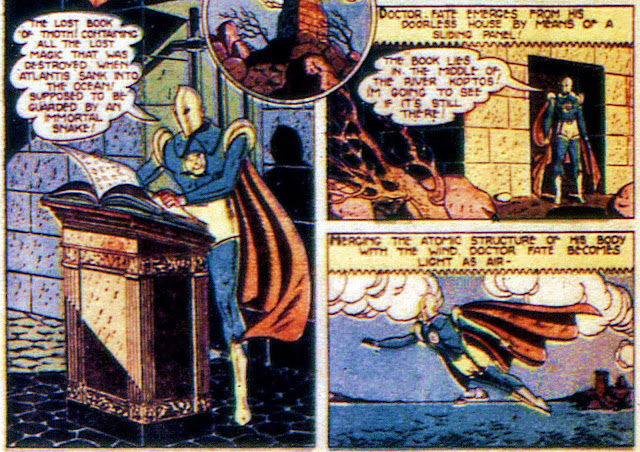
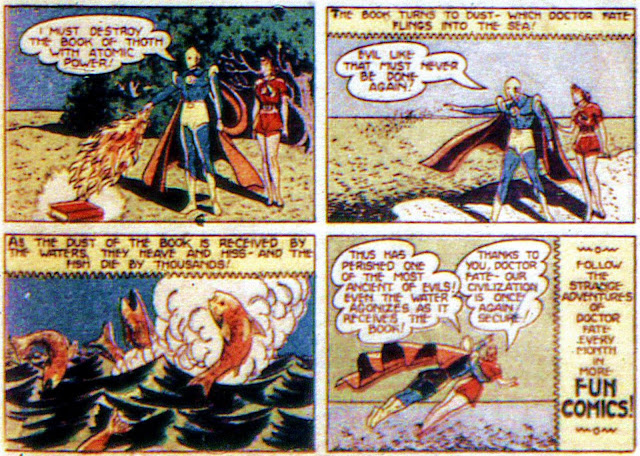
    The Lost Book of Thoth, containing all the magics of sunken Atlantis, is supposed to rest on the bottom of the Nile under the watchful eye of an immortal serpent. The plans of mice and men and whoever is in charge of everlasting snakes often go astray, alas, and the book is stolen by an unnamed mage and nearly used to destroy the world. Having solved that particular problem, Dr Fate doesn’t take any chances and reduces the book to a powder.

    Origin: Ancient Atlantis

    Status: Destroyed (More Fun Comics 058, 1941)
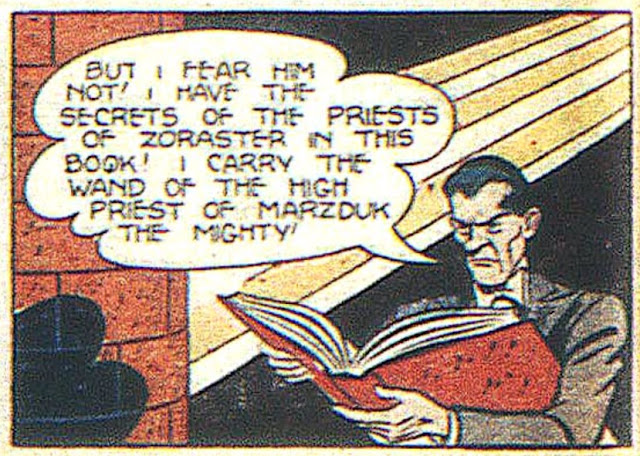
    The Secrets of the Priests of Zoraster (sic) might not be the official title of the book used by Haldane the Sorcerer, but it’s a pretty good title for a made-up book of magic and we have no other options. This one gets left behind in a secret passage rather than being destroyed, so it’s technically up for grabs.

    Origin: Persian? 

    Status: Extant (More Fun Comics 063, 1941)
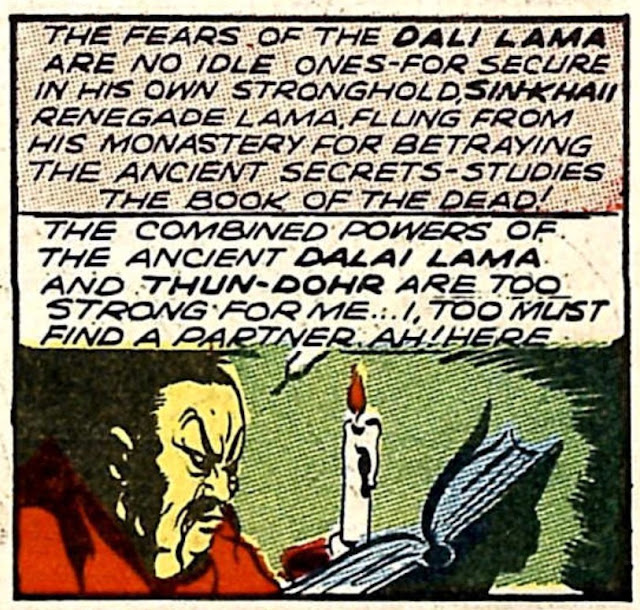
    Though Sin Khaii is an apostate Tibetan Buddhist, the Book of the Dead that he is referencing here is more likely to be the Egyptian on than the Tibetan, as he is using it to research the Black Pharaoh. He also casts spells out of it later!

    Origin: Ancient Egyptian 

    Status: Extant (Silver Streak Comics 014, 1941) 

    Theatre:
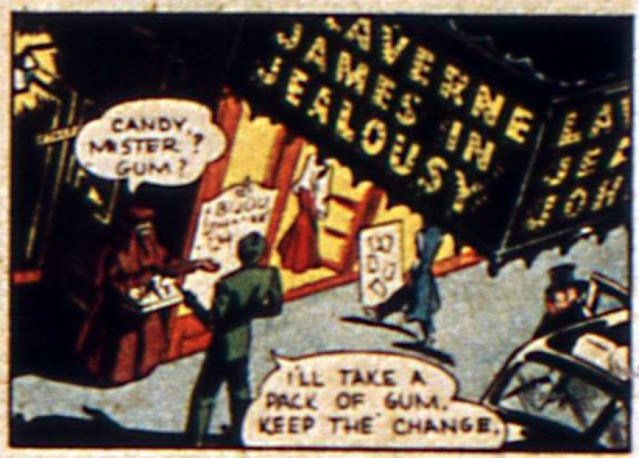
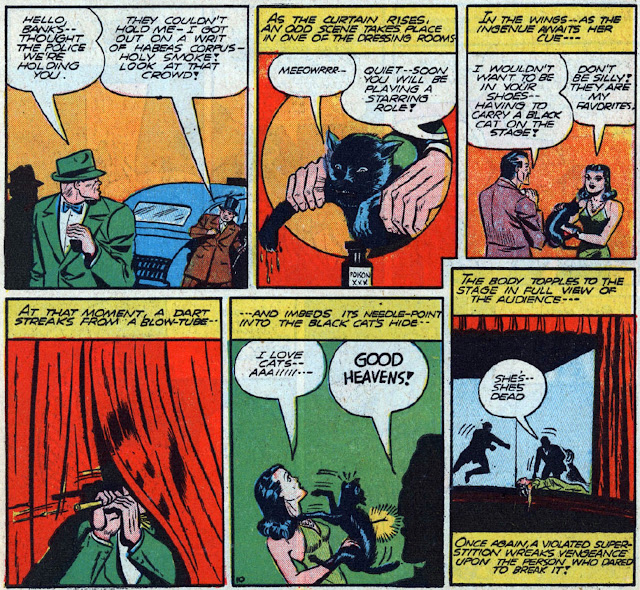
    Detective Larry Steele is called to the set of Jealousy to look into threats against star Laverne James, and then stays to solve the murder of Laverne James. More interesting than the murder mystery, however, is the mystery of just what is going on in this production.
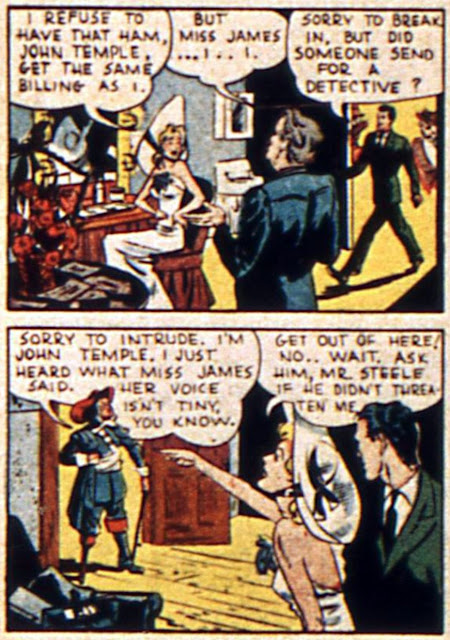
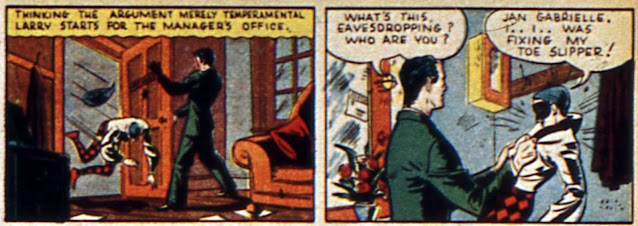
     

    We don’t actually see any of the on-stage action, but the costuming is extremely intriguing: James’ co-stars John Temple and Jan Gabrielle are dressed like off-model commedia dell’arte characters, while she looks more like a character from a Southern Gothic. Finally we have Peggy, who is part of the chorus line and is dressed like she is in a high-budget napkin advertisement. It’s a baffling selection. (Detective Comics v1 047, 1941) 
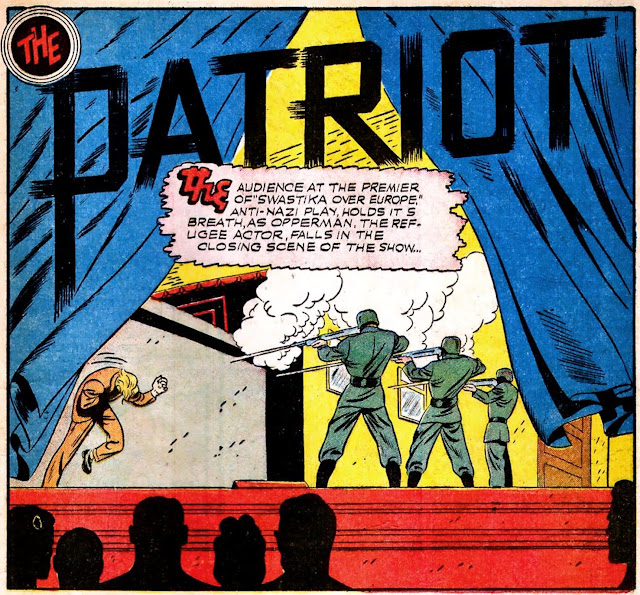
    Swastika Over Europe is a play designed to rally American support for the beleaguered nations of the Continent and as such is a target for sabotage by Nazi fifth columnists, as seen here when lead actor Opperman is murdered on-stage. (Marvel Mystery Comics v1 023, 1941)
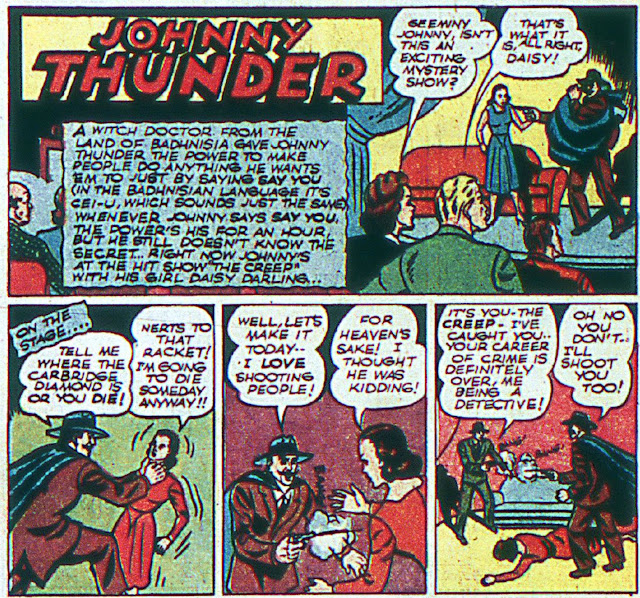
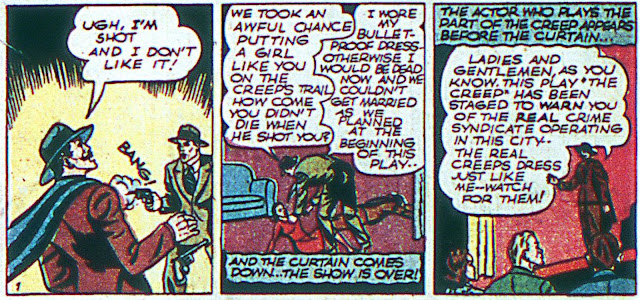
    Here we have The Creep, a play written expressly to warn the people of NYC about the threat of Crime & Corruption, Inc. I guess it works, because Johnny Thunder slapsticks them out of existence. (Flash Comics 013, 1941)
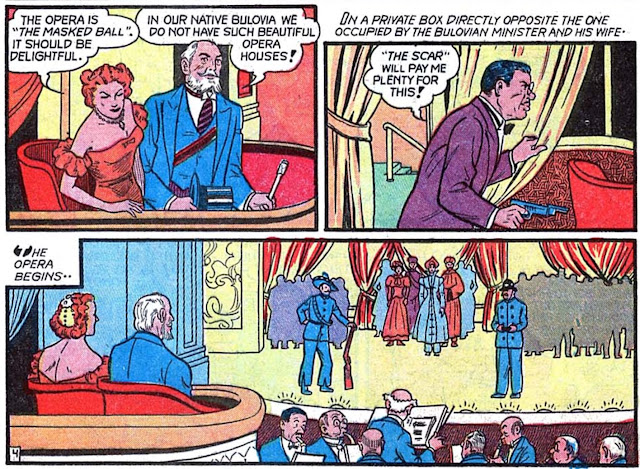
    Ordinarily getting such a good view of the stage would be very exciting to me as it would be a chance to divine some information about the production. Alas, this is an opera called The Masked Ball and so the only thing we can learn is that someone at the titular ball has come dressed as a police officer. (More Fun Comics 067, 1941)
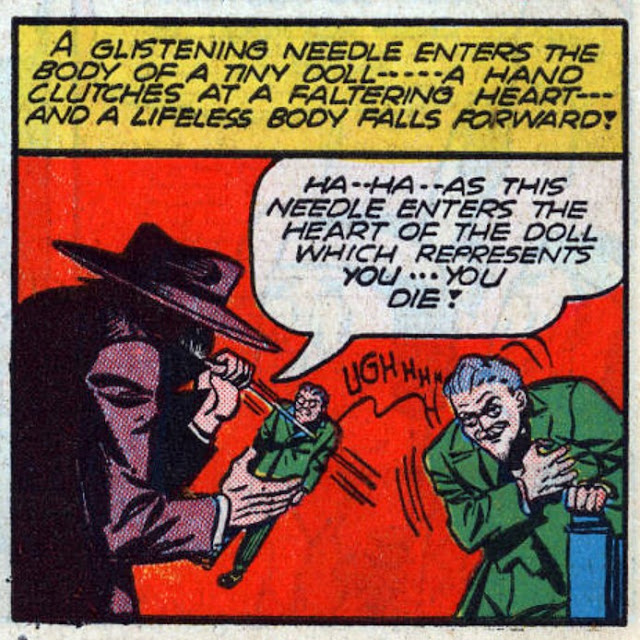
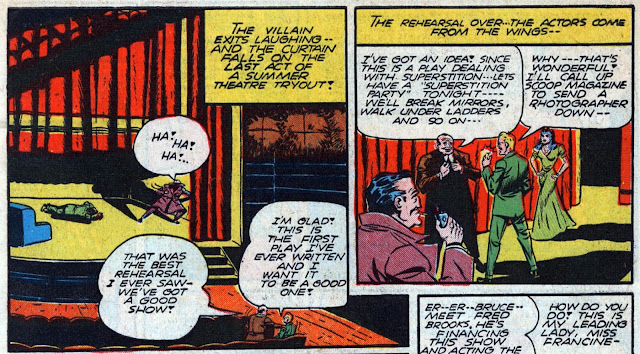
    The Superstition Murders is of course the play written by Johnny Glim the alter ego of the villainous Masked Man, who commits a series of superstition-themed murders in the hopes of tanking the production and thus securing the movie rights for his work. Though the motivation for the fictional killer is unrevealed, this seems to essentially be what the play is about as well. (Batman Comics v1 008, 1941)
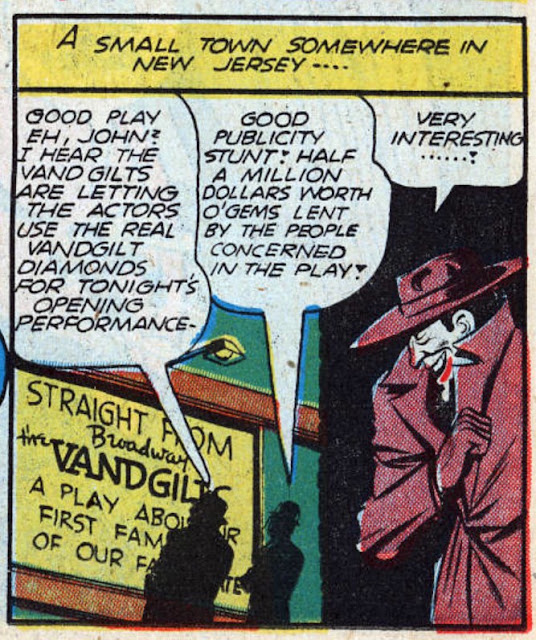
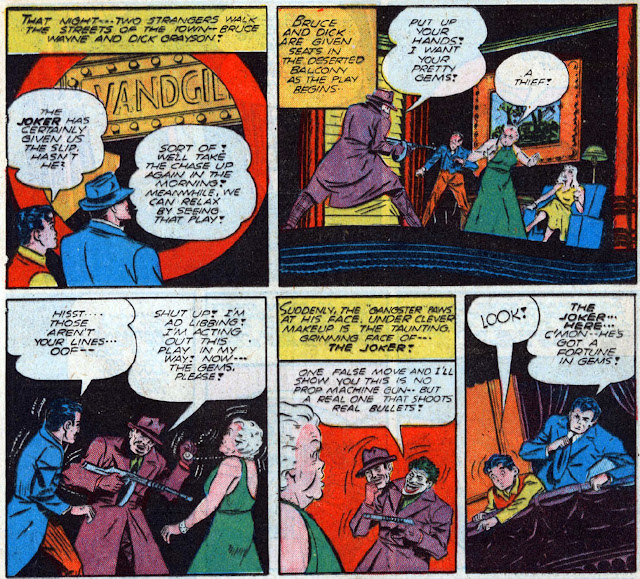
    Though there are many fine plays about the lives of the wealthy, there is no way The Vandgilts, about a real-life family who are on good enough terms with the production to lend them half a million dollars worth of jewellery, isn’t complete sycophantic mush. Luckily the Joker spices things up by robbing the actors mid-performance. (Batman Comics v1 008, 1941)

  • MINOR SUPER-VILLAIN 989: THE ARTIST

    (Jackpot Comics 004, 1941)

    An otherwise-unnamed portraitist, the Artist finds himself down on his luck because he refuses to flatter his clients by painting them in anything but complete realism. After his latest client, a banker, literally kicks him out onto the street, he continues to work on the man’s portrait in a hate-fueled haze until he unlocks a power within himself: once he has painted someone’s portrait realistically enough, their soul becomes trapped inside and the husk of their body is forced to do the Artist’s bidding. It’s the ultimate service worker power fantasy!

    As befits a power born out of hatred and frustration at being rejected, the Artist sets out to enrich himself at the cost of others. He begins with the banker, who he forces to rob his own bank and then allows to be carted off to jail. And he still has his soul stuck in the painting, so in a way he’s in double jail.

    If the Artist’s first crime was at least a little bit justified (I personally would not say that a rude client should be sent to jail for twenty years but I know a fair few artists who might disagree), his subsequent crime spree is exclusively aimed at making money and damn the consequences. In short succession he: forces a woman to kill her husband and then fork over the insurance money, enslaves the leader of Tomania to enable a Nazi invasion of that country, and sells his services as a trial fixer (by way of a desouled District Attorney) to gangster Knuckles Werner.

    You just can’t get away with this kind of thing forever, and especially not in Mr Justice’s unnamed town. Thanks to a little ghostly trickery, the Artist is forced to paint own portrait and confess to his crimes, and I guess that the jury was in a mood to accept the existence of the supernatural because he is found guilty and executed. Perhaps targeting the District Attorney like he did was not the best long-term strategy for the Artist.

    Categorized in: Accessories (Henchmen (Mind-Controlled Thralls), Power (Magic (Soul Theft)), Profession (Artists)

  • MINOR SUPER-VILLAIN 988: FORD

    (Jackpot Comics 003, 1941)

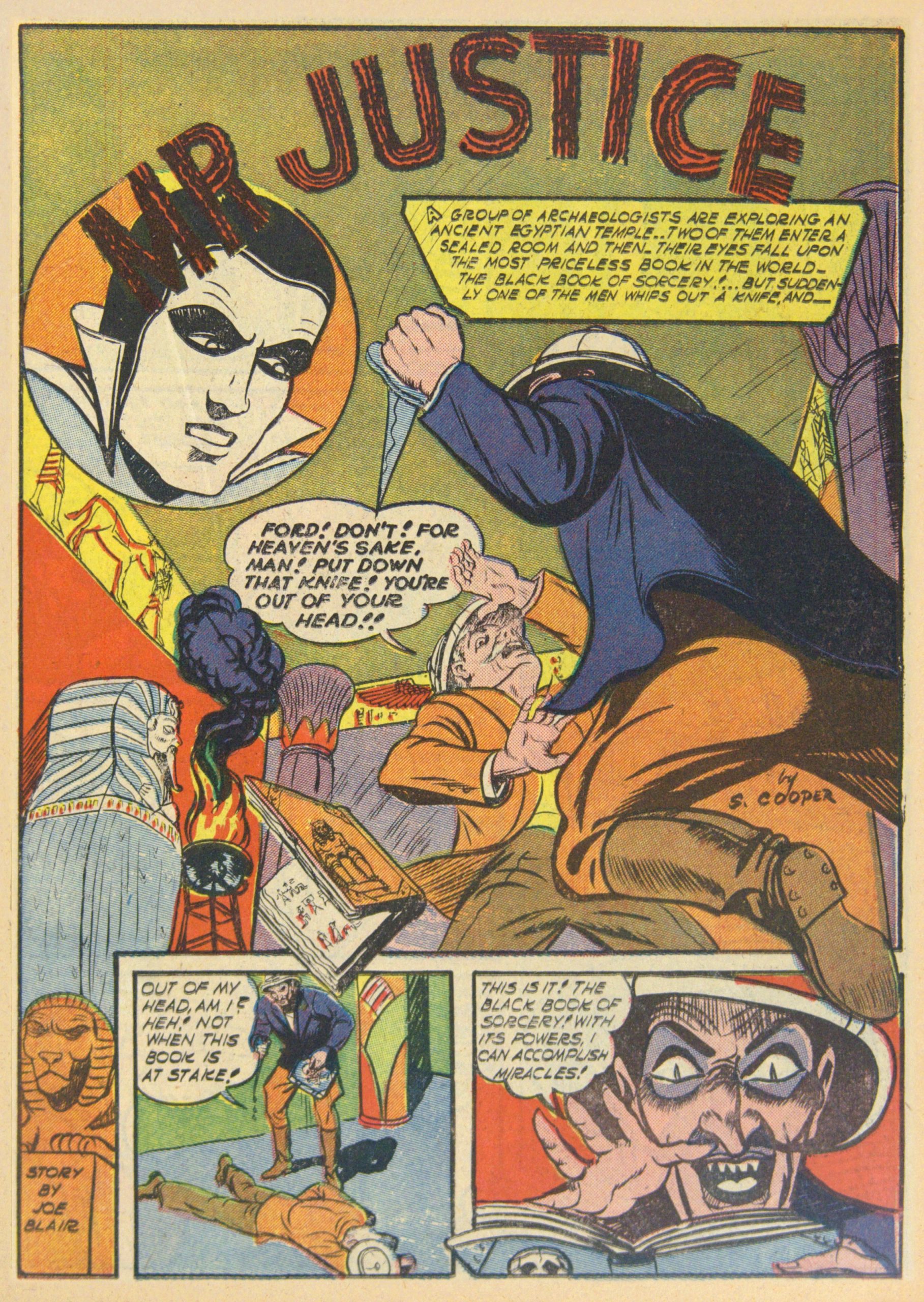
    We meet Ford for the first time as he is knifing his fellow archaeologist Baker to death in an ancient Egyptian tomb, in order to be the sole possessor of the fabled Black Book of Sorcery which they have just found.

    Two points about Ford right off the bat: 1. he is only ever called Ford. No first name, even! This is what I get for grumbling internally about how boring William Scott’s name was. 2. He looks like the Devil. This makes sense in the context of a Mr Justice comic, as artist Sam Cooper was never shy about tying one’s morality to their appearance, but in-universe, is it a reflection of the corruption of his soul or was he always that one archaeologist who looked like Satan?

    Having secured the Black Book of Sorcery, Ford is now subject to critiques of how he uses it. His first effort involves raising the mummies that are housed in the temple from the dead in order to murder the remaining six archaeologists in the expedition and thus cover up his crime. I would call this a rash act, but then again I would probably try stealing the book before committing murder in the first place. I suppose Ford and I are just different people.

    Next, he covers up the mummy murders by collapsing the entire temple on top of the bodies. This is a pretty wild stunt for an archaeologist of all people to pull, and on top of that it’s not even a great way to conceal some bodies, as rubble is famously clearable. It’s also a waste of a number of perfectly good mummies, mummies who might have been some help in cleaning up a crime scene.

    Having made his way back to the unnamed city that both he and Mr Justice call home, Ford attempts to profit off of his new mastery of the necromantic arts by raising deceased millionaire’s son John Grant from the dead to hit up his parents for a loan. Ethical considerations aside, this kind of thing isn’t the worst way to make some dough via dark magic: you could emotionally blackmail the parents with the thought of their child being condemned to a miserable half-dead existence, or maybe use privileged family information to commit some sort of financial fraud or very precise burglary, for example. 

    Ford just sends Grant to bust down the front door and demand cash, which is a total bust as Grant’s parents are left feeling more existentially horrified than inclined to pay out.  Honestly, if smash-and-grab stuff like this is all that you’re going to use necromancy for you might as well stick with the squad of beefcake mummies rather than raising up bespoke dead guys for every job.

    This is the point that Mr Justice gets involved in the story, by the way. You can’t do dark majick inside the borders of [CITY NAME NOT FOUND] and hope to escape his gaze.

    For his final trick, Ford summons the very off-model spirit of Nero, “the most horrible tyrant the world has ever known” as a counter to Mr Justice. Nero in turn proposes a sort of ghost road trip to the Edge of Infinity to access the Immunity Vacuum and become immortal in a way that is distinct from the immortality already enjoyed by the souls of the dead in the Mr Justice cosmology.

    Perhaps the Immunity Vacuum confers a version of immortality that prevents one’s soul from being beaten up by another ghost and thrown into the “depths of eternal nothingness,” never to emerge, and if it is it’s too bad for Ford and Nero that the latter’s chariot isn’t faster because that’s exactly what Mr Justice does to them.

    Unsurprisingly, this kills Ford’s body, which makes it simplicity itself for Mr Justice to collect the Black Book of Sorcery and use the convenient self-destruct spell that it holds to render it blank.

    Categorized in: Accessories (Book of Magic), Day Jobs (Archaeologists), Supercrime (Necromancy)

  • MINOR SUPER-VILLAIN 988: FORD

    MINOR SUPER-VILLAIN 988: FORD

    (Jackpot Comics 003, 1941)

    We meet Ford for the first time as he is knifing his fellow archaeologist Baker to death in an ancient Egyptian tomb, in order to be the sole possessor of the fabled Black Book of Sorcery which they have just found.

    Two points about Ford right off the bat: 1. he is only ever called Ford. No first name, even! This is what I get for grumbling internally about how boring William Scott’s name was. 2. He looks like the Devil. This makes sense in the context of a Mr Justice comic, as artist Sam Cooper was never shy about tying one’s morality to their appearance, but in-universe, is it a reflection of the corruption of his soul or was he always that one archaeologist who looked like Satan?

    Having secured the Black Book of Sorcery, Ford is now subject to critiques of how he uses it. His first effort involves raising the mummies that are housed in the temple from the dead in order to murder the remaining six archaeologists in the expedition and thus cover up his crime. I would call this a rash act, but then again I would probably try stealing the book before committing murder in the first place. I suppose Ford and I are just different people.

    Next, he covers up the mummy murders by collapsing the entire temple on top of the bodies. This is a pretty wild stunt for an archaeologist of all people to pull, and on top of that it’s not even a great way to conceal some bodies, as rubble is famously clearable. It’s also a waste of a number of perfectly good mummies, mummies who might have been some help in cleaning up a crime scene.

    Having made his way back to the unnamed city that both he and Mr Justice call home, Ford attempts to profit off of his new mastery of the necromantic arts by raising deceased millionaire’s son John Grant from the dead to hit up his parents for a loan. Ethical considerations aside, this kind of thing isn’t the worst way to make some dough via dark magic: you could emotionally blackmail the parents with the thought of their child being condemned to a miserable half-dead existence, or maybe use privileged family information to commit some sort of financial fraud or very precise burglary, for example. 

    Ford just sends Grant to bust down the front door and demand cash, which is a total bust as Grant’s parents are left feeling more existentially horrified than inclined to pay out.  Honestly, if smash-and-grab stuff like this is all that you’re going to use necromancy for you might as well stick with the squad of beefcake mummies rather than raising up bespoke dead guys for every job.

    This is the point that Mr Justice gets involved in the story, by the way. You can’t do dark majick inside the borders of [CITY NAME NOT FOUND] and hope to escape his gaze.

    For his final trick, Ford summons the very off-model spirit of Nero, “the most horrible tyrant the world has ever known” as a counter to Mr Justice. Nero in turn proposes a sort of ghost road trip to the Edge of Infinity to access the Immunity Vacuum and become immortal in a way that is distinct from the immortality already enjoyed by the souls of the dead in the Mr Justice cosmology.

    Perhaps the Immunity Vacuum confers a version of immortality that prevents one’s soul from being beaten up by another ghost and thrown into the “depths of eternal nothingness,” never to emerge, and if it is it’s too bad for Ford and Nero that the latter’s chariot isn’t faster because that’s exactly what Mr Justice does to them.

    Unsurprisingly, this kills Ford’s body, which makes it simplicity itself for Mr Justice to collect the Black Book of Sorcery and use the convenient self-destruct spell that it holds to render it blank.

    Categorized in: Accessories (Book of Magic), Day Jobs (Archaeologists), Supercrime (Necromancy)

  • MINOR SUPER-VILLAIN 987: WILLIAM SCOTT

    (Jackpot Comics 002, 1941)

    William Scott is your textbook mad scientist delving into the mysteries of life and death that man was not meant to comprehend, and in fact is so clearly going to be a problem that Mr Justice shows up to tell him off in advance, just based on a feeling. Despite this, Scott signs up condemned gangster “Rod” Dugan (and whether the Rod part is short for Rodney or the now-somewhat obscure slang for a gun is impossible to know. Probably the gun, though) as a candidate for post-execution reanimation. Prison officials! You have to stop releasing bodies to men with crazed looks in their eyes who stink of ozone!

    Scott’s plan is successful, and he soon has his very own science revenant that he sends out to loot and plunder for him. Please not the multiple dentition-based signifiers in the above: while Dugan’s tusk-like canines are one of the signifiers of the monstrous in Mr Justice comics, Scott’s missing teeth are a mark of his derangement, like his long messy hair and the deep circles around his eyes.

    Mr Justice has no trouble tracking down Scott as the source of the trouble, having already pegged him as a troublemaker. He proves to be more than a match for the the resurrected Dugan, but is unable to fully defeat him fully. The reason for this is simple: though Scott brought Dugan’s body back to life, his soul is condemned to wander in torment until it is laid to rest. This is all set-up for a Mortal Shell vs. Immortal Soul fight to the death, and the Immortal Soul is not playing around.

    Meanwhile, Scott takes the classic mad scientist’s way out and blows himself, along with his lab, to high heaven. Hopefully he gets to reconnect with his old friend Rod Dugan when he gets there.

    Categorized in: Supercrime (Monster Making)

  • MINOR SUPER-VILLAIN 987: WILLIAM SCOTT

    (Jackpot Comics 002, 1941)

    William Scott is your textbook mad scientist delving into the mysteries of life and death that man was not meant to comprehend, and in fact is so clearly going to be a problem that Mr Justice shows up to tell him off in advance, just based on a feeling. Despite this, Scott signs up condemned gangster “Rod” Dugan (and whether the Rod part is short for Rodney or the now-somewhat obscure slang for a gun is impossible to know. Probably the gun, though) as a candidate for post-execution reanimation. Prison officials! You have to stop releasing bodies to men with crazed looks in their eyes who stink of ozone!

    Scott’s plan is successful, and he soon has his very own science revenant that he sends out to loot and plunder for him. Please not the multiple dentition-based signifiers in the above: while Dugan’s tusk-like canines are one of the signifiers of the monstrous in Mr Justice comics, Scott’s missing teeth are a mark of his derangement, like his long messy hair and the deep circles around his eyes.

    Mr Justice has no trouble tracking down Scott as the source of the trouble, having already pegged him as a troublemaker. He proves to be more than a match for the the resurrected Dugan, but is unable to fully defeat him fully. The reason for this is simple: though Scott brought Dugan’s body back to life, his soul is condemned to wander in torment until it is laid to rest. This is all set-up for a Mortal Shell vs. Immortal Soul fight to the death, and the Immortal Soul is not playing around.

    Meanwhile, Scott takes the classic mad scientist’s way out and blows himself, along with his lab, to high heaven. Hopefully he gets to reconnect with his old friend Rod Dugan when he gets there.

    Categorized in: Supercrime (Monster Making)

  • MINOR SUPER-VILLAIN 986: THE ZOMBIE MASTER

    (Jackpot Comics 001, 1941)

    Zarro, the Zombie Master, is yet another take on an evil Haitian voodoo practitioner: we’ve seen ’em before and we’ll see ’em again. He is recruited by a couple of pseudo-Nazis named Karl Bezdek and Hugo Kempf for help in setting up a factory that uses zombies as workers in the production of war material for the Axis. Like the other Zombie Master we have covered, this one is a vibrant shade of green, just like a cartoon zombie, though I’m not entirely sure when that particular colour association started.

    I am going to lay out Karl and Hugo’s plan before telling you why I’m mad about it:

    1. Pose as magazine photographers in order to get total access to the defense factories in the as-yet unnamed city that Mr Justice calls home (the risk of targeting a city with a super-hero is leavened by the fact that it has the world’s most gullible mayor).

    2. Photograph as many workers as possible.

    3. Zarro uses the photographs as sympathetic magic links to the workers (plucking them out of the photographs = very cool) and kills them.

    4. The worker’s bodies are stolen and shipped to Haiti for use in the factory.

    So why does this plan make me mad? Because I want to critique it but I can’t. See, it’s a bad and inefficient plan with a lot of unnecessary steps, but only if the only goal is to make money. But that isn’t the goal! Karl and Hugo are spies for a fascist nation! Their goal is to hamper US war production while simultaneously boosting that of their own country using the Haitian zombie factory, and they have done both! It’s maddening! The only real flaw I can find is that the graverobbing and body shipping are a bit involved but I can’t really think of a good alternative that doesn’t introduce more points of failure to the plan.

    The risk of super-hero vs reward of gullible mayor calculation that we discussed earlier does in fact prove to be the trio’s downfall, as Mr Justice is able to make his way to Haiti (and please note the surprisingly grody-looking zombies that he finds there) thanks to a minor kidnapping subplot and strangle the Zombie Master, which in turn restores the workers to life. One smashed up Axis factory later, everyone is on the way back to [CITY NAME NOT FOUND].

    Categorized in: Generica (Masters), Powers (Magic (Create Zombies)), Supranormal Beings (Zombies))

  • CATALOGUE OF WOUNDS 012

    If I keep at this long enough then we will find the super-hero with the most comically-long list of wounds sustained in the course of their adventures. Currently in the lead: the Green Mask! Unless we’re talking about head traumas, in which case I must direct your gaze to the Blue Beetle.

    Domino the Miracle Boy:

    Shot in the right shoulder by Dr Moru while heroically leaping in front of a gun to save the Green Mask. (Mystery Men Comics 029, 1941)

    the Green Mask:

    Slashed on the left side of his head by the Manx’s weird wrist-claw. (Mystery Men Comics 026, 1941)

    Mr Justice:

    Mr Justice is a ghost-type super-hero, so his origin involves a gruesome death, in this case being hacked to pieces by some historically-questionable Englishmen. (Blue Ribbon Comics 009, 1941)

    It’s not quite as universal a trait, but Mr Justice also maintains a human form for times when he is not engaging in super-heroics, and since he’s already dead it doesn’t matter how often he sustains mortal wounds, such as this instance of him being riddled with bullets. (Blue Ribbon Comics 009, 1941)

    Or here, when he is fatally blasted by a beam. (Blue Ribbon Comics 010, 1941)

    (and again a few minutes later)

    Or just plain shot in the head. It’s just a shortcut to the emergence of Mr Justice from his mortal shell. (Jackpot Comics 002, 1941) 

    Sergeant Spook: 

    And speaking of ghostly super-heroes and their fatal origins, here’s Sergeant Spook blowing himself up with his poor lab safety. (Blue Bolt v1 001, 1940)

    Simba:

    Simba, newly-reformed nemesis of Dick Cole, gets his skull creased with a bullet by Dr Karno (Blue Bolt v2 006, 1941)

    Sub-Zero:

    Sub-Zero also gets his skull creased, but since he’s so cold he’s bulletproof Professor X has to use a white-hot bullet to do it. (Blue Bolt Comics v1 005, 1940)

    the Wraith: 

    Finally we have the Wraith, who becomes a ghost thanks to being riddled with bullets during a drive-by.  (Mystery Men Comics 027, 1941)

  • REAL PERSON ROUND-UP 027

    Real people? In comic books? Now I’ve seen everything.

    Abu Khan:

    I sincerely cannot tell if this Black Knight foe is supposed to be Abu Sa’id Bahadur Khan, last ruler of the Mongol Ilkhanate, or if they just pulled a couple of syllables out of the air and added “Khan” to the end and called it a day. On the one hand, the real Abu Khan never tried to invade Egypt, as the Black Knight is trying to prevent him from doing, but on the other he is from about the right time to be a Black Knight character, i.e., within about two hundred years of all the other elements of the comic. (The Funnies 059, 1941)

    Adolf Hitler:

    Pays for the services of super-villain the Artist to facilitate the invasion of Tomania with his soul-stealing powers. (Jackpot Comics 004, 1941)

    Al Capone:

    “Scar Lapone,” used as a generic gangster name. (Green Mask v1 005, 1941)

    Jean Lafitte:

    A false vision of Lafitte is summoned by a fake medium. (Green Mask v1 007, 1941)

    Napoleon Bonaparte:

    Viewed through a time machine’s viewscreen by the Black Hood. (Jackpot Comics 003, 1941)

    Nero:

    Kim Hale and the Purple Zombie, blasted back in time, are condemned to death by Emperor Nero for telling him about things that he hadn’t heard of before. (Reg’lar Fellers Heroic Comics 008, 1941)

    Though the duo make it out of the gladiatorial arena okay, they almost get caught up in the Great Fire of Rome before being shunted to another time zone by their allies. Unusually, Nero is not shown fiddling at all. (Reg’lar Fellers Heroic Comics 009, 1941)

    Nero, or at least his ghost, appears in a very different form after being summoned by the would-be necromancer Ford. Is this barbaric Nero a reflection of how the Emperor saw himself, or did the artist just kind of wing it? (Jackpot Comics 003, 1941)

    Paul Revere:

    Minor comic book protagonist Paul Revere Jr is awfully smug for someone who just has the name of a famous patriot, and that goes double for his friends Betsy Ross and Patrick Henry.

    His father Paul Revere Sr is at least out there writing a column called “America, Awake!” and putting himself in the crosshairs of local fascists. (Banner Comics 003, 1941)

    Sherlock Holmes:

    Yet another comedy Holmes analog with a terrible if intriguing name. Foreclose is just close enough to a play on Sherlock to be particularly maddening. Featuring: a Watson analog named Batsin Belfry. (Great Comics 001, 1941)

    Walter Winchell:

    He only appears as a corpse, but gossip columnist Walt Willard is a clear play on Walt Winchell. (Jackpot Comics 004, 1941)

  • REAL PERSON ROUND-UP 027

    Real people? In comic books? Now I’ve seen everything.

    Abu Khan:

    I sincerely cannot tell if this Black Knight foe is supposed to be Abu Sa’id Bahadur Khan, last ruler of the Mongol Ilkhanate, or if they just pulled a couple of syllables out of the air and added “Khan” to the end and called it a day. On the one hand, the real Abu Khan never tried to invade Egypt, as the Black Knight is trying to prevent him from doing, but on the other he is from about the right time to be a Black Knight character, i.e., within about two hundred years of all the other elements of the comic. (The Funnies 059, 1941)

    Adolf Hitler:

    Pays for the services of super-villain the Artist to facilitate the invasion of Tomania with his soul-stealing powers. (Jackpot Comics 004, 1941)

    Al Capone:

    “Scar Lapone,” used as a generic gangster name. (Green Mask v1 005, 1941)

    Jean Lafitte:

    A false vision of Lafitte is summoned by a fake medium. (Green Mask v1 007, 1941)

    Napoleon Bonaparte:

    Viewed through a time machine’s viewscreen by the Black Hood. (Jackpot Comics 003, 1941)

    Nero:

    Kim Hale and the Purple Zombie, blasted back in time, are condemned to death by Emperor Nero for telling him about things that he hadn’t heard of before. (Reg’lar Fellers Heroic Comics 008, 1941)

    Though the duo make it out of the gladiatorial arena okay, they almost get caught up in the Great Fire of Rome before being shunted to another time zone by their allies. Unusually, Nero is not shown fiddling at all. (Reg’lar Fellers Heroic Comics 009, 1941)

    Nero, or at least his ghost, appears in a very different form after being summoned by the would-be necromancer Ford. Is this barbaric Nero a reflection of how the Emperor saw himself, or did the artist just kind of wing it? (Jackpot Comics 003, 1941)

    Paul Revere:

    Minor comic book protagonist Paul Revere Jr is awfully smug for someone who just has the name of a famous patriot, and that goes double for his friends Betsy Ross and Patrick Henry.

    His father Paul Revere Sr is at least out there writing a column called “America, Awake!” and putting himself in the crosshairs of local fascists. (Banner Comics 003, 1941)

    Sherlock Holmes:

    Yet another comedy Holmes analog with a terrible if intriguing name. Foreclose is just close enough to a play on Sherlock to be particularly maddening. Featuring: a Watson analog named Batsin Belfry. (Great Comics 001, 1941)

    Walter Winchell:

    He only appears as a corpse, but gossip columnist Walt Willard is a clear play on Walt Winchell. (Jackpot Comics 004, 1941)