The Curse of Skeleton Munroe

Category: backward name

  • REAL PERSON ROUND-UP 019

    For various definitions of the word real. 

    Adolf Hitler: 

    Just why this nonsense-language-speaking pilot henchman of the Mask is named Reltih is a mystery, but it’s also a fact. BONUS VERY ANNOYING THING: I can decipher the nonsense in that second panel as “I’ll murder the bum” but this makes me think that I should be able to do the same with the rest of his half-dozen or so lines of dialogue but I can’t. Utterly vexing!

    The Mask also employs an English-speaker with the very annoying name of Inilossom in the same issue. (Whiz Comics 010, 1940)

    Here’s straightforward Hitler analog King Rodend of Kalnar about to be beaten up by the Flame. (Wonderworld Comics 011, 1940)

    Wretched humour comic “Don Quixote in Modern Times” features villain “Adolphus Stalini”. (Wonderworld Comics 020, 1940)  

    Devil’s Island: 

    Newsreel camerawoman Patty O’Day covers a prisoner’s revolt on the penal colony in what might just be the least sympathetic portrayal of Devil’s Island in comics. (Wonderworld Comics 015, 1940)

    J. Edgar Hoover:

    Minor appearances: 

    Whiz Comics 003a, 1940 

    Whiz Comics 005, 1940 

    John Galt: 

    File this one under “amazing coincidences”. A character named John Galt, a full seventeen years before Atlas Shrugged is published. And to top it off:

    Dr John Galt’s radium has been stolen by Dr James Kirk (aka Doctor Death), a full twenty-six years before Star Trek debuts. Would it be a bit more narratively satisfying if John Galt was the selfish shitheel and James Kirk was the selfless hospital administrator? Sure, but that’s just details. (Whiz Comics 002, 1940)

    the Koh-i-Noor Diamond:

    Reporter Scoop Smith is sent on assignment to find the fabled South African Rooirand Emerald, which his editor sees as a direct parallel to the Koh-i-noor. Just how this is the case is what baffles me – I initially thought that it might have been stolen and editor Lane was thinking of the Agatha Christie novel in which that happened, but the more I look at it the more I think that it’s just a big gem that some white guys are trying to steal. 

    (this story also has one of the more stupid desus ex machina endings in all comics, when the sacred snake handler of the isolationist tribe that worship the emerald turns out to be Sam Jones, African American train porter and eternally loyal to Smith because of a five dollar tip) (Whiz Comics 004, 1940) 

    Lázaro Cárdenas del Rio: 

    You know me: I love to dunk on old comics for their portrayals of in-office world leaders, and let’s just say that if you look up a picture of Lázaro Cárdenas, president of Mexico from 1934 to November of 1940, he doesn’t have a long white beard. I didn’t bother to check if the President of Mexico has an enormous ornate throne to sit in, but I can only hope. (Whiz Comics 005, 1940)

    Mata Hari: 

    Hundanian spy Mata Dara, the latest in a long line of women in espionage to have a sound-alike name to Mata Hari. (Zip Comics 001, 1940)

    Senusret III: 

    Mentioned as being a cousin of Taia’s in Whiz Comics 002, “King Senwosri” aka Pharaoh Senusret III then makes an appearance in person as he rises from the dead to punish an American explorer for violating the sanctity of his tomb. He returns to his eternal slumber after an intervention by cousin Taia and cousin-in-law Ibis the Invincible. (Whiz Comics 003b, 1940)

  • MINOR SUPER-VILLAIN 837: THE SKULL

    (Top-Notch Comics 009, 1940)


    The Skull is the recurring foe of the Golden Age Black Hood, and as is common for such characters he is a kind of generalist super-villain willing to dabble in everything from theft to kidnapping to espionage to murder as circumstances dictate. He even indulges in a little housebreaking on occasion, and it is while doing so that he is interrupted by police officer Kip Burland, who he frames for the crime and then eventually attempts to have murdered when he refuses to give up on proving himself innocent. 

    This of course is the origin of the Black Hood, as Burland recovers and trains under the tutelage of one of the Skulls other victims. Accidentally creating your own nemesis is one of the occupational hazards of being a successful super criminal, after all, and the Skull is so successful as he kind of did it twice, as Kip Burland’s mentor is a different lawman who the Skull framed and ruined who swore revenge on him but then took too long preparing and had to be content with weaponizing another to do the deed.

    By the time that Kip Burland is prepared to go into action as the Black Hood, the Skull has devised the first of what I now recognize as his signature: an overcomplicated scheme. Specifically, he has targeted the debut/masquerade ball being held for wealthy socialite Barbara Sutton, and has not only informed all of the guests that they must show up in their best jewelry so that he can steal it but has also announced his plans in the papers. I think that the intent is to ensure compliance through fear, but it really seems like he’s just introducing ways that his scheme can go wrong.

    The Skull’s instructions are clear: he will steal the jewels off of the guests during the party and they are to keep quiet about it. None of them manage this, and each victim ends up being killed via a blowgun dart tipped with a poison that turns the human head all green and corpsey. Plus – and this is hard to see but trust me – the dart leaves a little skull-shaped mark at the point of contact.

    The Black Hood eventually works out how the Skull is doing all this: he has disguised himself as hostess Mrs Sutton and has been shooting the darts out of a blowgun shaped like a cigarette holder. One dunk in an oversized decorative vase later, the case is solved!

    (also please note that the Black Hood is in attendance in costume as himself. It still counts even if this is his first public appearance in costume) 

    After the Black Hood turns the Skull in to the police at the end of his first costumed adventure, his ally the Hermit predicts that they will be unable to hold him, and what do you know but he’s right. The Skull dramatically breaks jail and immediately puts another overly complicated scheme into action. Major Quentin Duff has invented the unspecified-but-presumably-valuable Iota Ray, and the Skull wants it, but is not prepared to do anything so simple as to steal the plans. Instead, he implements a simple three-part plan:

    Step One: ambush Major Duff at his house and murder him just after he hands the Iota Ray plans over to Mrs Duff for safekeeping. 

    Step Two: While Mrs Duff and Barbara Sutton are taking the plans from Washington DC via train, kidnap Duff and gaslight Sutton into believing that she was never there. This requires at least a half-dozen confederates as well as an appearance by the Skull as a Dr van Luks, a backward name so annoying that I audibly groaned when I worked it out.

    Step Three: Once the plan falls apart, just try to murder everyone and take the plans off of Mrs Duff’s body. Please note that this step was an option from the start, and that the theft could have been committed using the Major’s gruesome murder as cover.

    As 1940 draws to a close, the Skull is left shaking his fist after a speeding train as the Black Hood escapes with the plans. We will see him again in 1941!

    SKULL SCORE: A very generous 2/5, considering that this particular Skull isn’t actually missing any facial features. The combination of his emaciated face, sunken eyes and perpetual rictus goes a long way nonetheless. Plus he’s green.

  • MINOR SUPER-HERO ROUND-UP 042

    Boys! Boys! Boys! Super powered boys!

    Magno: 

    Magno, aka the Miracle Man, aka the Magnetic Man, aka Tom Dalton, was a power line worker who died when he was shocked with 10 000 volts DC and then revived when he was shocked again with 10 000 volts AC. As a result, Dalton developed electromagnetic powers that he used to fly, simulate super strength when dealing with metal and create magnetic force fields. Not a bad deal.

    Magno’s Golden Age career was short and fairly undistinguished, and his main claim to fame is being the only one of the old Quality heroes to be killed off by Roy Thomas in All-Star Squadron to never be brought back (Magno’s look also reminds me of Jericho of the Teen Titans for some reason, but that’s hardly another claim to fame). (Smash Comics 013, 1940)

    the Ray: 

    I had a couple of issues of The Ray comics from the early 90s when I was younger and so have a tendency to think of the Ray as being a far more prominent character than he actually is – he’s got to be fourth-tier at best, really (assuming that top-tier characters are the ones that everyone knows, your Batmans and Supermans, and second-tier are the ones that even a casual comics reader would consider essential. Third-tier and below is where you get into debating territory).

    Regardless of his level of prominence, the Ray is actually Happy Terrill, a devil-may-care young reporter who signs on as crew in a balloon trip to the upper atmosphere and is… empowered? When he ventures out into a cosmic storm to secure some essential safety equipment. Honestly, as presented on the page Terrill could be assumed to have been replaced with some sort of cosmic entity but maybe I’m the only one who thinks that because it certainly isn’t reflected in subsequent Ray lore.

    Cosmic entity posing as human or no, the Ray is endowed with a startling array of powers, including at least partial invulnerability, the ability to become and travel along light, giant growth, a healing touch, light projection and telekinetic rays. At first, anyway – after a couple of issues he adopts more of a two-fisted adventurer persona whose main power is the ability to change between Happy Terrill and Ray identities and who occasionally remembers that he can fly and shoot rays of light at people.

    A fairly consistent thing that I’ve noticed in depictions of the Ray post-Golden Age is a tendency to portray him as a very dour and serious guy, which seems a disservice to someone with the nickname “Happy.” I suppose I must give it to those later scribes in that the Ray himself almost discards his Happy Terrill identity in his first adventure before eventually coming to his senses. Neither the reason for resuming life as Happy nor the process by which he explained how he made his way back from the upper atmosphere is shown on-panel, but I have to assume that being a super-hero 24/7 just gets boring after a while and he wanted to have a bit of a break. (Smash Comics 014, 1940)
    Master Man: 

    Master Man starts out as a weedy little kid, too small to play, who is gifted a magic vitamin pill by a kindly doctor and becomes incredibly powerful adult man. It’s all there on his one-page introduction, but what’s missing is one important detail: is this a gradual process like the Champ’s origin, where he takes the vitamin every day and grows up big and strong, or did this little kid instantly transmogrify into a grown man, like a permanent Captain Marvel? I suppose that if Master Man really is a little kid in a man’s body it would explain why his first act is to build a cool clubhouse on top of a mountain, presumably containing lots of slides and fireman poles instead of stairs. 

    Being a Fawcett Comics character, Master Man is technically owned by DC Comics now, though they haven’t yet bothered to trot him out of retirement, possibly because of his name, which sounds fascist enough that Marvel Comics has several full-fledged Nazi characters that use it. He would be an interesting character to use as a foil for Superman, since his powers are magic-based, but Captain Marvel does usually fill that role so we’re unlikely to get a Master Man revival any time soon. (Master Comics 001, 1940)

    El Carim:

    One more crime-fighting-stage-magician-with-actual-magical-powers for the pile, El Carim (“miracle” backwards, as the caption box is at some pains to inform you at the start of every story) also subscribes to the same tuxedo and thin black mustache school of fashion as his contemporary Zatara, though the turban does make it easy to tell the two apart.

    What sets El Carim apart from his contemporaries early on is the fact that his crime fighting is done with a series of magical items rather than with magical spells. He has a magical monocle that can deflect bullets (in what must be a very alarming manner, visually) and project illusions and which can be combined with a device called the Spectograph to scry distant locations. In addition, he has a super powerful magnet capable of plucking bullets from the air (useful for when he already has a headache from bouncing a few off of his eye, perhaps) and the Arrestor, which is able to freeze others in place, even against the pull of gravity.

    Over time, El Carim starts slinging spells in a way more in line with the other magic men of comics, and I personally reckon that that’s why he has languished in relative obscurity since the 1940s (other than an appearance in a 2016 issue of Scooby-Doo Team-Up, that is), as without that hook he is not appreciably different from any of his peers. (Master Comics 001, 1940)

  • MINOR SUPER-HERO ROUND-UP 042

    Boys! Boys! Boys! Super powered boys!

    Magno: 

    Magno, aka the Miracle Man, aka the Magnetic Man, aka Tom Dalton, was a power line worker who died when he was shocked with 10 000 volts DC and then revived when he was shocked again with 10 000 volts AC. As a result, Dalton developed electromagnetic powers that he used to fly, simulate super strength when dealing with metal and create magnetic force fields. Not a bad deal.

    Magno’s Golden Age career was short and fairly undistinguished, and his main claim to fame is being the only one of the old Quality heroes to be killed off by Roy Thomas in All-Star Squadron to never be brought back (Magno’s look also reminds me of Jericho of the Teen Titans for some reason, but that’s hardly another claim to fame). (Smash Comics 013, 1940)

    the Ray: 

    I had a couple of issues of The Ray comics from the early 90s when I was younger and so have a tendency to think of the Ray as being a far more prominent character than he actually is – he’s got to be fourth-tier at best, really (assuming that top-tier characters are the ones that everyone knows, your Batmans and Supermans, and second-tier are the ones that even a casual comics reader would consider essential. Third-tier and below is where you get into debating territory).

    Regardless of his level of prominence, the Ray is actually Happy Terrill, a devil-may-care young reporter who signs on as crew in a balloon trip to the upper atmosphere and is… empowered? When he ventures out into a cosmic storm to secure some essential safety equipment. Honestly, as presented on the page Terrill could be assumed to have been replaced with some sort of cosmic entity but maybe I’m the only one who thinks that because it certainly isn’t reflected in subsequent Ray lore.

    Cosmic entity posing as human or no, the Ray is endowed with a startling array of powers, including at least partial invulnerability, the ability to become and travel along light, giant growth, a healing touch, light projection and telekinetic rays. At first, anyway – after a couple of issues he adopts more of a two-fisted adventurer persona whose main power is the ability to change between Happy Terrill and Ray identities and who occasionally remembers that he can fly and shoot rays of light at people.

    A fairly consistent thing that I’ve noticed in depictions of the Ray post-Golden Age is a tendency to portray him as a very dour and serious guy, which seems a disservice to someone with the nickname “Happy.” I suppose I must give it to those later scribes in that the Ray himself almost discards his Happy Terrill identity in his first adventure before eventually coming to his senses. Neither the reason for resuming life as Happy nor the process by which he explained how he made his way back from the upper atmosphere is shown on-panel, but I have to assume that being a super-hero 24/7 just gets boring after a while and he wanted to have a bit of a break. (Smash Comics 014, 1940)

    Master Man: 

    Master Man starts out as a weedy little kid, too small to play, who is gifted a magic vitamin pill by a kindly doctor and becomes incredibly powerful adult man. It’s all there on his one-page introduction, but what’s missing is one important detail: is this a gradual process like the Champ’s origin, where he takes the vitamin every day and grows up big and strong, or did this little kid instantly transmogrify into a grown man, like a permanent Captain Marvel? I suppose that if Master Man really is a little kid in a man’s body it would explain why his first act is to build a cool clubhouse on top of a mountain, presumably containing lots of slides and fireman poles instead of stairs. 

    Being a Fawcett Comics character, Master Man is technically owned by DC Comics now, though they haven’t yet bothered to trot him out of retirement, possibly because of his name, which sounds fascist enough that Marvel Comics has several full-fledged Nazi characters that use it. He would be an interesting character to use as a foil for Superman, since his powers are magic-based, but Captain Marvel does usually fill that role so we’re unlikely to get a Master Man revival any time soon. (Master Comics 001, 1940)

    El Carim:

    One more crime-fighting-stage-magician-with-actual-magical-powers for the pile, El Carim (“miracle” backwards, as the caption box is at some pains to inform you at the start of every story) also subscribes to the same tuxedo and thin black mustache school of fashion as his contemporary Zatara, though the turban does make it easy to tell the two apart.

    What sets El Carim apart from his contemporaries early on is the fact that his crime fighting is done with a series of magical items rather than with magical spells. He has a magical monocle that can deflect bullets (in what must be a very alarming manner, visually) and project illusions and which can be combined with a device called the Spectograph to scry distant locations. In addition, he has a super powerful magnet capable of plucking bullets from the air (useful for when he already has a headache from bouncing a few off of his eye, perhaps) and the Arrestor, which is able to freeze others in place, even against the pull of gravity.

    Over time, El Carim starts slinging spells in a way more in line with the other magic men of comics, and I personally reckon that that’s why he has languished in relative obscurity since the 1940s (other than an appearance in a 2016 issue of Scooby-Doo Team-Up, that is), as without that hook he is not appreciably different from any of his peers. (Master Comics 001, 1940)

  • MINOR SUPER-VILLAIN 525: RIALB

    (Blue Ribbon Comics 012, 1941)

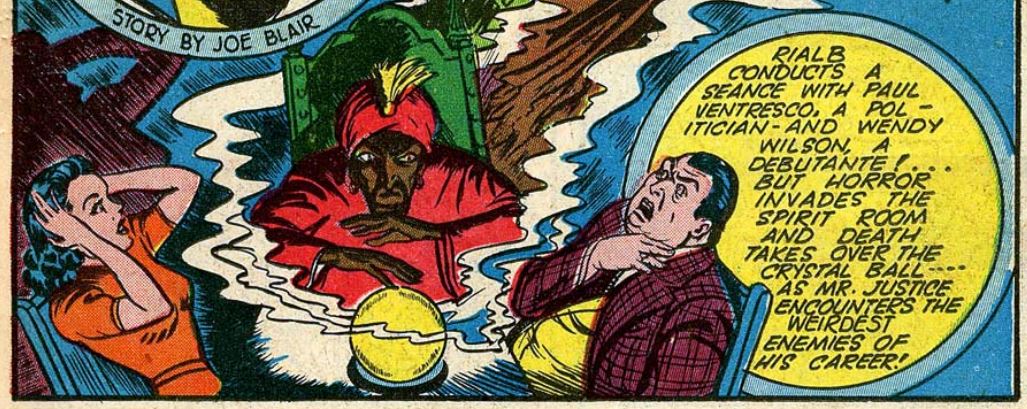
    Here’s a story about my powers of observation: I immediately noticed that our friend Rialb here had a backward name and spent a good half hour trying to figure out which Blair he might be named in reference to (a 1940s spiritualist? a famous skeptic?) before my eyes drifted slightly to the left and I took in the fact that the story was written by Joe Blair. I still have no idea why Joe Blair named the wet-rag villain of the story after himself, but let’s all be happy I figured it out before moaning about it here.

    Speaking of wet rags: let’s discuss Rialb. He’s a fake medium who accidentally discovers that he can actually summon the spirits of the dead but seems to have a knack for bringing back spirits who wish their descendants harm. Further, the first time he does so is witnessed by crooked politician Paul Ventresco, who puts the easily pushed-over Rialb to work as his personal ghost-powered hitman.

    The real stars of the story are the extremely grody ghosts that Rialb manages to conjure up. Just look at this gross old misogynist.

    Shadow imp, skull-faced spectre, pointillism lizard-man… this comic has it all!

    The real star is absolutely this skeleton-limbed hair-face who gets his bony ass kicked back to the netherworld he came from by Mr Justice before he can get up to any mischief. I really enjoy how the unchanging expression on his face reads as both menacing and sad depending on which side of the ass kicking he is.

    Just a regular ghost.

    It’s a bit of a letdown that the last ghosts we see are three sad sack victims of Ventrusco who Mr Justice calls up to cow the pair into surrendering, though he really only needed them for Ventrusco, given that Rialb shows no actual evidence of having a spine during the story – Mr Justice could have just thrown a sheet over a chair and gotten the same result.

  • MINOR SUPER-VILLAIN 525: RIALB

    MINOR SUPER-VILLAIN 525: RIALB

    (Blue Ribbon Comics 012, 1941)

    Here’s a story about my powers of observation: I immediately noticed that our friend Rialb here had a backward name and spent a good half hour trying to figure out which Blair he might be named in reference to (a 1940s spiritualist? a famous skeptic?) before my eyes drifted slightly to the left and I took in the fact that the story was written by Joe Blair. I still have no idea why Joe Blair named the wet-rag villain of the story after himself, but let’s all be happy I figured it out before moaning about it here.

    Speaking of wet rags: let’s discuss Rialb. He’s a fake medium who accidentally discovers that he can actually summon the spirits of the dead but seems to have a knack for bringing back spirits who wish their descendants harm. Further, the first time he does so is witnessed by crooked politician Paul Ventresco, who puts the easily pushed-over Rialb to work as his personal ghost-powered hitman.

    The real stars of the story are the extremely grody ghosts that Rialb manages to conjure up. Just look at this gross old misogynist.

    Shadow imp, skull-faced spectre, pointillism lizard-man… this comic has it all!

    The real star is absolutely this skeleton-limbed hair-face who gets his bony ass kicked back to the netherworld he came from by Mr Justice before he can get up to any mischief. I really enjoy how the unchanging expression on his face reads as both menacing and sad depending on which side of the ass kicking he is.

    Just a regular ghost.

    It’s a bit of a letdown that the last ghosts we see are three sad sack victims of Ventrusco who Mr Justice calls up to cow the pair into surrendering, though he really only needed them for Ventrusco, given that Rialb shows no actual evidence of having a spine during the story – Mr Justice could have just thrown a sheet over a chair and gotten the same result.

  • NOTES – MAY 2024

    Cops Shooting: 

    I’ve been reading old Dick Tracy strips and while tracking all of the times that Tracy fires on a fleeing suspect would be a fool’s errand I would like to note that so far in the 1933 he has been responsible for the shooting deaths of two non-criminals.

    Nova Scotia:

    Speaking of Dick Tracy and filled with home-town pride: this July 1933 strip and the next week or so take place in Halifax, Nova Scotia.

    Honours:

    Black X declines a medal from the president. (Smash Comics 001, 1939)

    Names:

    Look kids, it’s Al Lirog, the racketeer! (Speed Comics 003, 1939)

  • NOTES – MAY 2024

    Cops Shooting: 

    I’ve been reading old Dick Tracy strips and while tracking all of the times that Tracy fires on a fleeing suspect would be a fool’s errand I would like to note that so far in the 1933 he has been responsible for the shooting deaths of two non-criminals.

    Nova Scotia:

    Speaking of Dick Tracy and filled with home-town pride: this July 1933 strip and the next week or so take place in Halifax, Nova Scotia.

    Honours:

    Black X declines a medal from the president. (Smash Comics 001, 1939)

    Names:

    Look kids, it’s Al Lirog, the racketeer! (Speed Comics 003, 1939)

  • MINOR SUPER-HERO ROUND-UP 001

    Some minor super-heroes I only have a small amount to say about:

    the Wraith:

    The Wraith is a very similar concept to the Spectre: a murdered cop comes back to mete out justice. They even have the same white/ green colour scheme, only reversed. A few things about the Wraith that sets him apart: though he does have some general ghost powers his main trick is possession, he is limited to the hours between midnight and dawn, and he has weird gross arms. A major difference between him and the Spectre is that whereas the latter broke up with his fiance the minute he became a dead guy, the Wraith is all about the romantic possibilities of being a ghost, as seen in the second panel above where he seems to be erotically passing through a nude woman. (Mystery Men Comics 027-031, 1941-1942)

    Dr Hypno: 

    Dr Hypno, “psychologist, chemist, hypnotist and criminologist” develops a technique for temporarily placing his mind into an animal and lucky for him there’s always one handy when he sees a crime go.(Amazing-Man Comics 014-021, 1940-1941)

    Dash Dartwell, the Human Meteor:

    Like a surprising number of other Golden Age speedsters Dash Dartwell (who incidentally has the most on-the-nose name I have seen in a long time) gets his powers from his teacher, in this case one Dr Moss. Dartwell remains a student at “Dravrah University” so his adventures hew closer to those of a college sportsman with lots of unscrupulous gamblers attempting to influence the results of sporting events between Dravrah and their rival Elay. Also, Dartwell’s powers wear off pretty quickly so he’s constantly popping Metabo-Accelerater pills while he messes up college track statistics for everyone. (Amazing-Man Comics 021, 1941)

    Tommy the Amazing Kid:

    Amazing-Man already had a cool sidekick named Zona Henderson but I guess Robin or some other kid sidekick was a bit too popular because she was replaced with her younger brother Tommy, who was hiding under a couch when Aman got a power boost and was left with enhanced strength and the ability to fly. He’s a little wiener who says things like “jumpin’ jellybeans!” all the time. It’s a real downgrade. (Amazing-Man Comics 023-026, 1941-1942)

  • MINOR SUPER-VILLAIN 432: THE CONQUEROR

    (Keen Detective Funnies 011, 1939)

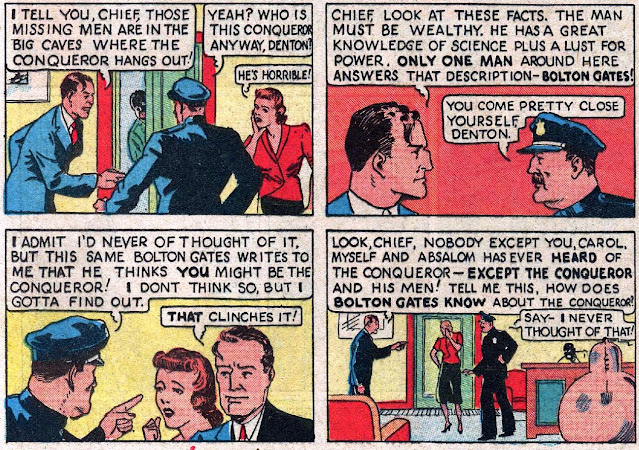
    The Conqueror is the major recurring foe of Dean Denton, Scientific Adventurer, about whom we will briefly aside: Dean Denton was created by Harry Campbell, who was also responsible for such characters as Ace of Space, Bruce Blackburn and the wretched Scarlet Seal, but also Wizard Wells and John Law, Scientiective, who form a kind of thematic triad of scientific detectives with Dean Denton.

    Dean Denton is definitely the most entertaining of the three to read (with the unfortunate caveat that his are the adventures that are most riddled with racial stereotypes. The Golden Age, folks!) due partially to his former occupation as a well-known ventriloquist but mostly to his archfoe the Conqueror, who beats John Law’s Avenger and Wizard Wells’ collection of no-name goons hands down.

    The Conqueror is actually rich guy Bolton Gates and over the course of a couple of dozen appearances he has my favourite villainous character arc: the villain of means with vast resources is foiled several times by Our Hero and ends up scrabbling around doing comparatively petty crimes for chump change. 

    In his first few appearances the Conqueror has a lavish estate under which is a technologically advanced lair filled with brainwashed minions. After Dean Denton blows all that up it seems like the Conqueror is forever seeking to recreate it with schemes that place him in positions of high status: not only does he pose as divine figures to dupe tribal groups in both Central America and Africa but he founds somewhere between two to three cults:

    Somewhat surprisingly, the White Crusaders, over which the Conqueror presided as the Master Crusader/ the White Master, was not a racially problematic group.

    Meanwhile the Cult of Astra was mostly a way to flimflam flaky Hollywood types and blackmail their studios with the threat of religion-related work stoppages (a scheme that nets him a two-episode arc on the Villains of Old Hollywood podcast).

    The third example is somewhere between a cult and his old habit of minion recruitment through mind control: he takes advantage of the conflict between the countries of Namreg and Feltia (and in case “Namreg” was too subtle for you they clash near the “Tonigam Line”) to capture and brainwash both Namreg and Feltian forces. 

    Even though the Conqueror gets away as per usual at the end of this scheme, it’s his last appearance in comics (that I know of, natch). One can imagine his conflict with Dean Denton continuing indefinitely and why not. It’s more fun than most things that might logically happen to a lone civilian trapped in the midst of two armies that he recently made enemies of. after all.