The Curse of Skeleton Munroe

Category: undersea

  • SUPER-HERO FILE 007: NAMOR THE SUB-MARINER

    (Marvel Mystery Comics 003, 1940)

    Though Namor started his comics journey as an outright villain, by his third appearance, the world was ready to see a softer side of him. This journey to redemption begins when the police notice just how horny he was in his last outing and assign NYPD officer Betty Dean to capture him. On her own with no backup, of course.

    Despite the fact that her boss is seemingly trying to commit murder by super-villain on her, Betty is very good at her job and puts a plan into place that theoretically has the Sub-Mariner at her mercy: she lurks around the waterfront with a swimsuit under her clothes until someone spots Namor in the vicinity and then pretends to be drowning. Once he has answered the siren call of an attractive woman in trouble, Betty employs Sherlock Holmes’ favourite means of capturing someone: get close to them and then put a gun to their head.

    Alas for Betty, while this plan would have worked if Namor had been an ordinary swimming murderer, he is in fact a bulletproof fish man and she ends up stranded on a buoy far out at sea. It is at this point, however that Namor performs his very first super-heroic act: when confronted with a sea battle between a British convoy and some German sea raiders, he instinctively comes to the aid of the underdog and sinks the Nazis.

    Betty takes this as an opportunity to explain that Americans are, like, totally peaceful and would never blow up Atlantis on purpose, and actually manages to sway his opinion! No more will he war on the USA, unless another attractive woman takes the time to point out that maybe they would have if they thought it was a good idea or profitable enough or might have inconvenienced the English/French/Spanish depending on historical era.

    Namor returns to Atlantis’ cool-ass iceberg palace in Marvel Mystery Comics v1 004 and convinces the Emperor and never-before-seen Council of Three to change their minds about the US in about five minutes, then sets out with a fleet of Atlantis’ finest steam-powered (I’m sorry: artificial steam-powered) aerial submarines to wage war on the Axis. I’m not going to cover a lot of it because it’s pretty repetitive, but a large part of Namor’s Golden Age super-heroic career consists of sallying forth with the Atlantean Aerial Navy and blowing up huge chunks of the German and Japanese Navies. Like he possibly blows up more ships than the Axis actually possessed.

    Don’t think that we have seen the last of the villainous Namor, by the way, because that guy is always lurking in the (small, ankle-mounted) wings.

    Update 1940 

  • SUPER-HERO FILE 007: NAMOR THE SUB-MARINER

    (Marvel Mystery Comics 003, 1940)

    Though Namor started his comics journey as an outright villain, by his third appearance, the world was ready to see a softer side of him. This journey to redemption begins when the police notice just how horny he was in his last outing and assign NYPD officer Betty Dean to capture him. On her own with no backup, of course.

    Despite the fact that her boss is seemingly trying to commit murder by super-villain on her, Betty is very good at her job and puts a plan into place that theoretically has the Sub-Mariner at her mercy: she lurks around the waterfront with a swimsuit under her clothes until someone spots Namor in the vicinity and then pretends to be drowning. Once he has answered the siren call of an attractive woman in trouble, Betty employs Sherlock Holmes’ favourite means of capturing someone: get close to them and then put a gun to their head.

    Alas for Betty, while this plan would have worked if Namor had been an ordinary swimming murderer, he is in fact a bulletproof fish man and she ends up stranded on a buoy far out at sea. It is at this point, however that Namor performs his very first super-heroic act: when confronted with a sea battle between a British convoy and some German sea raiders, he instinctively comes to the aid of the underdog and sinks the Nazis.

    Betty takes this as an opportunity to explain that Americans are, like, totally peaceful and would never blow up Atlantis on purpose, and actually manages to sway his opinion! No more will he war on the USA, unless another attractive woman takes the time to point out that maybe they would have if they thought it was a good idea or profitable enough or might have inconvenienced the English/French/Spanish depending on historical era.

    Namor returns to Atlantis’ cool-ass iceberg palace in Marvel Mystery Comics v1 004 and convinces the Emperor and never-before-seen Council of Three to change their minds about the US in about five minutes, then sets out with a fleet of Atlantis’ finest steam-powered (I’m sorry: artificial steam-powered) aerial submarines to wage war on the Axis. I’m not going to cover a lot of it because it’s pretty repetitive, but a large part of Namor’s Golden Age super-heroic career consists of sallying forth with the Atlantean Aerial Navy and blowing up huge chunks of the German and Japanese Navies. Like he possibly blows up more ships than the Axis actually possessed.

    Don’t think that we have seen the last of the villainous Namor, by the way, because that guy is always lurking in the (small, ankle-mounted) wings.

    Update 1940 

  • ALIENS AND SO FORTH ROUND-UP 046

    ALIENS AND SO FORTH ROUND-UP 046

    Good lord! Aliens!

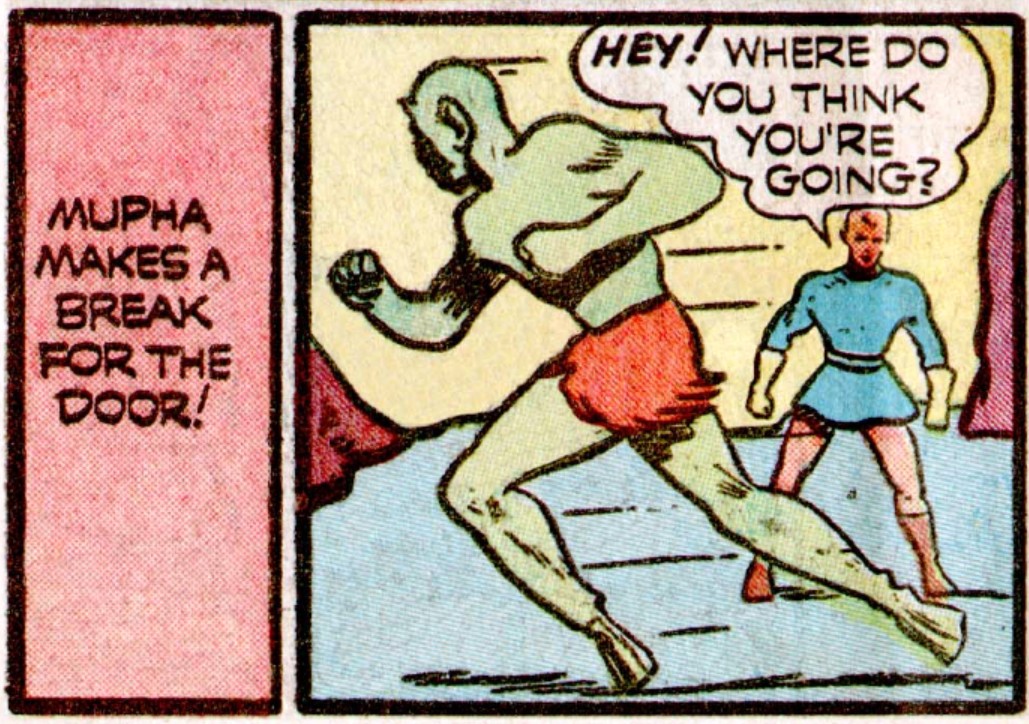
    Mupha’s Species:

    Mupha, ruler of the undersea Land of Peril, is the kind of creep who sends his subjects to kidnap women to become his queen. This eventually brings him into conflict with underwater adventurer Sub Saunders -not because Sub is looking for kidnappees but because he happens to pass by the Land of Peril and makes Mupha nervous enough to open fire on his submarine.

    As Mupha appears to have only two subjects we must assume that either a) his species is nearly extinct (which explains his quest for a mate but does not excuse it) or b) the Land of Peril is a breakaway group from a larger population somewhere, political exiles, perhaps, because of their pro-kidnapping policies. In either case, the group does not survive its encounter with Sub Saunders. 

    Also please note their stylish hooves, a very unusual feature in an aquatic species. (Fantastic Comics 018, 1941)

    Martians:

    The only example of this particular Martian species who we meet is Kodi, partner to Nick Nelson in the Space Patrol. At least, I think so. See, much like the adventures of Spacehawk, “Space Patrol” is a Basil Wolverton comic, and one thing that Basil Wolverton liked was drawing all kinds of different weird-looking aliens. So while Kodi is the only big-headed orange Martian who we see in the course of the series, there are also a variety of other Martians in a range of colours and shapes and who’s to say whether they aren’t all the same species? (Amazing Mystery Funnies v2 012, 1939)

    Spider Men:

    While there are also a variety of different Venusians depicted in the pages of “Space Patrol,” I am pretty confident in my assessment that they are unrelated to the Venusian Spider Men. Encountered by Nick and Kodi as they pursue a fugitive into the deep jungles of Venus (Tropical Jungle Planet being one of the old sci-fi paradigms for the planet), the Spider Men are presented as relentless predators of intelligent humanoids. They also look great, even better than my beloved Martian Spider-Men. Imagine: a whole species of balding men with unkempt beards!

    The Spider Men manage to drag Nick Nelson back to their cave home (where we learn that they are tool users!) but are ultimately no match for the Space Patrol’s various beams and rays. (Amazing Mystery Funnies v2 012, 1939)

    Mercurians:

    While looking into the disappearance of a space freighter and its cargo of green diamonds, Nick and Kodi track its location to a volcanic crater on Mercury, where the ship’s pilot has murdered the rest of the crew, stolen the diamonds and dumped the ship itself into a lava pit, with the aid of a crew of Mercurian Mole-Men. As is so often the case in a sci-fi story, our impression of an entire species must be formed by the actions of one of its worst members, and we simply must assume that this kind of theft and murder is atypical, or however would our nameless villain have gotten his job in the first place?

    As for the Mole-Men, they don’t get a lot of characterization beyond the fact that they are “the savage inhabitants of the underground regions,” but as always I do enjoy Wolverton’s use of morphological similarities (specifically the ears, nose and especially feet and legs) to show that they and our Mercurian friend evolved from some common ancestor. Plus it’s hard not to love a cave-full of little glaring goblin-men. 

    The Mercurian gets a bit to smug about the fact that he has Nick and Kodi at his mercy and manages to nearly blow his own head off with a phenomenally bad shot. I do not like his knees, but I do like that horde of rampaging Mole-Men.

    Having made their way back to their ship, Nick and Kodi decide to just skip the tedious parts of the legal system (arrest, trial, state-mandated punishments, etc) and skip straight to the execution. A few well-placed atom bombs and the volcano takes care of both the Mercurian and the Mole-Men for them. (Amazing Mystery Funnies v3 003, 1940)

    (very similar Mercurians are featured in Amazing Mystery Funnies v3 006, 1940)

  • ALIENS AND SO FORTH ROUND-UP 042

    ALIENS AND SO FORTH ROUND-UP 042

    I hope you like aliens, because I just can’t stop finding new ones. 

    Kobolians:

    The Kobolians are from the underwater city of Kobol in the year 10 000 CE, and while we don’t learn too much about how their society functions we can intuit a certain amount of civic pride, given that their leader is named Lobok – did he rise to power on the strength of that name? Did he adopt it? Is the city named after him? Whichever it is, Lobok commands enough loyalty that the Kobolians go along with him when he decides to acquire a human wife via extortion. And not just any human either, but the daughter of Biran, leader of the Army of New America!

    Though the Kobolians live in an underwater city, it is not flooded, indicating that they are amphibious rather than fully water-breathing. They might even be that most rare of things: the underwater species that is fully air-breathing!

    Anyway, Sub Saunders blows the place up after rescuing Ms Nirab. (Fantastic Comics 014, 1941)

    Magyans:

    Space adventurer Iron Munro (born on Jupiter in the 22nd Century and thus very physically mighty. If his name seems familiar it’s because it was swiped by Roy Thomas and used as the name of the post-Crisis Superman replacement) and his companions, after being blasted into a “new universe” (contextually, a new solar system) by a rogue asteroid, find themselves in the middle of a conflict between two groups called the Magyans and the Tefflans. 

    As explained by the Magyan leader, the roots of this conflict stem from a war between their ancestors and the underground-dwelling Tefflans on another planet, tens of thousands of years earlier, a conflict that resulted in the destruction of their mutual home continent as the remnants of both populations fled into outer space. Iron Munro takes an immediate wild swing and identifies this continent as Mu (why no Atlantis? Is Iron Munro a hipster?). 

    If the Magyans are the lost inhabitants of Mu, then what does that make the Tefflans? Why, they are weird evil goat-men, and thus the basis for all of humanity’s legends about demons and devils!

    Munro and his pals side with the humans, of course, and over the next six issues there is an escalating back-and-forth war between the Magyans and the more technologically-advanced Tefflans that culminates in a devastating final attack in which the Magyans launch their twin moons Ma-Ran and Ma-Kanee at the Tefflan planet of Teff-El. It’s a horrifying way to end a war! (Shadow Comics v1 002, 1940)

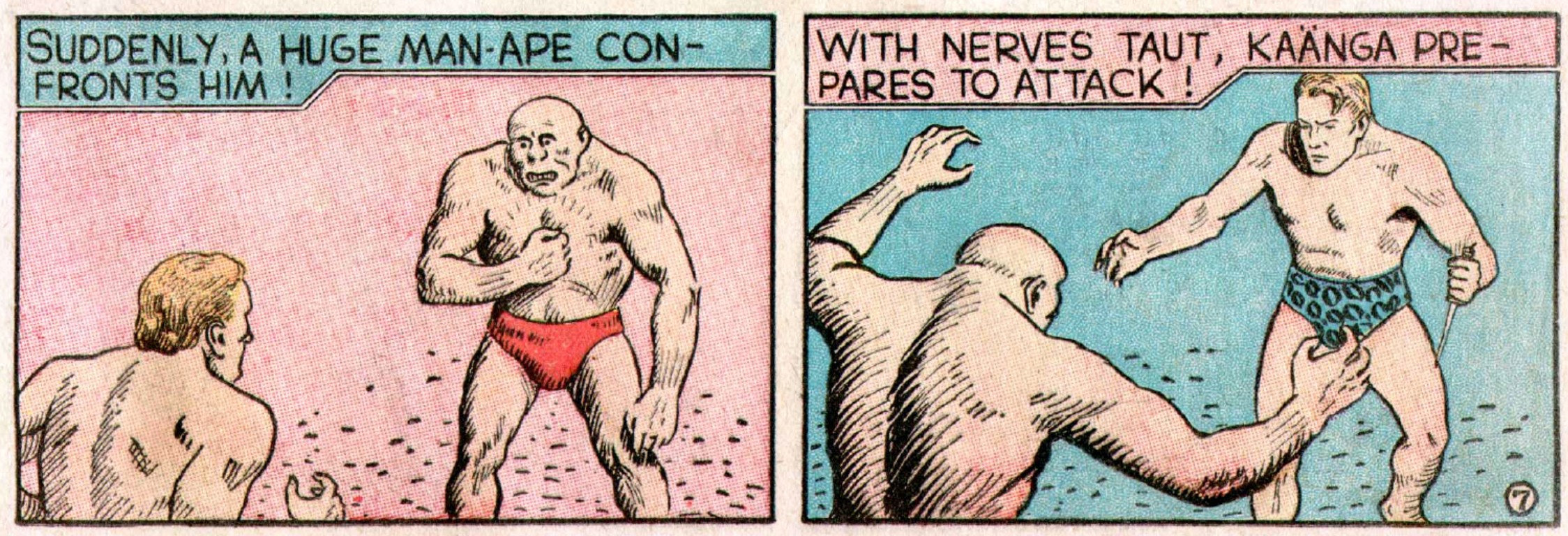
    Man-Apes:

    These Man-Apes serve megacreep Dr Wratt as muscle. They hold the particular distinction of being the least apelike ape-men that I have ever seen. (Jungle Comics 002, 1940)

  • GENERIC COSTUMED VILLAIN ROUND-UP 042

    GENERIC COSTUMED VILLAIN ROUND-UP 042

    Celebrated by none… until now. And then only mildly.

    Slavin:

    This masked man is the leader of a gang who have been systematically robbing warehouses and then burning them down. The culprit turns out to be Slavin, the general manager of the warehousing company, and not the red herring suspect Slivers, owner of the company (who is ugly, and therefore more likely to be evil than the handsome Slavin). PI Dan Williams is too enlightened to judge others based on their appearances though, and busts the right man.  (Exciting Comics 014, 1941)

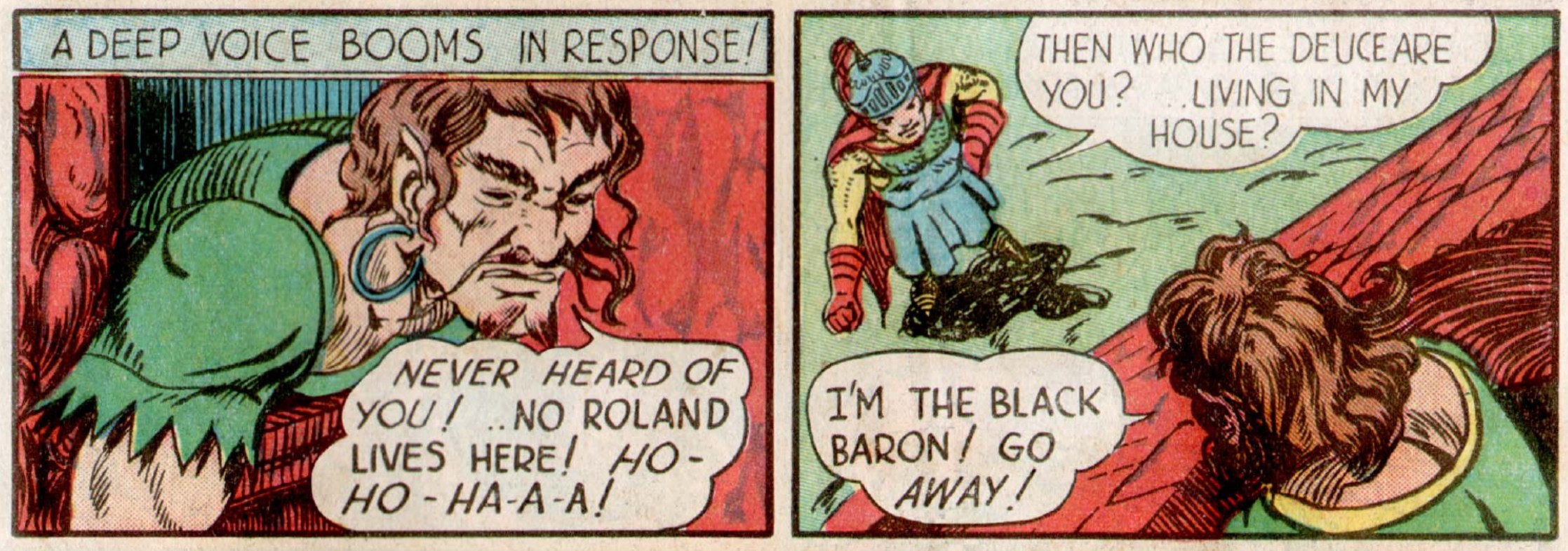
    the Black Baron:

    After wandering around Europe and North Africa and only really hitting up the Crusades long enough to kill Saladin, Sir Richard of Warwick, aka the Golden Knight, returns home to find that his younger brother Roland is missing and a very rude man called the Black Baron is squatting on his lands.

    The Black Baron seemed like he might get a numbered entry by name alone but alas, he’s a true scrub. The Golden Knight and his friends murder all of his men with what I would call embarrassing ease and the Baron passes up an opportunity to get away with his life for another shot at the gold he is convinced that Roland is hiding from him. The Golden Knight then enacts a little Crusader-style justice on him. To death. (Fantastic Comics 014, 1941)

    Unnamed Fascists:

    What do you do when you’re notorious comic book oddball Fletcher Hanks and you need to draw a selection of Axis leaders but the US comics industry isn’t yet 100% on board with just explicitly depicting Hitler as an evil villain and so you need to have a bit of plausible deniability? Masked Axis leaders, obviously! (Fantastic Comics 014, 1941)

    Kong:

    This fellow, name of Kong, has a super-sub and is looking to use it to extort some quick cash from the future state of New America. A classic plan!

    Kong’s cachet is spoiled somewhat by the fact that the heroic Sub Saunders just walks in through the front door of his underwater base and lays him out with a single punch. As a villain it is very hard to come back from something like this. (Fantastic Comics 015, 1941)

  • ALIENS AND SO FORTH ROUND-UP 037

    Every once in a while I hit a particularly dense seam of aliens and so forth and this week is one of those times. 

    Neptunii: 

    The Neptunii (and that name is a guess based on the fact that one guy uses “Neptunus” as a singular version of the noun) live in Neptunia, an underground kingdom that could be described as “a big cave” at the bottom of the Atlantic Ocean. There, they seem to just kind of fly around shouting, though this short comic book story might not give a full picture of their society.

    There are a few points of interest about the Neptunii: they are both finned and winged, they all wear little horned circlets, they call their leader the “Sub-Ruler”… but the thing I am always struck by is just how much Prince Ikor and his pal in the above panel look like quirky characters from a late-90s webcomic. 

    Though Peter “the Fin” Noble becomes the ruler of Neptunia via a bit of impulsive regicide and remains so in his infrequent appearances to this day, to my knowledge the Neptunii themselves have not showed their faces since their first appearance in 1941. (Daring Mystery Comics 007, 1941)

    Inus-Men:

    The Inus-Men take their name from the fact that they are the inhabitants of the planet Inus. They are pretty regular-style cavemen, only more red, and are one of the many dangers faced by Dr X’s niece Cynthia when her astral form is blasted willy-nilly through space by her most unethical uncle. (Startling Comics 001, 1940)

    Jovians:

    The Jovians of the year 3964 AC (sic) are an oppressed underclass who work in the radium mines of the human colony on Jupiter. They are unable to own weapons by law, are possibly disallowed from large gatherings or approaching humans (see the first two panels above where the “boldness” of the Jovians is discussed) and generally mirror the conditions of colonized peoples on our world. This all clearly sucks and is unjust, which is especially interesting because the comic it all appears in clearly considers it to be the natural order of things.

    The Jovians are ripe for (and right to) revolt, and do so under the leadership of the evil Space Emperor. Once he is captured and revealed to be an opportunist by Major Mars they are returned to their place under the collective human thumb. (Exciting Comics 001, 1940)

    Jovians:

    Our second set of Jovians are also radium focused, but rather than mining it for their human overlords they use it to generate power, and having run out they are now demanding that both Earth and Mars hand over their radium supply or face annihilation. This draws the ire of space adventurer and Earth-Mars envoy Mitey Powers and he sets out with his entourage to resolve the situation.

    The title of this story is “The Super-Giants of Jupiter,” and I really appreciate that it lives up to the name. These Jovians are big, man. They’re also pleasingly alien, with their fish heads and tendril hands.

    I can only assume that it is the fact that the Jovians and their warships are so big contributes to Mitey’s decision to commit a war crime against their populace by unleashing a swarm of Martian Poison Gnats that will breed uncontrollably and “[kill] off most of the people.” It’s a horrible crime, Mitey! Particularly as radium is one of the less-used radioactive elements today! (Superworld Comics 003, 1940)

  • ALIENS AND SO FORTH ROUND-UP 037

    Every once in a while I hit a particularly dense seam of aliens and so forth and this week is one of those times. 

    Neptunii: 

    The Neptunii (and that name is a guess based on the fact that one guy uses “Neptunus” as a singular version of the noun) live in Neptunia, an underground kingdom that could be described as “a big cave” at the bottom of the Atlantic Ocean. There, they seem to just kind of fly around shouting, though this short comic book story might not give a full picture of their society.

    There are a few points of interest about the Neptunii: they are both finned and winged, they all wear little horned circlets, they call their leader the “Sub-Ruler”… but the thing I am always struck by is just how much Prince Ikor and his pal in the above panel look like quirky characters from a late-90s webcomic. 

    Though Peter “the Fin” Noble becomes the ruler of Neptunia via a bit of impulsive regicide and remains so in his infrequent appearances to this day, to my knowledge the Neptunii themselves have not showed their faces since their first appearance in 1941. (Daring Mystery Comics 007, 1941)

    Inus-Men:

    The Inus-Men take their name from the fact that they are the inhabitants of the planet Inus. They are pretty regular-style cavemen, only more red, and are one of the many dangers faced by Dr X’s niece Cynthia when her astral form is blasted willy-nilly through space by her most unethical uncle. (Startling Comics 001, 1940)

    Jovians:

    The Jovians of the year 3964 AC (sic) are an oppressed underclass who work in the radium mines of the human colony on Jupiter. They are unable to own weapons by law, are possibly disallowed from large gatherings or approaching humans (see the first two panels above where the “boldness” of the Jovians is discussed) and generally mirror the conditions of colonized peoples on our world. This all clearly sucks and is unjust, which is especially interesting because the comic it all appears in clearly considers it to be the natural order of things.

    The Jovians are ripe for (and right to) revolt, and do so under the leadership of the evil Space Emperor. Once he is captured and revealed to be an opportunist by Major Mars they are returned to their place under the collective human thumb. (Exciting Comics 001, 1940)

    Jovians:

    Our second set of Jovians are also radium focused, but rather than mining it for their human overlords they use it to generate power, and having run out they are now demanding that both Earth and Mars hand over their radium supply or face annihilation. This draws the ire of space adventurer and Earth-Mars envoy Mitey Powers and he sets out with his entourage to resolve the situation.

    The title of this story is “The Super-Giants of Jupiter,” and I really appreciate that it lives up to the name. These Jovians are big, man. They’re also pleasingly alien, with their fish heads and tendril hands.

    I can only assume that it is the fact that the Jovians and their warships are so big contributes to Mitey’s decision to commit a war crime against their populace by unleashing a swarm of Martian Poison Gnats that will breed uncontrollably and “[kill] off most of the people.” It’s a horrible crime, Mitey! Particularly as radium is one of the less-used radioactive elements today! (Superworld Comics 003, 1940)

  • MINOR SUPER-HERO ROUND-UP 087

    If the last group of minor Marvel super-heroes had a tiny chance of appearing in a modern comic book I would say that this group’s chances are tiny-plus. Like a further 5% chance. Except for Dynaman.

    Dynaman:

    Dynaman, aka Lagaro, which means “Dynaman”, was born in the ancient super-advanced Kingdom of Korug, located somewhere in the Atlantic Ocean. Endowed with super strength, a photographic memory and enhanced intelligence, the ability to fly and a general superiority to even his peers in the ancient Korugan super society, Dynaman had it all.

    Korug eventually suffers the fate of all ancient island super-societies and sinks into the sea, leaving Lagaro as the only survivor. He makes his way to Ancient Egypt (and the presence of the Sphinx when he does so gives us a more accurate guess than usual as to when in the past this adventure takes place, if only by telling us that it was some time after 2500 BCE) where he helps the heretofore unknown Pharaoh Khufor with a couple of problems (i.e., a giant caveman invasion). His further adventures go unrecorded.

    Dynaman, like Breeze Barton before him, is a simple concept (super guy) wrapped up in a lot of extra layers (last survivor of a super-race, in the past, somehow still looks like a 20th Century super-hero). This is one of two things that they have in common, with the other being that they were both brought back in the same Marvel Zombies sequel, only to be gruesomely killed off. (Daring Mystery Comics 006, 1940) 

    the Fin:

    The Fin is in reality Lieutenant Peter Noble, engineer in the US Naval Reserve, whose submarine is wrecked while on manoeuvres in the Atlantic. Noble, the only survivor, finds that for never-explained reasons he is able to breathe underwater and makes his way to the underground kingdom of Neptunia (a big cave). He then becomes the new Sub-Ruler of Neptunia via the traditional methods of attaining nobility: being a colossal jerk, picking a fight with the reigning Prince Ikor and shooting him in the head, then shooting anyone who disagrees with his rule.

    This would be the origin of a villain, if the Neptunii didn’t immediately declare him to be the reincarnation of their ancient hero the Fin, making him a bit less likely to blow them away. Over time he grows into the role and becomes the true champion of Neptunia, and hey, perhaps he is the real Fin after all, which might explain his water-breathing ability an innate ability to speak Neptunian.

    As with so many great super-hero costumes, the Fin’s is just thrown together out of some old crap that Peter Noble had lying around. (Daring Mystery Comics 007, 1941) 

    Blue Diamond:

    GOOD NEWS: Professor Elton Morrow’s Antarctic expedition was a success! He found a huge blue diamond!

    BAD NEWS: Morrow’s ship was sunk by Nazis on the way home.

    GOOD NEWS: He escaped the sinking ship and managed to bring the diamond with him!

    BAD NEWS: The Nazis shelled the bit of wreckage he was clinging to, causing the diamond to explode and riddle his body with shards. 

    The final bit of good news is that despite the loss of the diamond, the shards in Morrow’s body have somehow made him”super hard,” which is an inelegant way of saying resistant to pain, invulnerable to harm and extra dense or simply unable to be moved by something like a truck hitting him, and though he’s not precisely super strong, these features add up to produce something like super strength.

    After foiling a pretty low-stakes museum robbery, Morrow decides to adopt a costumed persona to continue fighting crime. Every time I see his costume I am surprised by a) just how much yellow is on it and b) just how big that diamond on the chest it. It’s also a wild move to have a completely exposed face and call yourself the Blue Diamond when you are the one guy who is prominently associated with a blue diamond. (Daring Mystery Comics 007, 1941) 

    the Silver Scorpion:

    Betty Barstow, secretary for private detective and huge asshole Dan Hurley, is secretly vigilante the Silver Scorpion. I want to say that Golden Age Marvel has very few female super-heroes compared to its contemporaries, but my reckoning is probably being biased by the fact that DC’s stable includes all of Quality and Fawcett’s female characters. I reckon that the percentage is pretty much the same on a per-publication basis.

    Betty’s origin as the Silver Scorpion is in fact identical to that of Barbara Gordon as Batgirl, in that she is on her way to a costume party when she stumbles upon the scene of a crime (in this case a bunch of counterfeiters operating out of a cemetery rather than whatever the Killer Moth was doing) and intervenes, armed with a pre-concealed identity and some martial arts knowledge. She only has three Golden Age appearances but they’re all pretty fun.

    Finally the obvious question when discussing the Silver Scorpion: what’s with the name? Why silver when her costume is mostly yellow and red? The answer: the silver scorpion in question is this little fellow on the back of her cape, though just what the significance of it is is left unsaid. It is a masquerade costume, after all – since when do they have to make total sense? (Daring Mystery Comics 007, 1941)

  • MINOR SUPER-HERO ROUND-UP 087

    If the last group of minor Marvel super-heroes had a tiny chance of appearing in a modern comic book I would say that this group’s chances are tiny-plus. Like a further 5% chance. Except for Dynaman.

    Dynaman:

    Dynaman, aka Lagaro, which means “Dynaman”, was born in the ancient super-advanced Kingdom of Korug, located somewhere in the Atlantic Ocean. Endowed with super strength, a photographic memory and enhanced intelligence, the ability to fly and a general superiority to even his peers in the ancient Korugan super society, Dynaman had it all.

    Korug eventually suffers the fate of all ancient island super-societies and sinks into the sea, leaving Lagaro as the only survivor. He makes his way to Ancient Egypt (and the presence of the Sphinx when he does so gives us a more accurate guess than usual as to when in the past this adventure takes place, if only by telling us that it was some time after 2500 BCE) where he helps the heretofore unknown Pharaoh Khufor with a couple of problems (i.e., a giant caveman invasion). His further adventures go unrecorded.

    Dynaman, like Breeze Barton before him, is a simple concept (super guy) wrapped up in a lot of extra layers (last survivor of a super-race, in the past, somehow still looks like a 20th Century super-hero). This is one of two things that they have in common, with the other being that they were both brought back in the same Marvel Zombies sequel, only to be gruesomely killed off. (Daring Mystery Comics 006, 1940) 

    the Fin:

    The Fin is in reality Lieutenant Peter Noble, engineer in the US Naval Reserve, whose submarine is wrecked while on manoeuvres in the Atlantic. Noble, the only survivor, finds that for never-explained reasons he is able to breathe underwater and makes his way to the underground kingdom of Neptunia (a big cave). He then becomes the new Sub-Ruler of Neptunia via the traditional methods of attaining nobility: being a colossal jerk, picking a fight with the reigning Prince Ikor and shooting him in the head, then shooting anyone who disagrees with his rule.

    This would be the origin of a villain, if the Neptunii didn’t immediately declare him to be the reincarnation of their ancient hero the Fin, making him a bit less likely to blow them away. Over time he grows into the role and becomes the true champion of Neptunia, and hey, perhaps he is the real Fin after all, which might explain his water-breathing ability an innate ability to speak Neptunian.

    As with so many great super-hero costumes, the Fin’s is just thrown together out of some old crap that Peter Noble had lying around. (Daring Mystery Comics 007, 1941) 

    Blue Diamond:

    GOOD NEWS: Professor Elton Morrow’s Antarctic expedition was a success! He found a huge blue diamond!

    BAD NEWS: Morrow’s ship was sunk by Nazis on the way home.

    GOOD NEWS: He escaped the sinking ship and managed to bring the diamond with him!

    BAD NEWS: The Nazis shelled the bit of wreckage he was clinging to, causing the diamond to explode and riddle his body with shards. 

    The final bit of good news is that despite the loss of the diamond, the shards in Morrow’s body have somehow made him”super hard,” which is an inelegant way of saying resistant to pain, invulnerable to harm and extra dense or simply unable to be moved by something like a truck hitting him, and though he’s not precisely super strong, these features add up to produce something like super strength.

    After foiling a pretty low-stakes museum robbery, Morrow decides to adopt a costumed persona to continue fighting crime. Every time I see his costume I am surprised by a) just how much yellow is on it and b) just how big that diamond on the chest it. It’s also a wild move to have a completely exposed face and call yourself the Blue Diamond when you are the one guy who is prominently associated with a blue diamond. (Daring Mystery Comics 007, 1941) 

    the Silver Scorpion:

    Betty Barstow, secretary for private detective and huge asshole Dan Hurley, is secretly vigilante the Silver Scorpion. I want to say that Golden Age Marvel has very few female super-heroes compared to its contemporaries, but my reckoning is probably being biased by the fact that DC’s stable includes all of Quality and Fawcett’s female characters. I reckon that the percentage is pretty much the same on a per-publication basis.

    Betty’s origin as the Silver Scorpion is in fact identical to that of Barbara Gordon as Batgirl, in that she is on her way to a costume party when she stumbles upon the scene of a crime (in this case a bunch of counterfeiters operating out of a cemetery rather than whatever the Killer Moth was doing) and intervenes, armed with a pre-concealed identity and some martial arts knowledge. She only has three Golden Age appearances but they’re all pretty fun.

    Finally the obvious question when discussing the Silver Scorpion: what’s with the name? Why silver when her costume is mostly yellow and red? The answer: the silver scorpion in question is this little fellow on the back of her cape, though just what the significance of it is is left unsaid. It is a masquerade costume, after all – since when do they have to make total sense? (Daring Mystery Comics 007, 1941)

  • ALIENS AND SO FORTH ROUND-UP 029

    The wonders of the cosmos!

    Spiny Scalemen: 

    The Spiny Scalemen are yet another group of gross-looking underwater humanoids who threaten the mostly peaceful nation of Amloza, and what’s worse, they’re doing it as part of a Nazi plot to take over the city and use it as a naval base. Thankfully Mogg the Fish-Man and only competent citizen of Amloza realizes that city walls are a bit of a useless affectation in an underwater environment and destroys the Scalemen by collapsing Amloza’s onto them. (Champ Comics 016, 1941)

    Categorized in: Body (Nonhuman Parts), Generica (Men)

    Flat Heads: 

    “Og, Son of Fire” was a comic adapted from a Big Little Book that was based on a series of short stories and also a radio show about Og, a young caveman who is trying to make his way in a hostile world. And importantly for the purposes of this blog, one of the things making the world more hostile is this tribe of ape men led by a fellow named Long Tooth. Heaven knows I love an ape man, but I love ’em even more when they’re called something fun like “Flat Heads.” See also the Flat Heads’ Sun God here. (The Funnies 013, 1937)

    Categorized in: Body (Heads)

    the Flies:

    While the Barrangees of Planet Barrang have had a lot of problems with insects over the years – they famously grew giant and drove the Barangee population underground, while insect-worshipping Barrangee priests stymied any attempt to reclaim the surface – their most troublesome foes were always the giant flies. These creatures have adapted to their new size by becoming active hunters rather than scavengers, and the Barrangees are a favourite prey. Couple this with the fact that Earthman Captain Tornado and his cohort have encouraged the Barrangees to move above ground and you get situations like the above, in which a Fly abducts a Barrangee child in broad daylight.

    The Flies are the most intelligent and organized of the Barrang insect species featured in the “Captain Tornado” feature, and they make war on the Barrangee city under the direction of their Fly King until Tornado bring knowledge of both firearms and insecticide to the planet and effectively counters their offensive. (Popular Comics 054, 1940)

    Categorized in: Animals (Insects), Extrasolar (Planet Barrang)

    Fourth Dimensional Creatures:

    After foiling several of Satan Rex’s attempts to destroy humanity, scientific adventurer Jon Linton and his pals return to their first love: tinkering around with spaceships. And since Jon et al exist in an adventure comic, the first test flight of their new rocket turns into an out-of-control flight through space at never-before-seen speeds, careening directly through planets without touching an atom and ending up on a world where thought and reality intersect, kind of like that one episode of Star Trek: The Next Generation.

    During their pell-mell flight through space, Linton and pals are briefly visited by these tentacle-legged lizard monsters, who appear to be kind of generically hostile for a few minutes before fading back into the ether. Just what the heck is going on?

    Jon hits upon the answer with his customary swiftness: these are inhabitants of the Fourth Dimension, and the ship briefly intersected with their space. Does this justify the seeming aggression that their show to the people on the spaceship? We cannot accurately judge, alas. (Amazing Mystery Funnies v3 007, 1940)

    Categorized in: Extradimensional (Fourth Dimension)