The Curse of Skeleton Munroe

Category: Kaänga

  • DIVINE ROUND-UP 001

    As long as we’re dipping into the aliens of comics, we might as well go all the way and dig out all the various gods etc that people have made up too. Comic book divinities fall into a few broad styles:

    -real objects or creatures worshipped animistically but which do not display any real divine power

    -idols, verbal invocations or other trappings of religious worship without any indication that the being being represented is really real

    -actual supernatural beings, including:

    –versions of actual deities

    –new additions to real-world pantheons 

    –gods made up out of whole cloth

    Obviously there is some overlap between these categories. The idol that bestows curses or good luck, the invocation that does the same. Is a sacred tree an idol or animism or both? What if it delivers blessings on the faithful? 

    The other thing to mention about comic book representations or religion is that huge swathes of them are being presented through the triple lenses of Smug 40s Rationalism, Default Christianity and White Supremacy in a real racist trifecta. Barring the odd exception we’re going to see a lot of It’s Silly to Believe in a Non-Christian God and All Non-Christian Religions are Actually Long Cons by Priestly Classes along with some If There is a Real Entity Behind This Then They are Actually a Horrible Evil. Plus a lot of elder god-monsters and culturally safe classical deities and so forth.

    So: on we go! 

    the Guardian of the Grotto of Jewels: 

    Though the Red Mask is the leader of some or all of the peoples of the island of Kakura, he doesn’t seem to have much regard for their culture (as befits a proper 1940s rationalist hero, I suppose), as in quick succession he a) brings a girl to the sacred Grotto of Jewels, b) gives her some of the eponymous jewels and c) kills the grotto’s guardian god-monster with a boat. 

    God-style: animistic worship of a real beast (Best Comics 001, 1939)

    Akrifa: 

    Akrifa here is the god worshipped by the evil King Tongo. He’s some sort of fire god who Tongo does human sacrifice to, but before he really gets a chance after building Akrifa a shiny new temple, Kaänga ends up smashing the idol to flinders and Tongo is killed by an elephant. 

    God-style: idol only (Jungle Comics 009, 1940)

    Ailus the Flamingo God: 

    He may just be another idol that a hapless white lady almost gets sacrificed to to you, but Ailus the Flamingo God has a certain whimsy that is lacking in most of his ilk. 

    God-style: idol (Jungle Comics 011, 1940)

    Baako: 

    There’s not a lot of detail given here but who cares. Baako is a Martian god, and you know I’m going to be into something like that. And just in case you need a bit more sauce to get excited about a Martian deity, this one was created by Jack Kirby!

    God-style: invoked (Crash Comics Adventures 003, 1940)

  • MINOR SUPER-HERO ROUND-UP 029

    They’re trying, bless ’em.

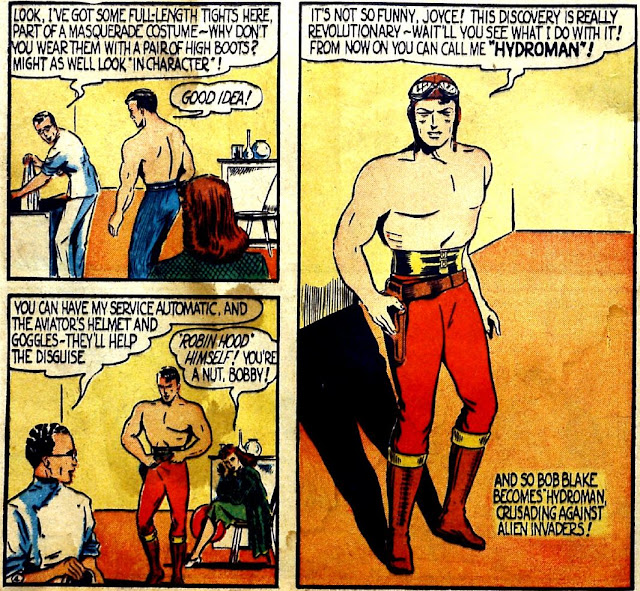
    Hydroman:

    I was going to say that much levity has been mined from Hydroman’s origin over the years, but realistically this guy is obscure at best. Some levity has been mined from Hydroman’s origin over the years. Is it deserved? Certainly.

    Scientist Harry Thurston is having fun mixing up chemicals (specifically water, alcohol and sulphuric acid, though there is some speculation that there might have been some mystery residue in the glassware used) and manages to get some on his hand, which promptly turns to water. In a panic, he calls his friend Bob Blake over to help, and when Bob arrives, fellow scientist Tom Kinsman dumps an entire bucket of the mixture over him like they’re all in a dang slapstick comedy.

    They manage to counteract the formula, at which point Bob agrees to have the formula injected into him, and while this works as comic book science (if a big splash turned me to water, surely an injection will allow me to control the process! Because it’s deliberate and thus more scientific!), surely by all other metrics it is an insane decision. What’s to say, for instance, that an injection won’t merely turn all of your blood or veins to water, killing you?

    Against all odd, the injection works and Bob Blake decides to use his newfound power to fight the wave of crime that is plaguing NYC. To go with his new role, Blake adopts a new moniker – Hydroman – and makes a super-hero costume in perhaps my favourite way, by scraping up all of the random crap in Harry Thurston’s lab.

    By issue 2, Hydroman gets what only I think of as his iconic look, a baggy suit of bulletproof Translite. It’s objectively kind of dumb looking but also… kind of great? It might be the combination of the leather pilot’s helmet and the riveted brass collar but the overall effect is very cool and retrofuturistic. Plus the transparent effect really plays well with Hydroman’s whole water theme. Finally, note that Hydroman’s assistant/ girlfriend Joyce Church is also wearing a bulletproof suit under her coat and I must commend him for being the rare Golden Age super-hero who thinks to distribute such protective super equipment to his civilian aides. (Reg’lar Fellers Heroic Comics 001, 1940)

    Update 1941 

    the Purple Zombie:

    Doctors Hale and Malinsky are partners, but while Hale was working to prolong human life, Malinsky was taking his research and using it to create an army of the undead in order to take over the world. His prototype is Zoro, the Purple Zombie, and once his zombification tech is proven to work (and once Hale starts mouthing off a bit to much), Malinsky decides that things might run a bit smoother if it was just him and the zombie and bumps off Hale.

    Unfortunately for Malinsky, some quirk of the zombie technology has made Zoro 1) amoral 2) bulletproof and super strong, and 3) loyal only to Hale, and so he makes short work of not only his erstwhile master but also his three foreign investors.

    Zoro is captured by the police and scheduled for an execution that hits a slight hitch when it turns out that in addition to bullets the Purple Zombie is immune to electricity (he also turns a more purpley purple when electrocuted!). Stymied, the authorities agree to release Zoro into the stewardship of Dr Hale (who survived the murder attempt, by the way). The Purple Zombie is not so much a hero as a gun that Hale points at people and situations, but as a pair they basically fit the brief. (Reg’lar Fellers Heroic Comics 001, 1940)

    Hyper the Phenomenal:

    Visually, Hyper the Phenomenal is great. I really like the… well “retrofuturistic” is the best description of it but of course at the time it was just futuristic. I really like his look, particularly what I assume is a breastplate since it seems to be separate to the shirt – there aren’t enough non-aquatic super-heroes with the courage to wear a big scallop shell as armour.

    Hyper is really the oddly-named Don-Vin, a scientist who has some sort of affiliation with the US Secret Service, either as an official agent or just a helpful pal. His main tools in the fight against evil are his Neogas Helmet that allows him to fly (plus is has a nifty two-way radio inside) and his Magno-Hydro Gauntlets, capable of both magnetic attraction and repulsion and with which he can both perform feats of superhuman strength (equivalent) and deflect incoming bullets.

    I chose the cover image above because it’s probably the most dynamic and interesting view available, due to the unfortunate fact that in Hyper the Phenomenal’s sole outing he does very, very little of note. His adventure on the Isle of Arunta was serialized over two issues and for fully half of that time (and somewhere between 1 and 2 days in-story), Hyper stands in front of a steel wall using his gauntlets to prevent a crushing room deathtrap from killing his ally Agent 2Y. A heroic act, to be sure, but not a visually interesting one. And since the first quarter of the story was devoted to setting up the action, Hyper only gets the final quarter to really strut his stuff, and even then he probably only gets the job done because the villains had oppressed the island’s inhabitants enough to start a rebellion. A poor showing indeed, Don-Vin. (Hyper Mystery Comics 001, 1940)

    Kaänga:

    Run-of-the-mill Tarzan clone who was orphaned in the jungle at a young age and whose Jane equivalent is named Ann Morgan. Kaänga’s only real point of interest is the umlaut on his second a, but he has close to 200 appearances over the years so I’m sure we’ll be seeing more from him. (Jungle Comics 001, 1940)

  • MAD AND CRIMINAL SCIENTIST ROUND-UP 013

    Progress! Science! 

    It’s blood that this nameless inventor wants, blood to make his super fuel! Too bad for him that he chose to steal it from US Marine Strut Warren because he ends up extremely dead for his efforts (and the world remains dependant on fossil fuels. Thanks, Strut). (Fight Comics 003, 1940)

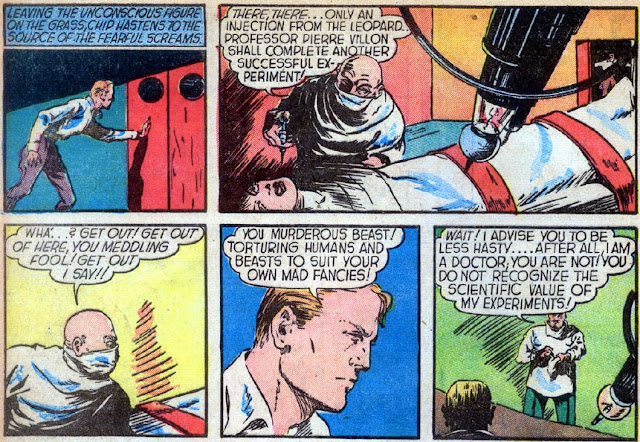
    Professor Pierre Villon, refugee from the Paris Medical Academy, has set himself up on a tropical island to further his scientific research into making human/animal hybrids. His method of acquiring test subjects by knocking aircraft out of the sky with an engine killing ray attracts the attention of Chip Collins of the Skull Squadron, and Villon ends up perishing at the hands, claws and teeth of his own creations. (Fight Comics 008, 1940)

    Professor Gustoff’s one interest is in administering his mutagenic fluid to people to turn them into “weird creatures”, aka bald guys with webbed hands and feet.He sets his sights too high when he tries to creaturize South Sea adventurer Shark Brodie and ends up beat up and presumably in some sort of colonial penal system. And the worst part? The poor weird creatures aren’t even fully amphibious – they all end up drowning. (Fight Comics 009, 1940)

    This is Dr Wratt, who lives on an isolated island populated by hypnotically controlled man-apes. He kidnaps Kaänga’s love interest Ann Mason for what I can only assume are weird creep reasons, based mostly on the fact that Wratt’s outfit consists of a short lab smock and nothing else. (Jungle Comics 002, 1940)

  • MAD AND CRIMINAL SCIENTIST ROUND-UP 013

    Progress! Science! 

    It’s blood that this nameless inventor wants, blood to make his super fuel! Too bad for him that he chose to steal it from US Marine Strut Warren because he ends up extremely dead for his efforts (and the world remains dependant on fossil fuels. Thanks, Strut). (Fight Comics 003, 1940)

    Professor Pierre Villon, refugee from the Paris Medical Academy, has set himself up on a tropical island to further his scientific research into making human/animal hybrids. His method of acquiring test subjects by knocking aircraft out of the sky with an engine killing ray attracts the attention of Chip Collins of the Skull Squadron, and Villon ends up perishing at the hands, claws and teeth of his own creations. (Fight Comics 008, 1940)

    Professor Gustoff’s one interest is in administering his mutagenic fluid to people to turn them into “weird creatures”, aka bald guys with webbed hands and feet.He sets his sights too high when he tries to creaturize South Sea adventurer Shark Brodie and ends up beat up and presumably in some sort of colonial penal system. And the worst part? The poor weird creatures aren’t even fully amphibious – they all end up drowning. (Fight Comics 009, 1940)

    This is Dr Wratt, who lives on an isolated island populated by hypnotically controlled man-apes. He kidnaps Kaänga’s love interest Ann Mason for what I can only assume are weird creep reasons, based mostly on the fact that Wratt’s outfit consists of a short lab smock and nothing else. (Jungle Comics 002, 1940)