The Curse of Skeleton Munroe

Category: Dell

  • MONSTER, CRITTER AND CREATURE ROUND-UP 004

    Everyone likes a good monster now and then.

    Horned Cat:

    With every one of these round-ups I accrue more evidence that the Slightly Different Big Cat is one of the classic monster types, as seen here when Congo Jack is confronted with this horned green feline in the mystical Valley of Vango in the Congolese jungle.

    As a bonus, a few steps later he has to deal with another classic: the carnivorous plant, or in this case flesh-eating bush. (Lightning Comics v2 004, 1941)

    Croco-Tiger:

    As further evidence, here’s Power Nelson fending off a strangely plush-looking croco-tiger in the wilds of the planet Pluvius in the far-flung year 1982 CE. For those like me who like to see a comic book creature survive now and then, worry not for the yellow pool this beast is being flung into merely shrinks it to kitten size, which is hopefully something that it can adapt to.

    Pluvius also features its own type of carnivorous plant, in this case some sort of tentacle (or possibly tendril?) based predator. (Prize Comics 003, 1940)

    Cannibal Tree:

    Rex Dexter of Mars and gal pal Synde have their own run-in with a carnivorous plant, the so-called cannibal tree, on an unnamed extrasolar planet. (Mystery Men Comics 018 1941)

    Dodman’s Serpent:

    Though the practice is now frowned upon in zoological circles, I can’t help but love the sound of an eponymous species name, and especially when the species in question is some sort of monster. Dodman’s Serpent is great because it has the lovely rhythm of an eponym without actually being named after some guy named Dodman who will later be cancelled and require a lot of textbooks to be reprinted. Instead, it is named after its hunting grounds near Dodman’s Point in Cornwall. Or its former hunting grounds, I suppose, since it made the mistake of attacking a ship containing the Black Knight. (The Funnies 049, 1940)

    Dragon:

    I really like this dragon, which spent its days peacefully eating maidens in an unnamed European kingdom until the Golden Knight showed up and slayed it. It has all the weird goofiness of the dragons that you see in Medieval illustrations from before the concept of what such a beast looks like was really codified. (Fantastic Comics 010, 1940)

    Dragons:

    These dragons, by contrast, are just a bunch of weird lizards that the Green Sorceress keeps in a cave and throws her enemies to. I really like them. (Blue Bolt v1 001, 1940)

    Drazil:

    Here we see Neptina associate Norma Kane be ambushed and nearly killed by a very cool-looking undersea reptile called a drazil. As is often the case with long-necked creatures, the drazil is vulnerable to having its head chopped off.

    Norma really was having a day of it, as immediately before the drazil attack, she was ambushed by this heinous looking crustacean which is referred to only as a “sea-beast.” (Champ Comics 011, 1940)

    Dream Plants:

    During one of the Green Sorceress’ many attempts to conquer the whole of the underground world, she employs dark majicks and weird science to move her armies through the Fourth Dimension. While pursuing her there, Blue Bolt is nearly killed by a Dream Plant, a carnivorous plant with the ability to project sexy illusions to lure its prey closer.

    Later, a second, airborne species of dream plant that forgoes the illusory lures in favour of active hunting almost does for the Green Sorceress herself before Blue Bolt spears it in its conspicuous weak point. (Blue Bolt v1 005, 1940) 

    Jungle Horse:

    Finally we have the jungle horse, potentially the only non-hostile species present on the Gorikon in the Negative Universe, or at least the only one encountered by Meteor Martin during his time there. These peaceful animals just hang around waiting to act as beasts of burden for passing humanoids – a truly selfless species. (Amazing-Man Comics 025, 1941)

  • MONSTER, CRITTER AND CREATURE ROUND-UP 003

    I hope everyone likes monsters as much as I do because there are a whole lot of them to cover.

    Beaked Tyros:

    When polar explorer Anthony Conrad gets lost in an Arctic storm and falls through a hole in the pack ice, he reasonably expects to meet his demise. Instead, he falls into the subterranean kingdom of Artica and is chosen by the elderly Artican king – also a stranded former surface explorer – as his successor. 

    As part of the coronation process, Anthony must prove his mettle to his prospective subjects, and step two of that process is Thrilling Arena Combat with the horrible beaked tyros “Lord of Artica’s Jungles,” and I love this thing. Though it looks like just another low-rent carnosaur at first glance, upon closer examination it has many bizarre features, including weird bird legs, thin, unpleasant-looking teeth, radially-symmetrical hands that are possibly equipped with suckers on the palms, and skin that is described as “hairy” in the caption box. Truly this is a strange and wonderful beast that sadly must be chopped up in service to the story. (Cyclone Comics 001, 1940)

    the Beast:

    When asked to prove his worthiness to wed the Princess Ahloo, our hero Abdallah knows exactly what to do: ride directly to a nearby valley full of dinosauroids and slay one of them. Though one of the pteranodon-adjacent flying reptiles that confront him when he enters the valley would probably be sufficient to satisfy Ahloo’s father, Abdallah instead opts to battle a creature referred to only as the Beast, a possibly-fire-breathing, possibly-carnivorous sauropodoid that give him a truly heroic-level challenge. And it works! He gets the girl! (Funny Pages v2 003, 1937)

    the Birds:

    These vulture-monsters come very close to destroying the Blue Bolt on his very first adventure. They are only prevented from doing so, in fact, because they work for the Green Sorceress and she has become infatuated with Our Hero here on sight.

    I’m always a big fan of these kinds of monster birds that up the ante on deadliness by throwing most of the birdliness of the creature out the window and instead give them the body plan of a griffin. Really great stuff and my only note is that some of the tails are very unpleasant to look at. (Blue Bolt v1 001, 1940)

    Bolu:

    Meg and Mickey are two children who have access to a magical time-travel stone and use it to just kind of blunder around throughout history. In this particular instance they have ended up in the Stone Age and are only saved from being eaten by some uncharitable portrayals of our collective ancestors by the appearance of a dinosaur, called Bolu by the cavemen and of course far, far more out of place than two 20th Century kids could ever hope to be. There is some indication that the bolu was summoned by the Spirit of the Stone to save the two from becoming dinner, but if that’s the case then why do the cavemen already know about it? (The Comics 007, 1938)

    Carnicantileia:

    The swamp-dwelling carnicantileia briefly menaces Flip Falcon and his associates during one of his early adventures when he mostly uses his fantastic time-and-space machine to go to Mars. It’s a pretty impressive snake-style beast, and as such it’s a real shame that it is killed in such a goofy way, by having a big rock thrown down its gullet. (Fantastic Comics 003, 1940)

    Carnivoplant:

    The carnivoplant is a classic man-eating plant, subtype seaweed, that almost kills adventurer Kinks Mason before it in turn is preyed upon by a swarm of phosphomites. And just what are phosphomites, you may ask? Contextually, they are small glowing creatures that eat carnivoplants, and that is all the information we get. (Fight Comics 001, 1940)

    Cave Monster:

    Modern day cowboy hero Bull’s-Eye Bill and his companions meet this cave reptile while pursuing an outlaw, and as I previously observed, it was clearly meant to set up an adventure into a prehistoric underground world that subsequent creators chose not to take advantage of. 

    As for the one beast that we do get to see fight some cowboys, I really appreciate how lizardy it looks, as well as how it seems to be posing for maximum dramatic effect in every panel, even when killing a guy or writhing around in its death throes. (Target Comics v1 007, 1940)

    the Ozix:

    Someday
    when I post a picture of a creature that is just a big cat with some extra stuff stapled onto it in one of these round-ups I will be able to refer to it
    as a standard type of creature, but I simply haven’t done the work yet.
    The ozix, then, is a beast with the body of a leopard and the head of a
    crocodile – how novel a concept! Adventurer Congo Jack must slay this
    one during his adventures under the earth. (Lightning Comics v2 002,
    1941) 

    Dakk:

    Returning to the adventures of King Anthony in the sub-Arctic world of Artica, here we see him as he is about to tour his kingdom on the back of a domesticated dakk, and I must say that I like the very beast-of-burden look that they have given to this creature’s head. Sadly, this particular dakk has been poisoned as part of an attempt to assassinate the new king.

    This assassination attempt is only partially successful, as Anthony survives the fall into the jungles of Artica but is then placed in further peril at the claws of the various creatures that live there, such as this amazing giraffe-patterned water lizard.

    Though he escapes the lizard, Anthony is almost immediately attacked by a great horned tigrid, which is is of course a regular tiger with two little horns on its head, and another example of what I was talking about in the ozix entry.

    Finally, after stumbling upon the roots of the conspiracy against him and dealing with them violently, King Anthony makes his way home on a humble unicorn. (Cyclone Comics 003, 1940) 

    the Storm Monster:

    A giant reptilian beast that plagues an African village on a yearly basis (during a huge storm, natch), the Storm Monster meets its end after swallowing Kaänga whole, upon which he carves his way free of its guts with his trusty knife. (Jungle Comics 021, 1941)

  • MAD AND CRIMINAL SCIENTIST ROUND-UP 027

    A series of cautionary tales for budding young scientists.

    Orid Dass:

    Orid Dass is your standard jungle scientist: he’s out there making apes into men and men into apes, all for the love of the ape-man game. He also has the distinction of being the only foe faced by Fantomah the one post-Fletcher Hanks adventure in which she is still kind of a jungle demigod rather than a jungle hero who knows some magic.

    In that capacity, Fantomah does a little man/ape transformation of her own, turning both Dass and his ape-men into little green monkeys until he reverts his latest victim (a white guy) to human form, though why she couldn’t just do it herself is not explored.

    Dass briefly gets one over on Fantomah by dropping her into a pit lined with radioactive ore, as this is also the one issue in which her powers are neutralized in the presence of radiation, but is subsequently crushed when his entire base collapses on top of him – the downside to the convenience of building your science compound on top of a huge radioactive cavern system, I guess. (Jungle Comics 016, 1941)

    Doktor Teufel:

    Doktor Teufel lives on the aptly-named Death Mountain and spends his time enslaving passing US aviators and building advanced radio-powered technology, implicitly in service to some nefarious plot against the United States. He’s a prime example of the kind of villain who is perfectly positioned to achieve all of his goals but who has not planned for the fact that a radium-powered super-hero – specifically Radior, the X-Ray Powerman – is going to walk fly a convertible through his front door and dismantle his entire operation in twenty minutes. (Key Ring Comics, 1941)

    Dr Dietz:

    We meet Dr Dietz after he has successfully stolen a high-powered experimental aircraft, and he spends so much time bragging about this and about how great a weapon it will make once he has mounted his disintegrator ray cannon (or “death-beam”) on it to Federal Agent Steve Crawford* that he never actually gets around to mentioning whether he intends to use it for espionage or for personal gain. He himself is disintegrated before he gets a chance to clarify. (Liberty Scouts Comics 002, 1941)

    *Referred to as “Steve Crawford, Undercover Man” despite the fact that in this, his only recorded adventure he is operating under his own name and openly as a lawman.

    the Mad Scientist:

    The aptly-named Mad Scientist has been setting forest fires as a way of capturing strapping young firefighters from the nearby CCC* base as fodder for his experiments. He is aided in this by his mind-controlled niece Nancy and a huge goon named Gaston (who wears a very cool-looking protective suit while traipsing through the burning forests).

    And just what is the radical theory that has driven the Mad Scientist to both the fringes of society and the outskirts of scientific ethics? Why, he believes that if he electronically incinerates a human body just right then it will become “solid gas.” Exactly what does this mean? I cannot really say, but going by the available evidence from his eventual successful creation the result is a living, tangible human with a massively decreased density and a radically different metabolism. 

    *the Civilian Conservation Corps, a New Deal work program.

    As I said, the process is eventually successful, turning a CCC firefighter named Jim into the mighty Fire-Man, but while the Mad Scientist was able to conceptualize and bring into existence an entirely new form of life he was not as visionary about the benefits of proper lab safety and both he and Gaston were fatally exploded in Fire-Man’s subsequent attempt to escape his captor. (Liberty Scouts Comics 002, 1941)

  • MAD AND CRIMINAL SCIENTIST ROUND-UP 027

    A series of cautionary tales for budding young scientists.

    Orid Dass:

    Orid Dass is your standard jungle scientist: he’s out there making apes into men and men into apes, all for the love of the ape-man game. He also has the distinction of being the only foe faced by Fantomah the one post-Fletcher Hanks adventure in which she is still kind of a jungle demigod rather than a jungle hero who knows some magic.

    In that capacity, Fantomah does a little man/ape transformation of her own, turning both Dass and his ape-men into little green monkeys until he reverts his latest victim (a white guy) to human form, though why she couldn’t just do it herself is not explored.

    Dass briefly gets one over on Fantomah by dropping her into a pit lined with radioactive ore, as this is also the one issue in which her powers are neutralized in the presence of radiation, but is subsequently crushed when his entire base collapses on top of him – the downside to the convenience of building your science compound on top of a huge radioactive cavern system, I guess. (Jungle Comics 016, 1941)

    Doktor Teufel:

    Doktor Teufel lives on the aptly-named Death Mountain and spends his time enslaving passing US aviators and building advanced radio-powered technology, implicitly in service to some nefarious plot against the United States. He’s a prime example of the kind of villain who is perfectly positioned to achieve all of his goals but who has not planned for the fact that a radium-powered super-hero – specifically Radior, the X-Ray Powerman – is going to walk fly a convertible through his front door and dismantle his entire operation in twenty minutes. (Key Ring Comics, 1941)

    Dr Dietz:

    We meet Dr Dietz after he has successfully stolen a high-powered experimental aircraft, and he spends so much time bragging about this and about how great a weapon it will make once he has mounted his disintegrator ray cannon (or “death-beam”) on it to Federal Agent Steve Crawford* that he never actually gets around to mentioning whether he intends to use it for espionage or for personal gain. He himself is disintegrated before he gets a chance to clarify. (Liberty Scouts Comics 002, 1941)

    *Referred to as “Steve Crawford, Undercover Man” despite the fact that in this, his only recorded adventure he is operating under his own name and openly as a lawman.

    the Mad Scientist:

    The aptly-named Mad Scientist has been setting forest fires as a way of capturing strapping young firefighters from the nearby CCC* base as fodder for his experiments. He is aided in this by his mind-controlled niece Nancy and a huge goon named Gaston (who wears a very cool-looking protective suit while traipsing through the burning forests).

    And just what is the radical theory that has driven the Mad Scientist to both the fringes of society and the outskirts of scientific ethics? Why, he believes that if he electronically incinerates a human body just right then it will become “solid gas.” Exactly what does this mean? I cannot really say, but going by the available evidence from his eventual successful creation the result is a living, tangible human with a massively decreased density and a radically different metabolism. 

    *the Civilian Conservation Corps, a New Deal work program.

    As I said, the process is eventually successful, turning a CCC firefighter named Jim into the mighty Fire-Man, but while the Mad Scientist was able to conceptualize and bring into existence an entirely new form of life he was not as visionary about the benefits of proper lab safety and both he and Gaston were fatally exploded in Fire-Man’s subsequent attempt to escape his captor. (Liberty Scouts Comics 002, 1941)

  • MINOR SUPER-HERO ROUND-UP 101

    It’s a big year for the jungle-based heroes of Fiction House, and also Radior is here.

    Camilla, Queen of the Lost Empire **UPDATE**:

    1941 is the year of change for Camilla. First off, she faces a series of threats to the Lost Empire itself, beginning when an evil magician nearly conquers and partially razes the city. (Jungle Comics 014, 1941)

    Next issue, the otherwise-unremarkable lech Prince Renardo finishes the job and burns the city to the ground as part of an attempt to win Camilla’s hand in marriage. Camilla and her surviving citizens rebuild but it is a far less grand affair, being more of a wooden stockade. (Jungle Comics 015, 1941)

    Perhaps inspired by the radical change in circumstances, Camilla and her subjects adopt a sort of retro-Norse style in keeping with their ancestry. Camilla’s lover Sir Champion disappears from the narrative at this point, never to be seen again. (Jungle Comics 016, 1941)

    The Viking revival among the people of the Lost Empire really takes off, and soon Camilla and her new paramour Erik are sailing around in longships having adventures with the seemingly endless variety of anachronistic societies littering the Central African jungle. This state of affairs continues for the remainder of 1941, as does Camilla’s insistence on wearing one of the most improbable bikini-chestplates in the history of fantasy illustration. How is it held on? (Jungle Comics 018, 1941)

    Fantomah **UPDATE**: 

    Following the departure of Fletcher Hanks, Fantomah too goes through some changes (and will continue to do so for a while yet). The first stage of this sees her lose a fair portion of her magical power, most importantly including her signature skull-faced “this means war” form. She also drops her black nightie look in favour of a more traditional jungle heroine’s one-piece, albeit made of leaves rather than the more typical animal skins. (Jungle Comics 017, 1941)

    By the end of 1941, Fantomah has become a mostly-regular jungle heroine. She has a panther pal named Fury, an orphan boy companion named Ken, and though she still busts out the odd magical ability – about once per adventure on average –  her supernatural power pales in comparison to the Hanks days. 

    Fantomah’s outfit has continued to evolve over the course of the year: from a green costume made of leaves to a pale blue one made of leaves to a more typical jungle one-piece that merely has the outline of something made of leaves. I can only assume that this change was a present from the (unknown!) artist to themself. (Jungle Comics 024, 1941)

    the Red Panther:

    Our final jungle makeover goes to the Red Panther, who adopts a sporty cowl-and-loincloth look to replace his more traditional super-hero outfit. His adventures don’t change as much as Fantomah or Camilla’s due to the fact that (barring the odd jaunt into outer space) he was about two steps away from being a Tarzan clone to begin with. The only real difference between the Old and New Look Red Panthers is in the latter’s increased use of panther companions to do his dirty work. (Jungle Comics 019, 1941)
    Radior:

    Radior, the X-Ray Powerman, is super strong, bulletproof, can fly, can hear radio waves, see through solid matter, and can transmit images directly into the human mind – a pretty thoroughly superhuman fellow. And just how did he get this way? Why, because his father, the famous Professor Kennedy, disappeared from public view when his son was born and spent the next twenty years feeding Radior as much radium as he could get his hands on. And while we might decry this as irresponsible parenting… hey, it worked! The kid grew up into a radiation and radio-themed superman!

    Sadly Radior only made the one appearance, in the oddball Key Ring Comics, a one-off collection of hole-punched and spot-coloured stories that it is very hard to find any real information about. (Key Ring Comics, 1941) 

  • MINOR SUPER-VILLAIN 982: CAPTAIN MARS

    MINOR SUPER-VILLAIN 982: CAPTAIN MARS

    (The Funnies 062, 1941)

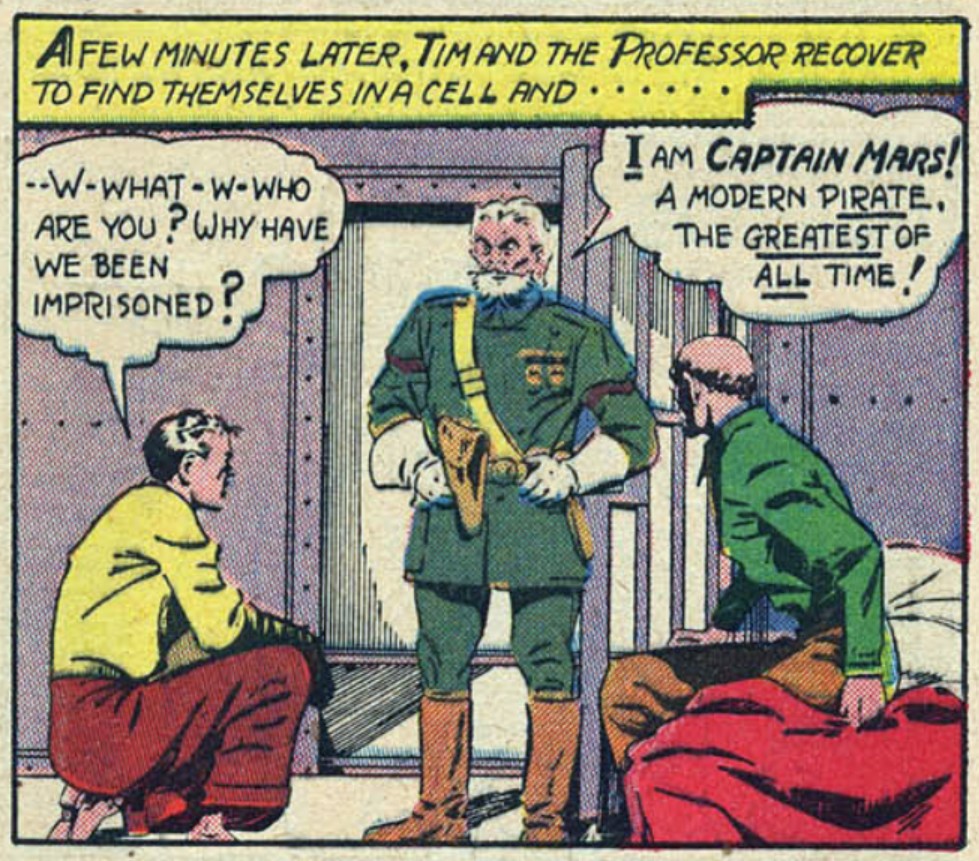
    “Rex, King of the Deep” is an adventure strip that ran in The Funnies 037 through to 063, the final issue. It stars titular King of the Deep Rex Withers, a wealthy young man who decides to put his money toward the betterment of humanity by funding the construction of a Super-Submarine designed by his friend Professor Bidoux. Over the next couple of years worth of comics he and his ever-expanding cast of associates (the Professor, second-in-command Tim and his own, less super submarine, former shipwreck victim Nan Barlow, young stowaway Butch, a large and mostly nameless crew of submariners) work to keep the seas safe for innocent travellers, at first independently and later on behalf of the Allied Powers. If you like comics about submarine combat I’m sure it’s perfectly thrilling but I personally find it to be a bit of a slog.

    Until, that is, The Funnies 061, in which Rex and his pals fend off a mysterious submarine attack on a convoy that they have been escorting across the Atlantic. They win handily and then follow the survivors with an eye toward discovering their base of operations, and are very surprised to find that it is an enormous, mobile undersea facility. This is the home of Captain Mars, who is not the commander of some Axis superweapon as they must have initially believed, but a highly ambitious and technologically proficient submarine pirate, which is possibly my second favourite kind of pirate after space!

    The centrepiece of Mars’ operation is his headquarters, which is frankly enormous. Not only can it easily accommodate the already huge Super-Sub in its docking bay, but there are frequent references to buildings and streets, and in The Funnies 063 Rex evades some pursuers by swinging on some vines that are hanging from what appears to be a full-grown oak tree in a courtyard and landing on the other side of a garden wall. They have so much extra space inside of this thing that they’re doing landscaping.

    Captain Mars has the classic Bad Boss and Bombastic Speechifying genes that are common to many super-villains, and which are almost certainly a necessity for anyone looking to set up shop as a submarine pirate. I would still recommend that he reconsider his policy of shooting his subordinates for “failures” such as disengaging from a combat engagement before their vessel was destroyed. If nothing else it must be terrible for morale.

    Despite the might of his base and the fact that he has cool holographic communication technology, Captain Mars is undone by Rex’s Underwater Tank, which was merely a useful tool in the first few of his adventures but which seems to also be an unstoppable war machine capable of defeating all barriers and attacks.

    Sadly, the cancellation of The Funnies brings with it a premature end to “Rex, King of the Deep,” just as Mars managed to bamboozle Rex out of the Underwater Tank and repurpose it as a coastal raider. While the original plan for the comic must have been for Rex to escape and reclaim his property and possibly even take the underwater base for his own, as it stands Captain Mars is forever ascendant. 

    Categorized in: Generica (Captains), Famous Figures (Mars), Theft (Submarine Pirates) 

  • MINOR SUPER-VILLAIN 982: CAPTAIN MARS

    (The Funnies 062, 1941)

    “Rex, King of the Deep” is an adventure strip that ran in The Funnies 037 through to 063, the final issue. It stars titular King of the Deep Rex Withers, a wealthy young man who decides to put his money toward the betterment of humanity by funding the construction of a Super-Submarine designed by his friend Professor Bidoux. Over the next couple of years worth of comics he and his ever-expanding cast of associates (the Professor, second-in-command Tim and his own, less super submarine, former shipwreck victim Nan Barlow, young stowaway Butch, a large and mostly nameless crew of submariners) work to keep the seas safe for innocent travellers, at first independently and later on behalf of the Allied Powers. If you like comics about submarine combat I’m sure it’s perfectly thrilling but I personally find it to be a bit of a slog.

    Until, that is, The Funnies 061, in which Rex and his pals fend off a mysterious submarine attack on a convoy that they have been escorting across the Atlantic. They win handily and then follow the survivors with an eye toward discovering their base of operations, and are very surprised to find that it is an enormous, mobile undersea facility. This is the home of Captain Mars, who is not the commander of some Axis superweapon as they must have initially believed, but a highly ambitious and technologically proficient submarine pirate, which is possibly my second favourite kind of pirate after space!

    The centrepiece of Mars’ operation is his headquarters, which is frankly enormous. Not only can it easily accommodate the already huge Super-Sub in its docking bay, but there are frequent references to buildings and streets, and in The Funnies 063 Rex evades some pursuers by swinging on some vines that are hanging from what appears to be a full-grown oak tree in a courtyard and landing on the other side of a garden wall. They have so much extra space inside of this thing that they’re doing landscaping.

    Captain Mars has the classic Bad Boss and Bombastic Speechifying genes that are common to many super-villains, and which are almost certainly a necessity for anyone looking to set up shop as a submarine pirate. I would still recommend that he reconsider his policy of shooting his subordinates for “failures” such as disengaging from a combat engagement before their vessel was destroyed. If nothing else it must be terrible for morale.

    Despite the might of his base and the fact that he has cool holographic communication technology, Captain Mars is undone by Rex’s Underwater Tank, which was merely a useful tool in the first few of his adventures but which seems to also be an unstoppable war machine capable of defeating all barriers and attacks.

    Sadly, the cancellation of The Funnies brings with it a premature end to “Rex, King of the Deep,” just as Mars managed to bamboozle Rex out of the Underwater Tank and repurpose it as a coastal raider. While the original plan for the comic must have been for Rex to escape and reclaim his property and possibly even take the underwater base for his own, as it stands Captain Mars is forever ascendant. 

    Categorized in: Generica (Captains), Famous Figures (Mars), Theft (Submarine Pirates) 

  • MINOR SUPER-VILLAIN 981: IVAN SHARK

    (The Funnies 057, 1941)

    Ivan Shark is the arch-enemy of Captain Midnight, direct from the Captain Midnight radio show. He is the head of a nationwide network of spies and gangsters dedicated to overthrowing the US government.

    The threat of Shark and his organization is so great, in fact, that it is the impetus for the formation of Captain Midnight’s Secret Squadron, and so efficient that he is aware of the clandestine meeting between Midnight and a heavily-disguised FDR that marks the Squadron’s beginning and is able to get there in time to attempt a presidential kidnapping. 

    Like Captain Midnight, Ivan Shark has an extensive supporting cast that has been sourced from the radio show and appear as shorthand versions of themselves in the comic, including henchmen Wolf, Fang and Gardo, the latter of whom finally appears in The Funnies 061 after being mentioned in every previous issue.

    The greatest of Shark’s minions is his daughter, the amazingly-named Fury Shark. In practice she is just a standard femme fatale espionage type, but she and her father make for a very entertaining evil scheming duo.

    Like his foe Captain Midnight, this version of Ivan Shark is but a pale shadow of his radio counterpart, doomed to live out an incomplete story due to the brief duration of the Dell adaptation.

  • REAL PERSON ROUND-UP 027

    Real people? In comic books? Now I’ve seen everything.

    Abu Khan:

    I sincerely cannot tell if this Black Knight foe is supposed to be Abu Sa’id Bahadur Khan, last ruler of the Mongol Ilkhanate, or if they just pulled a couple of syllables out of the air and added “Khan” to the end and called it a day. On the one hand, the real Abu Khan never tried to invade Egypt, as the Black Knight is trying to prevent him from doing, but on the other he is from about the right time to be a Black Knight character, i.e., within about two hundred years of all the other elements of the comic. (The Funnies 059, 1941)

    Adolf Hitler:

    Pays for the services of super-villain the Artist to facilitate the invasion of Tomania with his soul-stealing powers. (Jackpot Comics 004, 1941)

    Al Capone:

    “Scar Lapone,” used as a generic gangster name. (Green Mask v1 005, 1941)

    Jean Lafitte:

    A false vision of Lafitte is summoned by a fake medium. (Green Mask v1 007, 1941)

    Napoleon Bonaparte:

    Viewed through a time machine’s viewscreen by the Black Hood. (Jackpot Comics 003, 1941)

    Nero:

    Kim Hale and the Purple Zombie, blasted back in time, are condemned to death by Emperor Nero for telling him about things that he hadn’t heard of before. (Reg’lar Fellers Heroic Comics 008, 1941)

    Though the duo make it out of the gladiatorial arena okay, they almost get caught up in the Great Fire of Rome before being shunted to another time zone by their allies. Unusually, Nero is not shown fiddling at all. (Reg’lar Fellers Heroic Comics 009, 1941)

    Nero, or at least his ghost, appears in a very different form after being summoned by the would-be necromancer Ford. Is this barbaric Nero a reflection of how the Emperor saw himself, or did the artist just kind of wing it? (Jackpot Comics 003, 1941)

    Paul Revere:

    Minor comic book protagonist Paul Revere Jr is awfully smug for someone who just has the name of a famous patriot, and that goes double for his friends Betsy Ross and Patrick Henry.

    His father Paul Revere Sr is at least out there writing a column called “America, Awake!” and putting himself in the crosshairs of local fascists. (Banner Comics 003, 1941)

    Sherlock Holmes:

    Yet another comedy Holmes analog with a terrible if intriguing name. Foreclose is just close enough to a play on Sherlock to be particularly maddening. Featuring: a Watson analog named Batsin Belfry. (Great Comics 001, 1941)

    Walter Winchell:

    He only appears as a corpse, but gossip columnist Walt Willard is a clear play on Walt Winchell. (Jackpot Comics 004, 1941)

  • REAL PERSON ROUND-UP 027

    Real people? In comic books? Now I’ve seen everything.

    Abu Khan:

    I sincerely cannot tell if this Black Knight foe is supposed to be Abu Sa’id Bahadur Khan, last ruler of the Mongol Ilkhanate, or if they just pulled a couple of syllables out of the air and added “Khan” to the end and called it a day. On the one hand, the real Abu Khan never tried to invade Egypt, as the Black Knight is trying to prevent him from doing, but on the other he is from about the right time to be a Black Knight character, i.e., within about two hundred years of all the other elements of the comic. (The Funnies 059, 1941)

    Adolf Hitler:

    Pays for the services of super-villain the Artist to facilitate the invasion of Tomania with his soul-stealing powers. (Jackpot Comics 004, 1941)

    Al Capone:

    “Scar Lapone,” used as a generic gangster name. (Green Mask v1 005, 1941)

    Jean Lafitte:

    A false vision of Lafitte is summoned by a fake medium. (Green Mask v1 007, 1941)

    Napoleon Bonaparte:

    Viewed through a time machine’s viewscreen by the Black Hood. (Jackpot Comics 003, 1941)

    Nero:

    Kim Hale and the Purple Zombie, blasted back in time, are condemned to death by Emperor Nero for telling him about things that he hadn’t heard of before. (Reg’lar Fellers Heroic Comics 008, 1941)

    Though the duo make it out of the gladiatorial arena okay, they almost get caught up in the Great Fire of Rome before being shunted to another time zone by their allies. Unusually, Nero is not shown fiddling at all. (Reg’lar Fellers Heroic Comics 009, 1941)

    Nero, or at least his ghost, appears in a very different form after being summoned by the would-be necromancer Ford. Is this barbaric Nero a reflection of how the Emperor saw himself, or did the artist just kind of wing it? (Jackpot Comics 003, 1941)

    Paul Revere:

    Minor comic book protagonist Paul Revere Jr is awfully smug for someone who just has the name of a famous patriot, and that goes double for his friends Betsy Ross and Patrick Henry.

    His father Paul Revere Sr is at least out there writing a column called “America, Awake!” and putting himself in the crosshairs of local fascists. (Banner Comics 003, 1941)

    Sherlock Holmes:

    Yet another comedy Holmes analog with a terrible if intriguing name. Foreclose is just close enough to a play on Sherlock to be particularly maddening. Featuring: a Watson analog named Batsin Belfry. (Great Comics 001, 1941)

    Walter Winchell:

    He only appears as a corpse, but gossip columnist Walt Willard is a clear play on Walt Winchell. (Jackpot Comics 004, 1941)