The Curse of Skeleton Munroe

Category: minor super-villain

  • MINOR SUPER-VILLAIN 940: THE PARSON

    (Silver Streak Comics 014, 1941)

    The Parson is a weird little dude who takes over a gang of opportunistic London-based looters who have been taking advantage of the ongoing Blitz to make big bucks off of the misfortune of their fellows. Though the gang is initially against the notion of, again, a little weird dude muscling in on their racket, the Parson presses the issue with his powers of hypnotic domination, the source of which is as mysterious and unexplained as the reason for his nom de guerre. 

    (note the backward-speak in the above panel – this is the only instance of him using Zatara-style “magic words” in the story. After this it’s just big-eye hypnotism)

    We do, however know the Parson’s motivation for taking over the gang: he is in fact a Nazi agent working to destabilize London by encouraging the gang to greater and more violent crime, and he reports directly to – a very rude – Adolf Hitler.

    This is a Daredevil comic, which means that the Daredevil has to be in it, which means that he has to get to London somehow. This is achieved by having Bart “the Daredevil” Hill fly a bomber across the Atlantic to the British on a lark. Once he is on the ground, his super-hero intuition is strong enough that he immediately tracks the gang to their bunker lair.

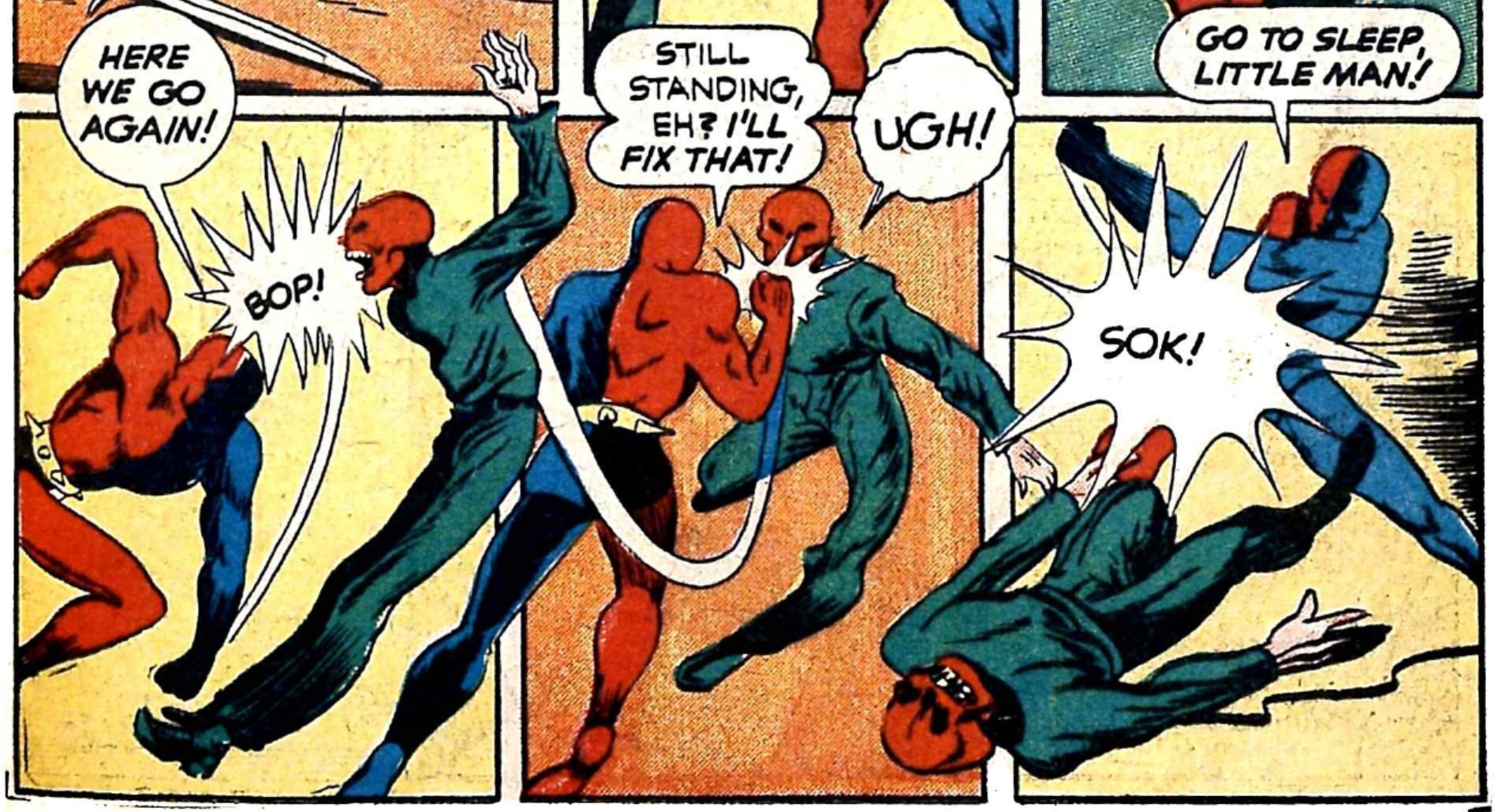
    Though the Parson gets briefly gets the upper hand with a little quick hypnotism, the Daredevil’s willpower proves too great to be suppressed for long and he swiftly batters the whole gang into submission.

    A final note: though the Parson’s men are low-down dirty thieves and murderers, they are still unwilling to work with a Nazi, to their moderate credit.

    Categorized in: Ideology (Nazis), Power (Mind Control), Professions (Religious)

  • MINOR SUPER-VILLAIN 939: THE BLACK PHARAOH

    (Silver Streak Comics 014, 1941)

    After his initial defeat at the hands of Thun-Dohr, the villainous Sin Khaii is on the lookout for an ally in his war on humanity and he finds one in the pages of a tome called the Book of the Dead, and presumably it’s the Egyptian Book of the Dead because the candidate he lines up is called the Black Pharaoh, the only Pharaoh evil enough that he was cursed and sealed up in a pyramid to think about what he had done for all time. The only way he would be able to go free is if a) the pyramid moves, which will free the Pharaoh’s servant Tut-Mut, who b) must then find new guys to take the place of the Black Pharaoh and his cronies. All of this stands as a real lesson for those inclined to mete out mystic justice: if you’re going to seal away evil or otherwise prevent awfulness from getting everywhere and your work can only be undone by a very specific set of circumstances, don’t write those circumstances down anywhere.

    As usual, I attempted to figure out just who if anyone the Black Pharaoh is supposed to be, with the only real clue being that he was buried in “the oldest pyramid in Egypt,” and while there are a few contenders for that title due to the gradual development of pyramid technology, the oldest pyramid-shaped pyramid like the depicted in the story seems to be the Red Pyramid near Cairo. What does this tell us? Only that the Black Pharaoh was interred some time after 2563 BC, alas.

    Sin Khaii isn’t one to be deterred by any Ancient Egyptian mystics. He uses his dark majicks to transport the pyramid to the former site of the New York World’s Fair and then deploys a bug from the criminally-underutilized Pandora’s Box to infect passersby with Curiosity so that they will enter the structure and fall prey to Tut-Mut.

    The innocent people of Queens need not fear, however, for Thun-Dohr and his mentor the Dalai Lama (not that one) are on the case. Thun-Dohr ambushes the Black Pharaoh’s servants as they ransack a museum, only to be captured via some pretty cool shadow magic.

    Finally, the Black Pharaoh and Sin Khaii get down to business and formulate a plan: they are going to recreate Ancient Egypt on a grand scale by smothering the entire United States in a layer of sand. This is why the Pharaoh’s men are looting museums, to get all of their boss’ stuff back before it is buried forever.

    (the duo’s apocalyptic sandstorm is shown blowing across the Atlantic from Egypt, and there’s a part of me that wants to get really pedantic about the relative sizes of the two countries and point out just how thin the available sand would be spread, but we are dealing with magic after all. Presumably the sand would be multiplied somehow? I’m much more concerned about the state that Egypt was left in – just how much of that sand was load-bearing?) 

    If there’s one thing about shadow magic, it’s that you need shadows to use it, and the Dalai Lama deals with that by blowing out the candle that was supplying the particular shadows keeping Thun-Dohr bound. Thun-Dohr disrupts the ritual – is the sand just hovering somewhere in the mid-Atlantic? This has to be the kind of thing that inspires conspiracy theories in a comic book universe, particularly in the kind where super-heroic stuff isn’t front page news.

    Thun-Dohr and the Black Pharaoh engage in Thrilling Astral Combat (I think. Whenever two people are battling on a cloud I assume that this is shorthand for their astral forms duking it out in the Aetherial Realms, but in this case it’s possible that they have merely chosen the clouds as their battlefield for some unexplained reason) with Our Hero emerging victorious and the villainous Pharaoh at the bottom of the ocean, weighed down by his sins. After that it is a simple matter for Thun-Dohr and his mentor to restore the pyramid and sand to Egypt.

    As always, it’s kind of disappointing when an ancient evil that was sealed away for untold eons is dispatched with relative ease in the present day. After all, why go to all the trouble with the curse of eternal slumber if you could just murder the guy in the first place? I suppose the fact that the Black Pharaoh was royalty might have played into it somehow, though on the other hand “being murdered” has to be the most expected way to die for a historical royal. Give me more formidable primordial evils!

    Categorized in: Colour (Black), Origin (Resurrected Mummy), Royalty (Pharaoh)

  • MINOR SUPER-VILLAIN 938: HERR SKULL

    (Silver Streak Comics 014, 1941)

    Herr Skull is the leader of the Skull Men, a band of fascist saboteurs who dress up like ghoulish skeletons in order to facilitate their crimes. Why do they have spikes on top of their heads? I do not know the answer to that. Perhaps Herr Skull just thought the look needed a bit more to really pop.

    Spike aside, the plan works! The Skull Men are terrifying enough that their victims are caught completely off guard, as these unfortunate armoured truck guards demonstrate, and those who do not manage to flee are ruthlessly killed.

    Using the defense money stolen from the armoured truck job, Herr Skull and his men embark on a campaign of death and destruction around NYC, striking at aircraft, naval and ammunition production.

    The flaw in the Skull Men’s operation is exposed by Captain Battle and sidekick Hale Battle, who almost capture them during the armoured car job but are knocked out by a gas grenade long enough for the gang to make their escape. Simply put, Herr Skull’s whole plan hinges on the Skull Men’s victims being too frightened to fight back with no apparent backup plan for if they do. When the Battle duo infiltrate their sewer lair it’s all over.

    SKULL SCORE: visible eyes make it a 4, dropping to 3 because it’s just a mask.

    Categorized in: Body (Skulls), Generica (Herrs), Ideology (Crypto-Fascists)

    Silver Streak Comics 014 is the issue in which Hale Battle starts his ongoing souvenir collection. He adds one of the Skull Men masks to it at the end of the issue…

    … but the real start of his obsession is in the cliffhanger from their previous adventure which involved sinking a u-boat and from which he retained a torpedo propeller.

  • MINOR SUPER-VILLAIN 937: THE SCARLET SKULL

    MINOR SUPER-VILLAIN 937: THE SCARLET SKULL

    (Silver Streak Comics 013, 1941) 

    The Scarlet Skull was a real surprise to me! Going by cover dates, he debuted about the same time as the second/”real” Red Skull over at Marvel, which means that he was probably created in the window between the death of the original, George Maxon, and the debut of the Red Skull we will eventually know as Johann Shmidt. Obviously the fact that these are now considered to be two separate characters is all retcon nonsense but the idea of Don Rico noticing that the Red Skull was dead and snaffling him for Lev Gleason is a fun one.

    That said, here are the similarities between the Scarlet Skull and the Red Skull: they are both a) Nazis who b) wear red skull masks and c) like to dress in green. And that’s about all. 

    Rather than being a fascist mastermind, the Scarlet Skull is instead the muscle. He works for a spy named Sinhart and does what I would call a poor job of keeping super-heroes out of his house.

    So bad a job, in fact, that he facilitates the Daredevil’s infiltration mission by providing him with a handy all-concealing costume to wear while he does it.

    This allows Daredevil to learn Sinhart’s plan: to kidnap the President and replace him with a double in order to destabilize the US to generic fascist ends. The Scarlet Skull is supposed to be the one doing the kidnapping, so I guess he must have skills beyond getting beaten up in the wooded section of Sinhart’s back yard.

    The Scarlet Skull does manage to recover from a super-heroic beating in time to ambush Daredevil’s fiance Tonia Saunders and then parley that into a second ambush of Daredevil himself. Is this redemption? Will my opinion of him raise?

    It will not, I’m afraid. The Daredevil is more than a match for the Scarlet Skull, even when the former is shackled to a wall. The Skull, Sinhart and the false FDR (who has the unnecessarily cool name of Condor, by the way) are soon captured.

    SKULL SCORE: The one place that the Scarlet Skull comes out ahead of his counterpart! Unlike the Red Skull, the Scarlet Skull’s mask has no visible eyes, giving him a total score of 4/5, i.e., the best possible without having an actual skull face!

    Categorized in: Body (Skull), Colours (Scarlet), Ideologies (Nazis)

  • MINOR SUPER-VILLAIN 936: SIN KHAII

    (Silver Streak Comics 013, 1941)

    Sin Khaii, a lama at the same monastery that Thun-Dohr was raised at, has been cast out for unspecified reasons. His reaction to being an outcast – to steal Pandora’s Box and use it in a war on all humanity – would seem to retroactively justify the exile, however. Just why a Tibetan monastery would be the hiding place of Pandora’s Box is likewise left unexplored.

    Sin Kahii is able to use the Box to unleash fresh evils upon mankind, in the form of mosquito-like insects that are under his control. The first such is a plague called the Black Madness, which seems to act both as a traditional and deadly disease and as a vector for insanity, as seen above after Dr Benson Bell concocts a cure for it and his assistant is immediately driven to homicidal rage to keep it from being distributed.

    No madness or madman is a match for the mystic might of Thun-Dohr, however. Sin Khaii’s first plot is foiled with a sock to the jaw. Of Clavell, the madman. Sin Khaii remains unpunched.

    Since regular humans have proved to be no match for his foe, Sin Khaii’s next plan involves allying with someone more powerful, namely the ancient and evil Black Pharaoh (check in in a day or two for more on him). To that end, he levitates the Pharaoh’s whole damn pyramid and moves it from Giza to the former site of the New York World’s Fair (I was going to gripe about the comic missing an opportunity to feature the pyramid next to the Trylon and Perisphere but it seems like they were demolished with much more alacrity than I might have expected).

    As will be discussed further in the Black Pharaoh’s own entry, his imprisonment in the pyramid can only be ended when he and his servants’ places are taken by other people. Sin Khaii facilitates this via another Pandora’s Box bug, in this case “curiosity.” Could one argue that curiosity is not one of the evils contained in the box since Pandora already had it her curiosity was in fact foundational to the whole myth? I think that one could, but of course if we’re going to insist on mythic accuracy then Sin Khaii is going to have to be finding increasingly unlikely ways to weaponize hope, seeing as it’s the only thing that’s supposed to still be in the dang thing.

    Once the Black Pharaoh is free, he and Sin Khaii plot to destroy the United States but are once again foiled by the flying fists of Thun-Dohr. The pyramid (and all of the sand in Egypt) is restored to its proper resting place and Sin Khaii, still at large, swears further vengeance. Sadly for us plot resolution fans out there, the “Thun-Dohr” feature never returned after this second instalment and Sin Khaii is presumably at large to this day.

    Categorized in: Accessories (Pandora’s Box), Day Jobs (Lamas), Powers (Various Magical)

  • MINOR SUPER-VILLAIN 935: PROFESSOR BLANKHORNE

    (Silver Streak Comics 013, 1941)

    Dickie Dean, Boy Inventor has a new invention: the Photo-Lightning Machine, with which he can cause a bolt of lightning to crash down on anyplace he pleases, like the deserted house across the road from him that nobody was planning on using, hopefully. The only catch is that he hasn’t yet figured out how to get the lightning to strike a target that is in water.

    Dickie and his pal Zip Todd take the plans for the machine to Dickie’s lawyer to have it registered at the patent office, only to find a new face ready to take his business. This is C.B. Wolf, a foreign agent who has infiltrated the firm specifically to steal Dickie’s inventions for his home country. Wolf wires the plans home to the laboratory of Professor Blankhorne, the second greatest inventor in the world, barring Dickie (and how that must rankle Professor Skinn), who decides that rather than using them to construct his own machine he will save time by travelling to Castleton to acquire the original.

    Dickie is of course unwilling to sign over his shiny new weapon of mass destruction to an Axis agent and capable of defeating the Professor’s crude attempt to mug him for it, which forces Blankhorne to establish a Stateside volcano lair to operate out of.

    Blankhorne’s second attempt at obtaining the Photo-Lightning Machine involves sending a storm of remote-controlled and explosive model planes down on Castleton, Pennsylvania and presumably just kind of hoping that they will kill Dickie but leave his invention intact. This attempt is foiled by a patented Dickie Dean lightning storm that brings all of the planes down safely outside of town.

    It is at this point that I must question Professor Blankhorne’s motives for confronting Dickie Dean. As mentioned above, he claims that stealing the machine will be quicker than building one, yet between the trans-Atlantic journey and the time spent in preparing his drone fleet, this effort has taken Blankhorne at least three and a half months so far. Is this the sunk cost fallacy at play, or is the Professor trying to prove that he is not merely the second-greatest inventor on Earth?

    Blankhorn (along with the surprisingly hands-on CB Wolf) are seemingly handed victory on a platter when Dickie’s pal Zip Todd sets out to confront them with a baseball bat and is promptly imprisoned and – both inexplicably and importantly – tied up and suspended in a big tub of water.

    Thanks to the aforementioned flaw in the Photo-Lightning Machine’s targeting, Dickie is able to blast Blankhorne’s entire base without hitting Zip Todd, and when the villains attempt to escape in the Sky Bug he blows them out of the air with a complete lack of remorse. 

    Astonishingly (considering the fact that he was blown up on-panel), Professor Blankhorne manages to return in Silver Streak Comics 015. He infiltrates Dickie Dean’s new high-tech laboratory in the guise of an old flower seller (and gruesomely murders Dickie’s head of security in a vat of lye) as part of a scheme to loot the place of all of its technological wizardry. A solid plan, though I will note that he does so on the first day that the lab is in operation and so his haul is mostly made up of the stuff that Dean had already created.

    Though the law is no match for Dickie Dean’s lightning cannon (a distinct invention from the Photo-Lightning Machine), Blankhorne is no match for a couple of teenaged boys in a smoke screen, and he is captured with much greater ease than in his first appearance.

    Categorized in: Accessories (Drones), Doctors & Professors, Ideologies (Crypto-Fascists)

  • MINOR SUPER-VILLAIN 935: PROFESSOR BLANKHORNE

    (Silver Streak Comics 013, 1941)

    Dickie Dean, Boy Inventor has a new invention: the Photo-Lightning Machine, with which he can cause a bolt of lightning to crash down on anyplace he pleases, like the deserted house across the road from him that nobody was planning on using, hopefully. The only catch is that he hasn’t yet figured out how to get the lightning to strike a target that is in water.

    Dickie and his pal Zip Todd take the plans for the machine to Dickie’s lawyer to have it registered at the patent office, only to find a new face ready to take his business. This is C.B. Wolf, a foreign agent who has infiltrated the firm specifically to steal Dickie’s inventions for his home country. Wolf wires the plans home to the laboratory of Professor Blankhorne, the second greatest inventor in the world, barring Dickie (and how that must rankle Professor Skinn), who decides that rather than using them to construct his own machine he will save time by travelling to Castleton to acquire the original.

    Dickie is of course unwilling to sign over his shiny new weapon of mass destruction to an Axis agent and capable of defeating the Professor’s crude attempt to mug him for it, which forces Blankhorne to establish a Stateside volcano lair to operate out of.

    Blankhorne’s second attempt at obtaining the Photo-Lightning Machine involves sending a storm of remote-controlled and explosive model planes down on Castleton, Pennsylvania and presumably just kind of hoping that they will kill Dickie but leave his invention intact. This attempt is foiled by a patented Dickie Dean lightning storm that brings all of the planes down safely outside of town.

    It is at this point that I must question Professor Blankhorne’s motives for confronting Dickie Dean. As mentioned above, he claims that stealing the machine will be quicker than building one, yet between the trans-Atlantic journey and the time spent in preparing his drone fleet, this effort has taken Blankhorne at least three and a half months so far. Is this the sunk cost fallacy at play, or is the Professor trying to prove that he is not merely the second-greatest inventor on Earth?

    Blankhorn (along with the surprisingly hands-on CB Wolf) are seemingly handed victory on a platter when Dickie’s pal Zip Todd sets out to confront them with a baseball bat and is promptly imprisoned and – both inexplicably and importantly – tied up and suspended in a big tub of water.

    Thanks to the aforementioned flaw in the Photo-Lightning Machine’s targeting, Dickie is able to blast Blankhorne’s entire base without hitting Zip Todd, and when the villains attempt to escape in the Sky Bug he blows them out of the air with a complete lack of remorse. 

    Astonishingly (considering the fact that he was blown up on-panel), Professor Blankhorne manages to return in Silver Streak Comics 015. He infiltrates Dickie Dean’s new high-tech laboratory in the guise of an old flower seller (and gruesomely murders Dickie’s head of security in a vat of lye) as part of a scheme to loot the place of all of its technological wizardry. A solid plan, though I will note that he does so on the first day that the lab is in operation and so his haul is mostly made up of the stuff that Dean had already created.

    Though the law is no match for Dickie Dean’s lightning cannon (a distinct invention from the Photo-Lightning Machine), Blankhorne is no match for a couple of teenaged boys in a smoke screen, and he is captured with much greater ease than in his first appearance.

    Categorized in: Accessories (Drones), Doctors & Professors, Ideologies (Crypto-Fascists)

  • MINOR SUPER-VILLAIN 934: THE LADY KILLER

    (Silver Streak Comics 012, 1941)

    The Lady Killer makes his debut at the glamorous Crane Club, in which he attacks and nearly kills rising stage star Betty Crawford and takes a moment to grandstand a bit before making his escape. The name is a somewhat presumptuous one here, given the fact that he has yet to kill a lady.

    He makes up for this over the next few days as he murders a whopping fourteen women and injures a similar number of people and leaves a “Lady Killer” calling card at the scene of each crime. Though this is a fast turnaround on murder, I think that technically he is a serial rather than spree killer as he seems to be choosing his victims rather than attacking targets of opportunity – it’s just that his pool of potential victims is so huge that he can kill whenever he feels like it.

    Presto Martin eventually lays hands on the Lady Killer in his usual manner, through disguise. Specifically, by announcing that the villain will reappear at the Crane Club and then impersonating him there at the appointed time, and sure enough, the Lady Killer’s ego is too great to allow this imposture to stand and he gets within range of the detective’s fists and has his big hat knocked off.

    This is the point at which a mystery story would pay off and one of the suspects would be unmasked, but the thing about this story is that there are no suspects. Like, literally none – the only named characters in the comic other than Presto and his supporting cast are Betty Crawford and her beau and they are the only ones who it couldn’t be. Instead the Lady Killer is just Some Guy who had a very bad breakup and lost all his money and decided to take it out on an entire gender instead of dealing with his issues in a more mature manner. As a fan of a mystery I feel robbed.

    Categorized in: Crime Theme (Killers), Language (Expressions), Murder (Serial Killers)

  • MINOR SUPER-VILLAIN 933: THE RIPPER

    (Silver Streak Comics 011, 1941)

    For the third issue in a row, a souped up super-plane takes to the skies of probably-California to menace law-abiding aviators. The Ripper, like the Heater before it, is a vehicle with a singular name being run by a group, which is a mildly interesting taxonomic trend that unfortunately does not continue to occur.

    Where the Wingers and the Heater were armed with sci-fi ray cannons, the Ripper relies on a comparatively low-tech blade that is used to slice up aircraft and parachutes alike. Ironically, this is a far less believable means of attacking a plane on the wing than a thermodynamic ray of some sort. Just what kind of flying does the Ripper’s pilot have to be doing to slice off a wing with a comparatively short, fixed blade, anyway? Just how sharp can that thing be considering that it looks perfectly cylindrical? There are some wavy lines around the blade in precisely one panel – perhaps it’s meant to be a vibro-blade of some kind.

    Like the Heater before them, the crew of the Ripper are prepared for Cloud Curtis and his crew to interfere in their plans. In addition to the standard-issue bulletproofing, their plane is equipped with a magnetic generator to lock the Golden Bullet’s grapplers in place on their hull and knockout gas dispensers on the plane’s exterior act as a counter to Curtis’ favoured tactic of clambering onto an enemy aircraft’s exterior. Cloud and his assistants are taken into custody but not, crucially, immediately murdered.

    In contrast to the Heater, the Ripper has an actual defined goal: shut down US aviation in order to weaken the country for vague foreign agent reasons. And it’s astonishingly effective!

    Having not been murdered, Cloud and pals soon escape and take to the skies, where the Ripper crew learn the same posthumous lesson as the Heater gang before them: if you render yourself impossible to capture then you are much more likely to be killed outright. One shattered propeller later, the skies are safe for trainee pilots once more.

    Categorized in: Accessories (Aircraft), Activities (Ripping), Espionage (Saboteurs)

  • MINOR SUPER-VILLAIN 932: THE GHOST OF THE DOMINO

    (Silver Streak Comics 011, 1941)

    The Domino is dead! All those murders he did and more importantly admitted to when he was trying to extort the NYPD have caught up to him via the electric chair, and all of New York breathes easier.

    Not for long, however, as the various witnesses at the Domino’s trial, and particularly the members of his own gang who turned state’s evidence, begin turning up dead with a domino – that has the Domino’s fingerprints on it! –  in their hands. Rumours that the ghost of the Domino has returned for revenge start flying around the underworld.

    And to top it all off, the Domino’s grave turns out to be empty!

    Now, the seemingly dead gangster returned from the dead to get revenge is a common enough trope that we can lay out the possible ways it might have happened with ease:

    1. the Domino’s death was faked and the “body” smuggled out for “revival” elsewhere

    2. the Domino really dies and his body was collected by an unscrupulous scientist for revival or brain transplant, etc.

    3. the Domino’s body was stolen and he is being impersonated, possibly by a secret identical twin

    4. it’s actually the Domino’s ghost

    Feel free to place a small bet on which of these comics-accurate options is the case here.

    Answer: it’s option 3! The Ghost of the Domino is in fact Pete Poulos, one of the Domino’s former lieutenants, who has faked his old boss’ return and done all of the seeming revenge killings as a smokescreen for his true goal: to eliminate all the other former members of the Domino gang who know where their old boss’ money is hidden.

    As per usual, a combination of facial disguises and a bulletproof vest carries the day for Presto Martin, and the Ghost of the Domino is sent to replace the original in prison (and possibly the grave).

    Categorized in: Accessories (Calling Cards), Activities (Dominoes), Fraud (Fake Ghosts)