The Curse of Skeleton Munroe

Category: minor super-villain

  • MINOR SUPER-VILLAIN 235: THE ORDER OF ASSASSINS

    (Flash Comics v1 005, 1940)

    It’s another version of the old Order of Assassins, this time as a revival founded by a supposed descendant of Hassan-i Sabbah, the original Assassin of yore, though since he died in 1124 AD there’s a decent chance that anybody is his descendant. 

    Legitimacy aside, this buncha yahoos operates out of a city-fortress called Alamut (but somewhere in the vicinity of Egypt rather than Iran) and is engaged in a somewhat nebulous plot to conquer the world by assassinating various leaders, including that of the very delicious-sounding nation of Frappe. Hawkman foils this scheme with a few well-placed sling bullets, but even though their leaders are killed, the bulk of the organization survives, possibly as part of the next iteration of the Order, whenever that crops up.

  • MINOR SUPER-VILLAIN 234: THE WITCH

    (Flash Comics v1 005, 1940) 

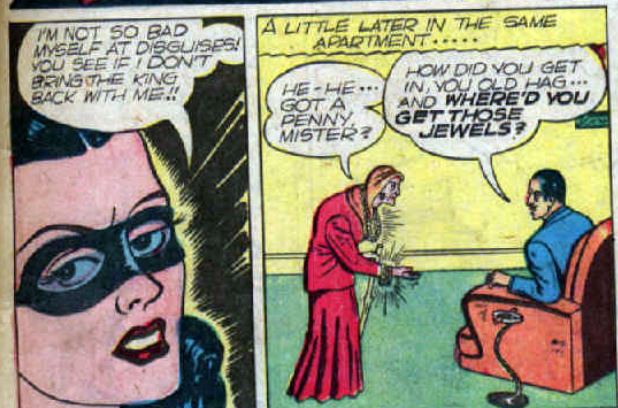
    Long-running foe/ally/love interest of Golden Age master of disguise the King (or King Standish, if you want to go by his full name), the Witch probably deserves a more thorough examination than I’m going to give her, but the fact is that though she is a good character and an admirable foil to the King, the King himself is a bit dull. Sorry, Witchie.

    I will say that the New Orleans-set King story in World’s Finest 002, in which the Witch is revealed to be a descendent of pirate Jean Lafitte and that her father was actually a crook who had kidnapped her as a baby to spite a different crook and in which she loses not one but two fathers… is a good time, will read again.

    ADDENDUM: I don’t know if she’s telling the truth here, but the idea tht the Witch’s criminal upbringing was messed up enough that she doesn’t even have a name is enough to make me like her 10x more. (Flash Comics v1 009, 1940)

  • MINOR SUPER-VILLAIN 233: THE VANDAL

    (Flash Comics v1 005, 1940)

    The Vandal is a wealthy art collector who kills artists to increase the value of their works and has a bunch of hired goons steal art for him. The best thing about him is his name/ concept, that his art collection would be as impactful to the art world as the ancient Vandals supposedly were in antiquity. Since he’s a Golden Age Flash villain, he mostly exists to be trolled at super-speed.

  • MINOR SUPER-VILLAIN 232: THE THOUGHT TERROR

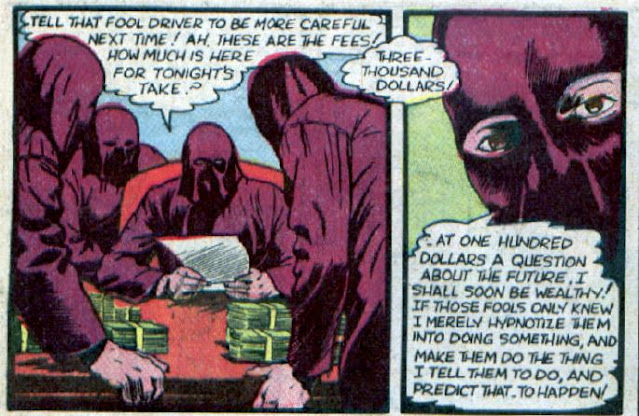
    (Flash Comics v1 004, 1940)

    I have complicated feelings about the Thought Terror! He has both good and bad traits! 

    Off the bat, the basics. His costume choice is pretty entry level for the Golden Age, but suitable for a guy who employs eye-based super-powers (which he does) and wants to project a certain aura of fear. 

    His name, by contrast, is both unusual and bad, and made all the worse for the fact that it’s almost good. Terror is usually a decent word to use in a name but it just doesn’t have the gravitas to work with a mealy word like Thought. The Thought Tyrant, the Thought Titan, the Thinking Terror… there had to be a better name.

    But maybe a poorly thought-out name is appropriate for this guy, because he’s not a very good planner in general. See, he has these amazing hypnotic powers, and he uses them to convince a little cult of people that he has amazing precognitive powers. He tells fortunes at a hundred bucks a pop and then fulfils them by planting hypnotic suggestions in his subjects’ minds, causing them to act out his predictions.

    Ordinarily, I’d be cheering for this guy – the thing that thinking a lot about super-villains does is give you a lot of opinions about how they should all just stick to easy small-scale scores and that’s what this is – but TT must be getting bored, because he’s making predictions like “you’re going to get drunk and wander into traffic,” and if you’re running a cult complete with costumed goons in New York City in a SUPER-HERO UNIVERSE the thing you absolutely do not want to do is draw attention to yourself by, for instance, killing someone.

    (this does of course happen – Hawkman shows up and ruins the whole operation, including the Thought Terror’s mind)

    One point in the Thought Terror’s favour is his use of costumed goons, in this case dressed just like him and given a dose of hypnotic mind-over-matter treatment such that they are physical powerhouses. Always a great choice, costumed goons. Plus they’re called the Mesmerized Men, a great name!

    Wildly, Thought Terror (without the “the”, not that it improves the name) was brought back in the year of our Lord 2005 along with several other Golden and Silver Age Hawkman foes (Thought Terror specifically in Hawkman v4 039). He’s just kind of a super-torturer, though, and he just kind of disappears halfway through the issue. I guess that’s about as good as he could hope to get.

  • MINOR SUPER-VILLAIN 231: UNA CATHAY

    (Flash Comics v1 003, 1940)

    Big fan of Una Cathay! The criminal scientist-type super-villains that you get in the Golden Age could get a little samey after a while – even if they all had their individual weirnesses, they were all of a common stripe – and it’s amazing how fresh a well put-together lady-villain makes the old tropes seem. 

    Una’s main deal was extracting the secret of eternal life from a young scientist named Dick Blendon who, unfortunately for her, was an old college pal of Carter “Hawkman” Hall.

    Like our old pal the Lord of Life, Una’s preferred technique was to administer to her victims a drug that simulated death and then grave-rob their bodies and pretend that she was bringing them back from the dead instead of reviving them. Unlike the Lord of Life, she kept her faux revenants in big jars that she claimed to be full of life-sustaining fluid. Love love love a guy in a big jar with his head poking out. Amazing visuals.

    Una also brings a kind of ambiguously ethnic element to her villainy, which of course means that she has voodoo powers that she nearly manages to kill Hawkman with except that Shiera somehow knows the warning signs of an incipient voodoo execution and saves his ass.

    Everything comes crashing down for Una Cathay after that: Hawkman lets all of the men out of their jars, her pal Count Torgoff falls off a roof while trying to stab Hawkman to death and she herself dies in a Hawkman-caused car accident. It’s almost like you shouldn’t turn to violent crime in your search for immortality, lest violence be meted back unto ye. Or something!

  • MINOR SUPER-VILLAIN 230: ALEXANDER THE GREAT

    (Flash Comics v1 002, 1940)

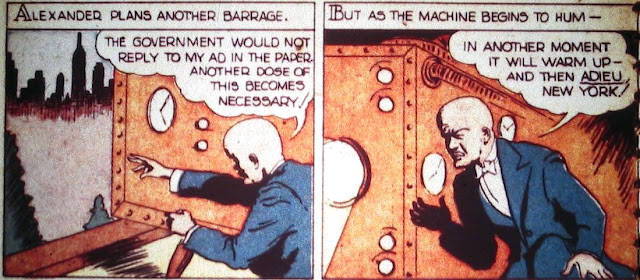
    On the one hand, Alexander the Great is your standard criminal scientist with an ego as big as his great big head who tries to extort the city of New York just as soon as he has developed the technology necessary to do so, in this case a density increasing ray.

    On the other hand, I like him a whole lot more than most criminal scientists. He’s cool! he wears a tux and is kind of suave! He does have that big ol’ dome, which I love on a science villain. He invites Carter Hall and Shiera Sanders over for dinner in an attempt to negotiate Hawkamn’s uninvolvement with his scheme in a sequence that is so cordial and charming that he might have also been angling for a threesome. Hawkman stabs him in the neck with a trident, which is if nothing else, not a common way to die. 

    Top marks to Alexander the Great, in other words. I wish he had showed up again outside of that one All-Star Squadron story that also had Sieur Satan in it.

    BONUS:

    Hawkman takes the density ray as a trophy!

  • MINOR SUPER-VILLAIN 229: THE FAULTLESS FOUR

    (Flash Comics v1 001, 1940)

    I have a lot of fondness for the Faultless Four, the first super-foes of original Flash Jay Garrick. Firstly and most simply, they are a perfect illustration of the power creep that super-heroes introduced to comic books: where this group of criminal scientists armed with mildly-fantastic skills and tactics would have been sufficient to occupy your traditional adventure hero for months if not years, the Flash walks all over them without a care in the world. Crime must adapt to this new reality!

    The second reason for my fondness requires a breakdown of the membership, so here we go, from left to right above:

    Sieur Satan: The biggest talker of the group and absolutely the one with the best look. I don’t think I’m alone in thinking of him as the leader of the Faultless Four even though the only real indication of this is his big mouth. The only thing he actually accomplishes, in fact, is to kill the other three as part of an attempt to get the Flash.

    Serge Orloff: Does absolutely nothing aside from looking cool. He might be suggesting that he is a great enough surgeon that he can bring the dead back to life in the above panel but I wouldn’t believe that he could do it unless I saw the frankenstein in question myself.

    Duriel: I always remember Duriel as “the handsome one” but he’s actually a very weird looking dude! In charge of torturing the Flash’s future father in-law Major Williams for information, he also is the group’s resident pilot.

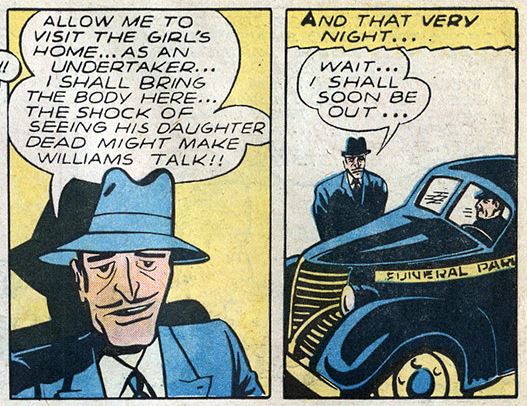
    Smythe: Absent from the first panel for a very good reason – Smythe is the guy who seems to do all of the footwork for the group. He’s the one who does a drive-by assassination attempt on Joan Williams and then later the one who goes to steal the (nonexistent) corpse in order to taunt Major Williams with it. He even has a minion of his very own! A little hearse driver guy!

    There’s a correlation here: how visually interesting a member of the Faultless Four is is inversely proportional to how useful they are. Thus, the one member of the gang to make a second appearance (in a Roy Thomas-penned All-Srar Squadron annual, natch) is Sieur Satan, the biggest fuckup and coolest-looking of the bunch. And as an indignity for poor Smythe alone, his entire role is taken by Duriel in the Secret Origins retelling of the story, leaving him to just stand around like some sort of Serge Orloff until he gets electrocuted.

    In conclusion, Sieur is a semi-archaic French honorific that is a root of the more familiar monsieur.

  • MINOR SUPER-VILLAIN 228: THE PURPLE MONSTER

    (Feature Comics 049, 1941)

    The Purple Monster is a pretty lacklustre super-villain. He ticks all the boxes: volcano lair on an island somewhere off BC, army of costumed henchmen, subjugated population of poor island yokels to exploit complete with fake human sacrifices and an unexplained sinister use for the sacrificial victims… it’s a complete checklist of features designed to qualify him for this list. He even draws his name from a local superstition, albeit one he started himself by projecting a monstrous face on the purple clouds that billow from the volcano.

    It’s all so… low-rent. He’s set himself up with all of this super-villain infrastructure to what? Extort resources out of a small community? Maybe organ harvesting or something? If he plans on moving on to greater things he doesn’t get around to saying it on-panel – just as well he suffers the fate of most volcano-dwelling crooks: death by exploding volcano.

  • MINOR SUPER-VILLAIN 227: FRAULEIN DOKTOR’S DAUGHTER

    (Feature Comics 046-055, 1941-1942) 

    If you, like me, aren’t familiar with WWI-era espionage figures, then this one will require some explanation. Fraulein Doktor was the only name that German spy Elsbeth Schragmüller was known by, even after the war had ended and up until German records were seized in 1945, in fact. And once Captain Bruce Blackburn’s adventures had wrung all of the interest they could out of the German-American Bund, a sexy spy nemesis was just the ticket! Thus: Sonya (presumably) Schragmüller, Fraulein Doktor’s Daughter!

    Sonya’s a fine foe for a regular-style espionage character like Bruce Blackburn, full of all of the staples of the genre: poisons, disguises, fake cults, horniness, etc., but she has three real features of interest aside from being the made-up child of a real person:

    -she has an enormous body count relative to her number of appearances, managing to knock off at least a couple of US intelligence agents per operation.

    -even though she refers to her country of origin as “the Homeland” as is standard in the Counterspy strip, she is presented as the daughter of a German intelligence agent – this is about as close to outright saying she’s a Nazi as you get in mid-1941! (I sometimes feel weird getting so excited for actual Nazis to show up in the books I’m reading, but if it’s so I can see them get beat up a bunch I guess it’s fine)

    -since she’s the major ongoing villain of the Bruce Blackburn strip, and since the industry standard way to keep an espionage villain around is to have them escape at the end of every story, she never really gets caught, and since the strip ends in mid-1942, she ends her time in comics at large, a rare fate.

    ADDENDUM: CARL

    In the first Fraulein Doktor’s Daughter story she has no henchmen. In the second, she has three, Carl, Fritz and Otto, all apprehended. In the third, a second Carl, probably also arrested. In the fourth, Karl, who ends up dead. What does this mean beyond the writers having a limited pool of German names to draw from? I have no idea!

  • MINOR SUPER-VILLAIN 227: FRAULEIN DOKTOR’S DAUGHTER

    (Feature Comics 046-055, 1941-1942) 

    If you, like me, aren’t familiar with WWI-era espionage figures, then this one will require some explanation. Fraulein Doktor was the only name that German spy Elsbeth Schragmüller was known by, even after the war had ended and up until German records were seized in 1945, in fact. And once Captain Bruce Blackburn’s adventures had wrung all of the interest they could out of the German-American Bund, a sexy spy nemesis was just the ticket! Thus: Sonya (presumably) Schragmüller, Fraulein Doktor’s Daughter!

    Sonya’s a fine foe for a regular-style espionage character like Bruce Blackburn, full of all of the staples of the genre: poisons, disguises, fake cults, horniness, etc., but she has three real features of interest aside from being the made-up child of a real person:

    -she has an enormous body count relative to her number of appearances, managing to knock off at least a couple of US intelligence agents per operation.

    -even though she refers to her country of origin as “the Homeland” as is standard in the Counterspy strip, she is presented as the daughter of a German intelligence agent – this is about as close to outright saying she’s a Nazi as you get in mid-1941! (I sometimes feel weird getting so excited for actual Nazis to show up in the books I’m reading, but if it’s so I can see them get beat up a bunch I guess it’s fine)

    -since she’s the major ongoing villain of the Bruce Blackburn strip, and since the industry standard way to keep an espionage villain around is to have them escape at the end of every story, she never really gets caught, and since the strip ends in mid-1942, she ends her time in comics at large, a rare fate.

    ADDENDUM: CARL

    In the first Fraulein Doktor’s Daughter story she has no henchmen. In the second, she has three, Carl, Fritz and Otto, all apprehended. In the third, a second Carl, probably also arrested. In the fourth, Karl, who ends up dead. What does this mean beyond the writers having a limited pool of German names to draw from? I have no idea!