The Curse of Skeleton Munroe

Category: minor super-villain

  • MINOR SUPER-VILLAIN 212: ECHO

    (Detective Comics v1 049, 1941)

    The story elements of this aren’t anything special: a mad scientist builds a giant robot (or something) and sends it to get revenge on the world what shunned him for his wild ideas about building giant robots (or something). Eventually he gets sloppy and the Crimson Avenger tracks him back to his lair and in a twist of mild irony the order that was meant to cause the ultra-literal Echo to kill the Crimson instead results in the death of the scientist.

    Echo is a perfectly fine example of the giant robot but the only really interesting part of this whole story is that it’s a bit ambiguous what exactly he is? Like he’s probably a robot, but read this:

    “A horrible experiment,” “a man-made giant.” He could be a frankenstein, or a weird clone beast or a cybernetic humanoid toadstool! He’s almost certainly supposed to be a robot, but the mind boggles at the possibilities! If only the Crimson Avenger hadn’t tossed him off a cliff!

  • SUPER-VILLAIN DEFINITION: THE ADDENDUM

    I’ve been thinking about super-villains and their degrees of notoriety and significance lately, because I’m almost always doing that. As a result: this addendum to my greatest work, the Super-Villain Definition entry on this very blog.

    Essentially, the only thing that separates a minor super-villain from a super-villain is continued relevance. Signal Man and Boss Zucco and Darkseid are all equivalent in their super-villain status on this front despite being entirely different otherwise (indeed, the only reason Boss Zucco is counted as a super-villain in my estimation is that he will continue to occasionally reappear as long as Dick Grayson is a comics character): they are antagonists to super-heroes.

    So: the gradations of super-villain are as follows

    ALSO-RANS

    These are the not-quite-super-but-more-than-regular guys. Sad sacks, the lot.

    -the generic costumed villain: fellas who throw on a hood or a mask to protect their identity but don’t have a special name or any real style. 

    -the generic mad scientist: they have super-science but fail to make an impression

    -style but no substance: a while back I ran across an utterly unremarkable crook who called himself the Crime Broker. Occasionally a name almost pulls someone through, and that is the most tragic of the also-rans.

    MINOR SUPER-VILLAINS

    -one and done: most minor super-villains are of this ilk: they show up, are killed or captured and never return.

    -the recurring foe: we haven’t actually run into a lot of these yet but they are what it says on the tin: a villain who makes occasional appearances as part of an ongoing rogues gallery but ultimately falls out of history – Zatara’s foe the Tigress is one such.

    -the reason for being: we’ve seen a few of these, such as the Mask or Fang Gow – villains who are the focus of a hero’s career, reappearing story after story.

    SUPER-VILLAINS

    -the rogues gallery: over time in something like the Marvel or DC Universes, a certain number of one and done characters – your Signal Mans or Calendar Mans – are brought back, recurring foes like Dr Sivana or Lex Luthor keep on recurring and such ‘reason for being’ villains who don’t end up decisively defeated lose some of their significance. This is your population of super-villains.

    To what end did I feel the need to write this up? See tomorrow’s post, in which we start talking about non-minor super-villains more!

  • SUPER-VILLAIN DEFINITION: THE ADDENDUM

    I’ve been thinking about super-villains and their degrees of notoriety and significance lately, because I’m almost always doing that. As a result: this addendum to my greatest work, the Super-Villain Definition entry on this very blog.

    Essentially, the only thing that separates a minor super-villain from a super-villain is continued relevance. Signal Man and Boss Zucco and Darkseid are all equivalent in their super-villain status on this front despite being entirely different otherwise (indeed, the only reason Boss Zucco is counted as a super-villain in my estimation is that he will continue to occasionally reappear as long as Dick Grayson is a comics character): they are antagonists to super-heroes.

    So: the gradations of super-villain are as follows

    ALSO-RANS

    These are the not-quite-super-but-more-than-regular guys. Sad sacks, the lot.

    -the generic costumed villain: fellas who throw on a hood or a mask to protect their identity but don’t have a special name or any real style. 

    -the generic mad scientist: they have super-science but fail to make an impression

    -style but no substance: a while back I ran across an utterly unremarkable crook who called himself the Crime Broker. Occasionally a name almost pulls someone through, and that is the most tragic of the also-rans.

    MINOR SUPER-VILLAINS

    -one and done: most minor super-villains are of this ilk: they show up, are killed or captured and never return.

    -the recurring foe: we haven’t actually run into a lot of these yet but they are what it says on the tin: a villain who makes occasional appearances as part of an ongoing rogues gallery but ultimately falls out of history – Zatara’s foe the Tigress is one such.

    -the reason for being: we’ve seen a few of these, such as the Mask or Fang Gow – villains who are the focus of a hero’s career, reappearing story after story.

    SUPER-VILLAINS

    -the rogues gallery: over time in something like the Marvel or DC Universes, a certain number of one and done characters – your Signal Mans or Calendar Mans – are brought back, recurring foes like Dr Sivana or Lex Luthor keep on recurring and such ‘reason for being’ villains who don’t end up decisively defeated lose some of their significance. This is your population of super-villains.

    To what end did I feel the need to write this up? See tomorrow’s post, in which we start talking about non-minor super-villains more!

  • MINOR SUPER-VILLAIN 211: THE MAD MADESPOS

    (Crackajack Funnies 038-040, 1941)

    It’s my favourite Golden Age Batman knockoff the Owl again and this time he’s up against the Madespos, a whole family of homicidal maniacs with their very own gorilla pal!

    The Madespos had already been collared by the Owl (in an unseen adventure of his civilian guise of Nick Terry, PI) some time earlier, so our tale begins with their escape from Lenmoor Asylum for the Criminally Insane with the help of their well-dressed gorilla friend. 

    In addition to the gorilla the family consists of Ma Madespo and her four unnamed, nearly identical sons (one wears glasses and two are taller than the rest. This is not relevant). They’re armed to the teeth and have holed up in a fortified mansion supplied by…

    The Masked Ambassador! A surprise second Minor Super-Villain 212 (if just barely) and smarter-than-average fifth columnist from Axis-coded Yugonia who has weaponized the Madespos rather than risk his own hide in sabotaging the American military. If he wasn’t caught by the Owl literally one panel after putting on his mask he might just be the most effective villain on this list.

    Sadly for the Madespos, the Owl soon takes advantage of a police siege of their mansion to befriend the ill-treated gorilla and bring the whole lot of them in.

  • MINOR SUPER-VILLAIN 210: THE SPECTRE

    (Crackajack Funnies 035-037, 1941) 

    There’s a lot to like about the Spectre. His motivation is okay – his face was blasted off by American shelling in WWI and he wants revenge – and his execution is nonexistent as he ends up getting caught during the planning and preparation stage. It’s the trappings that really do it for me.

    Fist up: costumes. The Spectre’s own is okay, but I have nothing but joy in my heart when I see henchmen dressed in such simple yet effective outfits. Stylish, easily recognizable, easy to remove in a pinch… they have it all!

    Next: lore. The Spectre’s story isn’t told until the third issue of the three he appears in but part of it is that in the 20 years since he vowed revenge on America he hasn’t slept, and in support of this, in basically every panel he appears in he is chugging coffee. A small but fun (and visually charming) detail.

    Finally: progressive values. All of the above panels feature a blonde woman. This is Miss Owl, the Owl’s fiancé/ crimefighting partner who has been captured in the mistaken belief that she herself is the Owl. And the Spectre – outbursts about “American women” aside – is perfectly willing to accept this, and to accept the services of a seemingly turncoat Owl. He might be a partially-exploded revenge-driven warmonger who probably went insane from lack of sleep decades ago but he isn’t a misogynist.

  • MINOR SUPER-VILLAIN 209: THE PANTHERMAN

    MINOR SUPER-VILLAIN 209: THE PANTHERMAN

    (Crackajack Funnies 031-033, 1941) 

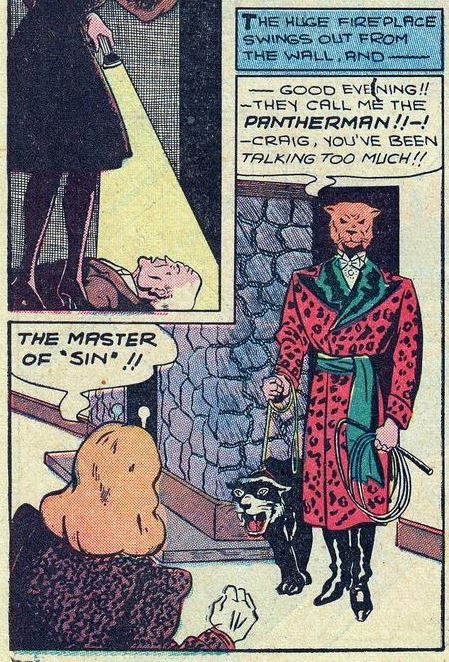
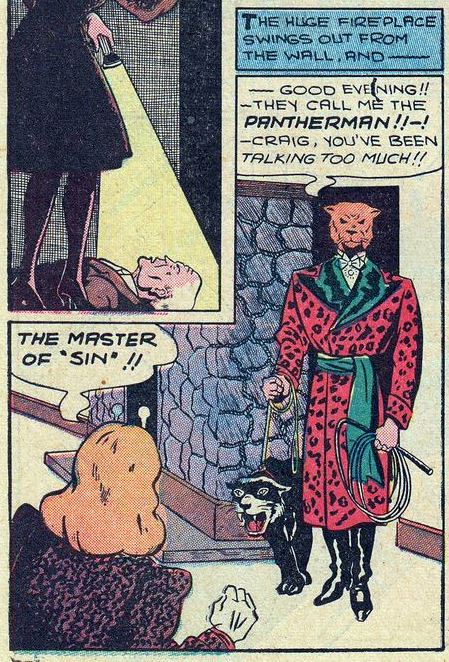
    The first costumed foe to face Dell Comics’ answer to Batman, the Owl, Pantherman strikes a very impressive figure and knows how to make an entrance. He does seem to be a very sloppy operator, however, as he initially attracts the attention of the Owl after mind controlling a man into stealing his own jewels but not somehow thinking to keep him from calling in the police (and renowned private investigator Nick “the Owl” Terry, natch) afterward.

    Subsequent issues reveal that the Pantherman’s sloppiness is more a recent thing, as he has been operating out of the city’s sewers for at least the past 4 years and is well on his way to uniting the underworld with himself at the head. It doesn’t take much to ruin a promising crime career, however, and once the Owl is on the case, Pantherman is soon caught.

  • MINOR SUPER-VILLAIN 209: THE PANTHERMAN

    MINOR SUPER-VILLAIN 209: THE PANTHERMAN

    (Crackajack Funnies 031-033, 1941) 

    The first costumed foe to face Dell Comics’ answer to Batman, the Owl, Pantherman strikes a very impressive figure and knows how to make an entrance. He does seem to be a very sloppy operator, however, as he initially attracts the attention of the Owl after mind controlling a man into stealing his own jewels but not somehow thinking to keep him from calling in the police (and renowned private investigator Nick “the Owl” Terry, natch) afterward.

    Subsequent issues reveal that the Pantherman’s sloppiness is more a recent thing, as he has been operating out of the city’s sewers for at least the past 4 years and is well on his way to uniting the underworld with himself at the head. It doesn’t take much to ruin a promising crime career, however, and once the Owl is on the case, Pantherman is soon caught.

  • MINOR SUPER-VILLAIN 208: THE TERROR

    (Crack Comics 018, 1941)

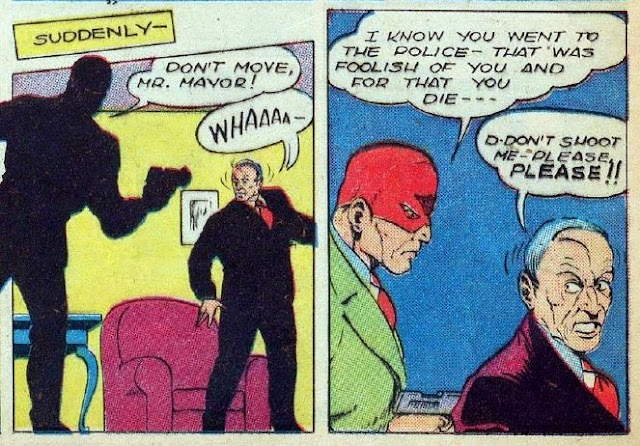
    Not too much to distinguish this guy: he’s Bumps Bale, a former pinball racketeer (you’re just as likely to see Batman smashing up a bunch of pinball machines as an underground casino or a slot machine in the 40s. Gambling is Bad and Pinball is Gambling, was the attitude) who had hit hard times and decided to go into extorting mayors as a second career. Accordingly, he poisoned city comptroller Ezra Daves and promised Unnamed Mayor here some of the same if one million dollars in small bills was not produced post haste. Sadly for the Terror, the Clock got involved.

    I do have to say that I appreciate the cowl-style mask that the Terror is sporting. Personally I find it far more aesthetically pleasing than the executioner’s hoods and cloth draperies that have been more the norm thusfar.

    (also for those keeping track this is presumably the mayor who took over after the Big Shot was ousted, placing him somewhere on a very spicy alternate Wikipedia page for List of Mayors of New York City)

  • MINOR SUPER-VILLAIN 207: THE BLACK WITCH

    (Crack Comics 018, 1941)

    The Black Witch is a member of a long comic book tradition: Haitian voodoo practitioners who use their sinister powers to get up to no good – in this case kidnapping the wife of one of Richard “Madam Fatal” Stanton’s friends as raw material in a search for eternal youth.

    The Black Witch is also part of a long-term demographic shift in comics: while the Haitian voodoo character is a staple villain s(and sometimes hero) into at least the 90s, in the early days they were basically all white folks like the Black Witch here, or the Master of Corpses. A question that I’m not qualified to answer: is this more racist than the state of things post 1960 or so when the population of voodoo villains more accurately represents the demographic makeup of Haiti or is it semi-vilifying an entire ethnoreligious group? 

  • MINOR SUPER-VILLAIN 206: THE CROW

    (Crack Comics 018, 1941)

    The Crow! Wanted in every country on the Earth! A villain with a very impressive resume! It’s actually a bit disappointing when he just does some regular bank robbing in this issue.

    To be fair, he does give the Spider much more of a run for his money than his usual foe, and he does end up returning in Crack 021 the next year, in which he steals the Black Widow and uses it for evil deeds. I don’t know if it’s quite enough, but it’s something.