The Curse of Skeleton Munroe

Category: minor super-villain

  • MINOR SUPER-VILLAIN 923: PROFESSOR SKINN

    (Silver Streak Comics 007, 1941)

    The Skinn family is being killed off – at least seven of them have been murdered on their birthdays, leaving only the odius Mortimer Skinn, and he soon follows, despite police protection. 

    Boy Inventor Dickie Dean hasn’t been idle while this campaign of murder has been going on: thanks to a surveillance balloon he raised over the town for the purpose, he and his pal Zip Todd are able to track the culprit to his home. There. they learn that he is a blind beggar whom they had prevented Mortimer Skinn from beating some months prior, and that he is in fact Mortimer’s brother and the sole surviving member of the Skinn clan.

    Professor Skinn (unsettling name. unsettling family name) reveals that Mortimer and his other brothers attempted to kill him for his life insurance some years back but had only succeeded in blinding him and leaving him for dead. He spent at least some of the intervening time creating his frankly amazing looking cybernetic eye/helmet and planning a revenge that with the death of Mortimer is complete. And now he’s ready to put his skills to use in the world of crime!

    Dickie rebuffs Skinn’s attempt to recruit him as a partner, so out comes the scalpel, the bone drill and the brain injection fluid, because Professor Skinn is not one to take no for an answer. Dickie Dean is promptly evilized and turned on to the benefits of a life of crime.

    The new super-science criminal duo proceed to create a precious metal-attracting magnet and go ham on the town’s gold supply.

    Fortunately for Dickie’s long-term viability as the lead character in a comic strip, Zip Todd gets himself free after days (weeks?) of imprisonment and turns the tables on Skinn thanks to some lax lab safety procedures that mean there’s just vials of nitroglycerine lying around to grab. Skinn reverses the evilization procedure with a handy ray and is hauled away… FOR NOW.

    (also Skinn is vulnerable to attacks on his enormous weak point, like a video game boss)

    Professor Skinn returns in Silver Streak Comics 008, where he escapes prison with the help of his assistant Blubber’s berserker strength. Please not that the Castleton PD saw fit to take away Skinn’s helmet when they locked him up, thus rendering him blind – I’d call that cruel and unusual punishment.

    Dickie, rightfully concerned about Skinn being on the loose, works on an invention that he can use to counter anything that the Professor throws at him, while Skinn does the same and then forces a confrontation by kidnapping Dickie’s parents.

    It’s a tehnological showdown: disintegrator ray vs invisibility ray, and Dickie’s invisibility gives him just enough of an edge to free his parents and destroy the disintegrator, though he himself is captured in the process.

    Professor Skinn next sets out to loot Castleton again, this time with an army of remote controlled robots, but between Zip Todd (overlooked in the scuffle) leading the entirety of the Castleton PD back to his base and a still-invisible Dickie getting loose and causing a ruckus he and Blubber are ultimately forced to zipline down the mountain to freedom.

    This is enough for Professor Skinn: he challenges Dickie to settle things with a war of inventions via singing telegram.

    Silver Streak Comics 009: the war of inventions kicks off after both parties have had a couple of months to prepare, in a fairly horrific fashion as Professor Skinn shells the Castleton High School.

    After putting some distance between them and their surviving classmates, Dickie and Zip Todd wait out the initial shelling in an impenetrable fort before sallying forth in a similarly impenetrable tank equipped with a force ray cannon. They are accompanied by a squadron of small but mighty robots to counter Skinn’s own robot forces. Skinn, in addition to his mechanical infantry, has an air force comprised of trained, bomb-dropping birds, and is conducting his artillery barrage from a base concealed behind a waterfall. 

    I must say that I was disappointed by Skinn’s use of fairly conventional artillery, but he won me back with the robot army and sea gull air force.  

    Professor Skinn is extracted from behind the waterfall when Dickie uses his force ray to bounce a few artillery shells back to their source, and then makes a bid for victory by having his birds carry off Dickie and Zip while he and Blubber steal Dickie’s super tank. It all ends badly, however, as Professor Skinn and Blubber blow themselves up while trying to activate the force ray. Professor Skinn has finally joined the rest of his family in Hell.

    OR HAS HE? 

    No, it turns out, because Silver Streak Comics 011 features a final appearance in which he attempts to chase Dickie and his pals away from fixing up an abandoned theme park that he has been hiding out in. This is a definite step down for the Professor, from legitimate threat to Scooby-Doo villain.

    Skinn’s main Teen Removal tool in this issue is a very Silver Age vehicle called the Gadget Octopus that is equipped with various gag tentacles (boxing glove tentacle, kicking foot tentacle, net tentacle, kid spanking tentacle etc) as well as a fire cannon for when things get serious.

    Once Dickie gets in a room with him, Professor Skinn is easily captured, as befits his fallen status. He’s taken off to jail once more (hopefully with a better lawyer who can successfully argue against eye confiscation this time) and is never seen again. Did he wisely retire or did the fact that Pennsylvania – where “Dickie Dean, Boy Inventor” is plausibly set – is a death penalty state and Skinn is a multiple murderer come into play? 

    Categorized in: Accessories (Various), Murder (Familicides), Origin (Blind Characters)

  • MINOR SUPER-VILLAIN 922: GENGHIS KHAN

    (Champ Comics 015, 1941)

    Okay, Genghis Khan. A lot of guys in comics like to call themselves Genghis Khan or claim to be his successor etc, and importantly they all seem to be into all the old Genghis Khan stuff like horse archers. Absolutely 100% stuff that Genghis was into at the time he was around of course, but I personally think that he would enjoy a machine gun if he had the chance. 

    Duke “the Human Meteor” O’Dowd is getting up to his usual day of driving cabs and palling around with his shoeshine boy pal Toby when suddenly the city is attacked by a mass of cavalry led by a shirtless giant wielding a flaming sword. This is Genghis Khan (a Genghis Khan, at least), and he is probably the Human Meteor’s only recurring foe, appearing in 3 (possibly 4, but Champ Comics 018 is currently AWOL) whole issues.

    A conquering giant cuts an intriguing figure, but the unfortunate thing about Genghis Khan is that the stories he appears in are pretty incoherent. There’s a plot, but everything other than the plot is just shiny bits glued on like sparkles. That said, here are the most interesting and intriguing things about him:

    1. Size and Origins

    Genghis Khan’s size remains fairly consistently enormous during his first two appearances – if anything, he might just be a bit bigger in the second one. His third appearance, however, shows him at a considerably reduced stature, from the third set of panel above in which he’s maybe ten feet tall to perhaps fifteen feet at maximum. Is this an indication that he can control his size or just a general disregard for continuity?

    The unanswered question of just what is up with this guy’s size is a symptom of the fact that he has no real origin. He just shows up one day, stomping around Manhattan. Is he even Mongolian? Not to put too fine a point on it, but I’ve read a lot of 1940s comics and I think that they would have drawn him differently if he was. 

    2. Technology

    The other major unanswered question about Genghis Khan is: just where did he get those wonderful toys? Such as… 

    His giant flaming sword that can also change its atomic structure on the fly, seemingly specifically so that the Human Meteor can’t pick it up.

    His cool dirigible base and its defensive screen of flamethrowers.

    The “sky road,” a transparent walkway that both men and horses can travel to and from the dirigible on, which need no support and must have some sort of crazy friction going on considering the angles that people are climbing it at.

    3. Goals

    Unsurprisingly, the self-declared successor of Genghis Khan, this fellow’s main goal is conquest. The attack on New York in his initial appearance is the first part of an attempted takeover of the US, for example.

    In Genghis Khan’s second appearance (Champ Comics 016, 1941), he is laying siege to the hidden, high-tech city of Bayakura, the place that Duke O’Dowd became the Human Meteor. 

    Though the Human Meteor drops a mountain on him at the end of that second appearance, Genghis Khan survives somehow (perhaps by shedding mass to allow himself to escape his mountain tomb? That’d be an interesting aspect of the character if it ever came up) and allies with the Japanese to harry the US fleet off China. The Human Meteor sinks the Khan’s entire fleet, and since he (probably) never appears again, drowning does what being crushed under a mountain failed to.

    Categorized in: Famous Figures (Genghis Khan), Real Folk (Genghis Khan), Supercrime (Attempted Conquest)

  • MINOR SUPER-VILLAIN 921: THE SCALY DRAGON

    (Champ Comics 014, 1941)

    The Scaly Dragon is what I would consider to be a very by-the-book fascist saboteur with a better-than-average name. He does have a couple of noteworthy things about him though, including 1. the fact that he is a pseudo-Imperial Japanese spy rather than the much more common pseudo-Nazis that we usually see.

    2. Though the Scaly Dragon’s first couple of efforts were aimed at sabotaging the water supply of New York City (which is where the Human Meteor gets on his tail), his home base appears to be in Cincinnati, an oft-ignored city in comics.  

    3. After he is rounded up by the Human Meteor, we get a rare scene of the Scaly Dragon getting booked. Most of the time these guys end up dead or just dropped off directly at a prison courtyard, so this is a real treat – I suppose the next milestone we must look forward to is a super-villain mug shot.

    Categorized in: Animals (Dragons), Espionage (Saboteurs), Locations (Cincinnati)

  • MINOR SUPER-VILLAIN 920: MHERSA

    (Champion Comics 003, 1940/ Champ Comics 011, 1940)

    Half sister to the mercurial undersea tyrant Neptina, Mhersa originally appears as the head of the Maella, a rebel group comprised of female members of the same race of underwater beings as Neptina (I’m not going into that again). Mhersa and the Maella are isolationist but reasonable compared to Neptina’s capricious ways. (Champion Comics 003, 1940)

    The Maella help Lt Brad Fletcher off and on during his conflict with Neptina, but Mhersa’s next major move comes in Champ Comics 011, when she seizes the throne of Amloza while Neptina is out and about. Though this is a pretty reasonable act considering the way that the kingdom was being run, it is framed as villainous due to the fact that Neptina had just finished reforming her ways when she got the news. 

    Still, in my eyes Mhersa is still on the side of the angels, just trying to do right by the people of Amloza. Right up to the point that she surrenders the city to the fascistic King Walro of the Walrus Men in exchange for an easy life in his administration, that is. 

    Just why Mhersa does this is never explained – perhaps her opposition to her sister was less about justice and more about some sort of irrational rivalry and this is the best way that she can think of to spite her? (Champ Comics 013, 1941)

    Neptina and her allies (now including Prince Eon, former ruler of the Walrus Men and new Neptina love interest) prepare to take the fight to Mhersa, but before they get much further than their initial brainstorming session Neptina gets a psychic vision: Mhersa has left Amloza. It turns out that she was somehow less popular than her half sister and is now gone by popular demand. 

    Mhersa enlists the aid of King Walro in an attempt to murder Neptina outright that really cements my theory that this is all about sibling rivalry rather than differing opinions on good governance.

    Believing Neptina to be dead, Mhersa leads a force of Walrus Men to retake Amloza, only to be defeated, captured and jailed by her sister, never to be seen again. (Champ Comics 014, 1941)

    Categorized in: By Birth (Undersea Beings), Generica (Ends in A), Theft (Usurpers) 

  • MINOR SUPER-VILLAIN 920: MHERSA

    (Champion Comics 003, 1940/ Champ Comics 011, 1940)

    Half sister to the mercurial undersea tyrant Neptina, Mhersa originally appears as the head of the Maella, a rebel group comprised of female members of the same race of underwater beings as Neptina (I’m not going into that again). Mhersa and the Maella are isolationist but reasonable compared to Neptina’s capricious ways. (Champion Comics 003, 1940)

    The Maella help Lt Brad Fletcher off and on during his conflict with Neptina, but Mhersa’s next major move comes in Champ Comics 011, when she seizes the throne of Amloza while Neptina is out and about. Though this is a pretty reasonable act considering the way that the kingdom was being run, it is framed as villainous due to the fact that Neptina had just finished reforming her ways when she got the news. 

    Still, in my eyes Mhersa is still on the side of the angels, just trying to do right by the people of Amloza. Right up to the point that she surrenders the city to the fascistic King Walro of the Walrus Men in exchange for an easy life in his administration, that is. 

    Just why Mhersa does this is never explained – perhaps her opposition to her sister was less about justice and more about some sort of irrational rivalry and this is the best way that she can think of to spite her? (Champ Comics 013, 1941)

    Neptina and her allies (now including Prince Eon, former ruler of the Walrus Men and new Neptina love interest) prepare to take the fight to Mhersa, but before they get much further than their initial brainstorming session Neptina gets a psychic vision: Mhersa has left Amloza. It turns out that she was somehow less popular than her half sister and is now gone by popular demand. 

    Mhersa enlists the aid of King Walro in an attempt to murder Neptina outright that really cements my theory that this is all about sibling rivalry rather than differing opinions on good governance.

    Believing Neptina to be dead, Mhersa leads a force of Walrus Men to retake Amloza, only to be defeated, captured and jailed by her sister, never to be seen again. (Champ Comics 014, 1941)

    Categorized in: By Birth (Undersea Beings), Generica (Ends in A), Theft (Usurpers) 

  • MINOR SUPER-VILLAIN 919: THE WEREWOLF

    (Cat-Man Comics 005, 1941)

    There are three remarkable things about the story of the Werewolf. The first is that it finally establishes that the city that the Pied Piper operates out of has a name and that it is Central City – this both a nice thing to have cleared up and a fun coincidence, given that the other comic book Pied Piper, the Flash villain, also lives in a place with that name. 

    The second thing is just how clearly and concisely the Werewolf’s motivation is: he was bitten by a werewolf while in Tibet some ten years earlier and he blames his colleagues, Doctors Martin and Smith, for not treating him properly and thus not preventing his eventual transformation. Specifically, Arno becomes filled with murderous vengeance when he realizes that his gnarled werewolf hands are no longer capable of performing brain surgery.

    Thirdly is this story’s treatment of lycanthropy. Among the points of interest:

    – Arno is bitten c. 1931 but does not transform until ten years later. 

    – Just what the “werewolf” that bit him in Tibet is is unclear. It’s probably meant to be a man-beast of the type that Arno himself has turned into, but 1940s comics also commonly refer to vampire bats as vampires and this has made me gunshy. 

    – Speaking of man-beasts: like the other Werewolf we have encountered, Arno is much more man than wolf. I’m sure that over time we will be able to identify trends in the morphology of comic book lycanthropes.

    – Arno treats his condition as if it is permanent, but the action of the story takes place over the course of two days, meaning that the full moon (implied to be the trigger for the initial transformation) has not yet passed. Presumably Arno did not turn back during the day or he might have been a bit less murderous about the whole thing.

    – On that note, it’s a bit unclear how much of Arno’s homicidal inclination is revenge and how much is werewolf insanity. 

    Though the Pied Piper is unable to prevent the Werewolf from murdering Dr Martin, he is able to track him to the abandoned lighthouse that he has holed up in and learn Arno’s motivation. The Piper’s magical instrument proves not only able to subdue a crazed wolfman but also to exert enough sheer musical force to bring the building down on his head to end his reign of terror.

    In the end, the Pied Piper and Dr Smith decide that the Werewolf was not wholly to blame for his crimes and conceal Arno’s involvement in them, meaning that Dr Ralph Arno is just kind of Famously Missing.

    REVENGE KILLER SCORE: 1/2

    Categorized in: Accessories (Lighthouse), Day Jobs (Brain Surgeons), Supranormal Beings (Lycanthropes)

  • MINOR SUPER-VILLAIN 918: THE BLACK PANTHER

    (Cat-Man Comics 004, 1941)

    The district attorney of Central City, the NYC clone that the Pied Piper inhabits, has been murdered by what the authorities can only conceive of as a beast! The city is in a real tizzy, especially once Police Commissioner Gurry receives a note informing him that he will be the next victim (and the cute little signature on this note is why I am calling this villain the Black Panther when it is not used elsewhere in the story – if we can’t go by what he calls himself then what’s the point?).

    True to his word, the Black Panther shows up at the Commissioner’s office at 10:30, and sics his small-b, small-p black panther on him (I know it looks white in the above panel but trust me). It is only the timely intervention of the Pied Piper that saves the day.

    Though the initial attempt failed, the Black Panther is nothing if not persistent and tries again once the commissioner gets home – I guess the police assumed that the scheduled 10:30 murder was some sort of hard and fast rule that the villain was going to stick to and so they all knocked off for the day once it didn’t happen. It’s all groovy though, because the Pied Piper is still on the case and his magic flute has a “panther-killing” setting. And his fist has a “villain-punching” setting that comes in handy when the Black Panther makes a third attempt on the Commissioner’s life sans pet.

    Once unmasked, the Black Panther turns out to be newspaper editor Purt Mason, and Purt Mason is revealed in turn to be gangster Razor Harris, who spent some time in South Africa while establishing his new identity (and acquiring a panther pal) and came back for revenge on the men who put him away. The Black Panther was a revenge killer the whole time!

    REVENGE KILLER SCORE: 1/2

    Categorized in: Animals (Panthers), Colours (Black), Murder (Revenge Killers)

  • MINOR SUPER-VILLAIN 917: THE GHOST

    (Cat-Man Comics 004, 1941)

    The Upper New York Castle District appears to also exist in the Temerson/Helnit universe, because when NYC-based vigilante the Ragman is hired to investigate a supposed haunting at a place called Glascow Castle he hops in his car and drives there. Glascow Castle’s owner, Sir Wilkens Sidney, claims to have seen the ghost of 18th Century murder victim Duke Edgeroy wandering the halls of his home and believes that the Ragman is the man to get to the bottom of things before he flees into the night screaming.

    And it turns out that Sir Sidney is correct, because the Ragman isn’t in the castle for five minutes before he discovers a secret basement full of counterfeiting equipment and finds himself battling a very solid Ghost and his even less ghostly henchmen.

    After a bit of back and forth involving swordplay, deathtraps and a trained attack dog the Ghost is finally unmasked and revealed to be racketeer Marty Vance, who was so invested in the castle as a perfect location for his operation that he moved in despite the fact that Sir Sidney was already living there. Perhaps he was in it for the love of the haunting game as much as the counterfeiting, who knows.

    One thing I’ll say about this particular Ghost: he’s got one of the more horrifying masks that I’ve seen on one of his ilk.

    Categorized under: Accessories (Headquarters (Castle)), Extortion & Fraud (Counterfeiting/ Fake Ghost), Supranormal Beings (Ghosts) 

  • MINOR SUPER-VILLAIN 917: THE GHOST

    (Cat-Man Comics 004, 1941)

    The Upper New York Castle District appears to also exist in the Temerson/Helnit universe, because when NYC-based vigilante the Ragman is hired to investigate a supposed haunting at a place called Glascow Castle he hops in his car and drives there. Glascow Castle’s owner, Sir Wilkens Sidney, claims to have seen the ghost of 18th Century murder victim Duke Edgeroy wandering the halls of his home and believes that the Ragman is the man to get to the bottom of things before he flees into the night screaming.

    And it turns out that Sir Sidney is correct, because the Ragman isn’t in the castle for five minutes before he discovers a secret basement full of counterfeiting equipment and finds himself battling a very solid Ghost and his even less ghostly henchmen.

    After a bit of back and forth involving swordplay, deathtraps and a trained attack dog the Ghost is finally unmasked and revealed to be racketeer Marty Vance, who was so invested in the castle as a perfect location for his operation that he moved in despite the fact that Sir Sidney was already living there. Perhaps he was in it for the love of the haunting game as much as the counterfeiting, who knows.

    One thing I’ll say about this particular Ghost: he’s got one of the more horrifying masks that I’ve seen on one of his ilk.

    Categorized under: Accessories (Headquarters (Castle)), Extortion & Fraud (Counterfeiting/ Fake Ghost), Supranormal Beings (Ghosts) 

  • MINOR SUPER-VILLAIN 916: THE STINGER

    MINOR SUPER-VILLAIN 916: THE STINGER

    (Cat-Man Comics 003, 1941)

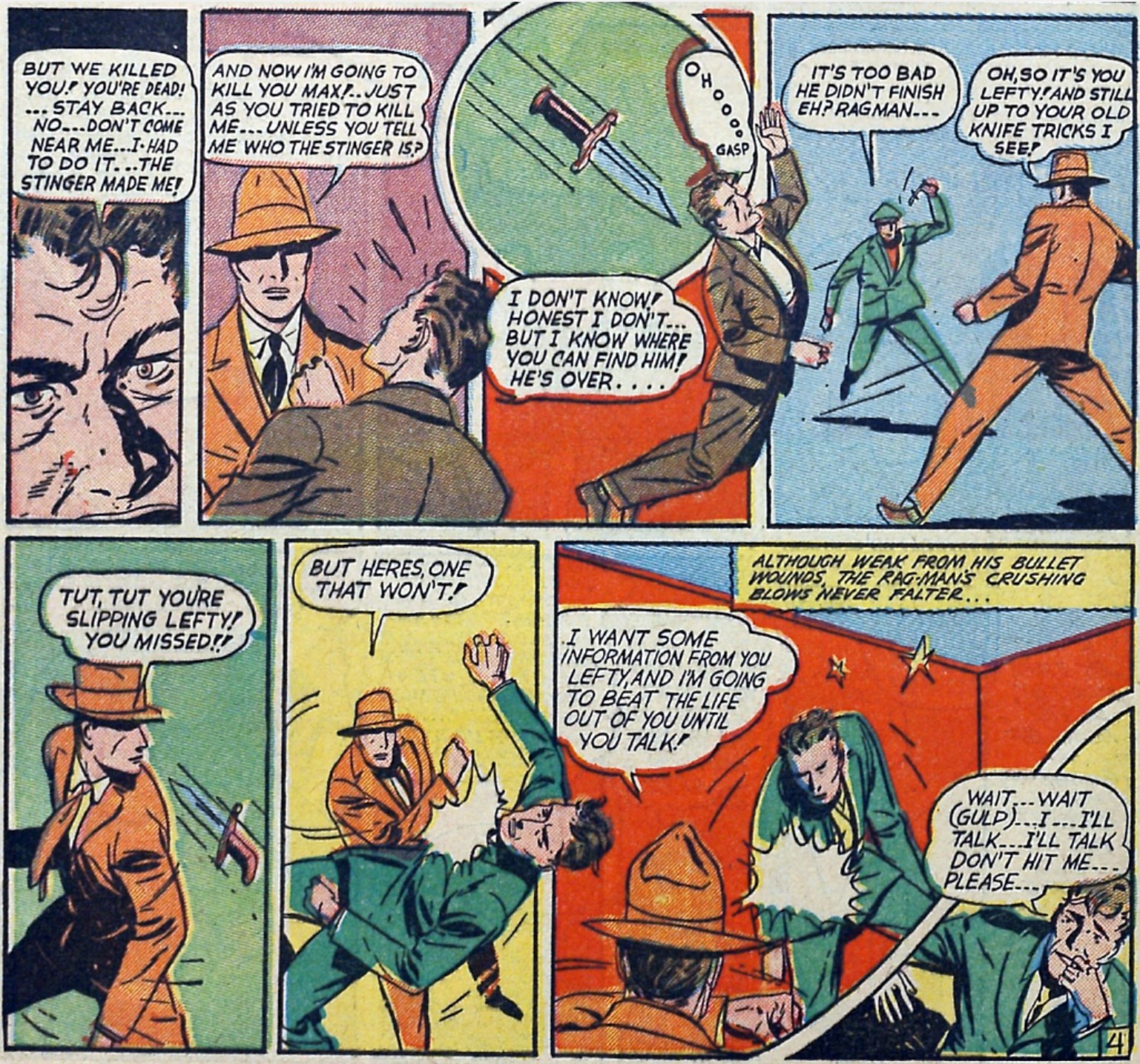
    The Stinger is in most respects an extremely generic masked gang boss of the kind that we have seen so frequently before, right down to the fact that he is wearing one of those hanging cloth face masks, an item only worn by generic masked gang bosses of the 1940s. The real difference between all those other guys and the Stinger is that the Stinger’s very first move was to send out some goons to ambush and murder local vigilante and only credible threat to his operations the Ragman. 

    This important step having been completed, the Stinger launches a massive crimewave, that includes four simultaneous bank robberies and the kidnapping of the police commissioner. Mayor Not La Guardia is not happy about all this, as he expresses to conspicuous named character police Lieutenant Burns.

    The only major flaw in the Stinger’s plan is that his gang is made up of 1940s comic book gangsters who don’t think to check for a pulse when they are sent to murder someone. This is important because it turns out that the Ragman was wearing a bulletproof vest the whole time and was just playing dead when he was dumped in the river. 

    Having beaten up the Stinger’s entire operation, the Ragman is able to track him down and unmask him as, you might have guessed it, Lt, Burns, the only new named character in the story. It’s the old classic “crooked cop becomes masked crimelord” story again, though this is the first crooked police lieutenant we’ve seen. 

    Categorized under: Body (Nonhuman Body Parts), Location (NYC), Profession (Law Enforcement)