The Curse of Skeleton Munroe

Category: minor super-villain

  • MINOR SUPER-VILLAIN 916: THE STINGER

    (Cat-Man Comics 003, 1941)

    The Stinger is in most respects an extremely generic masked gang boss of the kind that we have seen so frequently before, right down to the fact that he is wearing one of those hanging cloth face masks, an item only worn by generic masked gang bosses of the 1940s. The real difference between all those other guys and the Stinger is that the Stinger’s very first move was to send out some goons to ambush and murder local vigilante and only credible threat to his operations the Ragman. 

    This important step having been completed, the Stinger launches a massive crimewave, that includes four simultaneous bank robberies and the kidnapping of the police commissioner. Mayor Not La Guardia is not happy about all this, as he expresses to conspicuous named character police Lieutenant Burns.

    The only major flaw in the Stinger’s plan is that his gang is made up of 1940s comic book gangsters who don’t think to check for a pulse when they are sent to murder someone. This is important because it turns out that the Ragman was wearing a bulletproof vest the whole time and was just playing dead when he was dumped in the river. 

    Having beaten up the Stinger’s entire operation, the Ragman is able to track him down and unmask him as, you might have guessed it, Lt, Burns, the only new named character in the story. It’s the old classic “crooked cop becomes masked crimelord” story again, though this is the first crooked police lieutenant we’ve seen. 

    Categorized under: Body (Nonhuman Body Parts), Location (NYC), Profession (Law Enforcement)

  • MINOR SUPER-VILLAIN 915: THE BAT

    (Cat-Man Comics 002, 1941)

    While rescuing the inhabitants of the mining town of Red Creek from the forest fire that threatens their town, Flying Legion leader Chute Harmon learns that the fire might in fact have been deliberately set and that the arsonist might be nearby. Donning his Asbestium suit, he sets off to investigate and soon finds himself in a confrontation with a masked man who calls himself the Bat.

    The Bat has a very succinct five-panel appearance, which is just long enough to explain his plan (burn down the town and then steal all of the miners’ gold after things cool down), get bopped on the head and flee into a raging inferno.

    There is some implication that the Bat might have lived to vex Chute Harmon and the Flying Legion another day, but as this was their only published adventure we must instead conclude that he was burned to a crisp.

  • MINOR SUPER-VILLAIN 914: THE BRIDGE-DESTROYERS

    (Cat-Man Comics 001, 1941)

    Some villains are puzzles, high-concept enigmas whose motivations and goals are a mystery that must be solved to understand them. The Bridge-Destroyers are not that. They are exactly what their name declares them to be: a couple of guys in a tower who destroy bridges using a long-range heat-ray cannon.

    But why the Bridge-Destroyers destroy bridges, that must be a mystery, yes? Perhaps it is, but the authorities are pretty certain that they are working for “some foreign power” to disrupt America’s ability to move troops and war materiel from place to place. Despite this, the official response to the group seems to be resigned acceptance as their defenses are so good that it is considered foolhardy to even try to stop them.

    Despite their fearsome reputation, Cat-Man is determined to face the Bridge-Destroyers head-on, which means that he meets their fist line of defense: a bunch of guys who live in a hole just outside the tower and suck up intruders using a giant vacuum. This might be enough to stop your every-day lawman, but the Cat-Man has all the powers of a cat, man. He simply avoids being battered to death by the whirling storm of debris and beats up the hole-dwellers when they come to retrieve his corpse.

    To their credit, the Bridge-Destroyers do manage to kill Cat-Man with a blast from their heat-ray as he makes his second approach to the tower but then they are treated to a lesson about how the “nine lives” part of his super-powers works. Stripped of their ray, their tower and their hole full of men, the masterminds between the war on America’s infrastructure are swiftly subdued.

  • MINOR SUPER-VILLAIN 914: THE BRIDGE-DESTROYERS

    (Cat-Man Comics 001, 1941)

    Some villains are puzzles, high-concept enigmas whose motivations and goals are a mystery that must be solved to understand them. The Bridge-Destroyers are not that. They are exactly what their name declares them to be: a couple of guys in a tower who destroy bridges using a long-range heat-ray cannon.

    But why the Bridge-Destroyers destroy bridges, that must be a mystery, yes? Perhaps it is, but the authorities are pretty certain that they are working for “some foreign power” to disrupt America’s ability to move troops and war materiel from place to place. Despite this, the official response to the group seems to be resigned acceptance as their defenses are so good that it is considered foolhardy to even try to stop them.

    Despite their fearsome reputation, Cat-Man is determined to face the Bridge-Destroyers head-on, which means that he meets their fist line of defense: a bunch of guys who live in a hole just outside the tower and suck up intruders using a giant vacuum. This might be enough to stop your every-day lawman, but the Cat-Man has all the powers of a cat, man. He simply avoids being battered to death by the whirling storm of debris and beats up the hole-dwellers when they come to retrieve his corpse.

    To their credit, the Bridge-Destroyers do manage to kill Cat-Man with a blast from their heat-ray as he makes his second approach to the tower but then they are treated to a lesson about how the “nine lives” part of his super-powers works. Stripped of their ray, their tower and their hole full of men, the masterminds between the war on America’s infrastructure are swiftly subdued.

  • MINOR SUPER-VILLAIN 913: CAPTAIN HOOD

    (Captain Aero Comics 001, 1941) 

    Captain Hood is your classic fascist of indeterminate allegiance, who has been holed up with a crew of pseudo-Nazis and pseudo-Imperial Japanese agents in a cave underneath Easter Island for four long years working on an “undersea tractor” designed to haul a cargo of explosives to the Panama Canal and then blow it up. Just why he requires a mask in order to oversee this operation is an exercise left for the reader – I prefer to imagine that he got into cosplay as a way to while away the long hours.

    Captain Hood makes two glaring errors over the course of this issue, the biggest of which is the fact that he is so punchy as the culmination of his plan approaches that he has his men open fire on the tramp steamer Suzy Q for merely approaching the island, with no indication that they are going to land. This of course enrages the ship’s captain and only survivor, adventurer Grit Grady. 

    The fact that Grady takes his revenge on Captain Hood by storming the cave and ultimately blowing the entire place, undersea tractor and all, to high heaven means that Hood never has to face up to his other, much larger error: choosing to set up shop on Easter Island.

    I feel like I’m going to be talking about this a lot, because Easter Island is a beloved exotic setting in comic books, but it is so far away from everything else. Once that undersea tractor was completed, the next step was going to be to drive it five thousand kilometres across the bottom of an ocean that was virtually unmapped at the time but speaking as someone with an Internet connection and thus a collection of maps at my disposal: it’s not a smooth path. I, personally, would not place a bet on Captain Hood making it there with his twenty thousand tons of explosives in one piece, no matter how good his tractor is.

  • MINOR SUPER-VILLAIN 913: CAPTAIN HOOD

    (Captain Aero Comics 001, 1941) 

    Captain Hood is your classic fascist of indeterminate allegiance, who has been holed up with a crew of pseudo-Nazis and pseudo-Imperial Japanese agents in a cave underneath Easter Island for four long years working on an “undersea tractor” designed to haul a cargo of explosives to the Panama Canal and then blow it up. Just why he requires a mask in order to oversee this operation is an exercise left for the reader – I prefer to imagine that he got into cosplay as a way to while away the long hours.

    Captain Hood makes two glaring errors over the course of this issue, the biggest of which is the fact that he is so punchy as the culmination of his plan approaches that he has his men open fire on the tramp steamer Suzy Q for merely approaching the island, with no indication that they are going to land. This of course enrages the ship’s captain and only survivor, adventurer Grit Grady. 

    The fact that Grady takes his revenge on Captain Hood by storming the cave and ultimately blowing the entire place, undersea tractor and all, to high heaven means that Hood never has to face up to his other, much larger error: choosing to set up shop on Easter Island.

    I feel like I’m going to be talking about this a lot, because Easter Island is a beloved exotic setting in comic books, but it is so far away from everything else. Once that undersea tractor was completed, the next step was going to be to drive it five thousand kilometres across the bottom of an ocean that was virtually unmapped at the time but speaking as someone with an Internet connection and thus a collection of maps at my disposal: it’s not a smooth path. I, personally, would not place a bet on Captain Hood making it there with his twenty thousand tons of explosives in one piece, no matter how good his tractor is.

  • MINOR SUPER-VILLAIN 912: COMMANDER DARKE

    MINOR SUPER-VILLAIN 912: COMMANDER DARKE

    (Bang-Up Comics 001, 1941)

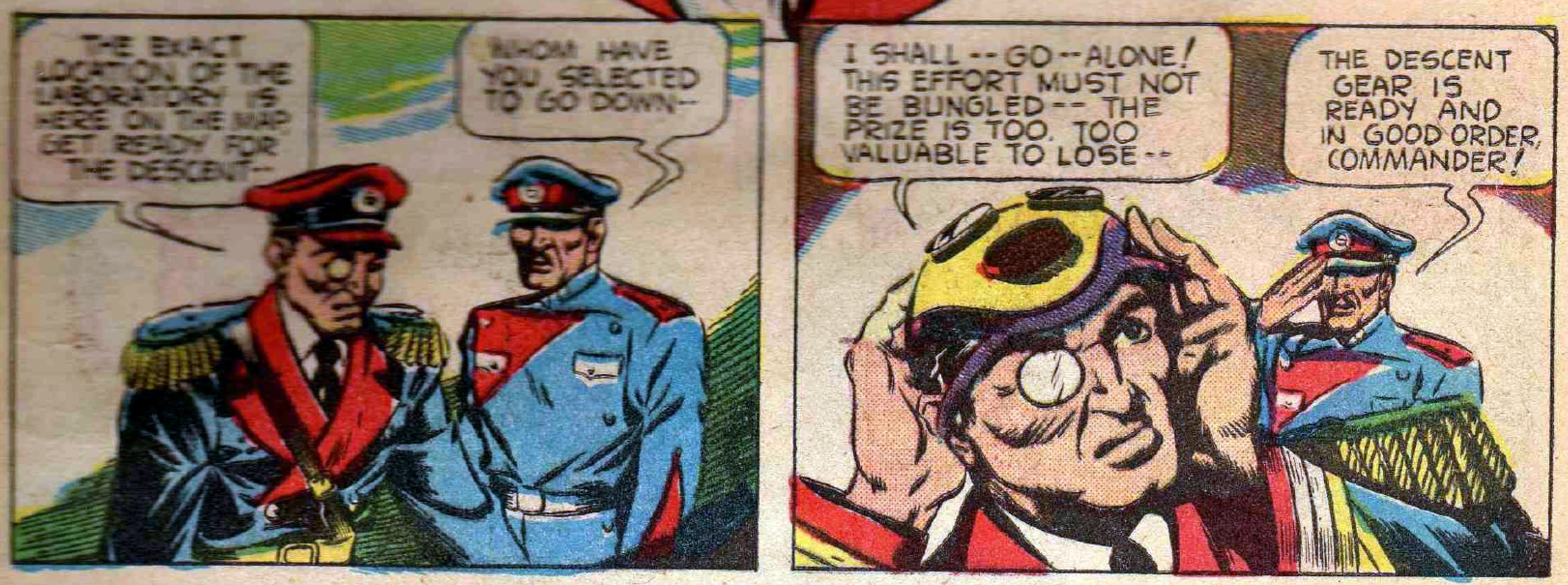
    Commander Darke, though ostensibly on a mission to invade the United States with his private military, is the arch-foe of scientist-adventurer Cosmo Mann and as such spends his entire career trying to Steal Those Gizmos. Perhaps things would be different if there had been more than three issues of Bang-Up Comics for Darke and Mann to clash, but as it stands all we get are the opening moves of their epic struggle.

    You probably already took note of the extreme ostentation on display in Commander Darke’s (almost certainly self-designed) uniform, but the seriousness with which he takes his wardrobe is really underscored in the above panels in which we can not only see that he took the care to screw in his monocle even when waking up in the middle of the night to take a call but that even his double-breasted pyjamas have epaulettes on them. 

    I was all ready to give Darke a bit of credit for undertaking the mission to secure Cosmo Mann’s Sun Ray Gun himself, but once he left his captured underlings behind to die in a cloud of poison gas I was forced to reevaluate: going himself is a part of his being a Bad Boss, an expression of his disdain for the ability of his minions to do even this simple task. He does have a cool-looking gas mask though.

    Commander Darke has a lot of villainous presence or potential, but never really gets a chance to show it off: he captures the Sun Ray and a man who he thinks is Cosmo Mann but turns out to be his assistant Archy and then spends his next appearance on the back foot as Mann attempts to recapture them from Darke as he escapes in his dirigible. His particular brand of bombastic villainy was lost to the vagaries of the comic book boom, alas.

  • MINOR SUPER-VILLAIN 911: RAMESES

    MINOR SUPER-VILLAIN 911: RAMESES

    (Whiz Comics 025, 1941)

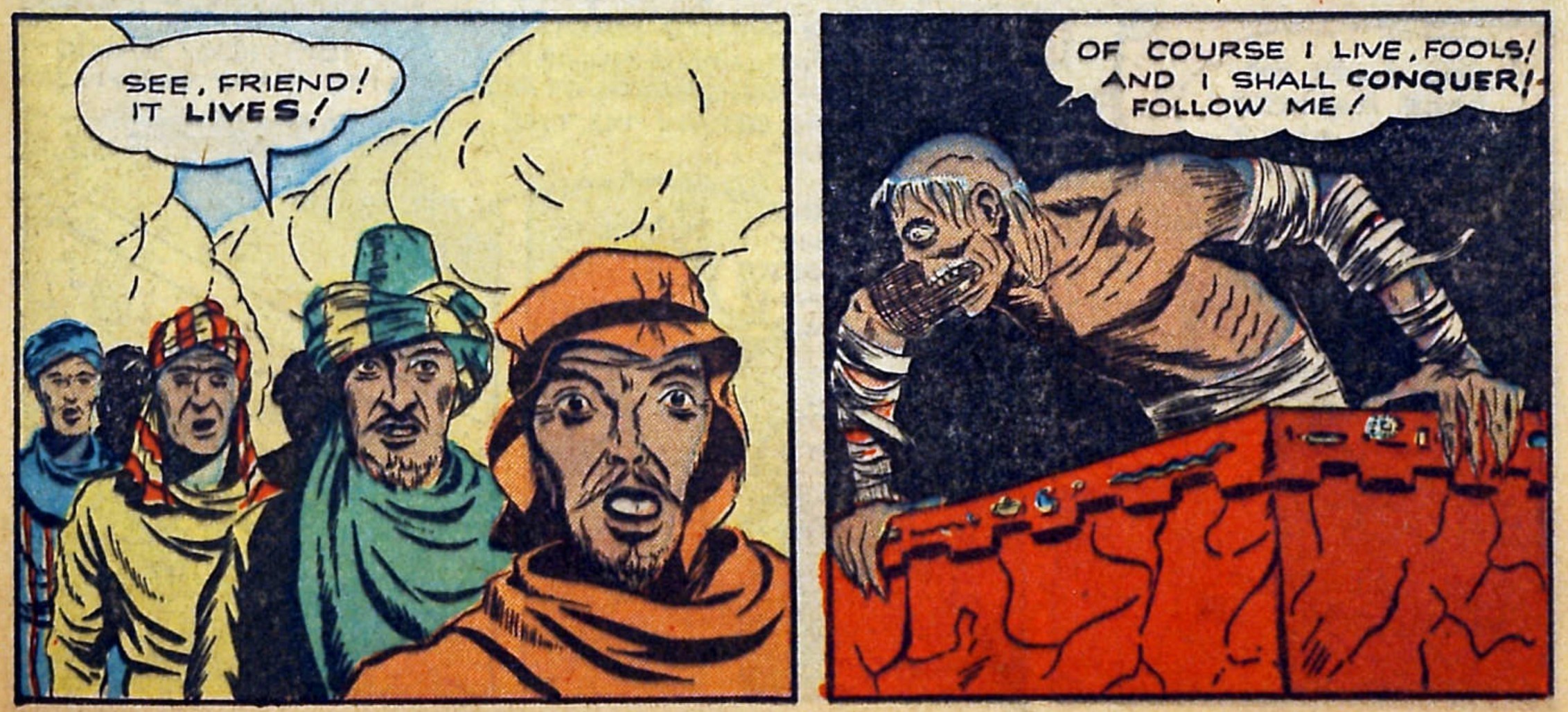
    We open in Egypt, where a group of partisans led by a fellow with the unlikely name of “Girbo, the Mad Mullah”* are brainstorming ways in which they might expel both the Germans and the British from their country, and Girbo has an innovative solution: he has procured the mummy of the Pharaoh Rameses, along with a vial of mummy-resurrection juice, and is going to bring the ancient king back to life to lead them. And it works!

    The problem that I am faced with here is that Egyptian history features a full eleven different rulers named Ramesses and just which one this was is not specified here. I was all fired up and ready to dig through the history of each one (on Wikipedia, at least), when I realized that there was a clear and obvious front-runner in the person of Ramesses II, ol’ Ozymandias himself, if only because he loomed largest in the public consciousness of the time as the presumed Pharaoh of the story of Exodus. 

    *while I’m not going to claim that the depiction of Egyptian Muslims in this story is good or even particularly sympathetic, you must believe me when I say that (aside from Girbo) these guys get about as sympathetic a depiction as you get in comics the 1940s, or indeed into the 80s. It’s a low bar but they cleared it.

    Rameses begins his campaign on a high note, with a raid on a British fort that establishes both his ruthlessness and complete invulnerability to bullets. One must pity his poor horse, however.

    Things take a turn when a Nazi officer shows up with the intention of allying with this new faction against the common British for, only to be slain at Rameses’ command. This violation of the flag of truce raises some concern amongst his followers but what really gets the talking is his assertion that he should be enough of a god for them and that they should abandon their faith to serve him.

    Having driven away his followers with his evil ways, Rameses drives home his point with magical snakes. 

    The loss of his followers means nothing to the undead Pharaoh, who simply raises an army of the dead to assist him in his next assault on the British forces. Meanwhile, Girbo attempts to slay Ibis the Invincible to prevent his further interference in their plans but is himself killed when Ibis proves his better in swordplay.

    Rameses’ undead forces, though formidable, are vulnerable to sunlight, something that the Ibistick can easily provide even though the mechanics of how it might have done so are troubling. But what to do with an eight foot tall megalomaniacal mummy-man? Things look hopeless until Rameses himself lets slip the fact that the only thing capable of containing him is his own tomb that Ibis is able to defeat him, by simply moving said tomb over top of the villain.

    Though Rameses is left to stew in the darkness, he is in fact one of Ibis the Invincible’s few recurring villains. We will see his bony face and weird mummy tonsure again.

  • MINOR SUPER-VILLAIN 911: RAMESES

    (Whiz Comics 025, 1941)

    We open in Egypt, where a group of partisans led by a fellow with the unlikely name of “Girbo, the Mad Mullah”* are brainstorming ways in which they might expel both the Germans and the British from their country, and Girbo has an innovative solution: he has procured the mummy of the Pharaoh Rameses, along with a vial of mummy-resurrection juice, and is going to bring the ancient king back to life to lead them. And it works!

    The problem that I am faced with here is that Egyptian history features a full eleven different rulers named Ramesses and just which one this was is not specified here. I was all fired up and ready to dig through the history of each one (on Wikipedia, at least), when I realized that there was a clear and obvious front-runner in the person of Ramesses II, ol’ Ozymandias himself, if only because he loomed largest in the public consciousness of the time as the presumed Pharaoh of the story of Exodus. 

    *while I’m not going to claim that the depiction of Egyptian Muslims in this story is good or even particularly sympathetic, you must believe me when I say that (aside from Girbo) these guys get about as sympathetic a depiction as you get in comics the 1940s, or indeed into the 80s. It’s a low bar but they cleared it.

    Rameses begins his campaign on a high note, with a raid on a British fort that establishes both his ruthlessness and complete invulnerability to bullets. One must pity his poor horse, however.

    Things take a turn when a Nazi officer shows up with the intention of allying with this new faction against the common British for, only to be slain at Rameses’ command. This violation of the flag of truce raises some concern amongst his followers but what really gets the talking is his assertion that he should be enough of a god for them and that they should abandon their faith to serve him.

    Having driven away his followers with his evil ways, Rameses drives home his point with magical snakes. 

    The loss of his followers means nothing to the undead Pharaoh, who simply raises an army of the dead to assist him in his next assault on the British forces. Meanwhile, Girbo attempts to slay Ibis the Invincible to prevent his further interference in their plans but is himself killed when Ibis proves his better in swordplay.

    Rameses’ undead forces, though formidable, are vulnerable to sunlight, something that the Ibistick can easily provide even though the mechanics of how it might have done so are troubling. But what to do with an eight foot tall megalomaniacal mummy-man? Things look hopeless until Rameses himself lets slip the fact that the only thing capable of containing him is his own tomb that Ibis is able to defeat him, by simply moving said tomb over top of the villain.

    Though Rameses is left to stew in the darkness, he is in fact one of Ibis the Invincible’s few recurring villains. We will see his bony face and weird mummy tonsure again.

  • MINOR SUPER-VILLAIN 910: HERR GLOOBELS

    (Whiz Comics 024, 1941)

    Herr Gloobels is a mysterious and somewhat gruesome figure who murders a motorcycle messenger in order to get ahold of some troop transport schedules and then murders a second one to get them again after Spy Smasher recovers them from the first theft. He does all of this using his Tornado Gun, a device that seems to be a ray gun but which actually fires beams of compressed air that can sink a ship as easily as perforate a hapless guard. 

    Herr Gloobels’ generally chaotic nature leaves us with a number of questions, the most narratively pressing of which is: is this guy a spy or what? There’s no real talk of the War Lord or any other Axis stand-in and Gloobels seems to be driven by scientific megalomania as much as any desire to advance the cause of world fascism. Maybe he’s just wacky.

    The second question is of course: what’s the deal with Gloobels’ assistant Hugo? Is he a trained gorilla? An ape-man? Something more racist? It’s never specified.

    Thirdly: just why does he look so much like a Basil Wolverton character in that last panel? Don’t get me wrong: it’s a good look! It’s just not quite what he looks like the rest of the time.

    After a spirited melee in Gloobels’ lighthouse HQ, Hugo ends up taking a Tornado Gun blast meant for Spy Smasher and is sent to his final reward. This seems to take the wind out of Gloobels’ sails and he surrenders without further incident – a surprising demonstration of affection for a henchman, particularly for a homicidal scientist type like Gloobels. The Tornado Gun is supposedly turned over to the US military for study, but as with all of these captured super-villain weapons they seemingly put their worst men on the job because the Allied forces continued to rely on plain old bullets.