The Curse of Skeleton Munroe

Category: minor super-villain

  • MINOR SUPER-VILLAIN 838: DR DREAD

    (Top-Notch Comics 008, 1940)

    After Harley Hudson perfects his muscular coordination technique and becomes the Firefly after two years of hard study, his first order of business is to move to New York City to find a job, because it’s hard to fight crime on an empty stomach. Plus NYC is the place to be for super-heroics and super-crime. Case in point: the very first job ad that Hudson follows up on turns out to be criminal scientist Dr Dread (unnamed in his first appearance), who is acquiring experimental subjects with a simple notice in the papes.

    Dread’s experiments involve “mechanical brains” that somehow mutate their recipients into huge goblinoid creatures (called the Green Men even though they trend more grey-brown) once implanted – the details are fuzzy at best. He believes that Hudson (and reporter Joan Burton, also unnamed this ish) have the fortitude necessary to be the Adam and Eve of an improved Green Man species, with which Dr Dread will take over the world.

    Luckily for Hudson/ unluckily for Dr Dread, the operation requires a period of complete darkness, allowing Harley to switch to his Firefly persona and begin beating some Green Man ass.

    At this point, it’s all over for Dr Dread – even the late-game addition of a mutated primate named Mongo does little to slow down the muscularly coordinated hero. Mongo goes out the window and the world is poorer for it.

    Indications at the end of that first Dr Dread story are that he escapes, but Thrilling Comics 009 finds him about to be executed for his crimes. After he is electrocuted, his body is collected by a henchman – presumably Selig, his assistant from his first appearance and also a rare example of a mad scientist’s assistant who doesn’t end up dead by the end of the adventure.

    Somewhat coincidentally, not long after Selig has hauled Dr Dread’s corpse away than the district attorney who prosecuted him is attacked and killed by a couple of walking corpses, who then spontaneously deanimate, leaving both a mess and a mystery in the middle of what was formerly a nice restaurant. 

    The mystery is solved when Joan Burton is kidnapped by some more walking corpses and spirited away to a remote castle, where she finds Dr Dread, alive and well. It turns out that he merely drank a potion that made him immune to being electrocuted – if the comic book justice system wants to keep on using capital punishment, they really are going to have to start treating villains like a superstitious peasant treats a suspected vampire: beheading the corpse is a minimum requirement to keep those suckers in the ground.

    Dr Dread is of course using his walking corpses to get revenge on those responsible for his capture and sentencing: the District Attorney (RIP), Joan, the Firefly and Judge Grayson. To that end, he locks Joan and the Firefly in a room with some kill-crazy corpses and then leaves to do something else, in classic super-villain deathtrap fashion.

    The Firefly makes use of his track and field experience to pole vault himself and Joan out of this sticky situation, leaving the kill-crazed corpses with nobody to murder. Thus, when Dr Dread comes back to admire his handiwork he instead finds himself as the target of their attack. He doesn’t make it.

    JUDGE AND JURY REVENGE KILLER SCORE: 1/4

  • MINOR SUPER-VILLAIN 837: THE SKULL

    (Top-Notch Comics 009, 1940)


    The Skull is the recurring foe of the Golden Age Black Hood, and as is common for such characters he is a kind of generalist super-villain willing to dabble in everything from theft to kidnapping to espionage to murder as circumstances dictate. He even indulges in a little housebreaking on occasion, and it is while doing so that he is interrupted by police officer Kip Burland, who he frames for the crime and then eventually attempts to have murdered when he refuses to give up on proving himself innocent. 

    This of course is the origin of the Black Hood, as Burland recovers and trains under the tutelage of one of the Skulls other victims. Accidentally creating your own nemesis is one of the occupational hazards of being a successful super criminal, after all, and the Skull is so successful as he kind of did it twice, as Kip Burland’s mentor is a different lawman who the Skull framed and ruined who swore revenge on him but then took too long preparing and had to be content with weaponizing another to do the deed.

    By the time that Kip Burland is prepared to go into action as the Black Hood, the Skull has devised the first of what I now recognize as his signature: an overcomplicated scheme. Specifically, he has targeted the debut/masquerade ball being held for wealthy socialite Barbara Sutton, and has not only informed all of the guests that they must show up in their best jewelry so that he can steal it but has also announced his plans in the papers. I think that the intent is to ensure compliance through fear, but it really seems like he’s just introducing ways that his scheme can go wrong.

    The Skull’s instructions are clear: he will steal the jewels off of the guests during the party and they are to keep quiet about it. None of them manage this, and each victim ends up being killed via a blowgun dart tipped with a poison that turns the human head all green and corpsey. Plus – and this is hard to see but trust me – the dart leaves a little skull-shaped mark at the point of contact.

    The Black Hood eventually works out how the Skull is doing all this: he has disguised himself as hostess Mrs Sutton and has been shooting the darts out of a blowgun shaped like a cigarette holder. One dunk in an oversized decorative vase later, the case is solved!

    (also please note that the Black Hood is in attendance in costume as himself. It still counts even if this is his first public appearance in costume) 

    After the Black Hood turns the Skull in to the police at the end of his first costumed adventure, his ally the Hermit predicts that they will be unable to hold him, and what do you know but he’s right. The Skull dramatically breaks jail and immediately puts another overly complicated scheme into action. Major Quentin Duff has invented the unspecified-but-presumably-valuable Iota Ray, and the Skull wants it, but is not prepared to do anything so simple as to steal the plans. Instead, he implements a simple three-part plan:

    Step One: ambush Major Duff at his house and murder him just after he hands the Iota Ray plans over to Mrs Duff for safekeeping. 

    Step Two: While Mrs Duff and Barbara Sutton are taking the plans from Washington DC via train, kidnap Duff and gaslight Sutton into believing that she was never there. This requires at least a half-dozen confederates as well as an appearance by the Skull as a Dr van Luks, a backward name so annoying that I audibly groaned when I worked it out.

    Step Three: Once the plan falls apart, just try to murder everyone and take the plans off of Mrs Duff’s body. Please note that this step was an option from the start, and that the theft could have been committed using the Major’s gruesome murder as cover.

    As 1940 draws to a close, the Skull is left shaking his fist after a speeding train as the Black Hood escapes with the plans. We will see him again in 1941!

    SKULL SCORE: A very generous 2/5, considering that this particular Skull isn’t actually missing any facial features. The combination of his emaciated face, sunken eyes and perpetual rictus goes a long way nonetheless. Plus he’s green.

  • MINOR SUPER-VILLAIN 836: MORGANA LE FAY

    (Top-Notch Comics 009, 1940) 

    It’s another version of Morgan le Fay, less than two weeks after the last one! Will le Fay end up being the mythic/fictional character with the greatest number of comic book interpretations? Possibly!

    This version of Morgan le Fay, Morgana le Fey, is after revenge on Galahad for the death of her husband the Knight of the Griffin and so sends out squads of knights to find him and bring him back to be tiger food. Unfortunately for her, her knights are pretty unprofessional and fail to question the fact that the “Galahad” that they capture is unusually scrawny and meek and in fact turns out to be Garlan, Galahad’s squire, doing a bit of roleplay while his boss is asleep.

    Once the real Galahad shows up, Morgana’s men prove to be as inadequate at combat as they are at knight-identification and she is forced to play her trump card: the Monster. An eight-foot tall green guy who looks like he just stepped out of a science fiction comic, the Monster proves to be a match for Galahad and his horse.

    Lucky for Galahad, Garlan is on-hand to save the day by delivering the poorly-named magic sword Scabor to him as he and the Monster are battling in the depths of Morgana’s moat. It’s a heroic act for the lad, and it really underscores how terrible it was when he was captured earlier in the story and Galahad did not go after him because he was late for a meeting.

    Presumably Morgana le Fay would have continued to vex Galahad going forward, but the series ends while she is planning her next move. 

  • MINOR SUPER-VILLAIN 835: KING QUANTUS

    (Top-Notch Comics 007, 1940)

    Streak Chandler’s adventures on Mars conclude with a space battle with Kalox, deposed king of the Gas Men, as he attempts to destroy the planet in retribution for losing his throne. Streak and his pals prevent this, but at the moment of their triumph they find themselves in the clutches of yet another villain, the pirate King Quantus, and spirited away to his secret headquarters on the Jovian moon Io.

    In addition to being a space pirate, King Quantus is big on slavery: he not only maintains a creepo harem of captured women but has a laboratory full of enslaved scientists. All this does nothing to save him from a good old American ass-kicking once Steak Chandler manages to sneak up on him, however.

    Quantus rallies his forces in an attempt to destroy Chandler and recapture his companions, but while he is doing so, Chandler’s erstwhile ally Lura leads a revolution of Quantus’ many slaves and captives.

    Lura, having been recently romantically rejected by Streak, turns on her former companions and announces herself as the new space pirate queen of Io. Between her and the still-at-large King Quantus, Streak’s space adventures appear to be just beginning but alas, we never get to see any of them as this is the final installment of his strip. 

  • MINOR SUPER-VILLAIN 834: THE KNIGHT OF THE GRIFFIN

    (Top-Notch Comics 007, 1940) 

    Tasked with finding the two-days-overdue Sir Gawain, Galahad discovers him being set upon by ruffians in the employ of the Knight of the Griffin, a dastardly character who hates King Arthur and the Knights of the Round Table.

    Galahad proceeds to confront the Knight himself, where we find that he is based on Sir Turquine, a villainous knight who had both the knight-summoning bell and tree full of defeated knights’ shields as seen above, but who critically hated Lancelot, Galahads father, and battled knights as part of a long-term plan to kill him, whereas the Knight of the Griffin is more of an anti-Knights of the Round Table guy.

    Thanks to an exposure to a Choose Your Own Adventure version of this story in my youth, I think I have an inflated sense of how iconic the tree of shields is, but I love it. It’s very ominous! 

    The Knight of the Griffin is also aided and abetted by his wife, Morgana le Fay, who hoodwinks knights into getting her a drink of water and then swaps their good swords for ones that will shatter during the cut and thrust of knightly combat. This is not a part of Sir Turquine’s story – though Morgan le Fay has plenty of evil knights in her roster of exes, she and Turquine don’t seem to have been an item.

    Between the broken sword and the home field advantage, the Knight of the Griffin has Galahad on the ropes, and might have emerged victorious if Merlin the Magician hadn’t been lurking nearby to bring the tree of shields crashing down to unhorse him. Given a more even contest, Galahad is able to employ some Arthurian judo and heave tKotG off of a cliff to his doom.

  • MINOR SUPER-VILLAIN 833: THE MASTER

    (Top-Notch Comics 005, 1940) 

    The Mosconians, stand-ins for Nazi-allied Russia (or possibly just Russian-flavoured stand-ins for Nazi Germany) have a lot more stick-to-itiveness than your typical gang of foreign espionage agents, to the extent that they manage to not only bedevil the Wizard for three whole issues but also the Shield over in Pep Comics, leading to what is touted as the first super-hero crossover in comics (as previously seen here). The Master is the shadowy figure behind the Mosconian schemes and as seen above he even managed to kidnap the Wizard’s brother Grover! A decent showing for a crypto-fascist, considering how ephemeral they usually are.

    The actual crossover-precipitating plan is an attempt to blow up the military academies at Annapolis and West Point, thus shutting off the supply of officers to the US armed forces and incidentally killing off a portion of the country’s political officials as they attend a ceremony at the latter. The actual crossovers between the Wizard and the two students is fairly ships-in-the-night – he basically waves at them as he leaves to beat up Mosconians at a second location.

    The Mosconians and their Master return in Top-Notch Comics 006 with an attempt to blow up Boulder Dam*, which is one of those plots that would be pretty horrifying in real life but is not so exciting or unusual in a comic book. This is also the point at which the Mosconians start to get really German.

    *Hoover Dam, which I just learned was in a state of naming limbo for years and only officially became Hoover in 1947! 

    The Mosconians next plot, in Top-Notch Comics 007, involves an attack on the Golden Gate Bridge. The Wizard manages to track them down to their staging area in British Columbia, where the Master is finally unmasked and revealed to be the Mosconian ambassador to the United States (not much of a surprise). This is also the point at which the Wizard is chemically blinded, leading him to change his costume to a more standard super-heroic one with no noticeably different eye protection. So attired, he rounds up the plotter in San Francisco with the aid of the Shield.

  • MINOR SUPER-VILLAIN 833: THE MASTER

    (Top-Notch Comics 005, 1940) 

    The Mosconians, stand-ins for Nazi-allied Russia (or possibly just Russian-flavoured stand-ins for Nazi Germany) have a lot more stick-to-itiveness than your typical gang of foreign espionage agents, to the extent that they manage to not only bedevil the Wizard for three whole issues but also the Shield over in Pep Comics, leading to what is touted as the first super-hero crossover in comics (as previously seen here). The Master is the shadowy figure behind the Mosconian schemes and as seen above he even managed to kidnap the Wizard’s brother Grover! A decent showing for a crypto-fascist, considering how ephemeral they usually are.

    The actual crossover-precipitating plan is an attempt to blow up the military academies at Annapolis and West Point, thus shutting off the supply of officers to the US armed forces and incidentally killing off a portion of the country’s political officials as they attend a ceremony at the latter. The actual crossovers between the Wizard and the two students is fairly ships-in-the-night – he basically waves at them as he leaves to beat up Mosconians at a second location.

    The Mosconians and their Master return in Top-Notch Comics 006 with an attempt to blow up Boulder Dam*, which is one of those plots that would be pretty horrifying in real life but is not so exciting or unusual in a comic book. This is also the point at which the Mosconians start to get really German.

    *Hoover Dam, which I just learned was in a state of naming limbo for years and only officially became Hoover in 1947! 

    The Mosconians next plot, in Top-Notch Comics 007, involves an attack on the Golden Gate Bridge. The Wizard manages to track them down to their staging area in British Columbia, where the Master is finally unmasked and revealed to be the Mosconian ambassador to the United States (not much of a surprise). This is also the point at which the Wizard is chemically blinded, leading him to change his costume to a more standard super-heroic one with no noticeably different eye protection. So attired, he rounds up the plotter in San Francisco with the aid of the Shield.

  • MINOR SUPER-VILLAIN 832: SIR GILBERT, THE SUN KNIGHT

    MINOR SUPER-VILLAIN 832: SIR GILBERT, THE SUN KNIGHT

    (Top-Notch Comics 005, 1940)

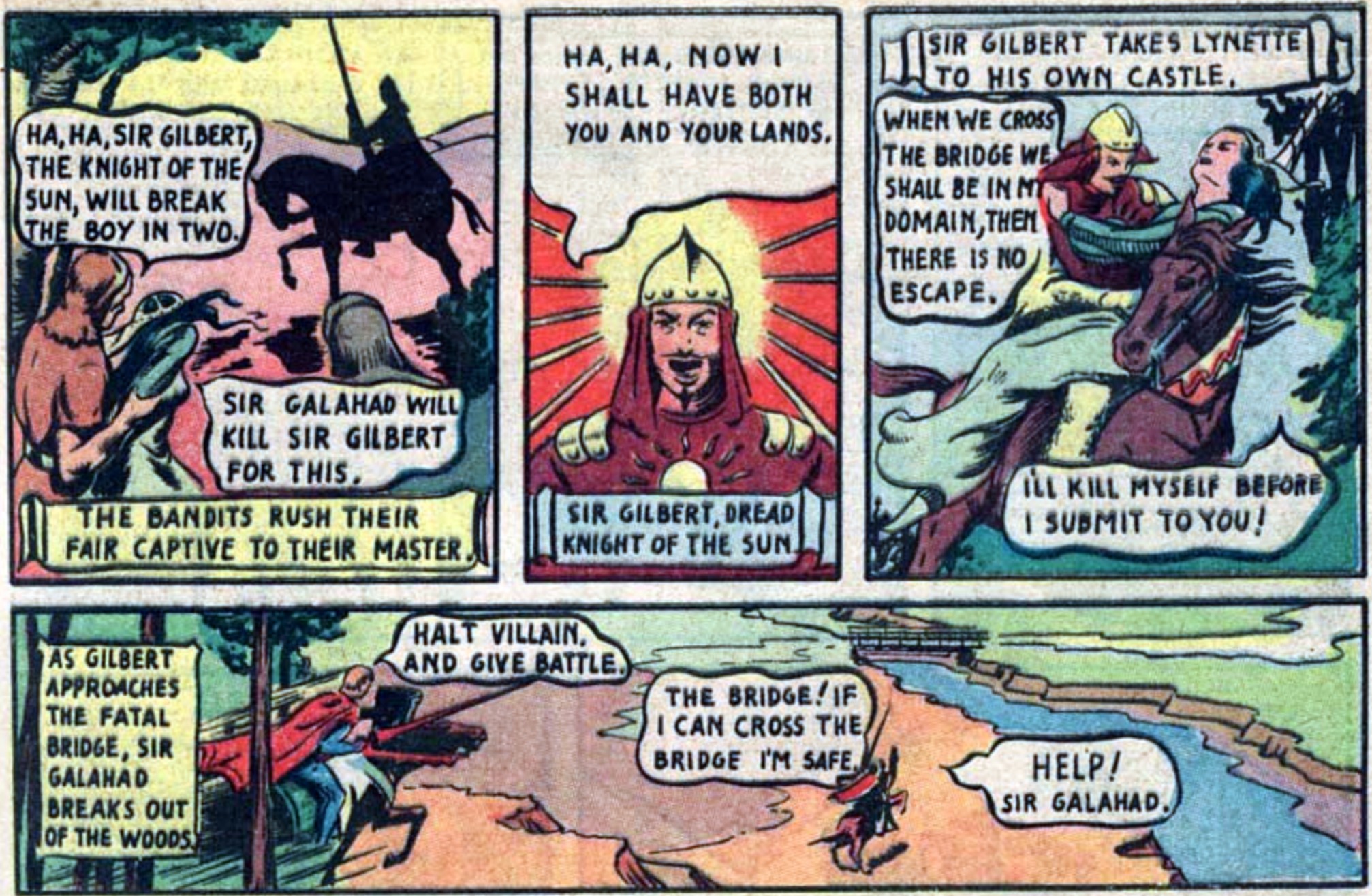
    Sir Gilbert is the evil knight who Galahad sets out to vanquish on his first official Knights of the Round Table mission. He’s got all the requisite qualities of an evil Arthurian knight: a cool name, a rakish attitude toward kidnapping and menacing women, and designs on the lands near his castle. And like most if not all non-Mordred evil knights in comic book Arthuriana, he’s a completely original character, which is always a bit confusing because there are ever so many villains and scumbags to choose from in the source material.

    Canonicity aside, Sir Gilbert is a good first foe for any character. He’s got a good name and a bit if a reputation, and he provides just enough challenge to be a credible threat before being defeated so thoroughly that he can be repurposed into an improvised missile.

  • MINOR SUPER-VILLAIN 831: THE BLACK DEATH

    (Thrilling Comics 010, 1940)

    Perry Knight has a problem: instead of starring as the titular costumed antagonist of stage production “The Black Death” he has been jailed for murder. He can’t remember doing it, but evidently he gunned down his costar Tinker in cold blood during the dress rehearsal.

    Enter Peggy Allen, the Woman in Red, who quickly discovers that there is a second Black Death running around when they have a confrontation in the wings. Is this a foolish move on the part of the second Black Death, who presumably wants Perry Knight to be the sole suspect in the murder? Absolutely it is.

    Peggy manages to get Knight bailed out to continue the role of the Black Death as bait for the real killer, and indeed the false Black Death attempts to murder Tinker’s replacement at the same point in the show as before. The Woman in Red of course manages to prevent this second murder, and after some running around etc the Black Death is unmasked to reveal… Weber, the theatre owner!

    It turns out that Weber is in love with lead actress Linda Lytell and that this murder/framing/attempted murder/kidnapping (he kidnaps Lytell before the second murder attempt) is all part of an effort to get him out of the way so that Weber can woo her. A foolish plan, and not just because Weber does not appear to have shared his feelings with Lytell at any point, but because literally the first thing that happens in the story is Lytell rejecting Knight, something that Weber might have learned if he had engaged in some conventional human conversation and courtship before jumping straight to adopting a costumed persona.

    Also, the critics hate the play.

  • MINOR SUPER-VILLAIN 831: THE BLACK DEATH

    (Thrilling Comics 010, 1940)

    Perry Knight has a problem: instead of starring as the titular costumed antagonist of stage production “The Black Death” he has been jailed for murder. He can’t remember doing it, but evidently he gunned down his costar Tinker in cold blood during the dress rehearsal.

    Enter Peggy Allen, the Woman in Red, who quickly discovers that there is a second Black Death running around when they have a confrontation in the wings. Is this a foolish move on the part of the second Black Death, who presumably wants Perry Knight to be the sole suspect in the murder? Absolutely it is.

    Peggy manages to get Knight bailed out to continue the role of the Black Death as bait for the real killer, and indeed the false Black Death attempts to murder Tinker’s replacement at the same point in the show as before. The Woman in Red of course manages to prevent this second murder, and after some running around etc the Black Death is unmasked to reveal… Weber, the theatre owner!

    It turns out that Weber is in love with lead actress Linda Lytell and that this murder/framing/attempted murder/kidnapping (he kidnaps Lytell before the second murder attempt) is all part of an effort to get him out of the way so that Weber can woo her. A foolish plan, and not just because Weber does not appear to have shared his feelings with Lytell at any point, but because literally the first thing that happens in the story is Lytell rejecting Knight, something that Weber might have learned if he had engaged in some conventional human conversation and courtship before jumping straight to adopting a costumed persona.

    Also, the critics hate the play.