The Curse of Skeleton Munroe

Category: minor super-villain

  • MINOR SUPER-VILLAIN 830: ROBERT W MARSH

    (Thrilling Comics 010, 1940)

    Fifth column activities are wreaking havoc on the US! Why, it’s so bad that the new National Defense Building has been bombed! Doc Strange is called in along with a crack team of industrialists to help solve the problem, and is pointed toward fellow committee member Henry Dallas by yet another member, Robert W Marsh. Could this be so easy a problem to solve?

    Henry Dallas kills himself rather than own up to working with the Nazis against American interests, but Doc Strange is able to trace his business dealings to the defunct Mammoth Automobile factory in the South, where he discovers a fascist tank-manufacturing setup. He also takes an explosive anti-tank shell to the back of the head, which is immaterial to the story, but it is fun to occasionally highlight just how powerful a super-hero is.

    Strange finally comes face to face with the leader of this operation (conveniently called the Leader) after both he and Virginia Thompson are captured by them, and unmasks him within minutes, revealing him to be… Robert W Marsh, who is coincidentally also the only other named character in the comic. I gotta say, I wish that the Leader facade had been maintained for longer, both because I always prefer referring to a guy by a codename rather than by what’s on his birth certificate, but also because that mask is a pretty sweet little number and I wish that Marsh had a reason to keep wearing it.

    Doc and Virginia of course escape from Marsh and prevent his bid to take over the US by bombing Washington DC into dust, but the former Leader is pretty conspicuously not among the casualties of that battle. And well he shouldn’t be, because he is also the antagonist of the next Doc Strange story:

    In Thrilling Comics 011, Marsh takes over the… Central?… American nation of Panamela to use as a staging area for another attempt to take over the US.

    (side note: it is pretty remarkable that Marsh is just a straight-up Nazi in 1940, albeit one with a reversed swastika. I suppose it’s possible that this is a small-n nazi, as a stand-in for fascist) 

    Marsh’s plan revolves around attacking the US using the Panamelan fleet and some new super-explosive artillery shells, but he is foiled when Doc Strange sabotages the explosive at the production stage. Pop! Plink!

    Though his fleet is blasted into oblivion by the US Navy, Marsh lives to fight another day. 

    I’ll be honest, I’m tired of the guy and I almost included his third appearance here to get him out of the way, even though it takes place in 1941. But when I started reading it to do just that I was startled to find out that it’s fun! There isn’t even any naval combat! Thus, I’m going to leave it as a treat for myself in the future.

  • MINOR SUPER-VILLAIN 830: ROBERT W MARSH

    (Thrilling Comics 010, 1940)

    Fifth column activities are wreaking havoc on the US! Why, it’s so bad that the new National Defense Building has been bombed! Doc Strange is called in along with a crack team of industrialists to help solve the problem, and is pointed toward fellow committee member Henry Dallas by yet another member, Robert W Marsh. Could this be so easy a problem to solve?

    Henry Dallas kills himself rather than own up to working with the Nazis against American interests, but Doc Strange is able to trace his business dealings to the defunct Mammoth Automobile factory in the South, where he discovers a fascist tank-manufacturing setup. He also takes an explosive anti-tank shell to the back of the head, which is immaterial to the story, but it is fun to occasionally highlight just how powerful a super-hero is.

    Strange finally comes face to face with the leader of this operation (conveniently called the Leader) after both he and Virginia Thompson are captured by them, and unmasks him within minutes, revealing him to be… Robert W Marsh, who is coincidentally also the only other named character in the comic. I gotta say, I wish that the Leader facade had been maintained for longer, both because I always prefer referring to a guy by a codename rather than by what’s on his birth certificate, but also because that mask is a pretty sweet little number and I wish that Marsh had a reason to keep wearing it.

    Doc and Virginia of course escape from Marsh and prevent his bid to take over the US by bombing Washington DC into dust, but the former Leader is pretty conspicuously not among the casualties of that battle. And well he shouldn’t be, because he is also the antagonist of the next Doc Strange story:

    In Thrilling Comics 011, Marsh takes over the… Central?… American nation of Panamela to use as a staging area for another attempt to take over the US.

    (side note: it is pretty remarkable that Marsh is just a straight-up Nazi in 1940, albeit one with a reversed swastika. I suppose it’s possible that this is a small-n nazi, as a stand-in for fascist) 

    Marsh’s plan revolves around attacking the US using the Panamelan fleet and some new super-explosive artillery shells, but he is foiled when Doc Strange sabotages the explosive at the production stage. Pop! Plink!

    Though his fleet is blasted into oblivion by the US Navy, Marsh lives to fight another day. 

    I’ll be honest, I’m tired of the guy and I almost included his third appearance here to get him out of the way, even though it takes place in 1941. But when I started reading it to do just that I was startled to find out that it’s fun! There isn’t even any naval combat! Thus, I’m going to leave it as a treat for myself in the future.

  • MINOR SUPER-VILLAIN 829: LOBELO

    (Thrilling Comics 008, 1940) 

    Lobelo is a modern day pirate, as you might guess from the splash panel above, and while my strong pro-pirate bias means that he was an easy inclusion in the ranks of the minor super-villain he is also a source of great frustration to me.


    First, though, I will note one thing that I really like about Lobelo and that is his array of costumes. Not only does he wear two distinct pirate outfits during the course of the adventure but he wears a separate classic early-1940s suit-cape-and-mask number while he is robbing the Metroploitan Museum in New York. This is clearly a man who loves an outfit – it’s like he’s padding out an action figure line over here.

    My problem with Lobelo is that he goes into piracy because he is the descendant of the famous 16th Century pirate Redhand. He sets up his headquarters on Redhand’s Crossbones Island and he is hunting for Redhand’s treasure with the help of Redhand’s map, which he stole from the museum. So why the heck doesn’t he call himself Redhand, or Redhand II, or something other than his own last name? The gall of it!

    (I’m also somewhat put out that the comic features a costume party and Doc Strange attends in a tuxedo rather than his super-suit. I suppose that Lobelo is attending in (one of) his super-villain outfit(s) at the very least)

    Lobelo has a pretty good run thanks to some poison he feeds Doc Strange at the party having a long-term weakening effect but ultimately comes up against the simple fact that he is a man armed with a sword versus a man who is completely invulnerable to harm and able to powerbomb a battleship. Lobelo is so outmatched here that maybe Doc Strange doesn’t need to kill him like a bear swatting a salmon, and yet he does. So long, Redhand Lobelo.

  • MINOR SUPER-VILLAIN 828: THE BLACK TERROR

    (Thrilling Comics 006, 1940)

    The Central Art Museum has a problem: a cloaked figure who creeps through the halls at night, murdering the guards and making off with their bodies. To make things worse, the investigation is being led by the boorish Inspector Cavanaugh, the Woman in Red’s new and very annoying comic foil, who I regret to inform you is a permanent addition to her cast.

    But speaking of the Woman in Red, she is also on the case. As Peggy Allen, she works as secretary to the museum director Dr Grier while patrolling the museum at night in her costumed identity… while Cavanaugh gets in the way to the extent that he prevents her from saving the Black Terror’s second victim. 

    It’s not a particular surprise when the Black Terror turns out to be the assistant museum director, Mr Tyler, as the story has only two real suspects, him and Dr Grier. Tyler turns out to have adopted the Black Terror persona in order to cover for some jewel thefts that nobody had actually cottoned on to yet – I can only conclude that he had the (fairly elaborate) costume ready to go and was just looking for an excuse, because this is definitely the kind of crime that isn’t helped by a series of high-profile murders.

  • MINOR SUPER-VILLAIN 827: MORGAN LE FAY

    MINOR SUPER-VILLAIN 827: MORGAN LE FAY

    (Thrilling Comics 005, 1940) 

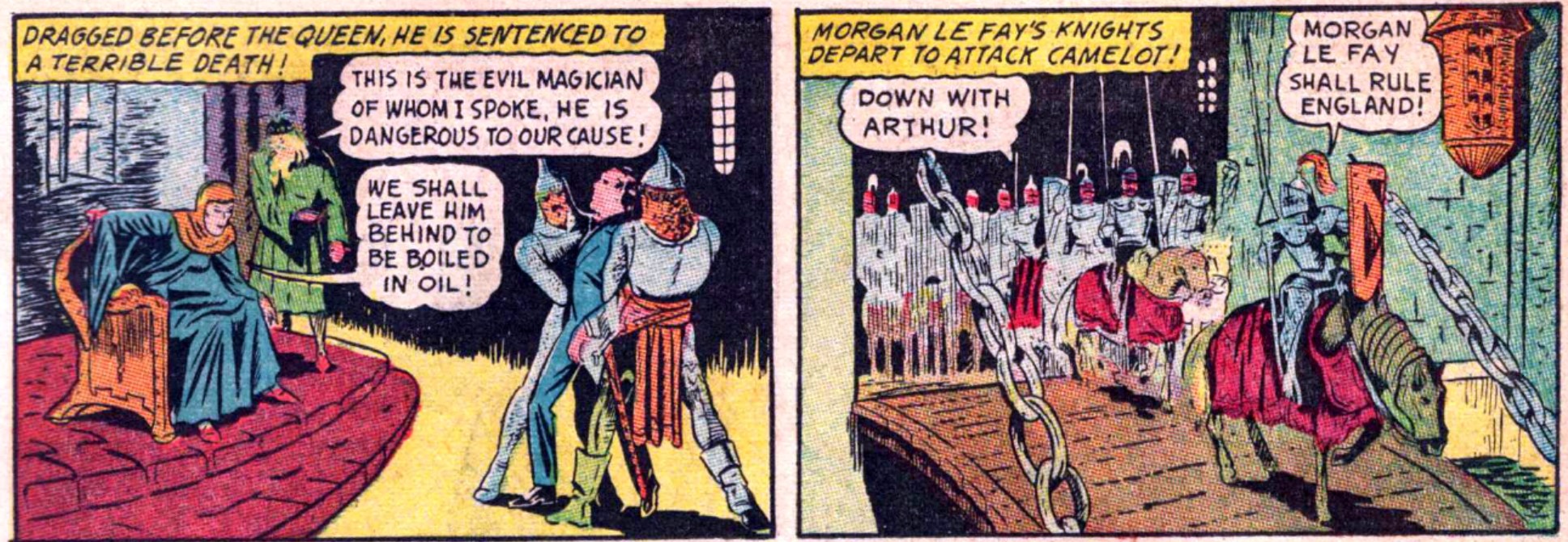
    Sometimes when I’m writing the original drafts of these entries I’m tired or rushed or the like and I go into Extreme Shorthand Mode, and sometimes that version of the writeup is very charming to me when I come back to it a couple of weeks later. Which is all to say that the younger, rushed version of me wrote “merlin stung by brutal own” to describe how the venerable wizard took being exposed as a fraud by the Ghost during one of his time-travel adventures, and I think it captures something. Is it enough to explain Merlin selling out Camelot to Morgan le Fay? Probably not, but it clearly was in the eyes of a 1940s comics book writer.

    Don’t worry, however, because the Ghost is still on hand and is most certainly not a charlatan. He conjures up a big pile of machine guns and grenades for the Knights of the Round Table, and s my past self put it: “modern weapons vs medieval is okay if its vs bad guys.”

  • MINOR SUPER-VILLAIN 826: THE BIG BOSS

    (Thrilling Comics 005, 1940)

    Things are bad in New York City: the city is corrupt seemingly from top to bottom, civic leader Henry Adams has had enough of it, and his zeal is infectious: Doc Strange sets out to clean up the municipal landscape and beats up a wide variety of crooked politicians and businessmen, including:

    – District Attorney Big Bill Roberts

    – Lawyer Ollie Saunders 

    – Contractor Alfred Quinn

    – Brewer Von Strohm

    – a bunch of unnamed gangsters and arsonists 

    Almost all of them (save Roberts and the odd gangster) end up dead, which leaves Doc Savage to find the head honcho, the Bog Boss, and put an end to the source of the corruption.

    The Big Boss makes a valiant attempt to turn Strange’s planned ambush against him, but even a very large knife is never going to be enough for that, and he is swiftly subdued and unmasked as – wouldn’t you know it – civic leader Henry Adams, who’s tough-on-crime act was a mere facade calculated to throw suspicion off of himself. 

  • MINOR SUPER-VILLAIN 825: PROFESSOR FENTON

    (Thrilling Comics 004, 1940) 

    A wave of kidnappings is sweeping the US! Important men are disappearing left and right! Never fear, however, for the Ghost is on the case, and thanks to his magical acumen he is able to trace the latest kidnappee to the mysterious mansion lair of the culprit: the pompadoured scientist known as Professor Fenton! 

    Professor Fenton’s plan turns out to be unusually, even impractically complicated. To whit: 

    1. kidnap all of America’s Important Men

    2. stash the Important Men in various historical periods using a time machine

    3. take over the US (though unstated, the lack of Important Men is probably part of the prep for this step)

    4. bring back the Important Men, who will be forced to serve Fenton in this new regime

    The Ghost is of course opposed to this plan, and proceeds to rescue the first batch of Important Men from the past. But there is a problem! The Ghost does not know where or when the other men are stashed, plus he suspects that Fenton would rather destroy his own time machine than see them rescued. This sets up the ongoing Ghost/Fenton dynamic for the next few issues, as the Ghost arranges various ruses and schemes in order to be sent in time to rescue Fenton’s victims while keeping Fenton himself in the dark.

    Some of Fenton’s temporal kidnap setups include:

    A prehistoric past rich with both dinosaurs and early man. The Ghost recruits a tribe of Piltdown Men to battle Professor Fenton’s Neanderthal followers. (Thrilling Comics 004, 1940)

    A castle in Arthurian England, that the Ghost storms with the help of the Knights of the Round Table, armed with magically-created machine guns. (Thrilling Comics 005, 1940)

    Just an inn in the middle of Commonwealth-era London. The innkeeper is clearly a local, so of course I am very curious about how the Fenton’s recruitment process goes – does he just appear in people’s houses until he finds one willing to hold prisoners for cash, no questions asked?  (Thrilling Comics 006, 1940)

    This issue is also the first time that Fenton tries to get his chosen nom de guerre, “Dictator F” going, but it never quite manages to get traction. He does keep trying!

    Fenton’s temporal hiding places have one important criteria: they act as a fixed point in time and space that he can target with his time beam. This is why this next one being in the ship, a notoriously mobile space, is strange. Sure, Professor Fenton has paid off the owners of the vessel not to go anywhere, but if he had bothered to take a look at the ship’s name he might have noted that it was in fact the Santa Maria, of Christopher Columbus fame, and concluded that he might be better off storing his victims elsewhere. 

    The Ghost and these two Important Men end up making the journey to the New World with Columbus before heading home. Considering the fact that Fenton-style time travel is depicted as if the same amount of time is taking place in the present as the past, this really throws the Ghost timeline out of whack with the real world. (Thrilling Comics 007, 1940)

    Fenton finally starts working toward his conquest of the present by stealing an electrical ray weapon that he stashes in Ancient Rome, c.64 CE, which inadvertently leads to the Great Fire of Rome. (Thrilling Comics 008, 1940)

    Fenton’s final foray into his kidnapping plan (for 1940, at least) involves hotshot bacteriologist Tom Rollins, who is stashed in Colonial America, 1776, while his stockpile of diseases is unleashed on the public in an attempt to blackmail Rollins’ home city of Duquesne. The Ghost not only rescues Rollins but helps Washington cross the Delaware and also meets his long-time love interest Betty Morris, a Revolutionary spy who decides to ditch the humdrum 1770s for the exciting 1940s. (Thrilling Comics 009, 1940)

    From Thrilling Comics 010 on, the Ghost basically just lets Professor Fenton, a multiple-time mass murderer and mass-kidnapper, remain at large so that he can sneak into Fenton’s lab and use his time machine whenever he wants. I’m sure that if someone pointed that out then the Ghost would say something about there still being some Important Men to be saved, but I’m not sure if they’re worth the body count.

  • MINOR SUPER-VILLAIN 824: THE SPIRIT KILLER

    (Thrilling Comics 004, 1940) 

    Things get hairy when businessman Ogden Phillips invites a selection of acquaintances to his country home for a seance, only to immediately be kidnapped by a terrifyingly earless phantasm once the lights go out. Bad news for Phillips (victim) and his guests (suspects) and even Police Inspector Dougherty (keeps getting bonked on the head), but great for me because these early Woman in Red comics are structured like whodunnit mysteries (which I love) but the first couple were a bit shy on suspects and thus fell a bit short of the mark.

    Our suspect list is shortened slightly by the murder of Phillips’ former fiance Gladys Arnold, followed by the kidnapping of guest Myra Loomis. At this point the only party guests left walking around are Messrs. Breen and Caswell.

    The Woman in Red is also present, of course, having been sent in under cover as Peggy Allen. And for a change of pace, this time she’s not a nurse but a maid! 

    The Woman in Red of course ultimately triumphs, despite briefly being captured and held in the secret tunnels that run throughout the estate, and reveals that the Spirit Killer is actually… Ogden Phillips! It turns out that he had fallen in love with Myra Loomis and that they had planned to take the ransom money and run away together. This is a wild plan, but even assuming that it is the only way for them to get the money (house already mortgaged, bank account near empty, etc) the fact that Phillips is so quick to murder and attempt to murder is such an unnecessary escalation – Gladys Arnold is killed because she knows about the romance between Phillips and Loomis and thus might put two and two together, but a simpler solution would have been to not invite her to the kidnapping – really cratered his chances of getting away with it.

  • MINOR SUPER-VILLAIN 824: THE SPIRIT KILLER

    (Thrilling Comics 004, 1940) 

    Things get hairy when businessman Ogden Phillips invites a selection of acquaintances to his country home for a seance, only to immediately be kidnapped by a terrifyingly earless phantasm once the lights go out. Bad news for Phillips (victim) and his guests (suspects) and even Police Inspector Dougherty (keeps getting bonked on the head), but great for me because these early Woman in Red comics are structured like whodunnit mysteries (which I love) but the first couple were a bit shy on suspects and thus fell a bit short of the mark.

    Our suspect list is shortened slightly by the murder of Phillips’ former fiance Gladys Arnold, followed by the kidnapping of guest Myra Loomis. At this point the only party guests left walking around are Messrs. Breen and Caswell.

    The Woman in Red is also present, of course, having been sent in under cover as Peggy Allen. And for a change of pace, this time she’s not a nurse but a maid! 

    The Woman in Red of course ultimately triumphs, despite briefly being captured and held in the secret tunnels that run throughout the estate, and reveals that the Spirit Killer is actually… Ogden Phillips! It turns out that he had fallen in love with Myra Loomis and that they had planned to take the ransom money and run away together. This is a wild plan, but even assuming that it is the only way for them to get the money (house already mortgaged, bank account near empty, etc) the fact that Phillips is so quick to murder and attempt to murder is such an unnecessary escalation – Gladys Arnold is killed because she knows about the romance between Phillips and Loomis and thus might put two and two together, but a simpler solution would have been to not invite her to the kidnapping – really cratered his chances of getting away with it.

  • MINOR SUPER-VILLAIN 823: ELECTRU

    MINOR SUPER-VILLAIN 823: ELECTRU

    (Thrilling Comics 004, 1940) 

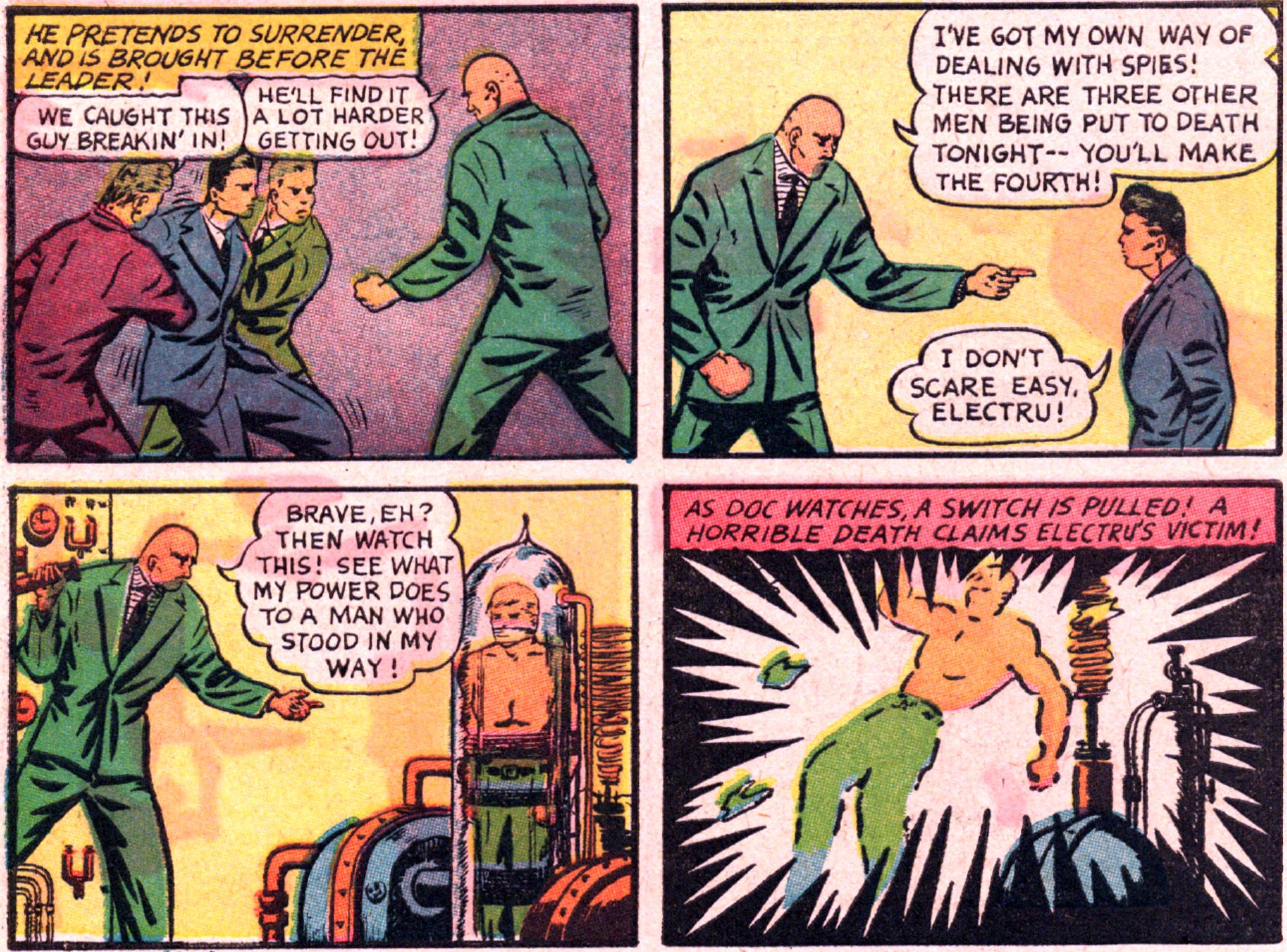
    Electru, aka the Giant Electru, is a giant guy with electrical powers. He also has a large gang armed with various electric ray guns and so forth. There’s not a lot to explore about him if I’m honest, but he does inspire a few questions:

    1. Just where did Electru come from? We never get an idea of how Electru acquired his great size, his incredible strength or his control over electricity. Are they as a result of his mastery of such things as electric ray guns and broadcast power or the inspiration for his research into them? Did Electru develop his gang’s technology at all or is there some poor uncredited criminal scientist somehwere? No answers are forthcoming. Also please note that Electru is robbing the NYC Subtreasury in the top set of panels.

    2. Just what was Electru up to? While the bulk of Electru’s efforts were directed at bank robbery, there is the possibility that he had some greater aim in mind, as his first act is to attack the Panama Canal and he eventually steals an entire cruiser from the US Navy. Is all this in aid of more plundering or was Electru setting his sights on conquest? No answers are forthcoming. (please also note the one glimpse we get of Electru’s cool electricity-themed island covered in power lines. This is some top-notch environmental theming)

    3. Why the heck does Doc Strange take so long to beat this guy up? I know that the real reason for this is “because of story pacing” but this is an especially egregious case of the hero just letting the villain go on with his day until the time seems right to sock him in the nose. I count four separate times that Doc Strange was within punching distance of Electru without taking his shot, only one of which is justified by a threat to Virginia Thompson’s life. Get your head in the game, Doc!

    Doc Strange does eventually get his dander up/ the story does eventually reach its required pagecount, and Electru ends up being ironically electrocuted when Doc punches him into his own equipment. Live by the electricity; die by the electricity, I guess.