The Curse of Skeleton Munroe

Category: minor super-villain

  • MINOR SUPER-VILLAIN 788: THE CRIMSON CIRCLE

    (Sure-Fire Comics 003b, 1940)

    The Crimson Circle are a masked gang with a more grandiose than normal name (and led by the Crimson Mask, as can just barely be made out under that rip in the third panel above, a rare instance of the named villain being less prominent than his named henchmen in a story), who have the fortune to rob the same loan company as the Raven, leading to them capturing, unmasking and forcing him to work for them under the threat of revealing that he is in reality Police Detective Sergeant Danny Dartin, the man in charge of catching the Raven.

    Did I say “fortune” above? That should in fact have read “to their misfortune,” since as characters in a continuity-light comic, being something as threatening to the status quo as a villain who knows the hero’s secret identity is tantamount to a death sentence, and indeed the entire Crimson Circle is gunned down by the Raven and the police as they try to shoot their way out of a bank robbery.

    Not that I would imply that Golden Age comics never have long-term plot developments. Case in point: this is the issue in which Danny Dartin’s fiance Lola Lash learns of his double life and goes from an enemy to an ally of the Raven. True love overcomes a mindless hatred of crime and so forth.

  • MINOR SUPER-VILLAIN 787: THE TERROR TRUST

    (Sure-Fire Comics 002, 1940)

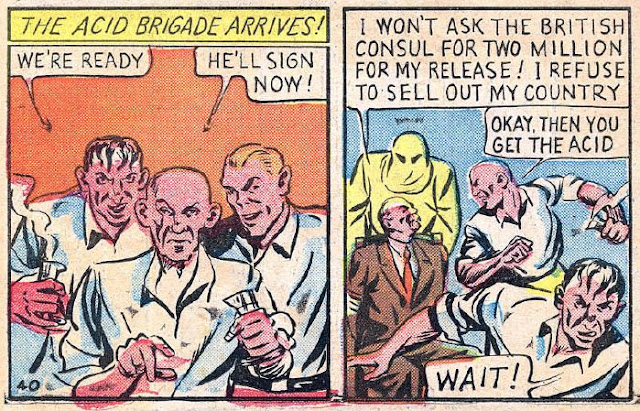
    The Terror Trust is a group with a very simple money-making scheme: demand money from millionaires and then throw acid in the faces of the one who refuse to pay up. X, the Phantom Fed infiltrates this group by breaking captured member Horton out of prison and then impersonating him.

     
    X’s scheme falls apart when the Trust’s members realize that Horton was simply not clever enough to effect his own escape, leading him to capture one of the ringleaders, prominent psychologist Professor Parks, and extract the names of the remaining two from him using some legally suspect truth serum.

    Does X then complete the roundup of the Terror Trust in disguise as Parks? Nothing so simple for the Phantom Fed. First off, he disguises himself as the local Police Commissioner, then enlists the aid of the Trust’s next victim, Sir Anthony, and then poses as Parks. Or rather as the Commissioner posing as Parks. Does he do this as a way to gain Sir Anthony’s trust, perhaps? A good guess, but no, he immediately tells Sir Anthony that he is actually X in disguise. It might be in an effort to make the local police look good but honestly I reckon that it’s merely for the challenge of the thing, that by his second appearance X is getting a bit tired of the regular master of disguise schtick and looking to up the difficulty a bit. Real adrenaline junkie stuff.

    As is customary we must take a moment to recognize the little people who make the true super-villainy happen, and this time our focus is on this bunch of absolute creeps, the Acid Brigade. Just something to keep in mind when you create a business that revolves around the act of throwing acid in people’s faces: you’re going to have to work with people willing to do that. It’s an HR nightmare, I can only assume.

  • MINOR SUPER-VILLAIN 786: THE TIGER MAN

    (Sure-Fire Comics 002, 1940)

    The Tiger Man (also referred to as the much snappier Tiger Mask in one panel but I reckon that was just some sort of lettering error or other style of brain glitch) is a fellow in an extremely cool cowl mask who is trying to corner the pearl market in the South Seas using some very crooked tactics, such as sticking pearl bed owner Rita van Dyke on a raft and abandoning her at sea. Only the intervention of Flash Lightning saves her, and he only knows to do so because the Old Man of the Pyramids tells him to.

    This is in many ways a fun little adventure, marred frequently by the threat being stated as “those dastardly South Seas natives trying to steal the pearl trade from the virtuous white people” (barely a paraphrase).

    Eventually, the Tiger Man is unmasked and it turns out that he didn’t kill Rita’s uncle as she had thought but rather that he was her uncle and that in addition to the harrowing near-death experience she just had she is going to have to really reevaluate a lifetime of memories and maybe have some serious talks with any other parents/cousins/etc who might be kicking around. Talk about an awkward next Thanksgiving dinner, am I right?

  • MINOR SUPER-VILLAIN 785: THE PHOENIX

    (Sure-Fire Comics 001, 1940)

    Flash Lightning’s first stop after getting juiced up with brand-new electric powers is New York City, super-hero capital of the world, and it’s a good career move for him because he immediately gets mixed up in some super shenanigans. An explorer named Parker has gone missing in Central America and the agents of someone named the Phoenix are doing their damnedest to prevent his daughter Mary from looking for him. Lightning and Mary dodge fiery deathtraps, tommy gun-wielding gangsters and threatening coffin deliveries and set out regardless.

    Mary and Lightning travel to what is now the Parque Nacional Sierra De Las Minas in Guatemala (there are coordinates!) and dodge some fellows known variously as the Tzutuhiles, the Jewel Men and the Python Men, a bunch of snake worshippers who help the Phoenix advance his plans for world domination by using slave labour to create artificial gemstones that are then shipped around the world to be sold (and this is not the first nor the last time we will see the creation of artificial jewels, a victimless if not virtuous activity, treated as equivalent to counterfeiting currency).

    It is at this point that the Phoenix makes an actual appearance in the story, and just what does a guy named after a mythical firebird who makes and distributes gemstones with the aid of both hard-boiled gangsters and snake worshipping tribesmen look like?

    You guessed exactly right: he looks like a character from a 1930s sci-fi movie serial. Unfortunately for the Phoenix he is completely unprepared for a superhuman opponent and he appears in a whopping four panels before being sent to his doom at the bottom of his own volcanic crater by Flash Lightning.

    Special shout-out to this fellow, John Roan, aka the Reptile Man, who accompanied Parker Sr on his expedition and managed to escape and return to New York for help only be killed by the Phoenix’s men. Just what is his deal? Was he a reptile man when the expedition started or is this something that happened to him at the hands of the Python Men? I’m asking but nobody is telling me anything.

  • MINOR SUPER-VILLAIN 784: THE GREEN MASK

    (Sure-Fire Comics 001, 1940)

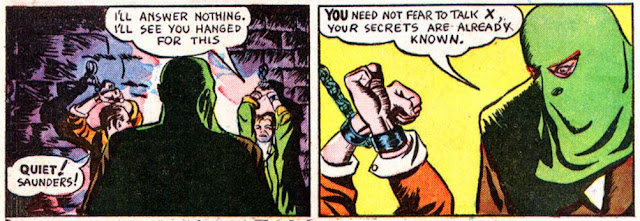
    The Green Mask is after one thing: world domination, and he’s looking to achieve it by capturing the Shock Ray, a weapon capable of paralyzing hundreds of people at a time, and which has been deemed too terrible to use by the US government (just why this is it unclear – my only idea is that it is either a fatal paralysis or a permanent one).

    The thing about the Green Mask that is very compelling is his hood – I’m always harping on about those characters who make the choice to have a nose cutout in their evil villain hood, and how that choice is a perfect one if you want comfort and also don’t mind looking bad, and while the Green Mask has chosen to have ear cutouts – very similar – he has also gone with nostril holes instead of the full nose, and I have to say that that strikes me as both bad-looking and immensely impractical/uncomfortable. His minions all look terrific in their Halloween demon masks, though.

    Another thing I’m always yapping on about is the long stretches of pointless action in the middles of Golden Age stories, and in no story is that more evident than this one. The Green Mask gets ahold of the Shock Ray plans on the first panel of the second page, and the much of the rest of the fifteen-page story involves his attempts to kill or capture various people tangentially involved in the theft for no stated reason, while X gathers more and more evidence toward his eventual capture.

    And speaking of that capture, once it happens the Green Mask is revealed to be… Sam Barkley! And let me tell you that when I first read this story I was a little tired and so I figured that the fact that I had no idea who Sam Barkley was meant that I hadn’t been paying enough attention, but no, Sam Barley is a “famous sportsman” who made a one-panel, non-speaking appearance, six pages earlier and that was it. It’s the most out-of nowhere reveal in comics history.

    Anyway, much beloved ancillary character Sam Barkley turned to a life of crime because he was mixed-race, and his American father abandoned his probably-Malaysian mother (based mostly on the fact that his henchmen are all or mostly Malaysian), leading him to hate all Americans and ultimately embark on a life of costumed crime. If his motivations were more nuanced than that then they will sadly go unexplored, as once captured he immediately chugs some prussic acid rather than be taken alive.

  • MINOR SUPER-VILLAIN 783: PHATSO

    (Superworld Comics 003, 1940)

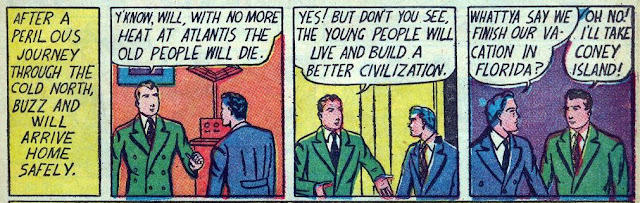
    Buzz “the Invisible Avenger” Allen and Will “also invisible but has no special name” Lawrence are taking an Alaskan vacation with some of the reward money they have earned via vigilantism (and it’s nice to see a variation on super-hero morality now and then – someone has to be accepting awards when offered, surely) when they, hard-core radio amateurs that they are, pick up a panicked broadcast from nearby. Making their way to the location, they find the man who sent the distress call dead and surrounded by weird ribbons of light.

    Finding that the light ribbons are solid, Buzz and Will make the amazing and completely understandable decision to grab onto them as they fly off, and end up being whisked even further North to a hidden city in the ancient Greek style.

    The lads attempt to bluff the city’s ruler, Phatso, with a bit of the old “cower before us for we are wizards” gag, but it turns out that this isn’t a primitive hidden city but a technologically advanced one, and a little bit of invisibility tech isn’t going to get so much as a shiver out of them. They also learn that Phatso is using the light ribbons to kill people and siphon the information from their minds in preparation for a full-scale Atlantean (did I mention that the city represents the remnants of sunken Atlantis?) invasion of the United States. The boys are unceremoniously paralysis-rayed and tossed in the clink.

    I really like Phatso’s villain patter, by the by. “I am Phatso, great, clever ruler of Atlantis. I can speak in any tongue and I am 212 years old!” is a terrific introduction. I just with his name wasn’t an as-far-as-I-can-tell purposeless pun, because it is annoying.

    Buzz and Will escape of course, and immediately blow up the machines that make Arctic Atlantis habitable by humans, with the wild justification that only the old people will die off and thus Atlantean civilization will be improved. Is this the morality of a hero who takes the reward cheques? Is this what I was asking for!!??

    (this is also part of a bit of a recurring theme in stories from Superworld Comics of “inflicting mass casualties” as a standard part of the heroic arsenal – the other examples are all from human vs alien stories that fall a bit outside of my self-imposed purview and so won’t be showing up here, but I assure you that it is there and it leaves a bit of a bad taste in your mouth once you recognize it)

  • MINOR SUPER-VILLAIN 782: ERIC MACFADDEN

    (Superworld Comics 001, 1940*)

    Eric MacFadden is a criminal scientist who has some sort of longstanding beef with Hip Knox, the Super Hypnotist, that was presumably covered in Superworld Comics 001, a comics I have yet to encounter for the simple reason that it would cost me at least $ 2000 US.

    MacFadden’s signature technology is the extremely stylish mesh anti-hypnosis mask that he wears to protect him from Hip Knox’s super-hypnotism, and he even has extras made to shield his men from the same (not a guarantee from your typical self-obsessed super-villain), making them the Mask Gang.

    As Superworld Comics represents Hugo Gernsback’s sole foray into comic book publishing, people more familiar with the politics and personalities of the sci-fi pulps than I am have speculated that Eric MacFadden is in some way based on Bernarr Macfadden, an enemy of Gernsback’s, and I gotta say that he’s a plausible guy to base a super-villain on. Like, obviously a man’s whole life cannot be summed up by his Wikipedia article, but an anti-medicine physical culture weirdo who gave himself the name “Bernarr” because he thought it sounded like a lion’s roar is at the very least super-villain adjacent.

    If MacFadden is indeed based on Macfadden (he also changed his last name from “McFadden” to “Macfadden” because he thought that it was “a more masculine spelling!) due to a deep Gernsback/Macfadden beef then it would go a long way toward explaining the dynamic between the two, wherein MacFadden attempts to destroy Hip Knox and then Knox turns around and ritually humiliates MacFadden rather than seeking more traditional forms of justice, and for that reason Eric MacFadden joins the ranks of super-villains who are still at large as of their final appearance.

    I would also like to make a special note of the fact that despite Hip Knox developing anti-mask technology in Superworld Comics 002, MacFadden does not then abandon the masks entirely, as is so frequently the case with science villains when their tech is countered. MacFadden is savvy – he knows that Knox isn’t going to wear that big-ass backpack every time he leaves the house.

    *Still haven’t read Superworld Comics 001 but I am assured that he was in it.

  • MINOR SUPER-VILLAIN 781: DR ANDERSON

    (Super Spy 001, 1940)

    A series of bank robberies rock the community of Unnamed Comics Book City, USA. Witnesses place local physician Doc Anderson at the scene of each crime, but when detectives look into it they find that he has a terrible alibi for each one: he was home alone. It sounds like an open and shut case, but another robbery occurs while the police are at his house. Just what is happening? Could the fact that the title of this comic is “the Twin Terror Case” play into it?

    The cops give up on Dr Anderson as a suspect following the alibi thing, even though they subsequently capture a zombie-like double of him at the scene of one of the crimes. The alibi is just that good. Fortunately for the forces of law and order, while Anderson might have figured out the ultimate crime hack he did not reckon with boorish local jock Gary Ross and his dislike of being snubbed by a casual acquaintance. Ross follows Anderson to an old abandoned house, where he witnesses the creation and destruction of an Anderson duplicate (this seems to be the necessary process to destroy the Anderson in police custody too, if you’re wondering).

    Ross beats up Anderson until he spills the beans: while attempting to earn more money by inventing something cool, he figured out how to create a mentally-controlled duplicate of himself and immediately hit upon the idea of using it to rob banks. As is the custom, I now present my problems with this scheme:

    1. Obligatory screed about how this is a very poor use of this technology. Depending on just how organic and subject to human frailties these duplicates are they could represent either a significant or world-changing advance in human labour. Heck, even if they are 1:1 duplicates of the human body, a human body that can go into a dangerous situation with minimal concern for its safety would revolutionize mining, manufacturing, space travel if range was no impediment… so many industries.

    2. Anderson keeps the machine in an old abandoned house for some reason instead of his own basement. I know that for plot reasons it’s so that Gary Ross can follow him to a second location, but it’s still a very strange thing to do.

    3. The duplicates are so perfectly useful as alibi-generators that Anderson gets too invested in generating alibis rather than getting away with his crimes. If he’d only put a disguise on the duplicate and then made sure to establish an actual alibi rather than sitting at home while a double of him maches into a bank holding a sign that says “DOCTOR ANDERSON?” then he might just have gotten away with it.

    Unfortunately for humanity as a whole and people in high-risk jobs in particular, Gary Ross is a philistine and a thug and smashes up the duplication machine because it is “trouble-making.” Also I’m no fancy big city lawyer, but I think that this might mean that Anderson is going to walk free once the prosecution is asked to prove this wild duplication theory that they are advancing.

  • MINOR SUPER-VILLAIN 781: DR ANDERSON

    (Super Spy 001, 1940)

    A series of bank robberies rock the community of Unnamed Comics Book City, USA. Witnesses place local physician Doc Anderson at the scene of each crime, but when detectives look into it they find that he has a terrible alibi for each one: he was home alone. It sounds like an open and shut case, but another robbery occurs while the police are at his house. Just what is happening? Could the fact that the title of this comic is “the Twin Terror Case” play into it?

    The cops give up on Dr Anderson as a suspect following the alibi thing, even though they subsequently capture a zombie-like double of him at the scene of one of the crimes. The alibi is just that good. Fortunately for the forces of law and order, while Anderson might have figured out the ultimate crime hack he did not reckon with boorish local jock Gary Ross and his dislike of being snubbed by a casual acquaintance. Ross follows Anderson to an old abandoned house, where he witnesses the creation and destruction of an Anderson duplicate (this seems to be the necessary process to destroy the Anderson in police custody too, if you’re wondering).

    Ross beats up Anderson until he spills the beans: while attempting to earn more money by inventing something cool, he figured out how to create a mentally-controlled duplicate of himself and immediately hit upon the idea of using it to rob banks. As is the custom, I now present my problems with this scheme:

    1. Obligatory screed about how this is a very poor use of this technology. Depending on just how organic and subject to human frailties these duplicates are they could represent either a significant or world-changing advance in human labour. Heck, even if they are 1:1 duplicates of the human body, a human body that can go into a dangerous situation with minimal concern for its safety would revolutionize mining, manufacturing, space travel if range was no impediment… so many industries.

    2. Anderson keeps the machine in an old abandoned house for some reason instead of his own basement. I know that for plot reasons it’s so that Gary Ross can follow him to a second location, but it’s still a very strange thing to do.

    3. The duplicates are so perfectly useful as alibi-generators that Anderson gets too invested in generating alibis rather than getting away with his crimes. If he’d only put a disguise on the duplicate and then made sure to establish an actual alibi rather than sitting at home while a double of him maches into a bank holding a sign that says “DOCTOR ANDERSON?” then he might just have gotten away with it.

    Unfortunately for humanity as a whole and people in high-risk jobs in particular, Gary Ross is a philistine and a thug and smashes up the duplication machine because it is “trouble-making.” Also I’m no fancy big city lawyer, but I think that this might mean that Anderson is going to walk free once the prosecution is asked to prove this wild duplication theory that they are advancing.

  • MINOR SUPER-VILLAIN 780: THE MUMMY

    (Funny Picture Stories v3 002, 1939)

    Like every other of my long-term projects, writing this blog has been an exercise in taking a simple premise (writing fairly succinctly about minor DC Comics super-villains) and expanding the scope until the seams start to creak (writing somewhat extensively about all super-villains and super-heroes and a bunch of other comics things and also maintaining a set of variably-useful indices about them all). This is all to lead into the fact that a comic I was just reading (Super Spy 001, 1940) contained a reprint of a story from a comic I read back when I started doing this and I was absolutely flummoxed that I had not written about the Mummy.

    We open in the palatial home of amateur Egyptologist Professor Stone, just in time to see him get murdered by someone with a creepy hand.

    Cops are soon swarming over the Professor’s residence, but that doesn’t stop the culprit from creeping back in to eliminate a potential witness in the victim’s niece and incidentally give us our first look at his mummy outfit. Not the most convincing getup with that huge exposed swath of visible and well-moisturized head, but I appreciate the green.

    This particular fake mummy also has mind control abilities thanks to the copy of the Egyptian Book of the Dead that he stole after murdering Professor Stone. These allow him to abduct Miss Stone and Police Detective Bull with ease.

    The super powers weren’t even the motivation for the murder of Professor Stone, it turns out. No, Stone was killed when he figured out that his fellow Egyptologist Dr Carver had been using Stone’s regular shipments of mummies from England as a way of smuggling drugs into the US, possibly because Carver’s plan doesn’t seem to include replacing the fake mummy after he steals and hollows it out each time.

    Also, Carver has built an entire acid pit in Stone’s basement, which is impressive but must have provided plenty of opportunities for Stone to cotton on to the fact that something was going on.

    Ultimately it all comes down to that old adage: no matter how well-prepared and capable of performing Ancient Egyptian mind control you are, you’re never ready to be shot in the back by a cop and dumped into your own acid pit.