The Curse of Skeleton Munroe

Category: minor super-villain

  • MINOR SUPER-VILLAIN 780: THE MUMMY

    MINOR SUPER-VILLAIN 780: THE MUMMY

    (Funny Picture Stories v3 002, 1939)

    Like every other of my long-term projects, writing this blog has been an exercise in taking a simple premise (writing fairly succinctly about minor DC Comics super-villains) and expanding the scope until the seams start to creak (writing somewhat extensively about all super-villains and super-heroes and a bunch of other comics things and also maintaining a set of variably-useful indices about them all). This is all to lead into the fact that a comic I was just reading (Super Spy 001, 1940) contained a reprint of a story from a comic I read back when I started doing this and I was absolutely flummoxed that I had not written about the Mummy.

    We open in the palatial home of amateur Egyptologist Professor Stone, just in time to see him get murdered by someone with a creepy hand.

    Cops are soon swarming over the Professor’s residence, but that doesn’t stop the culprit from creeping back in to eliminate a potential witness in the victim’s niece and incidentally give us our first look at his mummy outfit. Not the most convincing getup with that huge exposed swath of visible and well-moisturized head, but I appreciate the green.

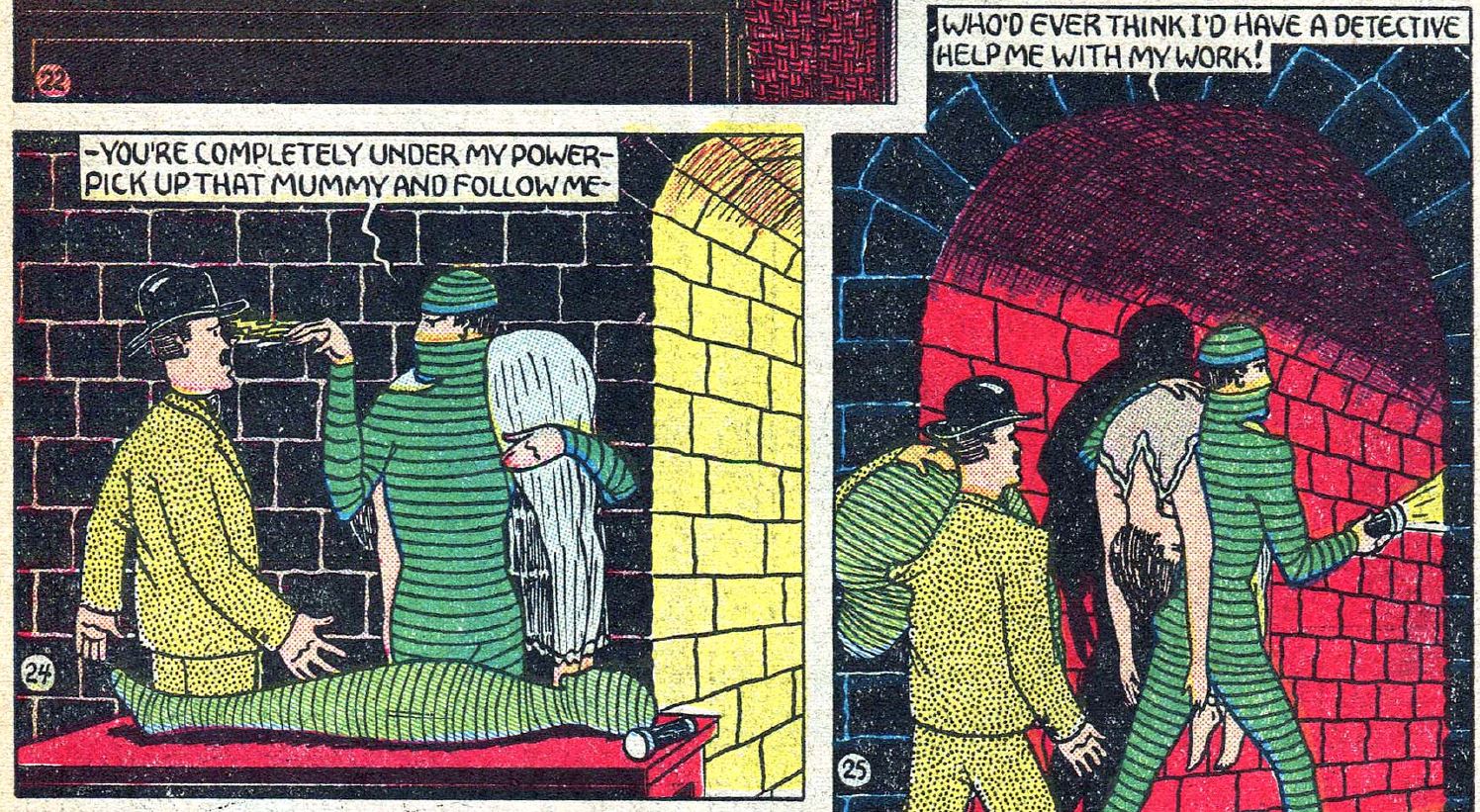
    This particular fake mummy also has mind control abilities thanks to the copy of the Egyptian Book of the Dead that he stole after murdering Professor Stone. These allow him to abduct Miss Stone and Police Detective Bull with ease.

    The super powers weren’t even the motivation for the murder of Professor Stone, it turns out. No, Stone was killed when he figured out that his fellow Egyptologist Dr Carver had been using Stone’s regular shipments of mummies from England as a way of smuggling drugs into the US, possibly because Carver’s plan doesn’t seem to include replacing the fake mummy after he steals and hollows it out each time.

    Also, Carver has built an entire acid pit in Stone’s basement, which is impressive but must have provided plenty of opportunities for Stone to cotton on to the fact that something was going on.

    Ultimately it all comes down to that old adage: no matter how well-prepared and capable of performing Ancient Egyptian mind control you are, you’re never ready to be shot in the back by a cop and dumped into your own acid pit.

  • MINOR SUPER-VILLAIN 779: THE CLOWN

    (Super-Mystery Comics v1 005, 1940)

    The Clown! One of the more prolific non-Marvel or DC/Fawcett/Quality super-villains of the Golden Age, and I’m kind of glad that he only made one appearance in 1940 because like his fellow crime clown the Joker, the Clown gets up to a wide variety of different schemes and plots and it’s nice to have the breathing room to just introduce his concept without having to detail a bunch of extra antics as well (and speaking of the Joker, I’ve never been sure if the various early-40s clown villains were all inspired by him or if there was something else in the zeitgeist that was responsible for there being so many of them running around).

    The Clown’s debut is as spectacular as it is inexplicable: Magno’s sidekick Davey is at the library checking out a book on chemistry and it just so happens that the Clown is there to get the same book. Faced with the fact that Davey got it first, how does he respond? By murdering the librarian, attempting to murder Davey and trashing the place. This is how one exemplifies the super-villain lifestyle, friends.

    And when Davey runs off and gets Magno, what do they return to find? Why, that the Clown has either burned down what appears to be the New York Public Library or merely set fire to enough of its stock  to make a roaring blaze out front, it’s hard to tell. Either way, it’s a heck of a debut and a real blow to the library sciences.

    Now, if you  know anything at all about the Clown it’s likely the fact that he is a Nazi, as is reported in Jeff Rovin’s Encyclopedia of Supervillains, but after scrubbing through a bunch of his appearances I don’t know if that’s entirely accurate. He certainly works for the Nazis once or twice but I also found a few instances of him in conflict with them – we shall have to see. What he certainly is, however, is vocally and aggressively anti-patriotic, to the point that he almost manages to burn an American flag before Magno and Davey butt in.

    This initial appearance also serve to show off the Clown’s scientific acumen: he performs super-leaps thanks to his “degravitating solvent,” deploys knockout gas to escape the two in their initial encounter, and even manages to whip up an “anti-magnetic compound” to prevent Magno and Davey from disarming him after experience that humiliation in their first encounter.

    Some more details from this lore-packed episode: the Clown has a secret lair in a mausoleum in a nearby cemetery, staffed by a suspiciously compliant lab assistant named Lydia. The Clown, having captured Magno and Davey, has plans to vivisect them and learn the secret of their powers.

    Though the Clown and Lydia have coated the entire lair in anti-magnetic compound they neglected to consider the pipes in the walls, and the whole place is soon awash (this is how Sub-Zero captured Professor X in their first encounter, too. Villains: look into PVC piping). The compound is washed away in the flood, allowing Magno and Davey to recommence the beating.

    The Clown is unsurprisingly not up-to-date on the latest lab safety guidelines and so the fight is only a couple of punches in before some shoddily-stored chemicals end up causing a huge explosion. Magno and Davey are fine, of course, as is Lydia, who – surprise, surprise – turns out to have been mind controlled into being the Clown’s lab assistant. And of course the Clown is fine. You simply don’t kill off a character like that after one appearance, after all. For our purposes, though, it’ll be some months until he returns.
  • MINOR SUPER-VILLAIN 778: THE SKYWAYMEN

    (Super-Mystery Comics v1 004, 1940)

    Over the course of the last few years I’ve really beefed up the amount of images and words I use to describe the minor super-villains I so love, but sometimes you gotta hearken back to the old ways:

    When aviator Sky Smith heads to Alaska to help out his friend Tom Harris with a mysterious problem, he finds that a band of air pirates called the Skywaymen (fantastic name) led by a man named Rolf Calgar (better-than-average name) are trying to drive him off of his land so that they can use it as an air base. Smith proceeds to blow most of the Skywaymen to smithereens using their own deathtrap and delivers Calgar to the authorities before flying off to seek further adventure.

  • MINOR SUPER-VILLAIN 777: EMBER, THE EMPRESS OF FIRE

    (Super-Mystery Comics v1 003, 1940)

    This is a bit of a weird one. Vulcan, the Volcanic Man, has just saved both a field of gasoline tanks and a government arson inspector named Grace Horner from being incinerated by “notorious arsonist-spy” Torchy Fargo, who then retires to a nearby castle* to report his failure to Ember, the Empress of Fire. Just what is the deal with these two, you ask? We shall explore that momentarily.

    *Vulcan is plausibly based out of New York City, so this is another location in the Castle District of the Northeastern United States.

    Ember decides to deal with both Vulcan and Horner by the simple expedient of inviting them to her castle. It’s a simple trick, but an effective one.

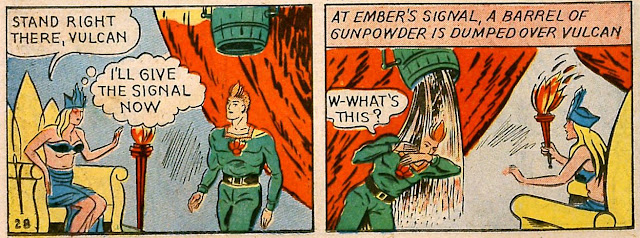
    Ember first tries to kill Vulcan by dumping a bunch of gunpowder on him and then setting him on fire and then, once he proves to be as fireproof as his name might imply, she decides to recruit him to the cause. Why together they could dump gunpowder on entire nations and set them alight!

    Sadly for Ember, Vulcan does not want to become her Emperor of Fire and so declines her offer. Stung, she dumps him and Grace into a standard-issue super-villain’s death pit to rot or possibly be subjected to further deathtraps. And this is where things take a turn – everything up until now has been within the normal bounds of what on might expect in a super-hero comic: a spy who specializes in arson reports to some sort of fire-themed… cult leader? living in a castle staffed by ersatz Pacific Islanders. Regular stuff, like I said.

    But then, Torchy Fargo tosses Ember down into the hole as well, because he is the real head of the (fake?) fire cult and he heard her say that she would replace him with Vulcan. Ember was just a figurehead who let the power go to her head, as she says.

    But… what the hell was this arrangement? Ember isn’t going on television to claim responsibility for Torchy’s crimes or acting as a go-between with people looking to contract his services. Heck, the government already knew about Torchy because that’s why Grace Horner was on his tail! So just why was Torchy going back to a castle filled with (fake?) fire cultists and reporting to a fake superior in a bikini top every night?

    I’m going to deploy this carefully, because there are certain comic book theories and observations that are usually only trotted out by the intellectually tedious, but I think that this might have been a sex thing. We don’t need to explore it further, it’s just the conclusion that most fits the evidence at hand.

    But speaking of sex things, as in gender, a thing happens at the end of this comic that I have noticed a fair few times in the first three issues of Super-Mystery Comics, as having brought Torchy Fargo to justice via a massive gas explosion, Vulcan just lets Ember go so that she can “devote the rest of [her] life to serving humanity.” Did Ace Magazines hold the official position that women can not truly be evil? The evidence is mounting that they might have!

  • MINOR SUPER-VILLAIN 776: THE BLUE SPARK

    (Super-Mystery Comics v1 002, 1940)

    In terms of crime, the Blue Spark is ambitious but not extraordinary: a little corporate extortion, some bank robbery, a few kidnappings. Nothing we haven’t seen a few hundred times by now.  When it comes to the trappings of super-villainy, however, the Blue Spark is on the cutting edge.

    Just look at that costume – it’s not quite the standardized super-villain getup we will eventually see on so many one-shot Batman villains but it’s pretty damn close, and particularly in an era in which most villains are still pairing a mask with a suit and tie or a robe. Even more impressive and ahead of its time is the Blue Spark’s choice to dress his henchmen in a simplified version of his own uniform. Just really impressive stuff.

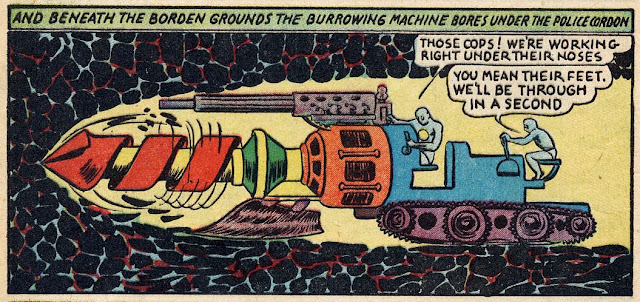
    The Blue Spark’s main gimmick, a heat ray cannon mounted on a truck, isn’t quite as remarkable but it is a pretty sweet bit of gear. Plus he has another one mounted on a cool-ass drilling machine!

    (it is somewhat unclear if the Blue Spark has a second ray that allows him to mind control people or if his heat ray doubles as a mind control ray, and determining this is not helped by the fact that he clearly has an aesthetic fondness for that particular style of scientific greebling on the outside of the rays. It’s a good clean visual on the mind control ray, I will say that)

    The Blue Spark’s henchmen (called the Blue Rubber Men at one point, btw) are not just well-dressed:  their costumes have  little nozzles in the chest that lets them be inflated like a balloon to render them immune to fisticuffs  – another idea that sounds like something out of a Silver Age comic, twenty years early.

    Technology or no, inflation fetish suits or no, the Blue Spark vs Magno is your classic case of a villain who is so little of an even match for the hero that the plotter’s concern must lie in keeping them apart for as long as possible because the instant they meet up, something like the above happens. Magno didn’t even give him a chance to blow up his suit, the poor guy.

  • MINOR SUPER-VILLAIN 776: THE BLUE SPARK

    (Super-Mystery Comics v1 002, 1940)

    In terms of crime, the Blue Spark is ambitious but not extraordinary: a little corporate extortion, some bank robbery, a few kidnappings. Nothing we haven’t seen a few hundred times by now.  When it comes to the trappings of super-villainy, however, the Blue Spark is on the cutting edge.

    Just look at that costume – it’s not quite the standardized super-villain getup we will eventually see on so many one-shot Batman villains but it’s pretty damn close, and particularly in an era in which most villains are still pairing a mask with a suit and tie or a robe. Even more impressive and ahead of its time is the Blue Spark’s choice to dress his henchmen in a simplified version of his own uniform. Just really impressive stuff.

    The Blue Spark’s main gimmick, a heat ray cannon mounted on a truck, isn’t quite as remarkable but it is a pretty sweet bit of gear. Plus he has another one mounted on a cool-ass drilling machine!

    (it is somewhat unclear if the Blue Spark has a second ray that allows him to mind control people or if his heat ray doubles as a mind control ray, and determining this is not helped by the fact that he clearly has an aesthetic fondness for that particular style of scientific greebling on the outside of the rays. It’s a good clean visual on the mind control ray, I will say that)

    The Blue Spark’s henchmen (called the Blue Rubber Men at one point, btw) are not just well-dressed:  their costumes have  little nozzles in the chest that lets them be inflated like a balloon to render them immune to fisticuffs  – another idea that sounds like something out of a Silver Age comic, twenty years early.

    Technology or no, inflation fetish suits or no, the Blue Spark vs Magno is your classic case of a villain who is so little of an even match for the hero that the plotter’s concern must lie in keeping them apart for as long as possible because the instant they meet up, something like the above happens. Magno didn’t even give him a chance to blow up his suit, the poor guy.

  • MINOR SUPER-VILLAIN 775: THE OCTOPUS

    (Super-Mystery Comics v1 001, 1940)

    The Octopus! Leader of a nation-wide crime wave! Keenly interested in branding! His men slap little octopus stickers on cops and burgled vaults alike! And when the Octopus talks to his men, he is represented by what appears to be an animated octopus! As far as criminal operations go, this one is pretty slick.

    Unfortunately for the Octopus, nothing gold can stay and that includes excellent crime setups. While he might be able to outmanoeuvre a nation’s worth of police, it is somewhat harder to get by the newly-fledged super-hero Magno, who begins to eat into the profit margins of the Octopus’ New York operations. Perhaps this is why he steps out from behind his octopoid avatar and dons a mask in order to participate in a dirigible-based theft of 5 000 000 dollars in gold bullion, only to be forced to abandon airship when Magno shows up yet again. This understandably goes over poorly with the lads.

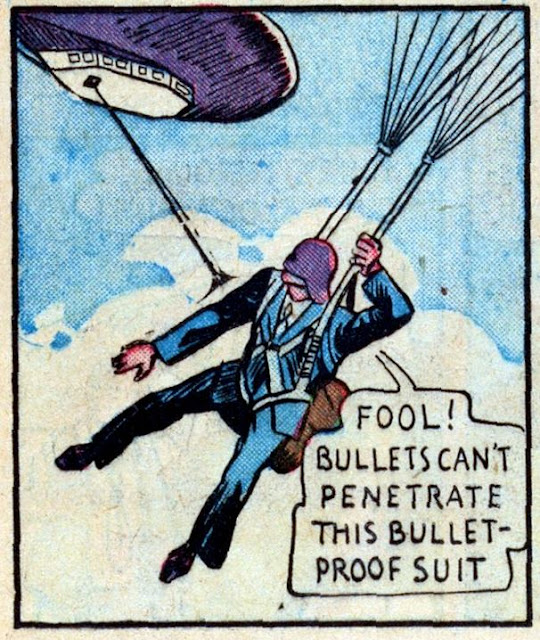
    Never has a villain had a more rapid transition from triumphant moment (you cannot shoot me thanks to my bulletproof suit!) to comeuppance (my bulletproof suit is the means by which I am captured by Magno thanks to the very qualities which previously protected me. Woe unto my poor soul).

    The Octopus is finally unmasked! And just who is this criminal mastermind? None other than Professor Beale, the famous criminologist who was consulted on the scourge of his own alter ego earlier in the issue and who somewhat clumsily attempted to throw suspicion onto Magno! Why, I never saw that coming *head vigorously nodding to indicate that I did, in fact, see it coming*.

    Beale/the Octopus takes advantage of a moment of distraction on Magno’s part and makes another bid for freedom, but critically fails to grab the parachute he needs to really nail the jump and plummets to his death. Magno… pretty conspicuously opts not to save him, something that he has already shown that he can do. Sorry, hard-core Magno fans, but it’s true.

  • MINOR SUPER-VILLAIN 774: THE TERROR

    (Super-Mystery Comics 001, 1940)

    The Terror is really Scar (or Scar-Face) Pontois, a gang boss who is expending a lot of effort in order to drive people away from a rich gold claim that he has hijacked but has perhaps gone a bit too far, as Corporal Flint of the RCMP, the hero of our story, is only nosing around Scar’s locale because of the strange rumours he and/or his superiors have heard. Please note his giant hat.

    In addition to the fearsome Terror identity, Scar’s efforts include playing off of local superstitions by sending the daughter of the man he stole the gold claim from out to play the ominous Flame Maiden, but the real star of the show is the Coffin of the Mad. Based on the idea that radium can destroy the human brain (an idea that I can find no real source for, which probably means that it appeared in one Scientific American article that the comic’s writer read in 1935 or so), the coffin is made out of radium-bearing pitchblende ore. Various characters in the story claim that men have been made mad after being placed in the coffin, but even taking the “radium destroys brains” thing as gospel as far as I can tell pitchblende is so much less radioactive that radium that it’s more likely that they all went nuts because they were shut up in a stone coffin alive. I wouldn’t bet against their chances of getting cancer at some point though.

    In conclusion, the Terror probably would have been better off just killing people. Or just investing in that guy’s mine through a shell company.

  • MINOR SUPER-VILLAIN 774: THE TERROR

    (Super-Mystery Comics 001, 1940)

    The Terror is really Scar (or Scar-Face) Pontois, a gang boss who is expending a lot of effort in order to drive people away from a rich gold claim that he has hijacked but has perhaps gone a bit too far, as Corporal Flint of the RCMP, the hero of our story, is only nosing around Scar’s locale because of the strange rumours he and/or his superiors have heard. Please note his giant hat.

    In addition to the fearsome Terror identity, Scar’s efforts include playing off of local superstitions by sending the daughter of the man he stole the gold claim from out to play the ominous Flame Maiden, but the real star of the show is the Coffin of the Mad. Based on the idea that radium can destroy the human brain (an idea that I can find no real source for, which probably means that it appeared in one Scientific American article that the comic’s writer read in 1935 or so), the coffin is made out of radium-bearing pitchblende ore. Various characters in the story claim that men have been made mad after being placed in the coffin, but even taking the “radium destroys brains” thing as gospel as far as I can tell pitchblende is so much less radioactive that radium that it’s more likely that they all went nuts because they were shut up in a stone coffin alive. I wouldn’t bet against their chances of getting cancer at some point though.

    In conclusion, the Terror probably would have been better off just killing people. Or just investing in that guy’s mine through a shell company.

  • MINOR SUPER-VILLAIN 773: CAPTAIN DEATH

    (Super Comics 027, 1940)

    Pirate Captain Death comes into conflict with Jim Ellis and his brother Bud when the former, a dead ringer for Death, is shanghaied by the slightly less villainous Captain “Iron” Shard in an attempt to bluff his way onto Death’s Forbidden Island headquarters and steal his treasure.

    This “identical hero/villain duo” situation is hardly unprecedented in fiction, and there are broadly two ways that it plays out. In the first, the villain is not so bad as their reputation might suggest, and things play out like a classic comedy of errors. This is the other way, in which the villain is so over the top and evil that looking like him is almost a moral challenge to the hero.

    After being talked up as an evil dude for a fair number of issues, our first look at Captain Death is when he sails into the comic just as Jim Ellis and Captain Shard have come to terms and are about to leave for less perilous climes. Captain Death sets the tone by immediately sinking Shard’s ship and picking off the swimming survivors with a rifle. Evil stuff! Of course Jim and Bud manage to make their way to land and over the course of the next few issues Jim takes a tremendous amount of abuse but eventually switches places with Death and he and Bud skip town at the next available port. Weirdly Captain Death never returns, as far as I can tell. Maybe he’s not as big on vengeance as other pirates.