The Curse of Skeleton Munroe

Category: minor super-villain

  • MINOR SUPER-VILLAIN 765: KILLRAYE

    (Speed Comics 007, 1940)

    Killraye is the leader of the extremely wild and wonderful looking Jupiter Men (courtesy of writer/artist/wild alien designer Munson Paddock) of an unspecified future, and leads them in an attempt to hijack plans for an advanced ray gun design from inter-planetary mail courier Mars Mason.

    (whether the Jupiter Men have a caste-based physiology and Killraye represents their ruling form or he is of a different species entirely is unclear. He certainly looks a lot different that them but on the other hand he does have the same furry legs and weird little round feet as they do)

    Mars Mason does not allow this violation of the sanctity of the mail to go unavenged, and not only blows up a considerable portion of the Jupiter Men’s city but send Killraye himself spinning off into space via what must have been a superhumanly powerful kick. Surely this is the end of Killraye!

    OR IS IT? 
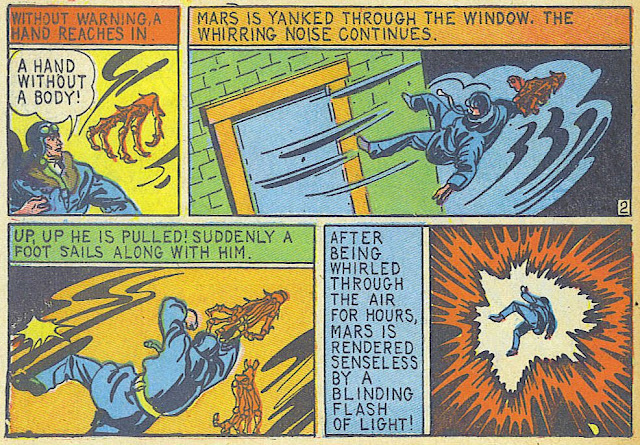
    In fact, no, that was not the end of Killraye. In Speed Comics 008 it is revealed that the dastardly Jovian had not in fact been consigned to eternal exile in space but had landed on a comet complete with a population of Needle Men (related to and indistinguishable from Jupiter Men and just as willing to follow a guy like Killraye) as well as a weird super-powered skeleton alien. Rather than enjoy his second chance at life in peace, Killraye immediately resumes his piratical ways and inevitably ends up clashing with Mars Mason again.
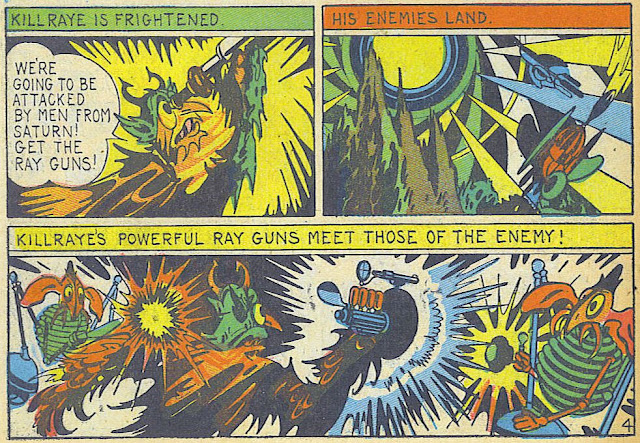
    It seems like Killraye is finally going to get the upper hand, when the community-minded Saturn Men get involved and wreck house so thoroughly that Killraye himself does not actually get a death scene. Good night, sweet alien bastard.

    ADDENDUM: Killraye was a fine villain, but the real star of his second appearance was this unnamed hench-creature, whose host of positive attributes include:

    – amazing skeleton body

    – rare 1940s anime hair

    – a catch phrase: “Bah!”

    – the power to send its skeletal hands and feet across interplanetary distances to snatch up people and loot

    – a boss ray gun

    Truly this is the villain I want to see in my space comics.

  • MINOR SUPER-VILLAIN 764: THE BLACK KNIGHTS

    (Speed Comics 008, 1940)

    Like I said in the Queen Sheba entry, her brand of evil was a bit too depressing and I almost skipped making an entry for her in favour of doing this one but it ended up being mostly about her and her unpunished slaving ways anyway, and that wasn’t fair.

    The Black Knights are just what it says on the tin: a bunch of knights who dress in black. Presumably they are descended from the same group of crusaders as Sheba’s loyal followers, only instead of passively propping up a corrupt monarchy the Black Knights are out there busting heads and doing crimes. At least, I assume that’s their deal – the only actual crime that they are shown to have committed is kidnapping Sheba’s son, and I suppose that that could be the action of a group of slavery abolitionists who believe in direct action.

    Whatever their place on the alignment chart, the Black Knights try and fail to prevent Shock Gibson from rescuing the prince. Some days it just doesn’t pay to sally forth.

  • MINOR SUPER-VILLAIN 763: QUEEN SHEBA

    (Speed Comics 008, 1940)

    Shock Gibson has been reading magazines, specifically an expose on slave trading in Africa, and being of a heroic turn of mind he decides to do something about it. Making his way across the Atlantic, Shock engages in various animal-related hijinks before finally ambushing a slave caravan and using some elephant-based enhanced interrogation to learn just what is going on with all the slaving.

    Turns out to be a pretty classic jungle adventure scenario: a hidden kingdom smack in the middle of Africa with ties to some historical people, in this case called the Secret Kingdom and ruled by a direct descendant of the biblical Queen of Sheba (who is traditionally placed somewhere in the vicinity of Yemen but who are we, the geography police?). And it’s a twofer, as Queen Sheba is served by an order of knights descended from a group of crusaders who somehow found themselves in the Secret Kingdom (okay, maybe we are the geography police because crusaders would also make more sense in the vicinity of Yemen and I’m having a hard time letting go of that fact).

    No mere knight is a match for the electrically-charged muscles of Shock Gibson, however, and by defeating the guard at the border of the kingdom Shock gains access to a one-on-one meeting with the Queen. I must say that this is a astonishingly bad precedent to set as far as security is concerned – this knight is just lucky that Shock wasn’t a particularly adept assassin.

    Here’s where I almost decided not to feature Queen Sheba as a super-villain, because once Shock manages to interrogate her it turns out that her motivations are depressingly banal. She isn’t buying slaves in order to feed them into a soul gem to power a world-conquering battle robot or using them as biological material to create an army of flesh beasts or even doing mass human sacrifice to appease her dark gods, she’s just building a pyramid and can’t see any way to do so that doesn’t involve exploiting her lessers. It’s frankly depressing.

    If this were any other style of Secret Kingdom Ruler (white-bearded man, withered old crone, American crook running a scam, etc) then Shock Gibson would pull their pyramid down around their ears, but Queen Sheba is a bodacious babe and so instead he offers to use his amazing gifts to complete the thing in a matter of hours so long as the Queen subsequently releases her slaves. And then he only goes and does it!

    And then! Queen Sheba has the audacity to add a caveat to the deal! Specifically she is not going to release her slaves unless Shock goes and frees her son from the Black Knights who have taken him hostage. The gall of it! Especially after all of this pyramid nonsense! You know what a… well, not a good reason to have a bunch of slaves, certainly, but a better one than mindlessly building your kingdom’s twentieth pyramid: using them as an army to storm the castle where your son is a hostage.

    The Black Knights (full review tomorrow!) prove just as ineffectual at stopping high-voltage super-heroes as their law-abiding counterparts and Shock recovers the very informative (“Help! I’m the prince!”) young royal from his prison.

    Queen Sheba makes the obligatory offer for Shock to stay and become her kings, and while ordinarily I’d roast a hero for fleeing in terror before the advances of a lady like this, honestly this time Shock has it right: this woman is a monster.

  • MINOR SUPER-VILLAIN 762: THE DEVILFISH

    (Speed Comics 006, 1940)

    The Devilfish is a pseudo-Nazi mastermind who vexes Lieutenant Jim Cannon of the Royal British Navy for the first 2 or 3 of his handful of appearances in Speed Comics and I won’t lie: it’s all about that great name for me, although that same name is annoying the part of me that loves to put things into categories due to the fact that “devilfish” is such a loose term. People – especially in the first half of the 20th Century when we were really starting to poke around under water but didn’t really know anything about what was going on down there – love call any scary ocean being a devilfish, including rays, octopus, squid, some whales, all kinds of deep-sea monstrosities… it’s impossible to know just which devilfish this fellow was named for.

    So what is notable about the Devilfish aside from his wonderful and vexing name? In his debut, he’s directing attacks on British shipping and if I’m going to highlight anything it’s his wide range of vehicular transport, from ship to plane to submarine, all in one six-page adventure. This issue also establishes a bit where the Devilfish will send Cannon a taunting radio message after getting away, which is a fun bit of business.

    The Devilfish returns to plague shipping in Speed Comics 007, and regional pride compels me to point out that this issue begins in Halifax, Nova Scotia. Go, Windjammers!

    The Devilfish’s actual plan this issue is pretty incoherent: set a bunch of icebergs loose in the shipping lanes and also cover those same icebergs with nautical mines. But… what does this accomplish? Does the Devilfish think that ships just bump innocently and harmlessly into icebergs all the time and the mines are meant to spice things up? Is this a plot to distribute the mines into whichever random stretch of ocean the bergs pass through as they melt? Why not at least paint the mines white so that they aren’t so visible that someone (i.e., Lt Cannon) can’t just easily spot them and blow them up from a distance? It’s maddening to contemplate!

    As in his first appearance, this one ends with the Devilfish seemingly being killed but actually scuttling away in a submarine (this actually completes a second ship > plane > submarine sequence) only to taunt Lt Cannon via radio. While it’s entirely probable that the Devilfish returned again in Speed Comics 008, the only extant scan of that comic does not include the relevant story and I personally am not willing to pay $100+ for a physical copy to find out. Did the Devilfish return again? Did he die? Does he remain at large? We may never know.

  • MINOR SUPER-VILLAIN 761: THE HOODED RIDERS

    (Speed Comics 007, 1940)

    Despite their KKK-adjacent looks and tactics, the Hooded Riders are nothing more than a gang of rural protection racketeers. Over the course of the adventure the riders keep rolling out more elaborate equipment and plans to deal with both their targets and the interference of Shock Gibson and I kept thinking that their deep well of resources was going to turn out to be due to some sort of secret funding from a hostile country but no, they’re just unusually well-prepared gangsters. 

  • MINOR SUPER-VILLAIN 760: THE FIRE-MEN

    (Speed Comics 004, 1940) 

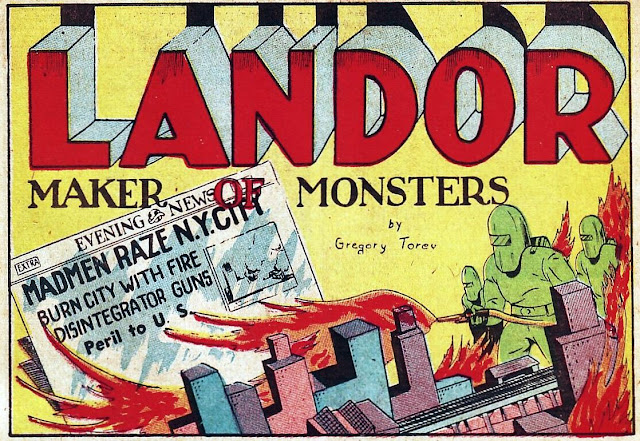
    The Fire-Men make an impressive debut: dressed in bulletproof suits and wielding powerful flamethrowers, they carve a path of destruction through both New York City and the tank division that is sent to bring them to heel. Nothing seems able to stop these mysterious marauders!

    Nothing, that is, until Landor, Maker of Monsters emerges from the shadows to offer his creature-based services to the US government. He’ll fight on the side of law and order for once, but only in exchange for his hated enemy, Tony Torrence. It’s a triumph of negotiation, in that there is absolutely no way that a patriotic fellow like Torrence could fail his country in its hour of need, even at the cost of his own life, the rube.

    To his credit, Landor follows through, and while up to this point I thought that the Fire-Men might have secretly been more of his creatures under those suits the whole time, they are in fact what will eventually be a comics staple: the minor villain that exists only to be utterly trounced as a demonstration of the prowess of another character. Whatever the Fire-Men’s goals might have been will never be revealed due to their grisly deaths at the claws of a giant fireproof cyborg.

  • MINOR SUPER-VILLAIN 760: THE FIRE-MEN

    (Speed Comics 004, 1940) 

    The Fire-Men make an impressive debut: dressed in bulletproof suits and wielding powerful flamethrowers, they carve a path of destruction through both New York City and the tank division that is sent to bring them to heel. Nothing seems able to stop these mysterious marauders!

    Nothing, that is, until Landor, Maker of Monsters emerges from the shadows to offer his creature-based services to the US government. He’ll fight on the side of law and order for once, but only in exchange for his hated enemy, Tony Torrence. It’s a triumph of negotiation, in that there is absolutely no way that a patriotic fellow like Torrence could fail his country in its hour of need, even at the cost of his own life, the rube.

    To his credit, Landor follows through, and while up to this point I thought that the Fire-Men might have secretly been more of his creatures under those suits the whole time, they are in fact what will eventually be a comics staple: the minor villain that exists only to be utterly trounced as a demonstration of the prowess of another character. Whatever the Fire-Men’s goals might have been will never be revealed due to their grisly deaths at the claws of a giant fireproof cyborg.

  • MINOR SUPER-VILLAIN 759: THE IRON HAND

    (Master Comics 006, 1940)

    While monitoring the world for trouble one day (using his Troublescope, natch), Master Man spots, in quick succession: an auto-gyro creating green rainclouds, a collection of mysteriously paralyzed wildlife, a full-fledged paralysis epidemic dubbed “the Living Death” in a nearby city, and the news that the preeminent scientist working to cure the plague has been murdered. He takes what I would say is a surprising amount of time to put two and two together and determine that these events might just be linked.

    The culprit behind all of these occurrences is the arch-criminal known as the Iron Hand, due to his iron hand. He has been dispensing the Living Death disease into the city’s reservoir using the green rain, and plans on expanding his operation world wide if he is successful in bringing the unnamed city under his heel. It’s a real shame that much of the rest of the story involves the Iron Hand’s minions vs Master Man in a series of retreat actions because the Iron Hand himself is barely present and he’s just the kind of bombastic jagoff villain I love.

    Master Man eventually works his way through all of the Iron Hand’s low-level doofuses in time to crash his auto gyro in a lake and drown him. There’s a teaser that suggests that maybe the drowning wasn’t quite enough to defeat such a cool villain, but as this is the final Master Man comic, it has to stand.

  • MINOR SUPER-VILLAIN 759: THE IRON HAND

    (Master Comics 006, 1940)

    While monitoring the world for trouble one day (using his Troublescope, natch), Master Man spots, in quick succession: an auto-gyro creating green rainclouds, a collection of mysteriously paralyzed wildlife, a full-fledged paralysis epidemic dubbed “the Living Death” in a nearby city, and the news that the preeminent scientist working to cure the plague has been murdered. He takes what I would say is a surprising amount of time to put two and two together and determine that these events might just be linked.

    The culprit behind all of these occurrences is the arch-criminal known as the Iron Hand, due to his iron hand. He has been dispensing the Living Death disease into the city’s reservoir using the green rain, and plans on expanding his operation world wide if he is successful in bringing the unnamed city under his heel. It’s a real shame that much of the rest of the story involves the Iron Hand’s minions vs Master Man in a series of retreat actions because the Iron Hand himself is barely present and he’s just the kind of bombastic jagoff villain I love.

    Master Man eventually works his way through all of the Iron Hand’s low-level doofuses in time to crash his auto gyro in a lake and drown him. There’s a teaser that suggests that maybe the drowning wasn’t quite enough to defeat such a cool villain, but as this is the final Master Man comic, it has to stand.

  • MINOR SUPER-VILLAIN 758: THE WIZARD

    (Smash Comics 017, 1940)

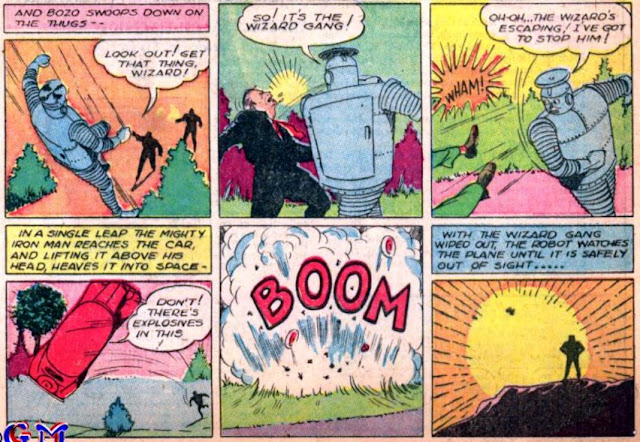
    The Wizard is your classic big-headed smart guy gang boss (his head is on the smaller end of the bighead spectrum but he accentuates it perfectly with the most unpleasant hairstyle I have ever seen). He and his gang (the Wizard Gang, natch) have been lying low for long enough that one of them starts getting squirrely and talking about leaving, with deadly consequences. The Wizard shoots him, is what I’m saying. And what a shame, because the Wizard has just finished his master plan: put bombs in little remote controlled planes and then use them to do robberies. Not the most groundbreaking scheme in the world, but not bad.

    The plane bombs seem to be effective, as the Wizard Gang really cleans up on loot. Is there a major difference between a bomb mounted on a plane and one thrown by a guy? Evidently! 

    Even more impressively, the Wizard’s plan to just stay out of town for a while has had the intended effect of erasing all of his gang members from the collective police memory. It’s quite remarkable, though again the simpler answer might just be that they are managing to stay out of sight of the cops.

    All good things must come to an end, however, in this case in the form of Hugh Hazzard and his explosion-proof robotic exoskeleton. And of course once a superstrong robot is involved it’s just a matter of time before the Wizard meets his end in a recklessly-hurled car full of explosives.