The Curse of Skeleton Munroe

Category: minor super-villain

  • MINOR SUPER-VILLAIN 967: THE FANG

    (Fantastic Comics 017, 1941)

    The Fang is a recurring villain in the mould of his Fox Features contemporaries the Rook and the Beast: you can knock him down and seemingly kill him as much as you want but he’s just going to keep on coming back to do more crimes.

    When he first appears, the Fang’s major goal is to acquire the Burma Emerald from its caretaker Princess Kava, in order to decipher the secret of invisibility that has been carved into its surface. His initial attempt to snatch the emerald leads him to murder Police Sergeant Marley of the Princess’ protection detail, which directly inspires Marley’s son Chuck to become a costumed crimefighter under the tutelage of the Black Fury.

    Perhaps because Black Fury scribe realized that a series of comics about a man trying and failing to achieve invisibility would be less interesting than one about an invisible crook, the Fang breaks prison in his second appearance and gets ahold of the emerald almost immediately. So what does he use his newfound powers of invisibility for?

    – bank robbery (Fantastic Comics 018)

    – framing a man for murder in order to buy his house that has an ideal smuggling setup in the form of a secret tunnel to the coast (Fantastic Comics 019)

    – sabotaging arms shipments to Allied Europe on behalf of the Axis (Fantastic Comics 020)

    I judge these… okay criminal uses of invisibility. Nothing spectacular.

    Though I set up the comparison between the Fang and the Rook/the Beast
    myself, I must now point out the way in which he differs from them: he doesn’t seemingly die at the end of every appearance. Instead, he alternates seeming to die being caught: he’s caught in Fantastic 017, crashes into an oil tank in 018, caught again in 019, and does a header into a well full of slime in Fantastic Comics 020. 

    If there’s one thing that invisibility powers are extremely good at it’s in helping to fake one’s own death, though how they help to get out of an ooze pit is beyond me.

    Sadly and annoyingly, the final page or two of the Fang’s last appearance is not currently available. He is in the process of planting a bomb at the end of the portion that we do have, which makes it highly likely that he went on to be blown up, and that death finally claimed him. Alternately, perhaps he was arrested again and just treated with the appropriate amount of care by the authorities. It is my hope that we will someday learn the truth.

    Categorized in: Body (Nonhuman Parts – Fangs), Narrative Footballs (Origin Story Guys), Powers (Invisibility)

  • MINOR SUPER-VILLAIN 967: THE FANG

    (Fantastic Comics 017, 1941)

    The Fang is a recurring villain in the mould of his Fox Features contemporaries the Rook and the Beast: you can knock him down and seemingly kill him as much as you want but he’s just going to keep on coming back to do more crimes.

    When he first appears, the Fang’s major goal is to acquire the Burma Emerald from its caretaker Princess Kava, in order to decipher the secret of invisibility that has been carved into its surface. His initial attempt to snatch the emerald leads him to murder Police Sergeant Marley of the Princess’ protection detail, which directly inspires Marley’s son Chuck to become a costumed crimefighter under the tutelage of the Black Fury.

    Perhaps because Black Fury scribe realized that a series of comics about a man trying and failing to achieve invisibility would be less interesting than one about an invisible crook, the Fang breaks prison in his second appearance and gets ahold of the emerald almost immediately. So what does he use his newfound powers of invisibility for?

    – bank robbery (Fantastic Comics 018)

    – framing a man for murder in order to buy his house that has an ideal smuggling setup in the form of a secret tunnel to the coast (Fantastic Comics 019)

    – sabotaging arms shipments to Allied Europe on behalf of the Axis (Fantastic Comics 020)

    I judge these… okay criminal uses of invisibility. Nothing spectacular.

    Though I set up the comparison between the Fang and the Rook/the Beast
    myself, I must now point out the way in which he differs from them: he doesn’t seemingly die at the end of every appearance. Instead, he alternates seeming to die being caught: he’s caught in Fantastic 017, crashes into an oil tank in 018, caught again in 019, and does a header into a well full of slime in Fantastic Comics 020. 

    If there’s one thing that invisibility powers are extremely good at it’s in helping to fake one’s own death, though how they help to get out of an ooze pit is beyond me.

    Sadly and annoyingly, the final page or two of the Fang’s last appearance is not currently available. He is in the process of planting a bomb at the end of the portion that we do have, which makes it highly likely that he went on to be blown up, and that death finally claimed him. Alternately, perhaps he was arrested again and just treated with the appropriate amount of care by the authorities. It is my hope that we will someday learn the truth.

    Categorized in: Body (Nonhuman Parts – Fangs), Narrative Footballs (Origin Story Guys), Powers (Invisibility)

  • MINOR SUPER-VILLAIN 966: ARPOR, HIGH PRIEST OF EVIL

    (Fantastic Comics 015, 1941)

    I’ve mentioned this in the past but it bears repeating: some Golden Age comics read like a fever dream, in which barely connected events just kind of float by as you read. This story is one of those, but also has a sort of exquisite corpse quality in that the connections between events almost make sense but when you step back and look at the whole it is astonishing. To whit:

    – Samson and David are just hanging around in whatever US city they call home when they notice a weird truck in the street outside. When they go out to investigate the truck it turns out to be full of poison gas.

    – After disposing of the truck (the purpose of which is never revealed), the duo follow some nearby thugs to a warehouse full of counterfeiting equipment. Samson tosses the whole building into the river and then fishes out the one surviving thug.

    – The thug reforms out of gratitude and tells Samson that the mastermind behind the warehouse is Arpor, High Priest of Evil.

    – Samson and David make their way to Arpor’s stronghold in the nearby mountains, dodging various traps and ambushes along the way. Eventually, Samson pretends to be knocked out by a fall so that he can be captured. He is taken back to Arpor’s temple lair to be sacrificed to a moderately off-model Kali. As an aside, Arpor’s cultist minions appear to be called Fiends, which is fun.

    – Not even a whole cult is enough to take on Samson and Arpor is eventually rounded up (after a few more hijinks) and taken away to jail.

    So what is Arpor up to here? Is the counterfeiting setup funding the cult or meant to destabilize society in some way that ties in with the usual comic book shorthand of Kali = Thuggees = wanton murder? Is this where the poison gas comes in? We will never know!

    Shout out to this sweet cone-shaped lightning rifle that Arpor uses to blast Samson into submission. Love an energy weapon that dares to not just look like a fancy tommy gun.

    Categorized in: Abstract Concepts (Evil), Misc (Cult Leaders), Profession (Priests)

  • MINOR SUPER-VILLAIN 966: ARPOR, HIGH PRIEST OF EVIL

    (Fantastic Comics 015, 1941)

    I’ve mentioned this in the past but it bears repeating: some Golden Age comics read like a fever dream, in which barely connected events just kind of float by as you read. This story is one of those, but also has a sort of exquisite corpse quality in that the connections between events almost make sense but when you step back and look at the whole it is astonishing. To whit:

    – Samson and David are just hanging around in whatever US city they call home when they notice a weird truck in the street outside. When they go out to investigate the truck it turns out to be full of poison gas.

    – After disposing of the truck (the purpose of which is never revealed), the duo follow some nearby thugs to a warehouse full of counterfeiting equipment. Samson tosses the whole building into the river and then fishes out the one surviving thug.

    – The thug reforms out of gratitude and tells Samson that the mastermind behind the warehouse is Arpor, High Priest of Evil.

    – Samson and David make their way to Arpor’s stronghold in the nearby mountains, dodging various traps and ambushes along the way. Eventually, Samson pretends to be knocked out by a fall so that he can be captured. He is taken back to Arpor’s temple lair to be sacrificed to a moderately off-model Kali. As an aside, Arpor’s cultist minions appear to be called Fiends, which is fun.

    – Not even a whole cult is enough to take on Samson and Arpor is eventually rounded up (after a few more hijinks) and taken away to jail.

    So what is Arpor up to here? Is the counterfeiting setup funding the cult or meant to destabilize society in some way that ties in with the usual comic book shorthand of Kali = Thuggees = wanton murder? Is this where the poison gas comes in? We will never know!

    Shout out to this sweet cone-shaped lightning rifle that Arpor uses to blast Samson into submission. Love an energy weapon that dares to not just look like a fancy tommy gun.

    Categorized in: Abstract Concepts (Evil), Misc (Cult Leaders), Profession (Priests)

  • MINOR SUPER-VILLAIN 965: DR THORNE

    (Fantastic Comics 014, 1941)

    We open on a mysterious figure using backwards-talk magic to raise hundreds of spirits from their graves and shunt them into the Fourth Dimension. To what end? We shall learn that soon!

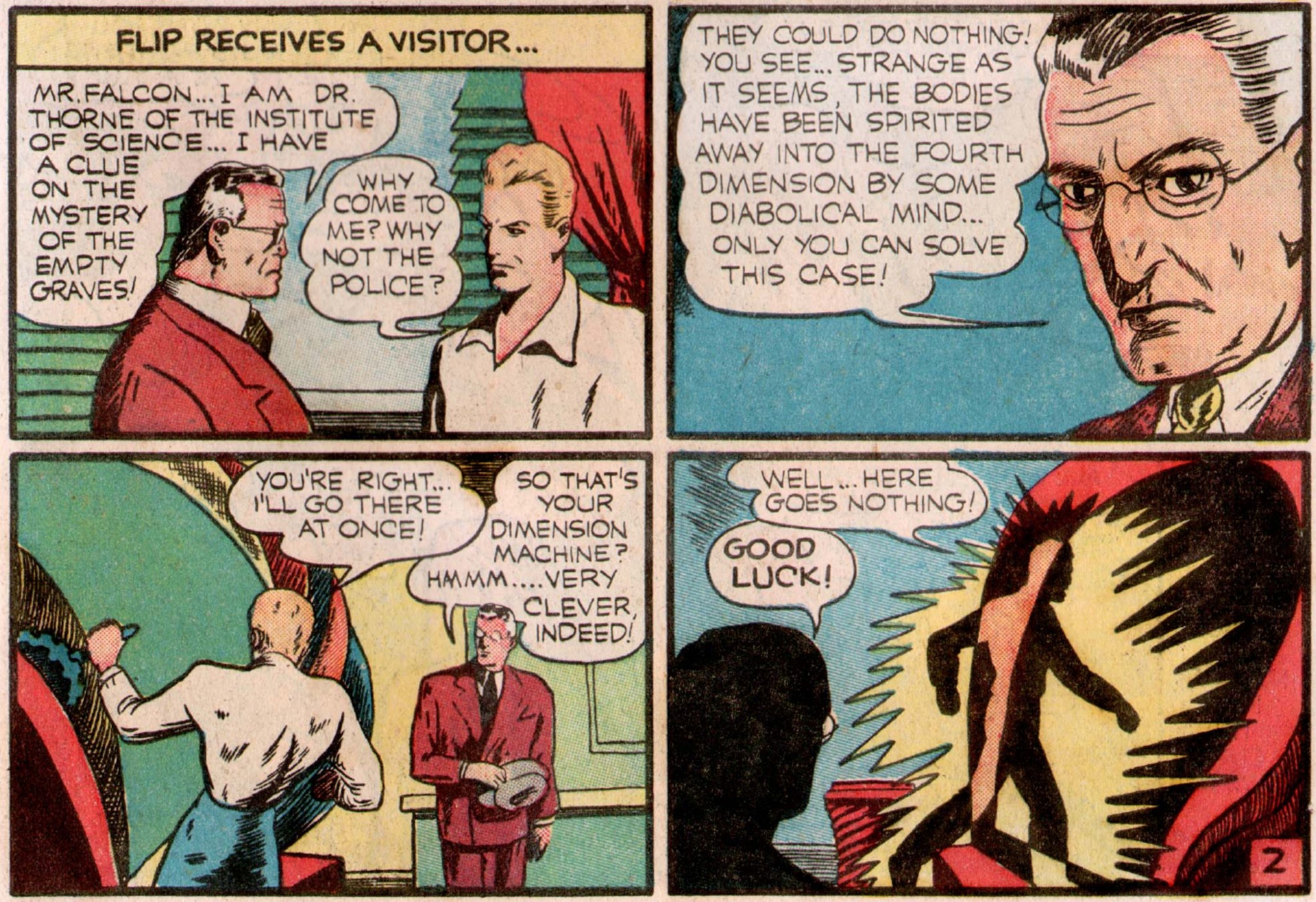
    Flip Falcon, expert in all things fourth dimensional. is contacted by Dr Thorne of the Institute of Science asking for help with this problem. You might have noticed that Dr Thorne is also the name of Minor Super Villain 965, and that is because they are the same guy. This is a trap, and Flip should be able to see that because while the border between the Third Dimension and the Fourth has proven to be quite permeable over the course of his comic adventures the idea that the missing bodies have travelled interdimensionally should not occur to any but the perpetrator. 

    Please also note that despite Dr Thorne’s minions being consistently described as ghost of spirits, their bodies are also dug up as part of his little necromantic ritual. Perhaps Thorne did so so that there would be evidence to point at in order to draw Flip in?

    Flip investigates and finds that the ghosts are indeed hanging around in the Fourth Dimension. He also finds (and is taken prisoner by) Dr Thorne, who knows that anyone hoping to engage in Fourth Dimensional villainy needs to take care of Flip Falcon first.

    Flip is transported to Thorne’s lab in his Castle of Misery (great name) where his dimensional energy-charged body is used as a battery to fill up the ghosts with extra ghost-energy that kills humans on contact. We can only speculate as to why Thorne is mass-murdering humans in this manner – perhaps its no more complicated than the classic necromancer’s desire to create more ghostly minions.

    For all that he has been a capable villain so far, Dr Thorne is in no way OSHA compliant, and he is electrocuted seemingly the instant a light tap from Flip causes him to sprawl over his instrument panel. Flip risks his life by touching the machinery long enough to turn it off, causing the ghosts on Earth to fall down “dead,” and all that’s left is the cleanup. That is, if these spirits were in fact housed in all of those missing bodies and those bodies are now littering the city streets. If they were indeed purely spiritual entities we might have a situation in which there are just incorporeal bodies everywhere and nothing can be done about it. Horrifying claim to fame for this poor city!

  • MINOR SUPER-VILLAIN 965: DR THORNE

    MINOR SUPER-VILLAIN 965: DR THORNE

    (Fantastic Comics 014, 1941)

    We open on a mysterious figure using backwards-talk magic to raise hundreds of spirits from their graves and shunt them into the Fourth Dimension. To what end? We shall learn that soon!

    Flip Falcon, expert in all things fourth dimensional. is contacted by Dr Thorne of the Institute of Science asking for help with this problem. You might have noticed that Dr Thorne is also the name of Minor Super Villain 965, and that is because they are the same guy. This is a trap, and Flip should be able to see that because while the border between the Third Dimension and the Fourth has proven to be quite permeable over the course of his comic adventures the idea that the missing bodies have travelled interdimensionally should not occur to any but the perpetrator. 

    Please also note that despite Dr Thorne’s minions being consistently described as ghost of spirits, their bodies are also dug up as part of his little necromantic ritual. Perhaps Thorne did so so that there would be evidence to point at in order to draw Flip in?

    Flip investigates and finds that the ghosts are indeed hanging around in the Fourth Dimension. He also finds (and is taken prisoner by) Dr Thorne, who knows that anyone hoping to engage in Fourth Dimensional villainy needs to take care of Flip Falcon first.

    Flip is transported to Thorne’s lab in his Castle of Misery (great name) where his dimensional energy-charged body is used as a battery to fill up the ghosts with extra ghost-energy that kills humans on contact. We can only speculate as to why Thorne is mass-murdering humans in this manner – perhaps its no more complicated than the classic necromancer’s desire to create more ghostly minions.

    For all that he has been a capable villain so far, Dr Thorne is in no way OSHA compliant, and he is electrocuted seemingly the instant a light tap from Flip causes him to sprawl over his instrument panel. Flip risks his life by touching the machinery long enough to turn it off, causing the ghosts on Earth to fall down “dead,” and all that’s left is the cleanup. That is, if these spirits were in fact housed in all of those missing bodies and those bodies are now littering the city streets. If they were indeed purely spiritual entities we might have a situation in which there are just incorporeal bodies everywhere and nothing can be done about it. Horrifying claim to fame for this poor city!

  • MINOR SUPER-VILLAIN 964: THE SHARK

    (The Face 001, 1941)

    “Sparky Watts” was a long-running comic feature in Big Shot Comics and other Columbia publications about the eponymous Sparky Watts, a down-on-his-luck young man whose life turns around when scientist Doc Static gives him super powers using his cosmic ray machine. Having started out as a comic strip, Watts’ adventures tend to hew closer to the comic adventurous rather than the super-heroic. Still, every once in a while he encounters a minor super-villain such as the Shark.

    The Shark is a crypto-fascist in the truest sense: he clearly started out as a Nazi and his men bear some of the visual tropes of Nazi spies, but between the bizarre formality of his speech (which mimics the mock-Japanese speech patterns of 1940s comics while also being distinct from them) and the names of his underlings (Flitoog, Saber, Egnog, Kabitz) which approach mock-German without really getting there, it all ends up being the mere suggestion of a smear of an Axis pastiche.

    The really important thing about the Shark is that he’s a shark weirdo. He looks like a shark, he loves sharks, he has shark-themed decor and he bites people’s throats out with his “shark-like teeth” or at least threatens to. It’s always a joy to see a true oddball find his groove, even if it’s as an evil fascist. But preferably not as an evil fascist.

    The Shark and his men have heard of Sparky’s remarkable strength and have set out to acquire it for themselves, and since Sparky isn’t really in this issue (he’s off playing baseball tow towns over) they don’t have much trouble roughing up his friends to get what they want.

    Doc Static, of course, neglects to tell them that absorbing an insufficient charge of cosmic rays means that the power is temporary, and that once the rays leave the human body it shrivels up and shrinks until it is smaller than a grain of sand. The fascists all turn on one another once they achieve any sort of power which occupies them until they shrivel, and then an over-zealous minion (who was not invited along to get super powers) seals the deal by crushing all of the “bugs.” The world is safe!

  • MINOR SUPER-VILLAIN 964: THE SHARK

    (The Face 001, 1941)

    “Sparky Watts” was a long-running comic feature in Big Shot Comics and other Columbia publications about the eponymous Sparky Watts, a down-on-his-luck young man whose life turns around when scientist Doc Static gives him super powers using his cosmic ray machine. Having started out as a comic strip, Watts’ adventures tend to hew closer to the comic adventurous rather than the super-heroic. Still, every once in a while he encounters a minor super-villain such as the Shark.

    The Shark is a crypto-fascist in the truest sense: he clearly started out as a Nazi and his men bear some of the visual tropes of Nazi spies, but between the bizarre formality of his speech (which mimics the mock-Japanese speech patterns of 1940s comics while also being distinct from them) and the names of his underlings (Flitoog, Saber, Egnog, Kabitz) which approach mock-German without really getting there, it all ends up being the mere suggestion of a smear of an Axis pastiche.

    The really important thing about the Shark is that he’s a shark weirdo. He looks like a shark, he loves sharks, he has shark-themed decor and he bites people’s throats out with his “shark-like teeth” or at least threatens to. It’s always a joy to see a true oddball find his groove, even if it’s as an evil fascist. But preferably not as an evil fascist.

    The Shark and his men have heard of Sparky’s remarkable strength and have set out to acquire it for themselves, and since Sparky isn’t really in this issue (he’s off playing baseball tow towns over) they don’t have much trouble roughing up his friends to get what they want.

    Doc Static, of course, neglects to tell them that absorbing an insufficient charge of cosmic rays means that the power is temporary, and that once the rays leave the human body it shrivels up and shrinks until it is smaller than a grain of sand. The fascists all turn on one another once they achieve any sort of power which occupies them until they shrivel, and then an over-zealous minion (who was not invited along to get super powers) seals the deal by crushing all of the “bugs.” The world is safe!

  • MINOR SUPER-VILLAIN 963: THE GENTLEMAN

    (Exciting Comics 015, 1941)

    The Gentleman, “the most elusive jewel thief in the country,” is after the fabulous Orloff Necklace, and District Attorney Tony Colby, aka the Mask, is on the case.

    I initially had my money on the goateed gallery manager being the Gentleman in a classic double bluff, but once this comically-affronted old lady showed up it became clear that my instincts were wrong. The Gentleman’s modus operandi turns out to involve a combination of disguise and smuggling gems out of places in his dog’s hollow collar, a very specialized grift indeed, considering that you need a place that allows dogs and that also has small, high-value items to steal.

    Is the masculine name/ feminine disguise an intentional attempt at misdirection or merely a coincidence? Sadly this is not addressed in the text and so we must take it as equally likely that the Gentleman dresses up in a variety of disguises as it is that he always cross-dresses.

    Categorized in: Accessories (Dogs), Origin (Cross-Dressing Characters), Royalty (Gentlemen)

  • MINOR SUPER-VILLAIN 963: THE GENTLEMAN

    (Exciting Comics 015, 1941)

    The Gentleman, “the most elusive jewel thief in the country,” is after the fabulous Orloff Necklace, and District Attorney Tony Colby, aka the Mask, is on the case.

    I initially had my money on the goateed gallery manager being the Gentleman in a classic double bluff, but once this comically-affronted old lady showed up it became clear that my instincts were wrong. The Gentleman’s modus operandi turns out to involve a combination of disguise and smuggling gems out of places in his dog’s hollow collar, a very specialized grift indeed, considering that you need a place that allows dogs and that also has small, high-value items to steal.

    Is the masculine name/ feminine disguise an intentional attempt at misdirection or merely a coincidence? Sadly this is not addressed in the text and so we must take it as equally likely that the Gentleman dresses up in a variety of disguises as it is that he always cross-dresses.

    Categorized in: Accessories (Dogs), Origin (Cross-Dressing Characters), Royalty (Gentlemen)