The Curse of Skeleton Munroe

Category: Son of the Gods

  • MAD AND CRIMINAL SCIENTIST ROUND-UP 024

    Let’s spare a thought for all the mad lab assistants who do so much for so little credit. 

    Rokula:

    Rokula’s plan is simple: kidnap inventors and then use his mind control machine to force them to work for him. Hey, it’s a classic for a reason, but it’s also a plan with a high chance of attracting super-heroic attention such as that of Zongar the Miracle Man.  

    Rokula might be a fan of the classics but like so many of his peers he is no as into workplace safety, and he meets his end when Zongar sends him careening into his own equipment with a forceful punch. (Silver Streak Comics 007, 1941)

    Quislor:

    Quislor is a fellow who has developed technology that turns aircraft into remote-controlled drones, and is using it to send bombers out to destroy airfields across the US, thus reducing its ability to field an air force. Though he never quite gets around to saying just why he’s doing this it is presumably in service to some sort of fascist plot.

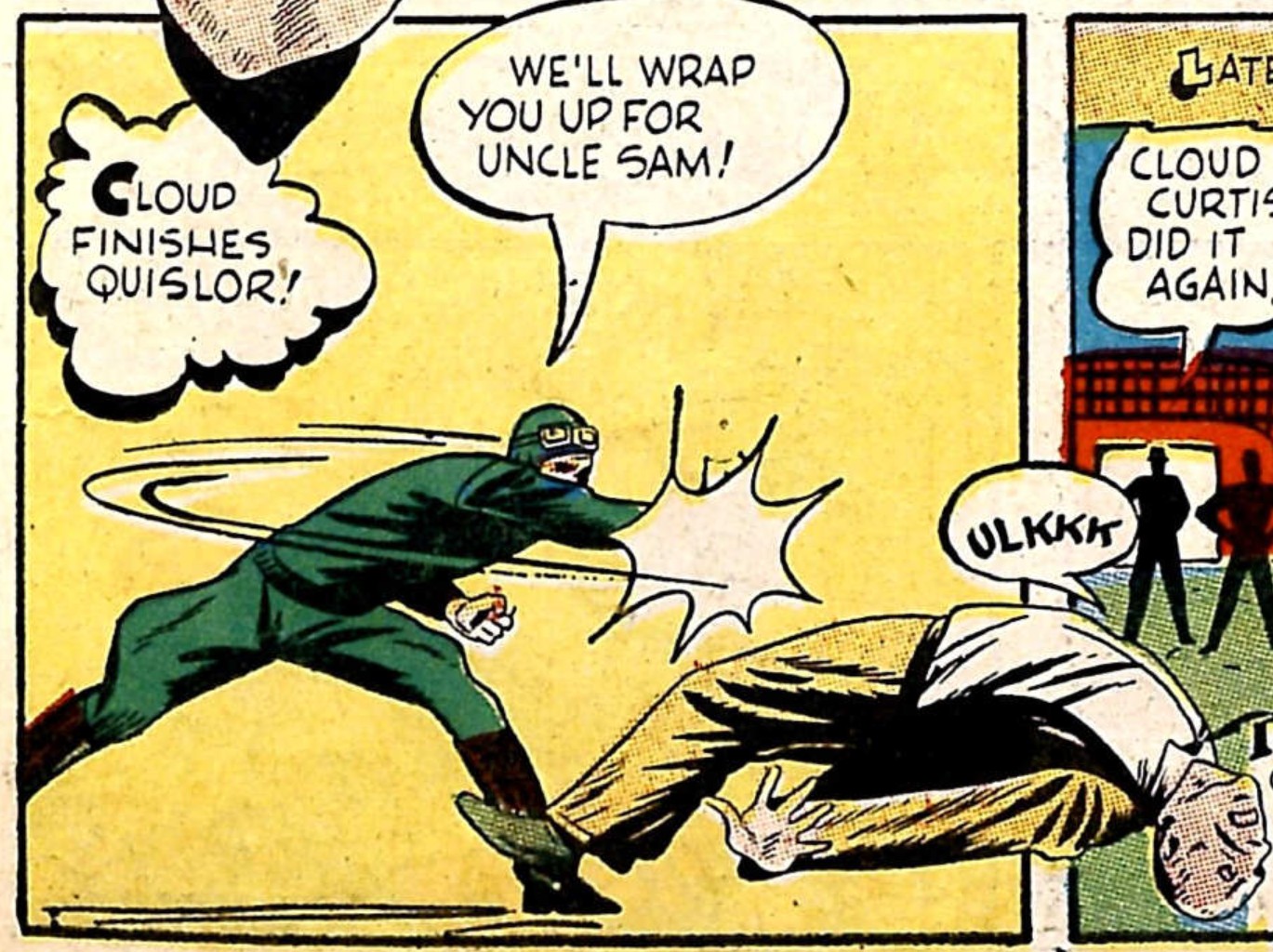
    Like all air-based crooks within Cloud Curtis’ flight range, Quislor soon learns that the only reward for messing with the sanctity of the wild blue yonder is a sock to the jaw and a trip to the hoosegow. (Silver Streak Comics 014, 1941)

    Professor Giess:

    Professor Giess, a crypto-fascist scientist with some very interesting eyebrows, has developed a fuel additive called Thanotane (great name) that causes vehicles using it to give off deadly fumes in their exhaust. His plan to distribute this fuel throughout the US to spread terror is stymied somewhat when the test shipment is hijacked by gangsters, but the plan is still on track until John Thesson, aka the Son of the Gods, gets involved and beats everyone up. This must be especially galling for Giess, who noted that Thesson was going to pose a challenge but put off dealing with him for too long. Live and learn, I guess, until you’re shot as an enemy agent. (Exciting Comics 007, 1941)

    Doctor Mord:

    Dr Mord is, like, the Platonic ideal of the comic book mad scientist. He lives in a castle that he explicitly just kind of found in the South African jungle and is attempting to scientifically extract the human soul and place it into a big jar of acid by electrocuting people’s brains. He claims that this will make him a god among men, but fails to lay out how, exactly.

    The old storytelling rule of Chekhov’s Unsealed Vat of Acid comes into play here and Doctor Mord ends up doused in the stuff before being chucked out a window by Captain Kidd. (Fantastic Comics 014, 1941)

  • MAD AND CRIMINAL SCIENTIST ROUND-UP 024

    MAD AND CRIMINAL SCIENTIST ROUND-UP 024

    Let’s spare a thought for all the mad lab assistants who do so much for so little credit. 

    Rokula:

    Rokula’s plan is simple: kidnap inventors and then use his mind control machine to force them to work for him. Hey, it’s a classic for a reason, but it’s also a plan with a high chance of attracting super-heroic attention such as that of Zongar the Miracle Man.  

    Rokula might be a fan of the classics but like so many of his peers he is no as into workplace safety, and he meets his end when Zongar sends him careening into his own equipment with a forceful punch. (Silver Streak Comics 007, 1941)

    Quislor:

    Quislor is a fellow who has developed technology that turns aircraft into remote-controlled drones, and is using it to send bombers out to destroy airfields across the US, thus reducing its ability to field an air force. Though he never quite gets around to saying just why he’s doing this it is presumably in service to some sort of fascist plot.

    Like all air-based crooks within Cloud Curtis’ flight range, Quislor soon learns that the only reward for messing with the sanctity of the wild blue yonder is a sock to the jaw and a trip to the hoosegow. (Silver Streak Comics 014, 1941)

    Professor Giess:

    Professor Giess, a crypto-fascist scientist with some very interesting eyebrows, has developed a fuel additive called Thanotane (great name) that causes vehicles using it to give off deadly fumes in their exhaust. His plan to distribute this fuel throughout the US to spread terror is stymied somewhat when the test shipment is hijacked by gangsters, but the plan is still on track until John Thesson, aka the Son of the Gods, gets involved and beats everyone up. This must be especially galling for Giess, who noted that Thesson was going to pose a challenge but put off dealing with him for too long. Live and learn, I guess, until you’re shot as an enemy agent. (Exciting Comics 007, 1941)

    Doctor Mord:

    Dr Mord is, like, the Platonic ideal of the comic book mad scientist. He lives in a castle that he explicitly just kind of found in the South African jungle and is attempting to scientifically extract the human soul and place it into a big jar of acid by electrocuting people’s brains. He claims that this will make him a god among men, but fails to lay out how, exactly.

    The old storytelling rule of Chekhov’s Unsealed Vat of Acid comes into play here and Doctor Mord ends up doused in the stuff before being chucked out a window by Captain Kidd. (Fantastic Comics 014, 1941)

  • MINOR SUPER-HERO ROUND-UP 091

    Have a few mid-tier minor super-heroes, for a change.

    the Black Terror:

    Pharmacist Bob Benton is the kind of guy who will step in when a little kid is being roughed up by thugs, but despite this he is pretty relentlessly bullied by city Comptroller Rodney Clark* and (in a less overt but still insidious way) their mutual love interest Jean Starr.

    * Clark is such a bully, in fact, that I assumed that he was going to eventually turn out to be crooked but instead he gets murdered** after a couple of issues.

    ** In fact I was wrong when I wrote this: he is merely almost  murdered and seemingly never recovers sufficiently to return to the comic. I guess I was just hoping that he would get murdered because he is, again, such a bully.

    Perhaps because of this, Benton spends his spare time working on a “tonic for run-down people,” or so he says. I assume that he’s going for something closer to anabolic steroids, and thanks to his new assistant Tim Roland (the kid who was getting beaten up earlier), he stumbles upon the formula for something even better: formic ether! 

    Thanks to those sweet sweet formic ether fumes, Benton becomes a super-human and in a real break for society decides to keep on being a decent guy rather than setting out for revenge on all those people who pushed him around when he was weak (though he does take the opportunity to give Rodney Clark a black eye every issue until he’s murdered he retires). He gets his super suit in the most efficient way possible: by sending Tim down to the costume shop to see what they have in stock.

    The formic ethers give Benton tremendous strength and a sort of mid-tier invulnerability: he can shrug off a sock on the jaw no problem, and eventually proves to be bulletproof, but he gets knocked around and knocked out an awful lot. (Exciting Comics 009, 1941)

    Tim Roland:

    Though Bob tells Tim that he can’t join him on his quest for vigilante glory, he also just kind of leaves a smoking bottle of super power serum sitting out where anyone can get it – frankly he’s lucky not to have to team up with Rodney Clark. Instead, Tim – who has had the foresight to pick up a second costume for himself, but not to pick a super-hero name – huffs a little formic ether and gets straight to busting heads.

    Tim is the rare Golden Age sidekick who appears to be legitimately around eight to ten years old, instead of a stocky thirteen to fifteen like so many of his peers. Even more remarkably, he stays roughly in this age bracket for a couple of years, as far as can be ascertained (multiple artists mean that his height fluctuates quite a lot, but he pretty consistently wears short pants in his civilian identity). He’s also one of those orphan boys who just kind of falls into a super-guy’s orbit and becomes adopted by default. (Exciting Comics 009, 1941)

    The Black Terror dabbles in the common practice of leaving a calling card in his first appearance, and makes the baffling decision to go with his domino mask as a design, rather than the cool skull-and-crossbones on his chest.

    Categorized in: Accessories (Calling Cards), Body (Emotions – Terror), Origins (Chemical Mutates), Origins (Sidekicks)

    the Sphinx **UPDATE**:

    The Sphinx adopts the identity of the Domino Kid in order to have a very brief boxing career. (Exciting Comics 012, 1941)

    Categorized in: Origins (Secondary Identities)

    the Liberator:

    Like many super-heroes, the Liberator starts out as a weedy nerd. Specifically, he is Dr Nelson Drew, lecturer in Chemistry at Claflin College. He is, troublingly, in love with Annabel, one of his students, who also serves as one of his major bullies – she is not only bored by chemistry (but you chose to take the course, Annabel!) but also scornful of Drew for caring about it when so much is afoot in the world, but… I don’t actually know what her problem is? Like, chemistry was wildly consequential to the US war effort? Perhaps if he taught a social science I could see her point of view, if not agree with it. 

    While doing a little light research into Ancient Egyptian poisons (okay, this is arguably inconsequential), Drew discovers the lost formula for a drug called Lamesis which will supposedly make one into their physical ideal. Though skeptical, he brews up a batch and since his lab safety appears to be nonexistent (troubling indeed for a guy who is researching poisons) he immediately gets a snootful of the stuff, and  turns into a big ol’ hunk. I really enjoy how viscerally unpleasant the transformation process looks here – sadly this transformation conceit doesn’t last more than a couple of issues.

    This unexpected transformation isn’t a dream come true for Drew, and he spends his first outing in his new body – the Lamesis turns out to be a temporary thing, you see – trying to figure out how to turn back, and engages in his first bout of super-heroism after discovering that the scientist he was trying to consult with had been murdered by fascists. 

    I also enjoy the origin of the Liberator’s costume: there are plenty of super-heroes going around in their old Halloween costumes, but he might be the only one who gets his outfit by stealing someone else’s. Would he have become such an explicitly patriotic hero if he hadn’t ended up in a star-spangled shirt? (Exciting Comics 015, 1941)

    Categorized in: Accessories (Drugs), Day Jobs (College Professors), Origins (Patriotic Heroes)

    VERY MINOR UPDATES:

    John Thesson, aka the Son of the Gods, after being a character of no fixed address for his first several appearances, finally settles down: he was in Washington DC in Exciting Comics 006, but it wasn’t until 007 that it became clear that that is where he chose to hang his hat and offer his services to the US Government.

    The Mask sheds two of his assistants, Silk and Butch, as of Exciting Comics 007, and becomes of interest to the law somewhere between 009 and 010. 

  • MINOR SUPER-HERO ROUND-UP 024

    Buncha fresh heroes here!

    Son of the Gods: 

    Dr John Thesson, big tall archaeologist and 1940s arch-skeptic, has the misfortune to find himself on an expedition to Crete with true believer Professor Craig who can’t stop running his mouth about how great Theseus was and how he totally existed and maybe Thesson and Craig can find Theseus’ mystic Ring of Poseidon if they look hard enough. It is a very annoying expedition for Thesson.

    Just kidding: this is a comic book and Professor Craig is completely right – it’s John “We’re Scientists” Thesson who has to get with the picture.

    The expedition is rich with incident: on the way there the duo ore attacked by a wild boar and Thesson kills it…

    … and then once they start the dig in earnest it is plagued by sabotage that is eventually traced back to their host Procostous and his manservant Cercion. This is the point at which the back of Professor Craig’s head blows clean off and he starts talking about how Thesson is the reincarnation of Theseus and is reliving his famed Six Labours (he actually does half: Periphetes the Club Bearer and Sinis the Tree Bender appear only as recounted myths and Sciron is not mentioned at all. And to be honest Cercion = Cercyon is a bit flimsy. It’s lucky for Professor Craig that he turns out to be correct. Again).

    Surprising nobody, Thesson does indeed find the Ring of Poseidon after one last sabotage attempt that leaves Procrustous dead. This is enough for the local mystery cult to acclaim him the Reincarnation of Theseus and he vows to use the powers granted by the ring (super strength and a degree of invulnerability, mostly) to battle crime and injustice. I initially hoped that Theseus would have fun mythology-inspired adventures like the MLJ Hercules but no, it’s all super-scientists and fascists – not even a hint of poor neglected Sciron and his giant turtle.

    (later issues cast Thesson as a mere descendant of Theseus but whether this is because reincarnation was a but too mystical or due to simple sloppy record keeping I cannot say)

    (the Minotaur only appears as one of Professor Craig’s stories but I just wanted to highlight the rare bull-bodied version here) (Exciting Comics 002, 1940)

    the Masked Rider:

    Geologist Jim Sanford becomes the Masked Rider in order to catch crooks (including the Specter) operating a covert gold min under the Diamond D Ranch without them knowing he was onto them with specific geological knowledge. Unlike most of his peers, he has no trouble hanging up his mask once the job is done. (Exciting Comics 002, 1940)

    the Sphinx:

    The Sphinx is a tuxedo-clad, domino-masked vigilante (real name Ellsworth Forrester!), a perhaps over represented group in early comics but generally a solid one (I initially forgot the name of the Scarab from Terra Obscura and thought that he was this guy – imagine my confusion). The main difference between the Sphinx and his peers like the Clock or the Mouthpiece or Just n’ Right is that the Sphinx is loosely affiliated with the police rather than being hunted by them.

    The other main difference is the fact that the Sphinx is one of the few suit-and-mask heroes with legitimate super powers, specifically super strength and at least partial invulnerability.

    Why is he called the Sphinx? As far as I can tell it’s just because he’s mysterious. (Exciting Comics 002, 1940)

    UPDATE – the Golden Knight:

    The Golden Knight
    stops off on his way to the Crusades to do a mission for Kara the
    Magician, who gifts him a magic ring that emits light in order to help
    him overcome the many dangers along the way and then a magic cloak of
    protection once he gets back – it’s a very Dungeons & Dragons style quest, honestly.

    The
    Golden Knight also takes a dip in a magic lake that triples his
    strength, which is handy for a warrior type. Does this strength persist? No idea. (Fantastic
    Comics 003, 1940)

     A couple of issues later, the Golden Knight meets the love of his life, Alice. Alice fell down a well as a child and was raised by (and eventually made queen of) a race of winged people in an underground city. Alice rules – in her first proper appearance she stabs two people to death which is way, way more than your typical female Golden Age adventurer. (Fantastic Comics 005, 1940)

  • MINOR SUPER-HERO ROUND-UP 024

    Buncha fresh heroes here!

    Son of the Gods: 

    Dr John Thesson, big tall archaeologist and 1940s arch-skeptic, has the misfortune to find himself on an expedition to Crete with true believer Professor Craig who can’t stop running his mouth about how great Theseus was and how he totally existed and maybe Thesson and Craig can find Theseus’ mystic Ring of Poseidon if they look hard enough. It is a very annoying expedition for Thesson.

    Just kidding: this is a comic book and Professor Craig is completely right – it’s John “We’re Scientists” Thesson who has to get with the picture.

    The expedition is rich with incident: on the way there the duo ore attacked by a wild boar and Thesson kills it…

    … and then once they start the dig in earnest it is plagued by sabotage that is eventually traced back to their host Procostous and his manservant Cercion. This is the point at which the back of Professor Craig’s head blows clean off and he starts talking about how Thesson is the reincarnation of Theseus and is reliving his famed Six Labours (he actually does half: Periphetes the Club Bearer and Sinis the Tree Bender appear only as recounted myths and Sciron is not mentioned at all. And to be honest Cercion = Cercyon is a bit flimsy. It’s lucky for Professor Craig that he turns out to be correct. Again).

    Surprising nobody, Thesson does indeed find the Ring of Poseidon after one last sabotage attempt that leaves Procrustous dead. This is enough for the local mystery cult to acclaim him the Reincarnation of Theseus and he vows to use the powers granted by the ring (super strength and a degree of invulnerability, mostly) to battle crime and injustice. I initially hoped that Theseus would have fun mythology-inspired adventures like the MLJ Hercules but no, it’s all super-scientists and fascists – not even a hint of poor neglected Sciron and his giant turtle.

    (later issues cast Thesson as a mere descendant of Theseus but whether this is because reincarnation was a but too mystical or due to simple sloppy record keeping I cannot say)

    (the Minotaur only appears as one of Professor Craig’s stories but I just wanted to highlight the rare bull-bodied version here) (Exciting Comics 002, 1940)

    the Masked Rider:

    Geologist Jim Sanford becomes the Masked Rider in order to catch crooks (including the Specter) operating a covert gold min under the Diamond D Ranch without them knowing he was onto them with specific geological knowledge. Unlike most of his peers, he has no trouble hanging up his mask once the job is done. (Exciting Comics 002, 1940)

    the Sphinx:

    The Sphinx is a tuxedo-clad, domino-masked vigilante (real name Ellsworth Forrester!), a perhaps over represented group in early comics but generally a solid one (I initially forgot the name of the Scarab from Terra Obscura and thought that he was this guy – imagine my confusion). The main difference between the Sphinx and his peers like the Clock or the Mouthpiece or Just n’ Right is that the Sphinx is loosely affiliated with the police rather than being hunted by them.

    The other main difference is the fact that the Sphinx is one of the few suit-and-mask heroes with legitimate super powers, specifically super strength and at least partial invulnerability.

    Why is he called the Sphinx? As far as I can tell it’s just because he’s mysterious. (Exciting Comics 002, 1940)

    UPDATE – the Golden Knight:

    The Golden Knight
    stops off on his way to the Crusades to do a mission for Kara the
    Magician, who gifts him a magic ring that emits light in order to help
    him overcome the many dangers along the way and then a magic cloak of
    protection once he gets back – it’s a very Dungeons & Dragons style quest, honestly.

    The
    Golden Knight also takes a dip in a magic lake that triples his
    strength, which is handy for a warrior type. Does this strength persist? No idea. (Fantastic
    Comics 003, 1940)

     A couple of issues later, the Golden Knight meets the love of his life, Alice. Alice fell down a well as a child and was raised by (and eventually made queen of) a race of winged people in an underground city. Alice rules – in her first proper appearance she stabs two people to death which is way, way more than your typical female Golden Age adventurer. (Fantastic Comics 005, 1940)

  • MINOR SUPER-VILLAIN 593: THE INVINCIBLE FIVE

    (Exciting Comics 006, 1940)

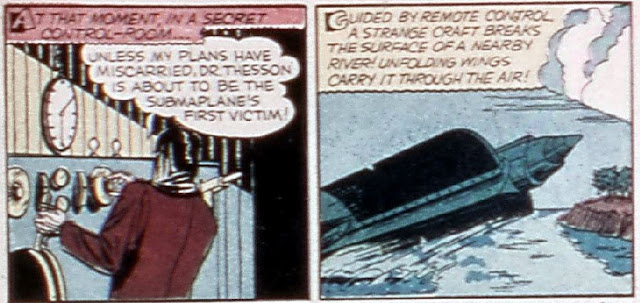
    The Invincible Five (good name!) are a mysterious group of hooded men who have been kidnapping skilled mechanics across the US in order to construct a fleet of vehicles known as Submaplanes.

    If you guessed that a Submaplane was either a submarine capable of flight or and airplane capable of operating underwater then give yourself a pat on the back because it is the former. Submaplanes also have some sort of electric forcefield, an electric ray cannon and appear to be remote controlled from a central location.

    Having seemingly done away with John “Son of the Gods” Thesson, whom they view as their only credible opposition, the Invincible Five proceed with their master plan: world conquest through intimidation and mass destruction. Various governments are given the opportunity to surrender peacefully then given the business when they refuse.

    (side note: these are some good hoods on the Invincible Five. The simple faces sketched on the front are a nice change from all of those regular-style hoods we usually see)

    Unsurprisingly, the leader of the Invincible Five is Burton, the sour-faced industrialist who turns up to advise FDR to surrender. Presumably at least some of his companions are also in on the scheme.

    It turns out that it was a good idea to try to kill John Thesson, because he ends up single-handedly taking down the entire operation by the simple expedient of punching people and things until the Submaplanes are grounded and the Invincible Five are in hand. Remember: if the only thing that stands between you and complete world domination is one person and you’re pretty sure that they’re dead: double check.

  • MINOR SUPER-VILLAIN 589: THE TANKONAUT

    (Exciting Comics 005, 1940)

    Stretching the definition of “super-villain” to the very limits here: the Tankonaut is a superweapon developed by US arms manufacturer M.V. Gage under contract to a man who is very clearly meant to be Hitler but is referred to only as the Dictator. Whether this would have qualified as treason in mid-to-late 1940 is beyond me but the next part, where the Tankonaut is tested on US targets (including Washington DC!) extremely is.

    Not only does the Tankonaut have an excellent name (100% the only reason it made the grade as an entry here, even under my already very loose policies about super-vehicles) but it has a neat gimmick: it isn’t a tank at all! Rather, it is a big beefy truck that carries around its own armour plating and weaponry for rapid deployment/ quick and sneaky escape! It’s a neat variation on the old “drive the crime vehicle into the back of a truck” scheme for the truck to actually be the crime vehicle.

    Unfortunately for M.V. Gage and the Tankonaut, John Thesson, the Son of the Gods, is on the case. He discovers the Tankonaut’s secret identity of A Truck by the simple expedient of flipping it over with a long pole. As usual, once the super vehicle has been disabled the non-super humans are quickly rounded up.

  • MINOR SUPER-VILLAIN 586: THE RED BLIGHT

    (Exciting Comics 003, 1940)

    Technically, the Red Blight is a ray weapon developed by mad scientist Dr Hodl on behalf of ideologically nonspecific aggressor General Pasko in order to facilitate the conquest of Europe, but just like when a guy with a regular name is tooling around in a vehicle with a cool codename I reckon that the good name should take precedence, particularly as 1) Dr Hodl never returns and 2) people make reference to the Red Blight as an entity more than once during the course of the story.

    Besides, the Red Blight is a super-weapon worth being named after: a ray that rapidly corrodes inorganic matter with a range of at least 2000 kilometres (Hodl’s Transylvanian castle to the North Sea) – why sleep on that, Hodl? Be the Red Blight!

    Dr Hodl spends most of his time attempting to eliminate John “Son of the Gods” Thesson, who he correctly views as his only real opposition. Why, before Thesson shows up, none of the authorities concerned with the Red Blight’s attacks even thought about discovering his location by triangulation. Clearly this is a case where the villain is right: the hero is the only thing standing between him and complete victory.

    Ultimately, Hodl and the Red Blight come up against the real problem with the weapon of mass destruction as an all-purpose tool: it’s very hard to select your targets. Despite an army of spies attempting to stymie him at every turn, the Son of the Gods makes his way to Hodl’s castle and chucks him off a wall.

  • MINOR SUPER-VILLAIN 586: THE RED BLIGHT

    (Exciting Comics 003, 1940)

    Technically, the Red Blight is a ray weapon developed by mad scientist Dr Hodl on behalf of ideologically nonspecific aggressor General Pasko in order to facilitate the conquest of Europe, but just like when a guy with a regular name is tooling around in a vehicle with a cool codename I reckon that the good name should take precedence, particularly as 1) Dr Hodl never returns and 2) people make reference to the Red Blight as an entity more than once during the course of the story.

    Besides, the Red Blight is a super-weapon worth being named after: a ray that rapidly corrodes inorganic matter with a range of at least 2000 kilometres (Hodl’s Transylvanian castle to the North Sea) – why sleep on that, Hodl? Be the Red Blight!

    Dr Hodl spends most of his time attempting to eliminate John “Son of the Gods” Thesson, who he correctly views as his only real opposition. Why, before Thesson shows up, none of the authorities concerned with the Red Blight’s attacks even thought about discovering his location by triangulation. Clearly this is a case where the villain is right: the hero is the only thing standing between him and complete victory.

    Ultimately, Hodl and the Red Blight come up against the real problem with the weapon of mass destruction as an all-purpose tool: it’s very hard to select your targets. Despite an army of spies attempting to stymie him at every turn, the Son of the Gods makes his way to Hodl’s castle and chucks him off a wall.