The Curse of Skeleton Munroe

Category: Standard/Better/Nedor

  • MINOR SUPER-HERO ROUND-UP 023

    The most minor bunch so far!

    Don Rance and the Mysticape: 

    Don Rance saves an old man from a tiger in the Indian jungle and is given a mystic cape as a reward. In his single documented adventure he runs into spy trouble while ferrying some papers from the American embassy in London to Washington DC and must use the cape’s powers (generic physical enhancement and slow falling or some other way to jump from a plane and land safely on the ground. Also possibly teleportation? The art was unclear) to complete his mission safely.

    So: an utterly generic character who barely qualifies as a super-hero, but I just can’t help but be tickled that he calls his mystic cape the Mysticape and dream of a world in which Don Rance was such a popular character that he continued appearing for long enough that some bored writer had him battle the Mystic Ape. (Detective Eye 002, 1940)

    Ken Traymore and the Invisobox:

    Really really enjoy these guys. Properly this strip should be called Ken Traymore and His Dad and Their Invisoboxes because that’s what it is: a guy and his dad and their invisibility girdles palling around and investigating mysteries. It’s very wholesome! Particularly as your standard Golden Age comic would have featured the murder of Traymore Sr on page 1 as a bit of motivation for Ken in his neverending quest for justice.

    Aside from the delightful father/son dynamics, the best part of the Traymores’ single adventure is the fact that they spend the entire time investigating three suspects in the murder of their friend and do not catch the killer. Rather, he accidentally sees one of them turn invisible and freaks out because he thinks that he’s being haunted by his victim’s ghost. They don’t even know who he is – it’s great! 10/10 no notes, BRING BACK the Traymores and their Invisoboxes immediately. (Detective Eye 002, 1940)

    the Mask:

    The Mask is an adaptation of pulp character the Black Bat, but without the bat part due to some sort of gentleman’s agreement with DC after a squabble over who ripped who off, bat-wise. What he does share with his predecessor is an origin: District Attorney Tom Colby is blinded when gangsters working for crimelord Olly Snate splash acid on some key evidence during Snate’s trial. When Colby’s sight is restored via an experimental operation he decides to continue working as a supposedly-blind DA while also punching crooks as the Mask.

    (Also like the Black Bat he has enhanced night vision as a result of the operation but it never really comes up)

    Colby also inherits the Black Bat’s stable of assistants: Silk Davis (crook turned butler), Carol Smith (the one who lined up the eye operation for him) and Butch O’Leary (former boxer). As with all heroic associates they spend about half the time helping out and half the time captured by crooks, with the added twist that since there are three of them they often end up rescuing each other or getting serially captured while trying to rescue one another.

    The Mask was also quite clearly going to be the Owl in his first couple of appearances – presumably someone at Exciting Comics noticed that 1940 was a big year for owl-themed comic book characters and decided to skip the potential drama. By Exciting issue 3 he had traded in his owl-cowl for a beakless version and replaced his owl calling cards with a frankly hilarious version featuring a picture of his own face, clearly labelled. 

    One thing that always springs to mind when reading comics from the Nedor (etcetera – these people could not settle on a name for their publishing company) stable: did Alan Moore include them in Terra Incognito? The answer is of course no – the Mask is utterly middle-of-the-road and would have added nothing to the proceedings. (Exciting Comics 001, 1940)

    Major Mars:

    Major Mars, hero of 3964 AC, is another retooled version of an older pulp character, in this case the still-occasionally-name-checked-to-this-day Captain Future. Some basic research into the character indicates that the broad details are the same: brought up on the Moon (i.e., he should be called Major Moon), Major Mars battles injustice across the Solar System with the help of his robot pal Grag and love interest Joan. My major (ha) beef with this is that they left out Captain Future’s other two associates, a sassy shapechanging android and a brain in a jar! 

    Why Captain Future became Major Mars and why all of the best companions were left out of this adaptation are a question for the ages. (Exciting Comics 001, 1940)

  • NOTES – AUGUST 2024

    Cops Shooting Fleeing Suspects: 

    The cops try to gun down the fleeing Sphinx. (Exciting Comics 004, 1940)

    Aliens:

    Can’t get over how much these alien bat-folk look like they’re Simpsons characters (Exciting Comics 005, 1940)

    It’s a shame that these Mercurians are weird misogynists, because I really dig their look. (Fantastic Comics 005, 1940) 

    A few issues later, Flip is back on Mercury and meets these giant insect-men and their queen, whose father (never seen) somehow made his way to Mercury and mated with a giant insect-man. Mated with a giant insect-woman, I suppose. It’s a heckuva thing to contemplate. (Fantastic Comics 007, 1940)

    Honours:

    Yank Wilson declared Public Hero No. 1 at an official banquet. (Fantastic Comics 002, 1940)

  • MAD AND CRIMINAL SCIENTIST ROUND-UP 010

    We have mad scientists at criminal scientist prices.

    Dr Koch is one of the many people hungry to get their hands on the secret vitamin supplement that turned the Champ (derogatory) into the Champ (aspirational) after its creator Dr Marlin is murdered. Koch’s mild claim to fame is the fact that he’s the first one to get ahold of the formula long enough to do anything with it. What he did, specifically, was to mix up a big batch and pump it directly into a poor guy named Cris, thus turning him into a lumpy rage-filled monster-man.

    Koch gets away at the end of his encounter with the Champ and his little pal Henry (Cris sadly does a header off a cliff) but characters later in the story talk about him as if he’s dead. Dead or hiding out in a cave in Mexico: either way he’s not bothering the Champ any more. (Champ Comics 011, 1940)

    Dr Bolms (excuse me, Doktar Bolms) here is a mere gangland plastic surgeon, which was enough to draw the attention of Secret Agent Z-2 here but not necessarily enough to draw ours. What really sets him apart from his peers is the fact that he has captured a government agent named Monty Wood and has been practising facial surgeries on him. Horrible! (Crash Comics Adventures 001, 1940)

    Dr Sax is a doctor/spy who needs Tornado Tom’s good good blood to rejuvenate his spy chief, but since he’s an evil man he is determined to take all of his blood instead of just some of it. (Cyclone Comics 005, 1940)

    These youngsters are the Space Rovers, Jane and Ted, a coupla youths who were forced to flee in Jane’s father’s spaceship rather than have it and its ray cannons fall into the hands of enemy spies and now just kind of ping pong around the Solar System in the hopes of getting home. Their first port of call is Mercury, where they have the misfortune of meeting the Mercurians of Thian, who only live twenty years, are mad about it and thanks to their head scientist Flaedo here have exactly one proposed solution: capture longer-lived beings and vivisect them.

    I love his little mustache! Don’t worry, he gets electrocuted in the Space Rovers’ escape. (Exciting Comics 002, 1940)

  • MINOR SUPER-HERO ROUND-UP 011

    Lotsa lil guys.

    Mr Justice: 

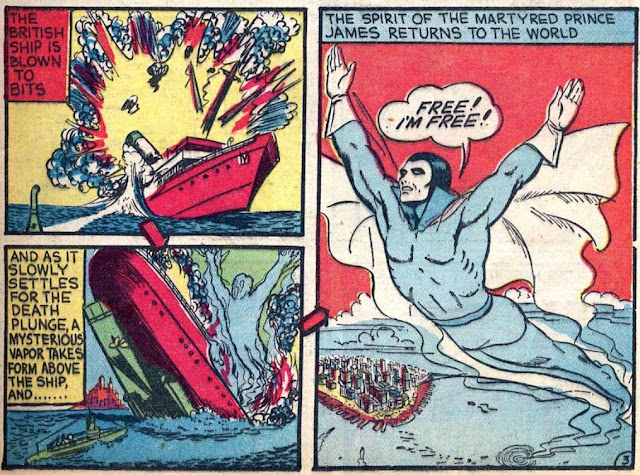
    Like the Spectre or the Wraith (or Sergeant Spook or the Gay Ghost or the Ghost Patrol…), Mr Justice is your classic restless spirit who remains on Earth to mete out justice to the wicked. Specifically, Mr Justice is the 200 year old ghost of the fictional English Prince James, cruelly slain by followers of Prince Richard during the Rogers Rebellion of the 1740s. Astute readers and students of history might have noticed a few things about the preceding sentence that all boil down to the fact that the 1740s were actually recent enough that we know a whole lot about what was going on then, including that people weren’t running around in Medieval armour even if they were sometimes still using swords and shields during the Jacobite Rebellion of 1745. Also, this is what the crown prince of England looked like in 1741. (they change it to the 11th Century later on, because that makes a lot more sense).

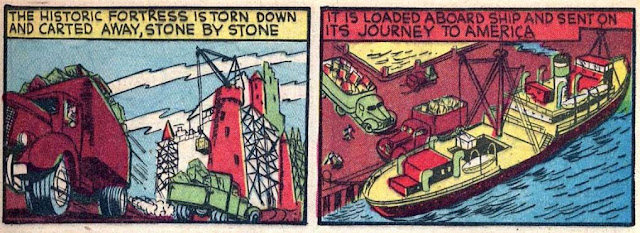
    Prince James’ ghost is tethered to the place of his death per the usual ghost rules but he manages to get around that in a fairly unprecedented way: due the the war, the British government decides to move the castle to America and it is sunk by the Nazis on the way there. And since a pile of stone on the bottom of the Atlantic is not a castle, James is free to go become Mr Justice, the ghost super-hero frequently compared to the Spectre but who doesn’t really get up to the sames sort of divine judgment stuff. He does fight the Devil/Satan a lot, though.

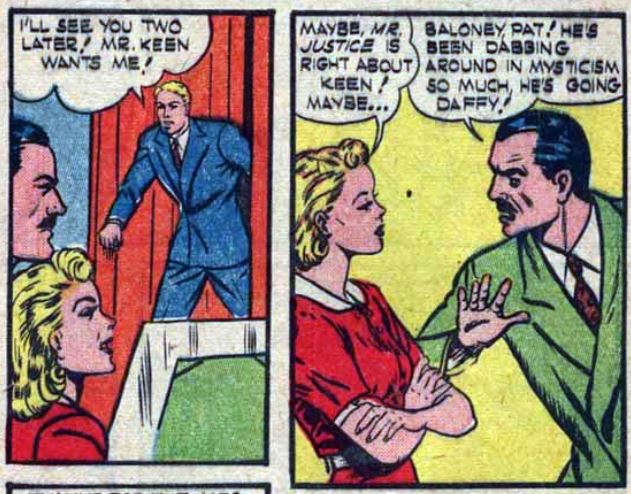
    Possibly my favourite thing about Mr Justice is the fact that his secret identity is a fellow named Mr Justice and nobody really calls any attention to that fact. Mr Justice (secret identity of Mr Justice) is attached to the office of Mayor Clark (city unnamed but very NYC-esque) as a sort of troubleshooter. He kind of has a love interest in mayor’s daughter Pat Clark and a rival in District Attorney Roy Winkler, above, but neither is explored very thoroughly. (Blue Ribbon Comics 009, 1941)

    Inferno:

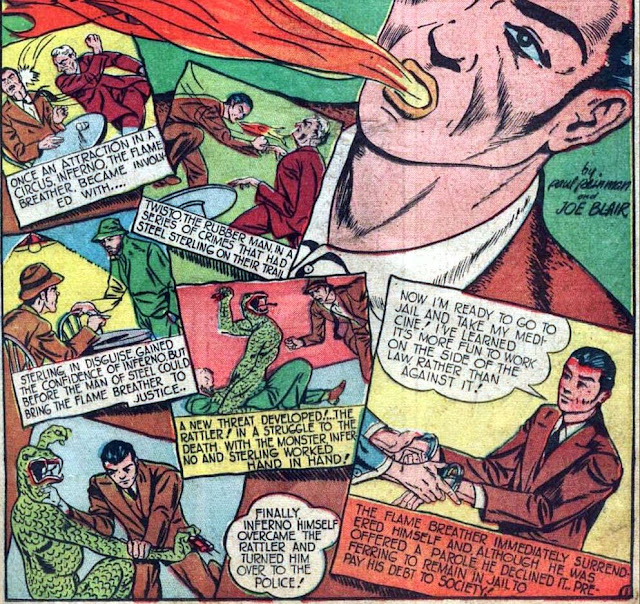
    Above is an abridged account of Inferno’s time as a super-villain, which we will treat separately because… well, because when you’re reading a lot of old comics in a somewhat systematic manner you have to have some sort of organizational method and I chose alphabetical by year, and Inferno’s time on the lists of crime happened in Zip Comics. I simply haven’t gotten there yet. Suffice to say that he was a crook who changed his ways due to the influence of Steel Sterling and opted to do his time.

    Despite his best efforts, Inferno is compelled to break jail to stop a group of prison escapees from murdering a judge and then is encouraged by that same judge to go on the lam because the authorities are going to try to murder Inferno. It’s a real reciprocal life-saving situation! Although I am tempted to think that that judge could possibly have just called someone and arranged for a stay of summary execution for Inferno.

    The rest of Inferno’s career as a Golden Age super-hero is kind of a fun twist on the old trope of the super-hero that everyone thinks is a crook, in that he doesn’t really have a secret identity per se so just travels around doing itinerant labour until he sees a crime go and changes outfits. The idea of this hobo existence kind of goes by the wayside after a couple of issues when Secret Service Agent Virginia Ames enters the picture, as Inferno’s stories were on the shorter side and just didn’t have the real estate for both a love interest and workplace drama.

    Inferno only managed seven adventures before trotting off to limbo to wait for Archie’s 1960s super-hero revival but don’t worry! He got a full pardon in his last adventure so the other heroes won’t be hassling him. (Blue Ribbon Comics 013, 1941)

    Captain Flag:

    On the one hand, Captain Flag is a regular-style patriotic hero but on a different, more entertaining hand he is a patriotic hero with a very fun origin. To whit: one day super-villain the Black Hand is attempting to wrest scientific secrets from inventor John Townsend when his playboy son Tom stumbles in half lit. The Black Hand is about to dispose of Tom using his horrible hand when a huge eagle just kind of… flaps into the room and ends up leaving with Tom Townsend in its talons.

    Thus saved, Tom just kind of lives with the eagle for a while and transforms from a dissipated youth to a lean, athletic man full of fish protein. And then the eagle comes back one day with an American flag! It’s a veritable sign from the heavens it what it is!

    And so, Tom Townsend becomes Captain Flag, who mostly fights the Black Hand. Which makes sense. Something else that would make a lot of sense: adding a belt to that costume. (Blue Ribbon Comics 016, 1941)

    The Red Mask:

    The Red Mask is very minor indeed! He appeared in four issues of Best Comics from Better Publications, of which only issue 2 appears to be available, which in turn was reprinting newspaper strips, of which only a handful are available. 

    What we have on the guy is this: he leads a tribe on the island of Kaukura, which is probably but not definitely in Oceania somewhere. Kaukura is chockablock with things like sacred grottoes, immortal monsters and hostile tribes and the Red Mask has assigned himself the task of protecting a bunch of clueless outsiders like Nina and Danny here who have blundered in looking for their friend and found themselves up to their neck in trouble.

    The most interesting thing about the Red Mask is that he is by a fair margin the first nonwhite super-hero, though thanks to colouring limitations and some inexact geography it’s a bit difficult to get more exact than that. (Best Comics 002, 1939)

  • MINOR SUPER-HERO ROUND-UP 011

    Lotsa lil guys.

    Mr Justice: 

    Like the Spectre or the Wraith (or Sergeant Spook or the Gay Ghost or the Ghost Patrol…), Mr Justice is your classic restless spirit who remains on Earth to mete out justice to the wicked. Specifically, Mr Justice is the 200 year old ghost of the fictional English Prince James, cruelly slain by followers of Prince Richard during the Rogers Rebellion of the 1740s. Astute readers and students of history might have noticed a few things about the preceding sentence that all boil down to the fact that the 1740s were actually recent enough that we know a whole lot about what was going on then, including that people weren’t running around in Medieval armour even if they were sometimes still using swords and shields during the Jacobite Rebellion of 1745. Also, this is what the crown prince of England looked like in 1741. (they change it to the 11th Century later on, because that makes a lot more sense).

    Prince James’ ghost is tethered to the place of his death per the usual ghost rules but he manages to get around that in a fairly unprecedented way: due the the war, the British government decides to move the castle to America and it is sunk by the Nazis on the way there. And since a pile of stone on the bottom of the Atlantic is not a castle, James is free to go become Mr Justice, the ghost super-hero frequently compared to the Spectre but who doesn’t really get up to the sames sort of divine judgment stuff. He does fight the Devil/Satan a lot, though.

    Possibly my favourite thing about Mr Justice is the fact that his secret identity is a fellow named Mr Justice and nobody really calls any attention to that fact. Mr Justice (secret identity of Mr Justice) is attached to the office of Mayor Clark (city unnamed but very NYC-esque) as a sort of troubleshooter. He kind of has a love interest in mayor’s daughter Pat Clark and a rival in District Attorney Roy Winkler, above, but neither is explored very thoroughly. (Blue Ribbon Comics 009, 1941)

    Inferno:

    Above is an abridged account of Inferno’s time as a super-villain, which we will treat separately because… well, because when you’re reading a lot of old comics in a somewhat systematic manner you have to have some sort of organizational method and I chose alphabetical by year, and Inferno’s time on the lists of crime happened in Zip Comics. I simply haven’t gotten there yet. Suffice to say that he was a crook who changed his ways due to the influence of Steel Sterling and opted to do his time.

    Despite his best efforts, Inferno is compelled to break jail to stop a group of prison escapees from murdering a judge and then is encouraged by that same judge to go on the lam because the authorities are going to try to murder Inferno. It’s a real reciprocal life-saving situation! Although I am tempted to think that that judge could possibly have just called someone and arranged for a stay of summary execution for Inferno.

    The rest of Inferno’s career as a Golden Age super-hero is kind of a fun twist on the old trope of the super-hero that everyone thinks is a crook, in that he doesn’t really have a secret identity per se so just travels around doing itinerant labour until he sees a crime go and changes outfits. The idea of this hobo existence kind of goes by the wayside after a couple of issues when Secret Service Agent Virginia Ames enters the picture, as Inferno’s stories were on the shorter side and just didn’t have the real estate for both a love interest and workplace drama.

    Inferno only managed seven adventures before trotting off to limbo to wait for Archie’s 1960s super-hero revival but don’t worry! He got a full pardon in his last adventure so the other heroes won’t be hassling him. (Blue Ribbon Comics 013, 1941)

    Captain Flag:

    On the one hand, Captain Flag is a regular-style patriotic hero but on a different, more entertaining hand he is a patriotic hero with a very fun origin. To whit: one day super-villain the Black Hand is attempting to wrest scientific secrets from inventor John Townsend when his playboy son Tom stumbles in half lit. The Black Hand is about to dispose of Tom using his horrible hand when a huge eagle just kind of… flaps into the room and ends up leaving with Tom Townsend in its talons.

    Thus saved, Tom just kind of lives with the eagle for a while and transforms from a dissipated youth to a lean, athletic man full of fish protein. And then the eagle comes back one day with an American flag! It’s a veritable sign from the heavens it what it is!

    And so, Tom Townsend becomes Captain Flag, who mostly fights the Black Hand. Which makes sense. Something else that would make a lot of sense: adding a belt to that costume. (Blue Ribbon Comics 016, 1941)

    The Red Mask:

    The Red Mask is very minor indeed! He appeared in four issues of Best Comics from Better Publications, of which only issue 2 appears to be available, which in turn was reprinting newspaper strips, of which only a handful are available. 

    What we have on the guy is this: he leads a tribe on the island of Kaukura, which is probably but not definitely in Oceania somewhere. Kaukura is chockablock with things like sacred grottoes, immortal monsters and hostile tribes and the Red Mask has assigned himself the task of protecting a bunch of clueless outsiders like Nina and Danny here who have blundered in looking for their friend and found themselves up to their neck in trouble.

    The most interesting thing about the Red Mask is that he is by a fair margin the first nonwhite super-hero, though thanks to colouring limitations and some inexact geography it’s a bit difficult to get more exact than that. (Best Comics 002, 1939)