The Curse of Skeleton Munroe

Category: Standard/Better/Nedor

  • CATALOGUE OF WOUNDS 008

    CATALOGUE OF WOUNDS 008

    Everybody gets shot now and then.

    the Bronze Terror: 

    The Bronze Terror is shot in the left arm during his first adventure by the wicked Scar Thornton, which gives him an excuse to show off his penchant for knocking out crooks’ teeth. (Daredevil Comics 002, 1941)

    Whiz, King of Falcons: 

    Whiz is shot through the left wing by a Lord Haw-Haw analog, and since this is the one issue in which he has the power of speech, he gets to complain about it. (Daredevil Comics 001, 1941)

    Trojak the Tiger Man: 

    Clawed across the chest by a lion. (Daring Mystery Comics 002, 1940)

    the Mask:

    The Mask gets his head creased by a bullet. (Exciting Comics 007, 1941)

    Sub-Zero: 

    Sub-Zero has an eventful 1941: first he gets shot in the right shoulder while parachuting… (Blue Bolt v1 012, 1941)

     … then breaks his right leg while in pursuit of a suspect… (Blue Bolt v2 001, 1941

    … and finally gets his skull creased by some trigger-happy miscreants.  (Blue Bolt v2 005, 1941

    the White Rider:

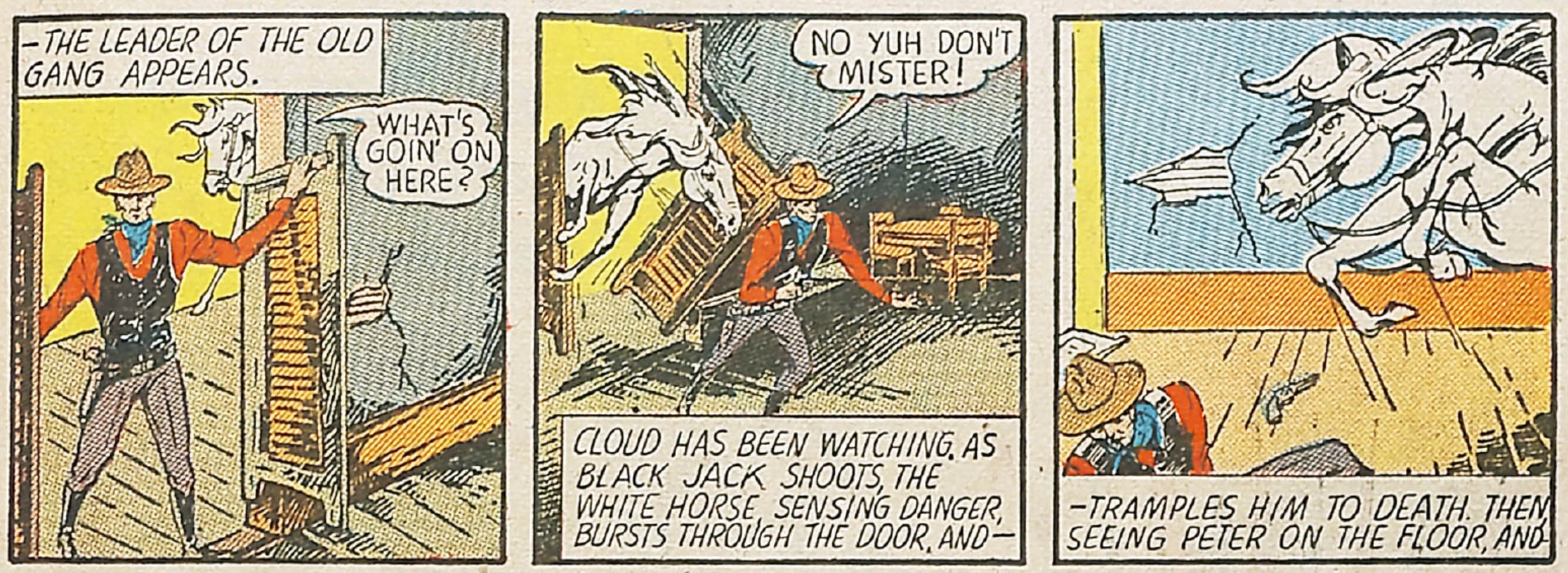
    The White Rider gets himself generically shot during his very first attempt to mete out vigilante justice, and it’s a lucky thing for him that he has Super Horse or there wouldn’t be a second. (Blue Bolt v1 001, 1940)

    Dr Miracle:

    Dr Miracle takes a thrown stiletto to the right shoulder while he is physically merger with his manservant Akim, which might also make this a stiletto to Akim’s shoulder as well. The physics of the situation are unclear. (Champ Comics 012, 1941)

    the Sphinx:

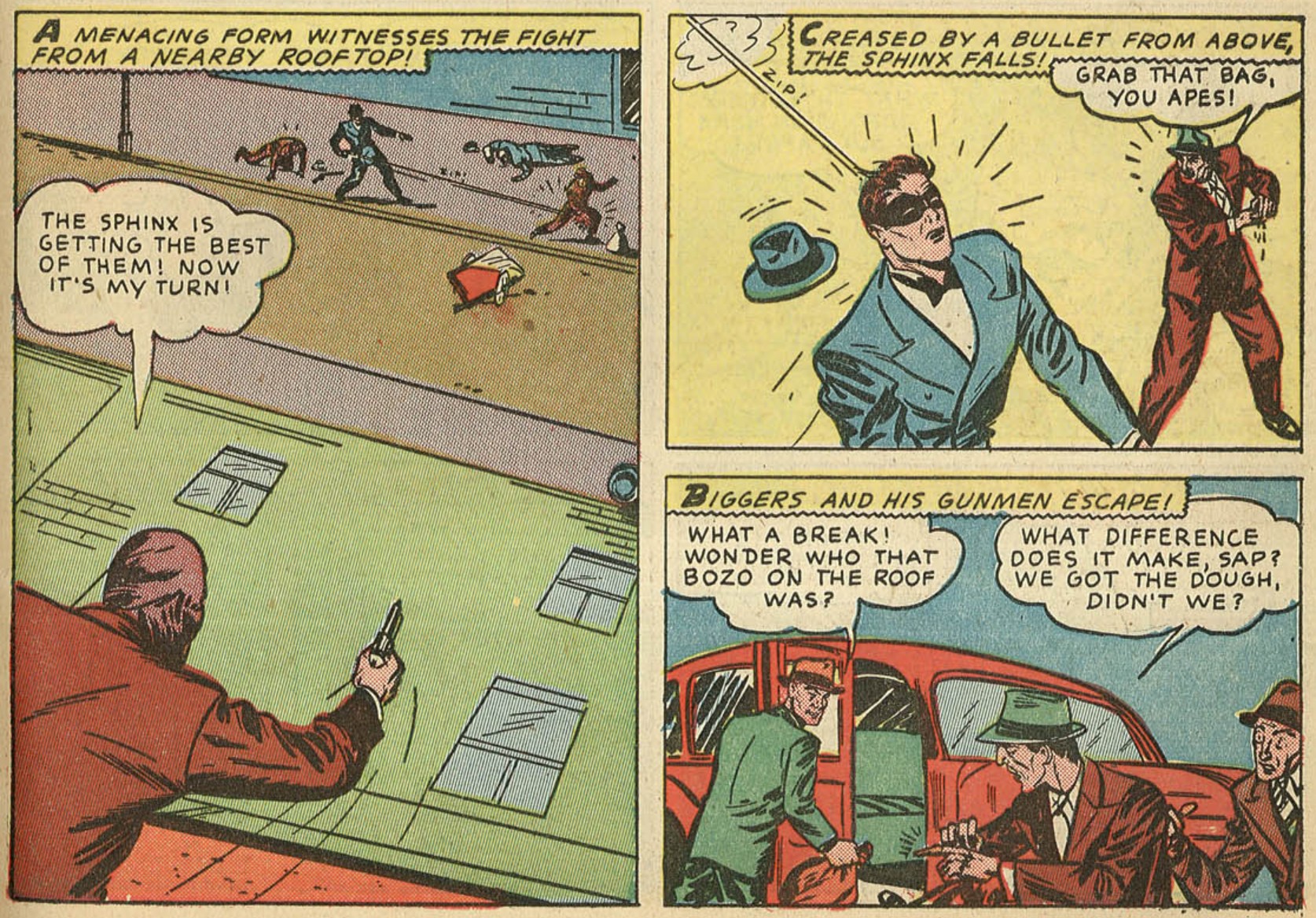
    Though he has in the past proved himself broadly invulnerable, the Sphinx is not immune to getting his skull creased by a bullet. (Exciting Comics 008, 1941) 

  • CATALOGUE OF WOUNDS 008

    CATALOGUE OF WOUNDS 008

    Everybody gets shot now and then.

    the Bronze Terror: 

    The Bronze Terror is shot in the left arm during his first adventure by the wicked Scar Thornton, which gives him an excuse to show off his penchant for knocking out crooks’ teeth. (Daredevil Comics 002, 1941)

    Whiz, King of Falcons: 

    Whiz is shot through the left wing by a Lord Haw-Haw analog, and since this is the one issue in which he has the power of speech, he gets to complain about it. (Daredevil Comics 001, 1941)

    Trojak the Tiger Man: 

    Clawed across the chest by a lion. (Daring Mystery Comics 002, 1940)

    the Mask:

    The Mask gets his head creased by a bullet. (Exciting Comics 007, 1941)

    Sub-Zero: 

    Sub-Zero has an eventful 1941: first he gets shot in the right shoulder while parachuting… (Blue Bolt v1 012, 1941)

     … then breaks his right leg while in pursuit of a suspect… (Blue Bolt v2 001, 1941

    … and finally gets his skull creased by some trigger-happy miscreants.  (Blue Bolt v2 005, 1941

    the White Rider:

    The White Rider gets himself generically shot during his very first attempt to mete out vigilante justice, and it’s a lucky thing for him that he has Super Horse or there wouldn’t be a second. (Blue Bolt v1 001, 1940)

    Dr Miracle:

    Dr Miracle takes a thrown stiletto to the right shoulder while he is physically merger with his manservant Akim, which might also make this a stiletto to Akim’s shoulder as well. The physics of the situation are unclear. (Champ Comics 012, 1941)

    the Sphinx:

    Though he has in the past proved himself broadly invulnerable, the Sphinx is not immune to getting his skull creased by a bullet. (Exciting Comics 008, 1941) 

  • ALIENS AND SO FORTH ROUND-UP 037

    Every once in a while I hit a particularly dense seam of aliens and so forth and this week is one of those times. 

    Neptunii: 

    The Neptunii (and that name is a guess based on the fact that one guy uses “Neptunus” as a singular version of the noun) live in Neptunia, an underground kingdom that could be described as “a big cave” at the bottom of the Atlantic Ocean. There, they seem to just kind of fly around shouting, though this short comic book story might not give a full picture of their society.

    There are a few points of interest about the Neptunii: they are both finned and winged, they all wear little horned circlets, they call their leader the “Sub-Ruler”… but the thing I am always struck by is just how much Prince Ikor and his pal in the above panel look like quirky characters from a late-90s webcomic. 

    Though Peter “the Fin” Noble becomes the ruler of Neptunia via a bit of impulsive regicide and remains so in his infrequent appearances to this day, to my knowledge the Neptunii themselves have not showed their faces since their first appearance in 1941. (Daring Mystery Comics 007, 1941)

    Inus-Men:

    The Inus-Men take their name from the fact that they are the inhabitants of the planet Inus. They are pretty regular-style cavemen, only more red, and are one of the many dangers faced by Dr X’s niece Cynthia when her astral form is blasted willy-nilly through space by her most unethical uncle. (Startling Comics 001, 1940)

    Jovians:

    The Jovians of the year 3964 AC (sic) are an oppressed underclass who work in the radium mines of the human colony on Jupiter. They are unable to own weapons by law, are possibly disallowed from large gatherings or approaching humans (see the first two panels above where the “boldness” of the Jovians is discussed) and generally mirror the conditions of colonized peoples on our world. This all clearly sucks and is unjust, which is especially interesting because the comic it all appears in clearly considers it to be the natural order of things.

    The Jovians are ripe for (and right to) revolt, and do so under the leadership of the evil Space Emperor. Once he is captured and revealed to be an opportunist by Major Mars they are returned to their place under the collective human thumb. (Exciting Comics 001, 1940)

    Jovians:

    Our second set of Jovians are also radium focused, but rather than mining it for their human overlords they use it to generate power, and having run out they are now demanding that both Earth and Mars hand over their radium supply or face annihilation. This draws the ire of space adventurer and Earth-Mars envoy Mitey Powers and he sets out with his entourage to resolve the situation.

    The title of this story is “The Super-Giants of Jupiter,” and I really appreciate that it lives up to the name. These Jovians are big, man. They’re also pleasingly alien, with their fish heads and tendril hands.

    I can only assume that it is the fact that the Jovians and their warships are so big contributes to Mitey’s decision to commit a war crime against their populace by unleashing a swarm of Martian Poison Gnats that will breed uncontrollably and “[kill] off most of the people.” It’s a horrible crime, Mitey! Particularly as radium is one of the less-used radioactive elements today! (Superworld Comics 003, 1940)

  • ALIENS AND SO FORTH ROUND-UP 037

    Every once in a while I hit a particularly dense seam of aliens and so forth and this week is one of those times. 

    Neptunii: 

    The Neptunii (and that name is a guess based on the fact that one guy uses “Neptunus” as a singular version of the noun) live in Neptunia, an underground kingdom that could be described as “a big cave” at the bottom of the Atlantic Ocean. There, they seem to just kind of fly around shouting, though this short comic book story might not give a full picture of their society.

    There are a few points of interest about the Neptunii: they are both finned and winged, they all wear little horned circlets, they call their leader the “Sub-Ruler”… but the thing I am always struck by is just how much Prince Ikor and his pal in the above panel look like quirky characters from a late-90s webcomic. 

    Though Peter “the Fin” Noble becomes the ruler of Neptunia via a bit of impulsive regicide and remains so in his infrequent appearances to this day, to my knowledge the Neptunii themselves have not showed their faces since their first appearance in 1941. (Daring Mystery Comics 007, 1941)

    Inus-Men:

    The Inus-Men take their name from the fact that they are the inhabitants of the planet Inus. They are pretty regular-style cavemen, only more red, and are one of the many dangers faced by Dr X’s niece Cynthia when her astral form is blasted willy-nilly through space by her most unethical uncle. (Startling Comics 001, 1940)

    Jovians:

    The Jovians of the year 3964 AC (sic) are an oppressed underclass who work in the radium mines of the human colony on Jupiter. They are unable to own weapons by law, are possibly disallowed from large gatherings or approaching humans (see the first two panels above where the “boldness” of the Jovians is discussed) and generally mirror the conditions of colonized peoples on our world. This all clearly sucks and is unjust, which is especially interesting because the comic it all appears in clearly considers it to be the natural order of things.

    The Jovians are ripe for (and right to) revolt, and do so under the leadership of the evil Space Emperor. Once he is captured and revealed to be an opportunist by Major Mars they are returned to their place under the collective human thumb. (Exciting Comics 001, 1940)

    Jovians:

    Our second set of Jovians are also radium focused, but rather than mining it for their human overlords they use it to generate power, and having run out they are now demanding that both Earth and Mars hand over their radium supply or face annihilation. This draws the ire of space adventurer and Earth-Mars envoy Mitey Powers and he sets out with his entourage to resolve the situation.

    The title of this story is “The Super-Giants of Jupiter,” and I really appreciate that it lives up to the name. These Jovians are big, man. They’re also pleasingly alien, with their fish heads and tendril hands.

    I can only assume that it is the fact that the Jovians and their warships are so big contributes to Mitey’s decision to commit a war crime against their populace by unleashing a swarm of Martian Poison Gnats that will breed uncontrollably and “[kill] off most of the people.” It’s a horrible crime, Mitey! Particularly as radium is one of the less-used radioactive elements today! (Superworld Comics 003, 1940)

  • NOTES – APRIL 2026

    Cops Shooting at Fleeing Suspects:

    Here’s an intrepid officer trying to shoot the Black Terror and his (very young) sidekick Tim in the backs as they run away from the scene of a late-night disturbance. (Exciting Comics 015, 1941)

    Samson Does the Thing: 

    Several new additions to the premiere Samson supercut:

    Marthas:

    A new addition to the League of Marthas: the Golden Knight’s mother, Queen Martha of the Tree People! (Fantastic Comics 015, 1941)

    Places and History:

    In a rare callback to some of the fake countries from previous Yank Wilson stories, Imperial Japan analog Hondo (Fantastic Comics 009) and Nazi Germany analog Prussland (Fantastic Comics 011) ally with Fascist Italy analog Napoli to form an Axis Powers analog referred to as the Triparty Aggression Pact. I have to say that it was a true thrill to see not one but two whole countries be re-used, rather than being new ones just made up on the spot.

    I was soon dashed from these giddy heights, however, as Yank Wilson almost immediately invented Japanese Hondoese Internment Camps. (Fantastic Comics 016, 1941)

  • NOTES – APRIL 2026

    Cops Shooting at Fleeing Suspects:

    Here’s an intrepid officer trying to shoot the Black Terror and his (very young) sidekick Tim in the backs as they run away from the scene of a late-night disturbance. (Exciting Comics 015, 1941)

    Samson Does the Thing: 

    Several new additions to the premiere Samson supercut:

    Marthas:

    A new addition to the League of Marthas: the Golden Knight’s mother, Queen Martha of the Tree People! (Fantastic Comics 015, 1941)

    Places and History:

    In a rare callback to some of the fake countries from previous Yank Wilson stories, Imperial Japan analog Hondo (Fantastic Comics 009) and Nazi Germany analog Prussland (Fantastic Comics 011) ally with Fascist Italy analog Napoli to form an Axis Powers analog referred to as the Triparty Aggression Pact. I have to say that it was a true thrill to see not one but two whole countries be re-used, rather than being new ones just made up on the spot.

    I was soon dashed from these giddy heights, however, as Yank Wilson almost immediately invented Japanese Hondoese Internment Camps. (Fantastic Comics 016, 1941)

  • NOTES – MARCH 2026

    Cops Shooting Fleeing Suspects: 

    The NYPD do their level best to gun down the Challenger for wearing a mask near the scene of a crime. (Daring Mystery Comics 007, 1941)

    Some probably-also-NYPD officers try to do the same to the Black Cobra. (Dynamic Comics 001, 1941)

    Some definitely-NYPD officers try to gun down a fleeing Mask. (Exciting Comics 010, 1941)

    Honours:

    Heroic dog K-9 is given a medal and made an official officer in what is also likely supposed to be the NYPD. (Dynamic Comics 001, 1941)

    Temporally Tricky Westerns:

    I’ve occasionally talked about the temporal uncertainty of depictions of the West in comics of the 1940s and 1950s, in that comics set in the modern day are given all of the tropes of the Old West, such that you don’t know what era they are taking place until someone flies a plane on-panel etc. The “Jim Hatfield” feature in Exciting Comics might just take the cake on this front. Every issue features Hatfield seemingly stepping from the present-day Texas Ranger HQ through a time portal to the 1850s.

  • ALIENS AND SO FORTH ROUND-UP 023

    A fine batch of aliens for ye this day, sor! 

    Inferians: 

    The wandering planet Inferno threatens to destroy the Earth with its heat, and the magician Zambini (plus some lady and the mad astronomer Professor Stargaze) travel to its surface in an attempt to cool it down. There they find the Inferians, charmingly can-shaped aliens made out of heat-resistant glass.

    We learn more information than usual about this alien culture from a handy text box: the nearby Inferian city is called Cinderburg, and the tap-based language is called Clink. From an Inferian tranformed into a human we learn that the king of Inferno is known as the Great Glassblower, plus the fact that Inferians can be horny.

    The Great Glassblower is implied to have made the Inferians somehow, so I had expected him to be some other manner of being but instead he is just a slightly better-dressed Inferian with a hostile attitude and a bowl full of molten glass that he’s not afraid to throw at intruders. Zambini nonetheless manages to seal up the huge volcano that is the source of Inferno’s great heat (and hopefully not important for maintaining the lives of the Inferians somehow) and thus Earth is saved! (Zip Comics 002, 1940)

    Etherians and Rodongees: 

    After helping the Barrangees move back to the surface of their world and defeat the giant insect species that had driven them underground in the first place, Captain Tornado and his fellow Earthicans were probably ready for a bit of a break from inter-species combat. Well, tough luck, because upon closer inspection, some of the giant insects flying around the surface of Barrang were not insects at all but insect-shaped vehicles piloted by four-armed, blue-haired guys with fragile constitutions and a bad attitude, and Tornado, his friends and a whole bunch of Barrangees are rounded up and taken prisoner by them.

    Their jailers turn out to be called Etherians, and the Etherians turn out to be jerks who have already enslaved a race called the Rodongees and now propose to do the same to the Barrangees. Tornado and his party fall in with a group of freedom-fighting Rodongees and pledge to help them overthrow the Etherians once and for all… and that is the end of the “Captain Tornado” feature. I sure hope they managed to complete their mission without having any more alien trouble on Barrang! (Popular Comics 056, 1940)

    the Evil Gods: 

    Ted Hunt and Jane Martin, the Star Rovers, are making an exploratory stop on Venus when they are captured by a tribe of post-apocalyptic Venusians, but just what exactly was the apocalypse that made them so? They soon find out when they witness a Venusian hunter being chased down and seemingly eaten by a robot referred to as one of the “Evil Gods.”

    And just what are the Evil Gods? Once Ted beats up the Venusian king he gets the story of how his people found six of them deep underground in some sort of suspended animation and how once they were accidentally revived they enslaved the former Venusian civilization and reduced the few free members of the species to starving in isolated swamps. Ted, now king of the Venusians, vows to free the people from the tyranny of the Evil Gods.

    Ted and Jane set out to find food and are immediately captured and transported back to the Evil Gods’ seat of power, where they learn that the tyrant beings are not in fact robots but blobby green aliens that use the impervious robotic exoskeletons to protect their frail flesh. 

    Ted escapes to retrieve his spaceship and takes advantage of the Gods’ habit of sleeping outside of their shells to kill five of them. The sixth, on watch over the Venusian slaves, is lassoed and dragged into a cave where it is then sealed, hopefully for all time. The Venusians (and Jane) are free! (Exciting Comics 003, 1940)

    Fang Men: 

    The Fang Men of Jupiter (or Jupitor, as it appears here) might have a rich and beautiful society that values poetry and art and presumably good dentistry but alas that is not how we encounter them while reading the adventures of Cosmic Carson. 

    Instead, all of the Fang Men we meet are space pirates, and particularly jerky ones at that. We can only hope that this is not an accurate picture of Fang-Man society as a whole. (Science Comics 001, 1940)

  • ALIENS AND SO FORTH ROUND-UP 023

    A fine batch of aliens for ye this day, sor! 

    Inferians: 

    The wandering planet Inferno threatens to destroy the Earth with its heat, and the magician Zambini (plus some lady and the mad astronomer Professor Stargaze) travel to its surface in an attempt to cool it down. There they find the Inferians, charmingly can-shaped aliens made out of heat-resistant glass.

    We learn more information than usual about this alien culture from a handy text box: the nearby Inferian city is called Cinderburg, and the tap-based language is called Clink. From an Inferian tranformed into a human we learn that the king of Inferno is known as the Great Glassblower, plus the fact that Inferians can be horny.

    The Great Glassblower is implied to have made the Inferians somehow, so I had expected him to be some other manner of being but instead he is just a slightly better-dressed Inferian with a hostile attitude and a bowl full of molten glass that he’s not afraid to throw at intruders. Zambini nonetheless manages to seal up the huge volcano that is the source of Inferno’s great heat (and hopefully not important for maintaining the lives of the Inferians somehow) and thus Earth is saved! (Zip Comics 002, 1940)

    Etherians and Rodongees: 

    After helping the Barrangees move back to the surface of their world and defeat the giant insect species that had driven them underground in the first place, Captain Tornado and his fellow Earthicans were probably ready for a bit of a break from inter-species combat. Well, tough luck, because upon closer inspection, some of the giant insects flying around the surface of Barrang were not insects at all but insect-shaped vehicles piloted by four-armed, blue-haired guys with fragile constitutions and a bad attitude, and Tornado, his friends and a whole bunch of Barrangees are rounded up and taken prisoner by them.

    Their jailers turn out to be called Etherians, and the Etherians turn out to be jerks who have already enslaved a race called the Rodongees and now propose to do the same to the Barrangees. Tornado and his party fall in with a group of freedom-fighting Rodongees and pledge to help them overthrow the Etherians once and for all… and that is the end of the “Captain Tornado” feature. I sure hope they managed to complete their mission without having any more alien trouble on Barrang! (Popular Comics 056, 1940)

    the Evil Gods: 

    Ted Hunt and Jane Martin, the Star Rovers, are making an exploratory stop on Venus when they are captured by a tribe of post-apocalyptic Venusians, but just what exactly was the apocalypse that made them so? They soon find out when they witness a Venusian hunter being chased down and seemingly eaten by a robot referred to as one of the “Evil Gods.”

    And just what are the Evil Gods? Once Ted beats up the Venusian king he gets the story of how his people found six of them deep underground in some sort of suspended animation and how once they were accidentally revived they enslaved the former Venusian civilization and reduced the few free members of the species to starving in isolated swamps. Ted, now king of the Venusians, vows to free the people from the tyranny of the Evil Gods.

    Ted and Jane set out to find food and are immediately captured and transported back to the Evil Gods’ seat of power, where they learn that the tyrant beings are not in fact robots but blobby green aliens that use the impervious robotic exoskeletons to protect their frail flesh. 

    Ted escapes to retrieve his spaceship and takes advantage of the Gods’ habit of sleeping outside of their shells to kill five of them. The sixth, on watch over the Venusian slaves, is lassoed and dragged into a cave where it is then sealed, hopefully for all time. The Venusians (and Jane) are free! (Exciting Comics 003, 1940)

    Fang Men: 

    The Fang Men of Jupiter (or Jupitor, as it appears here) might have a rich and beautiful society that values poetry and art and presumably good dentistry but alas that is not how we encounter them while reading the adventures of Cosmic Carson. 

    Instead, all of the Fang Men we meet are space pirates, and particularly jerky ones at that. We can only hope that this is not an accurate picture of Fang-Man society as a whole. (Science Comics 001, 1940)
  • ALIENS AND SO FORTH ROUND-UP 015

    A veritable bounty of aliens for your perusal.

    People of Venus, the Jibbering Giant of Jupiter, Weird Inhabitants of the Strange Planet: 

    Blast Bennett has lost his little pal Red, and his solution is to just kind of bop around from planet to planet, asking random aliens if they have seen a red-headed guy. I’ve grouped these alien together because they all represent a very boring alien design trend of the 40s and 50s (and beyond!): the alien as just some guy. The Venusians are short, bald guys; the Jovian is a really big guy and the weird inhabitants of the strange planet are guys who could use a shower. (Weird Comics 004, 1940)

    Ceresians:

    During an unscheduled stop on then-asteroid/now-dwarf planet Ceres for water, Ted Hunt and Jane Martin, aka the Star Rovers, stumble into a conflict between the underground-dwelling native Ceresians and gargoyle-like invaders known as the Harpies.

    This is a pretty classic setup! The planet full of generic white guys vs some horrible space monsters scenario is a surefire way to engender sympathy in an early 20th Century American audience! It does however leave you with some fairly uninteresting humanoid aliens – I do appreciate the seeming shift in Ceresian society from a Medieval to more of a Roman aesthetic as they are forced to abandon their castles for retrofuturistic bunkers, but that’s about it. (Exciting Comics 005, 1940)

    Harpies: 

    The Space Rovers make their way to the Harpy home on Asteroid Nunda and are almost immediately captured after being incapacitated by the thin Nundan atmosphere. They find that rather than being simple predators, the Harpies have an advanced society that places great value in both science and the democratic process. They are, sadly, complete Harpy chauvinists who don’t recognize the humanity harpianity shared intelligent experience of other species, which is why they’re so happy to raid Ceres for fun and food.

    Ted and Jane escape this fate due to the Harpies’ scientific curiosity about them, and manage to parley that into a successful escape attempt. Once back in their ship and armed with superior firepower, perhaps they will be able to force the Harpies to stop their vicious ways at the barrel of a gun!

    Just kidding! As a nonhuman species who pose a threat to a world of white guys, the Harpies are of course fair game for utter and total annihilation – I’m talking blow up their cities and hunt down all of the survivors. But don’t feel bad, because as Jane says, “they’re nothing but enormous, blood-thirsty bats!” Now the Ceresians are free to go back to inventing feudalism or whatever. (Exciting Comics 005, 1940) 

    Lunaris:

    The way I do these Alien Round-Ups is that the first entry is from whatever comic I’m reading at the moment and then I pluck the rest from a big ol’ spreadsheet that I’ve been maintaining for years, which is why it’s a pretty fun coincidence that the the next aliens on my list after the Ceresians were the Cold Men, who rule the surface of an unnamed icy moon while a race of white guys called the Lunaris hide in tunnels below. Once Ray Darrow, aka the Star Rover (another little coincidence there) stumbles into this conflict he of course sides with the noble Lunaris against the horrible Cold Men, and it doesn’t hurt that the Lunaris Queen is somehow descended from Earth humans, so that Darrow can feel okay with being attracted to her, I guess. (Doc Savage Comics v1 003, 1941)

    Cold Men: 

    Cold Man society isn’t quite as fleshed out as the Harpies’ was, but Darrow’s conclusion is the same: to ensure the continued safety of the much more familiar-looking Lunaris, the Cold Men must be utterly annihilated – sure hope that the newly surface-dwelling Lunaris don’t find the headquarters of some sort of Cold Man organization dedicated to fostering peace between the species or they might end up feeling guilty about their role in this genocide some day. 

    … I do like that the Cold Men seem to actually be made of snow or ice. (Doc Savage Comics v1 003, 1941)