The Curse of Skeleton Munroe

Category: Standard/Better/Nedor

  • DIVINE ROUND-UP 004

    Can you ever have enough made-up gods? 

    the Goddess of Fire: 

    Crooks Raoul and Victor Ladron hatch a scheme while hiding out on the South Pacific island of Kumoni: since the idol of the local Goddess of Fire looks identical to former super-villain Elena they will engineer her kidnapping, hypnotize her into impersonating the goddess and then kill her to prove that they are more powerful than her and thus deserve to make off with the temple gold. This plan is of course complicated by the fact that Elena is engaged to the nigh-omnipotent super-hero Mr Mystic, and the Ladrons meet a fiery end. 

    God style: idol only (The Spirit Section, 3 November, 1940)

    the Gansha:

    Adam Starr of the Space Legion is on the hunt for space pirate extraordinaire Black Michael, and no mealy-mouthed warning about a “water-god” who has “destroyed all who ventured near his cursed waters” for “untold ages” is going to stop him from searching the Martian canals.

    Starr’s manly skepticism doesn’t pay off this time, as Gansha the Water-God turns out not only to be real but to be a monstrous carnivorous fish that almost devours both him and his submersible without even needing to chew.

    Sadly for monster fans and fish fans alike, Gansha is unceremoniously blown to smithereens when Black Michael attempts to use it as a deathtrap to get rid of Starr without checking to see if he might have a ludicrously overpowered atomic sidearm on his person. Presumably the Martians are happy – the ones who like boat rides and don’t belong to any kind of Gansha-worshipping sect, at least.

    God style: animist (Crash Comics Adventures 003, 1940) 

    Golo:

    We get little in the way of detail on Golo, save that they are worshipped “from Ubangi to the Sudan” and that displaying a Golo fetish can grant safe passage in those areas. And that adventurer Ted Crane thinks it’s all poppycock, of course.

    God style: idol only (Exciting Comics 005, 1940) 

    the Ice Gods: 

    Stuart Taylor and his pals have been time travelling again, and this time they’ve ended up in the clutches of a prehistoric trip at the surprisingly rapid dawn of the last Ice Age, the environmental effects of which have been personified as the malevolent Ice 

    God style: animist (Jumbo Comics 028, 1941)

  • NOTES: JULY 2025

    The Fates of Various Nazi Warships: 

    Given the penchant for featuring even quite famous and obvious things under false names in comics, I always end up noticing when something or someone shows up under their own moniker, which is why I was very surprised when Royal Navy submarine captain Tom Niles, aka the Undersea Raider, is responsible for sinking several real Nazi warships in this 1940 comic. The casualties include the cruiser Admiral Scheer (sunk in 1945 in our world) and the battleships Bismarck (scuttled in 1941), and Scharnhorst (sunk in 1943). I had thought that the Admiral Graf Spee was another of these anachronistically early kills, but this depiction of it’s scuttling off of Montevideo, Uruguay is broadly accurate, except that it happened in 1939. A wild time for naval combat. (Thrilling Comics 004, 1940)

    The Fate of Rome:

    Specifically, the fate of Rome during the Great Fire of 64 CE. There are a lot of theories about how and why the fire was started, but very few of them revolve around it accidentally being started by magician/adventurer the Ghost and his companions while attempting to escape Emperor Nero’s soldiers with the help of an electric ray projector. (Thrilling Comics 008, 1940) 

    Honours – Doc Strange: 

    Doc Strange is given an unspecified medal by FDR for foiling a plot to bomb Washington DC. (Thrilling Comics 010, 1940) 

    The next issue, Doc gets a parade for saving NYC from being bombed into dust. (Thrilling Comics 011, 1940) 

    Honours – the Firefly: 

    Harley “the Firefly” Hudson was Intercollegiate Pole Vault Champion during his time at NYU – plus he went to NYU! Very exciting to know exactly where a super-hero got his education. (Top-Notch Comics 009, 1940) 

    Honours – Fran Frazer: 

    Magazine photographer Fran Frazer receives a medal from the country of Murania for preventing a Nazi invasion. (Top-Notch Comics 010, 1940) 

    Alternate Identity: 

    Doc Strange, while suffering from amnesia, boxes world heavyweight champion Bull Gallagher under the identity of the Unknown. (Thrilling Comics 001, 1940) 

  • DIVINE ROUND-UP 002

    Oh so spiritual, we are.

    Koli Tow: 

    Hal Hazard and his brother Hoagy are adventuring in the South Seas when they get shipwrecked, which is not really an excuse for just wandering into a local temple to eat the food offerings but I guess when you’re hungry a little sacrilege is easy to justify. Even so, the local worshippers of Koli Tow aren’t particularly understanding about it, and given the nature of the comic there’s a human sacrifice in the offing until Hal and Hoagy escape to take their brand of cultural sensitivity to another island. 

    God Style: idol (Circus, the Comic Riot 001, 1938)

    the Canal God: 

    An adventure on Mars brings the Space Rovers to the temple of the Canal God, who basically just looks like a dude because this is a Mars populated by basic-ass humanoids. Just what persentage of Martian gods are going to turn out to be canal-related, anyway? 

    God style: idol (Exciting Comics 004, 1940)

    Death: 

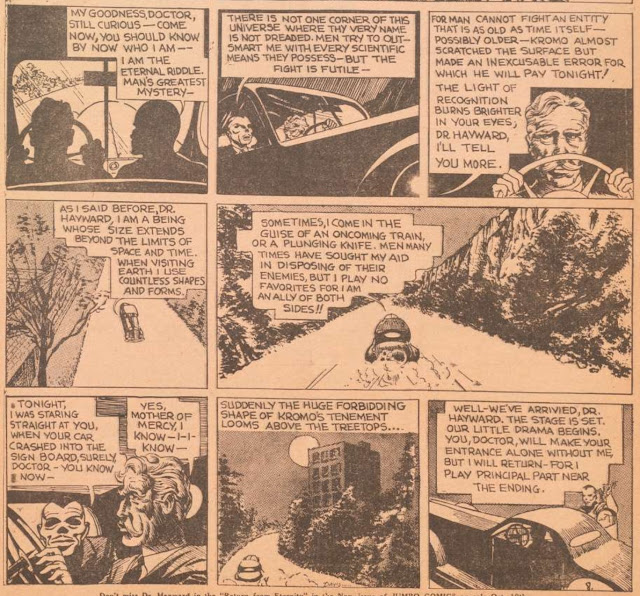
    There are a few ways that the anthropomorphic personification of death is commonly written -compassionate, dispassionate, cruel, goofy – but this particular one crops up in genre fiction a fair amount: personally offended by people attempting to extend their lifespan. This particular version of Death is both pissy about the scientist Kromo’s attempt to live forever via soul transfer and willing to take a hand in preventing him from doing so. He also seems to really enjoy freaking people out, as seen in his car ride with heroic scientist Dr Hayward. 

    God style: real, anthropomorphic personification. (Jumbo Comics 002-004, 1938) 

    Deli-Deli: 

    As is often the case I am torn between finding Malaysian idol-god Deli-Deli charmingly goofy looking and knowing that the goofiness is part of the sneering “these primitive people will worship anything at the heart of many this kind of jungle adventure.

    God-style: idol (Big Shot Comics 013, 1941) 

  • DIVINE ROUND-UP 002

    Oh so spiritual, we are.

    Koli Tow: 

    Hal Hazard and his brother Hoagy are adventuring in the South Seas when they get shipwrecked, which is not really an excuse for just wandering into a local temple to eat the food offerings but I guess when you’re hungry a little sacrilege is easy to justify. Even so, the local worshippers of Koli Tow aren’t particularly understanding about it, and given the nature of the comic there’s a human sacrifice in the offing until Hal and Hoagy escape to take their brand of cultural sensitivity to another island. 

    God Style: idol (Circus, the Comic Riot 001, 1938)

    the Canal God: 

    An adventure on Mars brings the Space Rovers to the temple of the Canal God, who basically just looks like a dude because this is a Mars populated by basic-ass humanoids. Just what persentage of Martian gods are going to turn out to be canal-related, anyway? 

    God style: idol (Exciting Comics 004, 1940)

    Death: 

    There are a few ways that the anthropomorphic personification of death is commonly written -compassionate, dispassionate, cruel, goofy – but this particular one crops up in genre fiction a fair amount: personally offended by people attempting to extend their lifespan. This particular version of Death is both pissy about the scientist Kromo’s attempt to live forever via soul transfer and willing to take a hand in preventing him from doing so. He also seems to really enjoy freaking people out, as seen in his car ride with heroic scientist Dr Hayward. 

    God style: real, anthropomorphic personification. (Jumbo Comics 002-004, 1938) 

    Deli-Deli: 

    As is often the case I am torn between finding Malaysian idol-god Deli-Deli charmingly goofy looking and knowing that the goofiness is part of the sneering “these primitive people will worship anything at the heart of many this kind of jungle adventure.

    God-style: idol (Big Shot Comics 013, 1941) 

  • DIVINE ROUND-UP 001

    As long as we’re dipping into the aliens of comics, we might as well go all the way and dig out all the various gods etc that people have made up too. Comic book divinities fall into a few broad styles:

    -real objects or creatures worshipped animistically but which do not display any real divine power

    -idols, verbal invocations or other trappings of religious worship without any indication that the being being represented is really real

    -actual supernatural beings, including:

    –versions of actual deities

    –new additions to real-world pantheons 

    –gods made up out of whole cloth

    Obviously there is some overlap between these categories. The idol that bestows curses or good luck, the invocation that does the same. Is a sacred tree an idol or animism or both? What if it delivers blessings on the faithful? 

    The other thing to mention about comic book representations or religion is that huge swathes of them are being presented through the triple lenses of Smug 40s Rationalism, Default Christianity and White Supremacy in a real racist trifecta. Barring the odd exception we’re going to see a lot of It’s Silly to Believe in a Non-Christian God and All Non-Christian Religions are Actually Long Cons by Priestly Classes along with some If There is a Real Entity Behind This Then They are Actually a Horrible Evil. Plus a lot of elder god-monsters and culturally safe classical deities and so forth.

    So: on we go! 

    the Guardian of the Grotto of Jewels: 

    Though the Red Mask is the leader of some or all of the peoples of the island of Kakura, he doesn’t seem to have much regard for their culture (as befits a proper 1940s rationalist hero, I suppose), as in quick succession he a) brings a girl to the sacred Grotto of Jewels, b) gives her some of the eponymous jewels and c) kills the grotto’s guardian god-monster with a boat. 

    God-style: animistic worship of a real beast (Best Comics 001, 1939)

    Akrifa: 

    Akrifa here is the god worshipped by the evil King Tongo. He’s some sort of fire god who Tongo does human sacrifice to, but before he really gets a chance after building Akrifa a shiny new temple, Kaänga ends up smashing the idol to flinders and Tongo is killed by an elephant. 

    God-style: idol only (Jungle Comics 009, 1940)

    Ailus the Flamingo God: 

    He may just be another idol that a hapless white lady almost gets sacrificed to to you, but Ailus the Flamingo God has a certain whimsy that is lacking in most of his ilk. 

    God-style: idol (Jungle Comics 011, 1940)

    Baako: 

    There’s not a lot of detail given here but who cares. Baako is a Martian god, and you know I’m going to be into something like that. And just in case you need a bit more sauce to get excited about a Martian deity, this one was created by Jack Kirby!

    God-style: invoked (Crash Comics Adventures 003, 1940)

  • GENERIC COSTUMED VILLAIN ROUND-UP 020

    We’re stretching the definition of the term “generic” this week, folks.

    Carr, the self-styled Planetary Potentate, is released from the insane asylum that he is imprisoned in when a resurrected sub-sea dinosaur called the Amphisaur crashes into it. He sets out to claim his rightful place at the head of society, along with his friend/ companion/ army, the wild man Simeo.

    While murdering and robbing a gas station attendant, Carr learns of the Amphisaur and its role in their escape and vows to aid his newfound ally against the forces of the enemy as represented by former mummy/current magical super-hero Mystico.

    At this point in the story I am fully expecting the pair to have a meaningful interaction with the Amphisaur, something along the lines of them interfering with Mystico’s second attempt to kill it and then either riding it around as a war-beast or getting eaten by an uncaring monster. Instead, they are unceremoniously knocked out by the Amphisaur’s death-throes. Mystico doesn’t even know that they’re there! (Startling Comics 004, 1940)

    Boris Ivanoff is not a particularly remarkable freelance spy in most respects, but he really does have a flair for the theatrical. I really like the flashlight bit above, but I really really like the fact that he wears that sheet ghost outfit for the entire adventure for no stated reason. The authorities already know his name, where he is and enough about his plans to substitute secret agent Q-13 for his new recruit, for heavens sake. They don’t even bother to dramatically unmask Ivanoff at the end, because the sheet is apparently just an affectation! (Super-Mystery Comics v1 003, 1940)

    This fellow is really Jay Jackson, publisher of newspaper the Morning Star, who extorts money out of people by threatening to print scandalous articles about them and then murders the ones who refuse to pay. He is very frustrating to me because I find his weird Halloween mask disguise very charming, except that I have read this story and know that it is a racist Chinese caricature, which is the opposite of charming. Annoying!

    Jackson is also the subject of what is possibly the most extreme version of the bit where a super-hero scares a confession out of someone I have ever read, in which Magno collapses an entire skyscraper on top of him, seemingly with no guarantee that he will survive the process. Plus, there are like half a dozen other crooks in the building when it comes down and none of them are extracted from the wreckage in time to confess their wrongdoings. (Super-Mystery Comics v1, 1940)

    Adopting the role of the high priest of the local Tiger-God might have seemed like a good way to take control of a region that contained a rich gold mine, but all too predictably it ended up with this fellow being thrown into his own tiger pit once he is revealed as a fraud by adventurer Scotty of the Skyways. (Super Spy 001, 1940)

  • MINOR SUPER-HERO ROUND-UP 045

    Ah the super-hero.

    Ace Buckley: 

    Ace Buckley is a time traveller, a subgenre of comic book hero mostly notable for the fact that they have no one to blame for their troubles but themselves. Like most of his peers, Buckley (along with his intriguingly-named companion Toni Stark, whose role in the stories is to get captured and then swan around in minimal clothing while waiting for Buckley to rescue her) flings himself willy-nilly into the hotspots of human history and then murders his way free with barely a though to such things as “causality” or “the grandfather paradox” or “the integrity of the timestream”. (Startling Comics 003, 1940)

    Magic Morro: 

    Some time around 1922, young Jack Morrow and his father are shipwrecked on an uncharted Atlantic island. Proclaimed to be the next prophesied leader of local inhabitants the Utangos, Jack is raised to be a superhuman white jungle guy in the classic Tarzan style, only with all kinds of magical knowledge imparted to him by the former ruler, Tanta Talu. As Magic Morro, he is super strong, immune to fire, possibly bulletproof, can turn himself invisible and move objects with his mind, and those are just the abilities that he demonstrated in his first year worth of adventures!

    (Bonus Parenthetical: despite having a fully magical ruler who can do prophecy and summon lightning and stuff, the Utangos also have a standard issue treacherous witch doctor, who is named Mango! What’s with all the evil Mangos?) (Super Comics 021, 1940)

    Vulcan: 

    Vulcan, the Volcanic Man is the descendant of the Roman god of the same name and shares with him a broad dominion over fire, if not an inclination toward metalworking. He generates heat, can pick up and manipulate flame, is immune to heat and flame and also the forces involved in being blasted out of a volcano in the South Pacific and landing in the United States, is bulletproof in the sense that bullets melt before they can injure him, etc. He also has a radical fire-themed haircut.

    Like a lot of fire-based super-heroes, Vulcan ends up fighting a lot of hapless arsonists who waste all of their best fire-based deathtraps of a guy who can’t shut up about how he used to live in a volcano. (Super Mystery Comics v1 001)

    UPDATE 1 

    Magno:

    Control over magnetism is one of the classic comic book powers and Magno here (not our first Magno and certainly not our last) has the bargain basement version of it: he can pull things toward himself or pull himself toward things, a version of flight that requires enough admin work on the part of the artist that it is eventually rounded up to his just being able to fly outright. He also eventually gets a magnetic anti-bullet force field for a similar reason, I reckon: it’s no fun having to do the admin of Magno disarming every crook in every room he enters individually.

    Also unfortunately falling by the wayside over time is Magno’s power to project his face onto solid objects to vex and annoy crooks and cops alike. Was this meant to be an aspect of his magnetic abilities somehow or just a cool thing he could do? It is never specified.

    Finally, I must note that the somewhat abstract design on Magno’s chest is a representation of a bar magnet, in one of its few victories over the horseshoe magnet on the battlefields of graphic design. (Super-Mystery Comics v1 001, 1940)

  • MINOR SUPER-HERO ROUND-UP 045

    Ah the super-hero.

    Ace Buckley: 

    Ace Buckley is a time traveller, a subgenre of comic book hero mostly notable for the fact that they have no one to blame for their troubles but themselves. Like most of his peers, Buckley (along with his intriguingly-named companion Toni Stark, whose role in the stories is to get captured and then swan around in minimal clothing while waiting for Buckley to rescue her) flings himself willy-nilly into the hotspots of human history and then murders his way free with barely a though to such things as “causality” or “the grandfather paradox” or “the integrity of the timestream”. (Startling Comics 003, 1940)

    Magic Morro: 

    Some time around 1922, young Jack Morrow and his father are shipwrecked on an uncharted Atlantic island. Proclaimed to be the next prophesied leader of local inhabitants the Utangos, Jack is raised to be a superhuman white jungle guy in the classic Tarzan style, only with all kinds of magical knowledge imparted to him by the former ruler, Tanta Talu. As Magic Morro, he is super strong, immune to fire, possibly bulletproof, can turn himself invisible and move objects with his mind, and those are just the abilities that he demonstrated in his first year worth of adventures!

    (Bonus Parenthetical: despite having a fully magical ruler who can do prophecy and summon lightning and stuff, the Utangos also have a standard issue treacherous witch doctor, who is named Mango! What’s with all the evil Mangos?) (Super Comics 021, 1940)

    Vulcan: 

    Vulcan, the Volcanic Man is the descendant of the Roman god of the same name and shares with him a broad dominion over fire, if not an inclination toward metalworking. He generates heat, can pick up and manipulate flame, is immune to heat and flame and also the forces involved in being blasted out of a volcano in the South Pacific and landing in the United States, is bulletproof in the sense that bullets melt before they can injure him, etc. He also has a radical fire-themed haircut.

    Like a lot of fire-based super-heroes, Vulcan ends up fighting a lot of hapless arsonists who waste all of their best fire-based deathtraps of a guy who can’t shut up about how he used to live in a volcano. (Super Mystery Comics v1 001)

    UPDATE 1 

    Magno:

    Control over magnetism is one of the classic comic book powers and Magno here (not our first Magno and certainly not our last) has the bargain basement version of it: he can pull things toward himself or pull himself toward things, a version of flight that requires enough admin work on the part of the artist that it is eventually rounded up to his just being able to fly outright. He also eventually gets a magnetic anti-bullet force field for a similar reason, I reckon: it’s no fun having to do the admin of Magno disarming every crook in every room he enters individually.

    Also unfortunately falling by the wayside over time is Magno’s power to project his face onto solid objects to vex and annoy crooks and cops alike. Was this meant to be an aspect of his magnetic abilities somehow or just a cool thing he could do? It is never specified.

    Finally, I must note that the somewhat abstract design on Magno’s chest is a representation of a bar magnet, in one of its few victories over the horseshoe magnet on the battlefields of graphic design. (Super-Mystery Comics v1 001, 1940)

  • MINOR SUPER-VILLAIN 770: GOLI

    (Startling Comics 004, 1940)

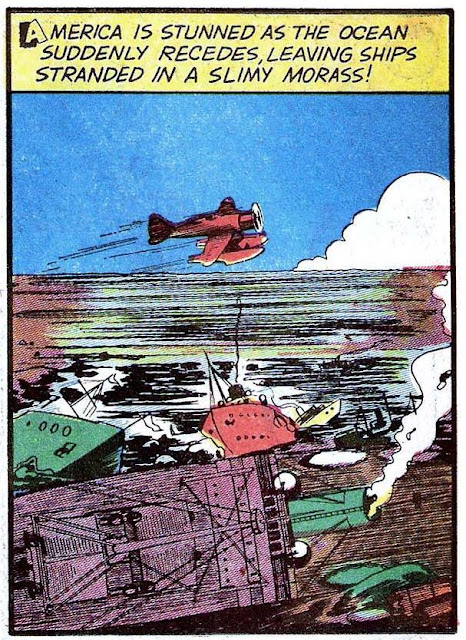
    We open on a world in turmoil! The tides are going crazy! New York City is trashed!

    The world’s leaders turn to the mysterious Dr X for help, and he immediately recognizes that the problem must be Moon-based, and further that the solution will require his niece’s fiance Bob to go beat someone up. This is the second and final Dr X story of the Golden Age, and I really wish that there were more. Wizened scientists sending burly aides to beat up crooks is entirely in my wheelhouse

    Bob and Cynthia are promptly teleported to the Moon in their finest protective beachwear, and Bob gets to fight an excellent moon-beast.

    Bob and Cynthia are captured by Moon-Man forces who do indeed turn out to be the ones messing up the tides. This Moon-aggression is technically happening under the command of the unnamed Moon King and his tall horny daughter, but it becomes clear that the real architect of the plot against Earth is the Head Scientist, Goli. Never one to waste a couple of good prisoners, Goli has plans to stick some Moon-Man brains in Bob and Cynthia’s bodies in order to use them as spies in the post-apocalyptic Moon-Man invasion of Earth.

    In a lucky turn for Bob, Cynthia and the Earth, the Moon Princess is so horny for Bob that she sets the prisoners free. Goli is killed by Bob in a move that also smashes the tide machine, and one short teleporter ride later everyone is safely back in Dr X’s secret laboratory in the Andes.

  • REAL PERSON ROUND-UP 014

    The last couple of 1940 issues of Startling Comics featured the adventures of time traveller Ace Buckley, something that has heavily flavoured this edition of Real Person Round-Up. 

    Alonso de Molina:

    Spanish conquistador who stayed behind after one of Pizarro’s excursions to the Americas and met a mysterious fate. Time traveller Ace Buckley finds his armour and impersonates him to a presumably face blind Pizarro. (Startling Comics 003, 1940)

    Atahualpa:

    Last of the Inca Emperors. Time Traveller Ace Buckley gives him a lot of good advice on how to deal with the incoming Spanish but he ignores it and is slain. (Startling Comics 003, 1940) 

    Commodore Edward Preble:

    Commander of the US forces besieging Tripoli during the First Barbary War, including cheeky time traveller Ace Buckley. (Startling Comics 004, 1940)

    Commodore Stephen Decatur:

    Commander of the USS Constitution (including crew member and time traveller Ace Buckley) during the Seige of Tripoli as part of the First Barbary War. Pedants take note: yes, I know he was a captain at this point.(Startling Comics 004, 1940)

    Fort Knox:

    Attacked by a bunch of crooks with a disintegrator ray. (Startling Comics 003, 1940)

    Francisco Pizarro:

    Encountered by and eventually tries to kill time traveller Ace Buckley while engaging his bloody conquest of the Inca Empire. Also Vincente de Valverde is there. (Startling Comics 003, 1940) 

    Hernando de Soto:

    The only person in 16th Century Peru with any chill, and so time traveller Ace Buckley rewards him with spoilers about his discovery of the Mississippi River. (Startling Comics 003, 1940)

    the Koh-i-Noor Diamond: 

    It’s a simple substitution as a crook steals the Kohinoor Ruby. (Startling Comics 003, 1940)

    William Eaton:

    Unconventional US consular agent to Tunis who played a key part in the US victory over Tripoli in the First Barbary War. Portrayed as a lunatic loose cannon loon in the Ace Buckley time travel story. (the fellow in blue on the left of the second panel above is Marine First Lieutenant Presley O’Bannon, who doesn’t play a huge role in the comic but is significant enough to note) (Startling Comics 004, 1940)

    Yusef Karamanli, Pasha of Tripoli: 

    Seen playing the villain during the Siege of Tripoli as part of the First Barbary War, as witnessed by time traveller Ace Buckley. (Startling Comics 004, 1940)