The Curse of Skeleton Munroe

Category: Standard/Better/Nedor

  • MINOR SUPER-VILLAIN 769: DR SLADE

    (Startling Comics 001, 1940)

    “Dr
    Slade is one of those rare and unfortunate villains who are a part of a
    super-hero’s origin story but who also die as a part of that origin, so that
    they don’t even have the dignity of actually properly being a part of
    that hero’s rogues gallery. That’s sad! On the other hand, Slade did
    develop his resurrection technology in order to build an army of the
    formerly-dead in aid of a fascist takeover of the United States, so
    maybe he got everything he deserved.”

    That right there is what I wrote about Dr Slade in what will be the next Mad and Criminal Scientist Round-Up, and it’s all true. That’s a wrap on Dr Slade, I thought, and took a big gulp of coffee as I turned to the Mystico story in Startling Comics 002. 

    What I’m trying to convey here is that I was shocked, nay, ultrashocked to find out that Dr Slade had not in fact died when his lab exploded but was back to properly vex Mystico as a villain and not a hapless facilitator of his resurrection. And he looks great! As a villain, I mean. It’s the only profession where having your face blown off has a lot of positives to it.

    Slade is presumably still working for the unnamed fascist country that was behind the Green Shirts and their attempt to take over the US with an army of the dead, and on their behalf he has created the hydrophage, a device that can split water into hydrogen and oxygen at a rate of a billion gallons per hour (that’s nearly 3.8 billion litres for all my fellow metric heads out there)! An impressive device with a cool name, but Slade’s proposal for how to use it in war – to lower the ocean level to such an extent that Allied ships run aground and become easy targets for Slade-aligned forces – is one of the stupidest plans in comics history.

    I mean, sure: it’s going to be effective. You’re absolutely going to catch some ships off guard with this one. But significantly reducing the amount of liquid water on Earth is going to have some wild knock-on effects for everyone, including fascist dictatorships, and that’s without mentioning that they’re just releasing the oxygen into the atmosphere (they’re saving the hydrogen for presumably nefarious purposes)! And what’s going on with the salt, I just realized! I was already concerned about the effects on the world’s ocean life, but now it’s going to have to contend with a supersaturated salt ocean as well? Yikes.

    Luckily for the fishes and the rest of us, Mystico is on the case. He dives into the hydrophage-created bubble that houses Slade’s sub-sea base (a cool use of water-destroying technology, I must admit) and though he is captured by some costumed henchmen that is not enough to prevent him from blowing the whole place to smithereens using the stored hydrogen. 

    Despite all of my hopes for a progressively more blown-up Dr Slade to keep coming back as Mystico’s major recurring foe, this is the last we’ll see of him.

  • MINOR SUPER-VILLAIN 769: DR SLADE

    (Startling Comics 001, 1940)

    “Dr
    Slade is one of those rare and unfortunate villains who are a part of a
    super-hero’s origin story but who also die as a part of that origin, so that
    they don’t even have the dignity of actually properly being a part of
    that hero’s rogues gallery. That’s sad! On the other hand, Slade did
    develop his resurrection technology in order to build an army of the
    formerly-dead in aid of a fascist takeover of the United States, so
    maybe he got everything he deserved.”

    That right there is what I wrote about Dr Slade in what will be the next Mad and Criminal Scientist Round-Up, and it’s all true. That’s a wrap on Dr Slade, I thought, and took a big gulp of coffee as I turned to the Mystico story in Startling Comics 002. 

    What I’m trying to convey here is that I was shocked, nay, ultrashocked to find out that Dr Slade had not in fact died when his lab exploded but was back to properly vex Mystico as a villain and not a hapless facilitator of his resurrection. And he looks great! As a villain, I mean. It’s the only profession where having your face blown off has a lot of positives to it.

    Slade is presumably still working for the unnamed fascist country that was behind the Green Shirts and their attempt to take over the US with an army of the dead, and on their behalf he has created the hydrophage, a device that can split water into hydrogen and oxygen at a rate of a billion gallons per hour (that’s nearly 3.8 billion litres for all my fellow metric heads out there)! An impressive device with a cool name, but Slade’s proposal for how to use it in war – to lower the ocean level to such an extent that Allied ships run aground and become easy targets for Slade-aligned forces – is one of the stupidest plans in comics history.

    I mean, sure: it’s going to be effective. You’re absolutely going to catch some ships off guard with this one. But significantly reducing the amount of liquid water on Earth is going to have some wild knock-on effects for everyone, including fascist dictatorships, and that’s without mentioning that they’re just releasing the oxygen into the atmosphere (they’re saving the hydrogen for presumably nefarious purposes)! And what’s going on with the salt, I just realized! I was already concerned about the effects on the world’s ocean life, but now it’s going to have to contend with a supersaturated salt ocean as well? Yikes.

    Luckily for the fishes and the rest of us, Mystico is on the case. He dives into the hydrophage-created bubble that houses Slade’s sub-sea base (a cool use of water-destroying technology, I must admit) and though he is captured by some costumed henchmen that is not enough to prevent him from blowing the whole place to smithereens using the stored hydrogen. 

    Despite all of my hopes for a progressively more blown-up Dr Slade to keep coming back as Mystico’s major recurring foe, this is the last we’ll see of him.

  • PROBLEMATIC ROUND-UP 004

    Sax Rohmer has a lot to answer for.

    the Golden Dragon:

    We’ve seen it before and we’ll see it again – the Golden Dragon is yet another Fu Manchu-style Yellow Peril crimelord bent on bending the world to his will. He messes up by making his campaign of kidnapping and extortion a bit too obvious, which attracts the attention of the Invisible Hood, who in turn rallies various kidnap victims etc into a fighting force to take the Dragon’s organization down from within. (Smash Comics 013, 1940)

    the Key: 

    The Key is a Chinese gang boss operating out of London who specializes in getting his men out of prison almost as soon as they go in, by the simple expedient of faking their deaths with an exotic drug then recovering their “corpses” once they’re trucked off for burial. The twist is that the Key is in fact the very non-Chinese warden of Yorkshire Prison, where all of these guys are escaping from. Two things about the Key: 1. while his mask is presumably just as effective and lifelike as any other rubberoid prosthetic in comics it is also just king of hilariously and obviously strapped onto his face as you can see above, and 2. dovetailing from this, I do not think that the Key was originally going to be the warden. I think that someone took a look at a story about a regular gang boss who was just very good at jailbreaks and decided that it needed something more and so went through and added some extra juice via the addition of the mask and a few lines (“Hmm… That voice is familiar…”) to the already-drawn panels. For what it’s worth, which is not much. (Smash Comics 013, 1940)

    the Scarlet Seal:

    The Scarlet Seal! A character who I absolutely was thinking of when I established the Problematic Round-Up, because he is Very Problematic!

    The basic concept of the Scarlet Seal is fairly innocuous, and in fact is one that creator Harry Campbell returned to again and again: the hero who excels at their first career but then casts that aside to take up scientific pursuits, and then is forced into the role of detective by circumstance. There’s been Wizard Wells (football star to scientist to reluctant detective), Dean Denton (world’s greatest ventriloquist to scientist to detective), John Law, kind of (scientist to lawyer to detective, but really all at once), and now Barry Moore, who leaves a lucrative career as a film star to become a police scientist back in his home town of Center City, and eventually segues into the role of vigilante.

    As far as the problematic aspect of the character goes, there are actually two distinct strains of the stuff going on here. The first involves the Center City Police Commissioner, a namby-pamby former social worker and bleeding heart liberal strawman who doesn’t even believe in torturing confessions out of people (and also bans the use of informants and undercover police officers for unclear reasons). As it turns out, it was only the threat of the rubber hose that was keeping the Center City underworld in check, and the press is having a field day at the expense of  Barry Moore’s dad, Police Chief Moore.

    It’s at this point that Barry decides that what Center City really needs is some sort of vigilante willing to go out and do the hard work that this soft-hearted Commissioner didn’t have the stones for. And you know, if that was it, if he had just put on a costume and set off into the night to beat people up, then it would just be a more extreme version of the authoritarian streak that comic book fans of a more thoughtful nature have always had to reckon with.

    But no, because Barry Moore it turns out was not just any actor, he was a villainous character actor, and the last movie he made was one in which he played a sinister Asian. Thus, he makes the decision to weaponize his skill at yellowface by establishing a secondary identity as Wen au Chung, importer of Chinese goods, who in turn is the sinister Scarlet Seal, bane of the underworld and the police alike. It’s the old classic Green Hornet setup where the Scarlet Seal acts like he’s horning in on various criminal enterprises while actually setting up the crooks to be arrested or (more frequently) killed.

    Two further things: 1. He’s called the Scarlet Seal because he leaves a red stamp on the foreheads of his victims and 2. In the above panels the Scarlet Seal has just allowed the issue’s crooks to kill each other in a gunfight and then arranges things so that one of them, a corrupt cop, is posthumously acclaimed as a hero rather than being held accountable for his crimes. An infuriating character in every respect, that’s our Scarlet Seal. (Smash Comics 016, 1940)

    Dr Feng: 

    Yet another Fu Manchu Yellow Peril villain who is actually a white guy in yellowface. This time we have Dr Feng, head of the Ling Yung Tong aka the Yellow Death Society, but in actuality Blaine Moffat, wealthy real estate mogul. Much of his appearance is taken up with a self-kidnapping scheme to get out of the fact that he has murdered an investigator who got too close, so his actual motivation for becoming a problematic super-villain are left unexplored. (Startling Comics 001, 1940)

  • MINOR SUPER-VILLAIN 768: THE PURPLE PLAGUE

    (Startling Comics 001, 1940)

    Shortly after acquiring his super powers, Andrew “Captain Future” Bryant uses them to sniff out a criminal conspiracy to rob a gold shipment from the nation of Finvania and then use that capital to finance a bid for world domination by someone called the Purple Plague. Exactly the sort of thing that a fledgling super-hero is going to be against!

    Captain Future spends the bulk of the issue in a back-and-forth tussle with the Purple Plague’s henchmen (called variously the Purple Plague Mob, the Followers of the Purple Plague and the very cool Knights of the Purple Plague), and also with the not-very-genre-savvy police, who keep thinking that the brightly-dressed superhuman is doing the crimes instead of the horde of concussed gangsters littering the landscape around him.

    Future does eventually locate the actual Purple Plague himself and at that point it’s just a case of one übermensch versus a room full of regular guys plus one older guy in a robe. Even a gang of moderately cool-looking killbots barely slows down the inevitable mass pummelling.

    As a side note, one of the Knights of the Purple Plague is Andrew Bryant’s boss, Mr Devlin, who fires Bryant as a cost-cutting measure and thus inspires him to pursue the reckless line of research that ends with the accident that turns him into Captain Future. Was Devlin cutting costs in order to funnel profits from the Pacific Electrical Corporation to the Purple Plague, or was the Plague’s brand of villainy just an attractive prospect to a small-minded capitalist like Devlin? Either way this is a classic case of the villain inadvertently creating the hero who would destroy them.

  • MINOR SUPER-HERO ROUND-UP 044

    A full hand of Better (Nedor/Standard/Pines) Comics characters for ye.

    Captain Future:

    When young Dr Andrew Bryant finds himself fired from his job as a… research physicist? electrical engineer?… at the Pacific Electrical Corporation he responds like any rational person would: by working day and night in in a desperate bid to finish his research in the time he has left, until his tired brain thinks its way into an industrial accident. Luckily for Bryant he lives in a super-hero universe, so when he crosses gamma and infra-red rays and blows up his laboratory he is not gruesomely killed but instead filled with super-energies.

    Dubbing himself Captain Future (because he represents the future state of humanity, natch) and donning a pretty minimal costume, Bryant sets out to mete out fist-based justice on the world using a suite of super powers including: mind reading, remote viewing, the ability to both hear and broadcast radio, flight, enhanced strength, energy blasts and a magnetic forcefield that repels bullets but is ineffective against cowardly blows to the head. Sometimes his powers run out or are used up and he has to scurry off and blast himself with radiation again, which makes him one of the earlier super-heroes to have that kind of narratively-interesting power limitation. Plus he is occasionally vulnerable to high levels of electricity or other energy disrupting his powers in a kryptonite kind of way – he’s just a “my powers don’t work on this specific material” away from the Limiting Your Super Powered Character trifecta! (Startling Comics 001, 1940)

    Mystico:

    When scientist Dr Slade needs to test his Vita-Ray device to see if it really can resurrect the dead like he thinks it can, does he start out on easy mode with a selection of freshly deceased lab mice like some sort of rule-following nerd? He does not! Instead, he gets ahold of a 2000-year-old mummy, perhaps the most dead guy available, and turns the power up as high as it can go. And it works! The mummy is restored to life! And also his flailing causes a power feedback that results in an explosion that kills everyone involved… maybe the lab mice would have been a good starting point after all.

    The one person to survive the lab explosion is the newly-resurrected mummy, who turns out to have a wide array of magical powers – lucky for the narrative that Slade grabbed the wizard mummy and not some minor aristocrat’s 3rd Dynasty failson or an unlucky desiccated tomb robber. Dubbing himself Mystico, the formerly-ancient Egyptian fast-tracks his assimilation to future society with some new clothes and a top-of-the-line car.

    In a fortuitous turn of events for the local authorities, Mystico also adopts a set of conventional American values and immediately sets his vast powers to the task of rooting out crime. I suppose that if you’re an ancient and powerful wizard suddenly thrust into a strange world your options boil down to overthrowing the status quo (super-villain), maintaining the status quo (super-hero) or keeping your head down and living a quiet life (boring comic book). (Startling Comics 001, 1940)

    Dr X:

    At first glance, Dr X slots neatly into the category of “scientist super-villains who headline their own comics serial” alongside such luminaries as Dr Doom and Landor, Maker of Monsters. After all, he’s a creepy looking rodent-man whose primary field of study is seeing just how many dangerous alien worlds he can send his niece Cynthia’s astral form to without really briefing her on what she’s getting into first, or indeed without a clear idea of exactly what happens to someone if their astral form is eaten by an alien dinosaur.

    But no, Dr X is a good guy! He tries his hardest to keep Cynthia and her boyfriend Bob Stone from getting eaten by those dinosaurs (after metaphorically delivering them to them on a platter, sure, but the thought is there), and even staves off an invasion of Earth by the Moon! Truly we must all learn not to judge a book by its sinister cover.

    That said, is it reasonable that Alan Moore made him a weird creepy murderer in the pages of Terra Incognito? Completely! (Startling Comics 001, 1940)

    the Masked Rider: 

    The Masked Rider is really Bronc Randall, cowboy and ex-rodeo performer, who returns home after two years to find small-town Western injustice running rampant and decides to do something about it by donning a small cloth mask and otherwise changing nothing about his fairly distinctive look. And it works! The Masked Rider then goes on to dispense justice for another dozen issues or so. 

    (is the Masked Raider another Western comic that fooled me into thinking it was set in the Old West until several issues in when someone rocked up in a truck? Indeed it is)

    This is actually Better Publications’ second Masked Rider, appearing one month after the one we have already encountered if I have my dates right. Plus, there was a bit of text fiction featuring a third Masked Rider in Best Comics the previous year. Did someone at the company have a thing for the name or is the Masked Rider just one of the most generic Western hero monikers? (Startling Comics 001, 1940)

  • REAL PERSON ROUND-UP 013

    REAL PERSON ROUND-UP 013

    Yet again we have a selection of comic book appearances of real-style people for you to enjoy.

    Adolf Hitler:

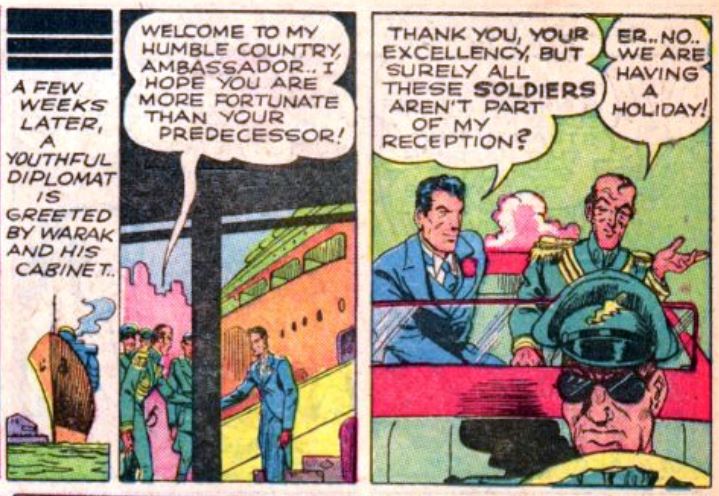
    Warak, dictator of Barbaria is a bit generic as far as pseudo-Hitlers go, but a pseudo-Hitler he is. (Smash Comics 017, 1940)

    Scraggs, leader of the Green Shirts, is very much a “make the leader look like Hitler as shorthand for These Guys Are Fascists” character, a subspecies that will nearly die out some time in 1941 but survives in small numbers to this day. (Startling Comics 001, 1940)

    Devil’s Island: 

    Black X has himself sent to, and then escapes from, Devil’s Island in order to secure a fellow prisoner with valuable US defense secrets in his head. (Smash Comics 013, 1940)

    FDR:

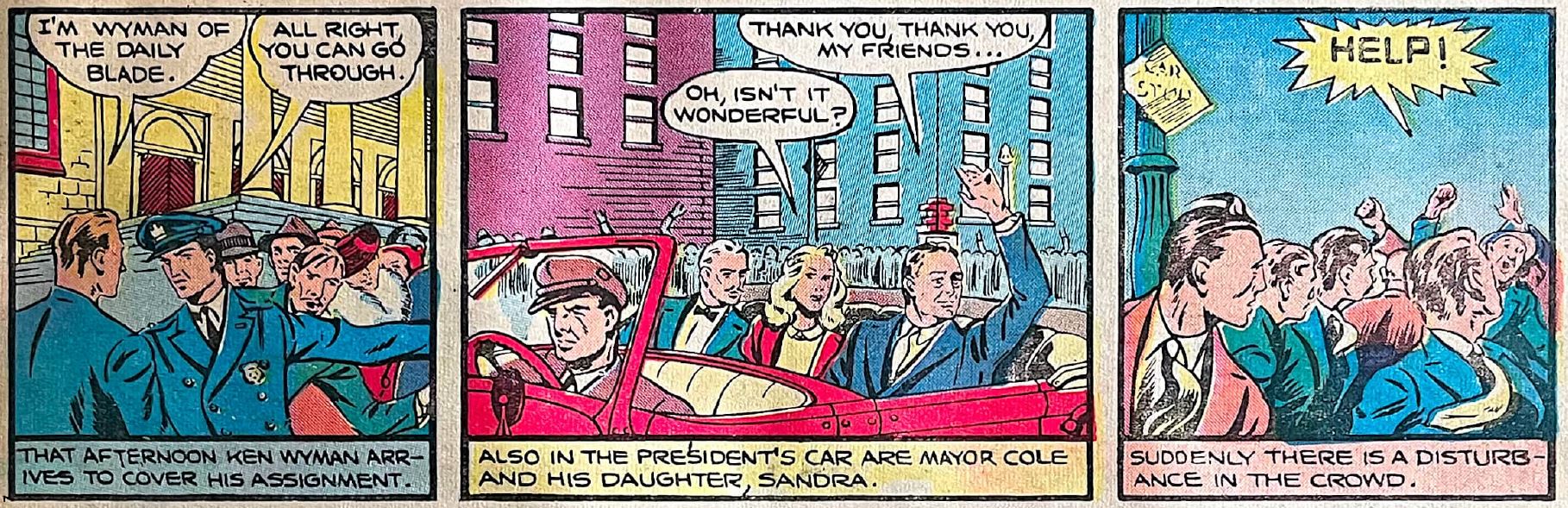
    An off-model Roosevelt visits Carterville and is kidnapped by Devil’s Dagger nemesis Jeff Marlowe (and thus retroactively by Marlowe’s boss Mr H). This is a wild move for a regional crime boss to pull! (Master Comics 006, 1940)

    Gill Fox:

    Probably a different guy to the last “Gil Fox” to appear in a Clip Chance comic – this one is just a small town baseball player. (Smash Comics 015, 1940)

    Groucho Marx:

    Goucho’s look lifted wholesale for this unnamed comedy character. (Star Comics 010, 1938)

    Hollywood:

    Autograph hound adds Shock Gibson to her collection along with “Cary Trooper” and “Glark Cable,” aka Gary Cooper and Clark Gable. (Speed Comics 009, 1940)

    Joe Devlin: 

    Given the prior instance of Joe Devlin being referenced in a Clip Chance story I must assume that the “John Devlin” mentioned here is another. (Smash Comics 014, 1940)

    Joseph Stalin:

    The Three Aces (but not the DC Comics Three Aces, the Harvey Comics ones) transport three anthropology-minded sisters to Paraguay to study the Guató people and stumble upon a plot by the sinister witch doctor Ni Lats to bring all under his sway via hypnotic mind control, for which crime he is drowned in a swamp.

    (slight aside: the Guató are a real people being used as set dressing for an exotic locale, and weirdly, in checking to see if that was the case I’m pretty sure I stumbled across the exact reference that Klaus Nordling drew from – every detail in the brief entry on the Guató in the 1911 Encyclopedia Britannica is reflected in the story. The mind control thing is added plot) (Speed Comics 010, 1940)

    Samuel Goldwyn:

    Is this movie producer named Sam meant to be Samuel Goldwyn or merely a lookalike reference to him? Regardless, this is clearly Samuel Goldwyn. (Speed Comics 010, 1940)

  • REAL PERSON ROUND-UP 013

    REAL PERSON ROUND-UP 013

    Yet again we have a selection of comic book appearances of real-style people for you to enjoy.

    Adolf Hitler:

    Warak, dictator of Barbaria is a bit generic as far as pseudo-Hitlers go, but a pseudo-Hitler he is. (Smash Comics 017, 1940)

    Scraggs, leader of the Green Shirts, is very much a “make the leader look like Hitler as shorthand for These Guys Are Fascists” character, a subspecies that will nearly die out some time in 1941 but survives in small numbers to this day. (Startling Comics 001, 1940)

    Devil’s Island: 

    Black X has himself sent to, and then escapes from, Devil’s Island in order to secure a fellow prisoner with valuable US defense secrets in his head. (Smash Comics 013, 1940)

    FDR:

    An off-model Roosevelt visits Carterville and is kidnapped by Devil’s Dagger nemesis Jeff Marlowe (and thus retroactively by Marlowe’s boss Mr H). This is a wild move for a regional crime boss to pull! (Master Comics 006, 1940)

    Gill Fox:

    Probably a different guy to the last “Gil Fox” to appear in a Clip Chance comic – this one is just a small town baseball player. (Smash Comics 015, 1940)

    Groucho Marx:

    Goucho’s look lifted wholesale for this unnamed comedy character. (Star Comics 010, 1938)

    Hollywood:

    Autograph hound adds Shock Gibson to her collection along with “Cary Trooper” and “Glark Cable,” aka Gary Cooper and Clark Gable. (Speed Comics 009, 1940)

    Joe Devlin: 

    Given the prior instance of Joe Devlin being referenced in a Clip Chance story I must assume that the “John Devlin” mentioned here is another. (Smash Comics 014, 1940)

    Joseph Stalin:

    The Three Aces (but not the DC Comics Three Aces, the Harvey Comics ones) transport three anthropology-minded sisters to Paraguay to study the Guató people and stumble upon a plot by the sinister witch doctor Ni Lats to bring all under his sway via hypnotic mind control, for which crime he is drowned in a swamp.

    (slight aside: the Guató are a real people being used as set dressing for an exotic locale, and weirdly, in checking to see if that was the case I’m pretty sure I stumbled across the exact reference that Klaus Nordling drew from – every detail in the brief entry on the Guató in the 1911 Encyclopedia Britannica is reflected in the story. The mind control thing is added plot) (Speed Comics 010, 1940)

    Samuel Goldwyn:

    Is this movie producer named Sam meant to be Samuel Goldwyn or merely a lookalike reference to him? Regardless, this is clearly Samuel Goldwyn. (Speed Comics 010, 1940)

  • REAL PERSON ROUND-UP 006

    REAL PERSON ROUND-UP 006

    More real people and their analogs. Lotta Hitlers in this one.

    Adolf Hitler:

    Hitler analogs c.1940 were often quite visually distinct from the actual man. Samson foe and dictator of Ratonia Dragor honestly looks more like a bald Stalin, and you might be excused for thinking that he was more of a pastiche of all extant dictators. The real clue is in the invasion of Belgium. (Fantastic Comics 002, 1940) 

    Meanwhile this as-yet unnamed dictator of the future super-nation of Russmany is a pretty clear Hitler-alike. (Fight Comics 001, 1940)

    Misc Minor Appearances:

    Hitler-alike dispatches the Tankonaut to sow terror in the US. (Exciting Comics 005, 1940)

    Hitlerian dictator Rigo funds Samson foe Kilgor’s robot army. (Fantastic Comics 006, 1940) 

    Benito Mussolini:

    He doesn’t actually appear in the comic but “Gasolini” is one of the better dumb stand-in names I have seen for Mussolini. Weirdly, the Dictator mentioned above is so generic that he’s not really enough of a reference to any one person to include here. (Fantastic Comics 010, 1940)

    Depicted with his pal Hitler as a background gag in a room full of faux Mayan statuary. (Fantoman 003, 1940)

    Fiorello Laguardia:

    At this point it’s worth noting any time that a generic Mayor of New York City shows up, just to have a record of them. (Fantastic Comics 011, 1940)

    Franklin D Roosevelt:

    Misc Minor Appearances:

    Meets up with Dr John “Son of the Gods” Thesson to discuss the threat of the Tankonaut. (Exciting Comics 005, 1940)

    Confers with Thesson and a panel of others about the threat of the Invincible Five (Exciting Comics 006, 1940) 

    Briefly kidnapped by super-gangster Rip-the-Blood, rescued by Stardust the Super Wizard (Fantastic Comics 002, 1940)

    Henry Ford:

    Motor king “Henry Lord” is kidnapped by the Miracle Men (Fantastic Comics 005, 1940)

    Hollywood Crowd Scenes:

    Comic strip “Olly of the Movies”, about young actress Olive Lane’s travails in Hollywood (seen here as a comic book reprint) is chock full of cameos – and under actual names! Marie Dressler, Mae West, Greta Garbo, Joan Crawford and Jimmy Durante are the ones named, but there are a whole swath (that I am not qualified to identify) in that second panel alone. (Famous Funnies 006, 1935)

    Saladin:

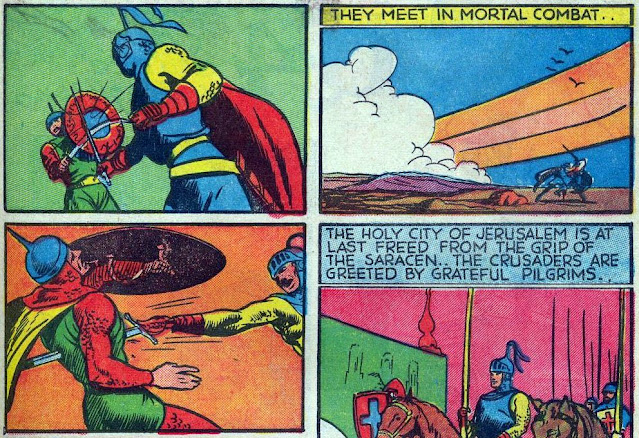
    Every Crusader hero eventually has to meet Saladin and the Golden Knight is no exception. The creators always have to balance the fact that they obviously think that Saladin is very cool with the idea that he is supposed to be the villain and this is a story where it is not quite pulled off: Saladin spares the Golden Knight because he is such a valiant battler and shows him great hospitality, while the Knight wanders around all surly and churlish talking about how he’d like to kill everyone present. Saladin definitely comes off better in the interaction. (Fantastic Comics 002, 1940)

    Saladin and the Golden Knight meet up again a few issues later and the encounter ends with the Golden Knight killing Saladin, a wildly ahistoric event but not a unique one, as you might see if I ever work my way through the hundreds of Real Person in Comics entries I have in spreadsheet form. For the record, Saladin died of a fever, still in control of Jerusalem, a full year after the Third Crusade ended. (Fantastic Comics 008, 1940)

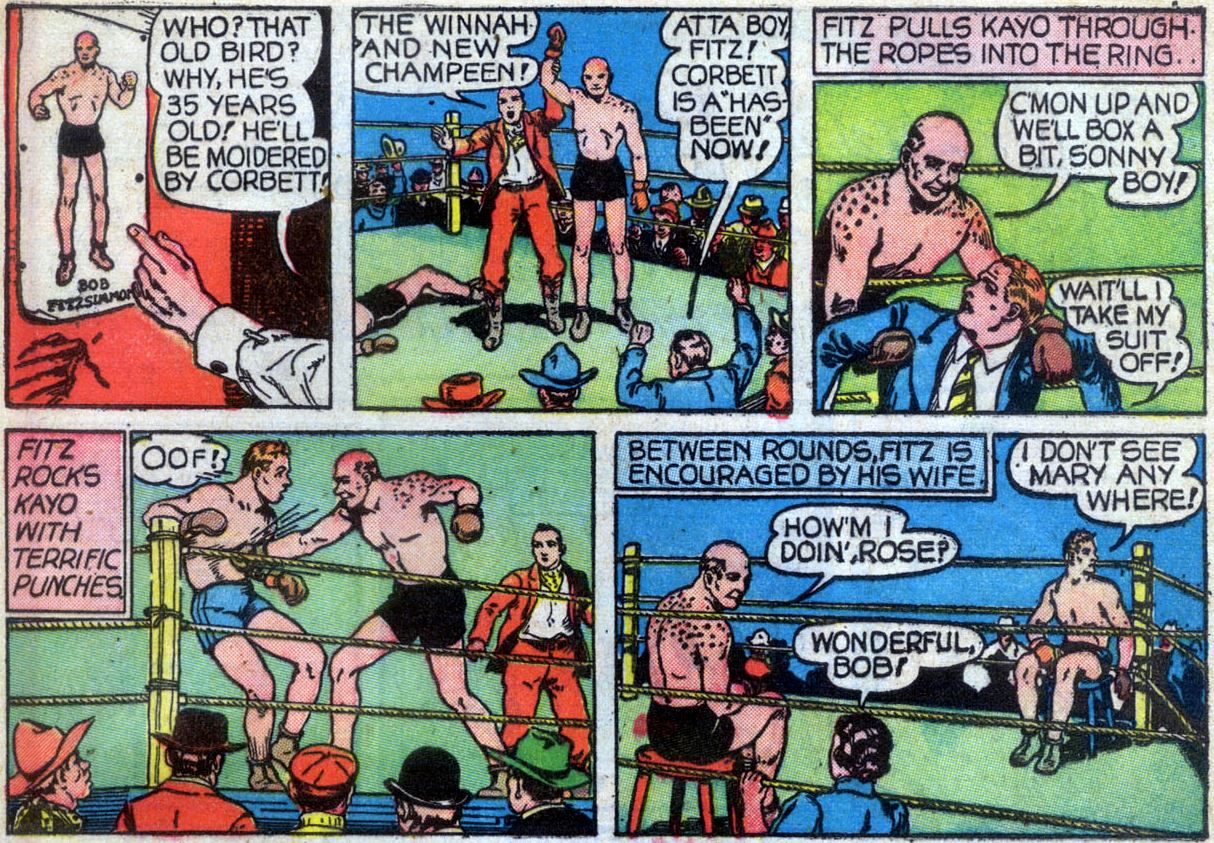
    Selection of Old-Time Boxers:

    Boxer and heavyweight champ Kayo Kirby has a stress dream in which he meets and is beaten up by successive old-time champs John L. Sullivan…

    … Gentleman Jim Corbett…

    … and Bob Fitzsimmons (with special appearance by his wife Rose).

    He also receives some training from old-time boxer Charley Mitchell, not that it does him much good against the spectres of his own mind. (Fight Comics 009, 1940)

    Unknown:

    Given that he was kidnapped immediately following “Henry Lord”, above, there is a strong possibility that “John Rancab” is also a stand-in name. As “Bacnar” does not appear to be a name and the only John Branca I can find was born in 1950, I am stumped – is it just a bad anagram of “banker”? Maybe. (Fantastic Comics 005, 1940)

  • GENERIC COSTUMED VILLAIN ROUND-UP 014

    Once again the also-rans.

    A bunch of small-time crooks get paid to fake the death of Titano (the largest gorilla in captivity!) for an insurance scam and of course use him to rob a series small-town banks. If only they had thought a bit more ambitiously they might have made the big time. (Exciting Comics 005, 1940)

    This Yank Wilson adventure features a fairly by-the-book super-spy ring headed by Count Lustig von Blackgard. They plot, they scheme, they are ultimately foiled. This mysterious radio message is the only mention of a higher-up, but their moniker – the extremely evocative Neuromania – was too good to pass over without comment. (there is of course the possibility that Neuromania is the spies’ home country. Either way, it’s great). (Fantastic Comics 002, 1940)

    This happy fellow has no name but makes up for it with a laundry list of distinctive features: missing left eye, hunch, catlike upper lip, pointy ears, bizarrely long hair on his forearms, etc. He lives under a fake man-eating tree in… probably the African jungle and spends his days torturing and poisoning people for no stated reason until he is killed by Captain Kid using his own poisoned melon. (Fantastic Comics 005, 1940)

    This is Nipon, ruler of an unnamed Asian country (wink, wink) from that period in late 1940 through 1941 when the Axis powers were very clearly the villains on everyone’s minds but the US was remaining neutral so you couldn’t in good conscience make the leader of a foreign nation the villain of your story. These guys are usually either extremely obvious stand-ins named, like Arnolf Hilter or Menito Bussolini (in which case they get added to a Real Folk entry) or so generic that I forget them entirely. Nipon is kind of neither – like, he’s obviously a stand-in for the Emperor of Japan but extremely generically, but also he has a very fun look! (Fantastic Comics 013, 1940)

  • MAD AND CRIMINAL SCIENTIST ROUND-UP 011

    Incorrigible scamps the lot of them.

    This unnamed scientist uses fake spirits, death traps and so forth to drive adventurer Ted Crane and his companions away from the jungle temple he is looting. BUT! He has made a classic mistake: they weren’t planning on entering the temple in the first place and based on their action in earlier issues they certainly don’t object to white people hauling off as much ancient African swag as possible. He gets punched out a window to his death for no reason! (Exciting Comics 004, 1940)

    This fellow, name of Terro, has a scheme to peddle his noiseless super explosive bombs to the hostile Kordian government, a sound, if evil, plan. His inventive genius is not however matched by his common sense, however, and he makes the key mistake of demonstrating his explosive by bombing the village just outside his front door. Like, if his castle wasn’t on top of a mountain I reckon it would be about a ten minute walk from the crater. Needless to say, Yank Wilson explodes him with extreme prejudice. (Fantastic Comics 004, 1940)

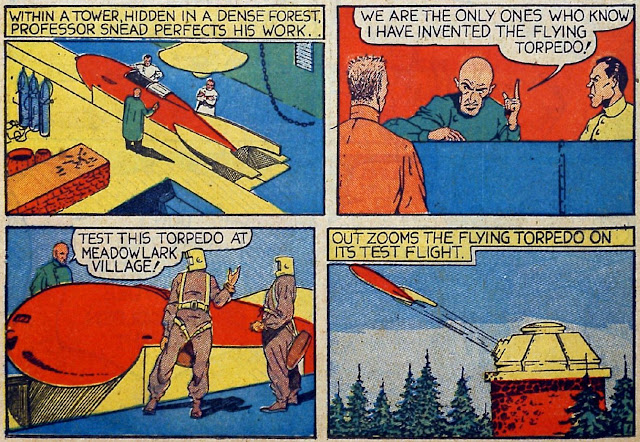
    Like Terro, Professor Snead here is a scientist of the near future who makes the critical error of testing his new explosive (in this case one of the military holy grails of the 40s, the flying torpedo, or to us savvy moderns, the guided missile) on a small town instead of, for example, a big rock. Wholesale loss of human life again leads Yank Wilson to show up and Snead too is exploded by his own creation. (Fantastic Comics 005, 1940)

    These unnamed Mexican scientists have an okay plan – sabotage the US agricultural industry so that they are forced to import food from South of the border – but I question the efficacy of giant crop-eating rat-lizards over, say, a plague of regular-sized mice. I also question the sanity of everyone who sees these things and calls them “giant insects”, i.e., everyone in the story.

    Samson of course steps in and defeats not only the – ugh – “giant insects” but also some chemically mutated bulls, and given the sensitive depictions of Mexicans above would it surprise you that the comic ends with him building a wall along the US-Mexico border? (Fantastic Comics 006, 1940)