The Curse of Skeleton Munroe

Category: Shock Gibson

  • MEDIA IN COMICS 005

    This is the stuff that my counterpart in a comic book universe is writing his little blogs about.

    Movies:

    Not only does this theatre feature an appearance by Lady Luck (an impostor, alas), but it has screenings of Boris Scarloff in Mummy Blood and Myrna Powell and William Loy in Thinner than the Thin Man! (Lady Luck, the Spirit Section 1940)

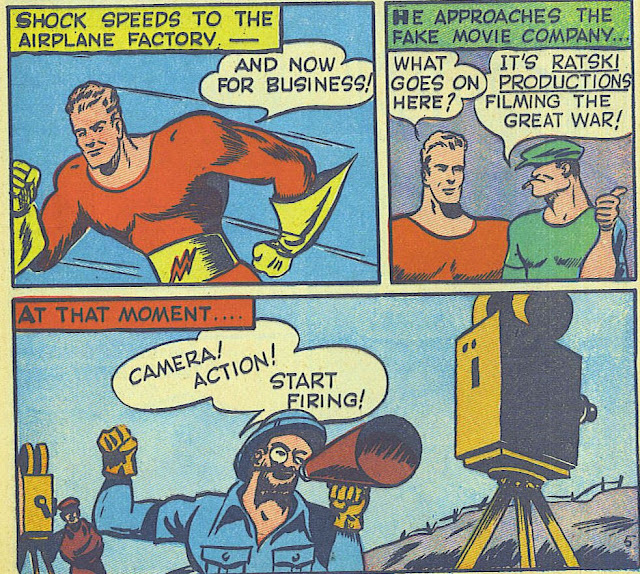
    The villainous Comrade Ratski might have founded Ratski Productions and filmed his opus The Great War as a cover for his espionage activities, but was it a real movie? Was he filming all of his crimes and if so who has the footage? (Speed Comics 009, 1940) 

    Ted Parrish, aka the Man With 1000 Faces stars in Thundering Hoofs, which might appear to be a generic Western to you and I but which nets him the 1941 Oscar for Best Actor – sorry, Jimmy Stewart. (Speed Comics 010, 1940)

    This is another Ted Parrish feature(, and though the title is partially obscured by that rude talking kid I am familiar enough with 1940s parody title conventions to confidently state that it is Went with the Gale. (Speed Comics 008, 1940)

    Newspaper Columns:

    “John Perry In the News,” with its sassy little “Perry Says….” opening is said to be and written like a gossip column but like Bob Phantom before him John “the Black Fury” Perry seems to mostly write about crime. Also please note that both of these clippings have “Daily Standard” down the side even though Perry is consistently said to work for the Daily Clarion. (Fantastic Comics 017, 1941)

    Martin Mitchell is another of these gossip columnist/ hard-core investigative journalist types, only he isn’t a super-hero and so when he starts writing about ongoing criminal activity in “Martin Mitchell About Town” he just gets murdered. (Rocket Comics 003, 1940)

    We don’t get anything more about “The Tattler” than its title, and even that is concealed beneath part of the Press Guardian’s name. Maybe Ted McCoy needs to dig up some hotter gossip. (Pep Comics 001, 1940)

    Radio: 

    Martin Mitchell (America’s most popular columnist!) also has a radio show, and since we never learn its name I’m going to assume that it is also named Martin Mitchell About Town. (Rocket Comics 003, 1940)

    We don’t learn too much about The Brady’s Better Bacon Program due to its star Biff Crossley being mixed up in a string of high-profile murders, but it certainly is well-attended. And it has a full orchestra!(Pep Comics 008, 1940)

    Theatre: 

    Tobacco Turnpike is one of those murder mystery plays that are so beloved of comic and television writers because of dramatic potential inherent in someone being murdered on-stage at the same time as they are supposed to be pretending to be murdered, as happens several times in this story before the Shield gets involved and reveals that the director is responsible and is trying to tank the play because he has sold half stakes in the play to at least four men and doesn’t want to pay out or go to jail.

    Tobacco Turnpike is such a specific name that I was sure that it was a reference to something. I almost gave up the quest for knowledge after my third unsuccessful search for a production of Cigarette Junction, before finally narrowing it down to a play called Tobacco Road. (Shield-Wizard Comics 002, 1940)
  • REAL PERSON ROUND-UP 013

    REAL PERSON ROUND-UP 013

    Yet again we have a selection of comic book appearances of real-style people for you to enjoy.

    Adolf Hitler:

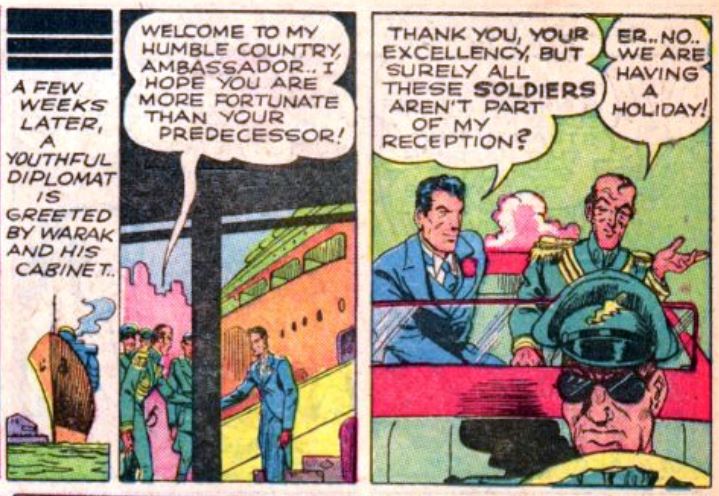
    Warak, dictator of Barbaria is a bit generic as far as pseudo-Hitlers go, but a pseudo-Hitler he is. (Smash Comics 017, 1940)

    Scraggs, leader of the Green Shirts, is very much a “make the leader look like Hitler as shorthand for These Guys Are Fascists” character, a subspecies that will nearly die out some time in 1941 but survives in small numbers to this day. (Startling Comics 001, 1940)

    Devil’s Island: 

    Black X has himself sent to, and then escapes from, Devil’s Island in order to secure a fellow prisoner with valuable US defense secrets in his head. (Smash Comics 013, 1940)

    FDR:

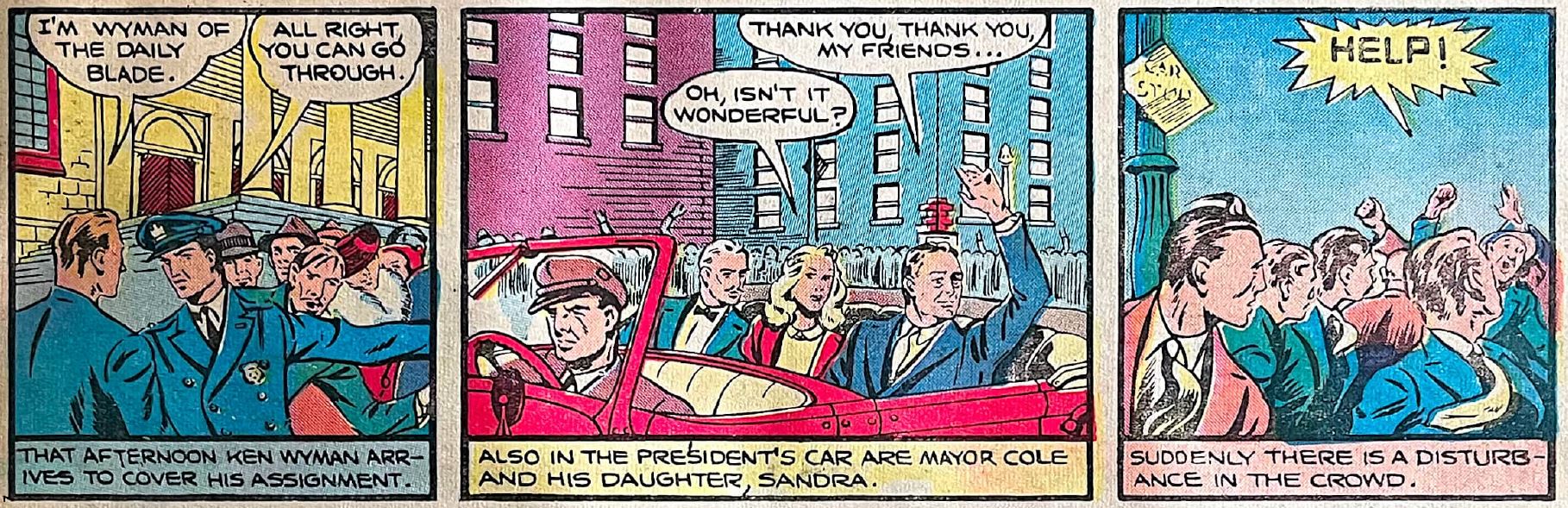
    An off-model Roosevelt visits Carterville and is kidnapped by Devil’s Dagger nemesis Jeff Marlowe (and thus retroactively by Marlowe’s boss Mr H). This is a wild move for a regional crime boss to pull! (Master Comics 006, 1940)

    Gill Fox:

    Probably a different guy to the last “Gil Fox” to appear in a Clip Chance comic – this one is just a small town baseball player. (Smash Comics 015, 1940)

    Groucho Marx:

    Goucho’s look lifted wholesale for this unnamed comedy character. (Star Comics 010, 1938)

    Hollywood:

    Autograph hound adds Shock Gibson to her collection along with “Cary Trooper” and “Glark Cable,” aka Gary Cooper and Clark Gable. (Speed Comics 009, 1940)

    Joe Devlin: 

    Given the prior instance of Joe Devlin being referenced in a Clip Chance story I must assume that the “John Devlin” mentioned here is another. (Smash Comics 014, 1940)

    Joseph Stalin:

    The Three Aces (but not the DC Comics Three Aces, the Harvey Comics ones) transport three anthropology-minded sisters to Paraguay to study the Guató people and stumble upon a plot by the sinister witch doctor Ni Lats to bring all under his sway via hypnotic mind control, for which crime he is drowned in a swamp.

    (slight aside: the Guató are a real people being used as set dressing for an exotic locale, and weirdly, in checking to see if that was the case I’m pretty sure I stumbled across the exact reference that Klaus Nordling drew from – every detail in the brief entry on the Guató in the 1911 Encyclopedia Britannica is reflected in the story. The mind control thing is added plot) (Speed Comics 010, 1940)

    Samuel Goldwyn:

    Is this movie producer named Sam meant to be Samuel Goldwyn or merely a lookalike reference to him? Regardless, this is clearly Samuel Goldwyn. (Speed Comics 010, 1940)

  • REAL PERSON ROUND-UP 013

    REAL PERSON ROUND-UP 013

    Yet again we have a selection of comic book appearances of real-style people for you to enjoy.

    Adolf Hitler:

    Warak, dictator of Barbaria is a bit generic as far as pseudo-Hitlers go, but a pseudo-Hitler he is. (Smash Comics 017, 1940)

    Scraggs, leader of the Green Shirts, is very much a “make the leader look like Hitler as shorthand for These Guys Are Fascists” character, a subspecies that will nearly die out some time in 1941 but survives in small numbers to this day. (Startling Comics 001, 1940)

    Devil’s Island: 

    Black X has himself sent to, and then escapes from, Devil’s Island in order to secure a fellow prisoner with valuable US defense secrets in his head. (Smash Comics 013, 1940)

    FDR:

    An off-model Roosevelt visits Carterville and is kidnapped by Devil’s Dagger nemesis Jeff Marlowe (and thus retroactively by Marlowe’s boss Mr H). This is a wild move for a regional crime boss to pull! (Master Comics 006, 1940)

    Gill Fox:

    Probably a different guy to the last “Gil Fox” to appear in a Clip Chance comic – this one is just a small town baseball player. (Smash Comics 015, 1940)

    Groucho Marx:

    Goucho’s look lifted wholesale for this unnamed comedy character. (Star Comics 010, 1938)

    Hollywood:

    Autograph hound adds Shock Gibson to her collection along with “Cary Trooper” and “Glark Cable,” aka Gary Cooper and Clark Gable. (Speed Comics 009, 1940)

    Joe Devlin: 

    Given the prior instance of Joe Devlin being referenced in a Clip Chance story I must assume that the “John Devlin” mentioned here is another. (Smash Comics 014, 1940)

    Joseph Stalin:

    The Three Aces (but not the DC Comics Three Aces, the Harvey Comics ones) transport three anthropology-minded sisters to Paraguay to study the Guató people and stumble upon a plot by the sinister witch doctor Ni Lats to bring all under his sway via hypnotic mind control, for which crime he is drowned in a swamp.

    (slight aside: the Guató are a real people being used as set dressing for an exotic locale, and weirdly, in checking to see if that was the case I’m pretty sure I stumbled across the exact reference that Klaus Nordling drew from – every detail in the brief entry on the Guató in the 1911 Encyclopedia Britannica is reflected in the story. The mind control thing is added plot) (Speed Comics 010, 1940)

    Samuel Goldwyn:

    Is this movie producer named Sam meant to be Samuel Goldwyn or merely a lookalike reference to him? Regardless, this is clearly Samuel Goldwyn. (Speed Comics 010, 1940)

  • MINOR SUPER-HERO ROUND-UP 043

    A grab bag of old characters I skipped over back in the early days when I thought that this blog wasn’t going to be completely self-indulgent. 

    Mr Clue: 

    He only had one adventure in which he solves the murder of a mayor by a police chief, but Mr Clue is too great a name not to take note of. (Master Comics 001, 1940)

    the Red Gaucho: 

    A swashbuckling hero in the Zorro mode, the Red Gaucho protects the South American nation of Santa Palos from threats both foreign and domestic before eventually just kind of wandering North to have adventures in a sort of generic Central America. He’s a fun character! He has one of the biggest hats in comics!

    The Red Gaucho is also a character I think about whenever the topic of white supremacy comes up. White supremacy is one of those topics that gets a lot of people very angry, but at its base it’s simply the belief that the world consists of white people and everyone else and more specifically that it’s white people versus everyone else in a competition to keep white people on top, where they belong. And the further back you go, the less people felt the need to hide the fact that that was their worldview, and possibly the place that that attitude is most on display is in early Golden Age comics – just read any set outside North America and you’ll catch on to it pretty quickly.

    Anyway, that is all to say that even though it’s more subtle than a lot of other examples of this worldview in comics, ever since I noticed that every single appearance of the Red Gaucho includes a disclaimer assuring readers that he was in fact the child of two Americans and not some horrible South American – heavens forfend! – his smiling face pops into my head whenever the subject comes up.(Nickel Comics 004, 1940)

    the Hawk:

    On a less heavy note, here’s the Hawk! Created by George Brenner, who also created the Clock, the Hawk has the distinction of being the first masked crimefighter to appear in a comic that would eventually be amalgamated into the DC Comics fold (the Clock had only appeared in Centaur comics up until this point and wouldn’t make his way into a Quality book for a few months yet). A heady and heavily qualified distinction!

    The Hawk is secretly T. James Harrington II, wealthy and useless playboy who hangs around looking bored until some crime happens and it’s time for the Hawk to hit the streets. It’s a bit Bruce Wayne/Batman only without the parental murder.

    Unlike Batman, the Hawk leans pretty minimal on the costume front, with his major identifying feature being a set of slip-on claws. 

    The Hawk also has a couple of assistants named Link and Rollo who are touted as the only people who know the Hawk’s identity but who don’t get much time to show their stuff in this, their one-panel appearance. Astute readers might note that the crook that the Hawk has just captured likely also knows his secret identity at this point but please note that Link and Rollo are identified as the only living people to know the secret. Sinister stuff!

    DC has already gone with the Crimson Avenger as the Official First Golden Age Super-Hero but I reckon that the Hawk would be a fun guy to be brung back for some future story involving early mystery men antics. (Feature Funnies 002, 1937)

    *Hero Update* Shock Gibson:

    It had to happen someday: Shock Gibson disguises himself as a cowboy and in the process abandons his iconic helmet forever. Fare the well, helmet. (Speed Comics 007, 1940)

  • MINOR SUPER-VILLAIN 766: COMRADE RATSKI

    (Speed Comics 009, 1940)

    Comrade Ratski’s first appearance is fairly undistinguished as far as comic book spymasters go. Sent to subvert US war preparations, Ratski targets an airplane factory operating out of Hollywood, California (for some damn reason) and sensibly decides to do so under the guise of a war movie shoot next door, though at the point that you have all of the equipment required for such an attack in place, why bother going through with the “we’re just filming a movie” deception? For the love of the game, of course.

    Ratski’s major distinguishing feature in this appearance is the fact that he is a pseudo-Soviet rather than the usual pseudo-Nazis who are the mainstay of the spy plot at this time. 

    Shock Gibson of course does not like all of this factory bombing, and Comrade Ratski, like Baron von Kampf before him, ends up stranded in the middle of the ocean. And he’s even more pessimistic about his chances at rescue!

    Ratski returns in Speed Comics 010 and immediately starts to collect top scientists from top universities: Dr Bronson from Yarvard, Prof Capchek from Rinceton, and… somebody from Hale. His goal? Force them to invent at gunpoint so that he can use their creations to destroy America

    Dr Bronson creates an earthquake machine which Ratski uses to attack democratic hub Western City. Ratski then makes the bizarre decision to send his men out to loot and plunder in the chaos, which is how Shock Gibson learns the location of Ratski’s base after using the tried-and-true method of capturing a henchman and threatening to kill them unless they talk.

    But even if Gibson hadn’t done so, Ratski just can’t stop signposting his location: after Prof Capchek develops an arthropod-enlarging serum Ratski just starts releasing giant beetles and flies from his front door in a way that I would call “highly visible.”

    Though Gibson does fight his way through various flies and spiders to make his way to Ratski’s mountain fastness, the Comrade’s ultimate undoing comes at the jaws of a freshly enlarged (and adorable!) cockroach with no sense of loyalty. He survives the encounter, but only with the help of a very ambitious mountain lion.

    Shock Gibson rescues Capchek and some guy we’ve never seen before, possibly the Hale man. Bronson is unaccounted for.

    Like Baron von Kampf before him, Comrade Ratski’s final appearance is in Speed Comics 011 when the two team up in a version of the Soviet/Nazi manouvres in Poland and Eastern Europe, though I don’t know quite enough about contemporary opinions on WWII to say if the fact that Ratski is clearly just exploiting von Kampf for cheap labour courtesy of his Zombie minions is further extrapolation of this relationship or just the writer favouring one villain over the other as the real heel.

    For an epic team-up between two men sworn to conquer and/or destroy the United States of America, the stakes on the Ratski/von Kampf plan are pretty minimal – essentially it’s just some run-of-the-mill piracy, only done by one-eyed green guys made of animal parts and flying a dirigible.

    More than anything this issue is an exercise in making the zombies look cool while also making Shock Gibson look cool: the Zombies are parachuting! The Zombies are firing a machine gun! Shock Gibson is posing on top of a whale! Shock Gibson is protecting the whale!

    Zombies in keen gas masks wielding cool gas guns! Zombies setting up a guillotine! Shock Gibson looking smug as hell while the guillotine blade smashes on his neck!

    After the guillotine fails to do its job, things go very wrong for Comrade Ratski and Baron von Kampf, culminating in the destruction of their base, the foiling of their plans and they themselves becoming a meal for at least nine alligators. Who presumably represent the Allied Forces.

  • MINOR SUPER-VILLAIN 552 UPDATE: BARON VON KAMPF (1940)

    Making his triumphant return to comics, the dome-headed goblin of crime: Baron von Kampf!

    Baron von Kampf’s initial return in Speed Comics 004 involves him heading a sabotage ring for an unnamed European nation that is probably meant to be Nazi Germany, and it’s possible that this is a relationship that were were meant to understand was behind his actions all along, but frankly it seems to me to be beneath him.

    The Baron’s schemes on behalf of his fascist overlords bring him to a secret submarine base, which is how he ends up stranded in the middle of the Atlantic after a final confrontation with Shock Gibson. Will he survive?

    Indeed he will, and does! The Baron returns in Speed Comics 006, and I could not tell you if he’s still working for the fascists or if he just likes a uniform. The Baron spends much of this issue employing the services of a bunch of crooks called the Palooka Gang to hijack trucks, and though he claims that this is in aid of a larger world conquest scheme I’d be tempted to call it a bit low-rent as far as super-villainy is concerned. Fortunately for his reputation, he still knows how to accessorize, and his headquarters (Mammoth Cave, Kentucky) and minions (the Zombies, making their long-awaited reappearance) really save the day.

    How can I complain about truck hijacking when they’re being done with such style?

    The coolness of living in a cave, of course, is offset by the ever-present threat of being crushed to death in a cave-in, and doubly so when you’re doing battle with a guy like Shock Gibson on the regular. Baron von Kampf manages to sneak out a side passage, but the Palooka Gang and this batch of Zombies are all toast, and the Harvey Comics version of Mammoth Cave is certainly the worse for wear.

    Baron von Kampf’s final appearance is in Speed Comics 011, in which he teams up with pseudo-Soviet spy and future entry Comrade Ratski, in what is probably a reference to the then-ongoing Soviet-Nazi nonaggression pact. What is certain about this alliance, however, is that Comrade Ratski is in charge – he seems to have taken von Kampf on as a partner mainly because he wants to use the Zombies as henchmen.

    Speaking of the Zombies, this is their final appearance, and while that is disappointing there is a silver lining, as we get a final bit of lore about the top band of henchcreatures of the 1940s: they can speak, and they speak in backward sentences. Fun!

    Like I said the scheme in this comic is basically all down to Comrade Ratski so we’ll cover it in his entry, but suffice to say it does not go well once Shock Gibson gets wind. Ratski and von Kampf make their escape into the depths of the Florida Everglades and end up as alligator chow.

  • MINOR SUPER-VILLAIN 764: THE BLACK KNIGHTS

    (Speed Comics 008, 1940)

    Like I said in the Queen Sheba entry, her brand of evil was a bit too depressing and I almost skipped making an entry for her in favour of doing this one but it ended up being mostly about her and her unpunished slaving ways anyway, and that wasn’t fair.

    The Black Knights are just what it says on the tin: a bunch of knights who dress in black. Presumably they are descended from the same group of crusaders as Sheba’s loyal followers, only instead of passively propping up a corrupt monarchy the Black Knights are out there busting heads and doing crimes. At least, I assume that’s their deal – the only actual crime that they are shown to have committed is kidnapping Sheba’s son, and I suppose that that could be the action of a group of slavery abolitionists who believe in direct action.

    Whatever their place on the alignment chart, the Black Knights try and fail to prevent Shock Gibson from rescuing the prince. Some days it just doesn’t pay to sally forth.

  • MINOR SUPER-VILLAIN 763: QUEEN SHEBA

    (Speed Comics 008, 1940)

    Shock Gibson has been reading magazines, specifically an expose on slave trading in Africa, and being of a heroic turn of mind he decides to do something about it. Making his way across the Atlantic, Shock engages in various animal-related hijinks before finally ambushing a slave caravan and using some elephant-based enhanced interrogation to learn just what is going on with all the slaving.

    Turns out to be a pretty classic jungle adventure scenario: a hidden kingdom smack in the middle of Africa with ties to some historical people, in this case called the Secret Kingdom and ruled by a direct descendant of the biblical Queen of Sheba (who is traditionally placed somewhere in the vicinity of Yemen but who are we, the geography police?). And it’s a twofer, as Queen Sheba is served by an order of knights descended from a group of crusaders who somehow found themselves in the Secret Kingdom (okay, maybe we are the geography police because crusaders would also make more sense in the vicinity of Yemen and I’m having a hard time letting go of that fact).

    No mere knight is a match for the electrically-charged muscles of Shock Gibson, however, and by defeating the guard at the border of the kingdom Shock gains access to a one-on-one meeting with the Queen. I must say that this is a astonishingly bad precedent to set as far as security is concerned – this knight is just lucky that Shock wasn’t a particularly adept assassin.

    Here’s where I almost decided not to feature Queen Sheba as a super-villain, because once Shock manages to interrogate her it turns out that her motivations are depressingly banal. She isn’t buying slaves in order to feed them into a soul gem to power a world-conquering battle robot or using them as biological material to create an army of flesh beasts or even doing mass human sacrifice to appease her dark gods, she’s just building a pyramid and can’t see any way to do so that doesn’t involve exploiting her lessers. It’s frankly depressing.

    If this were any other style of Secret Kingdom Ruler (white-bearded man, withered old crone, American crook running a scam, etc) then Shock Gibson would pull their pyramid down around their ears, but Queen Sheba is a bodacious babe and so instead he offers to use his amazing gifts to complete the thing in a matter of hours so long as the Queen subsequently releases her slaves. And then he only goes and does it!

    And then! Queen Sheba has the audacity to add a caveat to the deal! Specifically she is not going to release her slaves unless Shock goes and frees her son from the Black Knights who have taken him hostage. The gall of it! Especially after all of this pyramid nonsense! You know what a… well, not a good reason to have a bunch of slaves, certainly, but a better one than mindlessly building your kingdom’s twentieth pyramid: using them as an army to storm the castle where your son is a hostage.

    The Black Knights (full review tomorrow!) prove just as ineffectual at stopping high-voltage super-heroes as their law-abiding counterparts and Shock recovers the very informative (“Help! I’m the prince!”) young royal from his prison.

    Queen Sheba makes the obligatory offer for Shock to stay and become her kings, and while ordinarily I’d roast a hero for fleeing in terror before the advances of a lady like this, honestly this time Shock has it right: this woman is a monster.

  • MINOR SUPER-VILLAIN 761: THE HOODED RIDERS

    (Speed Comics 007, 1940)

    Despite their KKK-adjacent looks and tactics, the Hooded Riders are nothing more than a gang of rural protection racketeers. Over the course of the adventure the riders keep rolling out more elaborate equipment and plans to deal with both their targets and the interference of Shock Gibson and I kept thinking that their deep well of resources was going to turn out to be due to some sort of secret funding from a hostile country but no, they’re just unusually well-prepared gangsters. 

  • NOTES – APRIL 2025

    NOTES – APRIL 2025

    Aliens:

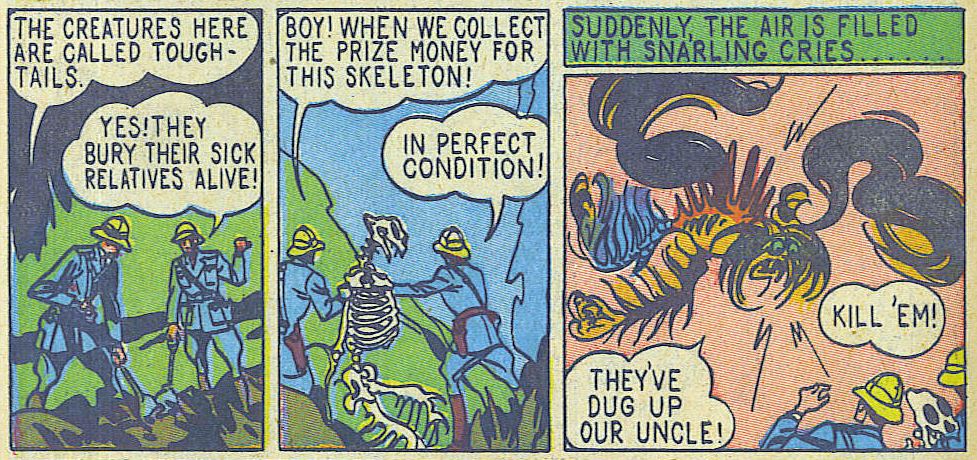
    The adventures of Mars Mason, interplanetary mailman, are rife with amazing alien designs thanks to creator Munson Paddock, but the Tough-Tails of Planet Greentrees and their allies the top-hatted Spear-Men are possibly my favourite aliens that I’ve seen in a couple of years. (Speed Comics 009, 1940) 

    The Speed Comics 010 Mars Mason adventure again features some more top-notch alien designs, including both the Mercurian leader with his enormous ears and his subjects with their amazing hats. The Uranian Monster-Men are okay, but the real star of that second set of panels is Mars Mason’s amazing radiator suit that seems to help him weather both the cold of Uranus and the heat of Mercury with equal aplomb.

    Drawn Without Reference:

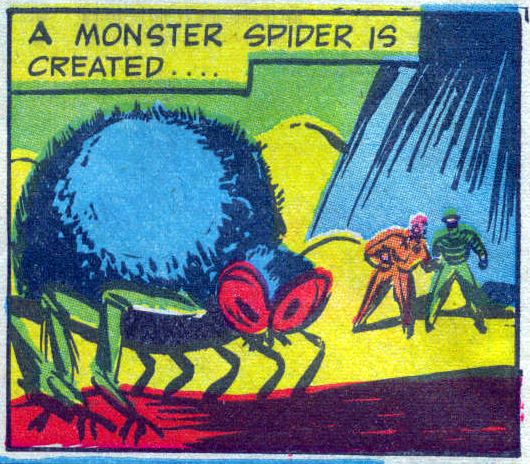
    A nice fuzzy spider created to menace Shock Gibson. (Speed Comics 010, 1940) 

    Good Henchmen:

    It’s not really germane to the story, but I would like to highlight the emotional journey that this henchman goes through over the course of a scheme by upcoming Minor Super-Villain Comrade Ratski. midway through a scheme to release giant arthropods on an unsuspecting populace is a heckuva time to confront your dislike of bugs. (Speed Comics 010, 1940)

    Honours:

    Ted Parrish, aka the mystery man known as the Man With 1000 Faces, wins the Academy Award for his performance in a film called Thundering Hoofs. We must make some assumptions – that Thundering Hoofs was completed and released in 1940, for example – but I think that Parrish might just have gotten his Oscar at the expense of Jimmy Stewart’s win for The Philadelphia Story. (Speed Comics 010, 1940)

    Mars Mason, Interplanetary Mailman, has his likeness on the Mercury Mail five-something stamp. (Speed Comics 011, 1940)