The Curse of Skeleton Munroe

Category: Harvey Comics

  • MONSTER, CRITTER AND CREATURE ROUND-UP 004

    Everyone likes a good monster now and then.

    Horned Cat:

    With every one of these round-ups I accrue more evidence that the Slightly Different Big Cat is one of the classic monster types, as seen here when Congo Jack is confronted with this horned green feline in the mystical Valley of Vango in the Congolese jungle.

    As a bonus, a few steps later he has to deal with another classic: the carnivorous plant, or in this case flesh-eating bush. (Lightning Comics v2 004, 1941)

    Croco-Tiger:

    As further evidence, here’s Power Nelson fending off a strangely plush-looking croco-tiger in the wilds of the planet Pluvius in the far-flung year 1982 CE. For those like me who like to see a comic book creature survive now and then, worry not for the yellow pool this beast is being flung into merely shrinks it to kitten size, which is hopefully something that it can adapt to.

    Pluvius also features its own type of carnivorous plant, in this case some sort of tentacle (or possibly tendril?) based predator. (Prize Comics 003, 1940)

    Cannibal Tree:

    Rex Dexter of Mars and gal pal Synde have their own run-in with a carnivorous plant, the so-called cannibal tree, on an unnamed extrasolar planet. (Mystery Men Comics 018 1941)

    Dodman’s Serpent:

    Though the practice is now frowned upon in zoological circles, I can’t help but love the sound of an eponymous species name, and especially when the species in question is some sort of monster. Dodman’s Serpent is great because it has the lovely rhythm of an eponym without actually being named after some guy named Dodman who will later be cancelled and require a lot of textbooks to be reprinted. Instead, it is named after its hunting grounds near Dodman’s Point in Cornwall. Or its former hunting grounds, I suppose, since it made the mistake of attacking a ship containing the Black Knight. (The Funnies 049, 1940)

    Dragon:

    I really like this dragon, which spent its days peacefully eating maidens in an unnamed European kingdom until the Golden Knight showed up and slayed it. It has all the weird goofiness of the dragons that you see in Medieval illustrations from before the concept of what such a beast looks like was really codified. (Fantastic Comics 010, 1940)

    Dragons:

    These dragons, by contrast, are just a bunch of weird lizards that the Green Sorceress keeps in a cave and throws her enemies to. I really like them. (Blue Bolt v1 001, 1940)

    Drazil:

    Here we see Neptina associate Norma Kane be ambushed and nearly killed by a very cool-looking undersea reptile called a drazil. As is often the case with long-necked creatures, the drazil is vulnerable to having its head chopped off.

    Norma really was having a day of it, as immediately before the drazil attack, she was ambushed by this heinous looking crustacean which is referred to only as a “sea-beast.” (Champ Comics 011, 1940)

    Dream Plants:

    During one of the Green Sorceress’ many attempts to conquer the whole of the underground world, she employs dark majicks and weird science to move her armies through the Fourth Dimension. While pursuing her there, Blue Bolt is nearly killed by a Dream Plant, a carnivorous plant with the ability to project sexy illusions to lure its prey closer.

    Later, a second, airborne species of dream plant that forgoes the illusory lures in favour of active hunting almost does for the Green Sorceress herself before Blue Bolt spears it in its conspicuous weak point. (Blue Bolt v1 005, 1940) 

    Jungle Horse:

    Finally we have the jungle horse, potentially the only non-hostile species present on the Gorikon in the Negative Universe, or at least the only one encountered by Meteor Martin during his time there. These peaceful animals just hang around waiting to act as beasts of burden for passing humanoids – a truly selfless species. (Amazing-Man Comics 025, 1941)

  • MEDIA IN COMICS 005

    This is the stuff that my counterpart in a comic book universe is writing his little blogs about.

    Movies:

    Not only does this theatre feature an appearance by Lady Luck (an impostor, alas), but it has screenings of Boris Scarloff in Mummy Blood and Myrna Powell and William Loy in Thinner than the Thin Man! (Lady Luck, the Spirit Section 1940)

    The villainous Comrade Ratski might have founded Ratski Productions and filmed his opus The Great War as a cover for his espionage activities, but was it a real movie? Was he filming all of his crimes and if so who has the footage? (Speed Comics 009, 1940) 

    Ted Parrish, aka the Man With 1000 Faces stars in Thundering Hoofs, which might appear to be a generic Western to you and I but which nets him the 1941 Oscar for Best Actor – sorry, Jimmy Stewart. (Speed Comics 010, 1940)

    This is another Ted Parrish feature(, and though the title is partially obscured by that rude talking kid I am familiar enough with 1940s parody title conventions to confidently state that it is Went with the Gale. (Speed Comics 008, 1940)

    Newspaper Columns:

    “John Perry In the News,” with its sassy little “Perry Says….” opening is said to be and written like a gossip column but like Bob Phantom before him John “the Black Fury” Perry seems to mostly write about crime. Also please note that both of these clippings have “Daily Standard” down the side even though Perry is consistently said to work for the Daily Clarion. (Fantastic Comics 017, 1941)

    Martin Mitchell is another of these gossip columnist/ hard-core investigative journalist types, only he isn’t a super-hero and so when he starts writing about ongoing criminal activity in “Martin Mitchell About Town” he just gets murdered. (Rocket Comics 003, 1940)

    We don’t get anything more about “The Tattler” than its title, and even that is concealed beneath part of the Press Guardian’s name. Maybe Ted McCoy needs to dig up some hotter gossip. (Pep Comics 001, 1940)

    Radio: 

    Martin Mitchell (America’s most popular columnist!) also has a radio show, and since we never learn its name I’m going to assume that it is also named Martin Mitchell About Town. (Rocket Comics 003, 1940)

    We don’t learn too much about The Brady’s Better Bacon Program due to its star Biff Crossley being mixed up in a string of high-profile murders, but it certainly is well-attended. And it has a full orchestra!(Pep Comics 008, 1940)

    Theatre: 

    Tobacco Turnpike is one of those murder mystery plays that are so beloved of comic and television writers because of dramatic potential inherent in someone being murdered on-stage at the same time as they are supposed to be pretending to be murdered, as happens several times in this story before the Shield gets involved and reveals that the director is responsible and is trying to tank the play because he has sold half stakes in the play to at least four men and doesn’t want to pay out or go to jail.

    Tobacco Turnpike is such a specific name that I was sure that it was a reference to something. I almost gave up the quest for knowledge after my third unsuccessful search for a production of Cigarette Junction, before finally narrowing it down to a play called Tobacco Road. (Shield-Wizard Comics 002, 1940)

  • FASCIST GOON CLEARING HOUSE 013

    Another batch of dumb-dumbs for the fire.

    the Green Shirts:

    Though only mentioned by crooked political boss and aspiring fascist bigwig Pete Rosky, these Green Shirts are the same kind of palate-swap allusion to the Nazi Brownshirts and/or the Italian Blackshirts that we’ve seen so many times before. Their Rosky-led attempt to take over the US-government is nipped in the bud by the Human Meteor. (Champ Comics 012, 1941)

    Categorized in: Colours (Green), Ideology (Crypto-Fascists), Objects (Shirts)

    the Black Legion:

    Led by a melted candle named Hans Schmutzdoff, the Black Legion are a group of fifth columnists who are infiltrating US war production with an eye to disrupting it, and who are ultimately undone because Chuck and Skip, aka the Liberty Lads, just kind of stumble upon them doing Nazi cosplay in the woods. (Champ Comics 016, 1941)

    Categorized in: Colours (Black), Espionage (Fascist Groups), Generica (Legions)

    the Ghost Ship:

    It’s one last hurrah for Cloud Curtis as yet another gang of fascists attempts to disrupt the development of the US air forces by deploying a gimmicked-up airplane. This one has projector mounted on it, allowing it to distract US pilots with visions of a phantom plane while the real one sneak attacks them from the rear. Like several other Cloud Curtis foes, this is a group operating under the singular name of the vehicle they pilot. (Silver Streak Comics 016, 1941)

    Categorized in: Fraud (Fake Undead – Ghost Planes), Objects (Planes), Supranormal Beings (Ghosts) 

    the Hooded League: 

    The Hooded League are as far as I can tell a home-grown fascist group dedicated to weakening America in advance of a Nazi invasion, and to that end they launch a coordinated attack on Chicago that includes blowing up both the El Train and every bridge over the Chicago River (this is the inspiration for my modern Captain Battle revival in which the rebuilt bridges have slightly taller guardrails thus preventing the Dave Matthews Band bus incident, which in turn causes aliens to invade or something. It’s a rich seam of potential that I will be strip mining). 

    Before things can get much more out of control, Captain Battle gets ahold of their leader, newspaper editor Thompson, and forces him to order the Hooded League to stand down. (Captain Battle Comics 001, 1941)

    Categorized in: Generica (Leagues), Objects (Hoods), Supercrime (Attempted Conquest)

  • FASCIST GOON CLEARING HOUSE 013

    Another batch of dumb-dumbs for the fire.

    the Green Shirts:

    Though only mentioned by crooked political boss and aspiring fascist bigwig Pete Rosky, these Green Shirts are the same kind of palate-swap allusion to the Nazi Brownshirts and/or the Italian Blackshirts that we’ve seen so many times before. Their Rosky-led attempt to take over the US-government is nipped in the bud by the Human Meteor. (Champ Comics 012, 1941)

    Categorized in: Colours (Green), Ideology (Crypto-Fascists), Objects (Shirts)

    the Black Legion:

    Led by a melted candle named Hans Schmutzdoff, the Black Legion are a group of fifth columnists who are infiltrating US war production with an eye to disrupting it, and who are ultimately undone because Chuck and Skip, aka the Liberty Lads, just kind of stumble upon them doing Nazi cosplay in the woods. (Champ Comics 016, 1941)

    Categorized in: Colours (Black), Espionage (Fascist Groups), Generica (Legions)

    the Ghost Ship:

    It’s one last hurrah for Cloud Curtis as yet another gang of fascists attempts to disrupt the development of the US air forces by deploying a gimmicked-up airplane. This one has projector mounted on it, allowing it to distract US pilots with visions of a phantom plane while the real one sneak attacks them from the rear. Like several other Cloud Curtis foes, this is a group operating under the singular name of the vehicle they pilot. (Silver Streak Comics 016, 1941)

    Categorized in: Fraud (Fake Undead – Ghost Planes), Objects (Planes), Supranormal Beings (Ghosts) 

    the Hooded League: 

    The Hooded League are as far as I can tell a home-grown fascist group dedicated to weakening America in advance of a Nazi invasion, and to that end they launch a coordinated attack on Chicago that includes blowing up both the El Train and every bridge over the Chicago River (this is the inspiration for my modern Captain Battle revival in which the rebuilt bridges have slightly taller guardrails thus preventing the Dave Matthews Band bus incident, which in turn causes aliens to invade or something. It’s a rich seam of potential that I will be strip mining). 

    Before things can get much more out of control, Captain Battle gets ahold of their leader, newspaper editor Thompson, and forces him to order the Hooded League to stand down. (Captain Battle Comics 001, 1941)

    Categorized in: Generica (Leagues), Objects (Hoods), Supercrime (Attempted Conquest)

  • DIVINE ROUND-UP 027

    I wonder if we’ll ever synthesize a unified theory of comic book religion out of this stuff.

    Isis:

    While attempting to thwart the magical con man Ahman-Ka-Lukor, Doctor Miracle calls upon the power of the Egyptian goddess Isis, who aids him by summoning the shade of the man whose reincarnated soul is now Ka-Lukor’s, and all so that Doctor Miracle can compare the two and make sure that he has the right man – it’s the most elaborate alternative to acquiring a photograph of the guy that I can imagine.

    Isis is depicted with a horns/sun disc/vulture headdress that is reasonably accurate to at least one era’s iconography, which is impressive enough for a just-wing-it medium like comics, but even more impressively for 1941 she is also totally topless, though also completely nipple-less.

    It’s not really anything to do with Isis, but Ka-Lukor has a cat familiar named Oasi who can turn into a lady who looks weirdly like the depiction of Isis and who caused me some confusion when I skimmed the story. I think that sh might just have represented another chance to draw a topless woman. (Champ Comics 013, 1941)

    the God of Hate: 

    The God of Hate is worshipped by the Claw’s followers at his skull castle in Tibet, and might just have the biggest head to body ratio that we have seen thusfar.

    Given the way that the God of Hate descends into the fiery pit and is then replaced with the Claw, it is possible that they are seen as aspects of the same being, that the Claw is the Earthly representative of the GoH, or even that the God works for the Claw, given the fanatical devotion that he elicits from his minions.

    Also: check out these guys. I’m sure that they came straight out of a National Geographic photo shoot but they also look quite cool. (Silver Streak Comics 007, 1941)

    the Great One: 

    This happens all the time when you’re a jungle adventurer: you rock up to an ancient temple to a near-forgotten god that is still worshipped with grisly rites and human sacrifice, and it turns out that there’s a big snake or other monster in there, just living it up. In this case, god of death the Great One has been played by Kadu, the Man-Eating Rat, who adventurer Lance Hale has personal beef with from a prior encounter, it seems. 

    God Style: Animist (Silver Streak Comics 011 1941)

    Moko:

    Moko is the god of a group of Tibetan bandits referred to as the Hoods, who I initially thought just had that weird yellow skin tone that comics used to render Asians with, but are later revealed or revised to be wearing cape and cowl getups. The actual worship of Moko is not detailed but does involve human sacrifice via a pit-and-pendulum style swinging blade.

    God Style: Idol (Silver Streak Comics 012, 1941)

  • DIVINE ROUND-UP 027

    I wonder if we’ll ever synthesize a unified theory of comic book religion out of this stuff.

    Isis:

    While attempting to thwart the magical con man Ahman-Ka-Lukor, Doctor Miracle calls upon the power of the Egyptian goddess Isis, who aids him by summoning the shade of the man whose reincarnated soul is now Ka-Lukor’s, and all so that Doctor Miracle can compare the two and make sure that he has the right man – it’s the most elaborate alternative to acquiring a photograph of the guy that I can imagine.

    Isis is depicted with a horns/sun disc/vulture headdress that is reasonably accurate to at least one era’s iconography, which is impressive enough for a just-wing-it medium like comics, but even more impressively for 1941 she is also totally topless, though also completely nipple-less.

    It’s not really anything to do with Isis, but Ka-Lukor has a cat familiar named Oasi who can turn into a lady who looks weirdly like the depiction of Isis and who caused me some confusion when I skimmed the story. I think that sh might just have represented another chance to draw a topless woman. (Champ Comics 013, 1941)

    the God of Hate: 

    The God of Hate is worshipped by the Claw’s followers at his skull castle in Tibet, and might just have the biggest head to body ratio that we have seen thusfar.

    Given the way that the God of Hate descends into the fiery pit and is then replaced with the Claw, it is possible that they are seen as aspects of the same being, that the Claw is the Earthly representative of the GoH, or even that the God works for the Claw, given the fanatical devotion that he elicits from his minions.

    Also: check out these guys. I’m sure that they came straight out of a National Geographic photo shoot but they also look quite cool. (Silver Streak Comics 007, 1941)

    the Great One: 

    This happens all the time when you’re a jungle adventurer: you rock up to an ancient temple to a near-forgotten god that is still worshipped with grisly rites and human sacrifice, and it turns out that there’s a big snake or other monster in there, just living it up. In this case, god of death the Great One has been played by Kadu, the Man-Eating Rat, who adventurer Lance Hale has personal beef with from a prior encounter, it seems. 

    God Style: Animist (Silver Streak Comics 011 1941)

    Moko:

    Moko is the god of a group of Tibetan bandits referred to as the Hoods, who I initially thought just had that weird yellow skin tone that comics used to render Asians with, but are later revealed or revised to be wearing cape and cowl getups. The actual worship of Moko is not detailed but does involve human sacrifice via a pit-and-pendulum style swinging blade.

    God Style: Idol (Silver Streak Comics 012, 1941)

  • REAL PERSON ROUND-UP 021

    REAL PERSON ROUND-UP 021

    They just love putting real folks and versions of real folks in comics and I just love finding them and putting them on my blog. 

    Adolf Hitler:

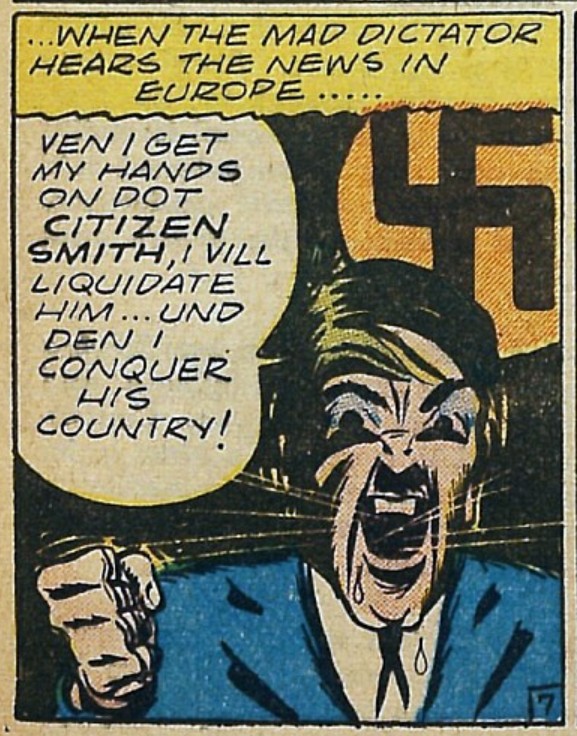
    An in-all-but-name version of Hitler gets mad at Citizen Smith for foiling his plans and plots. (Captain Fearless Comics 002, 1941)

    Gang boss and Deacon foe Duke Adare’s little toothbrush mustache is what initially drew my attention, even though that wasn’t nearly as glaring a signpost of a character being a Hitler stand-in in the 1940s. As the story wore on it became clear that my instincts were correct, as Adare used overwhelming military force to overwhelm the lawmen of Midland City and loot its treasury. And then of course you get to the end of the story, where they’re referring to him as a “would-be Crime Fuehrer”. (Cat-Man Comics 005, 1941)
    Minor appearances: 

    Captain Fearless Comics 001, 1941 

    Al Capone: 

    Lou Pacone, gang boss and murderer of the Secret Circle’s father, is yet another example of Al Capone’s name being remixed to give someone a gangstery sounding moniker. (Choice Comics 001, 1941)

    Axis & Allied Figures: 

    “America’s Air Army” was an extremely patriotic feature that was essentially US Army Air Force fan fiction about what would happen if and when the United States entered WWII, published just before they did. It’s the tale of the US forces (with a little help from the Brits) curb stomping the Axis for about half an hour before we get this little scene, with Hitler surrendering while Goering, Walther von Brauchitch (recently relieved of duty when this comic was published), Cordell Hull (I think) and Churchill observe. (Air Fighters v1 001, 1941) 

    FDR: 

    The President gets kidnapped by Dr Sivana! And Rescued by Captain Marvel! (Whiz Comics 014, 1941)

    Minor Appearances: Captain Aero Comics 001, 1941

    Lord Haw-Haw: 

    In his final Golden Age adventure, the Arrow aka intelligence agent Ralph Payne heads into Germany to apprehend the traitorous broadcaster “Lord Hawford.” (The Arrow 003, 1941) 

    Manuel Prado Ugarteche: 

    Lance O’Casey and his pal Dan’l Doom wash up on the shores of Peru and get mixed up in a scheme to overthrow the country by the wicked El Tigre. They foil him and restore power to the rightful president, Alfredo Blanco, who is extremely not Manuel Prado Ugarteche, the Peruvian president in our version of 1941. (Whiz Comics 015, 1941)

    Rudolph Hess: 

    “Deputy-Dictator Brinker” lands in a farmer’s field near Washington in what is certainly a reference to Hess’ flight to Scotland but is in fact revealed to be part of a plan to invade the US. The whole thing is nearly undone by the fact that the FBI doesn’t even bother to check on this seeming defection and just tells the poor farmer to deal with it. (Captain Fearless Comics 002, 1941)

    Sherlock Holmes:

    Dr Miracle is on the trail of a mystery, and who better to help than the summoned spirit of Sherlock Holmes Herlock Sholmes? Per the conceit of the story I guess this means that Sholmes was a real living guy at some point. (Champ Comics 012, 1941)

    Unknown Dancers: 

    Yet again we have an example of “this seems like a reference to something but I can’t find specifics,” in this case a dance team known as Velox & Costanza. The concept of a duo performing cultural dances from exotic locales crops up now and then as entertainment in comics but I’m never sure if the references to them are general or specific, and brief fads in live entertainment are among the trickiest things to casually research on the internet – it’s more of a “comb through several years’ worth of newspapers” kind of thing. (Whiz Comics 023, 1941)

    Walter Winchell: 

    As an example of why I include the Unknown entries in these round-ups: I had Walter Chinwell here listed as “Unknown Reporter” for something like two weeks before I came across Walter Winchell’s name in a list of 1940s radio announcers. And Winchell is someone I had already heard of! (Silver Streak Comics 008, 1941) 

  • ALIENS AND SO FORTH ROUND-UP 029

    The wonders of the cosmos!

    Spiny Scalemen: 

    The Spiny Scalemen are yet another group of gross-looking underwater humanoids who threaten the mostly peaceful nation of Amloza, and what’s worse, they’re doing it as part of a Nazi plot to take over the city and use it as a naval base. Thankfully Mogg the Fish-Man and only competent citizen of Amloza realizes that city walls are a bit of a useless affectation in an underwater environment and destroys the Scalemen by collapsing Amloza’s onto them. (Champ Comics 016, 1941)

    Categorized in: Body (Nonhuman Parts), Generica (Men)

    Flat Heads: 

    “Og, Son of Fire” was a comic adapted from a Big Little Book that was based on a series of short stories and also a radio show about Og, a young caveman who is trying to make his way in a hostile world. And importantly for the purposes of this blog, one of the things making the world more hostile is this tribe of ape men led by a fellow named Long Tooth. Heaven knows I love an ape man, but I love ’em even more when they’re called something fun like “Flat Heads.” See also the Flat Heads’ Sun God here. (The Funnies 013, 1937)

    Categorized in: Body (Heads)

    the Flies:

    While the Barrangees of Planet Barrang have had a lot of problems with insects over the years – they famously grew giant and drove the Barangee population underground, while insect-worshipping Barrangee priests stymied any attempt to reclaim the surface – their most troublesome foes were always the giant flies. These creatures have adapted to their new size by becoming active hunters rather than scavengers, and the Barrangees are a favourite prey. Couple this with the fact that Earthman Captain Tornado and his cohort have encouraged the Barrangees to move above ground and you get situations like the above, in which a Fly abducts a Barrangee child in broad daylight.

    The Flies are the most intelligent and organized of the Barrang insect species featured in the “Captain Tornado” feature, and they make war on the Barrangee city under the direction of their Fly King until Tornado bring knowledge of both firearms and insecticide to the planet and effectively counters their offensive. (Popular Comics 054, 1940)

    Categorized in: Animals (Insects), Extrasolar (Planet Barrang)

    Fourth Dimensional Creatures:

    After foiling several of Satan Rex’s attempts to destroy humanity, scientific adventurer Jon Linton and his pals return to their first love: tinkering around with spaceships. And since Jon et al exist in an adventure comic, the first test flight of their new rocket turns into an out-of-control flight through space at never-before-seen speeds, careening directly through planets without touching an atom and ending up on a world where thought and reality intersect, kind of like that one episode of Star Trek: The Next Generation.

    During their pell-mell flight through space, Linton and pals are briefly visited by these tentacle-legged lizard monsters, who appear to be kind of generically hostile for a few minutes before fading back into the ether. Just what the heck is going on?

    Jon hits upon the answer with his customary swiftness: these are inhabitants of the Fourth Dimension, and the ship briefly intersected with their space. Does this justify the seeming aggression that their show to the people on the spaceship? We cannot accurately judge, alas. (Amazing Mystery Funnies v3 007, 1940)

    Categorized in: Extradimensional (Fourth Dimension)

  • ALIENS AND SO FORTH ROUND-UP 028

    Dudes come in all kinds of shapes nowadays.

    Walrus Men:

    We first encounter the Walrus Men in Champ Comics 013 when the newly-reformed Neptina goes to them to ask for help in reclaiming the throne of Amloza from her sister Mhersa, only to discover that the friendly Prince Eon has been overthrown and that the Walrus Men are now ruled by the expansionist tyrant King Walro.

    Not that Walro is unopposed in his rule, as there are still Eon loyalists willing to help Neptina and her friends in their quest.

    Neptina, her friends and the loyalists rescue Eon from the hole that Walro has been keeping him in, upon which it becomes clear that, like the Fish-Man population of Amloza, the Walrus Man of Polaris are ruled by a very human-looking nobility. This isn’t such a huge contrast in the Walrus Men’s initial appearance, when their tusks are small and dainty, but…


    From Champ Comics 014 and onward they really put the walrus in Walrus Men. So no Neptina and Eon represent an ocean-wide ruling class? Did some sub-oceanic Queen Victoria seed the thrones of the Atlantic with her grandchildren? Should Neptina and Eon’s burgeoning romance be quashed for the sake of their children’s genetic health? 

    (this issue also establishes the signature piece of Walrus Man technology: “mole ships” that travel beneath the sea floor for surprise attacks) 

    Finally, Prince Eon is restored to the throne of Polaris in Champ Comics 015 after fatally(? it is under water, after all) punching Walro off of a balcony. 

    Categorized in: Aliens (Earth), Animals (Aquatic Mammals), Generica (Men)

    Fish-Men UPDATE: 

    Speaking of the Fish-Men of Amloza and the morphological differences between them and their ruling class, Neptina and her companions find themselves in the Kingdom of the Fishmen while fleeing from Walrus Men forces. The Fishmen, hyphenated or not, appear to be their own people who just happen to live in Amloza in significant number. Neptina’s chief scientist Mogg is welcomed to the Kingdom as a citizen, which introduces some interesting questions about how the nation-states of the Atlantic work.  (Champ Comics 014, 1941)

    Fernomacs:

    When space adventurer Spurt Hammond is appointed as Earth’s ambassador to the Mercury of the year 2520 CE, he quickly finds favour with Thermod, king of the Mercurian Fernomacs, a species of leather-skinned green humanoids. By contrast, Hammond and his rising influence makes him an enemy in the eyes of the sinister Baron Burno.

    Burno expresses his frustration by staging a coup and dumping Thermod and Hammond on the desolate dark side of Mercury (not how Mercury works). All seems lost until…

    Grubmen:

    … the Grubmen show up! These inhabitants of the dark side of Mercury don’t get a tremendous amount of characterization: they love light and worship the flashlight-wielding Spurt Hammond as a god and he’s happy to exploit their adulation for his own benefit. Pre-religious reformation under Hammond they appear to have been ruled by the largest member of their species but he sees the writing on the wall and joins up with Hammond without a fight.

    In a bit of good luck for the Grubmen, exposure to the light and heat of the light side of the planet causes them to grow powerful and so they are able to effectively combat Burno’s Fernomac forces rather than die en mass as Hammond had presumably assumed they would given the physical and technological gulf between the species initially.

    King Thermod is re-installed on the throne of Ferno and as the Grubmen are of no further use to Hammond he leaves them behind as citizens. A happy ending for everyone but Baron Burno and his co-conspirators! (Planet Comics 009, 1940)

    Categorized in: Aliens (Mercury), Animals (Insects), Generica (Men)

  • ALIENS AND SO FORTH ROUND-UP 028

    Dudes come in all kinds of shapes nowadays.

    Walrus Men:

    We first encounter the Walrus Men in Champ Comics 013 when the newly-reformed Neptina goes to them to ask for help in reclaiming the throne of Amloza from her sister Mhersa, only to discover that the friendly Prince Eon has been overthrown and that the Walrus Men are now ruled by the expansionist tyrant King Walro.

    Not that Walro is unopposed in his rule, as there are still Eon loyalists willing to help Neptina and her friends in their quest.

    Neptina, her friends and the loyalists rescue Eon from the hole that Walro has been keeping him in, upon which it becomes clear that, like the Fish-Man population of Amloza, the Walrus Man of Polaris are ruled by a very human-looking nobility. This isn’t such a huge contrast in the Walrus Men’s initial appearance, when their tusks are small and dainty, but…


    From Champ Comics 014 and onward they really put the walrus in Walrus Men. So no Neptina and Eon represent an ocean-wide ruling class? Did some sub-oceanic Queen Victoria seed the thrones of the Atlantic with her grandchildren? Should Neptina and Eon’s burgeoning romance be quashed for the sake of their children’s genetic health? 

    (this issue also establishes the signature piece of Walrus Man technology: “mole ships” that travel beneath the sea floor for surprise attacks) 

    Finally, Prince Eon is restored to the throne of Polaris in Champ Comics 015 after fatally(? it is under water, after all) punching Walro off of a balcony. 

    Categorized in: Aliens (Earth), Animals (Aquatic Mammals), Generica (Men)

    Fish-Men UPDATE: 

    Speaking of the Fish-Men of Amloza and the morphological differences between them and their ruling class, Neptina and her companions find themselves in the Kingdom of the Fishmen while fleeing from Walrus Men forces. The Fishmen, hyphenated or not, appear to be their own people who just happen to live in Amloza in significant number. Neptina’s chief scientist Mogg is welcomed to the Kingdom as a citizen, which introduces some interesting questions about how the nation-states of the Atlantic work.  (Champ Comics 014, 1941)

    Fernomacs:

    When space adventurer Spurt Hammond is appointed as Earth’s ambassador to the Mercury of the year 2520 CE, he quickly finds favour with Thermod, king of the Mercurian Fernomacs, a species of leather-skinned green humanoids. By contrast, Hammond and his rising influence makes him an enemy in the eyes of the sinister Baron Burno.

    Burno expresses his frustration by staging a coup and dumping Thermod and Hammond on the desolate dark side of Mercury (not how Mercury works). All seems lost until…

    Grubmen:

    … the Grubmen show up! These inhabitants of the dark side of Mercury don’t get a tremendous amount of characterization: they love light and worship the flashlight-wielding Spurt Hammond as a god and he’s happy to exploit their adulation for his own benefit. Pre-religious reformation under Hammond they appear to have been ruled by the largest member of their species but he sees the writing on the wall and joins up with Hammond without a fight.

    In a bit of good luck for the Grubmen, exposure to the light and heat of the light side of the planet causes them to grow powerful and so they are able to effectively combat Burno’s Fernomac forces rather than die en mass as Hammond had presumably assumed they would given the physical and technological gulf between the species initially.

    King Thermod is re-installed on the throne of Ferno and as the Grubmen are of no further use to Hammond he leaves them behind as citizens. A happy ending for everyone but Baron Burno and his co-conspirators! (Planet Comics 009, 1940)

    Categorized in: Aliens (Mercury), Animals (Insects), Generica (Men)