The Curse of Skeleton Munroe

Category: Zatara

  • CATALOGUE OF WOUNDS 006

    Why of why do they keep on hurting our boys?

    Meteor:

    Silver Streak’s partner Meteor is shot in the back by a Nazi, but it’s okay: the bullet only “nicked” his back. (Silver Streak Comics 016, 1941)

    Electro:

    Professor Zog, the brains behind Electro, is shot in the left arm. (Marvel Mystery Comics 016, 1941)

    the Sandman:

    The Sandman has a very rough 1940, starting with a shot to the right shoulder… (Adventure Comics 047, 1940)

    … then a shot to the left shoulder… (Adventure Comics 050, 1940) 

    … a second shot to the right shoulder… (Adventure Comics 055, 1940)

    … and the for symmetry’s sake, a second wound to the left shoulder (All-Star Comics 001, 1940)

    To add insult to injury, he has to have gotten at least a little radiation poisoning during his repeated encounters with the Yellow-Faced Terror and his killer radium ball. (All-Star Comics 002, 1940)

    Sargon the Sorcerer:

    Sargon the Sorcerer, shot in the left shoulder while trying to do his damn job. (All-American Comics 032, 1941) 

    Zatara:

    Zatara is shot in the right arm while hanging around a lost city of ape-men. (Action Comics 027, 1940) 

    Then he is shot in the left shoulder by an uncommonly fast-on-the-draw crook. (Action Comics 038, 1941)

    Zatara shot in the left shoulder again thanks to the fact that he overlooks a crook when making himself hypnotically invisible. (Action Comics 040, 1941)

  • ALIENS AND SO FORTH ROUND-UP 025

    We’re going heavy on the ape-man content this time. 

    Ape-Men: 

    These Ape-Men, like most ape men, are some sort of human offshoot population or remnant of another species of homo living in the isolated depths of, in this case, the Amazon jungle. They come into conflict with Doctor Voodoo after breaking their long-held peace treaty with his allies the Blancas and abducting many of them for human sacrifice. Also they use silver arrows for some unexplained reason. (Whiz Comics 013, 1941)

    Ape-Men: 

    These particularly wooly-looking Ape-Men briefly vex adventurer Cotton Carver in one of the various lands beneath Antarctica before learning about firearms the hard way, as so many of their fellow sub-Antarcticans do during Carver’s travels. (Adventure Comics 048, 1940)

    Apemen:

    More cave- than ape-men in my estimation, these fellows ambush Bill Dale and his guide Dagoo as they traverse the cheerily-named River of Skulls in Africa on their way to find Bill’s long-lost twin Steve. Notably, these are the Apemen who worship the crocodile swam god the Creeping Death. (Nickel Comics 001, 1940)

    Link Men: 

    Encountered by Zatara while searching for a missing biologist in modern-day Tanzania, the Link (for Missing Link, natch) Men are the most ape-like in appearance of all of our entries today. They live in a small city atop a plateau and are generally hostile to strangers.

    For all that they are literal ape-men, the Link Men are just as weirdly obsessed with the nuances of human race as so many other nonhuman intelligences: their leader is the ever-popular Random Blonde Lady, in this case one named Kara whose presence on the plateau is never really explored. They are also weirdly invested not in human sacrifice but in the sacrifice of a white man to their deity, the Sun-God. Zatara’s aide Tong isn’t even considered as a sacrifice.

    The potential sacrifice above is coincidentally also missing biologist Raoul d’Armand, who Kara has fallen in love with and thus reconsidered being the leader of a society of religious apes. Thankfully Zatara is on hand to foster true love by turning an entire intelligent species into marble statues. One would hope that he would turn them back before leaving but as with so many of the occasions in which Zatara transforms someone into an inanimate object the final fate of the Link Men is left to the reader’s imagination. (Action Comics v1 027, 1940)

  • DIVINE ROUND-UP 022

    DIVINE ROUND-UP 022

    Oh my gosh this place has so many god options.

    the Sacred Leopard: 

    The animal-worshipping tribe who all dress like the animal in question is a regular trope in jungle comics so of course Kalthar, lord of the jungle eventually encounters some of them. In this case it’s Leopard Men from the Leopard Village, who dress in leopard skins and worship Karno, the leopard (Karno seems to be the collective singular noun for the leopard, a thing that happens a lot in jungle adventure books. I’m sure that it happens in real-world language as well, just as I’m sure that most of the examples in comics are just arbitrarily made up). The Leopard Men attack Kalthar and his people because they are being manipulated by a slaver who has a vendetta against them, and end up minus a lot of leopards for their trouble.

    God Style: Animist (Zip Comics 005, 1940)

    Roor the Octopus God: 

    After former Zatara foe Setap achieves her goal of regaining her youth, she reforms and starts looking to reconnect with her Atlantean roots by the simplest way possible: enlisting Zatara’s help in finding the sunken city of Atlantis.

    Everything is going great – Setap is welcomed with open arms, she and Zatara are learning why Atlantis sank (hit by a lost second moon, natch), etc – when one of the sailors they brought with them starts trouble while stealing everything not nailed down, as so often happens when an ancient civilization is discovered by sea. Specifically, the sailor enters the temple of Roor, the Octopus God, within which the giant and insatiable immortal octopoid was not so much worshipped as imprisoned.

    Roor is free to lay waste to Atlantis, and not even the power of Zatara can touch him. The Atlanteans are justifiably upset by this.

    Thankfully, the one magic that Zatara has that can affect Roor is that of illusion, by which means he fools the ancient/powerful/gullible god into eating a whole heap of sponge and salt and then exploding himself by drinking more water than he can contain. Atlantis is saved!

    God Style: Real (Action Comics v1 018, 1939) 

    the Sacred Oak: 

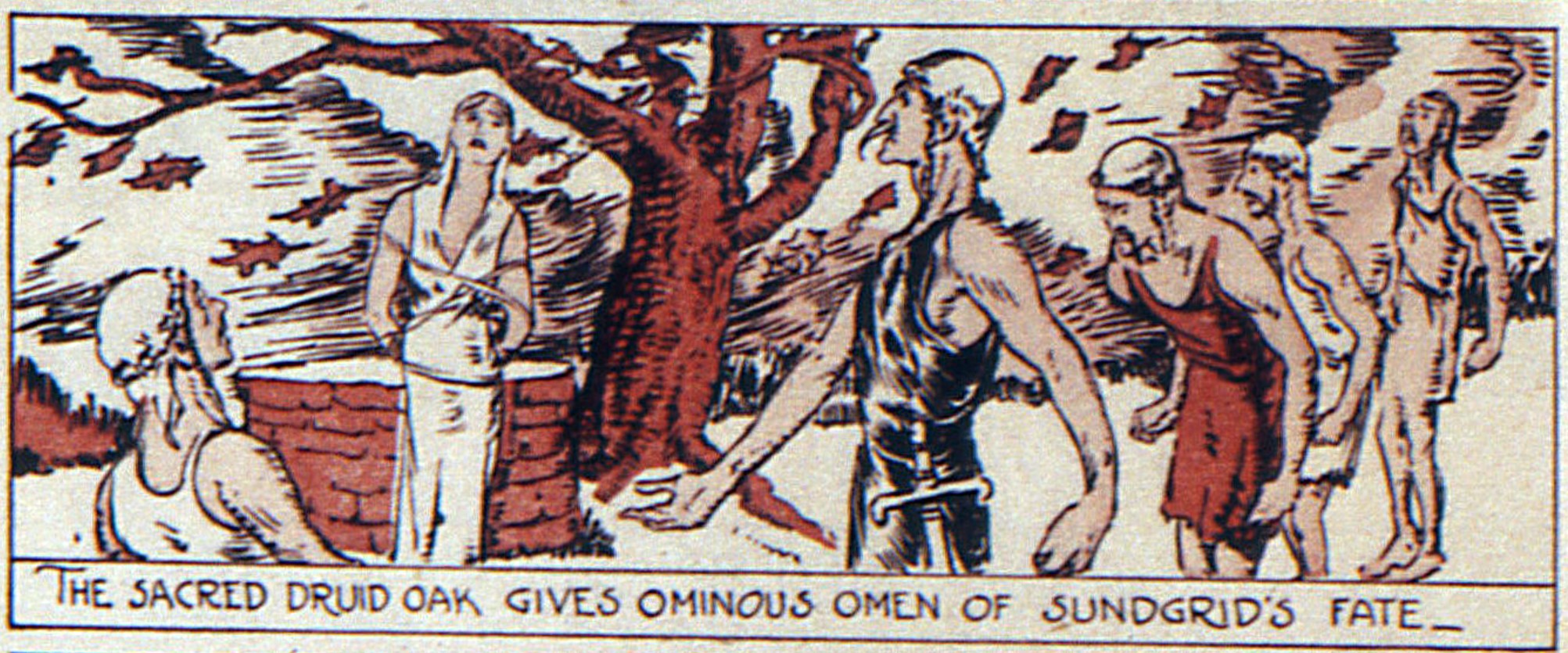
    One of the earliest DC books, New Comics (which eventually becomes New Adventure and then just Adventure Comics) had among its many features an adventure strip called ‘Vikings’ which was kind of slow and dour like a lot of early comics but did feature these doily-hatted Druids and their Sacred Oak that communicates to them via stiff breezes.

    God Style: Animist (New Comics v1 010, 1936) 

    Shin-Giva: 

    Shin-Giva is the god of the Dwarf People of Matto Grosso in Brazil, and his solid platinum idol is the focus of the attention of crooked explorer Frank Hart, who wants to steal it, and his former partner Henri Rinaldo along with Zatara, who want to return it to Shin-Giva’s worshippers and do so thanks to Zatrara’s mighty magicks (please note that the idol is not returned out of any sense that you shouldn’t just waltz in and take valuables from less technologically-advanced societies but rather out of a desire to not crash the world platinum market. So noble!).

    God Style: Idol (Action Comics v1 033, 1941) 

  • DIVINE ROUND-UP 018

    Idols, idols, idols! 

    the Great God Khwass: 

    Khwass, Great God of Vengeance, is a comparatively rare villain’s god who actually follows through on his promises. He is invoked vs Dr Fung by the daughter of a former foe and not only replies to her prayers but deploys sleeping gas and a weird monster to aid her in her quest for vengeance. 

    God Style: Real (Wonderworld Comics 016, 1940)

    Ice God Emul:

    Captain Venture and the Planet Princess Zyra’s great enemy, King Leon of Asteroid Djung, loves to subcontract out his villainy, and to that end he has engaged the services of Frigo, King of the Ice Planet. Frigo is to kill Captain Venture and deliver Zyra to King Leon for marriage but of course betrays him and slates all three for sacrifice to the Ice God Emul.

    The idol of Emul is destroyed in the subsequent battle and escape, and what’s interesting here is that Emul is explicitly just the idol. As Frigo states, “the god Emul is no more.” Wild.

    God Style: Idol (Master Comics 015, 1941)

    Bubastis & Isis:

    In an early adventure in Egypt, Zatara comes across a member of a lost archaeological expedition who is on the verge of death, and who is magically revealed to have found a lost temple to Bubastis. Travelling there in hopes of finding the rest of the expedition, Zatara encounters the ancient priest Amen-Hotep, who is part of one of those weird remnant Ancient Egyptian populations that exist under the sands of Egypt in adventure fiction, and whose priestly magics are comparable to Zatara’s own.

    The temple of Bubastis also turns out to be a temple to Isis, as Zatara discovers when he meets a less-powerful but still magically potent priestess of Isis and is almost sacrificed by her. Amen-Hotep seems to be an Isis worshipper as well, as he animates a statue of the goddess to smite Zatara with – it’s possible that the two goddesses are being conflated here.

    Zatara ends up melting the statue of Isis and disintegrating Amen-Hotep. The priestess is “sent away,” presumably with the rest of her people in tow, and the temple is turned over to the archaeologists to plunder.

    God Style: Real (Action Comics 005, 1938) 

    Khor: 

    Khor is known as the Blind God because the magical diamond that was the eye of his idol was stolen long ago, and since that diamond subsequently became the source of super-heroic adventurer Diamond Jack’s power, the priesthood of Khor is out for his blood.

    The high priest animates the idol of Khor and sends it to destroy Diamond Jack and recover the eye. This is impressive but not innovative – we just saw the Amen-Hotep do the same with a statue of Isis, after all – but what is is the custom roadster-cum-juggernaut that the thing rides around in. Was ever aan evil god so sporty?

    The whole thing ends back at the temple, as Diamond Jack disrupts the ritual that keeps Khor animated and the high priest ends up being crushed under the falling idol. So long, Khor. 

    God Style: Idol (Real?) (Slam-Bang Comics 004, 1940) 

  • DIVINE ROUND-UP 018

    Idols, idols, idols! 

    the Great God Khwass: 

    Khwass, Great God of Vengeance, is a comparatively rare villain’s god who actually follows through on his promises. He is invoked vs Dr Fung by the daughter of a former foe and not only replies to her prayers but deploys sleeping gas and a weird monster to aid her in her quest for vengeance. 

    God Style: Real (Wonderworld Comics 016, 1940)

    Ice God Emul:

    Captain Venture and the Planet Princess Zyra’s great enemy, King Leon of Asteroid Djung, loves to subcontract out his villainy, and to that end he has engaged the services of Frigo, King of the Ice Planet. Frigo is to kill Captain Venture and deliver Zyra to King Leon for marriage but of course betrays him and slates all three for sacrifice to the Ice God Emul.

    The idol of Emul is destroyed in the subsequent battle and escape, and what’s interesting here is that Emul is explicitly just the idol. As Frigo states, “the god Emul is no more.” Wild.

    God Style: Idol (Master Comics 015, 1941)

    Bubastis & Isis:

    In an early adventure in Egypt, Zatara comes across a member of a lost archaeological expedition who is on the verge of death, and who is magically revealed to have found a lost temple to Bubastis. Travelling there in hopes of finding the rest of the expedition, Zatara encounters the ancient priest Amen-Hotep, who is part of one of those weird remnant Ancient Egyptian populations that exist under the sands of Egypt in adventure fiction, and whose priestly magics are comparable to Zatara’s own.

    The temple of Bubastis also turns out to be a temple to Isis, as Zatara discovers when he meets a less-powerful but still magically potent priestess of Isis and is almost sacrificed by her. Amen-Hotep seems to be an Isis worshipper as well, as he animates a statue of the goddess to smite Zatara with – it’s possible that the two goddesses are being conflated here.

    Zatara ends up melting the statue of Isis and disintegrating Amen-Hotep. The priestess is “sent away,” presumably with the rest of her people in tow, and the temple is turned over to the archaeologists to plunder.

    God Style: Real (Action Comics 005, 1938) 

    Khor: 

    Khor is known as the Blind God because the magical diamond that was the eye of his idol was stolen long ago, and since that diamond subsequently became the source of super-heroic adventurer Diamond Jack’s power, the priesthood of Khor is out for his blood.

    The high priest animates the idol of Khor and sends it to destroy Diamond Jack and recover the eye. This is impressive but not innovative – we just saw the Amen-Hotep do the same with a statue of Isis, after all – but what is is the custom roadster-cum-juggernaut that the thing rides around in. Was ever aan evil god so sporty?

    The whole thing ends back at the temple, as Diamond Jack disrupts the ritual that keeps Khor animated and the high priest ends up being crushed under the falling idol. So long, Khor. 

    God Style: Idol (Real?) (Slam-Bang Comics 004, 1940) 

  • MINOR SUPER-VILLAIN 068: THE MASTER

    (Action Comics 030, 1940)

    I’ve decided to introduce a system for dealing with some of the more minor super-villains who do not incite as much excitement in me to vomit out more than a cursory sentence about them (slightly unfair to the Master, who is kind of interesting, but I am uninspired today) In such cases, we will be answering one or both of the following questions:

    What makes them a super-villain? In addition to his super-villain name, the Master has three qualifying super-villain attributes

    1) Methods: he kills those who resist his extortion attempts by releasing huge poisonous beetles in their homes.

    2) Powers: the Master, unlike many of Zatara’s opponents, is a magic user. Specifically, he has the ability to resist and shrug off Zatara’s own magic

    3} Association: he employs the services of the Tigress

    What’s interesting about them? Honestly, it’s the idea of a crook being able to resist a magical hero’s powers. Underused and underappreciated!

  • MINOR SUPER-VILLAIN 068: THE MASTER

    (Action Comics 030, 1940)

    I’ve decided to introduce a system for dealing with some of the more minor super-villains who do not incite as much excitement in me to vomit out more than a cursory sentence about them (slightly unfair to the Master, who is kind of interesting, but I am uninspired today) In such cases, we will be answering one or both of the following questions:

    What makes them a super-villain? In addition to his super-villain name, the Master has three qualifying super-villain attributes

    1) Methods: he kills those who resist his extortion attempts by releasing huge poisonous beetles in their homes.

    2) Powers: the Master, unlike many of Zatara’s opponents, is a magic user. Specifically, he has the ability to resist and shrug off Zatara’s own magic

    3} Association: he employs the services of the Tigress

    What’s interesting about them? Honestly, it’s the idea of a crook being able to resist a magical hero’s powers. Underused and underappreciated!

  • MINOR SUPER-VILLAIN 065: ASMODEUS

    (Action Comics 025, 1940)

    Former chess master turned crimelord, Asmodeus has three of my favourite features in a villain: 

    -he employs the Tigress

    -he builds little models of crime scenes to use as teaching aids for instructing his gang

    -he lives in a house of traps

    Unfortunately for him, he ends up battling Zatara, so all the traps in the world avail him not.

  • MINOR SUPER-VILLAIN 065: ASMODEUS

    (Action Comics 025, 1940)

    Former chess master turned crimelord, Asmodeus has three of my favourite features in a villain: 

    -he employs the Tigress

    -he builds little models of crime scenes to use as teaching aids for instructing his gang

    -he lives in a house of traps

    Unfortunately for him, he ends up battling Zatara, so all the traps in the world avail him not.

  • MINOR SUPER-VILLAIN 063: CHALO

    MINOR SUPER-VILLAIN 063: CHALO

    (Action Comics 024, 1940)

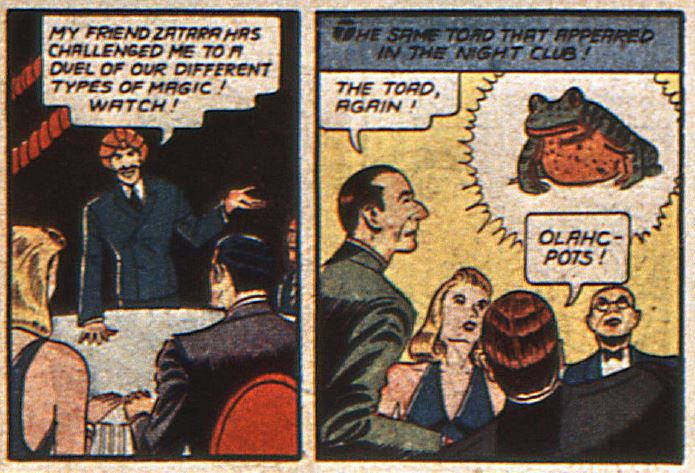
    Chalo was a stage magician who murdered his own brother to acquire real magical secrets which in turn he used for crime. He took a page from the Mad Lama’s book and hired at least one other magical crook as a henchman, a fire- and snake-summoner named Arko.

    By far the best thing about Chalo, however, is that his major use of the powers he murdered his brother to get is summoning a weird toad that freaks everyone out. He does it twice! Solid minor villain, should be BROUGHT BACK in the background of the Oblivion Bar or somewhere like that.