The Curse of Skeleton Munroe

Category: Lash Lightning

  • MINOR SUPER-VILLAIN 1002: MASTERMIND

    (Lightning Comics v2 001, 1941)

    Lash Lightning, while aimlessly flying around the countryside at night, encounters a footsore scientist named Amy Lane. Turns out that her castle (!) has been stolen by a man named Mastermind and that she has been walking for several hours in an attempt to get help. In a move that always seems kind of rude to me, Lightning immediately flies her all the way back to the castle to investigate. The mysterious Mastermind is no longer present when they arrive, but the castle’s laboratory is now filled with strange electrical equipment.

    But just where is Mastermind (who is also frequently called the Mastermind)? As you may recall from our one thousandth entry, he is in the middle of breaking Lightning’s recurring foe the Mummy out of jail in an attempt to wrangle the formula for his invulnerability coating out of him. You don’t see this kind of thing very often and I have to assume that the inherent egomania required to become a super-villain prevents most of them from acknowledging that anyone else might have a good idea.

    Upon returning to the castle and discovering Lightning and Lane in his newly-stolen laboratory, Mastermind demonstrates what the electrical equipment is for by using it to charge himself with lightning in this state he is immune to electricity (and only electricity, hence the need for the Mummy’s radium solution), can throw destructive bolts of lightning, and is able to teleport both himself and others, though just why this makes him resemble a dracula with glowing eyes is not explained.

    Mastermind and the Mummy demonstrate the value of teamwork by subduing Lightning with relatively little effort, then immediately revert to super-villain type and engage in a struggle for dominance that sees the Mummy reduced to a smouldering pile of medical gauze and Mastermind is left forever vulnerable to being punched in the face.

    Undeterred, Mastermind sets out to enact his ultimate scheme: to extort money from the US government in exchange for not helping the Axis to take over America, and as the government (in the form of this room full of Army officers) refuses to pay up based solely on the threats of a goth, he sets out to do just that.

    Mastermind seeks out a nearby cell of pseudo-Nazi spies and offers his services as a saboteur, then proves that he can deliver the goods by blowing up the Washington Monument. I am not ashamed to admit that I yelled aloud when I read this part of the book – that’s the sort of high-tier, messing-with-national-symbols villainy that you don’t get a lot of in this era.

    Mastermind’s pitch to the spies is of course successful and he goes on a real sabotage tear, though none of it is as crazy or memorable as that initial salvo. By this point Lash Lightning has recovered and escaped, and the two have a final confrontation back at Amy Lane’s castle as Mastermind is nipping back for a quick recharge. Instead of that pick-me-up, however, he gets thrown to his doom on the rocks below.

    OR DOES HE??

    No he does not, because Mastermind is back in Lightning Comics v2 002 and he’s explicitly rather than implicitly collaborating with the Nazis. This time, he’s got a mind control serum that he uses to take over the minds of everyone at Fort Hancock.

    And just why does he mind control an entire fort worth of soldiers? Why, to both prevent them from operating the shore defenses as the Nazi fleet is sailing into the nearby city’s harbour and as auxiliary troops for the subsequent shelling and invasion of that city, of course.

    Lightning is of course not going to stand for this kind of thing: he blows up/drives off the fleet, cures the men of the Mastermind’s control with a careful application of electricity and takes care of Mastermind himself with the careful application of a sock on the jaw.

    In his third appearance in Lightning Comics v2 003, Mastermind escapes jail by arranging to have himself sent a tiny recharging device that appears to just plug into the electrical outlet that I never really pictured 1940s prison cells as having but which gives him enough juice for one teleport away.

    This time around, Mastermind steals an experimental dirigible equipped with heat and paralysis rays and uses it to prep the way for yet another Nazi invasion by attacking US defense facilities.

    Not only does Lash Lightning show up and take him down with an almost insulting level of ease, but he does so accompanied by a pretty devastating put-down. It’s the old law of diminishing returns, as a villain who started out as a formidable opponent becomes more and more of a pushover as time goes on. Mastermind jumps to his death rather than being captured this time, only of course he doesn’t because he is a teleporter.

    Sure enough, when Mastermind returns in Lightning Comics v2 004, he confirms that teleportation saved his bacon. This time around he is working for the Nazis yet again, but rather than paving the way for invasion he is attempting to destroy some war materiel making its way from America to the UK via Canada. And speaking of Canada, since Lash Lightning prevents the supplies from being destroyed as they cross the border, the bulk of this issue takes place in my home country. Specifically, Mastermind is the very first super-villain who we have encountered doing supercrime in the province of Quebec!

    Not great supercrime, mind you. He does manage to poison Lightning, but instead of taking proper advantage of this he just throws him off of a roof, something that he would ordinarily survive and something I think would be reasonable to assume he would survive even while half dead.

    And yes, he does survive, returning to to punch out Mastermind’s lights and foil all of his plans. It’s back to prison for our pale friend, and this time they must have made sure to check all of his incoming cake deliveries a bit more thoroughly because as far as I can tell he never appears again.

    Categorized in: Origins (Evil Equivalents), Powers (Teleportation), Professions in Crime (Masterminds)
  • MINOR SUPER-VILLAIN 1000: THE MUMMY

    MINOR SUPER-VILLAIN 1000: THE MUMMY

    Number 1000!!*

    (Lightning Comics v1 005, 1941)

    The Old Man of the Pyramids summons (F)lash Lightning to his thundercloud lair to warn him about trouble at Midton College, and he is right, as can only be expected of a wise old oracular father figure. This particular trouble is called Professor Vatz and is a professor of chemistry who is ready to give up academia for the heady world of supercrime.

    Vatz’s new career is founded on two inventions: his “Hotlight,” a ray gun that seems to spit out both bright light and great heat sufficient to kill a regular person or knock out a superhuman figure like Lightning, and a radium compound that makes ordinary cloth into a form of armour resistant to conventional attack. Vatz decides to apply this solution to mummy wrappings, and while I can kind of see that being a way to ensure that the his armour is applied as close to his body as possible, but just what his justification is for using wrappings from an actual mummy is completely inscrutable to me.

    As always, mummy wrappings are a fantastic look and they are only enhanced by the fact that Vatz either chooses to leave the little flyaway portions of his hair sticking out of the sides or simply does not care that they are. It’s some very very strong bald guy energy and perhaps the most significant addition to the mummy look in two thousand years.

    The newly-fledged Mummy recruits a few gangsters and goes on a mild crime spree but is soon tracked down by a recovered Lightning. This leaves the problem of the Mummy’s invincibility to solve, and Lightning does so with aplomb: if the wrappings are the vehicle for the invulnerability, simply remove the wrappings before applying violence.

    (please note that the Mummy had a calling card all ready to go, and it’s a cute one. He only ever gets to use it the once, however)

    The Mummy returns in Lightning Comics v1 006, in what is effectively a bottle episode. Professor Vatz, given far both too much credit for a rapid reformation and unfettered access to the prison laboratory, is able to recreate his radium solution and take over – but not actually escape – the prison he has been locked up in.

    The only thing that the Mummy seems to be unable to replicate in prison is his Hotlight. Instead, he sports a much cooler “Nitro Gun” that shoots explosive pellets. He is also able to whip up a “Lightning Arrester” to drain the electric energy from Lash Lightning’s body when he inevitably turns up to foil the Mummy’s plans.

    Despite the fact that he is able to disable Lightning and throw him into the prison gas chamber, the Mummy does not account for the possibility that his lightning powers might return to him and allow him to escape. He is soon recaptured in the exact same manner as he was in their first encounter and I must say that the fact that Professor Vatz failed to account for this – perhaps by means of a tricky little knot or fastener – really lowers him in my estimation.

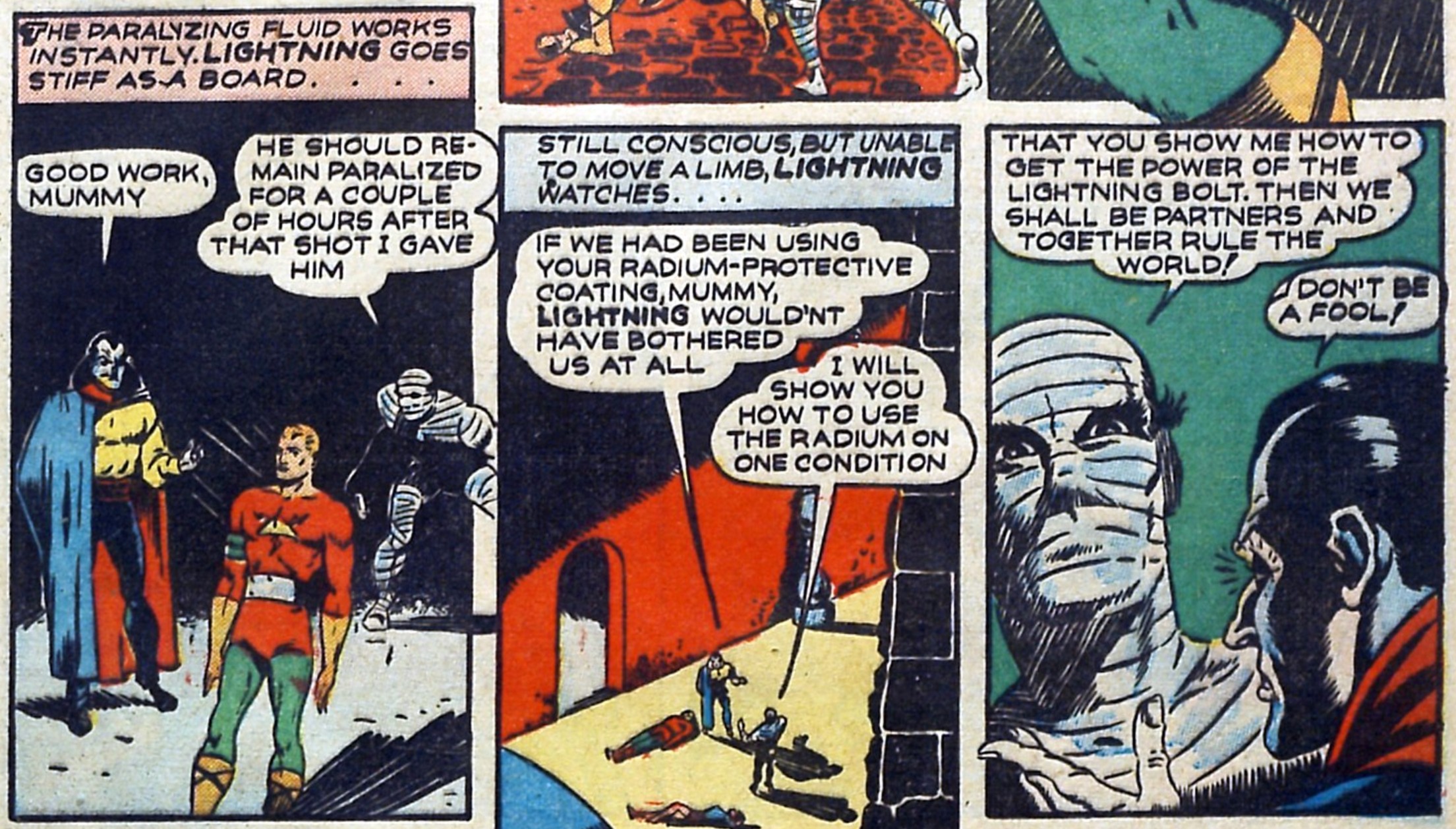
    In the Mummy’s final appearance, in Lightning Comics v2 001, he is broken out of a prison hospital by Lash Lightning’s new archfoe Mastermind, who is hoping to learn the secret of Professor Vatz’s radium coating in order render himself immune to harm. 

    The Mummy makes three key mistakes in his dealings with Mastermind: 1) he tries to negotiate after the initial deal has been struck, proposing that the radium formula be revealed in exchange for the secret to Mastermind’s own ability to command lightning. This might work if the Mummy were dealing with a reasonable person, but Mastermind is a super-villain, a class of inherently unreasonable people. 2) The Mummy escalates the confrontation to a physical one without first applying the radium solution and thus rendering himself immune to harm, and 3) he gets himself obliterated by a lightning bolt. he does therefore mess up Mastermind’s plans by taking his formula to the grave, but it must be cold comfort when one is a smouldering corpse.

    Farewell, the Mummy. You weren’t a very good super-villain but you were an entertaining one.

    Categorized in: Accessories (Anti-Hero; Heat Rays), Day Jobs (College Professors), Supranormal Beings (Mummies)

    *technically Fang Ryan is number 1000 and the Mummy is number 999, but I like mummies more than snake-themed gangsters so I fudged it for the sake of the round number.

  • MINOR SUPER-HERO ROUND-UP 103

    Soon there will be more minor super-heroes than there are humans for them to protect.

    the Sentinel:

    In 1783, on the Boston Common, the newly-minted Spirit of America charges a cannon with the “powders of patriotism” in anticipation that someday a champion will be needed to defend the new nation from destruction. Finally, in 1941 (the Civil War not, apparently, being enough of a reason), the cannon fires on its own and releases the Sentinel, mystic champion of the American people.

    As one might expect, the Sentinel is broadly superhuman: he can fly, is super strong and is immune to most harm. He also has a halo of fire that he can disappear into and shrink to a tiny flame, effectively rendering him invisible and allowing him to vex friend and foe alike with his comings and goings. Oddly, he has no other control over fire. (Liberty Scouts Comics 003, 1941)

    Doctor Nemesis:

    Doctor Nemesis is really Dr Jim Bradley, intern at Mercy Hospital in an unnamed city (that is probably meant to be NYC but later retconned as San Francisco) who has developed a foolproof truth serum and decided to keep it to himself rather than risk criminals getting their hands on it – presumably the concern is that they would use it to learn bank vault combinations and other secret information. Since he himself continually runs into situations in which a foolproof truth serum is a handy way to solve a crime, Bradley adopts a costumed identity and sets out to achieve a better tomorrow via a series of injections. 


    Doctor Nemesis might just be the most calling card-using super-person who we have yet encountered. He hands out at least four of them in his first adventure alone.

    Doctor Nemesis has a pretty simple crimefighting routine: identify a potential injustice and then drug everyone involved until he has a clear idea of who is responsible, then beat them up and have them give a drugged confession in front of a police witness. The police in turn are perfectly happy to receive these confessions that they technically haven’t coerced from people, though there has to be a clever defense attorney somewhere in Unnamed City who is just waiting to get a Doctor Nemesis client so that they can really dig into the admissibility of admissions given under the influence of mysterious vigilante juice.

    It’s been a while since we have encountered a character who was later revived and incorporated into the Battle-Axis, Marvel’s team of disaffected public domain Golden Age super-heroes who went over to the Nazis, but Doctor Nemesis here is one of them under the technically-but-not-really more badass name of Dr Death. As always, it’s hard to say just who got done dirtiest by Roy Thomas when he was assembling the Battle-Axis roster but Doctor Nemesis is certainly a candidate, if only because he doesn’t even have the Human’s Meteor’s flimsy “I’m Irish American and fuck the British” or the Spider Widow’s “the Commies killed my husband” excuses. Instead, he simply implies that the Nazis are paying him well.

    Subsequent writers (specifically Matt Fraction, if I have things right) clearly thought that Doctor Nemesis was worth revisiting. He was given a long career as a Nazi hunter to counteract his short career as a Nazi and briefly became a core X-Man, though nowadays every time I look up what he’s up to it seems that he has become weirder and more peripheral to the action than the last. (Lightning Comics v1 006, 1941)

    Lash Lightning **UPDATE**:

    I haven’t been very careful to delineate whether the character has been going by “Flash” or “Lash” Lightning due to the fact that it profoundly does not matter (they just call him “Lightning” in the stories themselves, for instance) but I might as well make note of this, the issue in which the actual change was made. (Lightning Comics v2 002, 1941)

    Marvo the Magician **UPDATE**:

    Up until the exact point pictured above, Marvo the Magician was unique among magical comic book super-heroes, for though many of them (including Zatara, the big cheese himself) are said to be using their magic to create illusions and fool the minds of others, it is all demonstrably lies (or more charitably a different definition of “illusion” than I am using), as they all produce material effects in the world. Only pure, beautiful Marvo can claim that he uses illusions and nothing more to frighten and confound his foes, and I have been checking.

    That is, up to this issue, when Marvo creates the “illusion” of an ocean liner (complete with a crooked sailor who kidnaps her and hands her over to pirates!) that the woman he is helping proceeds to board and sail away on. Unless the implication is that she has been so convinced that the liner exists that she has swum or perhaps hovered her way to her destination (well, part way to her destination), the inescapable fact is that this ship is more than a mere illusion. Nothing is certain in this wicked world, folks. (Lightning Comics v2 003, 1941)

  • MINOR SUPER-VILLAIN 980: THE WERE-WOLF

    (Four Favorites 001, 1941)

    Lash Lightning is one of those characters who is so very powerful that he outclasses all regular human opposition, barring some extraordinary circumstance. That’s why a movie-style, immune-to-all-harm werewolf is a perfect foil for him!

    The story of the Were-Wolf begins c.1921 (or possibly 1911 – accounts vary!), when Sumter Military Academy student Adolph Krimetz, sick of being bullied and nicknamed “Wolf” because of his unusual appearance, attacks a fellow student and accidentally kills him. Fearing official reprisals, Krimetz flees into the wilderness, where he remains for the next twenty (or thirty!) years. 

    Eventually, Krimetz decides to get revenge on the men who bullied him at school, as he blames them for his exile from society. He is emboldened in his quest by the fact that at some point in the intervening years he discovered that his childhood nickname was ironically close to the truth, because he is in fact an actual werewolf!

    Krimetz’s particular style of lycanthropy is worth noting here: he transforms into something approaching a fully canine form, but only in his upper body, meaning that he technically remains humanoid. It’s a wild look, particularly when paired with his homemade fur kilt and footwraps. As the Were-Wolf, Krimetz is super strong, able to travel long distances in a series of super-jumps and is completely immune to all harm – presumably excepting harm caused by silver, but this is never really brought up.

    Starting with his old classmates Generals Andrews and Johnson (and Johnson’s daughter Joan, filling the role of damsel in distress), Krimetz proceeds to kidnap at least sixteen people. Like fellow revenge-seeker the Master, he seems to be compelled to assemble all of his potential victims before killing any of them, and like the Master this ultimately backfires on him. Krimetz, at least, has a motive beyond revenge for doing so, as he plans on torturing military secrets out of his enemies so that he can sell them to the highest bidder.

    Before doing any of that, however, Krimetz sets out to destroy Sumter Military Academy, the scene of his childhood humiliations. Since he has captured Lash Lightning and is thus leaving him alone with all of his prisoners, this is effectively a recipe for their escape. Having freed everyone, Lash rushes off to prevent the bombing.

    While Lash might be incapable of harming the Were-Wolf, it turns out that a big old lightning bolt can compel him to turn back into a human, and a human is very vulnerable to, for instance, being punched headlong onto a barrel of TNT and exploding.

    REVENGE KILLER SCORE: either 0/16 or 0/216+ if we’re including all of the military school kids he also failed to murder.

    BUT WAIT:

    Even though the Were-Wolf is clearly exploded at the end of his first appearance, he does not in fact die. He returns in Four Favorites 002, still obsessed with revenge but directed against the US military in general, rather than the specific people and institutions who harmed him in his youth. To that end, he derails a troop train that is travelling across the Midwest, and goes on to attempt similar acts against an army convoy and some troop-transporting aircraft

    A lot of the dramatic focus of this issue is taken up by the plight of Old Mike Jasper, the railway switchman who Krimetz frames for the derailment and who is almost convicted for the crime a mere one day later despite the fact that a) the case against him is extremely circumstantial and b) much of it is based around a general skepticism of his claim that a werewolf did it, never mind that a werewolf just kidnapped more than a dozen high-level army officers and is currently out there sabotaging military transports. Old Mike has a terrible lawyer, is what I’m implying.

    Krimetz is jailed for the mass murdering, but he will return for a further two appearances in 1942! 

  • MINOR SUPER-HERO ROUND-UP 097

    It’s astonishing. They just keep on coming up with more super-heroes.

    the Flame **UPDATE**:

    Like many other long-running Fox Features characters, the Flame gets a bit of an overhaul late in 1941. In the Flame’s case, this includes an expansion to his powers: long able to get around by running on the stream of fire produced by his flame gun, the Flame is now simply able to fly. He can also now pick up and move fire around, as seen in this very innovative bit of fire-fighting in The Flame 006.

    The Flame also gets a proper secret identity (Gary Preston) and a job (private investigator) as a part of this revamp. And he gets a supporting cast, in the form of secretary Linda Dale and punch drunk ex-boxer/assistant/comic relief character Pug! (The Flame 007, 1941)

    Finally, though the Flame was explicitly a NYC-based super-hero in his earliest experiences, his 1940-41 adventures frequently have the liminal feel of the many stories set in generic unnamed US cities. In one of his very final appearances, he gets a proper fictional burg to call his own: Big City. (Big 3 006, 1941)

    the Yank and the Rebel:

    I think I’ve occasionally mentioned the inherent ridiculousness of the concepts behind many if not all patriotic super-heroes – it’s something that really jumps out at you as you read through as many Golden Age comics as I have. Please believe me, then, when I say that the Yank and the Rebel are the most conceptually ludicrous patriotic heroes of the lot, and I will be thoroughly (and probably not pleasantly) surprised if I’m ever proven wrong.

    As might be surmised from their names, the Yank and the Rebel are two otherwise unidentified soldiers who are on opposite sides during the American Civil War. While locked in hand-to-hand-to-gun combat, the two fall into a fissure opened by the artillery bombardments at the Battle of Gettysburg, landing next to a convenient radioactive pool that holds them in a state of suspended animation for the next seventy-eight years.

    The duo are eventually awakened when Army manoeuvres re-open the cavern, and they resume their battle until a helpful general explains that the American Civil War ended in some sort of peaceful draw, that nobody really “lost” or “won” the war and that the North and the South are all totally cool with one another now. So why did he put so much spin on history? Probably for the same notion of national unity in the face of war that inspired the people at Fox Features to do so.

    Regardless of the reasoning behind them, the officer’s words inspire a new spirit of patriotism and cooperation in the Yank and the Rebel, and the two team up to hunt spies and saboteurs for two whole adventures before evaporating in the Fox Features financial crisis of 1942. In what is certain to be a massive surprise to nobody, no modern publisher has taken advantage of the fact that these fellows are in the public domain. (The Flame 007, 1941)

    Categorized in: Locations (Specific Places), Origin (Patriotic Heroes), Team Membership (Confederate Army, Union Army) 

    Vulcan **UPDATE**:

    Taking a cue from the Flame, fellow fire-themed hero Vulcan gets a slight expansion to his powers in 1941: he can now create and use flame constructs such as this cool sword. (Four Favorites 001, 1941) 

    It’s not all good news for our favourite demigod, howver, as 1941 is also the year that Vulcan is given a weakness to cold. (Four Favorites 002, 1941)

    Lash Lightning **UPDATE**:

    Lash Lightning gives blood to injured army private Tom Jasper, who immediately develops mild superhumanism in the form of increased muscle mass and vigour. This is especially notable because it really is the ultimate expression of the writers on this feature forgetting that Lash’s powers are derived from a magical amulet and not from his own body. Sad times. (Four Favorites 002, 1941)

  • MINOR SUPER-HERO ROUND-UP 097

    It’s astonishing. They just keep on coming up with more super-heroes.

    the Flame **UPDATE**:

    Like many other long-running Fox Features characters, the Flame gets a bit of an overhaul late in 1941. In the Flame’s case, this includes an expansion to his powers: long able to get around by running on the stream of fire produced by his flame gun, the Flame is now simply able to fly. He can also now pick up and move fire around, as seen in this very innovative bit of fire-fighting in The Flame 006.

    The Flame also gets a proper secret identity (Gary Preston) and a job (private investigator) as a part of this revamp. And he gets a supporting cast, in the form of secretary Linda Dale and punch drunk ex-boxer/assistant/comic relief character Pug! (The Flame 007, 1941)

    Finally, though the Flame was explicitly a NYC-based super-hero in his earliest experiences, his 1940-41 adventures frequently have the liminal feel of the many stories set in generic unnamed US cities. In one of his very final appearances, he gets a proper fictional burg to call his own: Big City. (Big 3 006, 1941)

    the Yank and the Rebel:

    I think I’ve occasionally mentioned the inherent ridiculousness of the concepts behind many if not all patriotic super-heroes – it’s something that really jumps out at you as you read through as many Golden Age comics as I have. Please believe me, then, when I say that the Yank and the Rebel are the most conceptually ludicrous patriotic heroes of the lot, and I will be thoroughly (and probably not pleasantly) surprised if I’m ever proven wrong.

    As might be surmised from their names, the Yank and the Rebel are two otherwise unidentified soldiers who are on opposite sides during the American Civil War. While locked in hand-to-hand-to-gun combat, the two fall into a fissure opened by the artillery bombardments at the Battle of Gettysburg, landing next to a convenient radioactive pool that holds them in a state of suspended animation for the next seventy-eight years.

    The duo are eventually awakened when Army manoeuvres re-open the cavern, and they resume their battle until a helpful general explains that the American Civil War ended in some sort of peaceful draw, that nobody really “lost” or “won” the war and that the North and the South are all totally cool with one another now. So why did he put so much spin on history? Probably for the same notion of national unity in the face of war that inspired the people at Fox Features to do so.

    Regardless of the reasoning behind them, the officer’s words inspire a new spirit of patriotism and cooperation in the Yank and the Rebel, and the two team up to hunt spies and saboteurs for two whole adventures before evaporating in the Fox Features financial crisis of 1942. In what is certain to be a massive surprise to nobody, no modern publisher has taken advantage of the fact that these fellows are in the public domain. (The Flame 007, 1941)

    Categorized in: Locations (Specific Places), Origin (Patriotic Heroes), Team Membership (Confederate Army, Union Army) 

    Vulcan **UPDATE**:

    Taking a cue from the Flame, fellow fire-themed hero Vulcan gets a slight expansion to his powers in 1941: he can now create and use flame constructs such as this cool sword. (Four Favorites 001, 1941) 

    It’s not all good news for our favourite demigod, howver, as 1941 is also the year that Vulcan is given a weakness to cold. (Four Favorites 002, 1941)

    Lash Lightning **UPDATE**:

    Lash Lightning gives blood to injured army private Tom Jasper, who immediately develops mild superhumanism in the form of increased muscle mass and vigour. This is especially notable because it really is the ultimate expression of the writers on this feature forgetting that Lash’s powers are derived from a magical amulet and not from his own body. Sad times. (Four Favorites 002, 1941)

  • MINOR SUPER-VILLAIN 791: CATS ROMELT

    (Lightning Comics 004, 1940)

    Though Cats Romelt is the head of a gang of river pirates who organizes a fake warehouse guard union in order to call a general strike and leave the dock warehouses easy pickings, none of this is the reason for his being here. No, it is his sheer bloody-minded commitment to using starved alley cats with poisoned claws as weapons of terror and mass destruction that tipped him over into the category of super-villain. It’s an idea that certainly works better on paper than in practice, but the real question is: is he constantly doing it because his nickname is “Cats” or is that his nickname because he breaks out a poison-clawed alley cat as the solution to any problem?

  • MINOR SUPER-VILLAIN 789: THE GRAND DICTATOR

    (Sure-Fire Comics 003a, 1940)

    The Grand Dictator, aka Miko, is on a mission to conquer the US, and he’s doing it from a cool flying fortress. Miko and his men are probably intended to be at least Nazi-adjacent, but they don’t really come off that way, at least as compared with their contemporaries. I mean, sure, they’ve got the uniforms and the attitude, but where are the dimwitted goons named Hans and Franz shouting “Jah, jah!” as they scuttle off to commit civilian atrocities?

    The Grand Dictator’s forces really stand out in the coolness of their military tech, including these very imposing flame guns…

    The aforementioned flying fortress (including the terrific detail that the GD’s forces have solved the problem of how to make something huge in the sky look like a cloud by stapling cotton batting to the bottom like it’s a prop in an elementary school play)…

    And in a bit of a combination of the first two, some fairly impractical-looking flame throwing planes.

    We’re still quite early in the career of Flash Lightning, and so he’s still kind of finding his level with regards to the relative power of he and his opponents. Case in point: the main challenge that Lightning faces in this issue is in getting his companion on the lower right to safety, after which he destroys the Grand Dictator’s entire operation with one big lightning bolt.

  • MINOR SUPER-VILLAIN 786: THE TIGER MAN

    (Sure-Fire Comics 002, 1940)

    The Tiger Man (also referred to as the much snappier Tiger Mask in one panel but I reckon that was just some sort of lettering error or other style of brain glitch) is a fellow in an extremely cool cowl mask who is trying to corner the pearl market in the South Seas using some very crooked tactics, such as sticking pearl bed owner Rita van Dyke on a raft and abandoning her at sea. Only the intervention of Flash Lightning saves her, and he only knows to do so because the Old Man of the Pyramids tells him to.

    This is in many ways a fun little adventure, marred frequently by the threat being stated as “those dastardly South Seas natives trying to steal the pearl trade from the virtuous white people” (barely a paraphrase).

    Eventually, the Tiger Man is unmasked and it turns out that he didn’t kill Rita’s uncle as she had thought but rather that he was her uncle and that in addition to the harrowing near-death experience she just had she is going to have to really reevaluate a lifetime of memories and maybe have some serious talks with any other parents/cousins/etc who might be kicking around. Talk about an awkward next Thanksgiving dinner, am I right?

  • MINOR SUPER-VILLAIN 785: THE PHOENIX

    (Sure-Fire Comics 001, 1940)

    Flash Lightning’s first stop after getting juiced up with brand-new electric powers is New York City, super-hero capital of the world, and it’s a good career move for him because he immediately gets mixed up in some super shenanigans. An explorer named Parker has gone missing in Central America and the agents of someone named the Phoenix are doing their damnedest to prevent his daughter Mary from looking for him. Lightning and Mary dodge fiery deathtraps, tommy gun-wielding gangsters and threatening coffin deliveries and set out regardless.

    Mary and Lightning travel to what is now the Parque Nacional Sierra De Las Minas in Guatemala (there are coordinates!) and dodge some fellows known variously as the Tzutuhiles, the Jewel Men and the Python Men, a bunch of snake worshippers who help the Phoenix advance his plans for world domination by using slave labour to create artificial gemstones that are then shipped around the world to be sold (and this is not the first nor the last time we will see the creation of artificial jewels, a victimless if not virtuous activity, treated as equivalent to counterfeiting currency).

    It is at this point that the Phoenix makes an actual appearance in the story, and just what does a guy named after a mythical firebird who makes and distributes gemstones with the aid of both hard-boiled gangsters and snake worshipping tribesmen look like?

    You guessed exactly right: he looks like a character from a 1930s sci-fi movie serial. Unfortunately for the Phoenix he is completely unprepared for a superhuman opponent and he appears in a whopping four panels before being sent to his doom at the bottom of his own volcanic crater by Flash Lightning.

    Special shout-out to this fellow, John Roan, aka the Reptile Man, who accompanied Parker Sr on his expedition and managed to escape and return to New York for help only be killed by the Phoenix’s men. Just what is his deal? Was he a reptile man when the expedition started or is this something that happened to him at the hands of the Python Men? I’m asking but nobody is telling me anything.