The Curse of Skeleton Munroe

Category: monocle

  • GENERIC COSTUMED VILLAIN ROUND-UP 013

    GENERIC COSTUMED VILLAIN ROUND-UP 013

    Here come the also-rans.

    We’ve got another Leader, and this time he’s not a generically-fascist spy but the head of a gang looking to extort the New York World’s Fair via a series of bombings. Of course the Fantom of the Fair cannot let this stand and quickly tracks them down to a small island base.

    If the first reason I included the Leader aka Relmar here is because I enjoy a monocled man with a high opinion of himself then the second is the fact that the Fantom, without ever actually saying a word, lays such complete waste to Relmar, his men and his entire island. Don’t mess with the World’s Fair, is the message I’m getting. (Amazing Adventure Funnies 001, 1940)

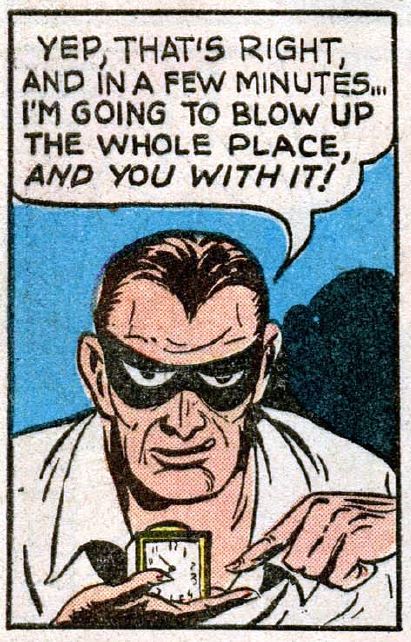
    A masked saboteur of no clear allegiance, Biff Durgo aka the Masked Man is the poorly-disguised sole foe faced by Pack Morgan, Super Detective. (Detective Eye 002, 1940)

    Lead by the mysterious “One”, gangsters Face Greer and Shiv Scarpino are bleeding the city of Midtown dry. That’s why Mayor Kurt Piersole calls in trigger-happy detective Gunner Thompson, only it’s not, because when it all shakes out it turns out that Mayor Piersole was indulging in the old trick of establishing his innocence by being the one to call in the forces of order. It was a cliche in 1940 and continues to be to this day and then as now it ends one way: the One wasn’t quite as clever as he thought he was and ends up on the wrong side of his own hired gun. (Exciting Comics 001, 1940)

    John Blodgett kills his partner Samuel Forbes in order to make off with his claim on a lucrative gold mine but fails to reckon with the fact that Forbes’ daughter Caroline might just wonder what happened to her father and so has to don a mask and engage in some truly half-assed attempts to bump both her and private eye Dan Williams off before they uncover his dumb secret. (Exciting Comics 001, 1940)

  • MINOR SUPER-VILLAIN 582: BARON BLOOD

    (Detective Eye 001, 1940)

    Not the first knockoff of Count “the Most Dangerous Game” Zaroff we’ve met, and certainly not the last. Baron Blood incorporates quite a lot of elements that you’ll find in various adaptations of the story: the island castle with built-in lighthouse to draw victims in via shipwreck, the monocle and prominent facial scar and the pack of hunting dogs and huge hunting guide/servant.

    What sets the Baron apart from the rest of the bored island-dwelling human-hunting aristocratic crowd is that for one he is not actually a baron but an escaped maniac. For two, he both dresses like a super-villain (orange chain mail!) and employs a staff composed of guys dressed as Vikings and armed with machine guns. Really great stuff, top score on the henchman front. Like the original and a lot of knockoff Zaroffs he also gives himself a bit of a hunting handicap, in his case using poisoned darts fired from a sling – some real eccentric villain behaviour.

    He of course (of course) meets his end at the point of his own darts after Dean Denton tackles him from out of a tree. Just carrying around a fistful of them like that is a Health and Safety nightmare in a regular workplace, let alone a jungle island where man hunts man.

  • MAD AND CRIMINAL SCIENTIST ROUND-UP 010

    We have mad scientists at criminal scientist prices.

    Dr Koch is one of the many people hungry to get their hands on the secret vitamin supplement that turned the Champ (derogatory) into the Champ (aspirational) after its creator Dr Marlin is murdered. Koch’s mild claim to fame is the fact that he’s the first one to get ahold of the formula long enough to do anything with it. What he did, specifically, was to mix up a big batch and pump it directly into a poor guy named Cris, thus turning him into a lumpy rage-filled monster-man.

    Koch gets away at the end of his encounter with the Champ and his little pal Henry (Cris sadly does a header off a cliff) but characters later in the story talk about him as if he’s dead. Dead or hiding out in a cave in Mexico: either way he’s not bothering the Champ any more. (Champ Comics 011, 1940)

    Dr Bolms (excuse me, Doktar Bolms) here is a mere gangland plastic surgeon, which was enough to draw the attention of Secret Agent Z-2 here but not necessarily enough to draw ours. What really sets him apart from his peers is the fact that he has captured a government agent named Monty Wood and has been practising facial surgeries on him. Horrible! (Crash Comics Adventures 001, 1940)

    Dr Sax is a doctor/spy who needs Tornado Tom’s good good blood to rejuvenate his spy chief, but since he’s an evil man he is determined to take all of his blood instead of just some of it. (Cyclone Comics 005, 1940)

    These youngsters are the Space Rovers, Jane and Ted, a coupla youths who were forced to flee in Jane’s father’s spaceship rather than have it and its ray cannons fall into the hands of enemy spies and now just kind of ping pong around the Solar System in the hopes of getting home. Their first port of call is Mercury, where they have the misfortune of meeting the Mercurians of Thian, who only live twenty years, are mad about it and thanks to their head scientist Flaedo here have exactly one proposed solution: capture longer-lived beings and vivisect them.

    I love his little mustache! Don’t worry, he gets electrocuted in the Space Rovers’ escape. (Exciting Comics 002, 1940)

  • MINOR SUPER-HERO ROUND-UP 020

    Super-heroes! Minor ones. 

    the Tulpa:

    The Tulpa and its originator Tsang had the misfortune to appear only once, in Sun Publications’ only proper comic, Colossus Comics 001. This is… a shame? No, it’s probably not. As it stands, the Tulpa is an interesting idea: a Tibetan hermit Lama named Tsang manifests a superhuman thoughtform to battle a bandit/Nazi alliance who are preying on nearby monasteries, and as far as 1940s comics set in Asia go, the whole thing isn’t even that racist!*

    The Tulpa itself is a fairly generic bulletproof muscleman with a pretty great look – I tried to see if that sort of draped hood/cloak was an actual thing that people in Tibet wore at some point (it’s just plausible enough looking that it might be inspired by actual clothing) but with the current state of image searching I think it’s once again a case of me giving up once it becomes clear that I would have to do Actual Research to find the answer. I also really like the very subtle eyeliner/ domino mask.

    *it’s still racist, though. Just in comparison.

    Perhaps the most interesting aspect of the Tulpa is the fact that it has to be actively maintained by Tsang at a fairly high physical and mental cost. At one point he almost drops his ally down a cliff because a concerned member of the temple staff brings him some food and breaks his trance and later on that poor berated person is proven right because Tsang has to slither over to eat it cold lest he miss the climax of the story. I just think it’s neat when a super-character doesn’t have unlimited energy. (Colossus Comics 001, 1940)

    Icarion:

    What could meet the definition of a minor super-hero more than one who never actually appeared in a published story? Yes, poor Icarion (Child of the Sun) here was advertised on the back cover of Colossus Comics 001 as a feature in the second, never-produced issue. All we can say about him is that he could probably fly, but as a long-time comic-book thinker-abouter I have a few well-informed theories as to what his deal might have been:

    -descendant or reincarnation of Icarus

    -adventurer or archaeologist who has found Icarus’ (or more plausibly Daedalus’) wings

    -winged alien or other nonhuman with a very coincidental name

    -scientist or inventor who has created wing tech and chosen an allusive name

    -non-flying adventurer with winglike cape (least likely but still possible)

    Outside of an amazing lore dump from a long-lost journal or something, we shall never know. (Colossus Comics 001, 1940)

    Strongman:

    Strongman! Of course there was a Superman knockoff named Strongman, how could there not be? 

    Rather than being rocketed to Earth from a doomed planet, Strongman here has been doing yoga (secret yoga) for years and now has super strength and speed as well as invulnerability to small arms etc, super breath and even telescopic vision. Pretty good yoga! He’s also wearing a costume that today reads either “1930s sci-fi” or “WWII Nazi character created in the 1980s” (foreshadowing).

    As far as secret identities go, Strongman is Percy van Norton, bored playboy complete with monocle, cigarette holder and coterie of socialites who sail around the world on his yacht with him, simultaneously giving him a reason to be in conflict zones and complicating his attempts to intervene in those conflicts. He also has one of the snottiest expressions ever depicted on a playboy – Bruce Wayne could only dream.

    Strongman is the second character we have encountered to later be drafted into Roy Thomas’ Battle-Axis of public domain super-heroes-turned Nazis and I have to say that he’s the one I can actually see doing it, whether because I find his snotty expression so unlikable or because early on he’s very against the US entering WWII and doesn’t last long enough to get on board with the war effort, so I associate him with the kind of nativist/nationalist/fascist-adjacent types who kept on with those beliefs. I also appreciate that his revised serum-based origin also made him dumber. (Crash Comics Adventures 001, 1940)

    the Blue Streak:

    The Blue Streak (aka the Defender of the People) is an otherwise-unnamed man with a simple charter: protect the weak and persecuted from the strong. He’s got an aide named Tago and together they fly all over the world righting wrongs and toppling a series of vaguely fascist dictators and generals. Technically he’s just a guy in a costume but due to the nature of comic book storytelling he accomplishes several feats that could be called lightly superhuman. He’s the kind of character who would be referred to as being in “peak physical condition” in a handbook or a who’s who. I like him! He’s got a simple charter and he sticks to it and most importantly if he showed up in a comic as a Nazi I’d figure that something was up. (Crash Comics Adventures 001, 1940)

  • MINOR SUPER-HERO ROUND-UP 019

    Look at all these dang guys

    Lobo, the Flying Sleuth: 

    Lobo, the Flying Sleuth, aka the Lobo, had a pretty short run. But! He’s a cowboy and a pilot and a detective. That’s a lot of things! (Champion Comics 006, 1940)

    Doctor Miracle:

    We’ve seen guys like Dr Miracle before: the nigh-omnipotent magician with so much power at his fingertips that his only real challenge is in finding a foe tough enough that he doesn’t defeat them instantly. He’s even got the obligatory Huge Asian Manservant, a Nepalese man named Akim depicted with all of the racial sensitivity that one might expect from 1940s comics.

    Dr Miracle’s real mark of distinction is that he is also a scientific hero, as likely to be blasting a foe with disintegration rays as to be slinging spells. 

    It’s a neat bit of variation in his adventures and of course it gets dropped almost immediately, as his second appearance establishes him as a student of the Elders of the aptly-named City of the Elders in Tibet. After passing a test to show his magical aptitude, Dr Miracle is sent out into the world to battle injustice, with Akim coming along as a… gift? Unsettling. (Champion Comics 009, 1940)

    Doctor Hormone:

    Doctor Hormone exemplifies a particular sort of cultural ingestion/ regurgitation of scientific ideas that permeates all fiction but really found a home in the medium of comic books. Any sufficiently impressive scientific discovery can be reinterpreted as being tantamount to magic, the major example of which is of course the part that radiation would play as a catch-all origin in the Silver Age (and nanotech and genetic engineering in turn as time marched on) but as in any field there are many also-rans for every big hit: vitamins and radio waves and transistors (in the case of Silver Age Iron Man) as science-magic that can accomplish any task. With Doctor Hormone it’s hormones. Obviously.

    As we join the Doctor and his destined-to-be-bullied granddaughter Jane Hormone, he has just been saved from age-related death by a youthening hormone. He and Jane subsequently set out to help the beleaguered nation of Novoslavia defend themselves from the depredations of Germany/Russia analog Eurasia.

    Hormone’s first major antagonist is Rassinoff, aka Assinoff, a Novoslavian official secretly working for Eurasia and dosed with donkey hormones by Jane due to his initial bad vibes. Assinoff is exactly the jackass that his form reflects and is a very satisfying villain to see be repeatedly defeated and humiliated.

    Highlighting some of the more noteworthy hormone effects: the youth hormone (calibrated to make anyone who takes it 25 years old) is cool and fun when used on the elderly but the implications of using it on the young swiftly become horrific. At least the baby was turned into an adult man to save his life – these poor boy scouts are signing up to be adult child soldiers.

    It’s not particularly visually interesting but Hormones second appearance concerns his deploying a gas-based hormone that turns Eurasians into Novoslavians, which raises the question of just what they thought a hormone was over at Popular Comics.

    In Popular Comics 056, Assinoff tries to destroy Hormone’s credibility by injecting Novoslavian citizens with random samples from a captured selection of Hormone’s work, which completely backfires when it turns out that the Novoslavian national character is extremely okay with being turned into some random animal. It’s a nation of furries! 

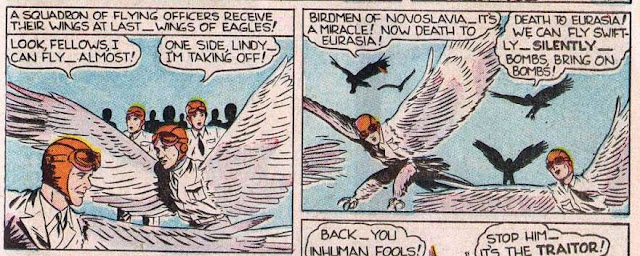
    These eagle-men pilots are the first of many Novoslavian animal-man hybrids, btw.

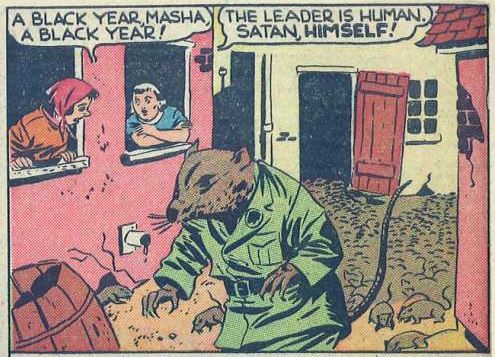
    Issue 57 of Popular Comics involves Novoslavian locust, wasp, termite and rat hybrids going out into the world to gather up plagues of their respective animals to unleash on Eurasia. Pictured here is the rat-man, my personal fave.

    The ultimate expression of Hormone’s hybridization efforts are these five Novoslavian volunteers who were turned into fleas and then restored to human form. Though they no longer look like fleas, they retain proportional jumping, flea-strength, etc, Spider-Man style. And the transformation is very gross-looking!

    So that’s Doctor Hormone in a nutshell: a bit light, plotwise, but full of charming characters and a cavalcade of new and interesting concepts in body horror. (Popular Comics 054, 1940)

    Martan the Marvel Man:

     I feel a bit bad making Martan follow Dr Hormone, honestly, because his adventures are at least as wild, but they aren’t as unique. In brief: Martan and his wife Vana are Antacleans, aliens from a super-advanced race a few million light years off. They kind of accidentally land on Earth and almost immediately get mixed up in the affairs of primitive humans. At first it’s regular old “they war amongst themselves, how foolish!” stuff but eventually they discover in incipient invasion by Antaclea’s ancient enemy the Martians and really throw their weight behind the Earth cause: supplying technology, setting up a world government etc. – Martan and Vana’s impact on the world is much greater than your typical comic book characters’. (Popular Comics 046, 1939)
  • MINOR SUPER-VILLAIN 560: VLADIM

    (Wonderworld Comics 005, 1939) 

    Our hero, Yarko the Great, is driving along a country lane outside London when his travels are interrupted by a bestial figure who runs out of a nearby castle and immediately drops dead. While Yarko is examining the body a monocled creep emerges from some nearby bushes Homer Simpson-style to introduce himself as “Vladim, a genius!” For me, this is exciting, because he shares his somewhat-unusual name with the seldom-mentioned, never-seen airplane designer of the Blackhawk Squadron and you better believe I think about that guy more than most people (just how these two characters created by Will Eisner came to share a name is a mystery for the ages).  

    As any self-proclaimed genius would, Vlamir brings Yarko to his underground sanctum to show off his magical experiments and I just want to emphasize something about his setup: beneath his castle is a series of bridges and staircases seemingly to the scale of Moradin in the first Lord of the Rings movie, yet his magical laboratory is housed in a room the size of a large bathroom and furnished with one (1) light, one (1) art and one (1) large skull-themed throne.

    Also please note that the initial view of the throne was out of proportion for dramatic effect and that the actual placement of the skull ensures that unless it is made of plush velvet, that sucker is going to be wildly uncomfortable to sit in for any length of time. This as much as the fact that Vladim has trapped a woman in a fire pit using a voodoo doll has me convinced that he’s just started out on the road of dark magic and is indulging his every whim – a more experienced villain would know the long-term importance of good lumbar support.

    Yarko of course has little trouble dealing with a dilettante like Vladim: in short order he frees the girl, turns a bestial henchman back on his creator and kind of kills Vladim. If hounding a man along a narrow bridge with an image of your own floating head until he slips on his own knife and falls into the murky depths of his basement can be counted as killing a guy. Which I suppose it can.

  • MINOR SUPER-HERO ROUND-UP 013

    More. MORE!

    Spiritman: 

    It’s impossible to say if Spiritman’s real name is Spirit Malcolm or if Spirit is just a nickname. The Golden Age is definitely a time in which nicknames are clearly signposted with quotation marks (including names like “Hank” half the time) but they’re also an age of inconsistent editorial standards. Let’s assume it is his given name, because then it’s another fun case of comic book nominative determinism.

    Spiritman is a scientific hero: armed with a Rayodine Pistol, he uses his Futurscope remote viewing device to hunt out evildoers and then – and this is where the “Spirit” part comes in – employs his Mistodine device to teleport to their location, or possibly to astrally project to their location. Either way, the effects are the same: the projected Spiritman can fly and is selectively invisible and intangible, allowing him to really just do whatever he wants. In his sole recorded adventure, this means killing about a dozen men for stealing US gold reserves. (Silver Streak Comics 001, 1939)

    the Wasp:

    Daily Free Press reporter Burton Slade is also masked vigilante the Wasp, so named because his weird cape looks a bit like insect wings if you squint. He also makes a buzzing sound sometimes. (Silver Streak Comics 001, 1939)

    Black X:

    Black X is Richard Spencer, a US espionage agent who travels around with his Indian manservant Batu (who of course is gifted with assorted mental powers). His stories are interesting enough to read but Black X himself is, appropriately enough, a bit of a cipher. Probably the most interesting thing about him is that the monocle he always wears is in fact more of an eye patch to cover his gouged-out eye. He also briefly went by the moniker Black Ace but that failed to stick. (Feature Funnies 013, 1938)

    the Invisible Hood:

    The fun thing about the Invisible Hood is that he doesn’t get his signature invisibility cloak until his second appearance, which means that for an unknown number of adventures he was just a Sandman-style two-fisted gas gun jockey in a very impractical full length form-fitting robe. Perhaps he was simply looking for a challenge. (Smash Comics 001, 1939)

  • MINOR SUPER-VILLAIN 535: VON HAUPT

    (Fantastic Comics 001, 1939)

    Von Haupt is  more like a journey through the traits and attributes of a style of  super-crook than a character: Aviator Captain Kidd is flying over an unspecified jungle when his plane is forced down by an engine-killing ray. Captured by costumed goons, Kidd is brought to a jungle fortress before a vaguely European man  with a German-sounding last name and a monocle. Though threatening, this exchange turns out to be a job interview, as von Haupt needs a few good men to help him take over  the world.

    Von Haupt claims to be (and indeed is) physically immortal due to his experiments but makes sure to clearly signpost his weak point, a withered hand encased in a keen metal gauntlet.

    He demonstrates his power, as well as the razor sharp claws on his gauntlet.

    And finally falls from grace (into vat of sulphur). The weak point comes into play as the gauntlet comes off. The fortress explodes, but Captain Kidd gets out in the nick of time.

  • MINOR SUPER-VILLAIN 524: THE KING OF THE VAMPIRES

    MINOR SUPER-VILLAIN 524: THE KING OF THE VAMPIRES

    (Blue Ribbon Comics 011, 1941) 

    We open not on the King of the Vampires but on a different vampire, one with a monocle. This is Carlos Hubbello, a diplomatic envoy from South America who has been sent to discuss a trade deal with the US that would leave the Nazis in the cold. The two gentlemen with him are no gentlemen at all but rather Nazi spies who are controlling Hubbello by the simple expedient of having turned him into a vampire, which is certainly harder to get out of than say kidnapping his loved ones but comes with a whole lot of extra risk for his handlers.

    This story is rife with lore. To whit:

    LORE: Vampires are easily cowed with a cross, even when wielded by evil men.

    Hubbello comes very close to vampiring Mr Justice’s love interest Pat Clark while they watch a performance of the very weird and cool “Waltz of the Vampire”. A ghost/ vampire brawl ensues.

    LORE: A vampire can lose control when exposed to great art.

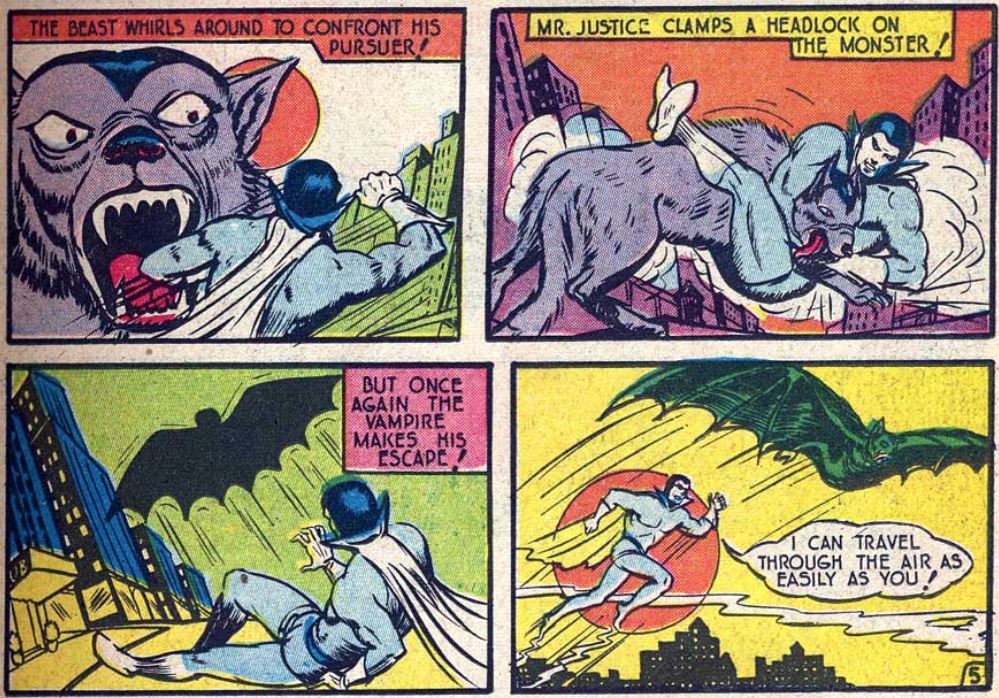
    LORE: vampires can transform into wolves and bats and retain their special vampire haircut in both forms (you can just make out a teeny tiny widow’s peak on the bat if you squint).

    Hubbello, defeated, spills the beans. The Nazis imported the King of the Vampires from Transylvania as part of their scheme to control the trade negotiations. Is the King of the Vampires a Nazi or merely using them to his own ends? This is not explored. Is the King of the Vampires supposed to be Dracula or is Transylvania just a good place for a vampire to come from? We can never know.

    LORE: Kill the head vampire in time and its under-vampires can be saved. What is “in time”? Not sure but it isn’t “before the under-vampire takes a life/ drinks human blood” as in a lot of vampire media, because Hubbello has already done both.

    Enter the King of the Vampires, freshly gorged on the blood of the innocent and battle commences. And I sure hope that Mr Justice knew the LORE that vampire cannot fight vampire because it means that he is on his own.

    LORE: this is the kind of vampire that seemingly isn’t harmed by light so much as by not physically being in his coffin at dawn. And he isn’t, so he dies.

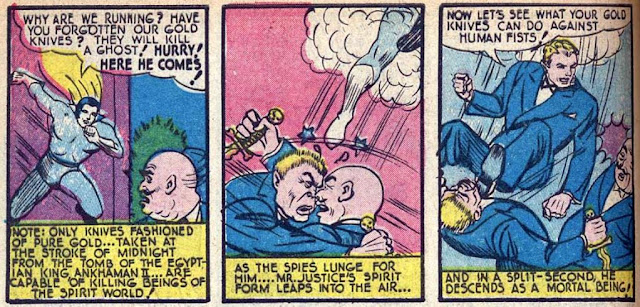
    Hubbello is saved! The trade deal can go forward! And back in the US we are reacquainted with the Nazi vampire-handlers, who come with one last piece of LORE: that knives fashioned of pure gold taken from the tomb of the Egyptian King Ankhaman II are capable – possibly the only things capable – of killing a ghost. A potent weapon against Mr Justice, if only they were any good at knifing. But they aren’t so they get captured immediately and the knives are presumably never seen again.

  • MINOR SUPER-VILLAIN 524: THE KING OF THE VAMPIRES

    MINOR SUPER-VILLAIN 524: THE KING OF THE VAMPIRES

    (Blue Ribbon Comics 011, 1941) 

    We open not on the King of the Vampires but on a different vampire, one with a monocle. This is Carlos Hubbello, a diplomatic envoy from South America who has been sent to discuss a trade deal with the US that would leave the Nazis in the cold. The two gentlemen with him are no gentlemen at all but rather Nazi spies who are controlling Hubbello by the simple expedient of having turned him into a vampire, which is certainly harder to get out of than say kidnapping his loved ones but comes with a whole lot of extra risk for his handlers.

    This story is rife with lore. To whit:

    LORE: Vampires are easily cowed with a cross, even when wielded by evil men.

    Hubbello comes very close to vampiring Mr Justice’s love interest Pat Clark while they watch a performance of the very weird and cool “Waltz of the Vampire”. A ghost/ vampire brawl ensues.

    LORE: A vampire can lose control when exposed to great art.

    LORE: vampires can transform into wolves and bats and retain their special vampire haircut in both forms (you can just make out a teeny tiny widow’s peak on the bat if you squint).

    Hubbello, defeated, spills the beans. The Nazis imported the King of the Vampires from Transylvania as part of their scheme to control the trade negotiations. Is the King of the Vampires a Nazi or merely using them to his own ends? This is not explored. Is the King of the Vampires supposed to be Dracula or is Transylvania just a good place for a vampire to come from? We can never know.

    LORE: Kill the head vampire in time and its under-vampires can be saved. What is “in time”? Not sure but it isn’t “before the under-vampire takes a life/ drinks human blood” as in a lot of vampire media, because Hubbello has already done both.

    Enter the King of the Vampires, freshly gorged on the blood of the innocent and battle commences. And I sure hope that Mr Justice knew the LORE that vampire cannot fight vampire because it means that he is on his own.

    LORE: this is the kind of vampire that seemingly isn’t harmed by light so much as by not physically being in his coffin at dawn. And he isn’t, so he dies.

    Hubbello is saved! The trade deal can go forward! And back in the US we are reacquainted with the Nazi vampire-handlers, who come with one last piece of LORE: that knives fashioned of pure gold taken from the tomb of the Egyptian King Ankhaman II are capable – possibly the only things capable – of killing a ghost. A potent weapon against Mr Justice, if only they were any good at knifing. But they aren’t so they get captured immediately and the knives are presumably never seen again.