The Curse of Skeleton Munroe

Category: monocle

  • MINOR SUPER-VILLAIN 335: THE THREAT

    (All-Flash 002, 1941) 

    The Threat is an example of a type of morality tale that was very popular in 40s and 50s comic books but never really went out of style: a tale of promise squandered in service to a life of crime. In this case, the subject is a crook named Tough Joe Connor, who swears revenge on Jim Kelley, the prosecutor who sent him to jail for ten years. 

    My summarizing powers are not up to this task, ergo, a timeline:

    1911 CE:

    -Jim Kelley sends Tough Joe Connor to jail. Connor swears revenge.

    -believing that Kelley got the better of him because he was more clever, Connor devotes himself to study.

    1917 CE:

    -Connor has become a model prisoner. He is a qualified lawyer, doctor and research scientist specializing in chemistry and physics. He is paroled 4 years early. On the outside, he is already wealthy due to research he did in prison.

    -Connor goes to visit Kelley. Ostensibly a good will visit, it is actually in order to provide an alibi: when thugs he has hired burst in and steal Kelley’s newborn baby, Connor takes a carefully choreographed bullet to the arm while “attempting to stop them”.

    -Connor meets and falls in love with a woman named Annie Crowley. They marry and he briefly goes straight (but keeps the baby).

    1923 CE:

    -Annie dies (possibly in childbirth, as they have a daughter). Connor resumes his quest for revenge and begins telling the boy, Roy, that Kelley killed his mother in order to turn him into a weapon against his own father.

    1937 CE:

    -Connor has consolidated underworld power in the region, becoming the Threat. He makes his first attempt on the life of now-Mayor Jim Kelley but both his criminal activities and his murder attempt are disrupted by the Flash. Roy heads to the family farm to lie low with his step-sister Ann.

    1941 CE:

    -The Threats’s power continues to grow. A second attempt on Mayor Kelley’s life ends with Joe Connor back in prison as one of his own henchmen.

    -Connor escapes in an old lye barrel. Severely burned, missing an eye, he adopts a series of new identities: an unnamed garage owner, plastic surgeon Doctor Cravath, mechanic Jake Boles. He finds Roy hiding out in the country and together they make an attempt on gubernatorial candidate Kelley’s life but once more the Flash steps in.

    -Connor makes one last push to kill now-Governor Kelley: he breaks Roy out of prison and arranges a big confrontation. All is for naught, as the Flash, Joan Williams and Ann Connor have pieced together the clues and revealed to Roy his real parentage. Faced with this and the futility of his life of revenge, Connor smokes a poisoned cigarette and dies.

    -Roy and Ann are now in love, which happens in these kinds of Secret Step-Sibling situations an unsettling amount.

    There are several interesting things about this sequence of events. The first, as seen above, is that young Roy, at age 5, chooses the name Roy Revenge for himself as part of his vendetta and keeps using it into his mid-twenties. It is, frankly, great – it’s exactly the kind of henchman name that a villain called the Threat would assign in a campy 60s comic, but earnestly, in the 40s.

    The second involves the fact that at this point Keystone City is not a thing and the Flash explicitly lives in New York City, which means that Jim Kelley was presumably Mayor of NYC (eroding La Guardia’s term by about four years) and Governor of New York (impacting Herbert H. Lehman).

    Meanwhile, the chronology of the story is fairly tentative – the actual timeframes are correct, but the dates are speculative. The crucial point is that four-year gap between Roy Revenge”s first attempt on Kelley’s life and the remainder of the story: as presented the bulk of the story is set in 1941, the year of publication, but the Flash is running around three years earlier than previously established. BUT! if we start the story in 1941 the bulk of the action takes place in 1945, which is even more temporally messy. Fun stuff for the old timeline!

    The Threat, ultimately, is a bit of a nothing villain but I like him nonetheless. Too bad about the wasted life, better luck next time, Joe.

    JUDGE AND JURY REVENGE KILLER SCORE: 0/1 

    (I know, he’s focused on the lawyer, but “judge and jury and prosecutor revenge killer” is just too long and even then someone is going to go after the witnesses and bailiffs. Better to be succinct)

  • MINOR SUPER-VILLAIN 335: THE THREAT

    (All-Flash 002, 1941) 

    The Threat is an example of a type of morality tale that was very popular in 40s and 50s comic books but never really went out of style: a tale of promise squandered in service to a life of crime. In this case, the subject is a crook named Tough Joe Connor, who swears revenge on Jim Kelley, the prosecutor who sent him to jail for ten years. 

    My summarizing powers are not up to this task, ergo, a timeline:

    1911 CE:

    -Jim Kelley sends Tough Joe Connor to jail. Connor swears revenge.

    -believing that Kelley got the better of him because he was more clever, Connor devotes himself to study.

    1917 CE:

    -Connor has become a model prisoner. He is a qualified lawyer, doctor and research scientist specializing in chemistry and physics. He is paroled 4 years early. On the outside, he is already wealthy due to research he did in prison.

    -Connor goes to visit Kelley. Ostensibly a good will visit, it is actually in order to provide an alibi: when thugs he has hired burst in and steal Kelley’s newborn baby, Connor takes a carefully choreographed bullet to the arm while “attempting to stop them”.

    -Connor meets and falls in love with a woman named Annie Crowley. They marry and he briefly goes straight (but keeps the baby).

    1923 CE:

    -Annie dies (possibly in childbirth, as they have a daughter). Connor resumes his quest for revenge and begins telling the boy, Roy, that Kelley killed his mother in order to turn him into a weapon against his own father.

    1937 CE:

    -Connor has consolidated underworld power in the region, becoming the Threat. He makes his first attempt on the life of now-Mayor Jim Kelley but both his criminal activities and his murder attempt are disrupted by the Flash. Roy heads to the family farm to lie low with his step-sister Ann.

    1941 CE:

    -The Threats’s power continues to grow. A second attempt on Mayor Kelley’s life ends with Joe Connor back in prison as one of his own henchmen.

    -Connor escapes in an old lye barrel. Severely burned, missing an eye, he adopts a series of new identities: an unnamed garage owner, plastic surgeon Doctor Cravath, mechanic Jake Boles. He finds Roy hiding out in the country and together they make an attempt on gubernatorial candidate Kelley’s life but once more the Flash steps in.

    -Connor makes one last push to kill now-Governor Kelley: he breaks Roy out of prison and arranges a big confrontation. All is for naught, as the Flash, Joan Williams and Ann Connor have pieced together the clues and revealed to Roy his real parentage. Faced with this and the futility of his life of revenge, Connor smokes a poisoned cigarette and dies.

    -Roy and Ann are now in love, which happens in these kinds of Secret Step-Sibling situations an unsettling amount.

    There are several interesting things about this sequence of events. The first, as seen above, is that young Roy, at age 5, chooses the name Roy Revenge for himself as part of his vendetta and keeps using it into his mid-twenties. It is, frankly, great – it’s exactly the kind of henchman name that a villain called the Threat would assign in a campy 60s comic, but earnestly, in the 40s.

    The second involves the fact that at this point Keystone City is not a thing and the Flash explicitly lives in New York City, which means that Jim Kelley was presumably Mayor of NYC (eroding La Guardia’s term by about four years) and Governor of New York (impacting Herbert H. Lehman).

    Meanwhile, the chronology of the story is fairly tentative – the actual timeframes are correct, but the dates are speculative. The crucial point is that four-year gap between Roy Revenge”s first attempt on Kelley’s life and the remainder of the story: as presented the bulk of the story is set in 1941, the year of publication, but the Flash is running around three years earlier than previously established. BUT! if we start the story in 1941 the bulk of the action takes place in 1945, which is even more temporally messy. Fun stuff for the old timeline!

    The Threat, ultimately, is a bit of a nothing villain but I like him nonetheless. Too bad about the wasted life, better luck next time, Joe.

    JUDGE AND JURY REVENGE KILLER SCORE: 0/1 

    (I know, he’s focused on the lawyer, but “judge and jury and prosecutor revenge killer” is just too long and even then someone is going to go after the witnesses and bailiffs. Better to be succinct)

  • MINOR SUPER-VILLAIN 334: THE MONOCLE

    (All-Flash Quarterly 001, 1941) 

    I love a foppish gang boss, and the Monocle might just be the most foppish I’ve seen in some time. He’s got all the accessories: the monocle, natch, but also the eccentric mustache, cigarette holder, neat suit with nosegay and tiepin and pocket square and to top it off one of the more eccentric comic book hobbies I have ever encountered: a twee little garden where he displays his stolen gems in artificial flowers. Pretty great stuff.

    The Monocle is also a technically-minded villain, whose main line is planning knockout gas-centric crimes but with a sideline in deathtraps – his booby-trapped HQ does a better job than most at almost bumping off the Flash.

    Of particular note is that the Monocle hits upon the same discovery as an unnamed criminal scientist the year before: that though the Flash moves fast enough that he uproots shrubs and blows the clothing off of people in his wake, he also moves slow enough that a stroboscopic lighting setup will make it possible to effectively aim a firearm at him. He might even have actually killed the Flash if, succumbing to the deathtrap-maker’s hubris, he hadn’t left mid-battle to check on his gem garden.

  • MINOR SUPER-VILLAIN 322: THE BARRACUDA

    (Daring Mystery Comics 008, 1942)

    A certain number of uboat captains are going to be written villainously enough to meet all of my criteria and Captain Erich von Wolff, AKA the Barracuda, is one such.

    Like seriously a real stinker of the highest order. It’s a good thing that the Fin is on the case to beat the tar out of him and deliver him to the British. I was going to say that hopefully he was tried and executed after the war but some cursory research suggests that u-boat commanders who weren’t killed in battle largely weren’t. I’m sure he had a long career as an investment banker or something.

  • MAD AND CRIMINAL SCIENTIST ROUND-UP 002

    Back again with another collection of science-villains who didn’t quite make the grade!

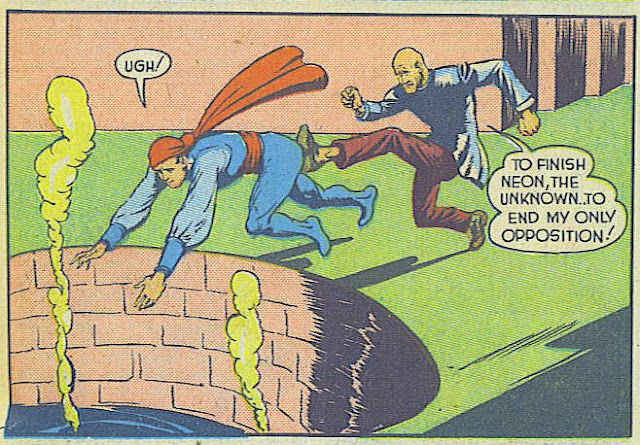
    Fritz Cardif here has a gunpowder-exploding ray and a lot of big plans. He probably would have made the main list except that I personally find his antics very dull, with the exception of the lil’ stinker moment pictured above. (Hit Comics 006, 1940)

    Dr Marko figured on using kidnapped scientists as research slaves in his Grand Canyon hideout, but he too was corralled by Neon the Unknown. (Hit Comics 013, 1941)

    Professor Dorn here is your typical Nazi scientist obsessed with replicating the powers of the Sub-Mariner for the glory of the cause. He ends up lasting about fifteen minutes after meeting the real deal. (Marvel Mystery Comics v1 023, 1941)

     Dr Sunga has a pretty good scheme going wherein he seeming kills people by sending them a cursed wand that is actually harmless – seemingly the perfect crime! But the Golden Age Falcon figures out the trick: it’s actually the box that the wand is sent in that does the killing. Sunga of course ends up dead by his own fiendish device. (Daring Mystery Comics 005, 1940)

  • MAD AND CRIMINAL SCIENTIST ROUND-UP 002

    Back again with another collection of science-villains who didn’t quite make the grade!

    Fritz Cardif here has a gunpowder-exploding ray and a lot of big plans. He probably would have made the main list except that I personally find his antics very dull, with the exception of the lil’ stinker moment pictured above. (Hit Comics 006, 1940)

    Dr Marko figured on using kidnapped scientists as research slaves in his Grand Canyon hideout, but he too was corralled by Neon the Unknown. (Hit Comics 013, 1941)

    Professor Dorn here is your typical Nazi scientist obsessed with replicating the powers of the Sub-Mariner for the glory of the cause. He ends up lasting about fifteen minutes after meeting the real deal. (Marvel Mystery Comics v1 023, 1941)

     Dr Sunga has a pretty good scheme going wherein he seeming kills people by sending them a cursed wand that is actually harmless – seemingly the perfect crime! But the Golden Age Falcon figures out the trick: it’s actually the box that the wand is sent in that does the killing. Sunga of course ends up dead by his own fiendish device. (Daring Mystery Comics 005, 1940)

  • MINOR SUPER-VILLAIN 276: THE INVISIBLE SLAYER

    (Marvel Mystery Comics v1 019, 1941)

    There’s a bit in the introductions to the Top 10 anthologies in which Neopolis mayor John Q. Public lays out the exponential propagation of super-heroes, -villains, -pets, -monsters and so forth that takes place in a comic universe that I think of often as I read through these old adventures. Heroes inspire sidekicks and imitators; their enemies build robots and create doppelgangers to counter them, etc, until you have superhumans everywhere. 

    There’s one thing that isn’t brought up in that intro that absolutely contributes to the proliferation of the extranormal in a super-hero universe: any friend, family member or acquaintance (and especially any old college classmate, for some reason) is highly likely to either become a super-villain or to be targeted by one. Out of universe, it is of course an easy way to bring the hero in on a case, but in-universe: what a wild series of coincidences!

    In this case, we find Professor Zog summoned to the side of his old college pal Sir John Chadwick, who has seen almost his entire family killed by a mysterious set of floating hands in recent weeks. Zog is of course a bro and immediately flies to England to solve this problem via Applied Robot Violence. The first battle between Electro and the Invisible Slayer ends in a robo-defeat, but Zog manages to shoot the killer and follows its trail of blood to…

    The nearby mansion of Basil Drake, who turns out to be behind the whole thing to such a degree that one must wonder about Sir Chadwick’s powers of observation. Drake’s mansion contains a herd of gorillas, for heaven’s sake. His motivation for five murders and many more attempteds is that Chadwick’s daughter sensibly rejected his marriage proposal, which is, I must say, a stupid reason to delve into super-villainy.

    And of course even after Drake bumps himself off rather than be captured we must deal with the Invisible Slayer itself, or himself, as it turns out, because the Slayer is in fact Drake’s servant Chandi, cast as a monster due to his size and race.

    A story featuring disembodied hands and herds of gorillas, ruined for me by racism and misogyny. I hope you’re happy, Basil Drake.

  • MINOR SUPER-VILLAIN 271: PRINCE OMEI

    (Marvel Mystery Comics v1 016, 1941)

    This guy’s a real ding-dong, and I was sorely tempted to just pass him by. I couldn’t in good conscience not mention a guy who not only hypnotizes Professor Zog and (by proxy) Electro as his minions and does so while wearing both an eye patch and a monocle. PLUS he’s one of my favourite types of villains: a complete failure. Literally all he does after acquiring his new giant robot/ robot operator team is deal with some organizational strife in his gang, then Zog breaks free of his mental influence and Omei ends up blowing himself up in what is becoming a running theme in the world of Electro’s villains. 

  • MINOR SUPER-VILLAIN 160: THE FOUR CARDS

    (Batman Comics 005, 1941)

    A while ago I decided that groups were going to go into my lists (and charts and graphs) of super-villains. After all, if I was willing to accord one fellow who went around as the Masked Bandit, why should I spurn four guys who do exactly the same, only pluralized? Accordingly, masked gangs get as much credit as masked crooks, if they fulfil enough other criteria. The Four Cards, however, introduce a new wrinkle.

    Simply put: if any other four people with card-based nicknames had formed a card-themed gang I’d count them as minor super-villains, but one of them is the Joker. So the group is minor and three quarters of its members are – is that enough? Evidently!

    Aside from my categorization panic, the Four Cards are a bit basic: they operate a semi-legal gambling ship in international waters off Gotham and a disguised Joker, seductive Black Queen and socially adroit Jack of Diamonds line up wealthy targets for the King of Clubs to beat up and rob.

    Inevitably, Batman and Robin step in. The Black Queen falls in love with Batman and she and the Jack of Diamonds bump one another off over him. Meanwhile, the Joker has pulled his inevitable double cross and left (having set the ship on fire as he went), leaving poor Clubbsy as the only one left to be hauled away to jail.

  • MINOR SUPER-VILLAIN 142: DR DARRK

     (Adventure Comics 065, 1941)

    Another in a long line of scientist-villains faced by Hourman, Dr Darrk has a moderately cool name, a lighthouse HQ and an invisibility ray but ultimately is overshadowed by his really excellent robot goon, Giganto:

    Just look at that cool robot!