The Curse of Skeleton Munroe

Category: thief

  • MINOR SUPER-VILLAIN 1004: THE GREEN HOOD GANG

    (Lightning Comics v2 002, 1941)

    The Green Hood Gang, who are unsurprisingly a gang who wear green hoods (and please note the rare and stylish nose cutouts on those numbers), make their debut by barging in and robbing the Raven after he himself had just gone to the trouble of holding up the guests of a party at the home of retired gangster Joe Russo.

    From there, the Green Hoods embark on a crime spree so ambitious in scope that Police Chief Lash is compelled to set aside his personal crusade against the Raven and team up with him to hunt them down.

    For most of this story I had assumed that the leader of the Green Hood Gang would turn out to be Joe Russo, coming out of retirement and starting out by robbing his own party guests, and I suspect that the writer of this comic was also of this opinion right up until they got to page eight out of ten, at which point the men under the hoods – previously very clearly regular American gangsters – are revealed to be Native South Americans. Further investigation by Lash and the Raven reveals that these men are dupes who have been promised that the funds they are stealing are to be put toward the construction of a temple in their homeland, but who are really working for a former bootlegger named Larue.

    While I wouldn’t call the Joe Russo version of this story very original or exciting, the Larue reveal is so out of left field that I am left baffled and bamboozled. If I can’t trust a comic book writer 85 years ago, just who can I?

    Categorized in: Colours (Green), Generica (Gangs), Objects (Hoods)

  • MINOR SUPER-VILLAIN 1000: THE MUMMY

    MINOR SUPER-VILLAIN 1000: THE MUMMY

    Number 1000!!*

    (Lightning Comics v1 005, 1941)

    The Old Man of the Pyramids summons (F)lash Lightning to his thundercloud lair to warn him about trouble at Midton College, and he is right, as can only be expected of a wise old oracular father figure. This particular trouble is called Professor Vatz and is a professor of chemistry who is ready to give up academia for the heady world of supercrime.

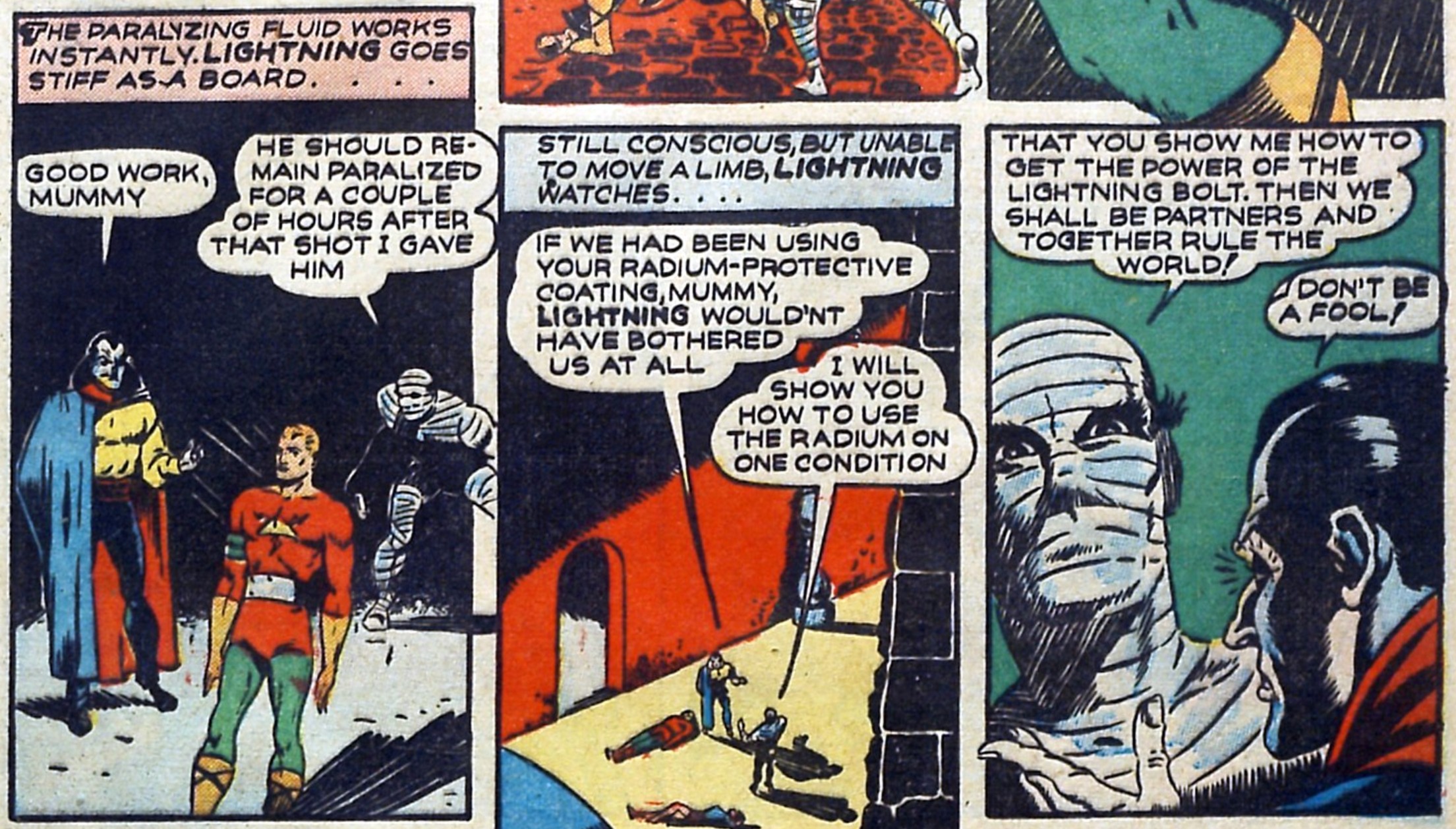
    Vatz’s new career is founded on two inventions: his “Hotlight,” a ray gun that seems to spit out both bright light and great heat sufficient to kill a regular person or knock out a superhuman figure like Lightning, and a radium compound that makes ordinary cloth into a form of armour resistant to conventional attack. Vatz decides to apply this solution to mummy wrappings, and while I can kind of see that being a way to ensure that the his armour is applied as close to his body as possible, but just what his justification is for using wrappings from an actual mummy is completely inscrutable to me.

    As always, mummy wrappings are a fantastic look and they are only enhanced by the fact that Vatz either chooses to leave the little flyaway portions of his hair sticking out of the sides or simply does not care that they are. It’s some very very strong bald guy energy and perhaps the most significant addition to the mummy look in two thousand years.

    The newly-fledged Mummy recruits a few gangsters and goes on a mild crime spree but is soon tracked down by a recovered Lightning. This leaves the problem of the Mummy’s invincibility to solve, and Lightning does so with aplomb: if the wrappings are the vehicle for the invulnerability, simply remove the wrappings before applying violence.

    (please note that the Mummy had a calling card all ready to go, and it’s a cute one. He only ever gets to use it the once, however)

    The Mummy returns in Lightning Comics v1 006, in what is effectively a bottle episode. Professor Vatz, given far both too much credit for a rapid reformation and unfettered access to the prison laboratory, is able to recreate his radium solution and take over – but not actually escape – the prison he has been locked up in.

    The only thing that the Mummy seems to be unable to replicate in prison is his Hotlight. Instead, he sports a much cooler “Nitro Gun” that shoots explosive pellets. He is also able to whip up a “Lightning Arrester” to drain the electric energy from Lash Lightning’s body when he inevitably turns up to foil the Mummy’s plans.

    Despite the fact that he is able to disable Lightning and throw him into the prison gas chamber, the Mummy does not account for the possibility that his lightning powers might return to him and allow him to escape. He is soon recaptured in the exact same manner as he was in their first encounter and I must say that the fact that Professor Vatz failed to account for this – perhaps by means of a tricky little knot or fastener – really lowers him in my estimation.

    In the Mummy’s final appearance, in Lightning Comics v2 001, he is broken out of a prison hospital by Lash Lightning’s new archfoe Mastermind, who is hoping to learn the secret of Professor Vatz’s radium coating in order render himself immune to harm. 

    The Mummy makes three key mistakes in his dealings with Mastermind: 1) he tries to negotiate after the initial deal has been struck, proposing that the radium formula be revealed in exchange for the secret to Mastermind’s own ability to command lightning. This might work if the Mummy were dealing with a reasonable person, but Mastermind is a super-villain, a class of inherently unreasonable people. 2) The Mummy escalates the confrontation to a physical one without first applying the radium solution and thus rendering himself immune to harm, and 3) he gets himself obliterated by a lightning bolt. he does therefore mess up Mastermind’s plans by taking his formula to the grave, but it must be cold comfort when one is a smouldering corpse.

    Farewell, the Mummy. You weren’t a very good super-villain but you were an entertaining one.

    Categorized in: Accessories (Anti-Hero; Heat Rays), Day Jobs (College Professors), Supranormal Beings (Mummies)

    *technically Fang Ryan is number 1000 and the Mummy is number 999, but I like mummies more than snake-themed gangsters so I fudged it for the sake of the round number.

  • MINOR SUPER-VILLAIN 999: FANG RYAN

    (Lightning Comics v1 005, 1941)

    We meet Fang Ryan after he grabs a payroll from the recently-deceased messenger who was in the process of delivering it. He then escapes despite the fact that Police Detective Danny “the Raven” Dartin is on the scene to engage him in thrilling gunplay, but drops his signature weapon, a stick with a couple of snake fangs on one end. It’s a neat gimmick: the stick has a reservoir full of poison inside of it, so when Fang whacks someone with it they die of what looks like a snakebite. It is therefore a shame that he does not actually use this item in the story (aside from in killing the courier, implicitly).

    Since Ryan has lost his weapon, the Raven knows that he will need a new supply of snake venom to make another, and waits in ambush for him at the zoo from which he had previously sourced the stuff. Sure enough, Ryan shows up in time for a fist fight, which ends in… perhaps not the only time that a super-hero is knocked out by a zebra but surely one of a very limited number of times that it happens.

    When a supercrook has rendered a super-hero unconscious and captured them, there are a few ways that they can proceed. The standard approach is of course to place the hero in a deathtrap in full costume and then leave the room, followed closely by “go to unmask them but take so long that they wake up and start fighting you again.” Fang Ryan instead opts for one of the rarer options and just immediately unmasks the Raven, and thanks to the gunfight from earlier he even recognizes him!

    Ryan’s next thoughts are both good: frame the Raven for his next job and expose the Raven’s identity, thus taking all the focus off of him and his piddly little crime spree. Where it all falls apart that he tries to do both at the same time instead of sequentially, as he calls up Dartin’s boss and rats him out before heading out to do the next robbery.

    The one-two punch of this means that when an insomniac sees the Raven and reports him to the cops, the entire police force shows up to get him rather than a car or two worth of guys.

    Meanwhile Dartin has escaped from where Ryan left him hogtied in the woods and shows up to avenge his honour. He ends up killing Ryan in a shootout, which somehow completely overwrites the part of Police Chief Lash’s brain that heard the information about Dartin being the Raven. It’s just the luck of the costumed vigilante, I guess.

    Categorized in: Animals (Snakes), Body (Nonhuman Parts), Fraud (Identity Theft (Hero Impostors))

  • PROBLEMATIC ROUND-UP 008

    Once again I must regretfully inform you that some comic books are problematic. Like, racially.

    the Laughing Hyenas: 

    Hey, it’s our first racial hate group, and I think I’m just going to preemptively file these under “problematic” because they’re a) not fun to talk about and b) necessitate talking about hate-crimes even if I, for example, choose not to use the panels with lynchings in them.

    The Laughing Hyenas are actually kind of a hate group by proxy, as they have been hired to keep the Black residents of the geographically-nonspecific town of Souda “in line” by murdering one of them every once in a while, and have been doing so frequently enough and/or long enough that even the local folks willing to volunteer for such a task have gotten sick of it, so boss Bull Karson had to import some Chicago toughguys to do his dirty work for him.

    Oddly, given the sheer volume of murder that the Laughing Hyenas were perpetrating, the Silver Streak doesn’t actually bring them in to the authorities ore even extra-judiciously kill them. Instead, he just dumps them on a slow boat to Rangoon. (Silver Streak Comics 013, 1941)

    the Modern Thief of Bagdad:

    Ali Hassan, aka the Modern Thief of Bagdad, is an Iraqi thief who comes to NYC to steal the Konoor Diamond, and as a result comes into conflict with Captain Battle and his young protege Hale Battle. A simple story that would ordinarily wrap up quite quickly, but this is a book-length yarn, which means that there is an extended chase sequence that occupies the 28 pages between the theft and Hassan’s arrival back in Baghdad. Some highlights:

    Chapter 1, “The Modern Thief of Bagdad!”: Hassan steals the gem, then give Battle and Hale the slip in Chinatown. Olyra, the mysterious guardian of the Konoor Diamond, is kidnapped.

    Chapter 2, “Perils of the Sargasso Sea!”: Hassan’s submarine becomes mired in sargassum and is attacked by a sea monster. Battle and Hale kill the beast. Hassan and his men dress up like ghost pirates. Olyra is rescued and then kidnapped again.

    Chapter 3, “Lost in the Underground World!”: Hassan’s plane crashes in Africa and he and Olyra are captured by cannibals (lil’ bonus racism for you there). Battle and Hale rescue them before being betrayed and dumped in a pit of quicksand. There is a brief interlude in an cave system full of monsters before it suddenly blows up. Hassan and his men dress up like ghosts. Olyra is rescued.

    Chapter 4, “House of Giants”: Battle & co track Hassan to a castle in Tibet, where they are captured and subjected to a shrink ray. They have various adventures as tiny men before resuming their original size. Olyra is kidnapped.

    I would call Hassan himself… an average amount of racist. He’s depicted in much the same generically foreign vein as I’ve seen in a South American president or a Basque fisherman (or indeed a Cape Breton fisherman at least once). As a villain, he’s pretty great: bombastic, treacherous, fond of leaving boastful notes for his enemies. If it was just him I might have skipped making this a Problematic Round-Up entry.

    It’s not just him, however, and once the story hits Chapter 5, “Magic Spell of the Arabian Nights” we get a real dose of Orientalism full in the face, as our heroes touch down in a Baghdad straight out of the Arabian Nights, complete with a wicked ruler (confusingly named Emperor Pasha Golu) who Hassan has been working for the whole time.

    It’s such a pastiche of a city, in fact, that Hale and Olyra just kind of stumble across Aladdin’s lamp and flying carpet while they are escaping from a dungeon. I suppose that all this is at least a little thematically appropriate, as Ali Hassan, the Modern Thief of Bagdad, is a reference to a movie that is a remake of a different movie that is itself a pastiche of the Arabian Nights.

    The Modern Thief of Bagdad meets his end in a pretty underwhelming manner: Captain Battle ducks as he swings a sword at him and he falls off of a balcony. A pretty terrible way to go for a villain who clearly thought that he was very cool, to be honest. The evil Pash Golu also meets his end in the process, leaving Olyra free to reveal that she is actually Olyria, Princess and true ruler of Bagdad. A truly impenetrable alias! 

    Finally, such is Hale Battle’s hunger for souvenirs that he uses his third genie with to acquire a replica of the diamond for his collection, even though for my money the real deal Lamp of Aladdin with one wish left on it would be the ultimate keepsake. (Captain Battle Comics 002, 1941)

    the King:

    The King is a fellow who gains control over a Romani group by showing them a… birthmark? tattoo? that proves his right to rule and that looks so intensely falsifiable that I am shocked there isn’t some sort two-factor authentication, or even a code phrase. And just what is is reason for exerting this control? Why, so that he can turn his new subjects into a child kidnapping ring. You can see how I would consider this problematic.

    The King is of course not the real ruler, that is not a real skull birthmark and he is no match for Dynamic Man. He turns out to be a crooked newspaper publisher named Brower who loves money more than making good plans to acquire it. (Dynamic Comics 002, 1941)

    the Dragon:

    The Dragon is a very ordinary Yellow Peril villain who is after some top secret bomber plans on behalf of an unspecified Asian nation. There are exactly four interesting things about him: 1) he is the first villain faced by Samson and David in their brief New Look era before they disappear along with most of Fox Features’ other characters during their financial trouble. 2) he is a classic calling card leaver in the form of a claw mark on the chests of men he has killed

     3) he works alongside his sister Orchid, which isn’t the rarest arrangement but is always fun to note

     4) he has these stone lions outside of his HQ that grab intruders as they come through. It’s a fun trap but never actually explained: are they some sort of mechanism, or demonic magic like the caption box suggests?

    Much of the issue in questioned is concerned with Samson chasing the Dragon and Orchid around. Once he catches up to them it’s all over. (Fantastic Comics 022, 1941)

  • PROBLEMATIC ROUND-UP 008

    Once again I must regretfully inform you that some comic books are problematic. Like, racially.

    the Laughing Hyenas: 

    Hey, it’s our first racial hate group, and I think I’m just going to preemptively file these under “problematic” because they’re a) not fun to talk about and b) necessitate talking about hate-crimes even if I, for example, choose not to use the panels with lynchings in them.

    The Laughing Hyenas are actually kind of a hate group by proxy, as they have been hired to keep the Black residents of the geographically-nonspecific town of Souda “in line” by murdering one of them every once in a while, and have been doing so frequently enough and/or long enough that even the local folks willing to volunteer for such a task have gotten sick of it, so boss Bull Karson had to import some Chicago toughguys to do his dirty work for him.

    Oddly, given the sheer volume of murder that the Laughing Hyenas were perpetrating, the Silver Streak doesn’t actually bring them in to the authorities ore even extra-judiciously kill them. Instead, he just dumps them on a slow boat to Rangoon. (Silver Streak Comics 013, 1941)

    the Modern Thief of Bagdad:

    Ali Hassan, aka the Modern Thief of Bagdad, is an Iraqi thief who comes to NYC to steal the Konoor Diamond, and as a result comes into conflict with Captain Battle and his young protege Hale Battle. A simple story that would ordinarily wrap up quite quickly, but this is a book-length yarn, which means that there is an extended chase sequence that occupies the 28 pages between the theft and Hassan’s arrival back in Baghdad. Some highlights:

    Chapter 1, “The Modern Thief of Bagdad!”: Hassan steals the gem, then give Battle and Hale the slip in Chinatown. Olyra, the mysterious guardian of the Konoor Diamond, is kidnapped.

    Chapter 2, “Perils of the Sargasso Sea!”: Hassan’s submarine becomes mired in sargassum and is attacked by a sea monster. Battle and Hale kill the beast. Hassan and his men dress up like ghost pirates. Olyra is rescued and then kidnapped again.

    Chapter 3, “Lost in the Underground World!”: Hassan’s plane crashes in Africa and he and Olyra are captured by cannibals (lil’ bonus racism for you there). Battle and Hale rescue them before being betrayed and dumped in a pit of quicksand. There is a brief interlude in an cave system full of monsters before it suddenly blows up. Hassan and his men dress up like ghosts. Olyra is rescued.

    Chapter 4, “House of Giants”: Battle & co track Hassan to a castle in Tibet, where they are captured and subjected to a shrink ray. They have various adventures as tiny men before resuming their original size. Olyra is kidnapped.

    I would call Hassan himself… an average amount of racist. He’s depicted in much the same generically foreign vein as I’ve seen in a South American president or a Basque fisherman (or indeed a Cape Breton fisherman at least once). As a villain, he’s pretty great: bombastic, treacherous, fond of leaving boastful notes for his enemies. If it was just him I might have skipped making this a Problematic Round-Up entry.

    It’s not just him, however, and once the story hits Chapter 5, “Magic Spell of the Arabian Nights” we get a real dose of Orientalism full in the face, as our heroes touch down in a Baghdad straight out of the Arabian Nights, complete with a wicked ruler (confusingly named Emperor Pasha Golu) who Hassan has been working for the whole time.

    It’s such a pastiche of a city, in fact, that Hale and Olyra just kind of stumble across Aladdin’s lamp and flying carpet while they are escaping from a dungeon. I suppose that all this is at least a little thematically appropriate, as Ali Hassan, the Modern Thief of Bagdad, is a reference to a movie that is a remake of a different movie that is itself a pastiche of the Arabian Nights.

    The Modern Thief of Bagdad meets his end in a pretty underwhelming manner: Captain Battle ducks as he swings a sword at him and he falls off of a balcony. A pretty terrible way to go for a villain who clearly thought that he was very cool, to be honest. The evil Pash Golu also meets his end in the process, leaving Olyra free to reveal that she is actually Olyria, Princess and true ruler of Bagdad. A truly impenetrable alias! 

    Finally, such is Hale Battle’s hunger for souvenirs that he uses his third genie with to acquire a replica of the diamond for his collection, even though for my money the real deal Lamp of Aladdin with one wish left on it would be the ultimate keepsake. (Captain Battle Comics 002, 1941)

    the King:

    The King is a fellow who gains control over a Romani group by showing them a… birthmark? tattoo? that proves his right to rule and that looks so intensely falsifiable that I am shocked there isn’t some sort two-factor authentication, or even a code phrase. And just what is is reason for exerting this control? Why, so that he can turn his new subjects into a child kidnapping ring. You can see how I would consider this problematic.

    The King is of course not the real ruler, that is not a real skull birthmark and he is no match for Dynamic Man. He turns out to be a crooked newspaper publisher named Brower who loves money more than making good plans to acquire it. (Dynamic Comics 002, 1941)

    the Dragon:

    The Dragon is a very ordinary Yellow Peril villain who is after some top secret bomber plans on behalf of an unspecified Asian nation. There are exactly four interesting things about him: 1) he is the first villain faced by Samson and David in their brief New Look era before they disappear along with most of Fox Features’ other characters during their financial trouble. 2) he is a classic calling card leaver in the form of a claw mark on the chests of men he has killed

     3) he works alongside his sister Orchid, which isn’t the rarest arrangement but is always fun to note

     4) he has these stone lions outside of his HQ that grab intruders as they come through. It’s a fun trap but never actually explained: are they some sort of mechanism, or demonic magic like the caption box suggests?

    Much of the issue in questioned is concerned with Samson chasing the Dragon and Orchid around. Once he catches up to them it’s all over. (Fantastic Comics 022, 1941)

  • MINOR SUPER-VILLAIN 959: THE INVISIBLE MENACE

    (Dynamic Comics 002, 1941)

    It’s a story as old as comics and then some: an inventor has come up with a cool superscientific gizmo – in this case an invisibility serum – and no sooner are they done than some gangsters come stiffing around looking to exploit it. This particular gang is headed by an unnamed and trigger-happy fellow who guns down the scientist and then his own men in order to get his mitts on the single available dose of the stuff.

    The gangster dubs himself “the Invisible Menace” and this is the only reason I am calling him that instead of “the Invisible Killer” as everyone else in the story including the caption boxes does. 

    There’s a kind of critical and/or cultural debate over the madness of the main character in HG Wells’ the Invisible Man, over whether the titular character goes mad with the power inherent in being invisible or the process itself has some flaw that warps the human mind. Whichever way you slice it, the Invisible Menace has Invisibility Madness: no sooner does he fade from sight than he is slaughtering people left and right. Not that he wasn’t killing people while he was still visible but at least that was to some purpose. This is just wanton murder.

    The big question is: is this guy invisible forever? Neither he nor we ever find out, and frankly it matters quite a lot because it’s going to be pretty difficult to enjoy your riches as an invisible guy if the only other invisible guy anyone has ever heard of is famous for attacking a garden party with a tommy gun.

    The question never really gets resolved thanks to one of the great flaws in any invisibility-related plan: that you are still detectable via other senses. Accordingly, the Invisible Menace is stopped at the fangs of the dog hero K-9.

    Categorized in: Abstract Concepts (Menace), Body (Physical Qualities – Invisibility), Powers (Invisibility)

  • MINOR SUPER-VILLAIN 938: HERR SKULL

    (Silver Streak Comics 014, 1941)

    Herr Skull is the leader of the Skull Men, a band of fascist saboteurs who dress up like ghoulish skeletons in order to facilitate their crimes. Why do they have spikes on top of their heads? I do not know the answer to that. Perhaps Herr Skull just thought the look needed a bit more to really pop.

    Spike aside, the plan works! The Skull Men are terrifying enough that their victims are caught completely off guard, as these unfortunate armoured truck guards demonstrate, and those who do not manage to flee are ruthlessly killed.

    Using the defense money stolen from the armoured truck job, Herr Skull and his men embark on a campaign of death and destruction around NYC, striking at aircraft, naval and ammunition production.

    The flaw in the Skull Men’s operation is exposed by Captain Battle and sidekick Hale Battle, who almost capture them during the armoured car job but are knocked out by a gas grenade long enough for the gang to make their escape. Simply put, Herr Skull’s whole plan hinges on the Skull Men’s victims being too frightened to fight back with no apparent backup plan for if they do. When the Battle duo infiltrate their sewer lair it’s all over.

    SKULL SCORE: visible eyes make it a 4, dropping to 3 because it’s just a mask.

    Categorized in: Body (Skulls), Generica (Herrs), Ideology (Crypto-Fascists)

    Silver Streak Comics 014 is the issue in which Hale Battle starts his ongoing souvenir collection. He adds one of the Skull Men masks to it at the end of the issue…

    … but the real start of his obsession is in the cliffhanger from their previous adventure which involved sinking a u-boat and from which he retained a torpedo propeller.

  • MINOR SUPER-VILLAIN 935: PROFESSOR BLANKHORNE

    (Silver Streak Comics 013, 1941)

    Dickie Dean, Boy Inventor has a new invention: the Photo-Lightning Machine, with which he can cause a bolt of lightning to crash down on anyplace he pleases, like the deserted house across the road from him that nobody was planning on using, hopefully. The only catch is that he hasn’t yet figured out how to get the lightning to strike a target that is in water.

    Dickie and his pal Zip Todd take the plans for the machine to Dickie’s lawyer to have it registered at the patent office, only to find a new face ready to take his business. This is C.B. Wolf, a foreign agent who has infiltrated the firm specifically to steal Dickie’s inventions for his home country. Wolf wires the plans home to the laboratory of Professor Blankhorne, the second greatest inventor in the world, barring Dickie (and how that must rankle Professor Skinn), who decides that rather than using them to construct his own machine he will save time by travelling to Castleton to acquire the original.

    Dickie is of course unwilling to sign over his shiny new weapon of mass destruction to an Axis agent and capable of defeating the Professor’s crude attempt to mug him for it, which forces Blankhorne to establish a Stateside volcano lair to operate out of.

    Blankhorne’s second attempt at obtaining the Photo-Lightning Machine involves sending a storm of remote-controlled and explosive model planes down on Castleton, Pennsylvania and presumably just kind of hoping that they will kill Dickie but leave his invention intact. This attempt is foiled by a patented Dickie Dean lightning storm that brings all of the planes down safely outside of town.

    It is at this point that I must question Professor Blankhorne’s motives for confronting Dickie Dean. As mentioned above, he claims that stealing the machine will be quicker than building one, yet between the trans-Atlantic journey and the time spent in preparing his drone fleet, this effort has taken Blankhorne at least three and a half months so far. Is this the sunk cost fallacy at play, or is the Professor trying to prove that he is not merely the second-greatest inventor on Earth?

    Blankhorn (along with the surprisingly hands-on CB Wolf) are seemingly handed victory on a platter when Dickie’s pal Zip Todd sets out to confront them with a baseball bat and is promptly imprisoned and – both inexplicably and importantly – tied up and suspended in a big tub of water.

    Thanks to the aforementioned flaw in the Photo-Lightning Machine’s targeting, Dickie is able to blast Blankhorne’s entire base without hitting Zip Todd, and when the villains attempt to escape in the Sky Bug he blows them out of the air with a complete lack of remorse. 

    Astonishingly (considering the fact that he was blown up on-panel), Professor Blankhorne manages to return in Silver Streak Comics 015. He infiltrates Dickie Dean’s new high-tech laboratory in the guise of an old flower seller (and gruesomely murders Dickie’s head of security in a vat of lye) as part of a scheme to loot the place of all of its technological wizardry. A solid plan, though I will note that he does so on the first day that the lab is in operation and so his haul is mostly made up of the stuff that Dean had already created.

    Though the law is no match for Dickie Dean’s lightning cannon (a distinct invention from the Photo-Lightning Machine), Blankhorne is no match for a couple of teenaged boys in a smoke screen, and he is captured with much greater ease than in his first appearance.

    Categorized in: Accessories (Drones), Doctors & Professors, Ideologies (Crypto-Fascists)

  • MINOR SUPER-VILLAIN 935: PROFESSOR BLANKHORNE

    (Silver Streak Comics 013, 1941)

    Dickie Dean, Boy Inventor has a new invention: the Photo-Lightning Machine, with which he can cause a bolt of lightning to crash down on anyplace he pleases, like the deserted house across the road from him that nobody was planning on using, hopefully. The only catch is that he hasn’t yet figured out how to get the lightning to strike a target that is in water.

    Dickie and his pal Zip Todd take the plans for the machine to Dickie’s lawyer to have it registered at the patent office, only to find a new face ready to take his business. This is C.B. Wolf, a foreign agent who has infiltrated the firm specifically to steal Dickie’s inventions for his home country. Wolf wires the plans home to the laboratory of Professor Blankhorne, the second greatest inventor in the world, barring Dickie (and how that must rankle Professor Skinn), who decides that rather than using them to construct his own machine he will save time by travelling to Castleton to acquire the original.

    Dickie is of course unwilling to sign over his shiny new weapon of mass destruction to an Axis agent and capable of defeating the Professor’s crude attempt to mug him for it, which forces Blankhorne to establish a Stateside volcano lair to operate out of.

    Blankhorne’s second attempt at obtaining the Photo-Lightning Machine involves sending a storm of remote-controlled and explosive model planes down on Castleton, Pennsylvania and presumably just kind of hoping that they will kill Dickie but leave his invention intact. This attempt is foiled by a patented Dickie Dean lightning storm that brings all of the planes down safely outside of town.

    It is at this point that I must question Professor Blankhorne’s motives for confronting Dickie Dean. As mentioned above, he claims that stealing the machine will be quicker than building one, yet between the trans-Atlantic journey and the time spent in preparing his drone fleet, this effort has taken Blankhorne at least three and a half months so far. Is this the sunk cost fallacy at play, or is the Professor trying to prove that he is not merely the second-greatest inventor on Earth?

    Blankhorn (along with the surprisingly hands-on CB Wolf) are seemingly handed victory on a platter when Dickie’s pal Zip Todd sets out to confront them with a baseball bat and is promptly imprisoned and – both inexplicably and importantly – tied up and suspended in a big tub of water.

    Thanks to the aforementioned flaw in the Photo-Lightning Machine’s targeting, Dickie is able to blast Blankhorne’s entire base without hitting Zip Todd, and when the villains attempt to escape in the Sky Bug he blows them out of the air with a complete lack of remorse. 

    Astonishingly (considering the fact that he was blown up on-panel), Professor Blankhorne manages to return in Silver Streak Comics 015. He infiltrates Dickie Dean’s new high-tech laboratory in the guise of an old flower seller (and gruesomely murders Dickie’s head of security in a vat of lye) as part of a scheme to loot the place of all of its technological wizardry. A solid plan, though I will note that he does so on the first day that the lab is in operation and so his haul is mostly made up of the stuff that Dean had already created.

    Though the law is no match for Dickie Dean’s lightning cannon (a distinct invention from the Photo-Lightning Machine), Blankhorne is no match for a couple of teenaged boys in a smoke screen, and he is captured with much greater ease than in his first appearance.

    Categorized in: Accessories (Drones), Doctors & Professors, Ideologies (Crypto-Fascists)

  • MINOR SUPER-VILLAIN 915: THE BAT

    (Cat-Man Comics 002, 1941)

    While rescuing the inhabitants of the mining town of Red Creek from the forest fire that threatens their town, Flying Legion leader Chute Harmon learns that the fire might in fact have been deliberately set and that the arsonist might be nearby. Donning his Asbestium suit, he sets off to investigate and soon finds himself in a confrontation with a masked man who calls himself the Bat.

    The Bat has a very succinct five-panel appearance, which is just long enough to explain his plan (burn down the town and then steal all of the miners’ gold after things cool down), get bopped on the head and flee into a raging inferno.

    There is some implication that the Bat might have lived to vex Chute Harmon and the Flying Legion another day, but as this was their only published adventure we must instead conclude that he was burned to a crisp.