The Curse of Skeleton Munroe

Category: Johnny Quick

  • MEDIA IN COMICS 015

    Comics love to have media in them, and I love telling you about those media.

    Music:

    Though the radio debut Roger Midas and His Melodeers is a hopeful sign for the relationship between former absentee workaholic father and snob Harvey Midas and his progeny, one can’t help but be a little cynical about the sudden success of a rich man’s passion project. (Detective Comics v1 047, 1941)

    When I detailed the musical output of the Murder Maestro in the last Media Round-Up I somehow missed that a) “I’m Getting Up in the World” was in fact written not by the Maestro but by Johnny Quick as part of a plan to trap the villain and b) it was performed by a radio ensemble called the Bandoliers. (More Fun Comics 072, 1941)

    Newspaper Columns:

    Golden Age Marvel Comics detective Ferret writes a column called “Crime Doesn’t Pay” for the Tribune. (Marvel Mystery Comics v1 004 1940)

    Radio:

    If Lester Pry’s radio gossip column is called anything other than “Lester Pry” then we get no indication of it in this Slam Bradley story. (Detective Comics v1 051, 1941)

    “The Scarlet Terror” is our first radio show featuring a pulp-style action hero, the eponymous “red-cloaked man from the planet Jupiter!” Sounds like a hoot. (Hit Comics 010, 1941)

    “The Happy Hour” features live music to delight all (but bemuse the Shining Knight). Just why the singer is dressed in a “hack comedian” outfit is unexplained but probably would have made sense to someone from the 1940s. Featuring the real-life novelty hit “the Hut-Sut Song.” (Adventure Comics 069, 1941)

    I assume that “Uncle Dan’s Kiddie Hour” is more than just a venue for sending messages to specific children over the airwaves, but that’s the part of the broadcast that we get to see as it is used by Spy Smasher as a semi-secure channel to convey information to Eve and Admiral Corby. (Whiz Comics 024, 1941)

    Alan “Green Lantern” Scott moves from radio engineer to radio presenter after his boss notices his pleasant voice and sticks him on “Man on the Street” duty. (Green Lantern v1 002, 1941)

    Further Apex Broadcasting System programming includes “What’s Your Trouble?” which involves a jury of smug-looking experts giving advice to those with problems (explained in All-American Comics 030 and then actually seen in action in Green Lantern v1 002, 1941)

    Apex also broadcasts “You the Public,” a forum for community members to tell their own stories, though only those stories that involve absolutely no controversy, as illustrated here by the unnamed Apex head choosing to let a huge slave ring go uncommented-upon rather than invite a bit of legal trouble. (All-American Comics 024, 1941)

    “You the Public” returns in All-American Comics 033 as the venue for a discussion of an ongoing conflict between unionizing cab drivers and the mob.

  • MEDIA IN COMICS 014

    Forget lost media, here are some media that only exist in comic books

    Movies: 

    A Modern Macbeth is one of innumerable in-comic movies that we never really learn anything about. Is it a musical? Is that why a singer is speaking at the premiere? Is it a reference to another movie? The only pre-1941 movie with a similar title that I can find is 1917’s A Modern Monte Cristo and that seems a bit of a stretch. (More Fun Comics 072, 1941)

    Captain Marvel stars in a film called Crusher of Crime in one of our earliest examples of a super-hero starring in a film as themselves. No clue what it’s about but we can probably assume that it’s standard 40s super-hero fare. (Whiz Comics 020, 1941)

    More intriguingly, the character of Whitey Murphy joins the Captain Marvel cast just two issues later, and dialogue between him and Billy Batson implies that not only does the real-world film The Adventures of Captain Marvel exist in the comics universe, but that both Captain Marvel and Billy Batson appeared in it and also that some or all the events of the film actually happened.

    This is reinforced by the fact that Billy goes to see “The Guillotine”, the second chapter of the serial, in Captain Marvel Adventures 003 (Whiz Comics 022, 1941)

    The costume party held for the premiere of The Phantom Duelist (film) held in the castle of the Phantom Duelist (ghost) provides the opportunity for the Phantom Duelist (super-villain) to murder Reynolds (film producer, universally-hated). (Doll Man Quarterly 001, 1941)

    One of the minor recurring tropes of comics is “tough guy goes to Hollywood and finds it exhausting,” seen here as the super-hero Hercules is talked into making a sadly unnamed jungle movie and it almost kills him. (Hit Comics 010, 1941)

    Music:

    The song “Icy Igloo Blues” is the key to District Attorney Steve Malone solving a major jewel robbery case. (Detective Comics v1 053, 1941)

    The “Symphony of Death” was employed by the nefarious Doctor Death in his murders. Do music nerds in comic book universes hold Nights of Evil concerts where they play pieces like this? (Wow Comics 002, 1941)

    Speaking of which, here are six extremely on-the-nose songs composed by the Murder Maestro as part of his own efforts in the field of killing: “A Message to My Heart” (victim shot in the heart), “I’m Drowning My Sorrows” (drowned), “I’m Burning Up Over You” (set on fire), “My Sleepy-Time Pal” (poisoned, weirdly), “I’m Walking on Air” (dropped from a plane) and “I’m Getting Up in the World” (fake attempt on own life). (More Fun Comics 072, 1941)

    Newspaper Columns:

    “Walter Winkle on Broadway” is of course yet another take on the gossip column of Walter Winchell. (Feature Comics 049, 1941)

    Television:

    There are in fact Martian invaders in this Human Torch story, but since they don’t get up to any NYC-destroying I must conclude that this is an unnamed and very coincidental television program. (Marvel Mystery Comics v1 003 1940) 

  • MINOR SUPER-VILLAIN 407: DR CLEVER

    (More Fun Comics 074, 1941)

    I have taken an immediate liking to Dr Clever. I mean, just look at the guy: the classic tuxedo-and-cape combo, the rictus grin, the bald pate with two little hair-horns, the tiny skull-and-crossbones pin… he’s really a triumph of design when you think about it. Lucky for us he’s a recurring foe of Johnny Quick so we’ll be seeing him again.

    Somewhat strangely for a man with such an overall villainous look, Dr Clever’s major line is in con artistry: he manages to pull off three schemes in short order in this issue and the only impediment to their success is the involvement of Johnny Quick. Maybe people just love a smiling man. In order then:

    1. Under a fairly flimsy pretense he gives away free food that contains a chemical that turns the eater blue, then sells an antidote for big bucks. This one might be a warm-up as he only seems to get about ten people.

    2. He advertises his new invention: a machine for extracting gold from seawater. Dr Clever sells the gold from this machine for 50 cents on the dollar, but really it’s just a way to launder stolen gold.

    3. He creates a service whereby he will register your patent for you but really he just keeps them for himself.

    It’s all almost wholesome, crime-wise. Don’t worry though: Dr Clever is actually an evil wretch of the highest order as evidenced by the above panel in which he murders two henchmen for essentially no reason.

  • MINOR SUPER-VILLAIN 402: THE BLACK KNIGHT

    (More Fun Comics 073, 1941)

    As our tale begins, a figure in black knight’s armour roams New York City, destroying statuary seemingly at random.

    Johnny Quick soon gets involved and ferrets out a link between the destroyed pieces: they all once belonged to a man implausibly named Black Knight, who went bankrupt and was forced to sell them. The statues turned out to be worth a great deal more than Knight paid for them and the prevailing theory is that he has returned for revenge.

    In actual fact it was the art dealer, Sam Kirby, who was behind the attacks. He had swindled not only Black Knight but his customers as well, by selling them fakes, and was now trying to cover up this fact via what turns out to be a remote-controlled automaton. 

    QUESTIONS NOT ANSWERED IN THE TEXT:

    Was the guy’s name really Black Knight? The Golden Age Comics Style Guide usually recommended signposting nicknames quite heavily and since he wasn’t referred to as “Black” Knight we just have to assume that one or both of his parents were real pranksters.

    What was Sam Kirby’s deal? As presented, he didn’t fleece Knight so much as not retroactively compensate him once the real value of the statues came out. But why did he sell the collectors counterfeits? Why destroy the counterfeits and keep the originals? Did he just want to own the real ones or was he planning to sell them a second time? Why go to all of this trouble? And speaking of that…

    What’s with the robot? I tend to go on about villains using technology that could make them a large fortune in order to acquire a small fortune but this is really egregious. I’m not even going to look up how much you could get for a really good statue before saying that a bipedal remote-controlled robot with full human articulation is orders of magnitude more valuable to industry. Mining! Manufacturing! Hazardous materials handling! The applications are endless!

  • MINOR SUPER-VILLAIN 399: THE MURDER MAESTRO

    (More Fun Comics 072, 1941) 

    The Murder Maestro comes out swinging with a rapid-fire campaign of musical murder. Over the course of two days he delivers five musical warnings followed by song-inspired deathtraps to members of the Tin Pan Alley Club, e.g., “I’m Walking on Air” delivered via singing telegram followed by an attempt to hang the recipient from a light aircraft.

    This of course leads to one of my favourite setups: a collection of possible suspects. Not as much as could be is done with this bunch – two are almost immediately targeted by the Murder Maestro, leaving only two actual suspects – but I still appreciate the effort.

    The Murder Maestro of course is Blind Harry Thorpe, the least likely of the suspects, who turns out to have Dr Mid-Nite-style “can only see in complete darkness” blindness. His murder spree was inspired by the fact that the Tin Pan Alley Club was a collective enterprise in which royalties were pooled and shared among the songwriter members, and of course fewer members meant more royalties for the survivors. Whether Thorpe had an excuse ready for when he was the only one left alive was left unexplored.

  • GENERIC COSTUMED VILLAIN ROUND-UP 008


    The Scar was a spymaster encountered and captured by adventurer Biff Bronson and maybe if he dressed like that all of the time he’d have an entry of his own but no, he had just left the opera. (More Fun Comics 067, 1941)

    This bunch work for the villainous Count Parla and his pal Eddie in a classic case of “work your way into polite society in order to set up a big score”. If there’s a non-evil Count in comics I have yet to encounter him. Beaten up by Captain Desmo in a rare unhelmeted appearance. (More Fun Comics 069, 1941) 

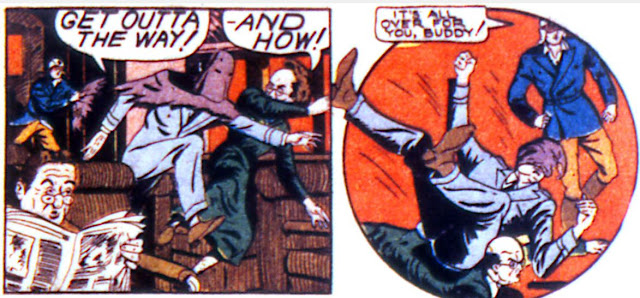
    This unnamed fellow got up to all kinds of hijinks on a train, including murder, espionage and impersonating a conductor. Seen here inadvertently unmasking a crossdressing thief – it was a very busy adventure for Captain Desmo. (More Fun Comics 070, 1941)

    Johnny Quick’s first outing features one of my favourite comic book things: a series of vignettes of prior cases to establish Johnny’s bona fides vis-a-vis crimefighting. Two of the adventures in question involve what would almost certainly have been Minor Super-Villain entries if they were featured players, so here’s to you, the Pharaoh’s Mummy and the Murderous Musician (and the Money-Mad Miser, not pictured) (More Fun Comics 071, 1941)

  • NOTES – DECEMBER 2023

    Weaknesses: 

    A very specific weakness for the Spectre: a once-in-a-hundred-million-year alignment of constellations that surely will never happen again. (More Fun Comics 071, 1941)

    Misc:

    This is my first encounter with Golden Age Johnny Quick so I’m not sure if the slow-down formula that he uses in the third panel above is a regular thing or a one-off but it sure has been left by the wayside. (More Fun Comics 071, 1941)

    EDIT: He does it again in More Fun Comics 072! 

    Memes of Yore – Keep ’em Flying!

    Johnny Quick (More Fun Comics 073, 1941)

    Green Arrow and Speedy (More Fun Comics 074, 1941)

    Drawn without reference:

    A wonderful 11-legged spider! (More Fun Comics 073, 1941)

    Origins:

    Poor ol’ Earth-Two Aquaman. Nobody even remembers that he exists half the time, plus he got eliminated in the Crisis. Anyway, here’s his origin: his dad found Atlantis and trained his son to breathe water (also a cheeky Fate of Atlantis – it sank and now Aquaman lives there). (More Fun Comics 073, 1941)

    Great Folk:

    I had completely forgotten about this story, but the old man who hoots and hollers and calls for detective Russell Granville until he’s on the case is the spectacular character find of 1939. Really, really great way to build up the detective before his appearance and I’m a bit sad that this is the only Russell Granville story because that old man needs more panel time. (Keen Detective Funnies v2 011, 1939)