The Curse of Skeleton Munroe

Category: real folk

  • REAL PERSON ROUND-UP 023

    REAL PERSON ROUND-UP 023

    It’s an Axis-heavy Round-Up this time, for reasons which will soon become clear.

    Adolf Hitler:

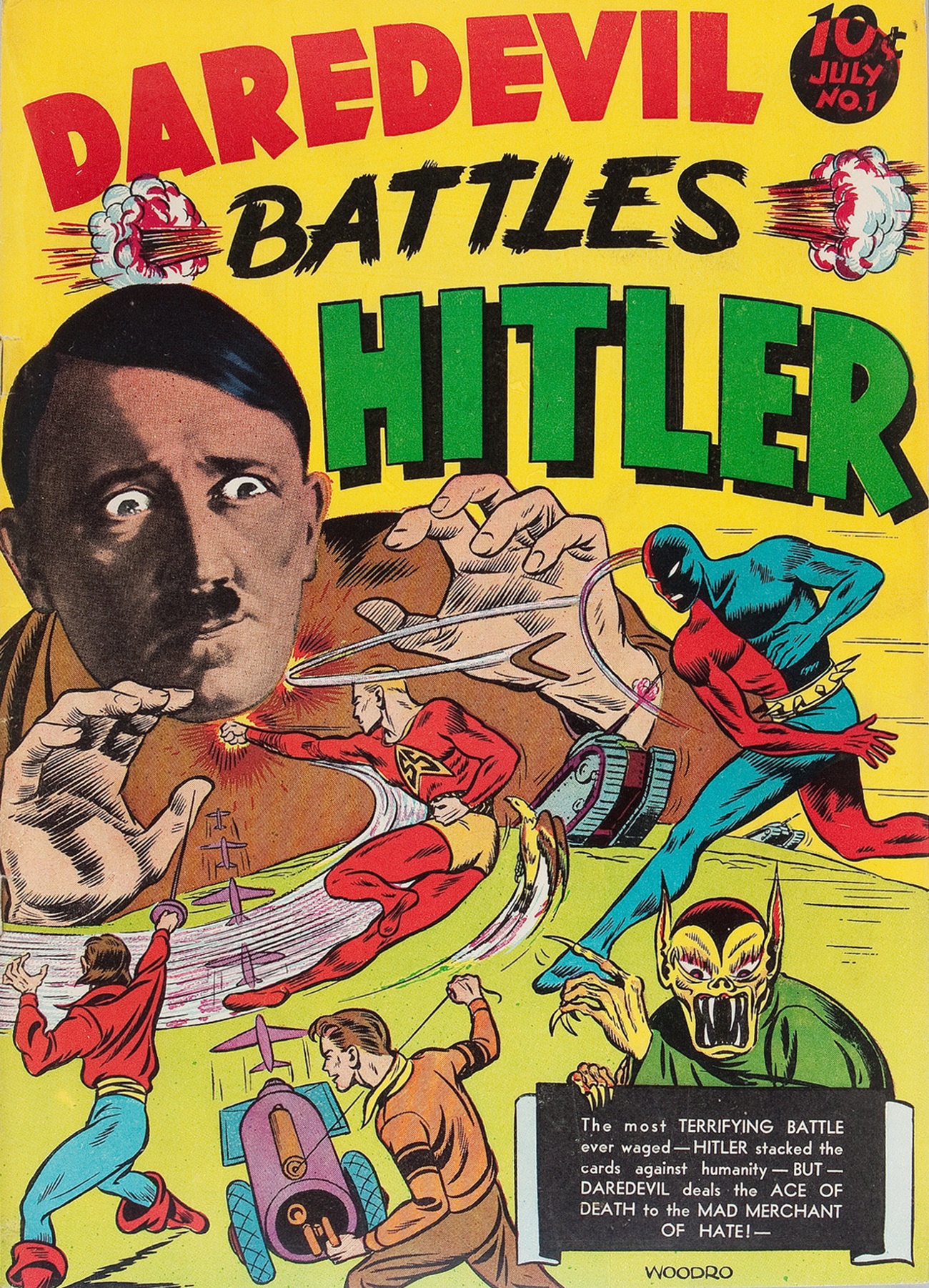
    Daredevil Comics 001 might not have been the first comic book to feature its title character physically attacking Adolf Hitler on the front cover, but it makes up for this in sheer volume of different characters who are getting in on the act. And the comic itself is also 100% concerned with super-heroes beating up and otherwise inconveniencing Hitler.

    Hitler’s first appearance in the comic proper also includes a rogue’s gallery of Third Reich figures, including Josef Goebbels, Heinrich Himmler, Hermann Goering, Admiral von Roeder* and General Walther von Brauchitsch. Also present: the fortune teller who supposedly advised Hitler on a day-to-day basis.

    *more on him later 

    Though Daredevil is present to merely spy on the well-attended meeting above, he is found out and has to punch out not just Hitler but Goering and Goebbels as well in order to make his escape.

    Hitler’s second major humiliation in the issue comes at the hands claws of the Claw. He makes a deal with the giant villain on behalf of his Japanese allies, but the Daredevil gets involved in and ruins the whole operation.

    Hitler has to pay a hefty bribe just to get out with his skin intact. This is a fine illustration of why most villains don’t negotiate this sort of thing in person.


    Finally, the suprisingly hands-on Hitler is coordinating a Nazi invasion of Africa when the Daredevil and jungle hero Lance Hale get involved, giving the Daredevil the opportunity to land two more punches and a boomerang-assisted trip on the dictator.

    Lance Hale, meanwhile, pranks Hitler by giving him a shave with an incredibly accurate arrow, then almost body slams him to death before he is interrupted by Nazis. (Daredevil Comics 001, 1941) 

    Benito Mussolini: 

    A sad cameo from Il Duce after a portion of his fleet is sunk by the British. (Daredevil Comics 001, 1941) 

    Heinrich Himmler:

    Is Blackout’s Nazi foe Heinrich Himmel meant to be a version of Himmler or is it just a very Nazi collection of syllables? Hard to say. (Captain Battle Comics 001, 1941) 

    Hermann Goering: 

    Like Hitler, Goering is surprisingly willing to lead from the front in this issue. He loses a dogfight with Cloud Curtis and almost kills himself over it. (Daredevil Comics 001, 1941)

    Josef Goebbels:

    Goebbels, meanwhile, steals a codebreaking machine devised by by boy inventor Dickie Dean.

    He doesn’t manage to hang onto it for long before he gets beaten up and mummified by Dean and the Daredevil (and Zip Todd, of course). (Daredevil Comics 001, 1941)

    the Koh-i-noor Diamond: 

    Once more a big ol’ gem is given a name that sounds like “Koh-i-noor,” in this case the (baseball-sized!) Kohnoor Diamond. (Captain Battle Comics 002, 1941)

    Lord Haw-Haw: 

    Lord Garnett here is a bit of a rarity as he starts out as a masked spy who will be appearing in the next Generic Costumed Villain Round-Up and then, after shooting Whiz, King of Falcons (see the next Catalogue of Wounds) flees to Germany and takes up a career in propaganda broadcasting, where his distinctive and annoying laugh earns him the epithet “Lord Hee-Haw.”

    His new career doesn’t last very long, as he is shot down by the Silver Streak while doing some aerial broadcasting. (Daredevil Comics 001, 1941)

    Admiral von Roeder:

    Who is von Roeder is a very good question, because I can find no evidence that he actually existed. There are four plausible explanations for this:

    1. He’s a fictional Nazi who somehow got conflated with real ones. 

    2. There was an Admiral von Roeder but he was only noteworthy for exactly the length of time it took for this comic to be written and he thereafter sank into such obscurity that he is no longer remembered.

    3. The state of internet search is so wretched that a moderately obscure Nazi is currently unsearchable.

    4. They couldn’t come up with a real Nazi Admiral and so just made one up. 

    Regardless of his actual historicity, this von Roeder is beaten up by both Daredevil and a time-travelling Pirate Prince. (Daredevil Comics 001, 1941) 

    Winston Churchill: 

    Churchill invites both Daredevil and Silver Streak (and the most obnoxious version of Whiz, King of Falcons) to No. 10 Downing St to solicit their help with the war effort. (Daredevil Comics 001, 1941)
    More of this kind of thing

  • REAL PERSON ROUND-UP 022

    REAL PERSON ROUND-UP 022

    What percentage of these people knew that they had ever been portrayed in a comic book, you reckon?

    Adolf Hitler:

    Hitler gets beaten up by the Silver Streak after he captures and attempts to kill Meteor. (Silver Streak Comics 016, 1941)

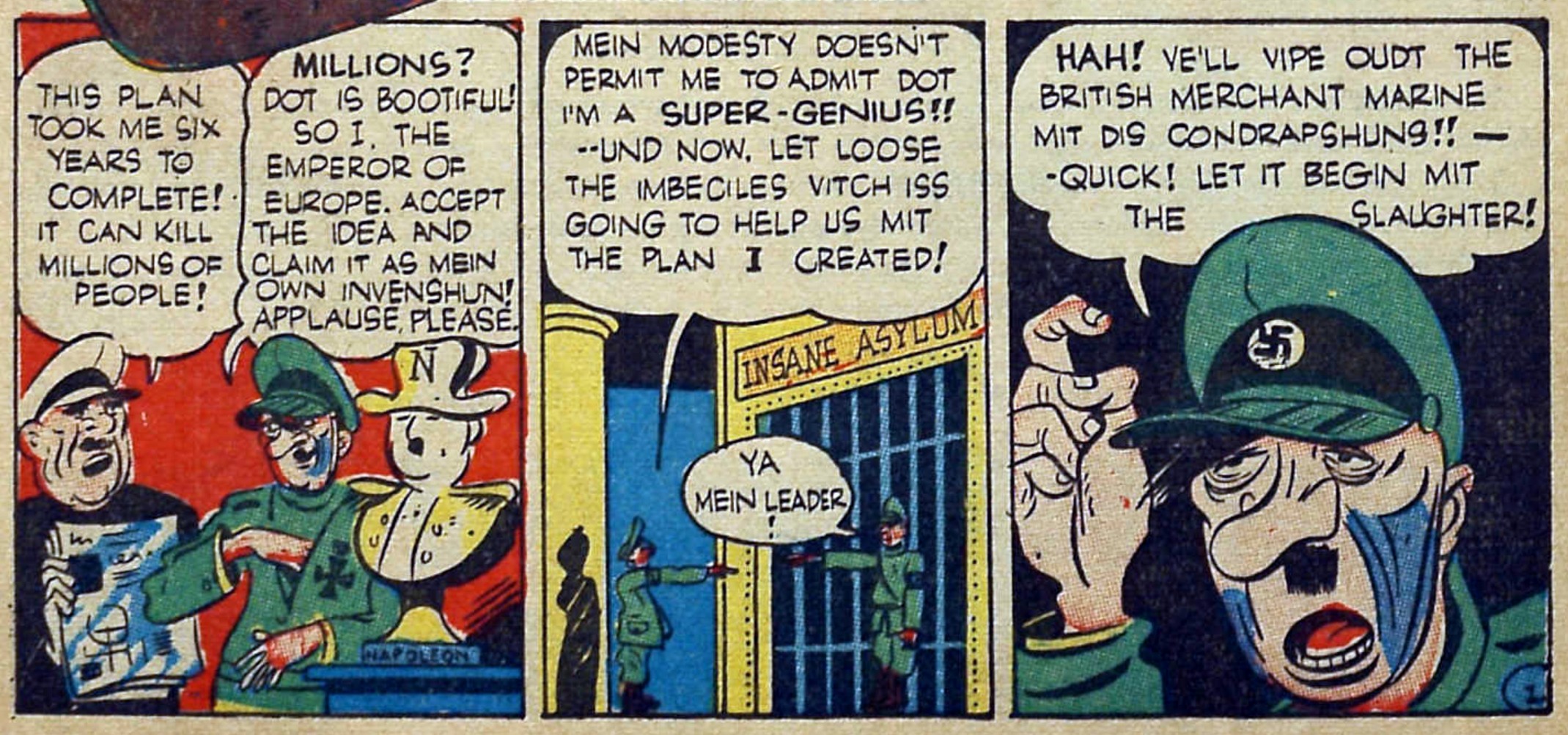
    A particularly parodic version of Hitler deploys a super weapon that is ultimately thwarted by Dickie Dean.  (Silver Streak Comics 017, 1941) 

    Charles Biro:

    Gangster Chick Biro almost gets killed by his boss the Domino but is saved when Presto Martin takes his place. (Silver Streak Comics 009, 1941)

    Genghis Khan:

    The Bingham Boys and their friends hunt down the Sword of Genghis Khan to a Tibetan lamasery, where the Grand Lama claims to be the descendant of the Khan and thus entitled to conquer the world. Our heroes beat up the would-be Khan and spirit the sword away to an American museum. (Silver Streak Comics 016, 1941)

    George Roussos: 

    It’s a classic case of slapping your fellow comic book creator’s name on a background sign as “Presto Martin” scribe Bob Wood uses Roussos’ name on an apartment building. (Silver Streak Comics 010, 1941)

    Next issue of the same strip features the headline “Roussos Does it Again! Famous Cartoonist Meets Second Deadline! I can hardly wait to read Roussos’ work in Daredevil Comics to see if he shoots back. 

    Same issue features Roussos’ Army & Navy Store, with a “Jerry Robinson, Prop.” thrown in for good measure. (Silver Streak Comics 011, 1941)

    George Washington: 

    Deploys his personal agent Dan Dearborn to escort a gunpowder shipment and help protect it from capture by the British. (Silver Streak Comics 008, 1941)

    George Rogers Clark: 

    That gunpowder is transported downriver by Clark, a Revolutionary War hero whom I was unfamiliar with and whose Wikipedia page is predictably fraught. (Silver Streak Comics 008, 1941)

    Captain John Neville: 

    Commander of the Fort Pitt garrison at Pittsburgh, where he briefly meets Dan Dearborn. (Silver Streak Comics 008, 1941)

    Mao Zedong: 

    He doesn’t play a direct role in the story, but Mao Tung here is definitely a stand-in for Mao Zedong, aka Mao Tse-tung. Captain Battle saves him from an assassination attempt by a Japanese spy. (Captain Battle Comics 001, 1941)

    Samuel Goldwyn:

    Goldbyn, head of Paragold Film Studios, is a classic stand-in for Sam Goldwyn of MGM. (Silver Streak Comics 017, 1941)

    Unknown News Broadcaster Jimmie Fidler: 

    As you can see, above, I was initially unable to find the reference point for Jimmy Fiddle here. The problem is that I have been conditioned to think a certain way about these stand-in names, so I spent a lot of effort looking for “James Diffle” and “John Oboe” and so forth, and didn’t even consider that it might be something as simple as “Jimmie Fidler” until I remembered that we had already encountered a Jimmy Fiddle and filed him under Unknown. 

    Sorry for disrespecting your 50+ year media career, Jimmie Fidler. In my defense, you retired when I was three years old. (Silver Streak Comics 009, 1941) 

  • REAL PERSON ROUND-UP 021

    REAL PERSON ROUND-UP 021

    They just love putting real folks and versions of real folks in comics and I just love finding them and putting them on my blog. 

    Adolf Hitler:

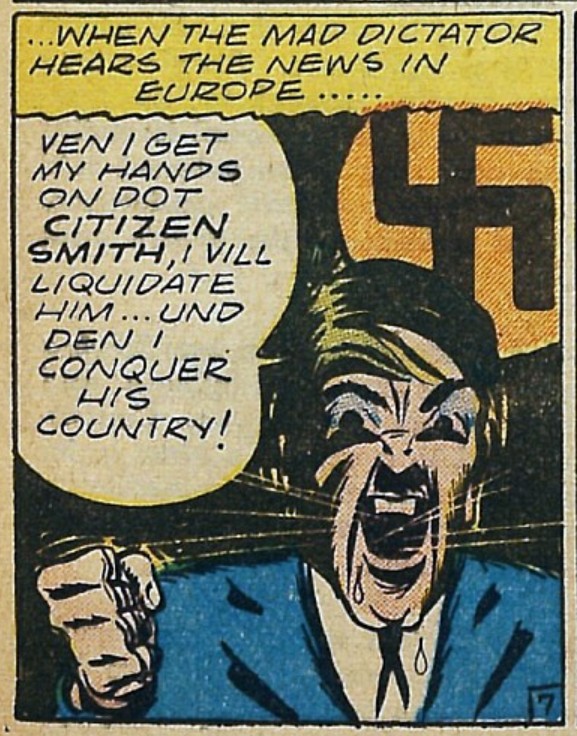
    An in-all-but-name version of Hitler gets mad at Citizen Smith for foiling his plans and plots. (Captain Fearless Comics 002, 1941)

    Gang boss and Deacon foe Duke Adare’s little toothbrush mustache is what initially drew my attention, even though that wasn’t nearly as glaring a signpost of a character being a Hitler stand-in in the 1940s. As the story wore on it became clear that my instincts were correct, as Adare used overwhelming military force to overwhelm the lawmen of Midland City and loot its treasury. And then of course you get to the end of the story, where they’re referring to him as a “would-be Crime Fuehrer”. (Cat-Man Comics 005, 1941)

    Minor appearances: 

    Captain Fearless Comics 001, 1941 

    Al Capone: 

    Lou Pacone, gang boss and murderer of the Secret Circle’s father, is yet another example of Al Capone’s name being remixed to give someone a gangstery sounding moniker. (Choice Comics 001, 1941)

    Axis & Allied Figures: 

    “America’s Air Army” was an extremely patriotic feature that was essentially US Army Air Force fan fiction about what would happen if and when the United States entered WWII, published just before they did. It’s the tale of the US forces (with a little help from the Brits) curb stomping the Axis for about half an hour before we get this little scene, with Hitler surrendering while Goering, Walther von Brauchitch (recently relieved of duty when this comic was published), Cordell Hull (I think) and Churchill observe. (Air Fighters v1 001, 1941) 

    FDR: 

    The President gets kidnapped by Dr Sivana! And Rescued by Captain Marvel! (Whiz Comics 014, 1941)

    Minor Appearances: Captain Aero Comics 001, 1941

    Lord Haw-Haw: 

    In his final Golden Age adventure, the Arrow aka intelligence agent Ralph Payne heads into Germany to apprehend the traitorous broadcaster “Lord Hawford.” (The Arrow 003, 1941) 

    Manuel Prado Ugarteche: 

    Lance O’Casey and his pal Dan’l Doom wash up on the shores of Peru and get mixed up in a scheme to overthrow the country by the wicked El Tigre. They foil him and restore power to the rightful president, Alfredo Blanco, who is extremely not Manuel Prado Ugarteche, the Peruvian president in our version of 1941. (Whiz Comics 015, 1941)

    Rudolph Hess: 

    “Deputy-Dictator Brinker” lands in a farmer’s field near Washington in what is certainly a reference to Hess’ flight to Scotland but is in fact revealed to be part of a plan to invade the US. The whole thing is nearly undone by the fact that the FBI doesn’t even bother to check on this seeming defection and just tells the poor farmer to deal with it. (Captain Fearless Comics 002, 1941)

    Sherlock Holmes:

    Dr Miracle is on the trail of a mystery, and who better to help than the summoned spirit of Sherlock Holmes Herlock Sholmes? Per the conceit of the story I guess this means that Sholmes was a real living guy at some point. (Champ Comics 012, 1941)

    Unknown Dancers: 

    Yet again we have an example of “this seems like a reference to something but I can’t find specifics,” in this case a dance team known as Velox & Costanza. The concept of a duo performing cultural dances from exotic locales crops up now and then as entertainment in comics but I’m never sure if the references to them are general or specific, and brief fads in live entertainment are among the trickiest things to casually research on the internet – it’s more of a “comb through several years’ worth of newspapers” kind of thing. (Whiz Comics 023, 1941)

    Walter Winchell: 

    As an example of why I include the Unknown entries in these round-ups: I had Walter Chinwell here listed as “Unknown Reporter” for something like two weeks before I came across Walter Winchell’s name in a list of 1940s radio announcers. And Winchell is someone I had already heard of! (Silver Streak Comics 008, 1941) 

  • MINOR SUPER-VILLAIN 911: RAMESES

    (Whiz Comics 025, 1941)

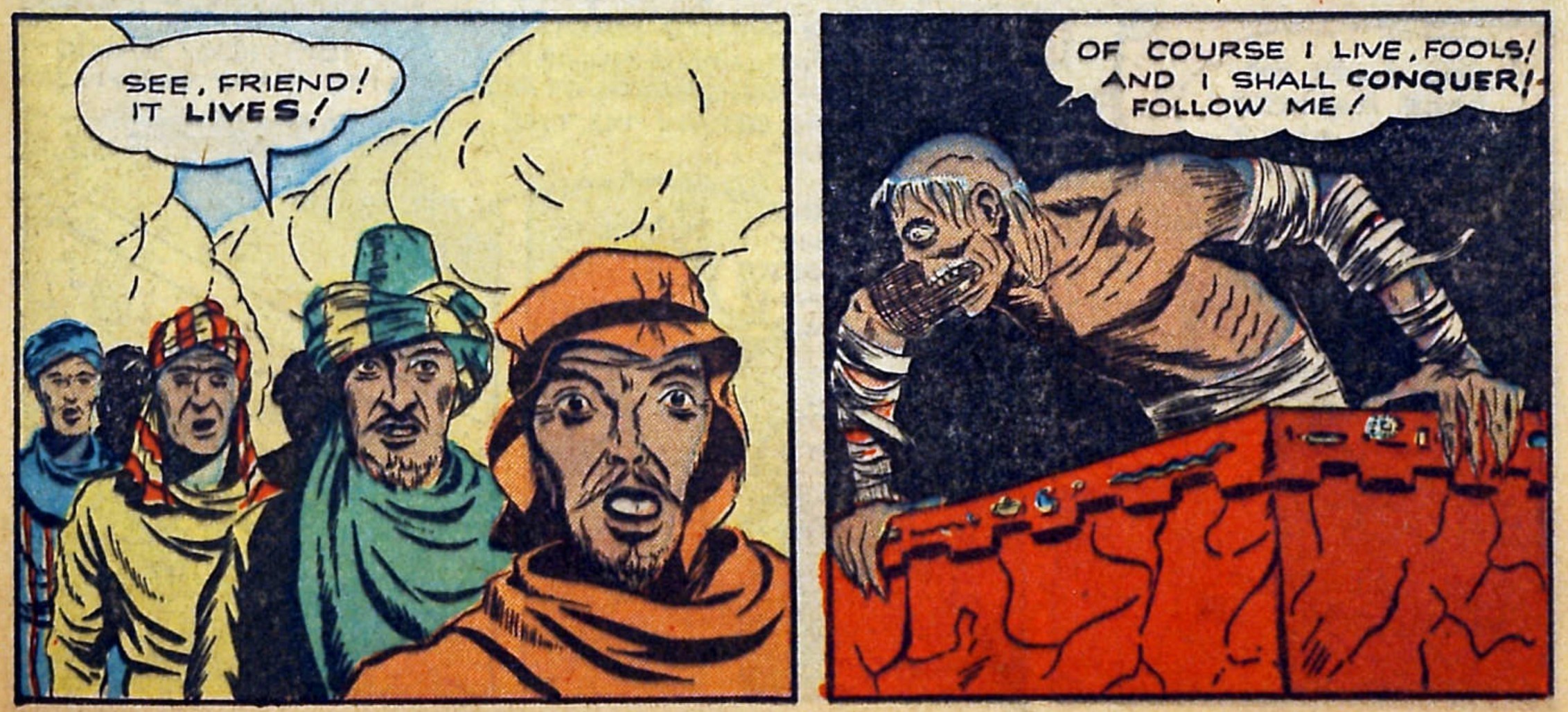
    We open in Egypt, where a group of partisans led by a fellow with the unlikely name of “Girbo, the Mad Mullah”* are brainstorming ways in which they might expel both the Germans and the British from their country, and Girbo has an innovative solution: he has procured the mummy of the Pharaoh Rameses, along with a vial of mummy-resurrection juice, and is going to bring the ancient king back to life to lead them. And it works!

    The problem that I am faced with here is that Egyptian history features a full eleven different rulers named Ramesses and just which one this was is not specified here. I was all fired up and ready to dig through the history of each one (on Wikipedia, at least), when I realized that there was a clear and obvious front-runner in the person of Ramesses II, ol’ Ozymandias himself, if only because he loomed largest in the public consciousness of the time as the presumed Pharaoh of the story of Exodus. 

    *while I’m not going to claim that the depiction of Egyptian Muslims in this story is good or even particularly sympathetic, you must believe me when I say that (aside from Girbo) these guys get about as sympathetic a depiction as you get in comics the 1940s, or indeed into the 80s. It’s a low bar but they cleared it.

    Rameses begins his campaign on a high note, with a raid on a British fort that establishes both his ruthlessness and complete invulnerability to bullets. One must pity his poor horse, however.

    Things take a turn when a Nazi officer shows up with the intention of allying with this new faction against the common British for, only to be slain at Rameses’ command. This violation of the flag of truce raises some concern amongst his followers but what really gets the talking is his assertion that he should be enough of a god for them and that they should abandon their faith to serve him.

    Having driven away his followers with his evil ways, Rameses drives home his point with magical snakes. 

    The loss of his followers means nothing to the undead Pharaoh, who simply raises an army of the dead to assist him in his next assault on the British forces. Meanwhile, Girbo attempts to slay Ibis the Invincible to prevent his further interference in their plans but is himself killed when Ibis proves his better in swordplay.

    Rameses’ undead forces, though formidable, are vulnerable to sunlight, something that the Ibistick can easily provide even though the mechanics of how it might have done so are troubling. But what to do with an eight foot tall megalomaniacal mummy-man? Things look hopeless until Rameses himself lets slip the fact that the only thing capable of containing him is his own tomb that Ibis is able to defeat him, by simply moving said tomb over top of the villain.

    Though Rameses is left to stew in the darkness, he is in fact one of Ibis the Invincible’s few recurring villains. We will see his bony face and weird mummy tonsure again.

  • MINOR SUPER-VILLAIN 911: RAMESES

    MINOR SUPER-VILLAIN 911: RAMESES

    (Whiz Comics 025, 1941)

    We open in Egypt, where a group of partisans led by a fellow with the unlikely name of “Girbo, the Mad Mullah”* are brainstorming ways in which they might expel both the Germans and the British from their country, and Girbo has an innovative solution: he has procured the mummy of the Pharaoh Rameses, along with a vial of mummy-resurrection juice, and is going to bring the ancient king back to life to lead them. And it works!

    The problem that I am faced with here is that Egyptian history features a full eleven different rulers named Ramesses and just which one this was is not specified here. I was all fired up and ready to dig through the history of each one (on Wikipedia, at least), when I realized that there was a clear and obvious front-runner in the person of Ramesses II, ol’ Ozymandias himself, if only because he loomed largest in the public consciousness of the time as the presumed Pharaoh of the story of Exodus. 

    *while I’m not going to claim that the depiction of Egyptian Muslims in this story is good or even particularly sympathetic, you must believe me when I say that (aside from Girbo) these guys get about as sympathetic a depiction as you get in comics the 1940s, or indeed into the 80s. It’s a low bar but they cleared it.

    Rameses begins his campaign on a high note, with a raid on a British fort that establishes both his ruthlessness and complete invulnerability to bullets. One must pity his poor horse, however.

    Things take a turn when a Nazi officer shows up with the intention of allying with this new faction against the common British for, only to be slain at Rameses’ command. This violation of the flag of truce raises some concern amongst his followers but what really gets the talking is his assertion that he should be enough of a god for them and that they should abandon their faith to serve him.

    Having driven away his followers with his evil ways, Rameses drives home his point with magical snakes. 

    The loss of his followers means nothing to the undead Pharaoh, who simply raises an army of the dead to assist him in his next assault on the British forces. Meanwhile, Girbo attempts to slay Ibis the Invincible to prevent his further interference in their plans but is himself killed when Ibis proves his better in swordplay.

    Rameses’ undead forces, though formidable, are vulnerable to sunlight, something that the Ibistick can easily provide even though the mechanics of how it might have done so are troubling. But what to do with an eight foot tall megalomaniacal mummy-man? Things look hopeless until Rameses himself lets slip the fact that the only thing capable of containing him is his own tomb that Ibis is able to defeat him, by simply moving said tomb over top of the villain.

    Though Rameses is left to stew in the darkness, he is in fact one of Ibis the Invincible’s few recurring villains. We will see his bony face and weird mummy tonsure again.

  • REAL PERSON ROUND-UP 020

    Where would comic books be without real people, after all?

    Easter Island: 

    Lance O’Casey and his pal Dan’l Doom fight some wreckers on Easter island, and while I can’t tell if the place saw enough ship traffic in the 1940s to make shipwrecking a profitable enterprise, I will say that the concept of Lance and Dan’l just casually passing by one of the most isolated islands in the Pacific Ocean while travelling from place to place is an eyebrow raiser.

    The whole Easter Island aspect of the adventure honestly seems to just be a bit of set dressing, but I sure do love these extremely flat moai statues.(Whiz Comics 013, 1941) 

    Fort Knox: 

    As “Fort Gnox,” robbed by Dr Sivana. (Whiz Comics 014, 1940)

    FDR: 

    Spy Smasher saves the president from being assassinated by probable-Nazi spy the Dark Angel, leading to what I can only interpret as a very awkward meeting between the two. (Spy Smasher 001, 1941) 

    Fiorello La Guardia (Not): 

    Wow Comics 004 features not one but two mayors who are not Fiorello La Guardia in comics previously established to be set in New York City. I’d say poor guy for not getting elected in two different versions of Earth-S but neither of these guys are exactly having a good time. (Wow Comics 004, 1941)

    Harry “A” Chesler: 

    The Zip Comics 007
    Steel Sterling story involves a crooked moneylending firm called the
    Uwana Loan Company, and here we see the door of that company with H. “A”
    C. listed as president. Comic book publisher Harry “A” Chesler was a
    decent boss as far as I can tell, so once and future Chesler employee/
    “Steel Sterling” scribe Charles Biro is probably indulging in some
    classic comic book yuk-em-ups here rather than a trenchant skewering.
    (Zip Comics 007, 1940) 

    Henry L. Stimson: 

    US Secretary of State. As “Secretary Simpson,” almost gets assassinated and mummified by the Black Thorn. (America’s Greatest Comics 001, 1941) 

    J Edgar Hoover:

    As “FBI Chief Doover” almost gets assassinated by the Ghost. (am greatest 001 1941)

    Ken Crawford: 

    The Mask adopts a reporter alias as part of an attempt to find out the Spy Smasher’s secret identity, and there is no doubt in my mind that “Crawf Kenford” is a classic syllable-flip reference to venerable political correspondent Ken Crawford. (Whiz Comics 013, 1941)

    Mort Meskin: 

    You have to squint to read it, but that red sign says “M. Meskin, Fish” on it. (Zip Comics 007, 1940)

    William Tell: 

    Golden Arrow plays William Tell in a local school pageant, with love interest Carol Braddock as the apple-headed son. (Whiz Comics 012, 1941) 

  • REAL PERSON ROUND-UP 019

    For various definitions of the word real. 

    Adolf Hitler: 

    Just why this nonsense-language-speaking pilot henchman of the Mask is named Reltih is a mystery, but it’s also a fact. BONUS VERY ANNOYING THING: I can decipher the nonsense in that second panel as “I’ll murder the bum” but this makes me think that I should be able to do the same with the rest of his half-dozen or so lines of dialogue but I can’t. Utterly vexing!

    The Mask also employs an English-speaker with the very annoying name of Inilossom in the same issue. (Whiz Comics 010, 1940)

    Here’s straightforward Hitler analog King Rodend of Kalnar about to be beaten up by the Flame. (Wonderworld Comics 011, 1940)

    Wretched humour comic “Don Quixote in Modern Times” features villain “Adolphus Stalini”. (Wonderworld Comics 020, 1940)  

    Devil’s Island: 

    Newsreel camerawoman Patty O’Day covers a prisoner’s revolt on the penal colony in what might just be the least sympathetic portrayal of Devil’s Island in comics. (Wonderworld Comics 015, 1940)

    J. Edgar Hoover:

    Minor appearances: 

    Whiz Comics 003a, 1940 

    Whiz Comics 005, 1940 

    John Galt: 

    File this one under “amazing coincidences”. A character named John Galt, a full seventeen years before Atlas Shrugged is published. And to top it off:

    Dr John Galt’s radium has been stolen by Dr James Kirk (aka Doctor Death), a full twenty-six years before Star Trek debuts. Would it be a bit more narratively satisfying if John Galt was the selfish shitheel and James Kirk was the selfless hospital administrator? Sure, but that’s just details. (Whiz Comics 002, 1940)

    the Koh-i-Noor Diamond:

    Reporter Scoop Smith is sent on assignment to find the fabled South African Rooirand Emerald, which his editor sees as a direct parallel to the Koh-i-noor. Just how this is the case is what baffles me – I initially thought that it might have been stolen and editor Lane was thinking of the Agatha Christie novel in which that happened, but the more I look at it the more I think that it’s just a big gem that some white guys are trying to steal. 

    (this story also has one of the more stupid desus ex machina endings in all comics, when the sacred snake handler of the isolationist tribe that worship the emerald turns out to be Sam Jones, African American train porter and eternally loyal to Smith because of a five dollar tip) (Whiz Comics 004, 1940) 

    Lázaro Cárdenas del Rio: 

    You know me: I love to dunk on old comics for their portrayals of in-office world leaders, and let’s just say that if you look up a picture of Lázaro Cárdenas, president of Mexico from 1934 to November of 1940, he doesn’t have a long white beard. I didn’t bother to check if the President of Mexico has an enormous ornate throne to sit in, but I can only hope. (Whiz Comics 005, 1940)

    Mata Hari: 

    Hundanian spy Mata Dara, the latest in a long line of women in espionage to have a sound-alike name to Mata Hari. (Zip Comics 001, 1940)

    Senusret III: 

    Mentioned as being a cousin of Taia’s in Whiz Comics 002, “King Senwosri” aka Pharaoh Senusret III then makes an appearance in person as he rises from the dead to punish an American explorer for violating the sanctity of his tomb. He returns to his eternal slumber after an intervention by cousin Taia and cousin-in-law Ibis the Invincible. (Whiz Comics 003b, 1940)

  • MINOR SUPER-HERO ROUND-UP 061

    Superfolk galore! 

    the Buzzard: 

    In an unnamed New-York-alike city, the gadgeteering mayor equips a young man with a suite of devices to help him engage in a vigilante crusade against crime. Chief among these gadgets is a gas that makes whomever it touches resemble a balding, big-nosed man in thick glasses and a tailcoat – the perfect disguise! Armed with this gas, plus some clawed gloves and a heat ray, the Buzzard begins tearing his way through the city’s underworld. 

    The gas also seems to allow the Buzzard to make his shadow resemble his namesake bird, an ability that is very useful for vexing the city’s Buzzard-hating police chief who, it turns out, is also the father of the Buzzard’s secret identity. 

    I unironically love the Buzzard and his whole weird setup, and while I find most modern revivals of public domain Golden Age characters to be a pretty mixed bag, I’m pretty bummed that none of them have elevated him out of his single issue obscurity – he’s got a real weirdo charm that the fiftieth version of the Nedor characters can’t approach. (Wham Comics 002, 1940) 

    the Cyclone: 

    The Cyclone is really Peter Grant, a young man who has a fairly unique version of the Batman origin, which of course is when a tragedy inspires an obsessive dedication to training and working toward some related goal, i.e., in Batman’s case the murder of his parents inspiring his eternal war against crime. The real twist in the Cyclone’s case seems to be the total absence of a motivation: Grant just woke up one day and decided to turn his body into a living weapon to aim at evil.

    The Cyclone is presented as being a regular human and so I had been assuming that the whirlwind patterns around his lower body when he jumps around were a stylistic choice meant to represent his fantastic leaping ability. They really are some enormous jumps, however, so it’s also possible that the Cyclone is meant to have some sort of wind-assisted jumping power. He only had three adventures, alas, so we shall never know. (Whirlwind Comics 001, 1940)

    Ibis the Invincible: 

    Ibis the Invincible, aka Prince Amentep, is a 12th Dynasty Egyptian who just kind of spontaneously comes back to life after 4000 years as a mummy. Why? Well, it’s not spelled out until the 1942 Ibis the Invincible series, but spoilers: his true love had been shot with an arrow that put her to sleep for those four millennia and he put himself in a magical sleep of his own in order to be with her again. 

    Ibis achieves this state of mystic sleep with the aid of the Ibistick, a magical wand capable of very nearly anything. Much like his fellow Golden Age magical super-heroes, Ibis’ near-omnipotence can occasionally seem plot-obliteratingly powerful. 

    The key difference between Ibis and his contemporaries, however, is that the Ibistick is a small object that is constantly being lost or stolen. Further, it requires absolutely no special knowledge to be used and can be operated by both children and animals with ease. More than a few of Ibis’ greatest foes (e.g., the Hobo-Millionaire) are simply regular humans armed with his own magic wand. The caveat to all this is the fact that the Ibistick will never harm its true owner, and will in fact inflict any baleful magic cast from it at him back on its wielder. This means that Ibis is able to defeat an evil wielder of the Ibistick by merely being annoying enough that they try to turn him into a toad or gold or ice or on on memorable occasion to mind control Taia into stabbing him to death and then wait for it to backfire on them. (Whiz Comics 002, 1940)

    UPDATE 1941 

    Taia: 

    Taia is the 4000-year-sleeping love for whom Ibis the Invincible made his way to the future. After a bit of moping around the globe he manages to track down her mummy and revive her, upon which they kind of implicitly are a married couple. While I very much enjoy Taia and the dynamic she has with Ibis, she does get a pretty raw deal – being your own husband’s de facto sidekick is bad enough, but Taia very rarely gets to be anything more than a kidnap victim/bargaining chip. The few modern versions of Ibis the Invincible try to do more with her, but they still don’t do much.

    Taia is said to be cousin to “Senwosri III” who is probably meant to be Pharaoh Senusret III, given that Taia and Ibis are said to be from the 12th Dynasty. So that’s something. (Whiz Comics 002, 1940)


  • REAL PERSON ROUND-UP 018

    World leaders and others. 

    Adolf Hitler: 

    I’m pretty sure that the “Navy Jones” strip is set in an undefined near-future time, which makes the Dictator of Europe here a future analog of Adolf Hitler rather than a stand-in for him. I’m almost certain that that’s the case. Anyway, he tries to invade the US with a fleet of amphibious tanks and gets his ass handed to him by Navy Jones and his fish men. (Weird Comics 008, 1940)

    Chiang Kai-shek and Soong Mei-ling: 

    Styled as Madame and Generalissimo “Kang Shy-check,” the former comes to adventurer Shanghai Sheridan for aid after the latter is captured by Japanese collaborator Wu Fang. (Top-Notch Comics 005, 1940)

    Clyde Beatty: 

    Famous animal trainer and circus mogul Clyde Beatty had a long-running strip across several Dell Comics titles, though given that the supporting cast and premise tended to reset to zero every time the strip changed hands it might be more accurate to say that he had a sequential series of features linked only by his presence. (Crackajack Funnies 001, 1938)

    Franklin Delano Roosevelt:

    A fairly off-model FDR chairs an emergency meeting to discuss what to do about an alien invasion. (War Comics 002, 1940)

    J Edgar Hoover: 

    The Sparkler accepts an assignment from “head G-Man”/his old college roommate’s dad M.L. Roover. (Wham Comics 002, 1940)

    Sténio Vincent: 

    I don’t necessarily trust the creators of the “Voodoo Man” feature to even remember that it is set in Haiti, let alone go to the trouble to accurately represent Haiti’s president on-panel, so I have to give it to them: this is an okay drawing of Sténio Vincent, the President of Haiti c. 1940. Was it done on purpose? Nobody can say. (Weird Comics 004, 1940) 

    Gaius Marius & Sulla: 

    It’s impossible to be certain if Marius and Sulla, the Roman figures associated with the origin of super-hero the Dart, are in fact meant to be Gaius Marius and Sulla, the political figures from the late Roman Republic, but the timeline almost matches up. Plus, there really weren’t that many Sullas running around Rome. (Weird Comics 005, 1940) 

    Mata Hari: 

    Just a notorious spy named Hattie Mary in the comedy melodrama comic strip “Hairbreadth Harry”. (Famous Funnies 074, 1940) 

    Winston Churchill: 

    Inspector Blake of Scotland Yard is called to 10 Downing Street to talk to the Prime Minister, and it sure doesn’t look like he’s Winston Churchill. I do like to roast comics for not getting the appearances of world leaders right, but when it’s somewhere like Madagascar you might at least have the excuse that finding a picture of the current leader of that country might be difficult in the US in 1940, but surely this not so for the Prime Minister of the UK.

    The other possible defense for this, of course, is that this comic came out in June 1940 and Churchill took power in April so Neville Chamberlain might still have been PM when this was drawn, but this is hampered somewhat by the fact that it doesn’t really look like him either. (Whirlwind Comics 001, 1940)

  • REAL PERSON ROUND-UP 018

    World leaders and others. 

    Adolf Hitler: 

    I’m pretty sure that the “Navy Jones” strip is set in an undefined near-future time, which makes the Dictator of Europe here a future analog of Adolf Hitler rather than a stand-in for him. I’m almost certain that that’s the case. Anyway, he tries to invade the US with a fleet of amphibious tanks and gets his ass handed to him by Navy Jones and his fish men. (Weird Comics 008, 1940)

    Chiang Kai-shek and Soong Mei-ling: 

    Styled as Madame and Generalissimo “Kang Shy-check,” the former comes to adventurer Shanghai Sheridan for aid after the latter is captured by Japanese collaborator Wu Fang. (Top-Notch Comics 005, 1940)

    Clyde Beatty: 

    Famous animal trainer and circus mogul Clyde Beatty had a long-running strip across several Dell Comics titles, though given that the supporting cast and premise tended to reset to zero every time the strip changed hands it might be more accurate to say that he had a sequential series of features linked only by his presence. (Crackajack Funnies 001, 1938)

    Franklin Delano Roosevelt:

    A fairly off-model FDR chairs an emergency meeting to discuss what to do about an alien invasion. (War Comics 002, 1940)

    J Edgar Hoover: 

    The Sparkler accepts an assignment from “head G-Man”/his old college roommate’s dad M.L. Roover. (Wham Comics 002, 1940)

    Sténio Vincent: 

    I don’t necessarily trust the creators of the “Voodoo Man” feature to even remember that it is set in Haiti, let alone go to the trouble to accurately represent Haiti’s president on-panel, so I have to give it to them: this is an okay drawing of Sténio Vincent, the President of Haiti c. 1940. Was it done on purpose? Nobody can say. (Weird Comics 004, 1940) 

    Gaius Marius & Sulla: 

    It’s impossible to be certain if Marius and Sulla, the Roman figures associated with the origin of super-hero the Dart, are in fact meant to be Gaius Marius and Sulla, the political figures from the late Roman Republic, but the timeline almost matches up. Plus, there really weren’t that many Sullas running around Rome. (Weird Comics 005, 1940) 

    Mata Hari: 

    Just a notorious spy named Hattie Mary in the comedy melodrama comic strip “Hairbreadth Harry”. (Famous Funnies 074, 1940) 

    Winston Churchill: 

    Inspector Blake of Scotland Yard is called to 10 Downing Street to talk to the Prime Minister, and it sure doesn’t look like he’s Winston Churchill. I do like to roast comics for not getting the appearances of world leaders right, but when it’s somewhere like Madagascar you might at least have the excuse that finding a picture of the current leader of that country might be difficult in the US in 1940, but surely this not so for the Prime Minister of the UK.

    The other possible defense for this, of course, is that this comic came out in June 1940 and Churchill took power in April so Neville Chamberlain might still have been PM when this was drawn, but this is hampered somewhat by the fact that it doesn’t really look like him either. (Whirlwind Comics 001, 1940)