The Curse of Skeleton Munroe

Category: real folk

  • REAL PERSON ROUND-UP 013

    REAL PERSON ROUND-UP 013

    Yet again we have a selection of comic book appearances of real-style people for you to enjoy.

    Adolf Hitler:

    Warak, dictator of Barbaria is a bit generic as far as pseudo-Hitlers go, but a pseudo-Hitler he is. (Smash Comics 017, 1940)

    Scraggs, leader of the Green Shirts, is very much a “make the leader look like Hitler as shorthand for These Guys Are Fascists” character, a subspecies that will nearly die out some time in 1941 but survives in small numbers to this day. (Startling Comics 001, 1940)

    Devil’s Island: 

    Black X has himself sent to, and then escapes from, Devil’s Island in order to secure a fellow prisoner with valuable US defense secrets in his head. (Smash Comics 013, 1940)

    FDR:

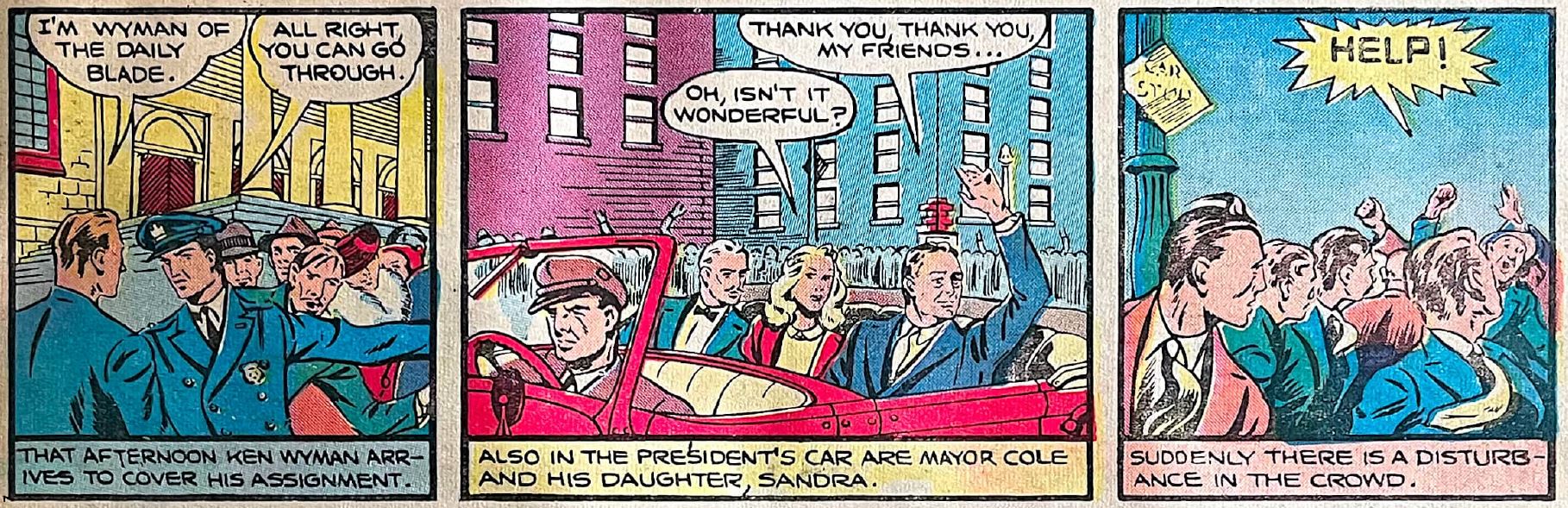
    An off-model Roosevelt visits Carterville and is kidnapped by Devil’s Dagger nemesis Jeff Marlowe (and thus retroactively by Marlowe’s boss Mr H). This is a wild move for a regional crime boss to pull! (Master Comics 006, 1940)

    Gill Fox:

    Probably a different guy to the last “Gil Fox” to appear in a Clip Chance comic – this one is just a small town baseball player. (Smash Comics 015, 1940)

    Groucho Marx:

    Goucho’s look lifted wholesale for this unnamed comedy character. (Star Comics 010, 1938)

    Hollywood:

    Autograph hound adds Shock Gibson to her collection along with “Cary Trooper” and “Glark Cable,” aka Gary Cooper and Clark Gable. (Speed Comics 009, 1940)

    Joe Devlin: 

    Given the prior instance of Joe Devlin being referenced in a Clip Chance story I must assume that the “John Devlin” mentioned here is another. (Smash Comics 014, 1940)

    Joseph Stalin:

    The Three Aces (but not the DC Comics Three Aces, the Harvey Comics ones) transport three anthropology-minded sisters to Paraguay to study the Guató people and stumble upon a plot by the sinister witch doctor Ni Lats to bring all under his sway via hypnotic mind control, for which crime he is drowned in a swamp.

    (slight aside: the Guató are a real people being used as set dressing for an exotic locale, and weirdly, in checking to see if that was the case I’m pretty sure I stumbled across the exact reference that Klaus Nordling drew from – every detail in the brief entry on the Guató in the 1911 Encyclopedia Britannica is reflected in the story. The mind control thing is added plot) (Speed Comics 010, 1940)

    Samuel Goldwyn:

    Is this movie producer named Sam meant to be Samuel Goldwyn or merely a lookalike reference to him? Regardless, this is clearly Samuel Goldwyn. (Speed Comics 010, 1940)

  • MINOR SUPER-VILLAIN 767: THE COUNT

    (Speed Comics 009, 1940)

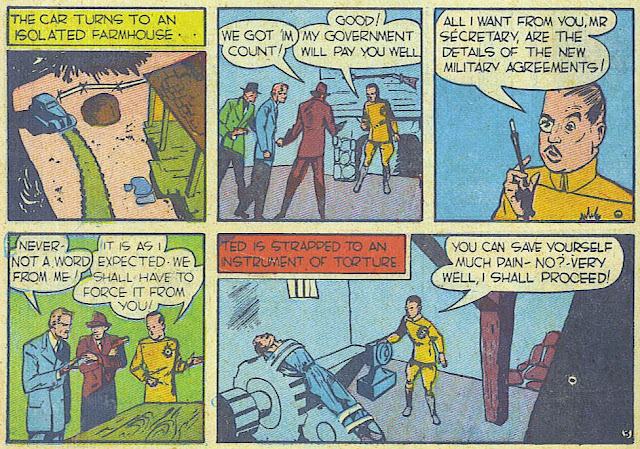
    The Count is a fairly by-the-book pseudo-Nazi spy with a very audacious plan for acquiring US military secrets: kidnap the US Secretary of State (a moderately off-model Cordell Hull) and extract them from him via gear-based torture.

    Unfortunately for the Count his plans were anticipated by the US Secret Service, who proactively substituted Ted Parrish, aka the Man With 1000 Faces, for Hull. Led to the spies’ farmhouse hideout by a special radium tracking device, the agents gun down the Count and his hirelings with some degree of prejudice, while Parrish just kind of looks on from his torture machine. An unusually passive role for a super-hero but I suppose here he is about three to five identity levels deep, so perhaps he ‘s just confused.

  • MINOR SUPER-VILLAIN 767: THE COUNT

    (Speed Comics 009, 1940)

    The Count is a fairly by-the-book pseudo-Nazi spy with a very audacious plan for acquiring US military secrets: kidnap the US Secretary of State (a moderately off-model Cordell Hull) and extract them from him via gear-based torture.

    Unfortunately for the Count his plans were anticipated by the US Secret Service, who proactively substituted Ted Parrish, aka the Man With 1000 Faces, for Hull. Led to the spies’ farmhouse hideout by a special radium tracking device, the agents gun down the Count and his hirelings with some degree of prejudice, while Parrish just kind of looks on from his torture machine. An unusually passive role for a super-hero but I suppose here he is about three to five identity levels deep, so perhaps he ‘s just confused.

  • MINOR SUPER-VILLAIN 763: QUEEN SHEBA

    (Speed Comics 008, 1940)

    Shock Gibson has been reading magazines, specifically an expose on slave trading in Africa, and being of a heroic turn of mind he decides to do something about it. Making his way across the Atlantic, Shock engages in various animal-related hijinks before finally ambushing a slave caravan and using some elephant-based enhanced interrogation to learn just what is going on with all the slaving.

    Turns out to be a pretty classic jungle adventure scenario: a hidden kingdom smack in the middle of Africa with ties to some historical people, in this case called the Secret Kingdom and ruled by a direct descendant of the biblical Queen of Sheba (who is traditionally placed somewhere in the vicinity of Yemen but who are we, the geography police?). And it’s a twofer, as Queen Sheba is served by an order of knights descended from a group of crusaders who somehow found themselves in the Secret Kingdom (okay, maybe we are the geography police because crusaders would also make more sense in the vicinity of Yemen and I’m having a hard time letting go of that fact).

    No mere knight is a match for the electrically-charged muscles of Shock Gibson, however, and by defeating the guard at the border of the kingdom Shock gains access to a one-on-one meeting with the Queen. I must say that this is a astonishingly bad precedent to set as far as security is concerned – this knight is just lucky that Shock wasn’t a particularly adept assassin.

    Here’s where I almost decided not to feature Queen Sheba as a super-villain, because once Shock manages to interrogate her it turns out that her motivations are depressingly banal. She isn’t buying slaves in order to feed them into a soul gem to power a world-conquering battle robot or using them as biological material to create an army of flesh beasts or even doing mass human sacrifice to appease her dark gods, she’s just building a pyramid and can’t see any way to do so that doesn’t involve exploiting her lessers. It’s frankly depressing.

    If this were any other style of Secret Kingdom Ruler (white-bearded man, withered old crone, American crook running a scam, etc) then Shock Gibson would pull their pyramid down around their ears, but Queen Sheba is a bodacious babe and so instead he offers to use his amazing gifts to complete the thing in a matter of hours so long as the Queen subsequently releases her slaves. And then he only goes and does it!

    And then! Queen Sheba has the audacity to add a caveat to the deal! Specifically she is not going to release her slaves unless Shock goes and frees her son from the Black Knights who have taken him hostage. The gall of it! Especially after all of this pyramid nonsense! You know what a… well, not a good reason to have a bunch of slaves, certainly, but a better one than mindlessly building your kingdom’s twentieth pyramid: using them as an army to storm the castle where your son is a hostage.

    The Black Knights (full review tomorrow!) prove just as ineffectual at stopping high-voltage super-heroes as their law-abiding counterparts and Shock recovers the very informative (“Help! I’m the prince!”) young royal from his prison.

    Queen Sheba makes the obligatory offer for Shock to stay and become her kings, and while ordinarily I’d roast a hero for fleeing in terror before the advances of a lady like this, honestly this time Shock has it right: this woman is a monster.

  • REAL PERSON ROUND-UP 012

    Lotta Hitlers in this one.

    Adolf Hitler: 

    Thalga, supreme dictator of Govania, is a clear Hitler analog. (Smash Comics 006, 1940)

    This unnamed Hitler-with-a-goatee comes with a bonus, very tired-looking, FDR! (Smash Comics 006, 1940)

    Hitler look-alike Rudolph Hitz acts as political representative and spy chief for Hitler act-alike dictator Holtz in a plot to rob the US gold reserve at Fort Knox-alike Fort Adam, only to meet defeat at the cold metal hands of Bozo the Iron Man. (Smash Comics 007, 1940)

    Hitlin is a Hitler stand-in who we never actually see and who acts as a motivation for the villains of the piece in their struggle to defeat Hugh Hazzard and his Iron Man, Bozo. Almost charmingly, Hitlin’s followers are called the Batzis or the Batzi Tribe. (Smash Comics 008, 1940) 

    There’s a lot of competition for the title of “most unflattering on-the-nose Hitler analog,” but Motler here might just take it. He’s top five, if nothing else – just an absolute bad’un. Like Hitlin and Holtz before him, Motler is thwarted by Bozo the Iron Man. Unlike them, he then falls off of a cliff and dies. (Smash Comics 009, 1940)

    Franklin D Roosevelt: 

    Briefed on the approach of the Metallic Army by intelligence agent Wings Wendall (Smash Comics 012, 1940)

    Gill Fox:

    Golden Age comics man Gill Fox might not be the coworker most often inserted in stories as a gag but he sure is the one I notice the most. Here he is as a college track star. (Smash Comics 012, 1940)

    Hollywood Crowd:

    Quality Comics comedy character King Archie O’Toole ends up in Hollywood and attends the usual star-studded party, featuring lightly parodic versions of Charlie Chaplin, Mae West, WC Fields, Clark Gable, the Marx Brothers, Hedy Lamarr, Greta Garbo and possibly Joe E. Brown,  Laurel and Hardy and Edward G Robinson, plus a guy who looks very specific and who I could probably figure out if I knew the right things to look for.  (Smash Comics 011, 1940)

    Joseph Stalin:

    Stalin is in the upper right panel here ordering the invasion of Finland, but I include the rest of the page for a history repeats itself kind of view vis-a-vis the invasion of Ukraine. (Smash Comics 010, 1940)

    Unknown:

    This right here is the kind of thing that preys on my mind: a character with a roughly equal chance of being completely made up or being a reference to a real person who I might know immediately if I were reading the news regularly in 1940, but who would take no small amount of research to identify now without stumbling upon a Wikipedia page titled List of Deposed German Intelligence Officials. (Smash Comics 008, 1940)

  • REAL PERSON ROUND-UP 011

    I hope you like the War of 1812 and its wacky cast of characters, because here they come!

    Dolley Madison:

    Seen saving the portrait of George Washington from the soon-to-be-burned White House. (Shield-Wizard Comics 002, 1940)

    Francis Scott Key:

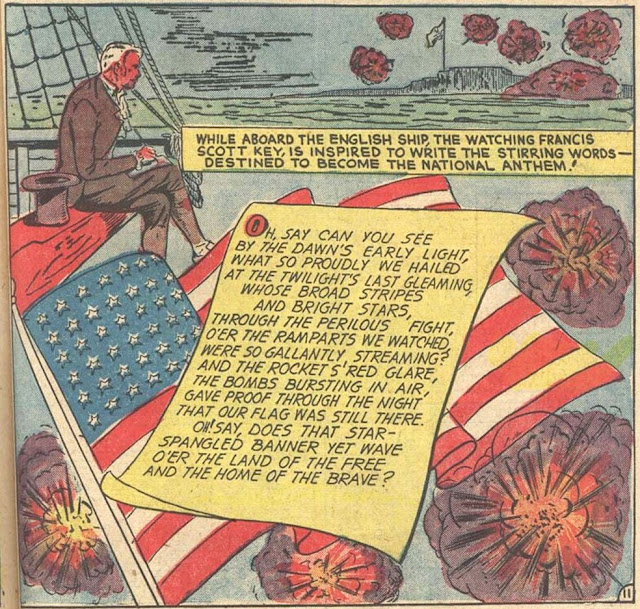
    Meets Tommy the Super-Boy while both are imprisoned by the British, then is freed by the second Wizard in time to be inspired to write a national anthem. (Shield-Wizard Comics 002, 1940)
    James Madison: 

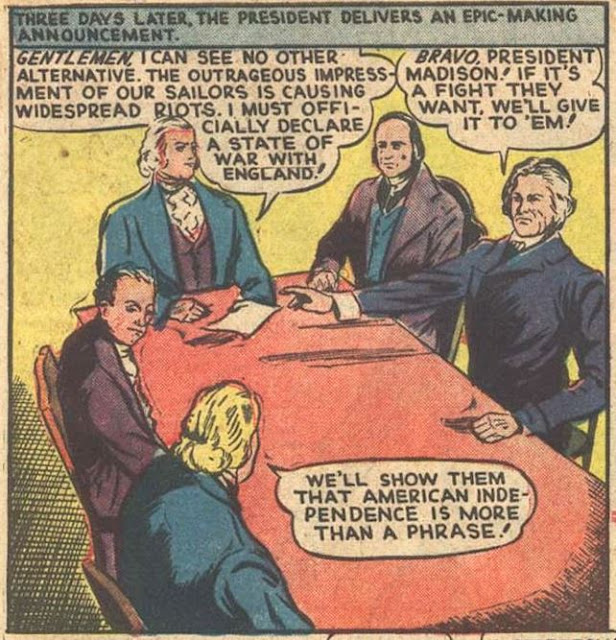
    Seen periodically in the lead-up and progress of the War of 1812. (Shield-Wizard Comics 002, 1940)

    Oliver Hazard Perry:

    Captain Perry, of “we have met the enemy and they are ours” fame, is aided in his greatest naval victory by the intervention of the second Wizard. (Shield-Wizard Comics 002, 1940)

    Tecumseh:

    The historical Wizard adventures in Shield-Wizard Comics 001 and 002 are on the whole very kind to even the more derided figures in American history (see William Hull, below), but Tecumseh here, who was held in pretty high esteem by his historical contemporaries as well as historians, is instead portrayed as a bloodthirsty creep. I WONDER WHY 

    This version of Tecumseh also meets his end at the hands of the second Wizard while attempting to murder General William Henry Harrison, rather than in battle. (Shield-Wizard Comics 002, 1940)

    William Henry Harrison:

    The future president is seen during his military days as he retakes Detroit from the British with the aid of the second Wizard. (Shield-Wizard Comics 002, 1940)

    William Hull:

    William Hull, governor of Michigan Territory at the beginning of the War of 1812, caught a lot of flak both in his own time and going forward for surrendering Detroit to the British. More recent evaluations of him have been kinder, including in his appearance in the story of the second Wizard. I’m not sure what the general opinion of him was in 1940 but the people at MLJ have added a kidnapped daughter as a major reason for his actions instead of blaming them on his general incompetence as seems to have been the norm for quite a while there. (Shield-Wizard Comics 002, 1940)

    Betsy Hull:

    Speaking of William Hull’s kidnapped daughter, this is her, and I would love to tell you if she was based on a real historical figure or not but a) I can’t find a biography of William Hull that lists his children’s names and b) I can’t seem to parse online genealogies – they have gone down some sort of structural route that has really obfuscated just how the people in the family trees actually relate to each other. In short, William Hull might or might not have had a daughter named Elizabeth but if he did she did not marry Blane Whitney, the second Wizard, like this young lady eventually does. (Shield-Wizard Comics 002, 1940)

  • REAL PERSON ROUND-UP 010

    The wartime exploits of the original Wizard, expressed as a series of encounters with famous figures from US history. 

    Benedict Arnold:

    Very nearly captured by the original Wizard. (Shield-Wizard Comics 001, 1940) 

    General Charles Cornwallis:

    Defeated by a coalition of the Americans, French and the original Wizard. (Shield-Wizard Comics 001, 1940)

    Admiral François-Joseph de Grasse:

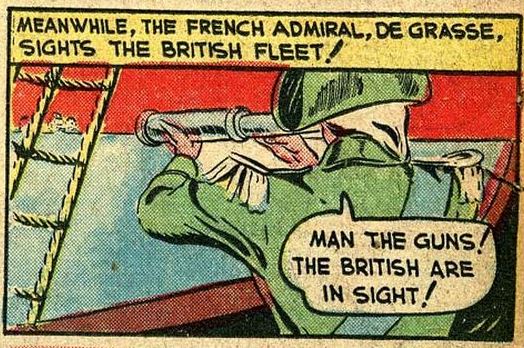
    Helps defeat the British fleet at Chesapeake Bay but of course he couldn’t have done it without the original Wizard. (Shield-Wizard Comics 001, 1940)

    George Washington:

    Wins the American Revolutiion with the help of the original Wizard. (Shield-Wizard Comics 001, 1940) 

    General Horatio Gates:

    Aided by the original Wizard at the Battle of Saratoga. (Shield-Wizard Comics 001, 1940)

    Colonel Johann Rall:

    The commanding officer in charge of the Hessian mercenaries famously defeated by Washington after the crossing of the Delaware, Rall (or Rahl, as here) supposedly did really ignore news of the impending attack to drink and play cards. (Shield-Wizard Comics 001, 1940)

    Major John André:

    Major André, head of British military intelligence in the Revolutionary War, captured thanks to the original Wizard. (Shield-Wizard Comics 001, 1940)

    Mad Anthony Wayne:

    Slightly less mad than in out timeline due to having the original Wizard with him when he charged the British (Shield-Wizard Comics 001, 1940)

    the Mayflower:

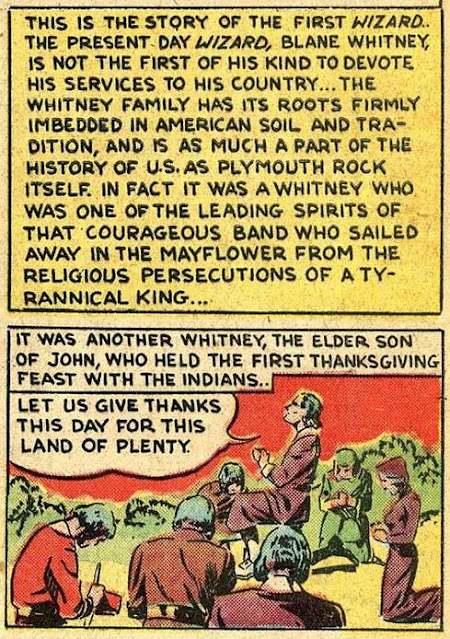
    I’m willing to bet that if I track the fictional ancestors of comic book characters who are said to have come over on the Mayflower then I will probably end up with a passenger list larger than the actual one. Our first entrants are two ancestors of Blane Whitney, aka the Wizard, and both named John. The younger of the two also organized the mythical first Thanksgiving, to boot! (Shield-Wizard Comics 001, 1940)

    Nathan Hale:

    In maybe the dumbest bit of American myth-making in the whole saga of the original Wizard, he frees Nathan Hale from his pre-execution imprisonment only for him to choose to stay behind and die because he can presumably somehow see all of the stupid patriotism that people load him down with in the future. Like of course his final words of defiance mean so much less if he’s essentially saying them and then blowing his own head off. Gah! (Shield-Wizard Comics 001, 1940)

    Paul Revere:

    Informed that the British are coming by the original Wizard (Shield-Wizard Comics 001, 1940)

    Thomas Jefferson:

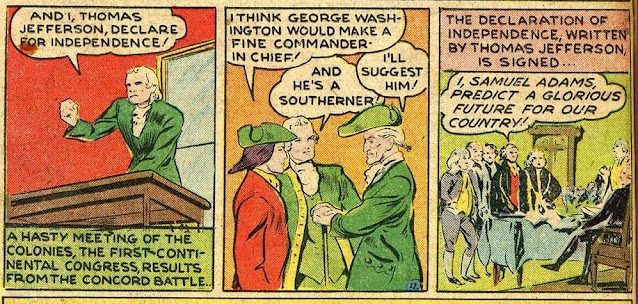
    Knocks out the Declaration of Independence after the original Wizard intervenes in the battle of Concord. Also Samuel Adams is there shouting his own name. (Shield-Wizard Comics 001, 1940)

  • REAL PERSON ROUND-UP 010

    The wartime exploits of the original Wizard, expressed as a series of encounters with famous figures from US history. 

    Benedict Arnold:

    Very nearly captured by the original Wizard. (Shield-Wizard Comics 001, 1940) 

    General Charles Cornwallis:

    Defeated by a coalition of the Americans, French and the original Wizard. (Shield-Wizard Comics 001, 1940)

    Admiral François-Joseph de Grasse:

    Helps defeat the British fleet at Chesapeake Bay but of course he couldn’t have done it without the original Wizard. (Shield-Wizard Comics 001, 1940)

    George Washington:

    Wins the American Revolutiion with the help of the original Wizard. (Shield-Wizard Comics 001, 1940) 

    General Horatio Gates:

    Aided by the original Wizard at the Battle of Saratoga. (Shield-Wizard Comics 001, 1940)

    Colonel Johann Rall:

    The commanding officer in charge of the Hessian mercenaries famously defeated by Washington after the crossing of the Delaware, Rall (or Rahl, as here) supposedly did really ignore news of the impending attack to drink and play cards. (Shield-Wizard Comics 001, 1940)

    Major John André:

    Major André, head of British military intelligence in the Revolutionary War, captured thanks to the original Wizard. (Shield-Wizard Comics 001, 1940)

    Mad Anthony Wayne:

    Slightly less mad than in out timeline due to having the original Wizard with him when he charged the British (Shield-Wizard Comics 001, 1940)

    the Mayflower:

    I’m willing to bet that if I track the fictional ancestors of comic book characters who are said to have come over on the Mayflower then I will probably end up with a passenger list larger than the actual one. Our first entrants are two ancestors of Blane Whitney, aka the Wizard, and both named John. The younger of the two also organized the mythical first Thanksgiving, to boot! (Shield-Wizard Comics 001, 1940)

    Nathan Hale:

    In maybe the dumbest bit of American myth-making in the whole saga of the original Wizard, he frees Nathan Hale from his pre-execution imprisonment only for him to choose to stay behind and die because he can presumably somehow see all of the stupid patriotism that people load him down with in the future. Like of course his final words of defiance mean so much less if he’s essentially saying them and then blowing his own head off. Gah! (Shield-Wizard Comics 001, 1940)

    Paul Revere:

    Informed that the British are coming by the original Wizard (Shield-Wizard Comics 001, 1940)

    Thomas Jefferson:

    Knocks out the Declaration of Independence after the original Wizard intervenes in the battle of Concord. Also Samuel Adams is there shouting his own name. (Shield-Wizard Comics 001, 1940)

  • REAL PERSON ROUND-UP 009

    Some day these won’t inevitably start with Hitler. Some day.

    Adolf Hitler:

    Rix, a human living on Venus in the peaceful year 3090 CE, learns about dictators thanks to the time capsule from the 1939 New York World’s Fair and immediately sets out to make himself into the Hitler of the future. Beat down by interplanetary troubleshooter Planet Payson. (Planet Comics 008, 1940)

    Aviator Ted O’Neil is brought down in the warlike nation of Gestapia (one of the more on-the-nose Nazi Germany stand-ins I have encountered), ruled over by dictator “Schnitzler.” (Prize Comics 004, 1940)

    Al Capone:

    It’s just a shorthand reference for “bigtime gangster” but Scarface Marone here is absolutely an Al Capone pastiche for the one and a half panels he appears in before jumping out a window to avoid capture. (Rocket Comics 002, 1940)

    Anna Roosevelt:

    She’s referred to only as “the President’s daughter” throughout this adventure which sees her being kidnapped and almost killed by Gerlandian spies before being rescued by Electro here, but it’s 1940 and the US has had precisely one President’s Daughter for nearly eight years at this point and it’s Anna Roosevelt. (Science Comics 001, 1940)

    Captain Nemo:

    It shouldn’t have surprised me when Navy Jones, established in the previous issue to be descended from the legendary Davy Jones, encounters not-just-fictional-but-fictional-from-about-seventy-years-earlier figure Captain Nemo while noodling around under the sea with his paramour Princess Coral, but I’m afraid that it did. And not only do they team up to battle octopus men and recover an ancient Roman map to Atlantis together but Nemo basically joins the “Navy Jones” cast going forward! (Science Comics 005, 1940)

    FDR:

    Minor Appearances:

    Science Comics 003, 1940

    Genghis Khan:

    Obvious allusion to Genghis Khan in Khangiz, the warlike master of Mars in the year 40 000 CE. (Planet Comics 002, 1940)

    J Edgar Hoover:

    You have a comic book character who works for the FBI and eventually an unnamed J Edgar Hoover is going to show up and congratulate them for doing their job, as happens to FBI agent Buck Brady here. (Prize Comics 005, 1940)

    J Edgar Hoover is not only Joe “the Shield” Higgins’ boss at the FBI but he was the best friend of Tom Higgins, Joe’s father. (Shield-Wizard Comics 001, 1940)

    Minor appearances:

    Science Comics 003, 1940

    Oak Island:

    Even though Fu Chang operates out of San Francisco and thus Money Pit Island is located somewhere in the Pacific, its name alone twigs it as at least inspired by the legend of Oak Island, which (I checked) was indeed going strong as of 1940 (Pep Comics 009, 1940)

  • MINOR SUPER-VILLAIN 725: THE SEA-WITCH

    (Science Comics 005, 1940)

    En route to the court of King Neptune to deliver a new invention to him, Navy Jones and Princess Coral find themselves the prisoner of a heinous-looking clarinet-playing mermaid who looks a lot like something out of a 19th Century political cartoon.

    I’ll be honest here: while the Sea-Witch is a notable-enough villain to cover here, the real attraction of this comic is that it all looks like an outsider art fever dream. The Grand Comics database says that the artist was Bert Whitman and that he did enough comics work in the 40s that I should have run into him, but either luck has conspired against me in that regard or this was just a more interesting assignment than usual for him, because it’s just really enjoyably weird.

    Navy Jones escapes the clutches of the One-Eyed Octopus when it turns out that it is fatally allergic to pepper, and he and Princess Coral are able to simply swim away under the cover of its dying ink-cloud. The Sea-Witch’s little imp minions give chase but are unable to contend with the sheer power of the “Speed Sea Tri-Motor” underwater jetapacks that the duo are wearing courtesy of Coral’s as-yet-unnamed father.

    Other weird and wonderful occurrences in this comic:

    An idyll with Queen Nina and her subjects in Mermaid City,

    This two-panel plot by a pair of incompetent undersea pirates,

    Navy Jones visiting the grave/locker of his great great great grandfather, Davy Jones (bah gawd, his name isn’t just a pun, it’s hereditary!),

    and the pomp, circumstance and wide array of weird sea creatures in King Neptune’s court. The question of whether this is the Neptune of myth or just some guy is overshadowed (and possibly answered) by the presence of, for example, a cutlass-wielding fish-man centaur in the background. Delightful!