The Curse of Skeleton Munroe

Category: real folk

  • REAL PERSON ROUND-UP 008

    If they’re real then why are they in a comic book?

    Anastacio Somoza García:

    The Shield meets with the President of Nicaragua and as per usual the artist did not bother to check what the President of Nicaragua actually looked like. (Pep Comics 006, 1940)

    Clark Gable:

    Boxer Kayo Ward stars in a movie (“Hot Lips and Hot Fists,” a riff on 1933’s “The Prizefighter and the Lady” starring real-life boxers Primo Carnera, Max Baer and Jack Dempsey) and the opening night crowd includes not only Clark Gable but Edgar Bergen and Charlie McCarthy, all under their real names in a wild break from comics custom. (Pep Comics 008, 1940)

    FDR:

    Misc minor appearances: 

    Meets with the Shield (Pep Comics 006, 1940)

    Shown blowing off a cabinet meeting to watch a boxing match (Pep Comics 007, 1940)

    J Edgar Hoover:

    He’s never actually named but “the Chief of the FBI” and only person who knows the secret identity of Joe Higgins, aka the Shield, is clearly supposed to be J Edgar Hoover, and they do occasionally refer to him by his surname. (Pep Comics 001-004, 006-009, 1940)

    Joe DiMaggio:

    Famed baseball player Slugger Madaggio (or possibly MaDaggio) is murdered mid-game for failing to pay protection money. Two other players, Wheezy Seen and Cal Bubble, as well as a manager named Terrier are mentioned in the story but I simply do not know enough about baseball to know who they are references to, if anyone. Also, the lady in the above picture is Madaggio’s wife and thus an oblique reference to actress Dorothy Arnold. (Pep Comics 007, 1940)

    Joe Louis:

    Boxer Kayo Ward is signed to fight Joe Louis for the heavyweight boxing championship, only Kayo is then kidnapped and replaced with a double by gamblers looking to fix the match, and when he manages to get free and fight for real the kidnapping has had enough of a negative effect on him that Louis sportingly calls the fight off rather than beat Ward to a pulp. They’re supposed to reconvene in six months – will it happen in 1941? (Pep Comics 006-007, 1940)

    Mata Hari:

    Sent to Antwerp to extract a British general’s daughter before the Nazi invasion, army hero Sergeant Boyle engages in some classic comedy of errors shtick as he accidentally brings back the wrong woman, only to find out that he has inadvertently captured the famed spy “Hatter Mary.” (Pep Comics 008, 1940)

    PT Barnum:

    There are a lot of comic book circus mans who are some sort of version of PT Barnum but this guy, Barnham by name, really captures the spirit of the man with his exploitation of Paul Bunyan’s ape-man friend. (National Comics 006, 1940)

    the Seven Dwarfs:

    The “Prince Buttonhead” feature in Pep Comics is from the school of one-page comic book humour strips that are best described as incoherent, with only the feeblest attempt at jokes or even a structured plot. The Five Dopes here (Block-Head, Lunk-Head, Stupid, Useless and Lame-Brain) are interesting for being so very on-model as a Seven Dwarfs parody. (Pep Comics 005, 1940)

    Various Golden Age Comics Creators:

    During Kayo Ward’s rise to the top he fights a lot of also-rans, and compiling a splash panel of them dovetailed nicely with the grand comic book tradition of using your coworkers’ names for mildly embarrassing purposes. In order (and focusing on MLJ credits because it’s an illustrious group), we have: 

    Butch Blezard – Okay I have no idea who this guy is. Bad start.

    “Canvas-Back” Shorten – Harry Shorten, co-creator of the Shield

    “Chick” Biro – Charles Biro, creator of Steel Sterling

    “Biff” Zoffer – Another mystery character

    “Mush” Meskin – Mort Meskin, prolific MLJ illustrator

    “Flash” Ashe – Edd Ashe, illustrator of the Wizard

    “Nosedive” Novick – Irv Novick, co-creator of the Shield

    “50 Second” Streeter – Lin Streeter, MLJ illustrator

    “Slam” Sundell – Abner Sundell, MLJ editor

    “Socker” Benson – probably not a reference, as he was a boxer faced by Ward in a prior issue. (Pep Comics 005, 1940)

    Pep Comics was a real hotbed of this kind of thing in 1940, as seen in this ad for “Meskin’s Matzhos”  (Pep Comics 007, 1940)

    Here’s Charles Biro ditching work to catch a boxing match. (Pep Comics 007, 1940)

    Handprints outside Grauman’s Chinese Theatre, featuring “Biro W. Mouskin,” “Sundell something (possibly M. Wood? as in Bob Wood, co-creator of Kayo Ward?) as well as “Mickey Looney” and “Joe E. Frown” (Mickey Rooney and Joe E. Brown, natch) (Pep Comics 008, 1940)

    And finally, the movie that Kayo Ward stars in is a Sundell Production. (Pep Comics 008, 1940)

    Unknown:

    The specifics of Jimmie Fiddle here, with his entertainment column in the NY Reflection, and especially the detail of him rating things with orchids, ping my “this is a version of a real guy” sense quite hard, but I can’t find a good thread to grab onto for a search. (Pep Comics 008, 1940)

    EDIT: a list of New York periodicals of the 1930s turned up the NY Review as a possible original of the NY Reflection, but any further investigation is hampered by the popularity of the New York Review of Books. It’s a dead end!

    ACTUAL UPDATE: We found him!

  • REAL PERSON ROUND-UP 008

    If they’re real then why are they in a comic book?

    Anastacio Somoza García:

    The Shield meets with the President of Nicaragua and as per usual the artist did not bother to check what the President of Nicaragua actually looked like. (Pep Comics 006, 1940)

    Clark Gable:

    Boxer Kayo Ward stars in a movie (“Hot Lips and Hot Fists,” a riff on 1933’s “The Prizefighter and the Lady” starring real-life boxers Primo Carnera, Max Baer and Jack Dempsey) and the opening night crowd includes not only Clark Gable but Edgar Bergen and Charlie McCarthy, all under their real names in a wild break from comics custom. (Pep Comics 008, 1940)

    FDR:

    Misc minor appearances: 

    Meets with the Shield (Pep Comics 006, 1940)

    Shown blowing off a cabinet meeting to watch a boxing match (Pep Comics 007, 1940)

    J Edgar Hoover:

    He’s never actually named but “the Chief of the FBI” and only person who knows the secret identity of Joe Higgins, aka the Shield, is clearly supposed to be J Edgar Hoover, and they do occasionally refer to him by his surname. (Pep Comics 001-004, 006-009, 1940)

    Joe DiMaggio:

    Famed baseball player Slugger Madaggio (or possibly MaDaggio) is murdered mid-game for failing to pay protection money. Two other players, Wheezy Seen and Cal Bubble, as well as a manager named Terrier are mentioned in the story but I simply do not know enough about baseball to know who they are references to, if anyone. Also, the lady in the above picture is Madaggio’s wife and thus an oblique reference to actress Dorothy Arnold. (Pep Comics 007, 1940)

    Joe Louis:

    Boxer Kayo Ward is signed to fight Joe Louis for the heavyweight boxing championship, only Kayo is then kidnapped and replaced with a double by gamblers looking to fix the match, and when he manages to get free and fight for real the kidnapping has had enough of a negative effect on him that Louis sportingly calls the fight off rather than beat Ward to a pulp. They’re supposed to reconvene in six months – will it happen in 1941? (Pep Comics 006-007, 1940)

    Mata Hari:

    Sent to Antwerp to extract a British general’s daughter before the Nazi invasion, army hero Sergeant Boyle engages in some classic comedy of errors shtick as he accidentally brings back the wrong woman, only to find out that he has inadvertently captured the famed spy “Hatter Mary.” (Pep Comics 008, 1940)

    PT Barnum:

    There are a lot of comic book circus mans who are some sort of version of PT Barnum but this guy, Barnham by name, really captures the spirit of the man with his exploitation of Paul Bunyan’s ape-man friend. (National Comics 006, 1940)

    the Seven Dwarfs:

    The “Prince Buttonhead” feature in Pep Comics is from the school of one-page comic book humour strips that are best described as incoherent, with only the feeblest attempt at jokes or even a structured plot. The Five Dopes here (Block-Head, Lunk-Head, Stupid, Useless and Lame-Brain) are interesting for being so very on-model as a Seven Dwarfs parody. (Pep Comics 005, 1940)

    Various Golden Age Comics Creators:

    During Kayo Ward’s rise to the top he fights a lot of also-rans, and compiling a splash panel of them dovetailed nicely with the grand comic book tradition of using your coworkers’ names for mildly embarrassing purposes. In order (and focusing on MLJ credits because it’s an illustrious group), we have: 

    Butch Blezard – Okay I have no idea who this guy is. Bad start.

    “Canvas-Back” Shorten – Harry Shorten, co-creator of the Shield

    “Chick” Biro – Charles Biro, creator of Steel Sterling

    “Biff” Zoffer – Another mystery character

    “Mush” Meskin – Mort Meskin, prolific MLJ illustrator

    “Flash” Ashe – Edd Ashe, illustrator of the Wizard

    “Nosedive” Novick – Irv Novick, co-creator of the Shield

    “50 Second” Streeter – Lin Streeter, MLJ illustrator

    “Slam” Sundell – Abner Sundell, MLJ editor

    “Socker” Benson – probably not a reference, as he was a boxer faced by Ward in a prior issue. (Pep Comics 005, 1940)

    Pep Comics was a real hotbed of this kind of thing in 1940, as seen in this ad for “Meskin’s Matzhos”  (Pep Comics 007, 1940)

    Here’s Charles Biro ditching work to catch a boxing match. (Pep Comics 007, 1940)

    Handprints outside Grauman’s Chinese Theatre, featuring “Biro W. Mouskin,” “Sundell something (possibly M. Wood? as in Bob Wood, co-creator of Kayo Ward?) as well as “Mickey Looney” and “Joe E. Frown” (Mickey Rooney and Joe E. Brown, natch) (Pep Comics 008, 1940)

    And finally, the movie that Kayo Ward stars in is a Sundell Production. (Pep Comics 008, 1940)

    Unknown:

    The specifics of Jimmie Fiddle here, with his entertainment column in the NY Reflection, and especially the detail of him rating things with orchids, ping my “this is a version of a real guy” sense quite hard, but I can’t find a good thread to grab onto for a search. (Pep Comics 008, 1940)

    EDIT: a list of New York periodicals of the 1930s turned up the NY Review as a possible original of the NY Reflection, but any further investigation is hampered by the popularity of the New York Review of Books. It’s a dead end!

    ACTUAL UPDATE: We found him!

  • MINOR SUPER-VILLAIN 689: THE MAN-MONSTER OF LONDON

    (Pep Comics 005, 1940) 

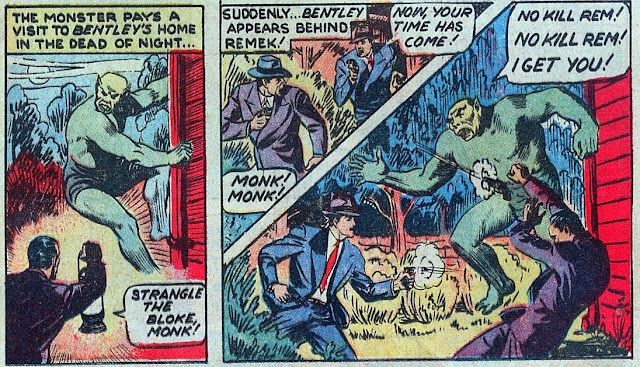
    The Man-Monster of London, aka Monk, doesn’t actually play that big a part in the plot of this Bentley of Scotland Yard story. I mean, he’s in a lot of it, but he doesn’t have a lot of volition of his own. In brief, the Rajah of Inrak (which is probably meant to be an Indian province or kingdom and not a whole country of its own) is in London to discuss some sort of treaty with the government of the UK and a fellow named Remek has been hired to prevent this meeting from taking place and the Man-Monster works for him. He’s very much the most spectacular part of the whole affair but he’s not really driving the action.

    The Man-Monster and Remek both end up being gunned down in self defense by Inspector Bentley and it’s honestly more sad than anything else – we never really get any idea of what Monk is exactly (some sort of mutant? a member of some isolated community of superhumans? just a big strong guy dyed green?), but whatever he is he clearly cares for Remek and doesn’t seem like he really chose to be a superhuman goon.

    ADDENDUM: If you bothered to read that text panel above you might have noticed that one of the potential suspects was the Prime Minister, as in the Prime Minister of England, who I assume was included purely because they were short on named characters for the suspect list this issue. This is him: not precisely Sir Neville Chamberlain (who would’ve just resigned as this issue was being put together) but close enough.

  • REAL PERSON ROUND-UP 007

    It’s a bumper crop of real people (and famous fictional ones) showing up in comics!

    Adolf Hitler:

    This is very, very tenuous but this adventure story is concerned with a hunt for mythical man-goat lycanthropes known as “weredolfs” and I’ll be danged if I can think of a reason for them to be called that other than as a very oblique jab at Adolf Hitler. (Hyper Mystery Comics 001, 1940)

    Less tenuous: when Cartho (one of the seemingly limitless number of lost empires dotting the jungles of Africa) attempts to invade Camilla’s Lost Empire, its jerk of a leader is of course named Hitlo. (Jungle Comics 010, 1940)

    Mias here is the leaser of a small Asian country that has set its sights on conquering the Philippines. He’s a pastiche of 40s dictators but his Hitlerian traits shine brightest. (National Comics 003, 1940)

    FDR:

    Minor appearances:

    Congratulates Wonder Boy for helping some farmers (National Comics 005, 1940)

    the Forty Thieves:

    It’s never really explained how, but the Forty Thieves of Arabian Nights fame steal the Ophar Jewel from a lady in modern London and Merlin the Magician heads back in time to get it back with the help of a contemporary Cockney street gang. (National Comics 004, 1940)

    Jack Dempsey:

    Former boxing champ Jack Dempsey and his New York restaurant pop up with a fair frequency in 1940s comics, particularly ones featuring boxers such as Kid Dixon here. Why he and other boxers tended to show up under their own names rather than under flimsy pseudonyms like “Dack Jempsey” is a mystery – although I suppose that the real life boxing community had already proven to be okay with showing up in the “Joe Palooka” comic strip so perhaps comics creators assumed that they would be fair game. (National Comics 003, 1940) 

    John D Rockefeller:

    Minor appearances:

    Never-seen millionaire and target of criminal scientist von Lohfer is by context clues an analog of Rockefeller. (National Comics 005, 1940)

    Michael Malloy:

    The story of Michael Malloy, the seemingly unkillable man targeted by a gang in a life insurance racket, is an evocative one, so it’s unsurprising to see it crop up as a comic book plot here and there. Happily for Malloy’s in-story equivalent Milligan, the gang is rounded up by comic book artist/ detective Pen Miller before they are finally able to overcome his iron constitution. (National Comics 002, 1940)

    Neville Chamberlain:

    The Kid Patrol, a mid-to-low-tier kid gang, encounters this clearly allusive lad, Sir Chamberlain Bumbershoote by name, while they are being pranked and vexed by another gang. Weirdly, though Bumbershoote’s talk of appeasement and attempt to get a signed nonaggression pact with this very Hitlerian gang leader are presented derisively he himself is a formidable figure who routs the entire gang with his trusty umbrella. Neville Chamberlain must have been hovering precisely on the precipice of becoming an historical punchline when this one was published. (National Comics 006, 1940)

    Ruby Keeler:

    Hollywood comic strip ‘Olly of the Movies,’ well into its second year, was overdue for some gratuitous movie star cameos so actress Ruby Keeler just kind of shows up on a beach along with Dick Powell and Busby Berkeley. Everyone says hello and then parts ways. (Famous Funnies 023, 1936)

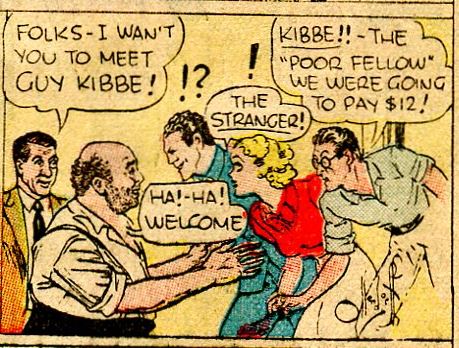
    The gratuity continues in the next issue, with perfunctory appearances by Hugh Herbert, Joan Blondell and Zasu Pitts, and with Guy Kibbee in a very minor role in the actual plot. (Famous Funnies 024, 1936)

    (Famous Funnies 024 also features this crowd of what are presumably supposed to recognizable Hollywood faces but I can only identify Bing Crosby in the yellow sweater vest and then only because someone did an impression of him on the previous page. Bub bub boo!)

    Sherlock Holmes: 

    They may not have given him a parody name, but Dinky Dinkerton here is clearly a Holmes parody comedy character, aided by Doctor Philip Anbust (aka Sniffy) in the Watson role (the third member of the trio, secretary Flossie, is not a Holmes character parody but is the brains of the operation, something that Holmes pastiches often leave out, to their ultimate detriment). (Reg’lar Fellers Heroic Comics 001, 1940)

    Another broad Sherlock Holmes pastiche is the unfortunately-named-to-modern-eyes Fuller Spunk, who is actually an actor known for playing “Herlock Olmes”, so perhaps he is more of a reference to Basil Rathbone. (interesting to note that the character of Marcel was originally bringing “female impersonation” to the group but that that skill was tossed aside in favour of a suite of stage magician tricks) (Hyper Mystery Comics 002, 1940)

    Shoshenq I:

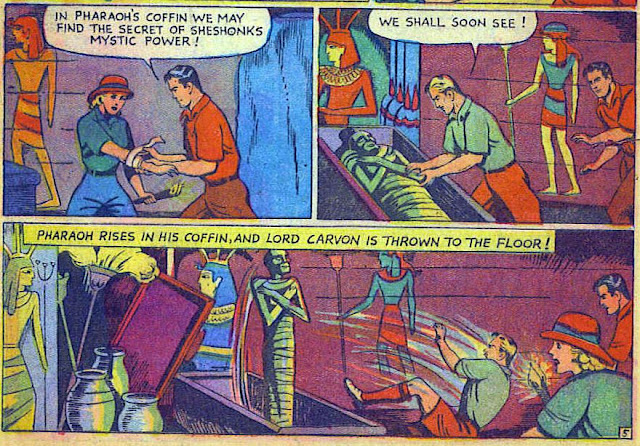
    In Jungle Comics 011, previously straightforward jungle explorer Roy Lance goes nuts for discovering the mystic secrets of the pharaohs* and specifically for finding the genie-controlling power of Sheshonk. Who is Sheshonk, you ask? Why, he is better known as Pharaoh Shoshenq I, more famous than he might otherwise be because he is associated with the Biblical figure Shishak who warred against Solomon and looted the treasures of the Temple – he is mentioned as having been the one to hide away the Ark of the Covenant in Raiders of the Lost Ark, for example. (Shoshenk I is also a candidate to be the father of an Egyptian princess married to Solomon, which the story alludes to by calling him “father-in-law to King Solomon”)

    *based on the fact that both the Roy Lance and Red Panther stories in Jungle 010 were out-of-context sci-fi adventures and that the Simba story in 009 was made up of repurposed panels from earlier Simba stories I suspect that Fiction House had gotten a bit behind and were renaming characters in any old stories they had spare in order to make deadlines.

    This story also features two other possible allusive figures: Lance’s doomed companion Lord Carvon seems likely to be a reference to Lord Carnarvon of the Curse of King Tut fame, while “Tera Bey, Mistress of Mysteries” is a figure as evocative as she is elusive. Literally the only thing I have been able to come up with is the possibility that she is a reference to Queen Tera, mysterious ancient mummy from the Bram Stoker novel The Jewel of Seven Stars, but it’s equally likely that she is a made-up bit of deus ex machina to get our heroes out of a sealed tomb. (Jungle Comics 011, 1940)

  • REAL PERSON ROUND-UP 006

    REAL PERSON ROUND-UP 006

    More real people and their analogs. Lotta Hitlers in this one.

    Adolf Hitler:

    Hitler analogs c.1940 were often quite visually distinct from the actual man. Samson foe and dictator of Ratonia Dragor honestly looks more like a bald Stalin, and you might be excused for thinking that he was more of a pastiche of all extant dictators. The real clue is in the invasion of Belgium. (Fantastic Comics 002, 1940) 

    Meanwhile this as-yet unnamed dictator of the future super-nation of Russmany is a pretty clear Hitler-alike. (Fight Comics 001, 1940)

    Misc Minor Appearances:

    Hitler-alike dispatches the Tankonaut to sow terror in the US. (Exciting Comics 005, 1940)

    Hitlerian dictator Rigo funds Samson foe Kilgor’s robot army. (Fantastic Comics 006, 1940) 

    Benito Mussolini:

    He doesn’t actually appear in the comic but “Gasolini” is one of the better dumb stand-in names I have seen for Mussolini. Weirdly, the Dictator mentioned above is so generic that he’s not really enough of a reference to any one person to include here. (Fantastic Comics 010, 1940)

    Depicted with his pal Hitler as a background gag in a room full of faux Mayan statuary. (Fantoman 003, 1940)

    Fiorello Laguardia:

    At this point it’s worth noting any time that a generic Mayor of New York City shows up, just to have a record of them. (Fantastic Comics 011, 1940)

    Franklin D Roosevelt:

    Misc Minor Appearances:

    Meets up with Dr John “Son of the Gods” Thesson to discuss the threat of the Tankonaut. (Exciting Comics 005, 1940)

    Confers with Thesson and a panel of others about the threat of the Invincible Five (Exciting Comics 006, 1940) 

    Briefly kidnapped by super-gangster Rip-the-Blood, rescued by Stardust the Super Wizard (Fantastic Comics 002, 1940)

    Henry Ford:

    Motor king “Henry Lord” is kidnapped by the Miracle Men (Fantastic Comics 005, 1940)

    Hollywood Crowd Scenes:

    Comic strip “Olly of the Movies”, about young actress Olive Lane’s travails in Hollywood (seen here as a comic book reprint) is chock full of cameos – and under actual names! Marie Dressler, Mae West, Greta Garbo, Joan Crawford and Jimmy Durante are the ones named, but there are a whole swath (that I am not qualified to identify) in that second panel alone. (Famous Funnies 006, 1935)

    Saladin:

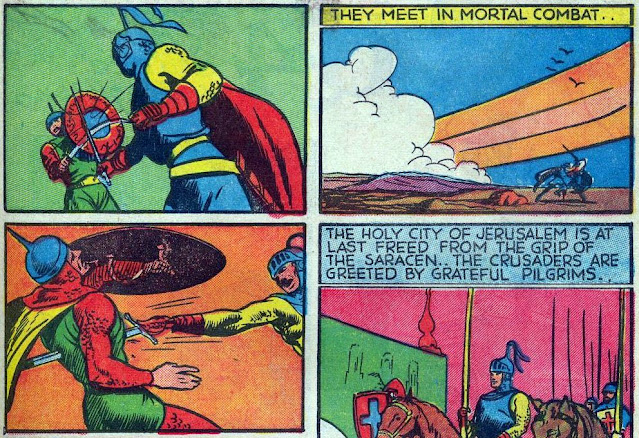
    Every Crusader hero eventually has to meet Saladin and the Golden Knight is no exception. The creators always have to balance the fact that they obviously think that Saladin is very cool with the idea that he is supposed to be the villain and this is a story where it is not quite pulled off: Saladin spares the Golden Knight because he is such a valiant battler and shows him great hospitality, while the Knight wanders around all surly and churlish talking about how he’d like to kill everyone present. Saladin definitely comes off better in the interaction. (Fantastic Comics 002, 1940)

    Saladin and the Golden Knight meet up again a few issues later and the encounter ends with the Golden Knight killing Saladin, a wildly ahistoric event but not a unique one, as you might see if I ever work my way through the hundreds of Real Person in Comics entries I have in spreadsheet form. For the record, Saladin died of a fever, still in control of Jerusalem, a full year after the Third Crusade ended. (Fantastic Comics 008, 1940)

    Selection of Old-Time Boxers:

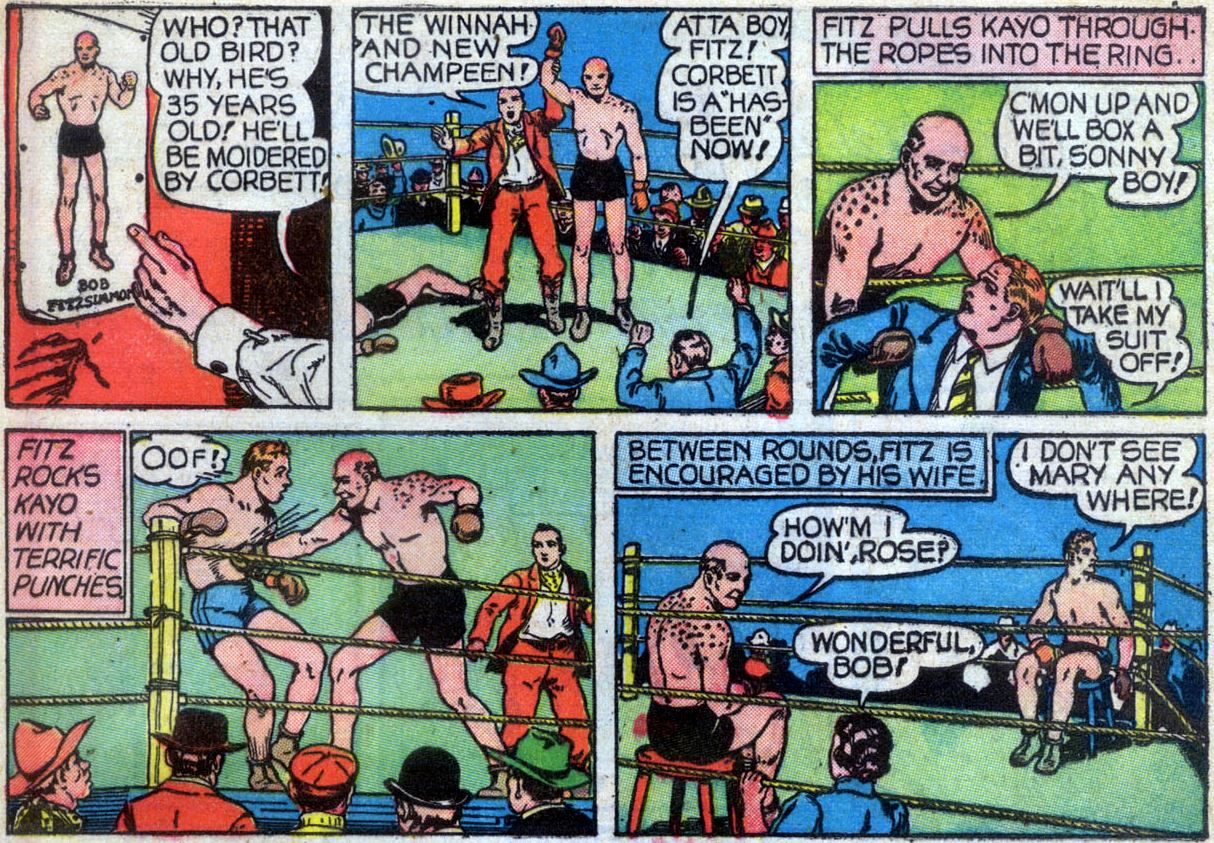
    Boxer and heavyweight champ Kayo Kirby has a stress dream in which he meets and is beaten up by successive old-time champs John L. Sullivan…

    … Gentleman Jim Corbett…

    … and Bob Fitzsimmons (with special appearance by his wife Rose).

    He also receives some training from old-time boxer Charley Mitchell, not that it does him much good against the spectres of his own mind. (Fight Comics 009, 1940)

    Unknown:

    Given that he was kidnapped immediately following “Henry Lord”, above, there is a strong possibility that “John Rancab” is also a stand-in name. As “Bacnar” does not appear to be a name and the only John Branca I can find was born in 1950, I am stumped – is it just a bad anagram of “banker”? Maybe. (Fantastic Comics 005, 1940)

  • REAL PERSON ROUND-UP 005

    REAL PERSON ROUND-UP 005

    You can’t deny that they were real people.

    Adolf Hitler:

    This unnamed leader of the unnamed forces that the Flying Trio are battling on behalf of the little nation of Sylvania is a real Hitlerian fellow (Crash Comics Adventures 005, 1940) 

    Amelia Earhart:

    Two variations on a theme: using the story of the disappearance of Amelia Earhart as fodder for a damsel-in-distress story. The first (Amazing-Man Comics 018, 1940) involves the Shark rescuing Amelia Reinhardt from an old man who has her trapped in the jungle in hopes that she will fall for him. The second (Big Shot Comics 019, 1941) features aviator Rocky Ryan and his pal rescuing Amy Every from cartoonishly racist cannibals.

    Captain Kidd:

    Crooks try to pull a fast one by purchasing Captain Kidd’s authentic treasure chest and then “discovering” it after filling it with stolen gold (Cyclone Comics 001, 1940)

    Ethan Allen: 

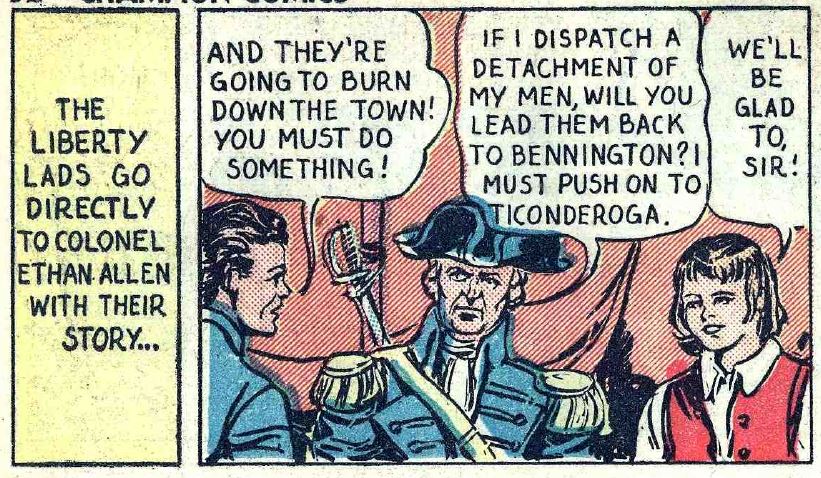
    The Liberty Lads are back at it, getting their grubby mitts all over the American Revolutionary War. This time they meet Ethan Allen and the Green Mountain Boys on the eve of the capture of Fort Ticonderoga. (Champion Comics 009, 1940)

    John Hancock and Samuel Adams:

    More Liberty Lads shenanigans. This time they’re saving Samuel Adams and John Hancock from capture by the British, something that as far as I can tell almost happened in our timeline. (Champ Comics 011, 1940)  

    Joseph Stalin:

    “Nilats,” leader of “Aissur” is tracked to his office in “Wocsom” by Strongman, who objects to the Aissurans’ invasion of the Balkan country of Rutania (Crash Comics Adventures 003, 1940)

    Orson Welles:

    For a while, Orson Welles’ ‘War of the Worlds’ broadcast is used as a shorthand for a reason that the cops blithely ignore multiple calls about some fantastic threat, only they certainly never do more than allude to the real thing. This time it’s giant mutant ivy plants and the dumb police are talking about a broadcast by “Worsen Welds”. (Amazing-Man Comics 006, 1939)

    Saladin:

    Makes a one-panel appearance in the otherwise undistinguished Crusades comic “Reynard the Fox”. (Cyclone Comics 005, 1940)

    Tecumseh:

    Whether “Metumseh” is a stand-in for Shawnee leader Tecumseh or they just mushed around his name to make up one for this fellow I cannot say, but they were certainly thinking of him while they did it. (Champion Comics 010, 1940)

  • REAL PERSON ROUND-UP 004

    More of those pesky real people have gotten into my comic books!

    Andrew Jackson:

    Character Keith Kornell, aka the West Pointer, is a descendant of Andrew Jackson, something you would perhaps be more proud of in 1939 than today. (Top-Notch Comics 001, 1939)

    Benito Mussolini:

    He’s a fairly oblique reference to Benito Mussolini but I reckon that up-and-coming Filipino dictator Remy Mussoni fits the brief. (Wonderworld Comics 008, 1939)

    Billy the Kid:

    Appears in a questionably true story told by character Windy Parks (Western Picture Stories 004, 1937)

    the Dionne Quintuplets:

    “Ad-Ventures at the Circus” was a recurring feature throughout the life of Star Comics (1937-1939), and it’s a fascinating artifact of the time that someone more qualified than me should write about some day. Long story short it was a twee little comic about advertising mascots going to the circus to watch other advertising mascots perform. There’s maybe a 75/25 split between the Surprisingly Familiar and Surprisingly Unfamiliar mascots with regular appearances by Surprisingly Racist ones. It’s a bit like a Neolithic Foodfight!. 

    Everything about this feature is weird, from the slightly uncanny valley illustrations by Raphael Astarita to the fact that it doesn’t really seem to be sponsored content (other than a command appearance by NRG, mascot of heavy Star Comics advertiser Baby Ruth). And then the final extant installment comes around and we get the weirdest advertising mascots of all as the Quaker Oats Man leads the Dionne Quintuplets onto stage – five living humans given the same status as the Crackerjack kid or Mr Peanut or some anthropomorphic orange who used to work for Sunkist. It’s a grim reminder of just how commodified those poor kids were, right down to their “act” being a pantomime of them going about their day, just like they did in the weird zoo they grew up in. (Star Comics v2 007, 1939)

    Gene Autry:

    An adventuring version of the singing cowboy in modern times (the Funnies 030, 1939)

    George VI of England:

    This here visit by King Arnold and his unnamed Queen is certainly meant to evoke the 1939 tour of Canada and the US by King George VI of England and Queen Elizabeth, the future Queen Mother. (Wonderworld Comics 005, 1939)

    George Washington:

    Not quite an appearance by Washington as adjacent to him, but the fact that one of the Wizard’s ancestors is given credit for a key part of the history of the American Revolution is worth noting. (Top-Notch Comics 001, 1939)

    FDR:

    Misc Minor Appearances: Thanks secret agent K-51 for saving foreign royals (Wonderworld Comics 005, 1939) 

    the Mona Lisa:

    As the “Lona Dizzi”, painted by “Lombardo da Ginki” (“Dixie Dugan” strip, 1931)

    Paul Revere:

    Ride witnessed – and hide saved – by American Revolution-era child-patriots the Liberty Lads. (Champion Comics 008, 1940)

    Robert E. Lee:

    Wizard ancestor Thomas Whitney accepts the surrender of Robert E Lee at Appomattox, whether in place of Grant or prior to his showing up cannot be said. (Top-Notch Comics 001, 1939)

    Tom Mix:

    Like Gene Autry, Tom Mix was a movie cowboy who starred in adventure comics as a larger-than-life version of himself having rootin’ tootin’ Wild West adventures. Unlike Autry, Tom Mix generally starred in stories set in the Old West, as himself but in the past. Tom Mix also holds the special distinction of appearing in comics from this earliest example (that I have found, at least) to at least the early 50s, long after he had died in October, 1940. (The Comics 001, 1937)

  • REAL PERSON ROUND-UP 004

    More of those pesky real people have gotten into my comic books!

    Andrew Jackson:

    Character Keith Kornell, aka the West Pointer, is a descendant of Andrew Jackson, something you would perhaps be more proud of in 1939 than today. (Top-Notch Comics 001, 1939)

    Benito Mussolini:

    He’s a fairly oblique reference to Benito Mussolini but I reckon that up-and-coming Filipino dictator Remy Mussoni fits the brief. (Wonderworld Comics 008, 1939)

    Billy the Kid:

    Appears in a questionably true story told by character Windy Parks (Western Picture Stories 004, 1937)

    the Dionne Quintuplets:

    “Ad-Ventures at the Circus” was a recurring feature throughout the life of Star Comics (1937-1939), and it’s a fascinating artifact of the time that someone more qualified than me should write about some day. Long story short it was a twee little comic about advertising mascots going to the circus to watch other advertising mascots perform. There’s maybe a 75/25 split between the Surprisingly Familiar and Surprisingly Unfamiliar mascots with regular appearances by Surprisingly Racist ones. It’s a bit like a Neolithic Foodfight!. 

    Everything about this feature is weird, from the slightly uncanny valley illustrations by Raphael Astarita to the fact that it doesn’t really seem to be sponsored content (other than a command appearance by NRG, mascot of heavy Star Comics advertiser Baby Ruth). And then the final extant installment comes around and we get the weirdest advertising mascots of all as the Quaker Oats Man leads the Dionne Quintuplets onto stage – five living humans given the same status as the Crackerjack kid or Mr Peanut or some anthropomorphic orange who used to work for Sunkist. It’s a grim reminder of just how commodified those poor kids were, right down to their “act” being a pantomime of them going about their day, just like they did in the weird zoo they grew up in. (Star Comics v2 007, 1939)

    Gene Autry:

    An adventuring version of the singing cowboy in modern times (the Funnies 030, 1939)

    George VI of England:

    This here visit by King Arnold and his unnamed Queen is certainly meant to evoke the 1939 tour of Canada and the US by King George VI of England and Queen Elizabeth, the future Queen Mother. (Wonderworld Comics 005, 1939)

    George Washington:

    Not quite an appearance by Washington as adjacent to him, but the fact that one of the Wizard’s ancestors is given credit for a key part of the history of the American Revolution is worth noting. (Top-Notch Comics 001, 1939)

    FDR:

    Misc Minor Appearances: Thanks secret agent K-51 for saving foreign royals (Wonderworld Comics 005, 1939) 

    the Mona Lisa:

    As the “Lona Dizzi”, painted by “Lombardo da Ginki” (“Dixie Dugan” strip, 1931)

    Paul Revere:

    Ride witnessed – and hide saved – by American Revolution-era child-patriots the Liberty Lads. (Champion Comics 008, 1940)

    Robert E. Lee:

    Wizard ancestor Thomas Whitney accepts the surrender of Robert E Lee at Appomattox, whether in place of Grant or prior to his showing up cannot be said. (Top-Notch Comics 001, 1939)

    Tom Mix:

    Like Gene Autry, Tom Mix was a movie cowboy who starred in adventure comics as a larger-than-life version of himself having rootin’ tootin’ Wild West adventures. Unlike Autry, Tom Mix generally starred in stories set in the Old West, as himself but in the past. Tom Mix also holds the special distinction of appearing in comics from this earliest example (that I have found, at least) to at least the early 50s, long after he had died in October, 1940. (The Comics 001, 1937)

  • REAL PERSON ROUND-UP 003

    Once more they ride: the REAL PEOPLE OF COMICS

    Abraham Lincoln:

    Lincoln’s shadow is used to symbolize the power of the US exerting a calming effect on the European belligerents. (Smash Comics 005, 1939)

    Adolf Hitler:

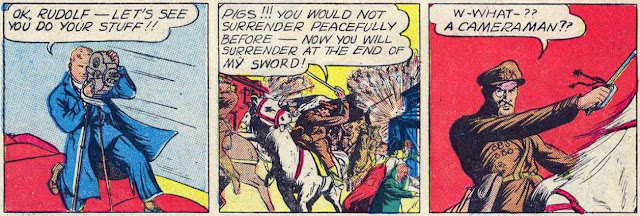
    Chancellor Rudolf of Wurtberg here is a more dynamic than usual Hitler analog (Smash Comics 004, 1939)

    Misc minor appearances:

    Getting some bad news about Nazi operations in Yugoslavia (Blue Ribbon Comics 015, 1941)

    Captain Kidd:

    For no particular reason this aviator/ adventurer is named after him. (Fantastic Comics 001, 1939)

    Franklin Delano Roosevelt:

    Discusses the threat of the Black Hand With J. Edgar Hoover (Blue Ribbon Comics 016, 1941)

    Misc Minor Appearances: appraised of the danger of invasion by Vlamir Koran (Smash Comics 001, 1939) 

    Seen ordering Americans in Europe to return home; meets Black Ace/X after he saves the transports that are returning them. (Smash Comics 003, 1939)

    Determines to defensively arm the US (Smash Comics 005, 1939)

    H.V. Kaltenborn:

    Radio commentator, appears as “H.V. Baltenhorn” (Blue Ribbon Comics 017, 1941)

    John Dillinger:

    Gangster “Jack Dilger” is vexed by Ty-Gor. (Blue Ribbon Comics 015, 1941) 

    Joseph Stalin:

    The same 3/4 perspective shot always used for FDR, now in Stalin form! (Smash Comics 002, 1939)

    Mahatma Gandhi:

    Aside from the pun name “Mohlasos Candhi”, this version of Gandhi is hitting a lot of the overt and casually racist checkmarks of the 1940s, including a disregard for the difference between India and the Middle East and a complete indifference for the distinction between Hindus and Muslims. Oh and also it’s another classic adventure based on propping up colonial rule. (Blue Ribbon Comics 017, 1941)

    Shirley Temple:

    As “Curley Semple” (“Dixie Dugan” comic strip, 1935)

    Sherlock Holmes:

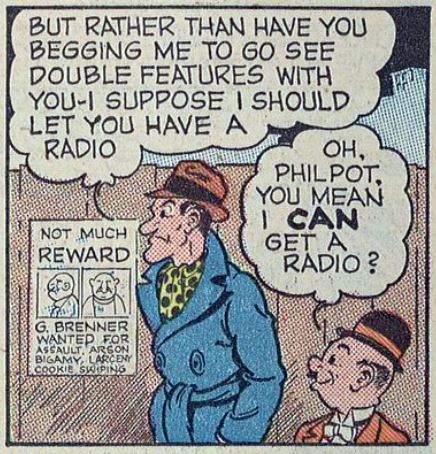
    Philpot Veep (along with his sidekick Waldo) was one of many humourous takes on Sherlock Holmes in Golden Age comics. Note also the wanted poster for G. Brenner, almost certainly referring to George Brenner, creator of the Clock. (Smash Comics 001, 1939)

    BONUS PHILPOT VEEP, DRUG FIEND

    COMIC BOOK DRAMA: in Smash Comics 005, George Brenner strikes back! Here’s Philpot Veep scribe Joe Devlin depicted AS A CLOWN! EPIC GOLDEN AGE BEEF SPOTTED
    Woodrow Wilson:

    Meets and gives sage advice to young Blane Whitney, who would grow up to become MLJ hero the Wizard. I am legitimately flabbergasted to see Wilson show up in this capacity. (Top-Notch Comics 001, 1939)

  • MINOR SUPER-VILLAIN 543: VLAMIR KORAN

    (Smash Comics 001, 1939)

    Vlamir Koran, Argentinean Adolf Hitler pastiche in charge of Nazi pastiche the Black Spot, takes over the entirety of South America in about half a page, because the real action of the story is centred around his attempt to continue his conquering ways into the United States.

    Koran’s first couple of attempts to invade the US are stymied by technology and tactics, so he hires the “greatest of all spies”, Mata Hari pastiche Mara Hani, to infiltrate the US military and steal their secrets. At this point Vlamir Koran effectively leaves the comic and the action shifts to a cat-and-mouse game of espionage between Mara Hani and Black X over possession of US defense plans.

    Although Mara Hani starts strong by vamping the plans out of a young and horny military engineer, Black X gets ’em back on the boat voyage back to South America and the goal of the cat-and-mousing switches to Mara Hani attempting to prevent Black X from reaching anti-Koran partisan Emanuel Hasana, who simultaneously has enough martial and political clout that he can shift the entire balance of South American power and little enough volition that he won’t emerge from his tiny jungle fort without US sayso.

    Mara Hani gets jaguared pretty good and Black X almost kills himself dragging her to the fort using his bullet-riddled body. And then she dies anyway.

    Luckily, the fifty guys that Hasana had in that fort were the real key to defeating Vlamir Koran, and South America is free to return to its old political state and borders with no lasting ramifications to the time everyone was conquered by fascist Argentina. Emanuel Hassan doesn’t even annex a couple of the smaller countries for himself! All this big talk about loving America and then he passes up a prime opportunity to emulate them.