The Curse of Skeleton Munroe

Category: colonialism

  • GENERIC COSTUMED VILLAIN ROUND-UP 044

    GENERIC COSTUMED VILLAIN ROUND-UP 044

    Bored? Unemployed? Why not explore a career in low-tier supercrime? 

    the ABC Gang:

    I must regretfully inform you that the ABC Gang that is described here does not appear in this issue, as Spencer Steel and his pal Doakes instead get sidetracked by a different gang that is looking to rob the bank that they pegged as the logical next target in the ABCs’ pattern. This is a real shame, because “gang who robs banks in alphabetical order by name, but only if the town also conforms to alphabetical order” is a 1950s Batman villain-level of crime-as-compulsive puzzle and I would love to see a 1940s interpretation of that.

    Logically, Steel and Doakes would pick up the hunt for the ABC Gang in the next issue but no, they are completely forgotten by then. Golden Age comics, baybee! (Fight Comics 011, 1941)

    the Vultures:

    The Vultures, an elite Nazi air squadron, owe their success to the fact that they get all hopped up on “dope” (weed? heroin? are either of those going to help you do a dogfight? My lack of familiarity with both hard drugs and aerial combat is showing) before taking to the air.

    The Vultures show up to defend the German military assets that Chip Collins and what I will charitably still call the Skull Squadron are busy blowing up. Disappointingly, the fact that the Vulture leader is high as hell throughout the ensuing dogfight and parachute duel does not come up at all.  (Fight Comics 014, 1941)

    the Dust Bandits:

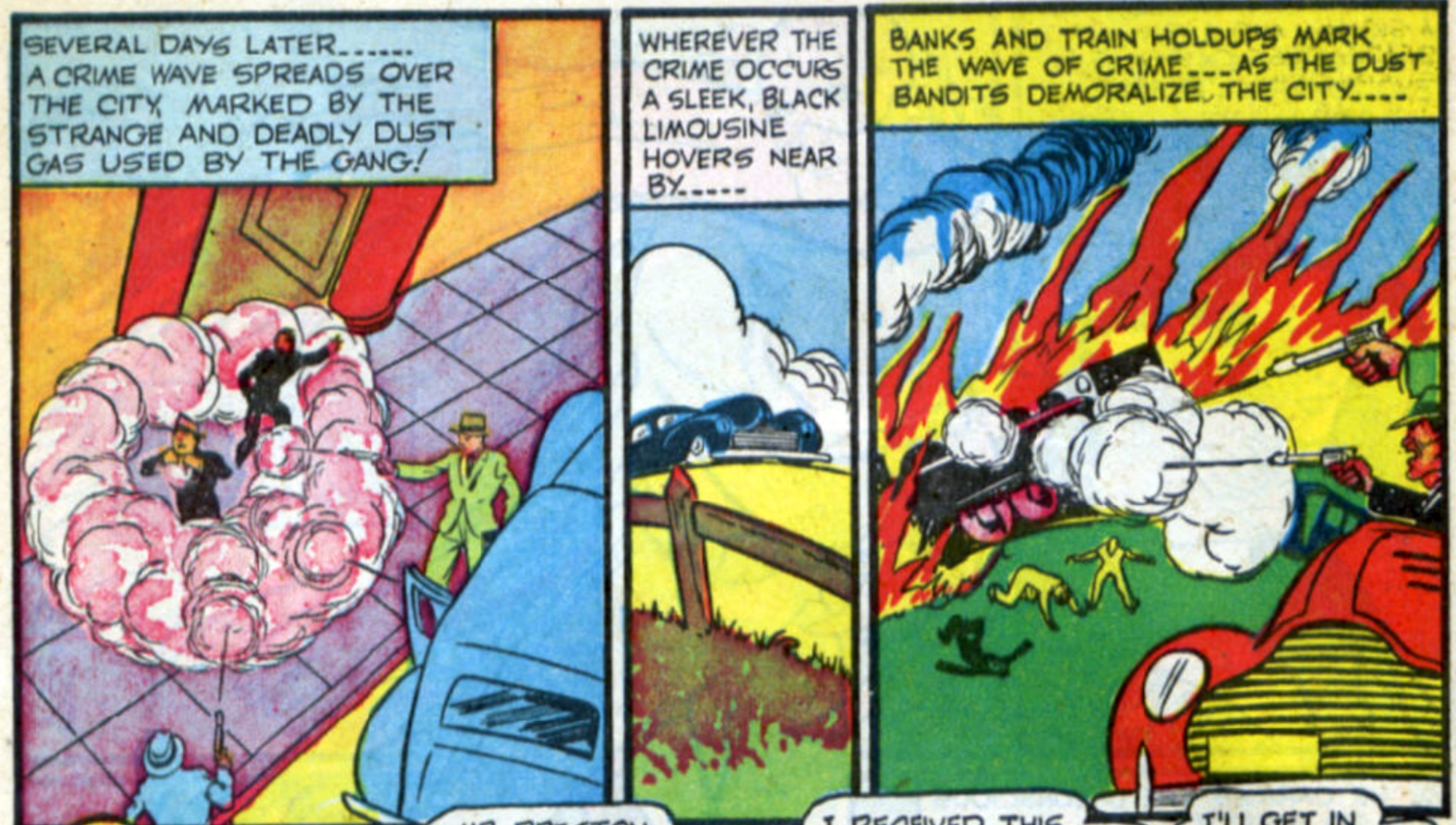
    When Professor Fraser’s incendiary dust gas bullets are rejected by the US Government for being a horrible war crime, he is determined to destroy the formula rather than, say, selling it to the Nazi Baron lurking in his home. Objecting to this lack of initiative, Fraser’s lab assistant and step-daughter conspire to kill him, then hook up with a crooked banker to organize the Dust Bandits, aka the Dust-Gas Gang, for a quick crime spree before taking the Baron up on his offer. As is so often the case with fire-based super-villains they find themselves opposed by a fire-based super-hero, in this case the Flame. (The Flame 007, 1941)

    the Leopard Men:

    To my shame, this instance of the Leopard Man trope marks the first time that I thought to look into whether there was a reason that it was so common in jungle fiction other than that leopards are cool. It turns out that as has so often been the case a cultural practice among a colonized people was vilified and outlawed as a part of the process of cultural subjugation. Leopard Societies appear to have filled a pretty diverse set of roles across West and Central Africa, ranging from pro-trade fraternal orders to vigilante groups, but thanks to sensationalist reporting and pulp writing we are going to keep on encountering them as generic jungle villains. 

    This particular bunch is after explorer Buck Johnson for some bullshit reason. (Great Comics 002, 1941)

  • ALIENS AND SO FORTH ROUND-UP 040

    Weird humanoids as far as the eye can see!

    Demon People: 

    The Demon People are seemingly native to the dimension that Breeze Barton travels to in his first adventure and are in conflict with Miracle City and its population of immortals. Even though their major goal is to get through the dimensional aperture and invade Earth, I would have a lot more sympathy toward them (eternal neighbours really must be the greatest test a people could have, after all) if they weren’t also huge slavers. I do really like the one big wing/fin that they have on their back, even if I can’t figure out what it could be for. (Daring Mystery Comics 003, 1940)

    Jupiterians:

    The Jupiterians, or more specifically the South Jupiterians, are a peaceful, swamp-dwelling people who want to live somewhere other than a swamp and have thus decided to enter into a colonial relationship with Earth. And it works! Against all historical precedent, the South Jupiterians are soon the proud owners of a new city called New Washington! No strings attached!

    The real threat to South Jupiterian sovereignty comes in the form of a diplomatic envoy of lop-eared North Jupiterians under the command of Princess Eelo (whose own long ears are presumably concealed under that kicky headscarf). They represent the bad kind of colonialism, in contrast to the warm fuzzy colonialism of Earth under Captain Nelson Cole, and it takes a plague scare and the complete destruction of New Washington to shift them. Back to work, South Jupiterians! (Planet Comics 009, 1940)

    Link People:

    Comics and other genre fiction are of course chock full of speculative missing links, but the key thing about the missing link concept is that it represents the bridge between ape and human. The idea that the missing link is instead some sort of humanoid reptile that just kind of ignores the existence of mammalian evolution and instead posits (I think) a chain of reptile -> reptile-man -> ape -> human is very weird!

    This being a comic book, such a wild speculation by a collection of white-haired scientists is of course 100% accurate, down to the location and architectural style of the Link Person community. Among other things, this means that the Descent of Man image is going to have to be heavily revised, and also that diver Kinks Mason is immediately sent in to bother this untouched society.

    Fearing that a mere photograph will not be believed, the scientists opt to kidnap one of the Link People, thus completing their introduction to humanity via a whirlwind of violence, death and loss (okay, they do try to sacrifice some of the scientists to their gods, but I think that they might have been justified). (Fight Comics 005, 1940)

  • ALIENS AND SO FORTH ROUND-UP 040

    Weird humanoids as far as the eye can see!

    Demon People: 

    The Demon People are seemingly native to the dimension that Breeze Barton travels to in his first adventure and are in conflict with Miracle City and its population of immortals. Even though their major goal is to get through the dimensional aperture and invade Earth, I would have a lot more sympathy toward them (eternal neighbours really must be the greatest test a people could have, after all) if they weren’t also huge slavers. I do really like the one big wing/fin that they have on their back, even if I can’t figure out what it could be for. (Daring Mystery Comics 003, 1940)

    Jupiterians:

    The Jupiterians, or more specifically the South Jupiterians, are a peaceful, swamp-dwelling people who want to live somewhere other than a swamp and have thus decided to enter into a colonial relationship with Earth. And it works! Against all historical precedent, the South Jupiterians are soon the proud owners of a new city called New Washington! No strings attached!

    The real threat to South Jupiterian sovereignty comes in the form of a diplomatic envoy of lop-eared North Jupiterians under the command of Princess Eelo (whose own long ears are presumably concealed under that kicky headscarf). They represent the bad kind of colonialism, in contrast to the warm fuzzy colonialism of Earth under Captain Nelson Cole, and it takes a plague scare and the complete destruction of New Washington to shift them. Back to work, South Jupiterians! (Planet Comics 009, 1940)

    Link People:

    Comics and other genre fiction are of course chock full of speculative missing links, but the key thing about the missing link concept is that it represents the bridge between ape and human. The idea that the missing link is instead some sort of humanoid reptile that just kind of ignores the existence of mammalian evolution and instead posits (I think) a chain of reptile -> reptile-man -> ape -> human is very weird!

    This being a comic book, such a wild speculation by a collection of white-haired scientists is of course 100% accurate, down to the location and architectural style of the Link Person community. Among other things, this means that the Descent of Man image is going to have to be heavily revised, and also that diver Kinks Mason is immediately sent in to bother this untouched society.

    Fearing that a mere photograph will not be believed, the scientists opt to kidnap one of the Link People, thus completing their introduction to humanity via a whirlwind of violence, death and loss (okay, they do try to sacrifice some of the scientists to their gods, but I think that they might have been justified). (Fight Comics 005, 1940)

  • ALIENS AND SO FORTH ROUND-UP 037

    Every once in a while I hit a particularly dense seam of aliens and so forth and this week is one of those times. 

    Neptunii: 

    The Neptunii (and that name is a guess based on the fact that one guy uses “Neptunus” as a singular version of the noun) live in Neptunia, an underground kingdom that could be described as “a big cave” at the bottom of the Atlantic Ocean. There, they seem to just kind of fly around shouting, though this short comic book story might not give a full picture of their society.

    There are a few points of interest about the Neptunii: they are both finned and winged, they all wear little horned circlets, they call their leader the “Sub-Ruler”… but the thing I am always struck by is just how much Prince Ikor and his pal in the above panel look like quirky characters from a late-90s webcomic. 

    Though Peter “the Fin” Noble becomes the ruler of Neptunia via a bit of impulsive regicide and remains so in his infrequent appearances to this day, to my knowledge the Neptunii themselves have not showed their faces since their first appearance in 1941. (Daring Mystery Comics 007, 1941)

    Inus-Men:

    The Inus-Men take their name from the fact that they are the inhabitants of the planet Inus. They are pretty regular-style cavemen, only more red, and are one of the many dangers faced by Dr X’s niece Cynthia when her astral form is blasted willy-nilly through space by her most unethical uncle. (Startling Comics 001, 1940)

    Jovians:

    The Jovians of the year 3964 AC (sic) are an oppressed underclass who work in the radium mines of the human colony on Jupiter. They are unable to own weapons by law, are possibly disallowed from large gatherings or approaching humans (see the first two panels above where the “boldness” of the Jovians is discussed) and generally mirror the conditions of colonized peoples on our world. This all clearly sucks and is unjust, which is especially interesting because the comic it all appears in clearly considers it to be the natural order of things.

    The Jovians are ripe for (and right to) revolt, and do so under the leadership of the evil Space Emperor. Once he is captured and revealed to be an opportunist by Major Mars they are returned to their place under the collective human thumb. (Exciting Comics 001, 1940)

    Jovians:

    Our second set of Jovians are also radium focused, but rather than mining it for their human overlords they use it to generate power, and having run out they are now demanding that both Earth and Mars hand over their radium supply or face annihilation. This draws the ire of space adventurer and Earth-Mars envoy Mitey Powers and he sets out with his entourage to resolve the situation.

    The title of this story is “The Super-Giants of Jupiter,” and I really appreciate that it lives up to the name. These Jovians are big, man. They’re also pleasingly alien, with their fish heads and tendril hands.

    I can only assume that it is the fact that the Jovians and their warships are so big contributes to Mitey’s decision to commit a war crime against their populace by unleashing a swarm of Martian Poison Gnats that will breed uncontrollably and “[kill] off most of the people.” It’s a horrible crime, Mitey! Particularly as radium is one of the less-used radioactive elements today! (Superworld Comics 003, 1940)

  • ALIENS AND SO FORTH ROUND-UP 037

    Every once in a while I hit a particularly dense seam of aliens and so forth and this week is one of those times. 

    Neptunii: 

    The Neptunii (and that name is a guess based on the fact that one guy uses “Neptunus” as a singular version of the noun) live in Neptunia, an underground kingdom that could be described as “a big cave” at the bottom of the Atlantic Ocean. There, they seem to just kind of fly around shouting, though this short comic book story might not give a full picture of their society.

    There are a few points of interest about the Neptunii: they are both finned and winged, they all wear little horned circlets, they call their leader the “Sub-Ruler”… but the thing I am always struck by is just how much Prince Ikor and his pal in the above panel look like quirky characters from a late-90s webcomic. 

    Though Peter “the Fin” Noble becomes the ruler of Neptunia via a bit of impulsive regicide and remains so in his infrequent appearances to this day, to my knowledge the Neptunii themselves have not showed their faces since their first appearance in 1941. (Daring Mystery Comics 007, 1941)

    Inus-Men:

    The Inus-Men take their name from the fact that they are the inhabitants of the planet Inus. They are pretty regular-style cavemen, only more red, and are one of the many dangers faced by Dr X’s niece Cynthia when her astral form is blasted willy-nilly through space by her most unethical uncle. (Startling Comics 001, 1940)

    Jovians:

    The Jovians of the year 3964 AC (sic) are an oppressed underclass who work in the radium mines of the human colony on Jupiter. They are unable to own weapons by law, are possibly disallowed from large gatherings or approaching humans (see the first two panels above where the “boldness” of the Jovians is discussed) and generally mirror the conditions of colonized peoples on our world. This all clearly sucks and is unjust, which is especially interesting because the comic it all appears in clearly considers it to be the natural order of things.

    The Jovians are ripe for (and right to) revolt, and do so under the leadership of the evil Space Emperor. Once he is captured and revealed to be an opportunist by Major Mars they are returned to their place under the collective human thumb. (Exciting Comics 001, 1940)

    Jovians:

    Our second set of Jovians are also radium focused, but rather than mining it for their human overlords they use it to generate power, and having run out they are now demanding that both Earth and Mars hand over their radium supply or face annihilation. This draws the ire of space adventurer and Earth-Mars envoy Mitey Powers and he sets out with his entourage to resolve the situation.

    The title of this story is “The Super-Giants of Jupiter,” and I really appreciate that it lives up to the name. These Jovians are big, man. They’re also pleasingly alien, with their fish heads and tendril hands.

    I can only assume that it is the fact that the Jovians and their warships are so big contributes to Mitey’s decision to commit a war crime against their populace by unleashing a swarm of Martian Poison Gnats that will breed uncontrollably and “[kill] off most of the people.” It’s a horrible crime, Mitey! Particularly as radium is one of the less-used radioactive elements today! (Superworld Comics 003, 1940)

  • MINOR SUPER-HERO ROUND-UP 084

    MINOR SUPER-HERO ROUND-UP 084

    Obscure Marvel super-heroes, you say? But of course!

    Monako, Prince of Magic:

    Monako is a classic comic book magic hero in the Zatara vein, right down to the top hat, tuxedo and little mustache, though he does eventually switch to wearing a fez. His major distinction from his legion of peers is that he was brought back in a fairly recent Doctor Strange run, though as is so often the case he was dug up only to be horribly killed off.

    Monako gets an origin story in Daring Mystery Comics 004, in which he is orphaned when an Indian group referred to only as “the Cruel Tribe” ritually explode the entire caravan that he and his parents were travelling in as missionaries (this at least gives us an answer to the perennial question of why bring your young child along on such a dangerous journey: because missionaries).

    Young Monako (a last name? a stage name?) inexplicably survives the conflagration and is subsequently adopted by the chief of the Cruel Tribe, who teaches him the ways of magic. Just why he does this is not explored and will never be, because the British eventually show up to massacre the entire village and send young Monako back to England. Were he a going concern for the seventy-odd years between his final Golden Age appearance and his death, I’m sure that the question of just how a whole group of people with powers similar to the nigh-omnipotent Monako were killed with simple firearms, but alas, such was not the case. (Daring Mystery Comics 001, 1940)

    Categorized in: Locations (Unrelated Name), Power Categories (Magic), Royalty (Princes)

    Phantom of the Underworld: 

    “Doc” Denton is a surgeon-turned-detective who helps the police round up a gang boss named Perrone in his sole recorded adventure. I one hundred percent am including him here because “Phantom of the Underworld” is such a terrific name, even if nobody calls him that in-story. (Daring Mystery Comics 001, 1940)

    Categorized in: Day Jobs (Private Detectives), Locations (the Underworld), Supranormal Beings (Phantoms)

    Trojak the Tiger Man: 

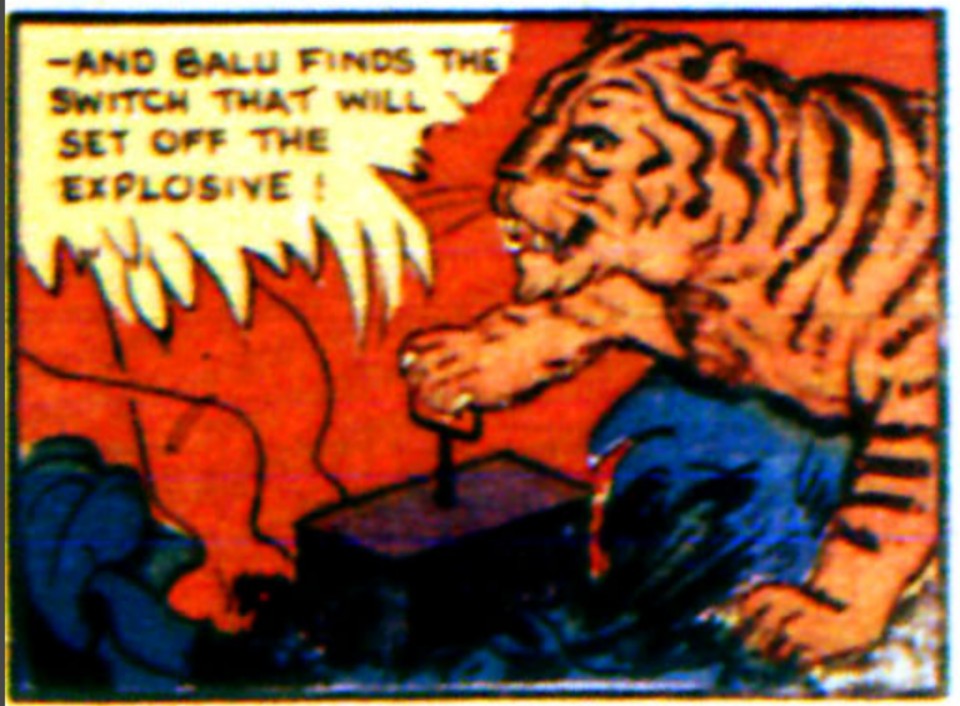
    Trojak, orphaned son of a jungle explorer who made the inexplicable yet very popular decision to bring a baby along with him on his travels (perhaps as a difficulty boost? Was Trojak’s father a gamer?), has grown up among a tribe his father died in defense of. As is so often the case in adventure literature, being a white guy in the jungle has made Trojak both stronger and cooler than everyone else, plus he can talk to animals like Balu, his geographically-anomalous tiger companion. (Daring Mystery Comics 002, 1940)

    (he is a very intelligent tiger)

    Categorized in: Animals (Tigers), Generica (Mans), Origin (Orphan Raised in Jungle)

    Tigerman:

    “Trojak the Tiger Man” becomes “Tigerman” for its final instalment, and it’s a bit of a toss-up on whether the two characters are supposed to be the same or not. Both Trojak and Tigerman are orphaned youths who were raised by jungle tribe and who now adventure while in the company of a tiger named Balu, sure, but crucially “Trojak” is set in Africa while the Tigerman roams India. You’d be forgiven for assuming that Tigerman was Indian but no, he’s American by birth – he’s just the rare near-naked jungle guy who has the ability to get a tan. 

    The one thing that could have cleared up the mystery of whether these two are the same guy or not would be more adventures featuring either one of them and sadly there are no more (Daring Mystery Comics 006, 1940)

    Categorized in: Animals (Tigers), Generica (Mans), Origin (Orphan Raised in Jungle) 

    K-4 and his Sky Devils:

    K-4 is the code name of a “flying spy,” and WWI/Spanish Civil War fighter ace (the youngest WWI ace, according to the text box, which would make him at most 18 as far as I can tell) who leads the Sky Devils, comprised of fellow WWI ace René d’Auvergne and makeup expert Ronald Wolverstone-Clodd. Some of the usual fun of the multinational team set-up is missing here because K-4 spends a lot of his time doing solo missions. (Daring Mystery Comics 002, 1940)

    Categorized in: Alphanumeric (K, 4), Origins (WWI vets), Supranormal Beings (Devils)

  • DIVINE ROUND-UP 021

    DIVINE ROUND-UP 021

    Just scads of gods.

    Yum Chac: 

    These Mayan priests have tied a recent drought to some archaeological excavations in the Yucatan and have decided that the only thing for it is to revive the practice of human sacrifice to Yum Chac, aka just Chac, god of rain. They of course do this just in time for Zambini the Miracle Man to show up and wreck their whole operation.

    The really interesting thing about this whole episode is that it takes place at a site called “Hichen-Citza” and let me tell you that it’s this sort of thing that really shakes my confidence with regard to my knowledge of just when and why Golden Age comic book creators did these cute little place name substitutions. Surely there was no concern that an ancient or present-day Mayan might get upset by this depiction of their city but not, say their god? Or maybe I should just look back on the whole Egyptasia thing and conclude that “Zambini” scribe Joe Blair just really liked making up silly names for real places.

    (also the high priest is named “Macchu Pacchu,” which again seems to just be Blair having fun with names)

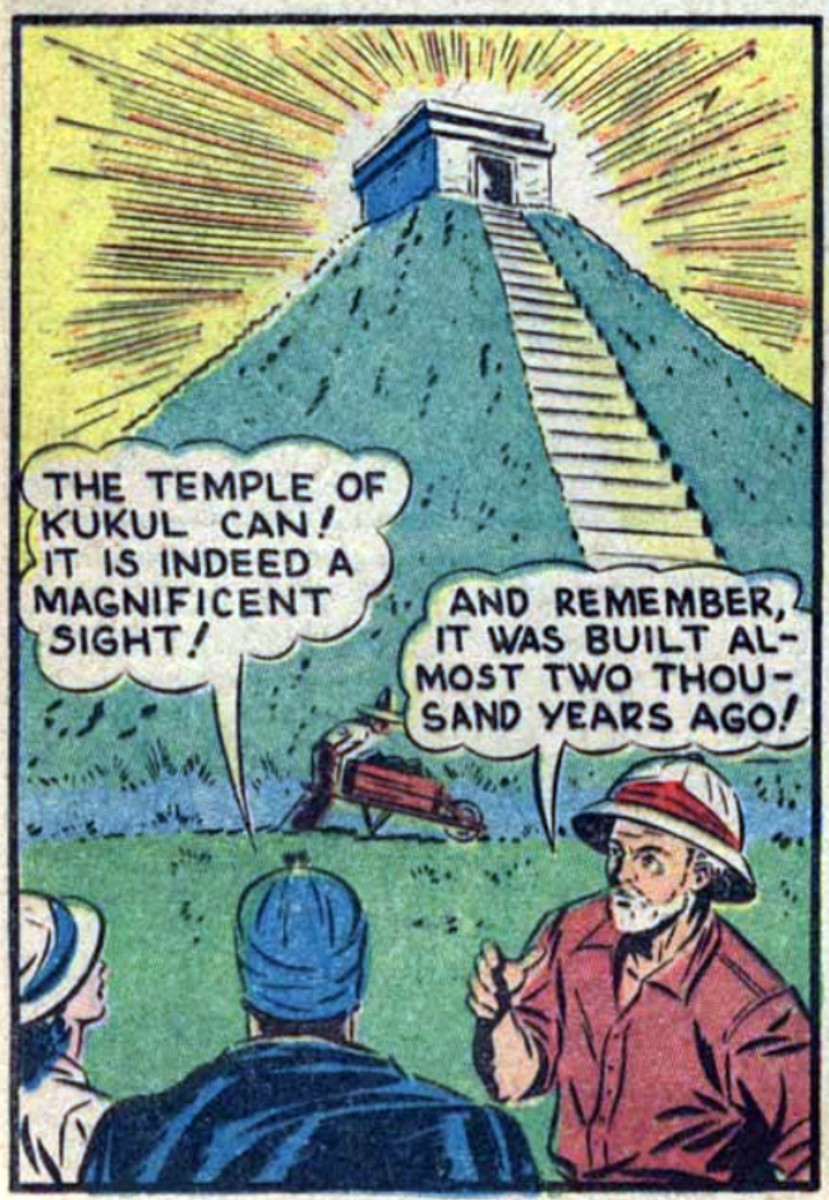
    El Castillo, the temple of Kukulcan also features, and evidently drawn from an old reference photo from back when the sides were still covered in vegetation. 

    God Style: Idol (Real Pantheon) (Zip Comics 008, 1940) 

    the Moon Orchid:

    I frequently like to point out when Golden Age explorers are just blithely waltzing into religious sites and stealing their sacred relics even in the face of stiff and reasonable resistance from the faithful, but this one is pretty beyond the pale. While most of the others at least attempt to adopt a pretense of respectability by claiming to be thieving for anthropological or other scientific reasons, Congo Bill and his pal Professor Kent are explicitly heading into the jungle to steal the Mesabi tribe’s sacred Moon Orchid so that they can sell it for big bucks.

    And steal it they do! And what’s worse: they blow up the entire Mesabi village in the process, so it’s not just sacrilege but mass murder. Worth it for that sweet orchid money, I guess.

    God Style: Animist (More Fun Comics 066, 1941) 

    Ozaz: 

    Adventurer Steve Conrad is on vacation in Egypt when he stumbles upon a weird cult looking to do a blood transfusion from a living woman into a mummy queen in order to bring her back to life and usher in a new age of the Pharaohs. Presumably this bunch worship all of your standard Ancient Egyptian gods, but they don’t name-drop any specific ones, until Steve fumbles his rescue attempt and is slated to be sacrificed to… 

    OZAZ THE FIRE GOD! Possessed of a pretty good name and nothing else, Ozaz is a made-up god who seems to have the head of a bird and whose statue is perfectly placed to topple over and kill the cultists when Steve’s assistant Chang opens the trap door underneath it. Too bad for Ozaz (no sacrifice today) and the Pharaoh cult (crushed to death).

    God Style: Idol (Real Pantheon) (Adventure Comics 063, 1941)

    Pyro:

    Worshipped by the Center People of Asteroid Djung, Pyro is a simple god: he hungers for sacrifice and he wants it via his sacred lava pit. 

    God Style: Invoked (Master Comics 019, 1941) 

  • ALIENS AND SO FORTH ROUND-UP 020

    ALIENS AND SO FORTH ROUND-UP 020

    You won’t believe the aliens and alien-adjacent societies we got in here. 

    Scorpians and Subterrines: 

    When crack reporter Scoop Smith and his photographer pal Blimp Black fly to Mexico to investigate reports of an “invisible revolutionary army” they get the story in a very direct way when they are shot down and taken captive by the Scorpians, who dwell in the underground kingdom of Scorpia and are extremely on-theme about the scorpion thing at all times, as can be seen in in the throne room of Scorpian King Cortes and its five distinct bits of scorpion decor.


    Scoop and Blimp are escorted to the Horror Chamber to be eaten by giant scorpions, because even the Scorpian methods of execution are on brand. They escape thanks to a thrown rock and a handy earthquake and discover the Subterrines, a second underground civilization that is also seeking to overthrow the Mexican government.  

    While the Scorpians under King Cortes kind of vaguely evoke the conquistadors of old, the Subterrines are pretty explicitly the descendants of native Mexican peoples who fled underground and now seek to reclaim their lands (and may I say that “everyone has long white beards now” is about the most benign version of becoming troglodytic cave-dwellers). The two groups of course hate one another and set to battling to the death for the honour of conquering Mexico, only to be annihilated together by the Mexican army. (Whiz Comics 005, 1940)

    Ape Men:

    If you’ve ever wondered if there was a version of the Paul Bunyan story in which he had an ape man for a companion, well wonder no more, because it happened in National Comics, when King, the ape man in question, wanders out of the woods and starts attacking lumberjacks, only to find himself on the receiving end of a beatdown from Paul Bunyan himself. After this, the impressionable King adopts the lumberjack way of life and joins Paul’s supporting cast. (National Comics 006, 1940)

    Joins Paul’s supporting cast for one issue, that is, because in National Comics 007 a scientist shows up at camp with a lead on where King might hail from, prompting Paul and the lads to set out to return him to his people, and if you’ve ever wondered if there was a version of the Paul Bunyan story in which he traveled through India to the Himalayas, well, you are in luck. Paul and the lads find King’s tribe and for the second time in as many issues, Paul Bunyan has to fist fight a Himalayan Ape Man in order to make peace.

    Bat-Men:

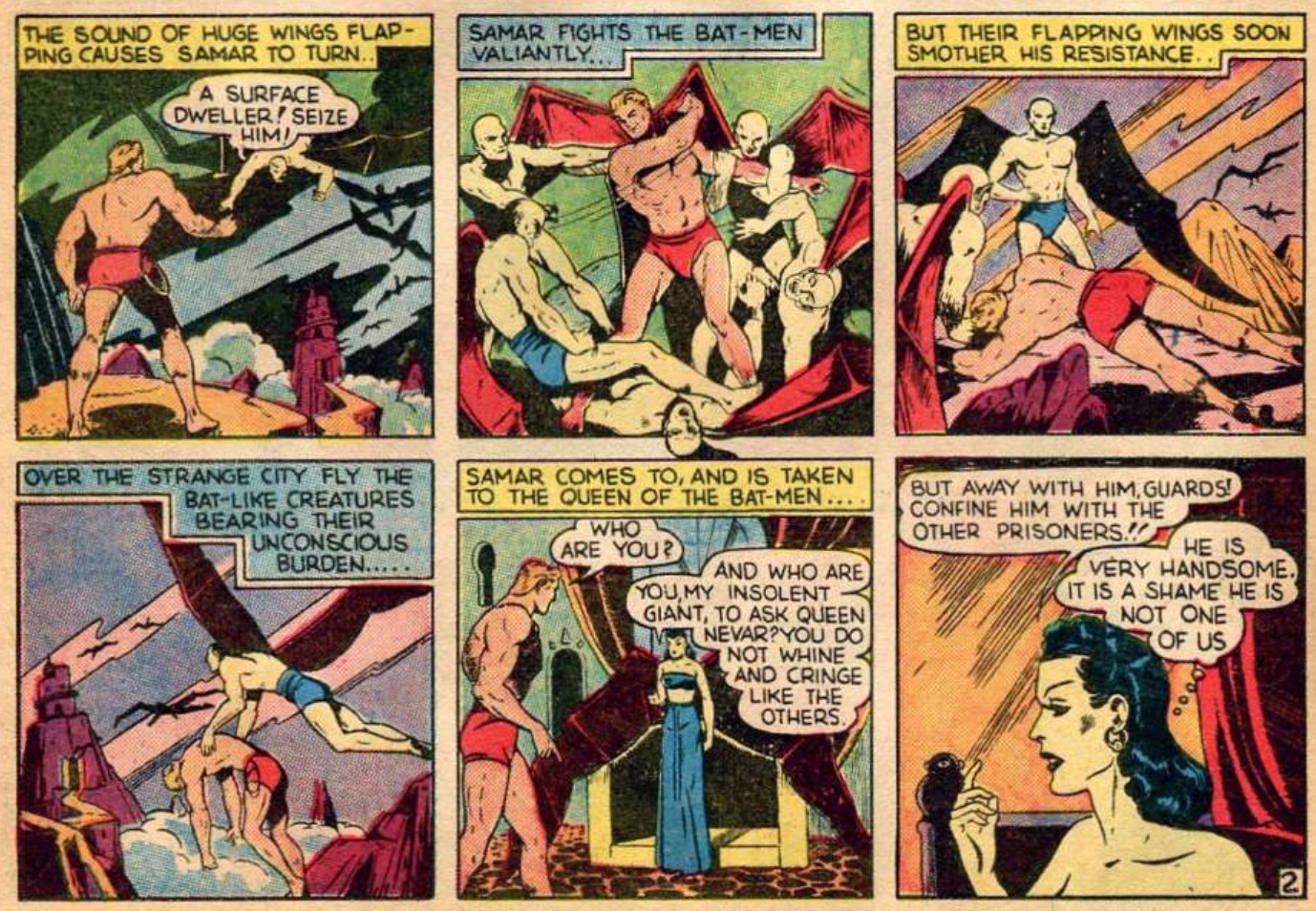
    Though the Bat-Men are very, very vampire-like – bat-winged humanoids who capture humans and drink their blood and can make humans into Bat-Men and are destroyed by sunlight – the keen senses of jungle-man Samar tell him that they are not, though he never really clarifies what they actually are. 

    The Bat-Men and their underground city are destroyed when they force Samar to battle a tyrannosaur in their gladiatorial arena and he inadvertently collapses the cave roof while killing the beast with a catapult. (Feature Comics 038, 1940)

    the Bat-Men of Mephis: 

    One of the many intelligent races to inhabit the planet Mephistos in the year 2500 CE, the Bat-Men of Mephis as their name suggests live in the tunnels beneath the city of Mephis, posing as statuary until it is time to attack. It’s a very urban adaptation, which is fun. I also appreciate their little ears. (Flash Comics v1 002, 1940)

  • ALIENS AND SO FORTH ROUND-UP 020

    You won’t believe the aliens and alien-adjacent societies we got in here. 

    Scorpians and Subterrines: 

    When crack reporter Scoop Smith and his photographer pal Blimp Black fly to Mexico to investigate reports of an “invisible revolutionary army” they get the story in a very direct way when they are shot down and taken captive by the Scorpians, who dwell in the underground kingdom of Scorpia and are extremely on-theme about the scorpion thing at all times, as can be seen in in the throne room of Scorpian King Cortes and its five distinct bits of scorpion decor.


    Scoop and Blimp are escorted to the Horror Chamber to be eaten by giant scorpions, because even the Scorpian methods of execution are on brand. They escape thanks to a thrown rock and a handy earthquake and discover the Subterrines, a second underground civilization that is also seeking to overthrow the Mexican government.  

    While the Scorpians under King Cortes kind of vaguely evoke the conquistadors of old, the Subterrines are pretty explicitly the descendants of native Mexican peoples who fled underground and now seek to reclaim their lands (and may I say that “everyone has long white beards now” is about the most benign version of becoming troglodytic cave-dwellers). The two groups of course hate one another and set to battling to the death for the honour of conquering Mexico, only to be annihilated together by the Mexican army. (Whiz Comics 005, 1940)

    Ape Men:

    If you’ve ever wondered if there was a version of the Paul Bunyan story in which he had an ape man for a companion, well wonder no more, because it happened in National Comics, when King, the ape man in question, wanders out of the woods and starts attacking lumberjacks, only to find himself on the receiving end of a beatdown from Paul Bunyan himself. After this, the impressionable King adopts the lumberjack way of life and joins Paul’s supporting cast. (National Comics 006, 1940)

    Joins Paul’s supporting cast for one issue, that is, because in National Comics 007 a scientist shows up at camp with a lead on where King might hail from, prompting Paul and the lads to set out to return him to his people, and if you’ve ever wondered if there was a version of the Paul Bunyan story in which he traveled through India to the Himalayas, well, you are in luck. Paul and the lads find King’s tribe and for the second time in as many issues, Paul Bunyan has to fist fight a Himalayan Ape Man in order to make peace.

    Bat-Men:

    Though the Bat-Men are very, very vampire-like – bat-winged humanoids who capture humans and drink their blood and can make humans into Bat-Men and are destroyed by sunlight – the keen senses of jungle-man Samar tell him that they are not, though he never really clarifies what they actually are. 

    The Bat-Men and their underground city are destroyed when they force Samar to battle a tyrannosaur in their gladiatorial arena and he inadvertently collapses the cave roof while killing the beast with a catapult. (Feature Comics 038, 1940)

    the Bat-Men of Mephis: 

    One of the many intelligent races to inhabit the planet Mephistos in the year 2500 CE, the Bat-Men of Mephis as their name suggests live in the tunnels beneath the city of Mephis, posing as statuary until it is time to attack. It’s a very urban adaptation, which is fun. I also appreciate their little ears. (Flash Comics v1 002, 1940)

  • MINOR SUPER-VILLAIN 786: THE TIGER MAN

    (Sure-Fire Comics 002, 1940)

    The Tiger Man (also referred to as the much snappier Tiger Mask in one panel but I reckon that was just some sort of lettering error or other style of brain glitch) is a fellow in an extremely cool cowl mask who is trying to corner the pearl market in the South Seas using some very crooked tactics, such as sticking pearl bed owner Rita van Dyke on a raft and abandoning her at sea. Only the intervention of Flash Lightning saves her, and he only knows to do so because the Old Man of the Pyramids tells him to.

    This is in many ways a fun little adventure, marred frequently by the threat being stated as “those dastardly South Seas natives trying to steal the pearl trade from the virtuous white people” (barely a paraphrase).

    Eventually, the Tiger Man is unmasked and it turns out that he didn’t kill Rita’s uncle as she had thought but rather that he was her uncle and that in addition to the harrowing near-death experience she just had she is going to have to really reevaluate a lifetime of memories and maybe have some serious talks with any other parents/cousins/etc who might be kicking around. Talk about an awkward next Thanksgiving dinner, am I right?