The Curse of Skeleton Munroe

Category: Black X

  • MINOR SUPER-VILLAIN 744: PROXOFF

    (Smash Comics 009, 1940)

    Proxoff is an example of a Kind of Guy that you see in Golden Age Comics: he came through the chaos of the Great War and said to himself “if this ever happens again then I’m going to come out on top.” Together with his aides van Damm and Count Trini, Proxoff has established secret airfields and fortresses in Siberia and presumably elsewhere and is waiting for his moment to swoop in and conquer the weakened nations of the world once they’ve fought one another for a while.

    Proxoff’s scheme hinges on his army of men who do not fear death, as exemplified by this would-be assassin who, having failed to kill Black X, bumps himself off using a cool skeletonizing drug (in-universe, the skeleton thing is not really for any reason, but on a meta level it points the Black X to its point of origin in Siberia).

    The “no fear of death” thing eventually proves to be Proxoff’s downfall. Firstly, they’ve been so heavily conditioned that Black X’s aide Batu is able to mesmerize an entire submarine without even trying, and secondly, the impulse to die rather than submit to capture overtakes them when Batu drops his concentration during some depth charge action and they all kill themselves rather than, say attempting to take back the ship.

    Things get even worse once Proxoff’s men see actual combat, as they don’t even see the point of returning enemy fire and prolonging their own existences. Truly this is an indictment of the trope of the henchman loyal unto death.
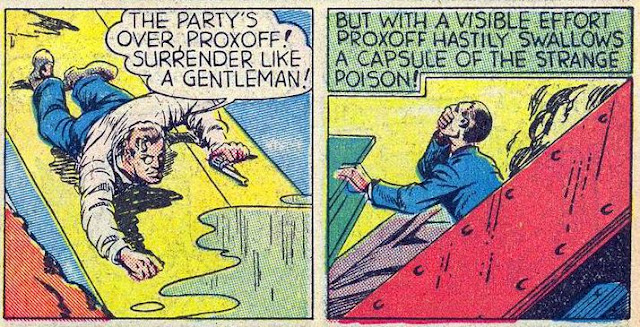
    Proxoff himself meets an ironic end: as Black X closes in on him he must resort to his own skeleton drug rather than being captured, and the caption makes sure to emphasize that he, unlike his men, does not particularly want to die.

  • MINOR SUPER-VILLAIN 740: THE DEATH BATTALION

    (Smash Comics 007, 1940)

    You’re going to have to trust me because I have gathered no evidence, but I can state with some confidence that the American people of late 1939/early 1940 had a great deal of (perhaps wishful) hope in the effectiveness of the French Maginot Line, right up to the point at which the Nazis did an end run around it and into France. A fair number of war comics of the time (like the adventures of Corporal Collins, for example) feature defenses of the Line (or fictional versions of the Line) from the advancing Axis. Perhaps the most interesting version of this Maginot Line fandom is the concept of the US defending itself via “the Caldwell Line,” a series of floating fortresses running from Canada to Tierra del Fuego, if the caption box is to be believed (the floating fortress is another frequently referenced Golden Age idea that I have no other examples of beyond “dude, trust me”).

    The Axis powers (still creeping up to the line of just saying Nazis) respond to this defensive superiority by deploying their finest spies, under the leadership of Madame la Coquin here. And since the greatest enemy of the spy in America is Black X (in a Black X comic, at least), la Coquin and her cadre start their campaign by hatching a plot to kill him.

    As is usually the case in plots to preemptively murder the protagonist of a comic, this proves to be a very bad idea. The Black X manages to fake his own death with the help of a handy psychic illusion (courtesy of his aide Batu) and uncovers the whole operation, namely a secret underground base from which Madame la Coquin and her Death Battalion comrades plan to attack the Caldwell Line using manned torpedoes. An insane plan!

    Black X manages to foil the suicide runs of the first two Death Battalion members by radioing their positions to the US Coast Guard, but finds himself unable to do so when la Coquin takes out the final torpedo herself, because they are very horny for one another. And he almost saves her! Oh Black X, are you ever going to find love in the arms of someone who isn’t an enemy agent?

    (in one of my patented unproveable theories about comics published before my father was born, I reckon that la Coquin was originally going to be our old friend Madame Doom but they didn’t want to blow her up)

  • MINOR SUPER-VILLAIN 738: KADU-KAN

    (Smash Comics 006, 1940)

    Time for a very obscure character indeed: Kadu-Kan, who put out Black X’s eye in an attempt to induce him to spill some military secrets. Kadu-Kan is therefore a major figure in the history of the character to be mentioned in one panel and never again, and then only to provide a reason for Black X’s ever-present monocle.

    (Speaking of Black X and setups with no real payoff, the first Black X adventure in Feature Funnies 013, 1938 includes this enemy spy who is a double of Black X and escapes into the night at the end of the story, to never return)

  • MINOR SUPER-VILLAIN 548: MADAME DOOM

    (Smash Comics 004, 1939)

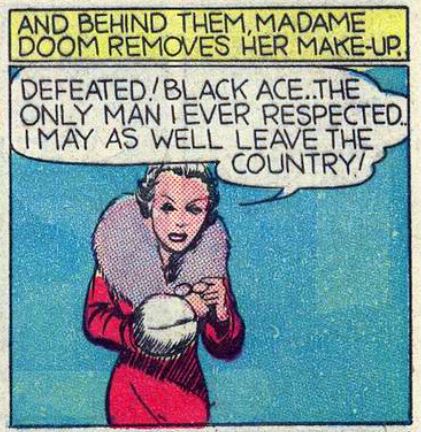
    We will be seeing more of Madame Doom, as she is Black X’s only real recurring foe (I think), but as far as 1939 goes she made one appearance and this is it. 

    Madame Doom, a freelance spy, is working for “the dictators” in an attempt to steal US defense plans and prevent the signing of a pretty vague treaty that acts as a deus ex machina reason for war not to have broken out yet (war with the US, that is).

    In this first appearance Madam Doom is a very by-the-book Will Eisner femme fatale: a ruthless lady with the hots for the hero (reciprocated).

    Black X doesn’t quite let her go on purpose but he certainly doesn’t try very hard to catch her. This is a mistake! The bloom definitely wears off the rose in this relationship later on.

    UPDATE: Madame Doom 1940

  • REAL PERSON ROUND-UP 003

    Once more they ride: the REAL PEOPLE OF COMICS

    Abraham Lincoln:

    Lincoln’s shadow is used to symbolize the power of the US exerting a calming effect on the European belligerents. (Smash Comics 005, 1939)

    Adolf Hitler:

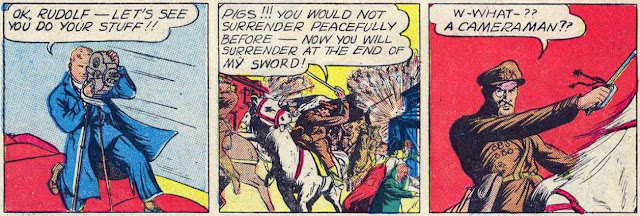
    Chancellor Rudolf of Wurtberg here is a more dynamic than usual Hitler analog (Smash Comics 004, 1939)

    Misc minor appearances:

    Getting some bad news about Nazi operations in Yugoslavia (Blue Ribbon Comics 015, 1941)

    Captain Kidd:

    For no particular reason this aviator/ adventurer is named after him. (Fantastic Comics 001, 1939)

    Franklin Delano Roosevelt:

    Discusses the threat of the Black Hand With J. Edgar Hoover (Blue Ribbon Comics 016, 1941)

    Misc Minor Appearances: appraised of the danger of invasion by Vlamir Koran (Smash Comics 001, 1939) 

    Seen ordering Americans in Europe to return home; meets Black Ace/X after he saves the transports that are returning them. (Smash Comics 003, 1939)

    Determines to defensively arm the US (Smash Comics 005, 1939)

    H.V. Kaltenborn:

    Radio commentator, appears as “H.V. Baltenhorn” (Blue Ribbon Comics 017, 1941)

    John Dillinger:

    Gangster “Jack Dilger” is vexed by Ty-Gor. (Blue Ribbon Comics 015, 1941) 

    Joseph Stalin:

    The same 3/4 perspective shot always used for FDR, now in Stalin form! (Smash Comics 002, 1939)

    Mahatma Gandhi:

    Aside from the pun name “Mohlasos Candhi”, this version of Gandhi is hitting a lot of the overt and casually racist checkmarks of the 1940s, including a disregard for the difference between India and the Middle East and a complete indifference for the distinction between Hindus and Muslims. Oh and also it’s another classic adventure based on propping up colonial rule. (Blue Ribbon Comics 017, 1941)

    Shirley Temple:

    As “Curley Semple” (“Dixie Dugan” comic strip, 1935)

    Sherlock Holmes:

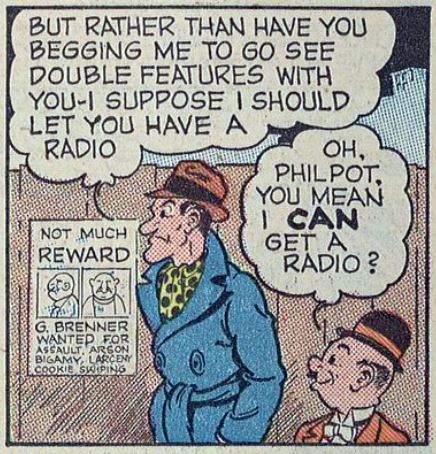
    Philpot Veep (along with his sidekick Waldo) was one of many humourous takes on Sherlock Holmes in Golden Age comics. Note also the wanted poster for G. Brenner, almost certainly referring to George Brenner, creator of the Clock. (Smash Comics 001, 1939)

    BONUS PHILPOT VEEP, DRUG FIEND

    COMIC BOOK DRAMA: in Smash Comics 005, George Brenner strikes back! Here’s Philpot Veep scribe Joe Devlin depicted AS A CLOWN! EPIC GOLDEN AGE BEEF SPOTTED

    Woodrow Wilson:

    Meets and gives sage advice to young Blane Whitney, who would grow up to become MLJ hero the Wizard. I am legitimately flabbergasted to see Wilson show up in this capacity. (Top-Notch Comics 001, 1939)

  • MINOR SUPER-VILLAIN 543: VLAMIR KORAN

    (Smash Comics 001, 1939)

    Vlamir Koran, Argentinean Adolf Hitler pastiche in charge of Nazi pastiche the Black Spot, takes over the entirety of South America in about half a page, because the real action of the story is centred around his attempt to continue his conquering ways into the United States.

    Koran’s first couple of attempts to invade the US are stymied by technology and tactics, so he hires the “greatest of all spies”, Mata Hari pastiche Mara Hani, to infiltrate the US military and steal their secrets. At this point Vlamir Koran effectively leaves the comic and the action shifts to a cat-and-mouse game of espionage between Mara Hani and Black X over possession of US defense plans.

    Although Mara Hani starts strong by vamping the plans out of a young and horny military engineer, Black X gets ’em back on the boat voyage back to South America and the goal of the cat-and-mousing switches to Mara Hani attempting to prevent Black X from reaching anti-Koran partisan Emanuel Hasana, who simultaneously has enough martial and political clout that he can shift the entire balance of South American power and little enough volition that he won’t emerge from his tiny jungle fort without US sayso.

    Mara Hani gets jaguared pretty good and Black X almost kills himself dragging her to the fort using his bullet-riddled body. And then she dies anyway.

    Luckily, the fifty guys that Hasana had in that fort were the real key to defeating Vlamir Koran, and South America is free to return to its old political state and borders with no lasting ramifications to the time everyone was conquered by fascist Argentina. Emanuel Hassan doesn’t even annex a couple of the smaller countries for himself! All this big talk about loving America and then he passes up a prime opportunity to emulate them.

  • MINOR SUPER-HERO ROUND-UP 013

    More. MORE!

    Spiritman: 

    It’s impossible to say if Spiritman’s real name is Spirit Malcolm or if Spirit is just a nickname. The Golden Age is definitely a time in which nicknames are clearly signposted with quotation marks (including names like “Hank” half the time) but they’re also an age of inconsistent editorial standards. Let’s assume it is his given name, because then it’s another fun case of comic book nominative determinism.

    Spiritman is a scientific hero: armed with a Rayodine Pistol, he uses his Futurscope remote viewing device to hunt out evildoers and then – and this is where the “Spirit” part comes in – employs his Mistodine device to teleport to their location, or possibly to astrally project to their location. Either way, the effects are the same: the projected Spiritman can fly and is selectively invisible and intangible, allowing him to really just do whatever he wants. In his sole recorded adventure, this means killing about a dozen men for stealing US gold reserves. (Silver Streak Comics 001, 1939)

    the Wasp:

    Daily Free Press reporter Burton Slade is also masked vigilante the Wasp, so named because his weird cape looks a bit like insect wings if you squint. He also makes a buzzing sound sometimes. (Silver Streak Comics 001, 1939)

    Black X:

    Black X is Richard Spencer, a US espionage agent who travels around with his Indian manservant Batu (who of course is gifted with assorted mental powers). His stories are interesting enough to read but Black X himself is, appropriately enough, a bit of a cipher. Probably the most interesting thing about him is that the monocle he always wears is in fact more of an eye patch to cover his gouged-out eye. He also briefly went by the moniker Black Ace but that failed to stick. (Feature Funnies 013, 1938)

    the Invisible Hood:

    The fun thing about the Invisible Hood is that he doesn’t get his signature invisibility cloak until his second appearance, which means that for an unknown number of adventures he was just a Sandman-style two-fisted gas gun jockey in a very impractical full length form-fitting robe. Perhaps he was simply looking for a challenge. (Smash Comics 001, 1939)

  • NOTES – MAY 2024

    Cops Shooting: 

    I’ve been reading old Dick Tracy strips and while tracking all of the times that Tracy fires on a fleeing suspect would be a fool’s errand I would like to note that so far in the 1933 he has been responsible for the shooting deaths of two non-criminals.

    Nova Scotia:

    Speaking of Dick Tracy and filled with home-town pride: this July 1933 strip and the next week or so take place in Halifax, Nova Scotia.

    Honours:

    Black X declines a medal from the president. (Smash Comics 001, 1939)

    Names:

    Look kids, it’s Al Lirog, the racketeer! (Speed Comics 003, 1939)

  • NOTES – MAY 2024

    Cops Shooting: 

    I’ve been reading old Dick Tracy strips and while tracking all of the times that Tracy fires on a fleeing suspect would be a fool’s errand I would like to note that so far in the 1933 he has been responsible for the shooting deaths of two non-criminals.

    Nova Scotia:

    Speaking of Dick Tracy and filled with home-town pride: this July 1933 strip and the next week or so take place in Halifax, Nova Scotia.

    Honours:

    Black X declines a medal from the president. (Smash Comics 001, 1939)

    Names:

    Look kids, it’s Al Lirog, the racketeer! (Speed Comics 003, 1939)

  • MINOR SUPER-VILLAIN 029: THE PURPLE HOODS

     (Feature Funnies 016, 1939)

    Not much to distinguish this spy organization foiled by Quality character Black X, other than the fact that their leader spends the entire adventure dressed for bed, complete with a little tasseled nightcap. I choose to ignore the in-text indications that he was in fact just about to go to sleep and instead believe that he dressed like that all the time. BRING BACK tasseled nightcaps!