The Curse of Skeleton Munroe

Category: Wizard

  • MINOR SUPER-VILLAIN 846: THE WIZARD

    (Weird Comics 003, 1940)

    The Wizard is the first of five villains to challenge the Sorceress of Zoom for the role of top villain in her own dang feature. He is unique among that group for being the only villain in the story he appears in, as while the rest of his peers come at the Sorceress while she is engaged in some nefarious activity, the Wizard shows up while she is peacefully hanging out with her friend Allan. 

    Once the Wizard’s weird humanoids have slaughtered all of the citizens of Zoom, he smashes the Sorceress’ never-before-seen magic mirror, which in this story only is the source of her magical power. He then absconds with the entire damn city.

    The Sorceress and Allan set out to restore the mirror by re-forging it in the heart of a volcano, only to find the Wizard and his goons waiting on the rim of the caldera to beat them up.

    This turns out to be a bad decision on the Wizard’s part, as the Sorceress is able to perform an extremely sick move that is let down somewhat by the art, wherein she leaps into the volcano holding the mirror and is thus able to use her magic to fly back out/become immune to flame/heal her horrific wounds once it re-forms. And the volcano does double duty, since she is able to dispose of the Wizard in there!

  • MINOR SUPER-VILLAIN 839: THE DOCTOR

    (Top-Notch Comics 010, 1940) 

    The Doctor operates a simple but brutal extortion racket: a network of crooked doctors refer workplace compensation cases to him at his fake hospital and he then charges them as much as they are being paid in compensation, and if anyone dares to complain, they suddenly require urgent surgery and die on the operating table.  

    For the second time in two days I must note: surgical scrubs are such a good super-villain costume.

    This is exactly the sort of thing that the Wizard hates, and you just know that Roy the Super-Boy has to get in on Beating Up an Entire Hospital. Roy almost gets murdered for his trouble, but the Wizard shows up in the nick of time, and the Doctor’s entire network gets handed over to the authorities.

  • MINOR SUPER-VILLAIN 833: THE MASTER

    (Top-Notch Comics 005, 1940) 

    The Mosconians, stand-ins for Nazi-allied Russia (or possibly just Russian-flavoured stand-ins for Nazi Germany) have a lot more stick-to-itiveness than your typical gang of foreign espionage agents, to the extent that they manage to not only bedevil the Wizard for three whole issues but also the Shield over in Pep Comics, leading to what is touted as the first super-hero crossover in comics (as previously seen here). The Master is the shadowy figure behind the Mosconian schemes and as seen above he even managed to kidnap the Wizard’s brother Grover! A decent showing for a crypto-fascist, considering how ephemeral they usually are.

    The actual crossover-precipitating plan is an attempt to blow up the military academies at Annapolis and West Point, thus shutting off the supply of officers to the US armed forces and incidentally killing off a portion of the country’s political officials as they attend a ceremony at the latter. The actual crossovers between the Wizard and the two students is fairly ships-in-the-night – he basically waves at them as he leaves to beat up Mosconians at a second location.

    The Mosconians and their Master return in Top-Notch Comics 006 with an attempt to blow up Boulder Dam*, which is one of those plots that would be pretty horrifying in real life but is not so exciting or unusual in a comic book. This is also the point at which the Mosconians start to get really German.

    *Hoover Dam, which I just learned was in a state of naming limbo for years and only officially became Hoover in 1947! 

    The Mosconians next plot, in Top-Notch Comics 007, involves an attack on the Golden Gate Bridge. The Wizard manages to track them down to their staging area in British Columbia, where the Master is finally unmasked and revealed to be the Mosconian ambassador to the United States (not much of a surprise). This is also the point at which the Wizard is chemically blinded, leading him to change his costume to a more standard super-heroic one with no noticeably different eye protection. So attired, he rounds up the plotter in San Francisco with the aid of the Shield.

  • MINOR SUPER-VILLAIN 833: THE MASTER

    (Top-Notch Comics 005, 1940) 

    The Mosconians, stand-ins for Nazi-allied Russia (or possibly just Russian-flavoured stand-ins for Nazi Germany) have a lot more stick-to-itiveness than your typical gang of foreign espionage agents, to the extent that they manage to not only bedevil the Wizard for three whole issues but also the Shield over in Pep Comics, leading to what is touted as the first super-hero crossover in comics (as previously seen here). The Master is the shadowy figure behind the Mosconian schemes and as seen above he even managed to kidnap the Wizard’s brother Grover! A decent showing for a crypto-fascist, considering how ephemeral they usually are.

    The actual crossover-precipitating plan is an attempt to blow up the military academies at Annapolis and West Point, thus shutting off the supply of officers to the US armed forces and incidentally killing off a portion of the country’s political officials as they attend a ceremony at the latter. The actual crossovers between the Wizard and the two students is fairly ships-in-the-night – he basically waves at them as he leaves to beat up Mosconians at a second location.

    The Mosconians and their Master return in Top-Notch Comics 006 with an attempt to blow up Boulder Dam*, which is one of those plots that would be pretty horrifying in real life but is not so exciting or unusual in a comic book. This is also the point at which the Mosconians start to get really German.

    *Hoover Dam, which I just learned was in a state of naming limbo for years and only officially became Hoover in 1947! 

    The Mosconians next plot, in Top-Notch Comics 007, involves an attack on the Golden Gate Bridge. The Wizard manages to track them down to their staging area in British Columbia, where the Master is finally unmasked and revealed to be the Mosconian ambassador to the United States (not much of a surprise). This is also the point at which the Wizard is chemically blinded, leading him to change his costume to a more standard super-heroic one with no noticeably different eye protection. So attired, he rounds up the plotter in San Francisco with the aid of the Shield.

  • MINOR SUPER-HERO ROUND-UP 056

    Some hot Archie/MLJ super-hero action. 

    **Hero Update** Bob Phantom:

    Perhaps in honour of his making the jump from Blue Ribbon Comics to Top-Notch Comics, Bob Phantom gets two hitherto-unseen powers: super-breath powerful enough to turn aside oncoming bullets and the ability to summon cyclones by flapping his cape. (Top-Notch Comics 003, 1940) 

    Bob Phantom also demonstrates super strength sufficient to tear an airplane to pieces in mid air. (Top-Notch Comics 004, 1940)

    And not content with three new super powers, in Top-Notch 010, Bob is shown to be completely bulletproof.

    Bob Phantom’s modus operandi, to reveal crimes and taunt both police and criminals in his gossip column as Walt Whitman and then bust things up as Bob Phantom, has never been particularly kind to the police of his corner of MLJ New York, and at this point they openly hate him in both of his identities. (Top-Notch Comics 009, 1940) 

    **Hero Update** the Wizard: 

    The Wizard’s powers also get expanded once 1940 rolls around: not only can he now hypnotically mind control people with a mere glance but he can mentally contact his thralls across distances of at least 500 miles (the above message was broadcast from somewhere in the vicinity of Dallas to somewhere in Mexico). 

    1940 is also the year that the Wizard’s already-formidible strength was rounded up to full-on super, seen here as he is bodily heaving an entire u-boat Bundonian submarine out of the water with only the power of his little kicking feet to hold him up.

    The Wizard’s arsenal of weapons and gadgets also gets a fair few additions this year, including:

    – more rays guns than one would assume could fit in a suit with such clean lines: death rays, two different engine-killing rays (the vibra-ray gun and the neutronic ray gun), an explosive ray (the destructo-ray), a metal-melting ray (the VB-ray gun), a paralysis ray (the electrolysis ray), a rainmaking ray (the H2-VX-0 ray), fire-extinguishing ray (the Hydra Gun), and the dynamagno saw ray projector, a cutting ray which can be tuned to selectively destroy mechanical parts such as the wires that hold a plane together.

    – secret chemicals including: Secret Chemical L-77 (solidifies liquids), Ethyl Formula 2X-Y-BZ (superfuel additive) and Super-Caloric Capsules and Secret Formula Ho Mg 4, which put pep back in a weary Wizard’s step.

    – special vehicles, the greatest of which is the Contra-Gravity Flask, pictured above, which allows the Wizard to float harmlessly to the ground from a height or run through the air, merely by virtue of being in his pocket.

    (Top-Notch Comics 002, 1940) 

    I somehow also failed to note in the original Wizard entry that he is not only a calling card guy but an obnoxiously patriotic one. (Top-Notch Comics 001, 1939) 

    After being blinded by his enemies the Mosconians, the Wizard changes out his tuxedo costume for a more super-heroic one with even less room for ray guns. This is supposedly to protect him from getting acid splashed in his eyes again, but since the Mosconians don’t actually get a chance for a second try the actual mechanism by which the same mask but a different shirt might help in that situation is not explored. (Top-Notch Comics 007, 1940)

    Finally, Blane Whitney abandons the life of the wealthy playboy to become a crusading newspaper publisher with ex-fiance Jane Barlowe as his star reporter, though he of course does not get a break for this. (Top-Notch Comics 008, 1940)

    Roy the Super-Boy: 

    He’s not quite the Sensational Character Find of 1940, but Roy the Super-Boy is the Marvel of 1940 and that has to count for something. He’s also our first Archie/MLJ sidekick (yes, yes, Tommy the Super-Boy, but he was a reference to Roy and we only covered him first because of the alphabet and its tricks). Does he suffer the “just running around without a mask calling yourself by your own name” problem common to a lot of Golden Age sidekicks? Sure he does, but at least he has a partial code name. And I was wrong: he totally wears a mask most of the time! 

    As is often the case, Roy is just a scrappy young orphan making his way in the world as a bootblack, when he ends up in a fight with some grown-ass men and impresses the Wizard with his sweet moves and devotion to justice. He soon finds himself with an invite to a rich man’s private gymnasium!

    Thanks to an intensive training regimen, Roy is quickly developed into an impressive physical specimen. The Wizard claims that they are equivalent barring the Wizard’s mind-powers, but I haven’t seen Roy bench-press a submarine yet. (Top-Notch Comics 008, 1940) 

    Kardak the Mystic: 

    There is a general consensus online that Kardak the Mystic is the same character as the Mystic, who appeared in Top-Notch Comics 001 and 002, but I ain’t buying it. For one, where the Mystic was an ordinary stage magician who used his skills at slight-of-hand to battle crime, Kardak has actual magical power. For another, where the Mystic was already engaged to an unnamed woman in his first adventure, Kardak’s adventures are all set in motion when a girl he just met on a cruise to India is kidnapped by undersea creatures. Certainly, relationships break up all the time, but not the Mystic and Unnamed Woman! Their love is forever!

    Kardak’s adventures take him and his gal-pal Lorna from the bottom of the Indian Ocean to Louisiana, where they enter a series of extra-dimensional lands populated by hostile weirdos. It’s a pretty good setup to showcase the power of a magical hero without having story after story of him just destroying regular gangsters.

    Kardak also acquires the services of Balthar, a huge dude with a magic turban, and he’s just as annoying as Tong and the other members of the Shirtless Broken English Magicians’ Assistants Collective. (Top-Notch Comics 004, 1940) 

  • MINOR SUPER-VILLAIN 758: THE WIZARD

    (Smash Comics 017, 1940)

    The Wizard is your classic big-headed smart guy gang boss (his head is on the smaller end of the bighead spectrum but he accentuates it perfectly with the most unpleasant hairstyle I have ever seen). He and his gang (the Wizard Gang, natch) have been lying low for long enough that one of them starts getting squirrely and talking about leaving, with deadly consequences. The Wizard shoots him, is what I’m saying. And what a shame, because the Wizard has just finished his master plan: put bombs in little remote controlled planes and then use them to do robberies. Not the most groundbreaking scheme in the world, but not bad.

    The plane bombs seem to be effective, as the Wizard Gang really cleans up on loot. Is there a major difference between a bomb mounted on a plane and one thrown by a guy? Evidently! 

    Even more impressively, the Wizard’s plan to just stay out of town for a while has had the intended effect of erasing all of his gang members from the collective police memory. It’s quite remarkable, though again the simpler answer might just be that they are managing to stay out of sight of the cops.

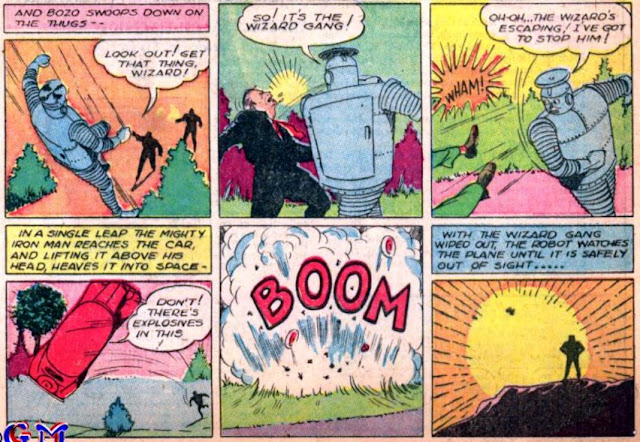
    All good things must come to an end, however, in this case in the form of Hugh Hazzard and his explosion-proof robotic exoskeleton. And of course once a superstrong robot is involved it’s just a matter of time before the Wizard meets his end in a recklessly-hurled car full of explosives.

  • MINOR SUPER-VILLAIN 758: THE WIZARD

    (Smash Comics 017, 1940)

    The Wizard is your classic big-headed smart guy gang boss (his head is on the smaller end of the bighead spectrum but he accentuates it perfectly with the most unpleasant hairstyle I have ever seen). He and his gang (the Wizard Gang, natch) have been lying low for long enough that one of them starts getting squirrely and talking about leaving, with deadly consequences. The Wizard shoots him, is what I’m saying. And what a shame, because the Wizard has just finished his master plan: put bombs in little remote controlled planes and then use them to do robberies. Not the most groundbreaking scheme in the world, but not bad.

    The plane bombs seem to be effective, as the Wizard Gang really cleans up on loot. Is there a major difference between a bomb mounted on a plane and one thrown by a guy? Evidently! 

    Even more impressively, the Wizard’s plan to just stay out of town for a while has had the intended effect of erasing all of his gang members from the collective police memory. It’s quite remarkable, though again the simpler answer might just be that they are managing to stay out of sight of the cops.

    All good things must come to an end, however, in this case in the form of Hugh Hazzard and his explosion-proof robotic exoskeleton. And of course once a superstrong robot is involved it’s just a matter of time before the Wizard meets his end in a recklessly-hurled car full of explosives.

  • REAL PERSON ROUND-UP 011

    I hope you like the War of 1812 and its wacky cast of characters, because here they come!

    Dolley Madison:

    Seen saving the portrait of George Washington from the soon-to-be-burned White House. (Shield-Wizard Comics 002, 1940)

    Francis Scott Key:

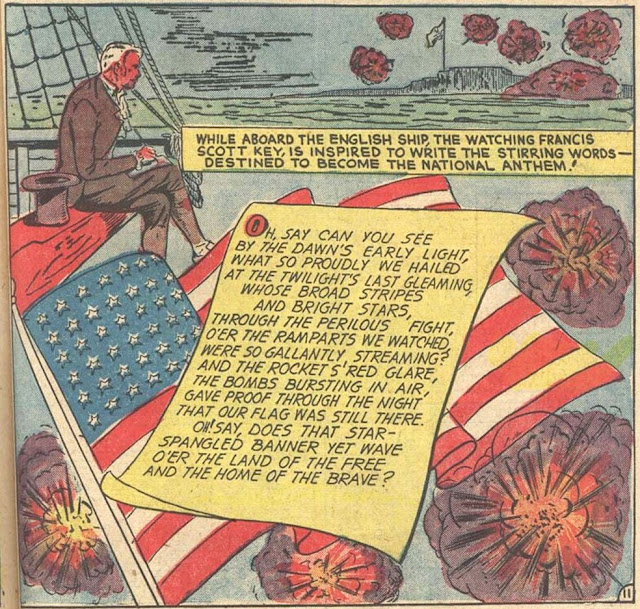
    Meets Tommy the Super-Boy while both are imprisoned by the British, then is freed by the second Wizard in time to be inspired to write a national anthem. (Shield-Wizard Comics 002, 1940)

    James Madison: 

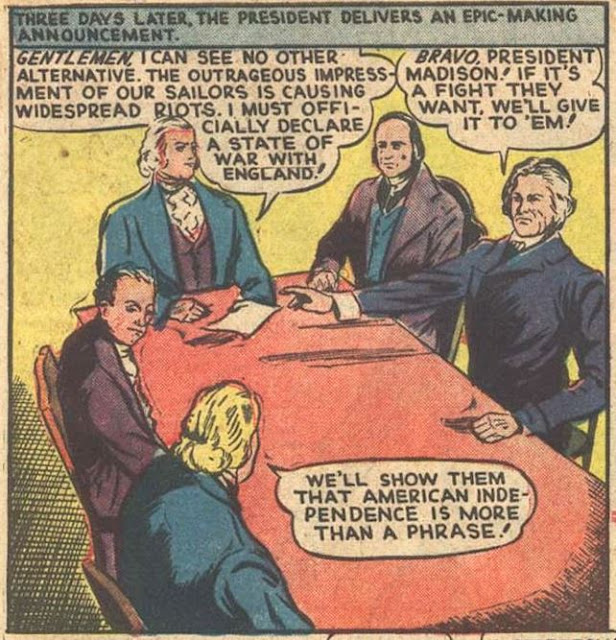
    Seen periodically in the lead-up and progress of the War of 1812. (Shield-Wizard Comics 002, 1940)

    Oliver Hazard Perry:

    Captain Perry, of “we have met the enemy and they are ours” fame, is aided in his greatest naval victory by the intervention of the second Wizard. (Shield-Wizard Comics 002, 1940)

    Tecumseh:

    The historical Wizard adventures in Shield-Wizard Comics 001 and 002 are on the whole very kind to even the more derided figures in American history (see William Hull, below), but Tecumseh here, who was held in pretty high esteem by his historical contemporaries as well as historians, is instead portrayed as a bloodthirsty creep. I WONDER WHY 

    This version of Tecumseh also meets his end at the hands of the second Wizard while attempting to murder General William Henry Harrison, rather than in battle. (Shield-Wizard Comics 002, 1940)

    William Henry Harrison:

    The future president is seen during his military days as he retakes Detroit from the British with the aid of the second Wizard. (Shield-Wizard Comics 002, 1940)

    William Hull:

    William Hull, governor of Michigan Territory at the beginning of the War of 1812, caught a lot of flak both in his own time and going forward for surrendering Detroit to the British. More recent evaluations of him have been kinder, including in his appearance in the story of the second Wizard. I’m not sure what the general opinion of him was in 1940 but the people at MLJ have added a kidnapped daughter as a major reason for his actions instead of blaming them on his general incompetence as seems to have been the norm for quite a while there. (Shield-Wizard Comics 002, 1940)

    Betsy Hull:

    Speaking of William Hull’s kidnapped daughter, this is her, and I would love to tell you if she was based on a real historical figure or not but a) I can’t find a biography of William Hull that lists his children’s names and b) I can’t seem to parse online genealogies – they have gone down some sort of structural route that has really obfuscated just how the people in the family trees actually relate to each other. In short, William Hull might or might not have had a daughter named Elizabeth but if he did she did not marry Blane Whitney, the second Wizard, like this young lady eventually does. (Shield-Wizard Comics 002, 1940)

  • REAL PERSON ROUND-UP 010

    The wartime exploits of the original Wizard, expressed as a series of encounters with famous figures from US history. 

    Benedict Arnold:

    Very nearly captured by the original Wizard. (Shield-Wizard Comics 001, 1940) 

    General Charles Cornwallis:

    Defeated by a coalition of the Americans, French and the original Wizard. (Shield-Wizard Comics 001, 1940)

    Admiral François-Joseph de Grasse:

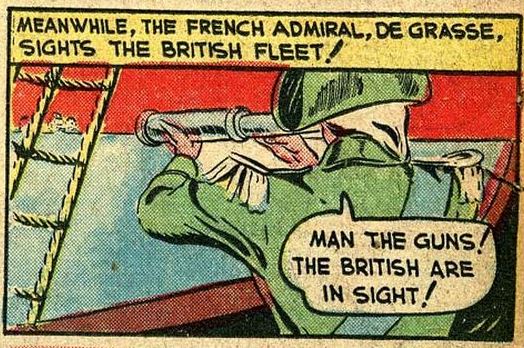
    Helps defeat the British fleet at Chesapeake Bay but of course he couldn’t have done it without the original Wizard. (Shield-Wizard Comics 001, 1940)

    George Washington:

    Wins the American Revolutiion with the help of the original Wizard. (Shield-Wizard Comics 001, 1940) 

    General Horatio Gates:

    Aided by the original Wizard at the Battle of Saratoga. (Shield-Wizard Comics 001, 1940)

    Colonel Johann Rall:

    The commanding officer in charge of the Hessian mercenaries famously defeated by Washington after the crossing of the Delaware, Rall (or Rahl, as here) supposedly did really ignore news of the impending attack to drink and play cards. (Shield-Wizard Comics 001, 1940)

    Major John André:

    Major André, head of British military intelligence in the Revolutionary War, captured thanks to the original Wizard. (Shield-Wizard Comics 001, 1940)

    Mad Anthony Wayne:

    Slightly less mad than in out timeline due to having the original Wizard with him when he charged the British (Shield-Wizard Comics 001, 1940)

    the Mayflower:

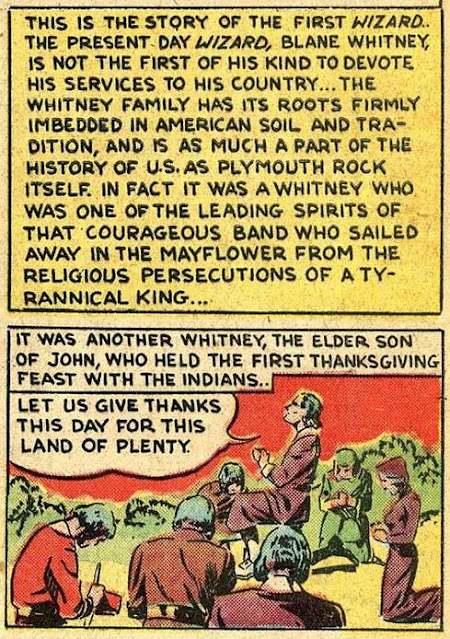
    I’m willing to bet that if I track the fictional ancestors of comic book characters who are said to have come over on the Mayflower then I will probably end up with a passenger list larger than the actual one. Our first entrants are two ancestors of Blane Whitney, aka the Wizard, and both named John. The younger of the two also organized the mythical first Thanksgiving, to boot! (Shield-Wizard Comics 001, 1940)

    Nathan Hale:

    In maybe the dumbest bit of American myth-making in the whole saga of the original Wizard, he frees Nathan Hale from his pre-execution imprisonment only for him to choose to stay behind and die because he can presumably somehow see all of the stupid patriotism that people load him down with in the future. Like of course his final words of defiance mean so much less if he’s essentially saying them and then blowing his own head off. Gah! (Shield-Wizard Comics 001, 1940)

    Paul Revere:

    Informed that the British are coming by the original Wizard (Shield-Wizard Comics 001, 1940)

    Thomas Jefferson:

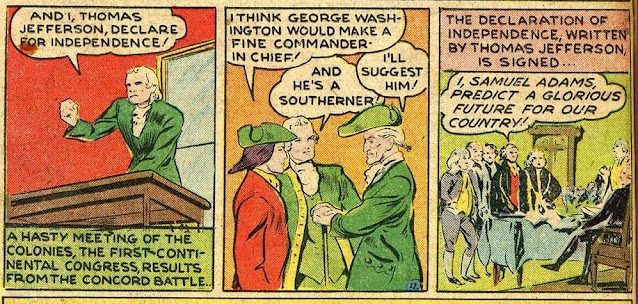
    Knocks out the Declaration of Independence after the original Wizard intervenes in the battle of Concord. Also Samuel Adams is there shouting his own name. (Shield-Wizard Comics 001, 1940)

  • REAL PERSON ROUND-UP 010

    The wartime exploits of the original Wizard, expressed as a series of encounters with famous figures from US history. 

    Benedict Arnold:

    Very nearly captured by the original Wizard. (Shield-Wizard Comics 001, 1940) 

    General Charles Cornwallis:

    Defeated by a coalition of the Americans, French and the original Wizard. (Shield-Wizard Comics 001, 1940)

    Admiral François-Joseph de Grasse:

    Helps defeat the British fleet at Chesapeake Bay but of course he couldn’t have done it without the original Wizard. (Shield-Wizard Comics 001, 1940)

    George Washington:

    Wins the American Revolutiion with the help of the original Wizard. (Shield-Wizard Comics 001, 1940) 

    General Horatio Gates:

    Aided by the original Wizard at the Battle of Saratoga. (Shield-Wizard Comics 001, 1940)

    Colonel Johann Rall:

    The commanding officer in charge of the Hessian mercenaries famously defeated by Washington after the crossing of the Delaware, Rall (or Rahl, as here) supposedly did really ignore news of the impending attack to drink and play cards. (Shield-Wizard Comics 001, 1940)

    Major John André:

    Major André, head of British military intelligence in the Revolutionary War, captured thanks to the original Wizard. (Shield-Wizard Comics 001, 1940)

    Mad Anthony Wayne:

    Slightly less mad than in out timeline due to having the original Wizard with him when he charged the British (Shield-Wizard Comics 001, 1940)

    the Mayflower:

    I’m willing to bet that if I track the fictional ancestors of comic book characters who are said to have come over on the Mayflower then I will probably end up with a passenger list larger than the actual one. Our first entrants are two ancestors of Blane Whitney, aka the Wizard, and both named John. The younger of the two also organized the mythical first Thanksgiving, to boot! (Shield-Wizard Comics 001, 1940)

    Nathan Hale:

    In maybe the dumbest bit of American myth-making in the whole saga of the original Wizard, he frees Nathan Hale from his pre-execution imprisonment only for him to choose to stay behind and die because he can presumably somehow see all of the stupid patriotism that people load him down with in the future. Like of course his final words of defiance mean so much less if he’s essentially saying them and then blowing his own head off. Gah! (Shield-Wizard Comics 001, 1940)

    Paul Revere:

    Informed that the British are coming by the original Wizard (Shield-Wizard Comics 001, 1940)

    Thomas Jefferson:

    Knocks out the Declaration of Independence after the original Wizard intervenes in the battle of Concord. Also Samuel Adams is there shouting his own name. (Shield-Wizard Comics 001, 1940)