The Curse of Skeleton Munroe

Category: multiple appearances

  • MINOR SUPER-VILLAIN 967: THE FANG

    (Fantastic Comics 017, 1941)

    The Fang is a recurring villain in the mould of his Fox Features contemporaries the Rook and the Beast: you can knock him down and seemingly kill him as much as you want but he’s just going to keep on coming back to do more crimes.

    When he first appears, the Fang’s major goal is to acquire the Burma Emerald from its caretaker Princess Kava, in order to decipher the secret of invisibility that has been carved into its surface. His initial attempt to snatch the emerald leads him to murder Police Sergeant Marley of the Princess’ protection detail, which directly inspires Marley’s son Chuck to become a costumed crimefighter under the tutelage of the Black Fury.

    Perhaps because Black Fury scribe realized that a series of comics about a man trying and failing to achieve invisibility would be less interesting than one about an invisible crook, the Fang breaks prison in his second appearance and gets ahold of the emerald almost immediately. So what does he use his newfound powers of invisibility for?

    – bank robbery (Fantastic Comics 018)

    – framing a man for murder in order to buy his house that has an ideal smuggling setup in the form of a secret tunnel to the coast (Fantastic Comics 019)

    – sabotaging arms shipments to Allied Europe on behalf of the Axis (Fantastic Comics 020)

    I judge these… okay criminal uses of invisibility. Nothing spectacular.

    Though I set up the comparison between the Fang and the Rook/the Beast
    myself, I must now point out the way in which he differs from them: he doesn’t seemingly die at the end of every appearance. Instead, he alternates seeming to die being caught: he’s caught in Fantastic 017, crashes into an oil tank in 018, caught again in 019, and does a header into a well full of slime in Fantastic Comics 020. 

    If there’s one thing that invisibility powers are extremely good at it’s in helping to fake one’s own death, though how they help to get out of an ooze pit is beyond me.

    Sadly and annoyingly, the final page or two of the Fang’s last appearance is not currently available. He is in the process of planting a bomb at the end of the portion that we do have, which makes it highly likely that he went on to be blown up, and that death finally claimed him. Alternately, perhaps he was arrested again and just treated with the appropriate amount of care by the authorities. It is my hope that we will someday learn the truth.

    Categorized in: Body (Nonhuman Parts – Fangs), Narrative Footballs (Origin Story Guys), Powers (Invisibility)

  • MINOR SUPER-VILLAIN 967: THE FANG

    (Fantastic Comics 017, 1941)

    The Fang is a recurring villain in the mould of his Fox Features contemporaries the Rook and the Beast: you can knock him down and seemingly kill him as much as you want but he’s just going to keep on coming back to do more crimes.

    When he first appears, the Fang’s major goal is to acquire the Burma Emerald from its caretaker Princess Kava, in order to decipher the secret of invisibility that has been carved into its surface. His initial attempt to snatch the emerald leads him to murder Police Sergeant Marley of the Princess’ protection detail, which directly inspires Marley’s son Chuck to become a costumed crimefighter under the tutelage of the Black Fury.

    Perhaps because Black Fury scribe realized that a series of comics about a man trying and failing to achieve invisibility would be less interesting than one about an invisible crook, the Fang breaks prison in his second appearance and gets ahold of the emerald almost immediately. So what does he use his newfound powers of invisibility for?

    – bank robbery (Fantastic Comics 018)

    – framing a man for murder in order to buy his house that has an ideal smuggling setup in the form of a secret tunnel to the coast (Fantastic Comics 019)

    – sabotaging arms shipments to Allied Europe on behalf of the Axis (Fantastic Comics 020)

    I judge these… okay criminal uses of invisibility. Nothing spectacular.

    Though I set up the comparison between the Fang and the Rook/the Beast
    myself, I must now point out the way in which he differs from them: he doesn’t seemingly die at the end of every appearance. Instead, he alternates seeming to die being caught: he’s caught in Fantastic 017, crashes into an oil tank in 018, caught again in 019, and does a header into a well full of slime in Fantastic Comics 020. 

    If there’s one thing that invisibility powers are extremely good at it’s in helping to fake one’s own death, though how they help to get out of an ooze pit is beyond me.

    Sadly and annoyingly, the final page or two of the Fang’s last appearance is not currently available. He is in the process of planting a bomb at the end of the portion that we do have, which makes it highly likely that he went on to be blown up, and that death finally claimed him. Alternately, perhaps he was arrested again and just treated with the appropriate amount of care by the authorities. It is my hope that we will someday learn the truth.

    Categorized in: Body (Nonhuman Parts – Fangs), Narrative Footballs (Origin Story Guys), Powers (Invisibility)

  • MINOR SUPER-VILLAIN 900: TRUG

    MINOR SUPER-VILLAIN 900: TRUG

    (Whiz Comics 013, 1941) 

    Trug is a student of magic and of Ibis the Invincible specifically who creeps out of the shadows after Ibis and Taia’s ward Tommy has defeated his school’s boxing champion and tempts the despondent youth into stealing the Ibistick for him (the sad boy is then turned into a tree and then never mentioned again – very sad).

    Trug’s Ibis scholarship extends beyond kind of dressing like him and knowing where his extended family hang out into important topics like how not to kill yourself while using the Ibistick. Unlike every poor chump who has gotten their hands on it before him, Trug is aware that it will visit any harm intended for Ibis back on its wielder and so deals exclusively in barriers, crevasses and other nonlethal means of keeping his rival at bay.

    Where Trug fails is in not being a creep and kidnapping Taia as he leaves to enjoy his newfound power. Quite aside from any moral implications, this is a sure way to make Ibis just that much more determined in his quest to defeat his foe.

    Fore reasons of his own, Trug heads north, subjugates the local peoples and builds a palace, and here I notice that he has kidnapped Taia not as a creepy “I will make you my queen” kind of thing but as a hostage, which I would still not call a good idea but which at least has a bit of logic to it.

    One thing that Trug has clearly not considered is that Ibis still has access to magical items that he used the Ibistick to create and that using two of these – the crystal ball and super-plane, specifically – he is able to locate and travel to Trug’s new kingdom in swift order. Trug thus makes the mistake of summoning an air force to deal with whoever might be encroaching on his airspace, only for them to turn on him and cause a piece of his own palace to fall and bonk him unconscious.

    Trug ends his days as a decorative statue as part of the compensation offered by Ibis to his former subjects. (Whiz Comics 014, 1941) 

    Trug isn’t a statue for very long before he is carried off by slavers and worshipped as an idol. When Ibis is then asked for help, he restores Trug to human form as part of a scheme to show that he is a mere mortal.

    Turning Trug back and forth from statue to man to show that he is in fact powerless swiftly convinces his erstwhile worshippers to abandon him, and somehow also that they should give up their warlike ways and make peace with their former enemies. Trug, meanwhile, is left at liberty and feeling vengeful, though he is under-dressed in the Arctic. (Whiz Comics 015, 1941)

    Undaunted by his circumstances, Trug hops on a log and starts paddling his way South, and has the good fortune to encounter a helpful man with a magic bag of wind, who he promptly robs and murders. He makes an opportunistic and unsuccessful attempt to kill Ibis and Taia by summoning a storm demon, then composes himself and… (Whiz Comics 016, 1941)

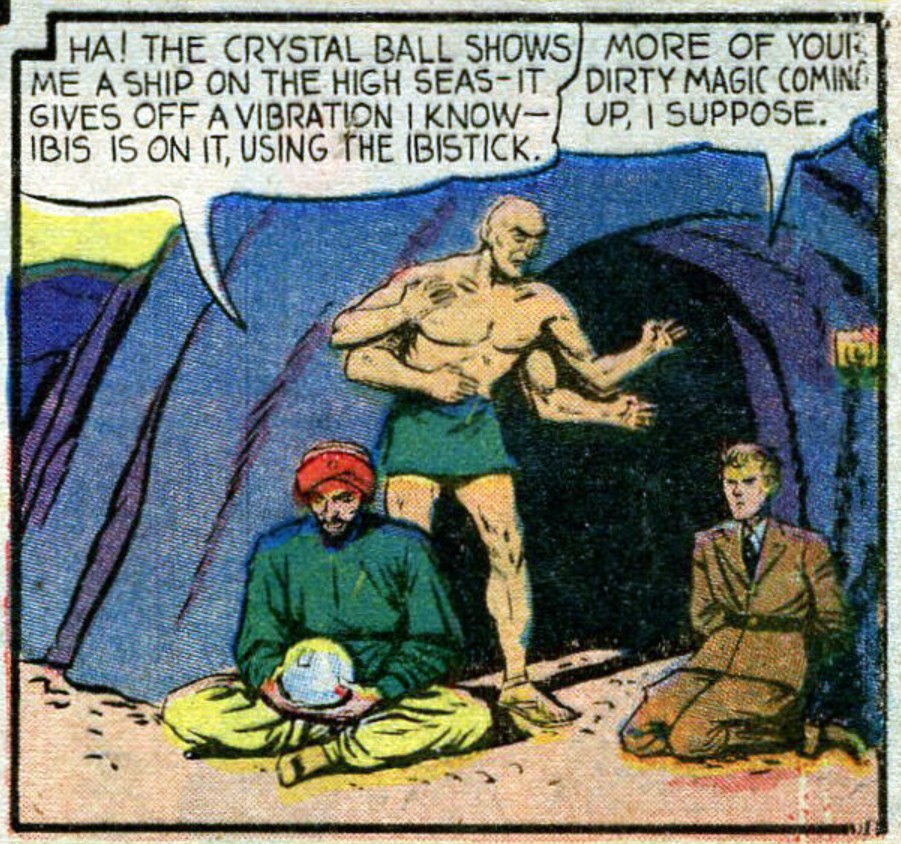
    … kidnaps Ibis and Taia’s ward Tommy and uses him as bait in yet another attempt to kill Ibis, and while the first part of that plan works like a charm, his trapping game is pretty haphazard. His ace in the hole is clearly the god-monster the Man of the Mountain (the four-armed guy above) but he also blows up the ship that Ibis is crossing the Pacific on (ineffective) and places fairly obvious traps like a clearly-carnivorous tree and a demon disguised as a pretty lady on the path leading to his cave hideout. (Whiz Comics 017, 1941) 

    The Man of the Mountain, though imposing, is not too bright and is lured off of a cliff with relative ease, after which Trug just kind of gives up. There is a small amount of tension as the ambient magical energies of the area render the Ibistick powerless and thus Ibis and Taia are trapped on the side of a mountain, but that barely counts as a deathtrap. (Whiz Comics 018, 1941)

    We now enter that phase of any recurring villain’s career in which they go from being a legitimate threat to a bit of a joke, and in Trug’s case this begins when he is rejected by a loser named Mudge who himself is looking to get revenge on Ibis for foiling his plans. Trug might have fallen on hard times but he knows how to size up a fool, and Mudge is exactly the kind of guy to fall for the old Fake Satan trick. Where he was unwilling to team up with an unsuccessful magician he is more than happy to sell his soul for a chance at revenge, the dope.

    Mudge and Satan/Trug attempt to kill Ibis and Taia with a magic bomb, but fail as Ibis saw them coming a mile away and substituted a couple of magical duplicates for them. He afflicts Mudge with donkey ears for his trouble, which only redoubles his commitment to revenge.

    The duo next attempt to harm Ibis by killing Taia and are fooled by the same magical duplicate trick, upon which Ibis reveals that he was not only on to them but that he know that “Satan” was actually Trug the whole time. Mudge and Trug are then sealed up in a wall to die, which is pretty tough justice, but we must remember that Ibis is from another time.

    Though Mudge’s fate is sealed, Trug will return in 1942. (Whiz Comics 020, 1941)

  • MINOR SUPER-VILLAIN 900: TRUG

    (Whiz Comics 013, 1941) 

    Trug is a student of magic and of Ibis the Invincible specifically who creeps out of the shadows after Ibis and Taia’s ward Tommy has defeated his school’s boxing champion and tempts the despondent youth into stealing the Ibistick for him (the sad boy is then turned into a tree and then never mentioned again – very sad).

    Trug’s Ibis scholarship extends beyond kind of dressing like him and knowing where his extended family hang out into important topics like how not to kill yourself while using the Ibistick. Unlike every poor chump who has gotten their hands on it before him, Trug is aware that it will visit any harm intended for Ibis back on its wielder and so deals exclusively in barriers, crevasses and other nonlethal means of keeping his rival at bay.

    Where Trug fails is in not being a creep and kidnapping Taia as he leaves to enjoy his newfound power. Quite aside from any moral implications, this is a sure way to make Ibis just that much more determined in his quest to defeat his foe.

    Fore reasons of his own, Trug heads north, subjugates the local peoples and builds a palace, and here I notice that he has kidnapped Taia not as a creepy “I will make you my queen” kind of thing but as a hostage, which I would still not call a good idea but which at least has a bit of logic to it.

    One thing that Trug has clearly not considered is that Ibis still has access to magical items that he used the Ibistick to create and that using two of these – the crystal ball and super-plane, specifically – he is able to locate and travel to Trug’s new kingdom in swift order. Trug thus makes the mistake of summoning an air force to deal with whoever might be encroaching on his airspace, only for them to turn on him and cause a piece of his own palace to fall and bonk him unconscious.

    Trug ends his days as a decorative statue as part of the compensation offered by Ibis to his former subjects. (Whiz Comics 014, 1941) 

    Trug isn’t a statue for very long before he is carried off by slavers and worshipped as an idol. When Ibis is then asked for help, he restores Trug to human form as part of a scheme to show that he is a mere mortal.

    Turning Trug back and forth from statue to man to show that he is in fact powerless swiftly convinces his erstwhile worshippers to abandon him, and somehow also that they should give up their warlike ways and make peace with their former enemies. Trug, meanwhile, is left at liberty and feeling vengeful, though he is under-dressed in the Arctic. (Whiz Comics 015, 1941)

    Undaunted by his circumstances, Trug hops on a log and starts paddling his way South, and has the good fortune to encounter a helpful man with a magic bag of wind, who he promptly robs and murders. He makes an opportunistic and unsuccessful attempt to kill Ibis and Taia by summoning a storm demon, then composes himself and… (Whiz Comics 016, 1941)

    … kidnaps Ibis and Taia’s ward Tommy and uses him as bait in yet another attempt to kill Ibis, and while the first part of that plan works like a charm, his trapping game is pretty haphazard. His ace in the hole is clearly the god-monster the Man of the Mountain (the four-armed guy above) but he also blows up the ship that Ibis is crossing the Pacific on (ineffective) and places fairly obvious traps like a clearly-carnivorous tree and a demon disguised as a pretty lady on the path leading to his cave hideout. (Whiz Comics 017, 1941) 

    The Man of the Mountain, though imposing, is not too bright and is lured off of a cliff with relative ease, after which Trug just kind of gives up. There is a small amount of tension as the ambient magical energies of the area render the Ibistick powerless and thus Ibis and Taia are trapped on the side of a mountain, but that barely counts as a deathtrap. (Whiz Comics 018, 1941)

    We now enter that phase of any recurring villain’s career in which they go from being a legitimate threat to a bit of a joke, and in Trug’s case this begins when he is rejected by a loser named Mudge who himself is looking to get revenge on Ibis for foiling his plans. Trug might have fallen on hard times but he knows how to size up a fool, and Mudge is exactly the kind of guy to fall for the old Fake Satan trick. Where he was unwilling to team up with an unsuccessful magician he is more than happy to sell his soul for a chance at revenge, the dope.

    Mudge and Satan/Trug attempt to kill Ibis and Taia with a magic bomb, but fail as Ibis saw them coming a mile away and substituted a couple of magical duplicates for them. He afflicts Mudge with donkey ears for his trouble, which only redoubles his commitment to revenge.

    The duo next attempt to harm Ibis by killing Taia and are fooled by the same magical duplicate trick, upon which Ibis reveals that he was not only on to them but that he know that “Satan” was actually Trug the whole time. Mudge and Trug are then sealed up in a wall to die, which is pretty tough justice, but we must remember that Ibis is from another time.

    Though Mudge’s fate is sealed, Trug will return in 1942. (Whiz Comics 020, 1941)

  • MINOR SUPER-VILLAIN 869: THE BLACK KNIGHT

    (Zip Comics 001, 1940)

    Shortly after giving himself super powers, Steel Sterling gets word of a brutal bank robbery in the town of Beeville and sets out to bring the culprits to justice. Determining that the crooks must have been guided by a mastermind of some sort, he trails their plane to a mountaintop fortress.

    The bow-wielding guards outside the Black Knight’s fortress (spoiler: it’s the Black Knight’s fortress, but what were you expecting) are notable for being the one time that he has anything related to his chosen theme around, and even they are supposedly only there to prevent… mountain cops?… from hearing the sound of gunfire. Inside, it’s plain old gangsters.

    Gangsters armed with ordinary machine guns are of course no match for a man with all the properties of steel, and Steel Sterling quickly makes his way to the Black Knight’s throne room, where he is immediately dropped into a deep pit full of rats.

    I’d just like to take a second here to appreciate the fact that the Black Knight’s costume is a) 100% brown and yellow with no black at all and b) a pretty conventional super-person getup aside from what appears to be a leather jerkin or similar. Historical, yes, but not particularly knightly. 

    A pit full of rats is also not enough to stop Steel Sterling, and he makes his way out, causes the Black Knight himself to fall in, and sets out after the fleeing gangsters just in time to avoid a secondary deathtrap as the fortress explodes behind him. The Black Knight is finished, it seems.

    The Black Knight is not, in fact, finished, and is soon (Zip Comics 002) hard at work robbing gold and fur shipments coming out of Alaska. Though he manages to capture Steel Sterling when he infiltrates the villain’s fake iceberg base he does a bad job of coming up with a suitable deathtrap for the hero and ends up in the hands of the US Navy.

    Steel Sterling’s next case brings him to the South American nation of Brazonia, where a man called Dr Yar has taken the famous scientist Walter Cummings in order to force him to develop weapons of war and help conquer the gold-rich country. 

    Dr Yar is of course eventually revealed to be an alias (or possibly the real identity?) of the Black Knight. Just why he has abandoned his old moniker is unstated but perhaps it is as simple as a desire not to attract the attention of Steel Sterling again. His new look is at least still visually interesting – particularly the periscopiscopes, which are of course goggles which allow 360 degree vision.

    Dr Yar really leans into the scientist aspect of his new identity, and deploys gadgets such as: flying tanks, oil bombs, electric rays and various viewscreens and visualizers.

    Plus: he not only has Alligator Men at his disposal but also a swarm of giant mosquitoes straight out of an ad for a pest control company (being big does not help them bate through steel skin, alas). 

    Once again the Black Knight/Dr Yar apparently meets his end, and this time it’s explicitly at the hands of Steel Sterling, who stuffs him into the barrel of his own super-howitzer before it fires. A truly brutal end, even for a dedicated super-villain. (Zip Comics 003, 1940)

    Steel doesn’t have to live with any guilt he might feel for long, however, as the Black Knight returns in the next issue, this time climbing the rungs of the aristocracy from mere knighthood to become the Radium King. His new plan is simple: steal the entire US radium supply and then ransom it back for 30 million dollars.

    The Radium King has appropriately impressive digs: an underwater base in Lake Superior that would probably be pretty hard to find if one of his minions hadn’t blabbed under threat of a beating from Steel Sterling.

    The Radium King costume turns out to borrow heavily from the original Black Knight getup, although without a lot of the yellow elements. I’d say that it’s better than the Dr Yar outfit but not as composed as the original, and that the half-mask/mustache combo is particularly unpleasant. Speaking of Dr Yar, the Radium King reveals that he survived Steel’s attempted cannon execution by simply crawling back out of the cannon.

    Not to be robbed of a kill, Steel Sterling uses the Radium King’s own submarine to blow him and his base to high heaven. Surely he’s dead this time! (Zip Comics 004, 1940)

    Not quite! The Black Knight’s fifth and final appearance (under the original name, this time) is probably his most ignominious, though it does feature his cool underground city headquarters, seen above. In it, he engages in a campaign of sabotage, kidnapping and extortion against his former kidnap victim/current minor member of Steel Sterling’s supporting cast Walter Cummings, who has gone into the munitions manufacturing game and has gotten the contract to produce the mysterious Zeta Ray for the US government. Somehow, if the Black Knight can delay production of the US Zeta Ray for long enough then his own scientists can produce one for him and that will be good, and if that description seems vague to you then I must assure you that it is 100% accurate to the comic. I don’t even know what the Zeta Ray does, for heaven’s sake.

    Though Cummings’ first factory is destroyed and his second collapses due to some sabotaged cement, Steel Sterling steps in and has almost completed a third when the Black Knight decides to take a personal hand and ram a tanker truck full of TNT into it. Now here’s the embarrassing part: not only does Steel Sterling handily prevent the truck from destroying the factory, but the first time that he is even aware that the Black Knight is involved in the plot against Dr Cummings is when he spots him just one fraction of a second before he is atomized in the explosion. It’s not even as dignified an end as being shot out of your own cannon would have been. (Zip Comics 005, 1940) 

  • PROBLEMATIC ROUND-UP 006

    Every time I relax, another one emerges from the shrubbery. And what’s depressing is the fact that they will continue emerging at a more or less steady rate for the entire history of comics. Here’s the latest batch of Problematic Characters.

    the Voodoo Man: 

    When Dr Bob Warren heads to Haiti to practice medicine and “investigate voodoo”, he comes into conflict with the Voodoo Man, a zombie-raising, curse-spouting, doll-pinning collection of every voodoo trope and stereotype. As compared to other headlining super-villains, the Voodoo Man’s exploits are pretty one-note: he’s trying to exert control over part or all of Haiti using zombies and other magics, while Warren foils him at every turn.

    The Voodoo Man’s finest moment is probably the time he turns an old woman into a pig to vex his enemies, but as always serving a super-villain is a dicey prospect, OSHA-wise, and the pig-woman gets a knife in the back for her efforts. (Weird Comics 001, 1940) 

    For a couple of issues (Weird Comics 004 and 005, specifically), Bob Warren seems to be pilling a Thin Man and becoming the Voodoo Man, as in a man who battles voodoo practitioners. Rather than the original titular Voodoo Man, Warren takes on a very similar fellow named Boanga (above) and the Grand Zombie (below), but after that the one and only original returns for the rest of the feature’s annoyingly long run.

    the Grand Zombie: 

    The Grand Zombie’s appearance coincides with a change in the “Voodoo Man” creative team, as evidenced by Bob Warren suddenly becoming a clean-shaven blonde instead of a mustachioed brunette. There is a chance that he is meant to in fact *be* the Voodoo Man, as his modus operandi – turn people into zombies for his own enrichment – is the same, but given that he looks completely different, operates at a site on the other side of the island and is called something else I’m willing to call the Grand Zombie a different character. 

    The Grand Zombie name, in addition to being a far better one than the Voodoo Man, reflects a linguistic quirk that might have been widespread but which I have only encountered in old comics, in which both the unquiet dead and their creators are referred to as zombies. Better name or not, the Grand Zombies is unceremoniously shot at the end of the story and the feature then reverts back to the Voodoo Man.

    This issue also feature perhaps the least empathetic missionary character in Golden Age comics. (Weird Comics 004, 1940)

    the Magic Mandarin: 

    The Magic Mandarin, aka Lee Ching, importer, is an extremely typical Yellow Peril villain. Perhaps the only moment of joy I found in his entire first appearance was when he met up with his fellows in the Brothers of the Bloody Blade (above) and they kept screaming “Allegiance!” at one another.

    The thing that puts the magic in the Magic Mandarin is an artifact called the Stone or Lodestone of the Dragon which is capable of such feats as paralyzing others, creating a force field, changing someone’s clothing and telekinesis, but which is unable to function if swaddled in silk or affect someone who is wearing silk, which comes in very handy for the Mandarin’s foes Smash Dawson and his team.

    The Magic Mandarin is one of your classic “seems to die at the end of every adventure but turns out to have survived in the next” villains, and like so many of those his final appearance must be assumed to be the one that finally killed him, as he was sucked into a dam in Whirlwind Comics 003 and there was no Whirlwind Comics 004. (Whirlwind Comics 001, 1940) 

    Fu Chu: 

    Fu Chu is a recurring villain of Yarko the Great, and while he is so patently a Fu Manchu knockoff that he even has most of his name, his major offence is in how boring he is. Like, I don’t find Yellow Peril comic book plots particularly fun to read, but at least they are usually rich with incident. Fu Chu’s debut involves him kidnapping the inventor of a death ray and then completely failing to prevent Yarko from waltzing in and taking him back.

    Fu Chu’s second appearance, in Wonderworld Comics 016, features him as the head of a cult of the Mayan Plumed Serpent Kukulkan, for reasons that are never quite explained, as the main thrust of the episode involves Fu Chu attempting to kill explorer Doctor Mayo and his daughter and Yarko the Great intervening to save them. The whole farce ends with an earthquake destroying all or part of Chichen Itza, which is wild.

    Fu Chu goes on to return at least a couple of times in 1941 but don’t hold your breath – he’ll have to really up his game to get an update, (Wonderworld Comics 013, 1940) 

  • MINOR SUPER-VILLAIN 866: THE SCAR

    (Wonderworld Comics 014, 1940)

    The Scar is a fairly ordinary crypto-fascist spy chief – in his first appearance he is leading a gang of incompetents in a plot to blow up a Europe-bound supply ship, for example – but I’ll be danged if he isn’t well suited to his nickname. Most guys named Scar in 1940s comics are maybe rocking one big facial scar, while our friend here not only has three, but is missing at least one ear! Whatever happened to this guy, he earned that nickname.

    The Scar’s other remarkable property is that he manages to return to vex super-spy K-51 on three separate occasions. In his second appearance, in Wonderworld Comics 015, he spearheads a plan to disrupt the burgeoning US air forces by sabotaging the training program and thus discouraging future applicants. K-51 of course foils this plan as well, but not before the Scar scampers off into the undergrowth and escapes.

    During the Scar’s final appearance, in Wonderworld Comics 016, he is attempting to secure some super-power-inducing powders invented by a Dr Barrow but is unable to do so before Barrow gives them to K-51. When K-51 then decides to use the powders to hunt down the Scar, the spy is so alarmed by the sight of a tiny man wielding a machine gun that he loses all control of his body and topples through a window to his doom. Truly an ignominious end for a slightly better-than-average spy.

  • MINOR SUPER-VILLAIN 866: THE SCAR

    (Wonderworld Comics 014, 1940)

    The Scar is a fairly ordinary crypto-fascist spy chief – in his first appearance he is leading a gang of incompetents in a plot to blow up a Europe-bound supply ship, for example – but I’ll be danged if he isn’t well suited to his nickname. Most guys named Scar in 1940s comics are maybe rocking one big facial scar, while our friend here not only has three, but is missing at least one ear! Whatever happened to this guy, he earned that nickname.

    The Scar’s other remarkable property is that he manages to return to vex super-spy K-51 on three separate occasions. In his second appearance, in Wonderworld Comics 015, he spearheads a plan to disrupt the burgeoning US air forces by sabotaging the training program and thus discouraging future applicants. K-51 of course foils this plan as well, but not before the Scar scampers off into the undergrowth and escapes.

    During the Scar’s final appearance, in Wonderworld Comics 016, he is attempting to secure some super-power-inducing powders invented by a Dr Barrow but is unable to do so before Barrow gives them to K-51. When K-51 then decides to use the powders to hunt down the Scar, the spy is so alarmed by the sight of a tiny man wielding a machine gun that he loses all control of his body and topples through a window to his doom. Truly an ignominious end for a slightly better-than-average spy.

  • MINOR SUPER-VILLAIN 862: BEAUTIA

    (Whiz Comics 003b, 1940)

    Captain Marvel first encounters Beautia after being tricked into taking a trip to Venus with a disguised Dr Sivana. There, she rules over a kingdom of wonderful frog aliens called Glompers

    If you’ve read any supplemental material about Dr Sivana then you probably know that Beautia is actually one of his four children, but this is not established since 1941, and honestly the Beautia/Sivana interactions in her first handful of appearances do not support the relationship as having been planned from the start. Dr Sivana is more of a Bad Boss than a Bad Dad here. 

    Dr Sivana is of course back on his quest to take over the US in this issue, with Beautia being brought in to act as his figurehead using her preternatural charm. After Captain Marvel disables the paralysis gas machine that the two are using to subdue the population, they flee into the night – after a bit of a flirtatious note for Captain Marvel. 

    The Beautia/Sivana team return in Whiz Comics 004 with an extremely simple and effective plot: use Beautia’s effect on the American male in order to get her elected President of the United States. 

    The plan might just have worked, too, if Dr Sivana had been able to curtail his villainous instincts for just a few weeks. Instead, he kidnaps Billy Batson in an attempt to rid himself of his great enemy and ends up giving him enough information to publish an expose, ruining Beautia’s chances for election and sending her back to Venus in disgrace.

    Beautia returns in Whiz Comics 009, as Dot Darling, beloved newsreel reporter, and also spy for Dr Sivana. By means of a concealed locket camera, she acquires information on US Naval manoeuvres so that Dr Sivana can destroy the US fleet and make yet another bid to take over the country.

    Though she has been happy to go along with Sivana up until now, the reality of the widespread death and destruction necessary for Sivana’s plan causes Beautia to rebel and attempt to warn the fleet away, upon which he attempts to murder her. This marks the beginning of Beautia’s reformation, though it would take one or two more appearances before she was fully distanced from her former ally/future father.

    UPDATES: 

    UPDATE 1941 

  • MINOR SUPER-VILLAIN 854: THE BEAST

    (Weird Comics 009, 1940)

    The Beast is the Eagle’s first and perhaps only recurring foe, and it’s unfortunate that he makes his first appearance at the very end of the 1940 run of Weird Comics because I really want to highlight the similarities between the Beast and his fellow Luis Cazaneuve creation the Rook, but danged if I have enough material for a real compare-and contrast on them yet. For now, we’ll just hit the obvious, such as the fact that they look very similar, right down to their staring eyes. Not the hair, though.

    The Beast’s focus in this story is on stealing a treasure map that just happens to be concealed in an ornamental box owned by Bill “the Eagle” Powers, which is as easy a way to involve the hero in the story as comics has come up with. His criminal tools of choice in this endeavour are a fairly gnarly clawed prosthetic hand from which he presumably derives his name and a poisoned blowgun which I am very interested to see if he keeps on using.

    The second point of comparison between the Rook and the Beast is the fact that they both have a criminal antagonist, in this case a gang boss known as the Gimp, who the Beast hires to retrieve the box initially and then double crosses once it’s time to pay for his services. The Gimp really comes into his own in 1941, when he starts using his signature weapon, an artificial leg with a knife on the end. For now we must simply assume that he’s kicking the Beast with a wooden foot.

    I’m calling this one based on very little evidence, but I reckon that the third commonality between the Rook and the Beast is going to be Seemingly Dying at the End of Each Adventure, based on the fact that the Beast does just that at the end of this one. See you next year, Beast!